sec, cosec and cot
“
understand the relationship of the secant, cosecant and cotangent functions to cosine, sine and tangent, and use properties and graphs of all six trigonometric functions for angles of any magnitude.
Three new names, no new mathematics. Each is simply the reciprocal (1 divided by it) of one you already know:
The pairing looks back to front: sec goes with cos, and cosec goes with sin. One way to remember it is the third letter: sec → cos, cosec → sin. Cot simply partners tan.
All three are undefined wherever the function underneath is zero, because you cannot divide by zero.
Each reciprocal graph drawn over its parent (dashed). Where the parent is zero, the reciprocal has a vertical asymptote: the zeros of cos become the asymptotes of sec, the zeros of sin those of cosec, and the zeros of tan those of cot.
- Where the original is zero, the reciprocal has a vertical asymptote: a vertical line the graph gets closer and closer to but never touches, because you cannot divide by zero.
- Where the original is , so is the reciprocal, and the two curves touch.
- Where the original is small, the reciprocal is large, and they share the same sign throughout.
- So and never take a value between and : their range is .
That last point is worth holding on to. An equation like has no solutions at all, and saying so is sometimes exactly what a question wants.
Function | Undefined (vertical asymptotes) where | Range | Repeats every |
|---|---|---|---|
: | or | () | |
: | or | () | |
: | every real number | () |
Each reciprocal repeats with the same period as its parent. cot θ is zero where cos θ is zero (90°, 270°, …), because the top of cos θ / sin θ is zero there.
Graphs with inside. Exam sketches often use or rather than . Doubling the angle squashes the graph sideways by a factor of , so everything happens twice as fast:
- the period halves: repeats every (), and every ();
- the asymptotes move to where the inside makes the parent zero. For that is , so and . For it is , so
The routine is always: find where the parent of the inside angle is zero, then solve for .
Values at any angle
Your calculator has no , or button, and it does not need one. To find , find first and then take divided by it. The same goes for (via ) and (via ).
This also settles the sign. A number and its reciprocal always have the same sign, so is negative exactly where is negative (the second and third quadrants), is negative exactly where is, and is negative exactly where is.
Exact values of the reciprocal functions
Without a calculator, find the exact values of (a) (b) (c) .
Show full working
- 1
(a) Write it as a reciprocal:
- 2
is in the second quadrant, where is negative. Its related acute angle is . So
The acute angle gives the size of the value; the quadrant gives its sign. This is the Paper 1 routine, unchanged.
- 3
Take the reciprocal. Dividing by gives
- 4
(b) . The angle is in the third quadrant, where is negative, and its related acute angle is . So
- 5
Take the reciprocal:
- 6
(c) Write as cos over sin:
- 7
A negative angle is measured clockwise, into the fourth quadrant, where is positive and is negative:
- 8
Divide:
The halves cancel. −1/√3 and −√3/3 are the same number; either is exact.
(a) (b) (c)
Recap: finding every solution
Every equation in this note ends with a line like or , so here is the Paper 1 routine in one place.
- Flip a reciprocal function first. means ; means ; means .
- Get one angle from the calculator (, or ).
- Get the partner angle in the same cycle from the symmetry of the graph:
- : and (in radians, );
- : and (in radians, );
- : and (in radians, ).
- Add or subtract a full period ( or for sin and cos; or for tan) until you have covered the whole interval, and throw away anything outside it.
- If the angle inside is not plain (say ), change the interval to match first: becomes . Find every value of in that interval, then halve each one. The Double angles section shows this in detail.
Each horizontal line cuts one cycle twice. For sine the second angle is 180° − α; for cosine it is 360° − α; for tangent it is α + 180°.
Solving with sec and cot
Solve, for , (a) (b) .
Show full working
- 1
(a) Make the subject. Subtract from both sides, then divide by :
- 2
Flip to cosine. means , so
Check the range first: −2 is not strictly between −1 and 1, so sec θ = −2 has solutions. After flipping, −½ is between −1 and 1, as a cosine must be.
- 3
The calculator gives .
- 4
The cosine partner is . Adding or subtracting leaves the interval, so there are no more.
- 5
(b) Flip to tangent: means
- 6
The calculator gives , which is to 1 d.p.
- 7
The tangent partner is . Adding another gives , outside the interval.
(a) (b)
When in doubt, convert to sin and cos
Almost every trig problem simplifies if you rewrite everything in terms of and . It is rarely the shortest route, but it is the most reliable one, and mark schemes accept it as an alternative method. Use it whenever you cannot see which identity the question wants.
Sketching a pair of graphs to count roots
Some Paper 3 questions say "by sketching a suitable pair of graphs, show that the equation … has exactly one root", and one of the two graphs is often , or . You need these graphs exactly right: where the asymptotes are, and which way each branch curves.
The argument: split the equation into two curves and sketch both. If one curve only goes up while the other only goes down, they can cross at most once. If one curve is above the other at the left end of the interval and below it at the right end, they must cross at least once. Together that is exactly one root. The Numerical Solution of Equations note covers this method in full.
The two marks go to: the first graph drawn correctly (asymptotes, intercepts, shape), and the second graph plus the crossing point marked with a dot and a sentence saying it is the root.
Reading mark-scheme codes
The past-paper solutions in this note mention mark codes. M is a method mark (a correct method, even with an arithmetic slip). A is an accuracy mark for a correct answer, and needs the M mark before it. B is a mark for a correct result on its own. A misread (for example answering in degrees when radians were asked) usually costs one mark.
Sketching sec and cot to show one root
By sketching a suitable pair of graphs, show that the equation has exactly one root in the interval .
Show full working
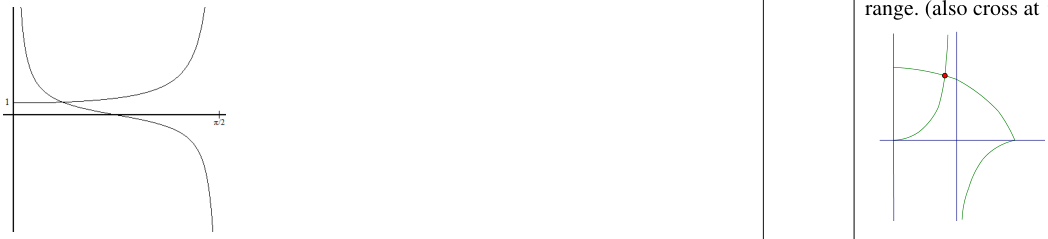
The mark scheme's sketch: y = cot 2x and y = sec x on 0 < x < ½π, meeting exactly once. The smaller panel shows an accepted alternative, y = tan 2x against y = cos x.
- 1
Split the equation into two curves: and , both for .
- 2
Asymptotes of : where , i.e. , so and . These are the two ends of the interval.
This is the 'find where the parent of the inside angle is zero' routine from the text above.
- 3
Shape of between them: it falls from (just after ) to (just before ), crossing zero where , at . It is decreasing all the way.
- 4
Shape of : , and as , , so . It is increasing all the way, starting at .
One curve only falls and the other only rises, so they can cross at most once.
- 5
Compare the ends. Near , is huge and positive, above . Near , while , so is above. The curves swap order, so they cross at least once.
- 6
At most once and at least once means exactly one root. Draw both curves, mark the crossing with a dot, and state that its -coordinate is the root.
The sketch shows exactly one intersection of and in , so the equation has exactly one root there.
Your turn
Range, exact values and the features of a sec 2x graph first, then solving, then two exam questions: one converted to sin and cos, one answered with a sketch of sec 2x.
- 1
State the range of and of . Hence say, without solving, whether each equation has any solutions: (a) (b) (c) .
Stuck? Show hint
sec and cosec never take a value strictly between −1 and 1. Decide whether each number is in that gap.
Show solution
- 1
and never take a value strictly between and , so their range is .
- 2
(a) lies strictly between and , so has no solutions.
- 3
(b) satisfies , so it is in range — does have solutions.
- 4
(c) is on the boundary of the range, , so it is attainable — does have a solution (at ).
The boundary case is the one people miss — |y| ⩾ 1 includes the endpoints, it is not a strict inequality.
Answer(a) no solutions (b) solutions exist (c) solutions exist
- 1
- 2
Find the exact values of (a) (b) .
Stuck? Show hint
Find sin 300° and tan 135° first, using the related acute angle and the quadrant, then take reciprocals.
Show solution
- 1
(a) . The angle is in the fourth quadrant, where is negative, and its related acute angle is .
- 2
So .
- 3
Take the reciprocal:
Dividing by a fraction means multiplying by its reciprocal: 1 ÷ (√3/2) = 2/√3.
- 4
(b) . The angle is in the second quadrant, where is negative, and its related acute angle is .
- 5
So , and
Answer(a) (or ) (b)
- 1
- 3
For with , state (a) the equations of the asymptotes (b) the period (c) the points where the graph turns (d) the range. Then sketch the graph.
Stuck? Show hint
Start from y = cos 2x: where is it 0, where is it 1, where is it −1?
Show solution
y = sec 2x drawn over its parent y = cos 2x (dashed). The asymptotes are where cos 2x = 0.
- 1
(a) Asymptotes where : or , so and .
- 2
(b) repeats every , so repeats when goes up by , i.e. every in .
- 3
(c) Where , is also and the curve turns. at and , giving and (bottoms of U-shapes). at , giving (the top of an upside-down U).
- 4
(d) As for : or .
- 5
Sketch (see the figure): a half U rising from towards the asymptote ; an upside-down U between and with its top at ; a half U coming down from the asymptote to . It is the sec graph squashed sideways by a factor of 2.
Answer(a) (b) (c) , , (d) or
- 1
- 4
Solve for , giving your answers correct to 3 significant figures.
Stuck? Show hint
Make cosec θ the subject, flip it to sin θ, and remember the interval is in radians.
Show solution
- 1
Divide by : .
- 2
Flip to sine:
- 3
With the calculator in radians, .
The interval 0 < θ < 2π is in radians, so the answers must be too.
- 4
The sine partner is . Both lie between and ; adding to either goes past .
Answer - 1
- 59709/31 O/N 2016 Q35 marks
Express the equation as a quadratic equation in . Hence solve this equation for .
Stuck? Show hint
Rewrite every term in sin and cos, multiply through by cos θ, then use sin²θ + cos²θ ≡ 1 to remove the remaining cos²θ.
Show solution
- 1
Rewrite in sin and cos:
- 2
Multiply every term by to clear the fractions:
- 3
The question wants a quadratic in , so replace by :
- 4
Expand the bracket:
- 5
Move every term to the left, so the term is positive:
- 6
Factorise, writing . Numbers multiplying to and adding to are and , so split the middle term: So .
- 7
So or .
- 8
Reject . It gives , which is the excluded endpoint of .
A strict inequality excludes its own endpoints — always check whether a 'nice' root like this one actually lies inside the open interval.
- 9
gives , which does lie in the interval.
Answeronly
- 1
- 69709/31 O/N 2025 Q9(a)2 marks
By sketching a suitable pair of graphs, show that the equation has only one root in the interval .
Stuck? Show hint
Find where cos 2x = 0 for the asymptote. Which branch of sec 2x is negative, like −eˣ?
Show solution
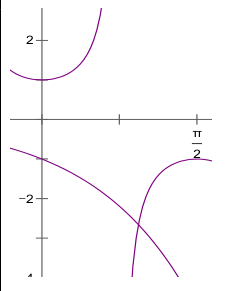
The mark scheme's sketch of y = sec 2x and y = −eˣ on 0 < x < ½π.
- 1
Asymptote of : where , i.e. , so .
- 2
Left branch, : runs from down to , so runs from up to . It is positive here.
- 3
Right branch, : runs from down to , so rises from up to . It is negative and increasing here.
- 4
starts at when and decreases (to ). It is always negative.
- 5
On the left branch, , so there is no crossing there.
A positive curve and a negative curve can never meet.
- 6
On the right branch, starts below (it comes up from ) and ends above it (). One curve rises and the other falls, so they cross exactly once. Mark it with a dot.
AnswerThe sketch shows one intersection, on the branch of between and , so there is only one root.
- 1
The rest of this note
Can you do all of these?
Write sec, cosec and cot in terms of cos, sin and tan without hesitating
Find exact values of sec, cosec and cot at any angle, with the sign from the quadrant
Find every solution in an interval using the sin, cos and tan partner rules
Sketch all six graphs, and say where the asymptotes of sec, cosec and cot are
State the asymptotes, period and range of graphs such as y = sec 2x and y = cot 2x
Find the greatest or least value of 1/(k + R sin(θ + α)) by making the bottom as small or large as possible
Split an equation involving sec, cosec or cot into two curves and use their shape to prove exactly one root
Derive sec²θ ≡ 1 + tan²θ by dividing, rather than recalling it
Use the rearranged forms sec²θ − tan²θ ≡ 1 to spot a difference of two squares
Expand sin(A ± B), cos(A ± B), tan(A ± B), getting the cos sign flip right
Find exact values such as sin 75° and tan 15° by splitting the angle
Collapse a compound-angle equation to a single tan by dividing by cos x
Given one trig ratio and the quadrant, find the others and the double angle values exactly
Factorise out a common cos θ or sin θ instead of dividing by it
Choose the version of cos 2A that leaves one function in the equation
Apply a double angle formula to any pair where one angle is twice the other
Stretch the interval for 2θ, and shrink it for ½x, before listing solutions
Express a sin θ + b cos θ in all four R-forms by comparing coefficients
Expand a compound angle first when the expression is not yet a sin θ + b cos θ
Adjust the interval for the whole bracket (e.g. 2θ − α) before solving an R-form equation
Read the maximum, minimum and their positions straight off an R-form
Remember that the least value of a squared R-form is 0, not −R²
Prove an identity working on one side only, ending at the printed expression
Reject roots outside the range of the function before writing answers down
Answer in the units the interval was stated in
Add two compound expansions to turn a product of trig functions into a sum
Substitute a new angle into a proved identity when the “hence” part demands it
Halve (or otherwise convert) every answer back to the variable actually asked for
Reject an impossible root such as tan² = −1 before listing solutions