Moments, couples and centre of gravity
“
understand that the weight of an object may be taken as acting at a single point known as its centre of gravity; define and apply the moment of a force; understand that a couple is a pair of forces that acts to produce rotation only; define and apply the torque of a couple
Why force alone doesn't decide rotation
Push on a heavy door close to the hinge and it barely moves; push with the same force at the handle, far from the hinge, and it swings open. Same force, very different effect. So the turning effect of a force depends on the force and on how far its line of action is from the turning point. This section builds that measurement (the moment), then uses it to explain the centre of gravity (the single point where an object's whole weight can be taken to act), and ends with a special pair of forces, the couple, and its torque.
Moment of a force
The turning effect of a single force about a point is called the moment of the force:
moment of a force about a point = force × perpendicular distance from the point to the line of action of the force
"Define the moment of a force" is a one-mark question (B1), and the mark needs the word perpendicular: "force × distance" alone scores nothing. Moments are measured in N m.
Two pieces of vocabulary keep the geometry honest:
- The line of action of a force is the infinite straight line along which the force pushes or pulls — extend the arrow in both directions to see it.
- The perpendicular distance is the shortest gap from the pivot to that line. It is never "the distance along the handle" unless the force happens to be at right angles to the handle.
Moment of a force about a point = force × perpendicular distance from the point to the force's line of action. Unit: N m.
- 1
Draw the line of action — extend the force arrow forwards and backwards as a dashed straight line.
The perpendicular distance runs to this line, not to the arrowhead.
- 2
Drop the perpendicular from the pivot to the line of action and label its length .
This is the distance the mark scheme wants; using the distance along the slanted arm instead is the classic lost mark.
- 3
Either find with trigonometry and use , or resolve the force into components perpendicular and parallel to the arm and keep only the perpendicular one, , where is the angle between the force and the arm.
Both routes always agree. The component parallel to the arm acts along a line through the pivot, so it has no moment.
- 4
Quote the answer in N m, stating which point it is taken about — a moment is always "about" a named pivot.
The same force has different moments about different points.
A clean demonstration: the spanner
A mechanic pulls on a spanner handle long with a force of directed at to the handle. Take moments about the bolt centre.
Route 1 — perpendicular distance. Draw the force's line of action. The perpendicular from the bolt to that line is the side opposite the angle in a right-angled triangle whose hypotenuse is the handle:
Now use the definition:
Route 2 — resolve the force. Only the component of the force perpendicular to the handle can turn the bolt:
That component acts at the end of the handle, from the bolt:
The two routes always agree. Notice the limiting case: if the mechanic pulled along the handle (), the moment would be zero. A force whose line of action passes through the pivot turns nothing, however large it is.
The slanted pull: the moment about the bolt uses only d⊥, the perpendicular distance from the bolt to the force's line of action — never the distance d along the handle.
Centre of gravity: the whole weight at one point
Gravity pulls on every part of an object: a spanner's head, its shaft and its handle each have weight. All these small forces are vertical, so they can be replaced by one force equal to the total weight, acting at one point:
The centre of gravity of an object is the point at which the whole weight of the object may be taken to act.
"Define centre of gravity" is worth one mark (B1) for that sentence. For a uniform object (same material and thickness all through) the centre of gravity is at its geometric centre: the middle of a uniform beam, the centre of a uniform square sheet. For a non-uniform object it can be anywhere. Two consequences are examined:
- The hanging test. Hang an object freely from a pivot and it settles with its centre of gravity directly below the pivot. In that position the weight's line of action passes through the pivot, so the weight has no moment about it and nothing turns. Move the object and the weight now has a moment about the pivot, which swings it back.
- The balance test. A flat card balances on a fingertip placed directly below its centre of gravity: the support force and the weight then act along the same line, so there is no turning effect either way.
The hanging test: from any release position, the weight's moment swings the card until its centre of gravity hangs directly below the pin — the only orientation in which the weight's line of action passes through the pivot.
Couples: turning without moving along
Turn a steering wheel with both hands: one hand pushes up, the other pushes down on the opposite side. The wheel turns, but it is not pushed sideways. That pairing has a name:
A couple is a pair of forces that are equal in size and opposite in direction, with parallel lines of action that do not coincide, so that their resultant force is zero.
Because the two forces cancel as vectors, a couple produces rotation only: the object turns, but its centre does not start moving in any direction. Use the definition as a checklist. If the two forces differ in size, or are not parallel, or do not cancel, then they are not a couple, whatever turning they produce. The spacecraft example below fails this test.
A couple: two equal forces F, opposite senses, parallel lines of action separated by perpendicular distance d. Resultant force is zero; the resultant turning effect is F d — rotation only.
Torque of a couple
How much turning does a couple deliver? Add the moments of its two forces about the midpoint between them. Each force has magnitude , each line of action is from the midpoint, and both turn the object the same way:
The midpoint was not special — take moments about any point and the two contributions still sum to . So one number captures the couple:
torque of a couple = (magnitude of one force) × (perpendicular distance between the lines of action of the forces)
Watch the word between: in "define the torque of a couple" the mark scheme gives M1 for "product of (one) force and distance" and A1 for "perpendicular distance between the (lines of action of the two) forces". The distance from one force to a pivot does not earn the A1.
Torque of a couple = magnitude of one force × perpendicular distance between the two lines of action. Unit: N m.
A clean demonstration: the steering wheel
Two hands grip a steering wheel of diameter , each pushing tangentially with .
Route 1 — two moments about the centre. Each hand is one radius, , from the centre, and both hands turn the wheel the same way, so the moments add:
Route 2 — couple formula. The two lines of action are a whole diameter, , apart:
The answers agree. The hands form a real couple: equal forces, opposite directions, parallel lines of action, zero resultant force. The wheel turns, and the steering column feels no overall sideways push.
The hanging square sheet
A square metal sheet of non-uniform density has a thin rod of negligible mass fixed at its centre. One of the corners of the sheet is labelled X. The mass of the sheet is . The rod is horizontal and the sheet is vertical.
(a) Define the torque of a couple. [2]
(b) When the rod is supported in such a way that it can rotate freely within its support, the sheet hangs in equilibrium with point X vertically above the rod, as shown in Fig. 2.2. On Fig. 2.2, draw a line to indicate the range of possible positions for the centre of gravity of the metal sheet. [1]
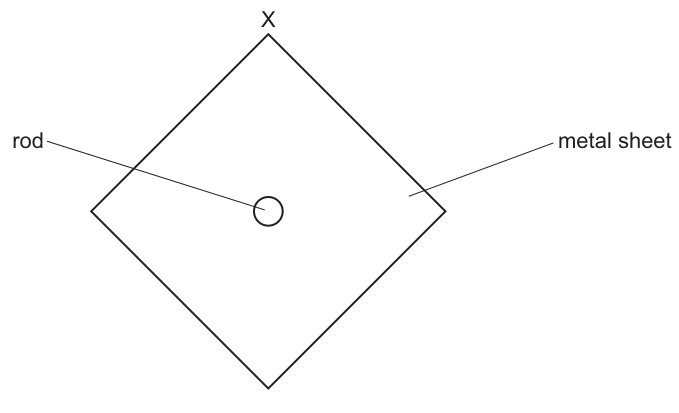
Fig. 2.2 — the square metal sheet hangs freely from the rod fixed through its centre, with corner X vertically above the rod.
Show full working
- 1
(a) Start with what a torque is made of:
This is the M1. It is not yet enough: the scheme needs to know WHICH distance.
- 2
Then name the distance: it is the perpendicular distance between the lines of action of the two forces (A1).
Saying 'distance from the pivot' instead of 'between the forces' loses the A1.
- 3
(b) The sheet is non-uniform, so its centre of gravity need not be at the centre. But it hangs in equilibrium from the rod, so the hanging test applies: the weight's line of action passes through the rod, and the centre of gravity is on the vertical line through the rod.
If the centre of gravity were to one side of that line, the weight would have a moment about the rod and the sheet would turn.
- 4
The centre of gravity must also be inside the sheet, and it must be below the rod (a point above the rod would make an unstable balance, so the sheet would not hang there). X is directly above the rod, so the vertical line through the rod is the sheet's diagonal. The possible positions form a straight vertical line from the centre of the sheet down to the bottom corner (B1).
A freely hanging object settles with its centre of gravity below the support, never above it.
(a) Torque of a couple = product of (one) force and the perpendicular distance between the lines of action of the two forces. (b) A vertical line from the centre of the sheet to the bottom corner.
Any 'hanging object' question is a centre-of-gravity question: the CoG ends up on the vertical line through the support. Draw that line first and the answer draws itself.
Two thrusters, one resultant moment
A spacecraft in deep space uses jets of hot gas from its thrusters to change its velocity. Fig. 2.1 shows a side view of the spacecraft and some of its thrusters.
Thruster A is a distance of leftwards from the centre of gravity of the spacecraft. Thruster C is a distance of upwards from the centre of gravity of the spacecraft.
Thrusters A and B can produce forces on the spacecraft in the upwards direction only. Thruster C can produce a force on the spacecraft in the leftwards direction only. All the thrusters shown produce forces entirely in the same plane as the centre of gravity.
(a)(i) Thruster A is activated, producing a force of upwards on the spacecraft. Thruster C is also activated, producing a force of in the leftwards direction on the spacecraft. Calculate the resultant moment due to these forces about the centre of gravity. [2]
(ii) State and explain whether the forces from A and C are a couple. [1]
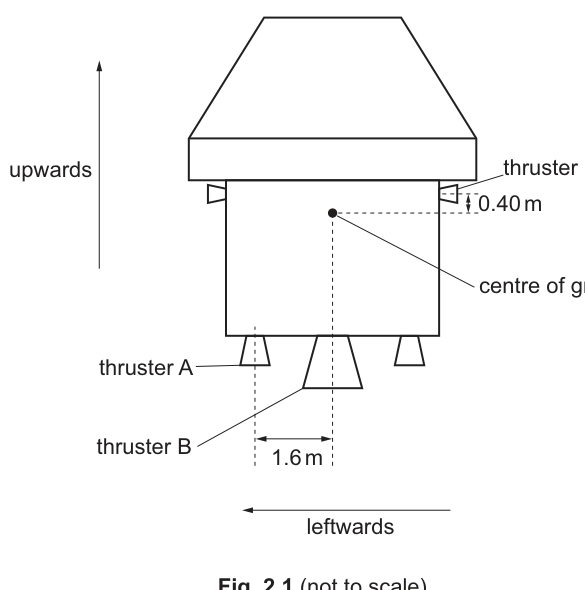
Fig. 2.1 — side view of the spacecraft: thruster A pushes upwards from a point 1.6 m left of the centre of gravity, thruster C pushes leftwards from a point 0.40 m above it.
Show full working
- 1
(i) Moment of A about the centre of gravity. A's force is vertical and acts to the left, so its perpendicular distance is :
For a vertical force the perpendicular distance is the horizontal gap to the pivot. C1 for either single moment.
- 2
Moment of C. C's force is horizontal and acts above the centre of gravity, so its perpendicular distance is :
For a horizontal force the perpendicular distance is the vertical gap to the pivot.
- 3
Compare the senses. A pushes up on the left of the centre of gravity: that turns the craft clockwise. C pushes left above the centre of gravity: that turns it anticlockwise. Opposite senses, so the moments subtract:
Moments in the same sense add; moments in opposite senses subtract. Always check the senses on the figure before combining.
- 4
(ii) Run the couple checklist. upwards and leftwards are not equal, not opposite and not parallel, so their resultant force is not zero. They are not a couple (B1).
One B1, and any one correct reason earns it: resultant force not zero, or not equal, or not opposite, or not parallel. The reason and the conclusion 'not a couple' must both be written.
(i) . (ii) Not a couple: the resultant force of the two thrusters is not zero (equally: the forces are not equal/opposite/parallel).
'Is it a couple?' is a definition question in disguise. Run the checklist: equal? opposite? parallel lines of action? If any answer is no, say which — that sentence is the mark.
Moment of the slanted force: using the full handle length.
Use the perpendicular distance: , not .
Distance along the arm only equals perpendicular distance when the force is at 90° to the arm. Every slanted-force diagram is testing exactly this.
"The two thruster forces are opposite-ish, so they form a couple."
Check all three conditions: equal magnitudes, opposite directions, parallel lines of action — and hence zero resultant force. 60 N up and 220 N left fail them all.
Any two forces that turn an object are not automatically a couple. Name the condition that fails to earn the B1.
Torque of a couple distance from one force to the pivot.
Torque perpendicular distance between the two lines of action — independent of any pivot.
The A1 wording is 'between the (two) forces'. A couple's turning effect is the same about every point; tying it to a pivot misstates the physics.
"The centre of gravity of the sheet is at its geometric centre."
Only for a uniform object. For a non-uniform sheet, use the hanging test: the centre of gravity is somewhere on the vertical line below the support.
The O/N 2025 sheet question wanted the whole vertical line from the centre to the bottom corner, not a single dot at the centre.
Your turn
One structured moment with a slanted bar, then three Paper 1 questions: a jar lid couple, a door handle and a tap.
- 19702/23 O/N 2022 Q3(b)2 marks
A hollow plastic sphere is attached at one end of a bar. The sphere is partially submerged in water and the bar is attached to a fixed vertical support by a pivot P, as shown in Fig. 3.1.
The sphere has weight . The distance from P to the centre of gravity of the sphere is . Assume that the weight of the bar is negligible.
Calculate the moment of the weight of the sphere about P.
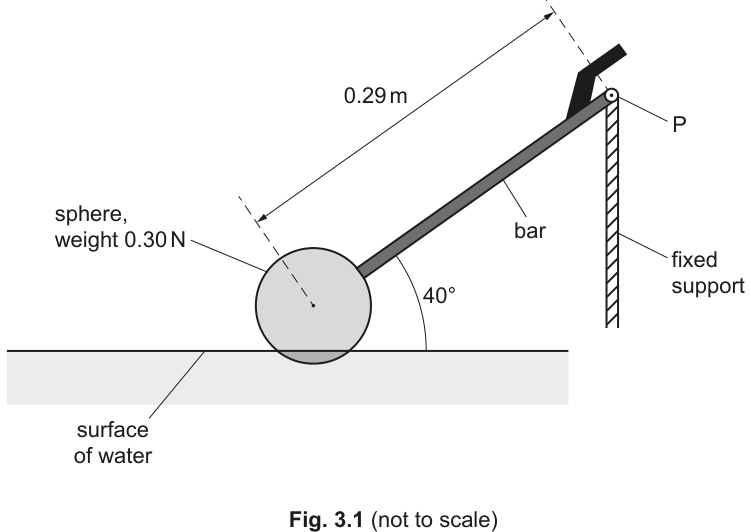
Fig. 3.1 — the bar runs from the pivot P down to the sphere at 40° to the horizontal.
Stuck? Show hint
The weight acts vertically downwards. Sketch its line of action through the sphere's centre and find the horizontal gap between that line and P.
Show solution
- 1
The weight's line of action is vertical, so the perpendicular distance from P to it is the horizontal distance from P to the sphere's centre of gravity. The bar () is the hypotenuse, and the horizontal side is next to the angle:
Using 0.29 m (the distance along the bar) is the classic error: the bar is not at 90° to the weight.
- 2
Moment = force × perpendicular distance:
C1 is for the product with the correct perpendicular distance; A1 for the value.
Answer - 1
- 29702/11 O/N 2023 Q11
A minimum torque of must be applied to the lid of a jar for it to open. The radius of the lid is .
What is the minimum force that must act on each side of the lid in order to open it?
Options
A
B
C
D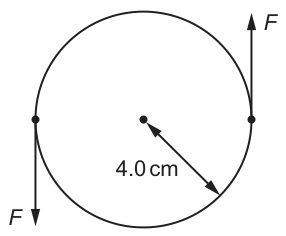
Top view of the jar lid: two equal tangential forces F act on opposite sides of the rim, and the radius marked is 4.0 cm.
Stuck? Show hint
Forces on each side of the lid, opposite senses — a couple. What is the perpendicular distance between the two forces' lines of action?
Show solution
- 1
Two equal forces on opposite sides of the lid form a couple. The distance needed is the separation between their lines of action, which is the diameter:
The radius is only half the gap between the two forces. Convert cm to m before using it in N m.
- 2
Torque of a couple:
Substitute the torque and the separation into the definition.
- 3
Rearrange:
Option C. D () uses the radius, , as the separation. A () and B () leave the distance in centimetres.
Checking where each wrong option comes from is a fast way to spot your own slip.
AnswerC — the two forces are separated by the lid's diameter, so .
- 1
- 39702/12 O/N 2023 Q11
A force is applied at an angle of to a door handle, at a distance from the pivot of the handle.
What is the moment of the force about the pivot?
Options
A
B
C
D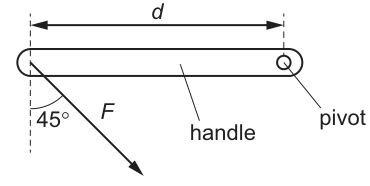
The door handle is pivoted at one end; the force F is applied at the other end, a distance d from the pivot and at 45° to the handle.
Stuck? Show hint
Only the component of F perpendicular to the handle contributes — or equivalently, use the perpendicular distance d sin 45°.
Show solution
- 1
Resolve into components along and perpendicular to the handle. The perpendicular component is
sin 45° = 1/√2. The component along the handle points at the pivot, so it has no turning effect.
- 2
That component acts a distance from the pivot:
Option A.
Same answer by the other route: the perpendicular distance from the pivot to F's line of action is d sin 45° = d/√2.
- 3
B () ignores the angle. C and D are larger than , which is impossible: is the moment when the force is at , the largest it can be.
A slanted force always gives LESS moment than the same force at 90°.
AnswerA — .
- 1
- 49702/14 O/N 2025 Q14
A couple is applied to a tap, as shown.
What is the torque of the couple?
Options
A
B
C
D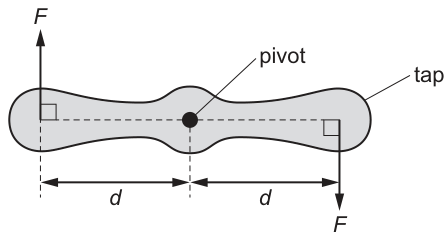
The tap handle: equal forces F up and down at the two ends, each a distance d from the central pivot.
Stuck? Show hint
The torque of a couple uses the separation between the two lines of action, not the distance from either to the pivot.
Show solution
- 1
Each force is from the pivot, on opposite sides, so the separation of the two lines of action is
The couple formula needs the gap BETWEEN the forces, not the distance from one force to the pivot.
- 2
Torque of the couple:
Option C. B () uses as the separation.
Check: two moments about the pivot, Fd + Fd, give the same 2Fd.
AnswerC — separation , so .
- 1
The rest of this note
Can you do all of these?
Calculate a moment as force × perpendicular distance from the pivot to the line of action
Define centre of gravity, and locate it with the hanging test
Define a couple and the torque of a couple, using the distance BETWEEN the forces
State and apply the principle of moments about a chosen point
Choose a pivot where an unknown force acts, so its moment is zero
Combine resultant force = 0 with resultant moment = 0 to find two unknown forces
Solve three-force problems with a closed vector triangle
Define density and pressure, and calculate p = F/A with the force normal to the area
Find the density of a mixture as total mass ÷ total volume
Derive Δp = ρgΔh from the definitions of density and pressure
Add atmospheric pressure when the total pressure is asked
Use equal pressures at the same level in a connected liquid (U-tubes)
Explain upthrust with the two points: pressure difference, then bigger upward force on the bottom
Apply F = ρgV with the fluid's density and only the submerged volume
Use floating conditions: U = W, and V_sub/V_total = ρ_obj/ρ_fluid