Mass, inertia, weight and F = ma
“
understand that mass is the property of an object that resists change in motion; recall F = ma and solve problems using it, understanding that acceleration and resultant force are always in the same direction; describe and use the concept of weight as the effect of a gravitational field on a mass and recall that the weight of an object is equal to the product of its mass and the acceleration of free fall
From describing motion to explaining it
The Kinematics note gave you the words for motion: displacement, velocity, acceleration, and the equations that connect them. It did not answer the next question: why does a velocity change at all? The answer is force. A force is a push or a pull that one body exerts on another. When the forces on a body do not cancel, what is left over — the resultant force — changes the body's velocity. This section starts with the two ideas every force problem needs: mass (how hard the body is to speed up or slow down) and weight (the pull of gravity on it).
Mass: resistance to change in motion
Push an empty shopping trolley and it speeds up easily. Push a parked car just as hard and it hardly moves. The car has more inertia: more resistance to a change in its motion. Mass is the measure of this:
Mass is the property of an object that resists change in motion.
Learn that sentence exactly; it is the syllabus wording. Three facts follow:
- Mass is measured in kilograms. It is a scalar.
- Mass belongs to the object itself: it is the same on Earth, on the Moon and in deep space.
- A larger mass needs a larger force to give it the same acceleration. That is what (below) says.
Mass measures resistance to change in motion; weight is a force — the gravitational pull on the mass. An astronaut's mass is the same on the Moon as on Earth, but her weight there is about one-sixth as large. When a question says "weight" it wants a force in newtons; when it says "mass" it wants kilograms.
Weight: gravity pulling on a mass
The Earth's gravitational field pulls on every kilogram near its surface with a force of per kilogram. So the weight of an object is the effect of the gravitational field on its mass:
with in kg and in newtons. The syllabus puts it in words: the weight of an object is the product of its mass and the acceleration of free fall. Questions write the unit of in two ways: (newtons per kilogram, the pull on each kilogram) and (the free-fall acceleration from the Kinematics note). They are the same thing: , so .
A quick example with invented numbers: a person of mass weighs
on Earth, but only on the Moon, where . The weight changed because the gravitational field changed; the mass stayed .
Convert grams to kilograms before using . A sphere of mass has weight , not .
Weight = mass × gravitational field strength. g = 9.81 N kg⁻¹ = 9.81 m s⁻² near the Earth's surface.
Resultant force and F = ma
Force and motion are linked by one equation (Newton's second law, stated fully in the next section):
where is the mass in kg, the acceleration in and the force in N. The letter means the resultant force: the vector sum of all the forces on the body, after forces in opposite directions have partly cancelled. Force and acceleration are both vectors, and
The acceleration and the resultant force are always in the same direction.
So always work in this order: list the forces, find the resultant (subtract the forces that oppose), and only then divide by the mass. If the resultant points backwards compared with the motion, the acceleration points backwards too, and the object slows down.
- 1
List the forces on the body with their directions, and state which direction you are calling positive.
- 2
Subtract the opposing forces to find the resultant along that direction. Only forces that something actually exerts belong in the list — there is no "force of motion".
A moving object does not need a forward force to keep moving. Adding an invented 'force of motion' is a common error.
- 3
Convert units: grams → kilograms; anything quoted in kN → N. Do this before substituting.
- 4
Apply and quote the answer with its unit.
- 5
Interpret the direction: the acceleration points along the resultant you computed — if that opposes the motion, say "decelerates", don't hide the minus sign.
A clean demonstration
A car of mass drives along a level road with a driving force of , while air resistance and friction together oppose it with .
Resultant force — take the direction of travel as positive:
Acceleration — divide by the mass:
in the direction of travel, as expected: the resultant points forwards, so the car speeds up.
Now the driver switches the engine off. At that instant only the resistance acts, backwards: , so
The minus sign means the acceleration points backwards: the car slows down at (a deceleration). Same car, same equation; the acceleration changed direction because the resultant did.
The released luggage trolley
A person uses a trolley to move suitcases at an airport. The total mass of the trolley and suitcases is .
(a) The person pushes the trolley and suitcases along a horizontal surface with a constant speed of and then releases the trolley. The released trolley moves in a straight line and comes to rest. Assume that a constant total resistive force of opposes the motion of the trolley and suitcases.
(a)(ii) Calculate the time taken for the trolley to come to rest after it is released.
(b) At another place in the airport, the trolley and suitcases are on a slope, as shown in Fig. 2.1. The person releases the trolley from rest at point X. The trolley moves down the slope in a straight line towards point Y. The distance along the slope between points X and Y is . The component of the weight of the trolley and suitcases that acts along the slope is . Assume that a constant total resistive force of opposes the motion of the trolley and suitcases.
(c) The angle of the slope in (b) is constant. The frictional forces acting on the wheels of the moving trolley are also constant. Explain why, in practice, it is incorrect to assume that the total resistive force opposing the motion of the trolley and suitcases is constant as the trolley moves between X and Y.
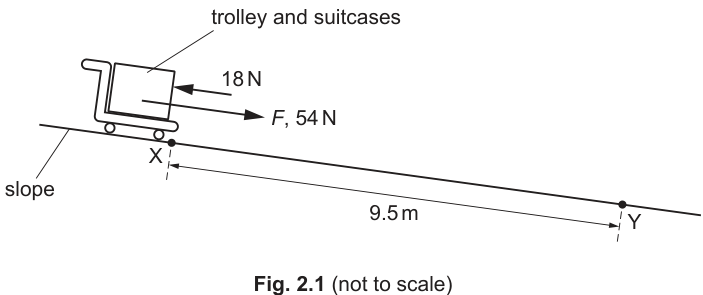
Fig. 2.1
Show full working
- 1
(a)(ii) List the forces after release. The push has stopped, so the only horizontal force is the resistive force, acting backwards. Take the direction of travel as positive:
The push disappears at release. Leaving a driving force in the sum is the error this part is testing.
- 2
Apply Newton's second law, , with (trolley and suitcases together):
The minus sign means a deceleration of : the resultant opposes the motion. (C1)
Mark-scheme codes: C1 is a mark for a correct formula or step (it can be earned even if the final answer is wrong), A1 is for the correct answer, B1 is for a correct stated fact, and M1 is a method mark that the A1 after it depends on.
- 3
Now the acceleration is known, use kinematics. List the quantities: , , , = ?. The equation without is
Choose the equation that leaves out the quantity you neither know nor want — here the distance s.
- 4
Substitute, keeping the signs:
- 5
Rearrange for and evaluate:
(C1 for , A1 for )
Three marks: C1 for using a = F/m, C1 for t = 1.4/0.25, A1 for 5.6 s. Writing the acceleration down on its own line makes the method marks easy to award.
- 6
(c) The wheel friction and the slope angle are constant, but part of the resistive force is air resistance, and air resistance increases with speed. The trolley starts from rest and speeds up down the slope, so the air resistance grows from X to Y and the total resistive force is not constant. (B1)
Any model that treats resistance as constant is a simplification. The section “Friction, drag and terminal velocity” explains why drag depends on speed.
(a)(ii) , from . (c) Air resistance increases with speed, so as the speed changes along X to Y the total resistive force changes — assuming it constant is wrong.
When a question asks why a 'constant resistive force' is unrealistic, the answer is almost always: air resistance changes with speed.
Connected bodies
Sometimes two objects are joined — a car towing a trailer, two blocks tied by a string — and move together. Because they are joined, they have the same acceleration. The tension in the tow bar or string pulls forwards on one body and backwards on the other with the same size. You can use in two ways:
- On the whole system. Add the masses, and use only the external forces (driving force, resistances, weights). The tension pulls forwards on one part and backwards on the other, so it cancels out. This gives the acceleration.
- On one body alone. Now the tension is an outside force on that body, so this finds the tension.
Find the acceleration from the whole system first, then the tension from one body.
Invented example. A car of mass tows a trailer of mass along a level road. The driving force is . The resistive forces are on the car and on the trailer.
Whole system (mass ), direction of travel positive:
Trailer alone (mass ): the tension pulls it forwards and of resistance pulls it back:
Check with the car alone: gives too.
A string over a frictionless pulley works the same way. The string changes the direction of the tension but not its size, so treat "along the string" as the direction of motion. For two masses hanging on either side, the resultant force on the system is the difference between the two weights, and the mass being accelerated is the total mass.
Top: the whole car–trailer system. The tension is internal, so only the driving force and the two resistances decide the acceleration. Bottom: the trailer on its own, where the tension T is an external force. (Weights and normal contact forces balance and are not drawn.)
A sphere of mass : weight .
Convert first: , so .
The drag question in “Friction, drag and terminal velocity” gives the mass as 49 g. Forgetting to convert makes the answer 1000 times too big.
"The engine force goes into F = ma."
Only the resultant force goes into F = ma: driving force minus resistance, found before dividing by m.
Using the driving force alone makes the acceleration too large. Multiple-choice wrong answers are often built from exactly this error.
"An object moving upwards must have an upward resultant force on it."
The resultant force points the same way as the acceleration, not the velocity. A ball thrown upwards is slowing down, so its resultant (its weight, if air resistance is negligible) points down.
Acceleration is the rate of change of velocity, so it need not point along the motion. F = ma ties the resultant to the acceleration.
Car towing a trailer: "a = driving force ÷ mass of the car".
The driving force accelerates the car AND the trailer: use the total mass for the whole system, or include the tension if you look at the car alone.
Each use of F = ma must say which body (or system) it is about, and include every external force on that body and only its mass.
"This astronaut weighs 80 kg."
Mass 80 kg everywhere; weight = 80 × 9.81 = 785 N on Earth — and different wherever g differs.
Weight is a force in newtons produced by a gravitational field; mass is the intrinsic resistance to change that the field acts on.
Your turn
A definition question, two invented calculations (a lift, then a car) and a pulley system from Paper 1.
- 19702/12 O/N 2021 Q8
What is meant by the mass of an object?
Options
A the property of the object that resists a change in motion
B the pull of the Earth on the object
C the total number of atoms in the object
D the weight of the objectStuck? Show hint
Which option names a property of the object itself, unaffected by where the object happens to be?
Show solution
- 1
B describes weight — a gravitational force on the object, not a property that resists change. D is the same confusion stated again.
- 2
C is not the definition: atoms have different masses, so the number of atoms does not measure mass.
- 3
A matches the definition exactly: mass is the property that resists a change in motion — option A.
This is the syllabus sentence from the start of this section. Short definitions like this are easy marks if learned word for word.
AnswerA — mass is the property of the object that resists a change in motion.
- 1
- 2
A passenger of mass stands on bathroom scales inside a lift. Take .
(a) The lift accelerates upwards at . Calculate the reading on the scales.
(b) The lift later cruises upwards at a constant . State the reading now, and explain why it differs from (a).Stuck? Show hint
The scales read the normal contact force R on the passenger. Write the resultant force in terms of R and W, then apply F = ma in each case.
Show solution
- 1
(a) Two forces act on the passenger: the normal contact force upwards from the scales, and the weight downwards. With up positive, the resultant is . Newton's second law:
Write the resultant (R minus the weight) before using numbers. This stops you writing R = mg out of habit.
- 2
Rearrange for :
- 3
Substitute , , (upwards, so positive):
So the scales read (2 s.f.), more than the passenger's weight.
To accelerate upwards the resultant must be upwards, so the floor must push harder than the weight. This is why you feel heavier as a lift starts to rise.
- 4
(b) Constant velocity means zero acceleration, so the resultant is zero:
- 5
Substitute:
The reading is now equal to the passenger's weight.
Only a change of velocity needs a resultant force. Any constant velocity, however fast, gives the same reading as standing still.
Answer(a) . (b) — at constant velocity the resultant is zero, so the contact force equals the weight.
- 1
- 3
A car of mass travels along a level road. Its engine provides a driving force of and the total frictional resistance is .
(a) Calculate the car's acceleration from rest.
(b) Ignoring any change in the resistive force, calculate the time taken to reach .Stuck? Show hint
(a): subtract the resistance first. (b): the acceleration you found is uniform, so one suvat equation finishes it.
Show solution
- 1
(a) Resultant force, taking the direction of travel as positive:
- 2
Newton's second law with :
- 3
(b) List the quantities: , , , = ?. The equation without is . Substitute:
- 4
Rearrange:
The question tells you to ignore any change in resistance. In reality air resistance grows with speed, so the real car would take longer.
Answer(a) . (b) (from ).
- 1
- 49702/11 O/N 2024 Q10
A lift (elevator) consists of a passenger car supported by a cable that runs over a light, frictionless pulley to a counterbalance. The counterbalance falls as the passenger car rises.
Some masses are shown in the table.
mass passenger car 520 counterbalance 640 passenger 80 What is the magnitude of the acceleration of the car when carrying just one passenger and when the pulley is free to rotate?
A B C D
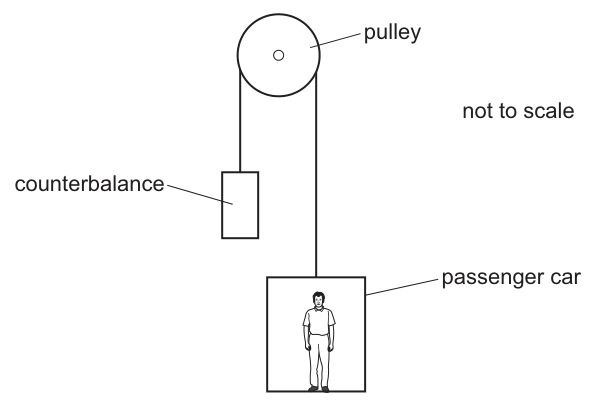
The printed figure.
Stuck? Show hint
Treat car, passenger and counterbalance as one system moving along the cable. Which weight drives it, which opposes it, and what total mass is accelerated?
Show solution
- 1
Mass on the car side: . Mass on the counterbalance side: . The counterbalance is heavier, so it falls and the car rises.
Group the masses by which side of the pulley they hang on.
- 2
Take "counterbalance down, car up" as positive. The tension acts on both sides and cancels for the whole system, so the resultant force is the difference between the two weights:
The cable's tension is internal to the system, just like the tow bar in the car–trailer example.
- 3
The mass being accelerated is everything that moves:
Option D comes from dividing by 600 kg only — but the counterbalance must be accelerated too.
- 4
Newton's second law:
Option B.
Option A (0.032) forgets to multiply the mass difference by g; option C (0.61) divides by 640 kg only.
AnswerB — .
- 1
The rest of this note
Can you do all of these?
Define mass ('resists change in motion'), momentum ('product of mass and velocity') and force ('rate of change of momentum') word-for-word
State the principle of conservation of momentum including 'for an isolated system / no resultant external force' — the clause carries its own mark
Identify third-law pairs: equal magnitude, opposite direction, same type, acting on two different bodies — weight's partner pulls the Earth, it is not the normal reaction
Find the resultant force first, then apply F = ma; acceleration points the same way as the resultant force, always
Connected bodies: whole system (total mass, external forces) for a; one body alone for the tension
Choose one positive direction, substitute signed velocities into Δp = m(v − u), and ADD magnitudes when motion reverses
Know that Δp/Δt gives the RESULTANT force; add the weight to get the force from the ground
Read p–t graphs: gradient = resultant force, constant even through p = 0; convert p–t to v–t (divide by m) for areas
Sketch a–t, d–t and p–t graphs feature by feature: steps, gradients, turning points
Solve stick-together and split-apart problems with conservation of momentum; find the percentage of kinetic energy transferred
Test elasticity two ways (kinetic energy; relative speeds), and solve elastic collisions with the momentum + relative-speed equations
In two dimensions, conserve momentum along x and y separately, then combine with Pythagoras and tan
Explain falling through air: drag grows with speed → resultant falls → acceleration falls from g to zero → terminal velocity
Thrown upwards through air: drag and weight both act downwards, so deceleration > g and the ball rises less high in less time
In 'show that' items reach the printed value with one more significant figure, and never round early