Work done by a force
“
understand the concept of work, and recall and use work done = force × displacement in the direction of the force
Why force alone is not enough
Push hard against a parked lorry all afternoon. It never moves. You get tired, but in physics you have done no work on the lorry, because the point where your force acts has not moved. Hitch a winch to the same lorry and it creeps forward: now a force acts through a displacement, and energy is transferred to the lorry.
That is what work means: work done is energy transferred by a force when its point of application moves. The energy can go into the object's motion, its height, or heating. Kinetic energy, potential energy and power in the rest of this note are all built from this one idea, so learn the definition exactly.
The definition
The work done by a force is the product of the force and the displacement in the direction of the force.
This whole sentence earns the mark when a paper asks for the definition (9702/21 O/N 2024 Q3(a)). The words "in the direction of the force" matter:
- If the force points the same way as the motion, work = force × distance moved.
- If the force is at an angle to the motion, only the component of the force along the displacement, , does work. That is where comes from.
Work is force (N) times distance (m), so its unit is the joule: . One joule is the work done when a force of moves its point of application in the direction of the force. Work is energy transferred, so it is measured in joules like every other energy in this note.
Work done by a constant force F over a displacement s, where θ is the angle between the force and the displacement. Unit: joule (N m).
force relative to displacement | work done | everyday instance |
|---|---|---|
parallel, same direction (θ = 0°) | , positive — energy supplied | pushing a trolley forward |
perpendicular (θ = 90°) | — cos 90° = 0, no transfer | carrying a bag level; the normal force on a sliding crate |
opposite (θ = 180°) | , negative — energy removed | friction and drag on anything moving |
The three cases. Remember the middle row: a force at right angles to the motion does no work, however large it is.
Only the component of F along the displacement — F cos θ — transfers energy; the perpendicular component F sin θ does no work at all.
- 1
Identify the displacement: where the point of application actually moves, and how far.
The displacement is usually drawn along the ground or the path — not along the rope or the limb applying the force.
- 2
Identify θ as the angle between the force vector and the displacement vector — not the angle to the vertical or to the ramp unless those coincide with the motion.
Misreading which angle the question gives is a common cause of using sin instead of cos.
- 3
Either substitute straight into , or resolve the force first ( along the motion) and use .
Both routes are the same mathematics; resolving first keeps the physics visible.
- 4
Quote the answer in joules, converting any kJ or cm first.
Energy answers are in joules. Give them to the same number of significant figures as the data (usually 2), in standard form if very large or small.
A demonstration: the sledge
A child pulls a sledge along horizontal snow. The rope pulls with a force of at above the ground.
- The displacement is along the ground, .
- The rope is above the ground, so the angle between force and displacement is .
- The rule: .
- Substitute: .
- Evaluate: and , so .
The vertical component of the pull, , does zero work because the sledge does not move up. That is why the factor appears. With a horizontal rope, all would have been transferred.
Define it, then use it on a real lift
(a) State what is meant by the work done by a force. [1]
(c) An electric motor has an input power of . The motor takes minute to lift a load of weight at constant speed through a vertical height of . Resistive forces are negligible.
(i) Show that the work done by the motor on the load in minute is . [1]
Show full working
- 1
(a) The work done by a force is the product of the force and the displacement in the direction of the force (B1).
One mark for the whole sentence. 'Force × distance' alone misses 'in the direction of the force', which is the part that leads to cos θ.
- 2
(c)(i) The load moves at constant speed, so the resultant force on it is zero. The upward force from the motor therefore equals the weight:
Newton's first law: constant speed means zero resultant force. The weight is given in newtons, so no g is needed.
- 3
The force (up) and the displacement (up) are in the same direction, so and the work is simply force × distance. The distance is .
Always check the angle before using W = Fs. Here cos 0° = 1, so the cos θ factor disappears.
- 4
Substitute into :
In a 'show that', write the substitution, then the value. The input power and the time are not needed yet; they are used later for power and efficiency (see the “Power” section).
(a) Product of (the) force and displacement in the direction of the force. (c)(i) .
When a weight is given in newtons, work against gravity needs no g at all: W = weight × height. Keep g for when you are handed a mass.
The kite buggy — force at an angle (Paper 1)
A man sits on a buggy that is pulled along by a wire attached to a kite. The wire is at an angle of to the horizontal and has a constant tension of . The man and buggy travel a distance of along a straight horizontal path. The wire and the path of the buggy are in the same vertical plane.
What is the work done by the tension force on the man and buggy?
Options
A B C D
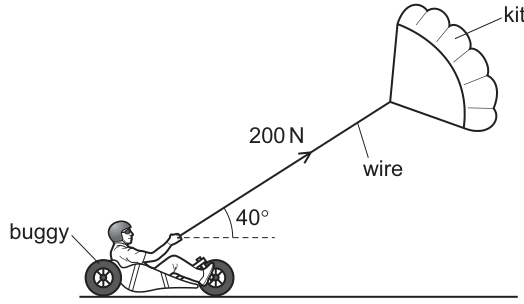
The kite's wire pulls the man and buggy with a tension of 200 N at 40° to the horizontal; they travel 20 m along a straight horizontal path.
Show full working
- 1
The displacement is horizontal (); the tension sits above it, so between force and displacement.
The 40° is measured from the horizontal, and the horizontal is the direction of travel. Always check which line the angle is measured from.
- 2
Substitute into :
Only the horizontal component of the tension, 200 cos 40°, is along the displacement.
- 3
Evaluate: and , so
Option B.
Option D (4.0 kJ) ignores the angle. Option A (2.6 kJ) uses sin 40° instead of cos 40°, which is the vertical component, and that does no work.
B — .
In angled-force questions, expect wrong options built from two mistakes: leaving out cos θ, and using sin instead of cos. Use the angle between F and s and you avoid both.
Work done by the kite wire: — "the force is 200 N and it moved 20 m".
— only the component along the displacement transfers energy.
Leaving out cos θ is the most common work-done error, and multiple-choice options usually include the answer without the angle.
Using the vertical component: .
Use the component in the direction of the displacement: when the motion is horizontal.
Whether you need sin or cos depends on which line the angle is measured from. Measure θ from the displacement.
"I pushed the lorry for an hour, so I did lots of work on it."
Zero displacement means zero work done on the lorry — no energy was transferred to it, however tired you feel.
Feeling tired is not work in physics. The definition needs the point where the force acts to move.
Counting the normal force or the weight when a crate slides horizontally: "W = (mg)(s)".
Both act perpendicular to a horizontal displacement: each does exactly zero work.
Use the table above: a force at 90° to the motion does no work, however large it is.
Your turn
An angled pull, a question with a zero-work part, and a case of negative work.
- 12 marks
A student drags a crate across a floor using a rope held at to the floor. The tension in the rope is .
Calculate the work done by the tension force.
Stuck? Show hint
θ is the angle between the rope and the direction of motion — which here is along the floor.
Show solution
- 1
Identify the quantities: , , and between the rope and the floor.
The crate moves along the floor, and the rope is 25° from the floor, so 25° is the angle between force and displacement.
- 2
Substitute into :
Only the component of the pull along the floor, 65 cos 25°, does work.
- 3
Evaluate: and , so
Give the answer to 2 s.f., like the data. The vertical component 65 sin 25° ≈ 27 N does no work because the crate does not move up.
Answer - 1
- 23 marks
A porter pulls a suitcase along a level corridor with a horizontal force of . The suitcase rests on a trolley, and the trolley pushes up on the suitcase with a vertical support force. There is also friction.
(i) State the work done by the vertical support force on the suitcase. Explain your answer.
(ii) Calculate the work done by the horizontal pull.Stuck? Show hint
For (i): what is the angle between an upward force and a horizontal displacement?
Show solution
- 1
(i) The support force is vertical. The displacement is horizontal. So the angle between them is .
Always find the angle between the force and the displacement first.
- 2
Use with :
The support force does no work: it holds the suitcase up but transfers no energy to it.
The explanation (force perpendicular to the displacement) is what earns credit, not the bare zero.
- 3
(ii) The pull is horizontal and the suitcase moves horizontally, so and :
This is the work done by the pull only. Some of this energy goes to the suitcase's motion and some is taken by friction; the “Conservation of energy, resistance and efficiency” section shows how to split it.
Answer(i) Zero — the force is perpendicular to the displacement. (ii) .
- 1
- 32 marks
A parachutist descends vertically at constant speed through a distance of . Air resistance on her is , acting vertically upwards.
Calculate the work done by the air resistance on the parachutist, and explain its sign.
Stuck? Show hint
The force acts opposite to the displacement — θ = 180°.
Show solution
- 1
The air resistance acts upwards and the displacement is downwards, so the angle between them is , and .
Opposite directions always mean θ = 180°.
- 2
Substitute into :
The minus sign means the air resistance takes energy away from the parachutist instead of giving energy to her.
- 3
The energy is not destroyed; it is transferred to the air as thermal energy. At constant speed the weight ( down, over down) does of work, and the air resistance does , so her kinetic energy does not change.
Constant speed means zero resultant force, so the weight equals the 800 N air resistance. The “Conservation of energy, resistance and efficiency” section builds on this kind of energy balance.
Answer— the force opposes the displacement, so it removes energy.
- 1
The rest of this note
Can you do all of these?
Define work done: force × displacement in the direction of the force; use Fs cos θ for an angled force
Spot the zero-work cases: no displacement, or a force perpendicular to the displacement
Derive E_K = ½mv² from W = Fs, F = ma and v² = u² + 2as, one line at a time
Rearrange ½mv² for v (√(2E/m)) and for m (2E/v²); use ratios (E_K ∝ m, E_K ∝ v²)
Compare ½mv² totals before and after a collision: equal totals means perfectly elastic
Convert eV ↔ J with 1 eV = 1.6 × 10⁻¹⁹ J
Derive ΔE_P = mgΔh from the work done lifting at constant speed, naming g
Use weight × Δh when a weight in newtons is given; Δh is always vertical
State the principle of conservation of energy: the total energy of a closed system is constant
Write energy balances in words first: loss in E_P = gain in E_K + work done against resistive forces
Find an average resistive force from the missing energy with F = W/s
Calculate efficiency as useful output ÷ total input; divide by the efficiency to find an input
Define power as work done per unit time and derive P = Fv
At constant speed: driving force = resistive force (vehicles), lifting force = weight (lifts, P = mgv)
Convert minutes, hours, km, kJ, g and percentages before substituting