The parts of a flower and what they do
“
16.3.1 Identify and draw the sepals, petals, stamens (anthers and filaments) and carpels (stigmas, styles, ovaries and ovules) of an insect-pollinated flower. 16.3.3 Relate the structure of the parts of flowers to their functions, limited to the parts listed in 16.3.1.
A flower is the organ of sexual reproduction in a flowering plant. The stamens are the male parts (the anther makes pollen, the filament holds it up); the carpel is the female part (the stigma catches pollen, the style holds up the stigma, the ovary holds the ovules); petals attract insects and sepals protect the flower when it is a bud.
What a flower is for
A flowering plant cannot walk to find a partner. It needs another way to bring its male gametes to its female gametes. The flower is the organ that does this job: it makes the gametes, and it is built so that pollen can be carried from one flower to another.
The whole story of this chapter is one cycle. A flower is pollinated; the ovules are fertilised; they grow into seeds inside a fruit; the fruit is dispersed (carried away); the seed germinates (starts to grow) into a new plant, which grows flowers of its own. The figure below is the route through the chapter.
The life cycle of a flowering plant. Each stage has its own section in this chapter.
The parts, from the outside in
Most exam diagrams show a half-flower: a flower cut in half from top to bottom, so you can see the parts inside. Learn the parts in rings, from the outside of the flower to the centre.
| Part | What it looks like | Function |
|---|---|---|
| Sepal | Small, usually green, leaf-like; the outer ring, below the petals | Protects the flower when it is a bud |
| Petal | Large and brightly coloured in an insect-pollinated flower | Attracts insects; gives them a landing platform |
| Stamen (male part) | A stalk with a small bag at the top. It has two parts: | |
| — anther | the bag at the top | Makes pollen (and releases it). Pollen grains contain the male gametes |
| — filament | the stalk | Holds the anther up in a good position |
| Carpel (female part) | In the centre of the flower. It has four parts: | |
| — stigma | the top, often sticky | Receives pollen — pollen sticks to it |
| — style | the stalk below the stigma | Holds the stigma up; the pollen tube grows down through it |
| — ovary | the swollen base | Contains and protects the ovules; becomes the fruit |
| — ovule | small round bodies inside the ovary | Contains the female gamete (the egg cell); becomes the seed |
Many insect-pollinated flowers also have nectaries at the base of the petals. They make nectar, a sugary liquid that insects feed on. Nectar is the insect's reward for visiting.
Two words to keep apart:
- Stamen = the whole male part (anther + filament). Anther = only the top, where pollen is made.
- Carpel = the whole female part (stigma + style + ovary with its ovules). Ovary = only the swollen base.
A question that asks "which part makes pollen?" wants anther, not stamen or filament. A question that asks "which structure contains the ovary?" wants carpel.
A half-flower of an insect-pollinated flower. The stamens (anther + filament) are the male parts; the carpel (stigma + style + ovary with ovules) is the female part.
Where the gametes are
Two parts make gametes, the haploid sex cells made by meiosis (see Cell Division and Reproduction):
- The anther makes pollen grains. Each pollen grain contains a male gamete (a male nucleus).
- The ovule contains the female gamete, the egg cell.
So if a question asks where the male gametes are made, the answer is the anther; where the female gamete is found, the ovule. The sepals, petals, filaments, style and stigma are made of ordinary body cells — they make no gametes.
Drawing a flower
The syllabus says "identify and draw", and practical papers ask for a drawing of a real flower. The mark schemes give marks for:
- clear, continuous lines drawn with a sharp pencil, and no shading;
- a large drawing that fills the space given;
- each part drawn in the right place and the right proportion: stamens with a filament and a separate anther; the style drawn with a double line (it is a tube, not a single line), with the stigma on top;
- label lines drawn with a ruler that touch the part they name.
Invented example — naming parts from their functions
Name the part of an insect-pollinated flower that:
(a) catches pollen grains
(b) makes pollen grains
(c) protects the flower when it is a bud
(d) contains the egg cell
(e) holds the anther in position
(f) attracts insects to the flower
Show full working
- 1
(a) Stigma. It is at the top of the carpel and is sticky, so pollen grains stick to it.
"Catches" or "receives" pollen is always the stigma. Do not confuse it with the anther, which releases pollen.
- 2
(b) Anther. Pollen grains are made inside the anther.
The anther is only the top of the stamen. When a question asks for the part that makes pollen, name the anther, not the whole stamen.
- 3
(c) Sepal. Sepals surround the bud before it opens.
Sepals are the outer, usually green ring. Their job is protection, not attraction.
- 4
(d) Ovule. The ovule holds the female gamete (egg cell).
The ovary contains the ovules, but the egg cell itself is inside an ovule. Name the smallest part that fits.
- 5
(e) Filament. It is the stalk of the stamen, holding the anther up.
Stalk of the stamen = filament. Stalk of the carpel = style.
- 6
(f) Petal. Large, brightly coloured petals attract insects.
In an insect-pollinated flower the petals are the "advert".
(a) stigma; (b) anther; (c) sepal; (d) ovule; (e) filament; (f) petal.
Learn the two "stalks": the filament holds up the anther; the style holds up the stigma.
What is the function of the sepals of most flowers?
Options
A to attract insects
B to produce pollen
C to protect the flower buds
D to receive pollen
Show full working
- 1
Sepals are the outer ring of small, leaf-like parts. They surround the flower when it is still a closed bud.
Start from where the part is. The outermost ring covers the bud.
- 2
A is wrong: attracting insects is the job of the petals.
This is the most common mix-up, because sepals and petals are next to each other.
- 3
B is wrong: pollen is produced by the anthers.
Pollen is made only in the male part of the flower.
- 4
D is wrong: pollen is received by the stigma.
The stigma is the top of the carpel.
- 5
C is correct: sepals protect the flower buds.
This is the one function to learn for sepals.
C
Sepals protect; petals attract; anthers make pollen; stigmas receive pollen.
The diagram shows a cross-section of an insect-pollinated flower.
Complete the table to show the name of structures P, Q and R and one function of each structure.
| structure | name | function |
|---|---|---|
| P | ||
| Q | ||
| R |
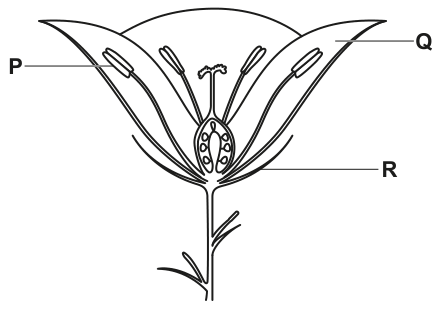
The diagram, as printed with the question.
Show full working
- 1
Six marks: one for each name and one for each function. Find each label line's end first.
Read where the line ends, not where the letter is.
- 2
P ends on the small bag at the top of a stalk inside the petals: the anther.
A bag on a thin stalk, inside the flower, is a stamen; the bag itself is the anther.
- 3
Function of P: it produces pollen (which contains the male gametes).
The mark scheme accepts "produces", "contains" or "releases" pollen, or the male gamete / male nucleus.
- 4
Q ends on the large outer part that forms the cup of the flower: a petal.
Large, forming the main shape of the flower = petal.
- 5
Function of Q: it attracts insects, or gives them a landing platform.
Either idea earns the mark. "Attracts" on its own is fine because the question says the flower is insect-pollinated.
- 6
R ends on the small part under the petals, at the base of the flower: a sepal.
Sepals are below and outside the petals.
- 7
Function of R: it protects the flower (in the bud). "Support" is also accepted.
Protection of the bud is the standard answer.
P: anther — produces pollen (male gametes). Q: petal — attracts insects / landing platform. R: sepal — protects the flower bud.
In a name-and-function table, give each function in its own words. "Petal — attracts insects" is a full mark pair.
Your turn
- 15090/12 O/N 2019 Q331 mark
Which structure contains the ovary of a flowering plant?
Options
A anther
B carpel
C ovule
D pollen grainShow solution
- 1
The carpel is the whole female part: stigma + style + ovary. So the carpel contains the ovary.
"Contains" means the bigger structure that the ovary is part of.
- 2
A is wrong: the anther is part of the male stamen.
Anthers make pollen; they contain no ovary.
- 3
C is wrong: the ovule is inside the ovary, so it cannot contain it.
The order of size is carpel > ovary > ovule.
- 4
D is wrong: a pollen grain is a tiny male structure made in the anther.
It is the wrong sex and far too small.
AnswerB
- 1
- 25090/11 O/N 2020 Q331 mark
The diagram shows a section of a flower.
Where are the male gametes made?
Options
A A
B B
C C
D D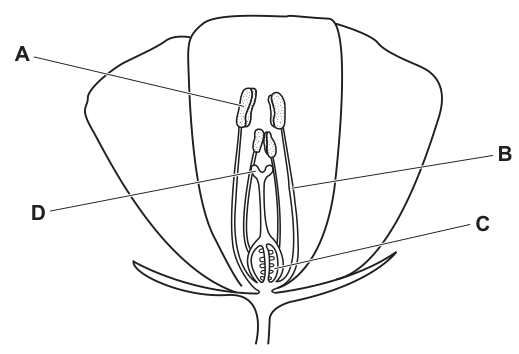
The diagram, as printed with the question.
Show solution
- 1
Male gametes are inside pollen grains, and pollen grains are made in the anther.
Turn "male gametes" into "pollen", then into "anther".
- 2
A ends on the dotted bag at the top of a stalk — an anther. So A is correct.
The dots show pollen inside the anther.
- 3
B ends on a filament (the stalk of a stamen), C on an ovule inside the ovary, D on the stigma.
The filament only holds the anther up; the ovule and stigma are female parts.
AnswerA
- 1
- 35090/21 M/J 2019 Q4(a)–(b)3 marks
The diagram shows stages in the life cycle of the same plant.
State the number of each of the following parts of the flower shown in the diagram.
petals = ______
filaments = ______On the diagram of the flower label the ovary (the structure containing ovules).
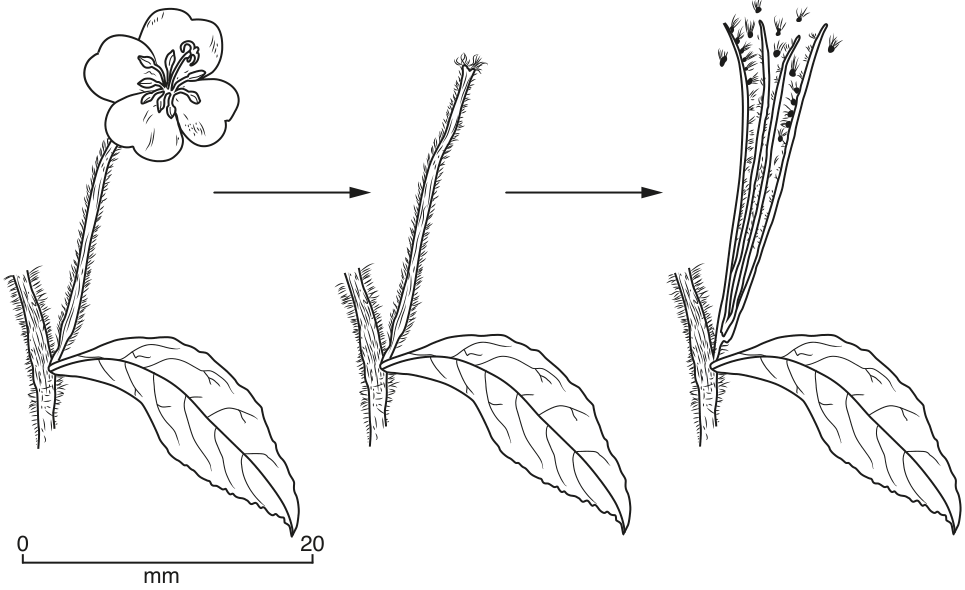
The diagram, as printed with the question.
Stuck? Show hint
Count carefully in the first drawing. For the ovary, compare the first drawing with the last one: the fruit grows from the ovary.
Show solution
- 1
Count the large, rounded parts that form the flower's shape: there are 4 petals.
Petals are the big outer parts. Count each one once.
- 2
Count the thin stalks inside the flower that carry anthers: there are 8 filaments.
Each stamen has one filament, so count the stalks with a bag at the top. Do not count the central carpel.
- 3
In this plant the ovary sits below the petals: it is the long, thin, hairy structure that runs from the base of the flower down to the leaf. It looks like a stalk, but it is the ovary. Draw a label line to it and write "ovary".
The mark scheme wants the ovary labelled between the flower and the leaf. Check with the other drawings: after the petals fall, this same structure grows into the long fruit that splits open to release the seeds — and a fruit develops from the ovary.
AnswerPetals = 4; filaments = 8. Ovary: label line to the long structure between the flower and the leaf.
- 1
- 43 marks
A student draws a half-flower. Her style is drawn as a single line, the anthers are shaded in, and her label lines stop short of the parts. Give three ways she should improve her drawing.
Show solution
- 1
Draw the style with a double line, because it is a tube with width, not a thread.
Practical mark schemes give a mark for the style drawn with a double line.
- 2
Do not shade: use clear, continuous outlines only.
"No shading anywhere" is part of the line-quality mark.
- 3
Make every label line touch the part it names, drawn with a ruler.
A label line that stops short does not show which part is meant.
AnswerDraw the style with a double line; remove the shading (clear continuous lines only); make each label line touch the part it names.
- 1
The rest of this note
Can you do all of these?
Identify and draw the sepals, petals, stamens (anther, filament) and carpel (stigma, style, ovary, ovules) of an insect-pollinated flower, and give the function of each
Identify and draw the hanging anthers and feathery stigmas of a wind-pollinated flower and explain how each helps wind pollination
Compare insect- and wind-pollinated flowers and their pollen, and decide how an unfamiliar flower is pollinated from its features
Define pollination and distinguish self-pollination (same flower or same plant) from cross-pollination (another plant of the same species)
Discuss the effects of self- and cross-pollination on a population: variation, ability to respond to environmental change, reliance on pollinators
Describe the pollen tube growing down the style, entering the ovule through the micropyle, and the male nucleus fusing with the egg cell nucleus
State that the ovule becomes the seed and the ovary becomes the fruit (and ovule wall → testa, zygote → embryo)
Name and give the function of the testa, radicle, plumule and cotyledons, and describe how to investigate the structure of a bean seed
Explain why dispersal helps (colonising new areas, less competition for a named resource) and relate wind and animal fruit features to their function
State water, oxygen and a suitable temperature as the conditions for germination, and plan and interpret an investigation with a control
Describe germination: water uptake, enzyme activation, digestion of stored food (named enzymes, substrates, products), respiration and growth by mitosis; interpret mass and starch/sugar data