The male reproductive system
“
16.4.1 Identify, on diagrams of the male reproductive system: the testes, scrotum, sperm ducts, prostate gland, urethra and penis, and describe their functions.
Sperm are made in the testes (which hang in the scrotum), travel up the sperm ducts, receive fluid from the prostate gland, and leave through the urethra in the penis.
Six structures, in the order sperm travel
A reproductive system is the group of organs that make gametes (sex cells) and bring them together. The male gametes are sperm.
| Structure | What it is | Function |
|---|---|---|
| Testes (one: testis) | Two oval organs | Make sperm (by meiosis). They also make the hormone testosterone |
| Scrotum | A sac of skin that hangs outside the body | Holds the testes outside the body, where it is slightly cooler — sperm are made best a little below body temperature |
| Sperm ducts | Two tubes, one from each testis | Carry sperm from the testes to the urethra |
| Prostate gland | A gland around the urethra, just below the bladder | Adds a fluid to the sperm. The fluid contains nutrients, and the sperm swim in it |
| Urethra | The tube running through the penis | Carries semen (sperm + fluid) out of the body. It also carries urine, but never at the same time |
| Penis | The organ containing the urethra | Places semen (sperm) into the woman's vagina during sexual intercourse |
Semen is the mixture of sperm and the fluid from the glands. Releasing semen from the penis is called ejaculation.
The pathway to learn
The sperm duct does not join the bladder. It joins the urethra, just below the bladder, where the prostate gland surrounds it. The bladder stores urine and is part of the urinary system (see Excretion), not the reproductive system. It is drawn on most diagrams only because it sits right next to the prostate gland.
The male reproductive system, side view. Sperm are made in the testis, carried up the sperm duct, mixed with fluid from the prostate gland, and leave through the urethra in the penis. The bladder is part of the urinary system and is shown only to help you find your way.
Two mix-ups that lose marks
- The prostate gland does not make sperm or testosterone. It makes the fluid the sperm swim in. Sperm and testosterone both come from the testes.
- Sperm duct or urethra? The sperm duct carries only sperm, from a testis to the urethra (there are two). The urethra carries semen or urine out through the penis (there is one).
Name the structure of the male reproductive system that does each job.
(a) makes sperm
(b) carries sperm from a testis towards the penis
(c) adds a fluid in which sperm can swim
(d) keeps the testes a little cooler than the rest of the body
(e) carries semen out of the body
Show full working
- 1
(a) Sperm are made in the testes.
The testes are the only place sperm are made. Every other structure only stores, carries or adds to them.
- 2
(b) The tube from a testis is the sperm duct.
There is one sperm duct from each testis. It leads up into the body and joins the urethra.
- 3
(c) The fluid is added by the prostate gland.
A gland makes and releases a substance. The prostate is the only gland on the syllabus list.
- 4
(d) The scrotum holds the testes outside the body, where it is cooler.
Sperm are made best slightly below normal body temperature, which is why the testes are not inside the body.
- 5
(e) Semen leaves through the urethra, which runs along the penis.
"Carries out of the body" is the urethra. The penis is the organ; the urethra is the tube inside it.
(a) testes; (b) sperm duct; (c) prostate gland; (d) scrotum; (e) urethra.
Learn each structure as a pair: name + one job. "Testis — makes sperm", "sperm duct — carries sperm", "prostate — fluid to swim in".
What is the main function of the prostate gland?
Options
A producing adrenaline
B producing testosterone
C producing a liquid in which the sperm can swim
D storing mature sperm cells
Show full working
- 1
The prostate gland adds a fluid to the sperm. The sperm swim in this fluid. So C is correct.
This is the prostate's job in the table above, almost word for word.
- 2
A is wrong: adrenaline is made by the adrenal glands (see Coordination and Control).
Adrenaline has nothing to do with reproduction. It is a distractor from the hormones chapter.
- 3
B is wrong: testosterone is made by the testes, not the prostate gland.
This is the most tempting wrong answer, because both the prostate gland and testosterone are "male".
- 4
D is wrong: the prostate gland does not store sperm. Sperm pass through the urethra next to it, but they are not kept there.
"Storing" is a job that does not belong to any structure on the syllabus list.
C
Prostate = fluid for sperm to swim in. Testes = sperm and testosterone.
What is the path taken by sperm cells during ejaculation from the male reproductive system?
Options
A sperm duct → testis → urethra
B sperm duct → urethra → testis
C testis → sperm duct → urethra
D testis → urethra → sperm duct
Show full working
- 1
Start where sperm are made: the testis. That rules out A and B, which start in the sperm duct.
A path always starts where the thing is made.
- 2
From the testis, sperm move up the sperm duct, and the sperm duct joins the urethra. So the order is testis → sperm duct → urethra: C.
The sperm duct is the only tube leaving a testis.
- 3
D is wrong: it puts the urethra before the sperm duct, and it ends in the sperm duct, which does not lead out of the body.
The last structure must be the urethra, because it is the only tube that opens to the outside.
C
Testis → sperm duct → urethra. The same question has been set in several years.
The diagram shows the human male reproductive system.
Which structure may contain sperm?
Options
A A
B B
C C
D D
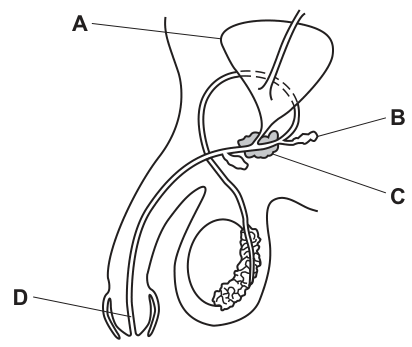
The diagram, as printed with the question.
Show full working
- 1
Sperm are found only in the testes and in the tubes they travel along: the sperm ducts and the urethra. So look for a label on one of those.
Turn "may contain sperm" into a short list of possible structures before looking at the letters.
- 2
A labels the large sac at the top: the bladder. It holds urine, not sperm.
The bladder sits at the top of a side view, with a ureter entering it from above.
- 3
B and C label the glands near the bottom of the bladder. Glands add fluid to the sperm; they are not the tubes the sperm travel in.
The grey gland wrapped around the tube just under the bladder is the prostate gland.
- 4
D labels the tube running along the inside of the penis: the urethra. Sperm pass through it during ejaculation. So D is correct.
The urethra carries semen, which contains sperm, out of the body.
D
On a side view, find the bladder first (top), then the tube leaving it (urethra), then trace back from the testis (sperm duct).
Your turn
- 12 marks
State the function of (a) the scrotum and (b) the penis.
Show solution
- 1
(a) The scrotum holds the testes outside the body, where the temperature is slightly lower.
Say where it holds the testes and why that matters: sperm are made best a little below body temperature.
- 2
(b) The penis places semen (sperm) into the vagina during sexual intercourse.
The penis contains the urethra, but its own job is to deliver the sperm into the woman's body.
Answer(a) It holds the testes outside the body, keeping them slightly cooler than body temperature, which is best for making sperm. (b) It places semen (containing sperm) into the vagina during sexual intercourse.
- 1
- 22 marks
A student writes: "Sperm are made in the prostate gland and then pass into the bladder." Correct both mistakes.
Show solution
- 1
Sperm are made in the testes, not the prostate gland. The prostate gland adds a fluid for the sperm to swim in.
Give the correct organ and say what the prostate really does.
- 2
Sperm pass along the sperm duct into the urethra, not into the bladder. The bladder stores urine.
The sperm duct joins the urethra just below the bladder.
AnswerSperm are made in the testes (the prostate gland only adds fluid). They travel along the sperm ducts into the urethra; they never enter the bladder, which stores urine.
- 1
- 35090/12 O/N 2016 Q351 mark
The diagram shows part of the male reproductive and urinary systems.
What is X?
Options
A prostate gland
B sperm duct
C ureter
D urethra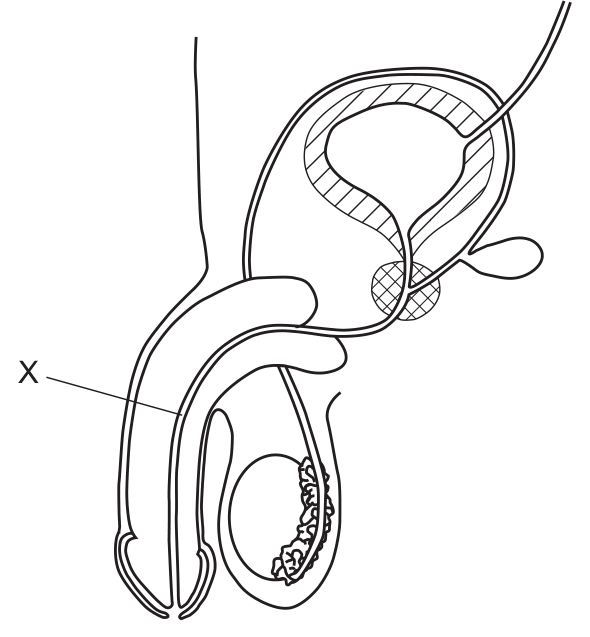
The diagram, as printed with the question.
Stuck? Show hint
Follow the tube labelled X. Where does it start and where does it end?
Show solution
- 1
X is a tube running along the length of the penis to its tip.
Look at where the label line touches, then follow the tube both ways.
- 2
The tube inside the penis that opens to the outside is the urethra. So D.
The urethra carries urine or semen out of the body.
- 3
A is wrong: the prostate gland is the round, cross-hatched gland just below the bladder. B is wrong: the sperm duct runs from the testis up into the body. C is wrong: the ureter enters the top of the bladder from the kidney.
Each wrong option is a real structure on the diagram, just in a different place.
AnswerD
- 1
The rest of this note
Can you do all of these?
Identify the testes, scrotum, sperm ducts, prostate gland, urethra and penis on a side-view diagram, and state the function of each
Identify the ovaries, oviducts, uterus, cervix and vagina on front and side views, and state the function of each
Explain how the flagellum, mitochondria and acrosome help a sperm, and how energy stores and the jelly coat help an egg
Define fertilisation as the fusion of the nuclei of a sperm and an egg, and compare sperm and eggs in size, structure, numbers and motility
State that testosterone (testes) and oestrogen (ovaries) cause and maintain the secondary sexual characteristics, and name examples of each
Describe the 28-day menstrual cycle: menstruation, repair of the lining, ovulation at about day 14, lining kept thick; find these on circles, calendars and lining graphs
Explain the jobs of FSH, LH, oestrogen and progesterone, identify each on a hormone graph, and predict their levels in pregnancy
Give the route of sperm to the oviduct, and describe fertilisation in the oviduct, mitosis to a ball of cells, and implantation in the uterus lining
State that amniotic fluid, held in the amniotic sac, protects the fetus from mechanical shock
Identify the placenta and umbilical cord, state what diffuses in each direction, compare the umbilical artery and vein, explain why the bloods do not mix, and state that some viruses (such as HIV) can cross the placenta