The structure of DNA
“
17.2.1 Describe the structure of a DNA molecule: (a) two strands coiled together to form a double helix (b) each strand is made up of a chain of nucleotides (c) each nucleotide contains a base (A, T, C, G; full names are not required) (d) bonds between pairs of bases hold the strands together (e) the bases always pair up in the same way: A with T, and C with G.
DNA is two strands coiled into a double helix. Each strand is a chain of nucleotides, and each nucleotide contains one base: A, T, C or G. Bonds between pairs of bases hold the two strands together, and the bases always pair the same way: A with T, C with G.
A quick reminder
In the Cell Division and Reproduction chapter you learned that the nucleus contains chromosomes, that each chromosome is one long molecule of DNA, and that a gene is a short length of that DNA. Now we look inside the DNA molecule itself.
Five facts about the structure of DNA
Learn these five facts in the syllabus words. Exam questions ask for them almost word for word.
- Two strands coiled together to form a double helix. A DNA molecule has two strands (not one, not four). They twist around each other like a twisted ladder. This shape is called a double helix.
- Each strand is made up of a chain of nucleotides. A nucleotide is the small unit that DNA is built from. Thousands of nucleotides join end to end to make one strand.
- Each nucleotide contains a base. There are four kinds of base, known by their letters: A, T, C and G. You do not need their full names.
- Bonds between pairs of bases hold the strands together. The bases stick out from each strand into the middle. A base on one strand bonds to a base on the other strand. These bonds are the "rungs" of the ladder.
- The bases always pair up in the same way: A with T, and C with G. A never pairs with C or G; C never pairs with A or T. This is called base pairing.
Two more facts that Paper 2 has asked for:
- DNA contains the elements carbon, hydrogen, oxygen, nitrogen and phosphorus (C, H, O, N and P).
- In animal and plant cells the DNA is in the nucleus, in long straight molecules (one per chromosome). In a bacterial cell there is no nucleus: the main DNA is a circular loop lying free in the cytoplasm.
Left: a short stretch of DNA, two strands coiled into a double helix. Right: the same stretch drawn "unwound" like a ladder. Each strand is a chain of nucleotides; each nucleotide carries one base; bonds between the paired bases hold the strands together.
Using the base-pairing rule
Because A always pairs with T, and C always pairs with G, one strand tells you the other strand exactly. The two strands are called complementary.
| Strand 1 | A | T | T | C | G | A |
|---|---|---|---|---|---|---|
| Strand 2 | T | A | A | G | C | T |
The rule also lets you count bases in a whole DNA molecule. Every A has a T partner, so in a double-stranded molecule:
- number of A = number of T
- number of C = number of G
So if you know how many A bases there are, you know how many T bases there are. And the A + T pairs plus the C + G pairs make up all the base pairs.
Worked example: complementary strand and counting bases
(a) One strand of a short piece of DNA has the base sequence A T G G C A T C. Write the base sequence of the other strand.
(b) A different DNA molecule contains 200 base pairs. 70 of the bases on one strand are A and 10 are T. How many base pairs in the molecule are A–T pairs, and how many are C–G pairs?
Show full working
- 1
(a) Take the first base, A. Its partner is T.
Work one base at a time, left to right. A always pairs with T.
- 2
Carry on: T → A, G → C, G → C, C → G, A → T, T → A, C → G.
Check each pair against the rule: A–T and C–G only. A common slip is to write the same letter again instead of its partner.
- 3
The other strand is T A C C G T A G.
The second strand has the same number of bases as the first, one partner for each.
- 4
(b) Every A on strand 1 is paired with a T on strand 2, and every T on strand 1 is paired with an A. So the A–T pairs = 70 + 10 = 80.
An A–T pair can have its A on either strand, so count both the As and the Ts on the one strand you are given.
- 5
All the other pairs must be C–G pairs: 200 − 80 = 120.
There are only two kinds of pair, so the rest of the 200 pairs are C–G.
(a) T A C C G T A G. (b) 80 A–T pairs and 120 C–G pairs.
Write the pairing rule, "A–T, C–G", at the top of your working before you start.
The nucleus of a cell contains DNA molecules that control cell function.
Fig. 6.1 is a diagram showing one of these DNA molecules.
Using information from Fig. 6.1:
(i) state the name of the structure labelled P
(ii) state the name of the unit of DNA labelled Q
(iii) state the letter of the base that pairs with G.
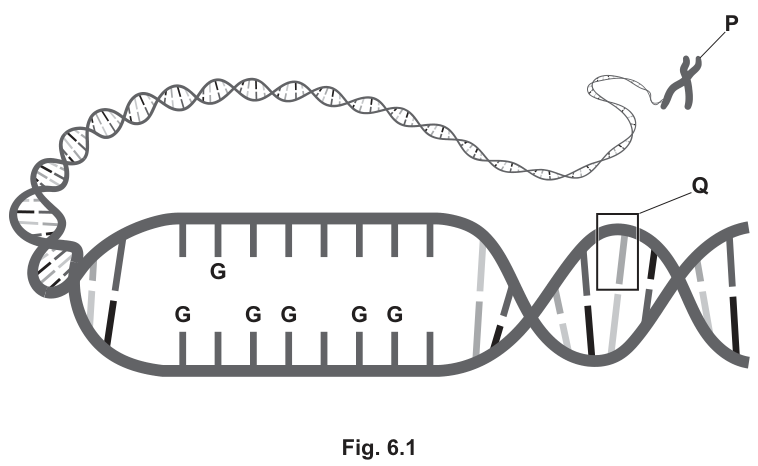
Fig. 6.1
Show full working
- 1
(i) P is the small X-shaped structure at the end of the long coiled DNA. It is a chromosome.
The diagram shows the DNA molecule uncoiling from P. A chromosome is one long DNA molecule, tightly coiled, so P is the chromosome.
- 2
(ii) Q is a box drawn around one short piece of one strand, including one base. It is a nucleotide.
A nucleotide is the unit each strand is built from, and each nucleotide contains one base. Do not write "base" (only part of Q) or "gene" (a gene is a long length of DNA).
- 3
(iii) G always pairs with C.
The pairing rule: A with T, C with G.
(i) chromosome; (ii) nucleotide; (iii) C.
"Unit of DNA" in a question means nucleotide.
"DNA is a single strand" or "DNA has four strands."
DNA has two strands coiled into a double helix.
Four is the number of different bases, not the number of strands.
"A pairs with G" or "C pairs with T."
A pairs with T; C pairs with G. Always.
Learn the pairs as two words: "AT" and "CG".
"The strands are held together by bonds between sugars."
The strands are held together by bonds between pairs of bases.
The syllabus wording is "bonds between pairs of bases hold the strands together".
"DNA is made of amino acids."
DNA is made of nucleotides. It codes for the order of amino acids in a protein.
Amino acids are the units of proteins; nucleotides are the units of DNA.
Your turn
- 11 mark
One strand of DNA has the sequence G C A A T G C T. Write the sequence of the complementary strand.
Stuck? Show hint
Swap each base for its partner: A↔T, C↔G.
Show solution
- 1
G → C, C → G, A → T, A → T.
Go one base at a time using the pairing rule.
- 2
T → A, G → C, C → G, T → A.
Keep the same order; do not reverse the strand.
AnswerC G T T A C G A
- 1
- 22 marks
In a double-stranded DNA molecule, 30% of the bases are C. What percentage of the bases are G, and what percentage are A?
Stuck? Show hint
Every C has a G partner. What is left over must be A and T, in equal amounts.
Show solution
- 1
Every C is paired with a G, so G = C = 30%.
Number of C = number of G in double-stranded DNA.
- 2
C and G together make 30% + 30% = 60% of the bases.
Add the two before working out what is left.
- 3
A and T make the other 100% − 60% = 40%.
All the bases are A, T, C or G, so the four must add up to 100%.
- 4
A = T, so A = 40% ÷ 2 = 20%.
A and T are always in equal numbers, so split the 40% equally.
AnswerG = 30%; A = 20%.
- 1
- 35090/22 M/J 2023 Q7(a)5 marks
The paragraph below describes the structure of a DNA molecule.
Complete the paragraph by writing the most appropriate word or letter in each space.
DNA contains the chemical elements carbon, hydrogen, oxygen, ______ and ______ . Two strands of DNA coil together to form a double ______ . Each strand is made up of a chain of ______ . Bonds between pairs of bases hold the strands together. These bases always pair up in the same way: T with ______ and ______ with ______ .
Show solution
- 1
The two missing elements are nitrogen and phosphorus.
DNA contains C, H, O, N and P. Carbohydrates contain only C, H and O, so N and P are what make DNA different.
- 2
Two strands coil to form a double helix.
"Double helix" is the name of the shape.
- 3
Each strand is a chain of nucleotides.
Nucleotides are the units of DNA.
- 4
T pairs with A, and C pairs with G (or G with C).
The pairing rule. The mark scheme gives the last mark for A + G + C all correct.
Answernitrogen; phosphorus; helix; nucleotides; A; C and G.
- 1
The rest of this note
Can you do all of these?
Describe DNA as two strands coiled into a double helix, each a chain of nucleotides, each nucleotide with one base (A, T, C or G), with bonds between paired bases holding the strands together
Use the pairing rule (A–T, C–G) to write a complementary strand and to count bases
Define a gene, and explain how the base sequence decides the amino-acid sequence, the shape of the protein and its function, so that DNA controls the cell (e.g. through enzymes)
Describe inheritance, define allele, and use dominant, recessive, genotype, phenotype, homozygous, heterozygous and pure-breeding correctly
Draw a full genetic diagram — phenotypes, genotypes, gametes in circles, Punnett square, offspring genotypes and phenotypes, ratio — for any monohybrid cross, and give results as a ratio, fraction, percentage or probability
Deduce the parents' genotypes from the offspring (surprise recessive child, 3 : 1, 1 : 1) and use a cross with a homozygous recessive to find an unknown genotype
Explain codominance with the ABO blood groups, list the six genotypes for the four blood groups, and solve blood-group crosses and other codominance crosses (including leaving out offspring that do not survive)
Explain why observed ratios differ from expected ratios (random fertilisation, small numbers of offspring), and turn counts into a ratio
Describe sex determination (XX, XY; the sperm decides) and multiply by 1/2 for "a boy/girl with …"
Read a family tree: decide dominant or recessive, write certain genotypes, work outwards, and find probabilities (including 2/3)
Describe variation, tell continuous from discontinuous (phenotypes, causes, examples, histogram vs bar chart), and plan an investigation of both
Describe gene mutation (sickle cell anaemia) and chromosome mutation (Down's syndrome, 47 chromosomes); read a karyotype; state that ionising radiation and some chemicals increase the mutation rate
State the four sources of genetic variation: mutation, meiosis, random mating, random fertilisation
Describe natural selection in five parts and explain how it makes a population evolve, applying it to a new context
Describe how antibiotic-resistant strains such as MRSA develop, and how to reduce the risk
Describe the four stages of artificial selection, its uses for economically important plants and animals (and how cloning and artificial insemination help), and how it differs from natural selection