Yeast: making bread and ethanol
“
18.1.1 Explain the role of yeast in the production of bread and ethanol
Yeast respires anaerobically: glucose → ethanol + carbon dioxide. Bread-making uses the carbon dioxide (the gas makes the dough rise). Ethanol production uses the ethanol (for fuel and for drinks).
What yeast is
Yeast is a single-celled fungus (kingdom Fungi). Like every living cell it respires to release energy. When there is little or no oxygen, yeast respires anaerobically:
You met this equation in the Respiration chapter. Ethanol is a type of alcohol. When a microorganism respires anaerobically and makes a useful product, the process is called fermentation.
Both products of this equation are useful, but to different industries:
- the bread industry wants the carbon dioxide;
- the ethanol industry wants the ethanol.
One reaction, two industries. Bread uses the carbon dioxide from yeast respiration; ethanol production uses the ethanol.
Making bread
- Flour, water, sugar and yeast are mixed into a dough and kneaded.
- The dough is left in a warm place for an hour or so. Warmth lets the yeast's enzymes work quickly (close to their optimum temperature), so the yeast respires quickly.
- Flour is mostly starch. Amylase digests starch into maltose, and maltase digests maltose into glucose. So there is a steady supply of sugar for the yeast.
- There is little oxygen inside the dough, so the yeast respires anaerobically. It makes carbon dioxide and ethanol.
- The carbon dioxide forms bubbles that are trapped in the dough. The bubbles make the dough rise (get bigger) and give bread its light, soft texture.
- The dough is baked. The heat makes the gas bubbles expand a little more, kills the yeast, and makes the small amount of ethanol evaporate. That is why bread contains no alcohol.
The yeast does not make the dough bigger by growing or reproducing. The cells are far too small for that. Only the gas makes the dough rise.
Making ethanol (for fuel and for drinks)
- Plants such as sugar cane or maize are grown. Sugar cane stores sugar. Maize stores starch, which is first broken down into sugar by amylase.
- The sugar is dissolved in water and yeast is added in large tanks.
- The tanks are kept without oxygen, so the yeast respires anaerobically and makes ethanol (and carbon dioxide).
- The ethanol is separated from the mixture (by distillation) and used as a biofuel, a fuel made from living material. It can replace petrol in cars.
The same fermentation makes beer and wine. There the ethanol stays in the drink. Wild yeast lives naturally on the skins of fruit such as grapes, where it feeds on the sugars from the fruit.
Why must there be no oxygen? With oxygen, yeast respires aerobically (glucose + oxygen → carbon dioxide + water). Aerobic respiration makes no ethanol, so the product would be lost.
| Bread-making | Ethanol production | |
|---|---|---|
| Organism | Yeast (a fungus) | Yeast (a fungus) |
| Process | Anaerobic respiration (fermentation) | Anaerobic respiration (fermentation) |
| Useful product | Carbon dioxide: makes the dough rise | Ethanol: biofuel, beer, wine |
| What happens to the other product | Ethanol evaporates during baking | Carbon dioxide escapes as gas |
"The yeast grows and reproduces, which makes the bread bigger."
The yeast respires and makes carbon dioxide gas; the gas bubbles make the dough rise.
This is a favourite wrong option in multiple-choice questions.
"Yeast is a bacterium."
Yeast is a single-celled fungus.
Questions ask for the group (kingdom) as well as the name.
"Ethanol is made by aerobic respiration."
Ethanol is only made by anaerobic respiration (fermentation). Aerobic respiration gives carbon dioxide and water.
"To carry out aerobic respiration of sugar" is a wrong option for the role of yeast in making beer and wine.
Worked example: dough at different temperatures
A student makes one batch of bread dough. She puts equal masses of it into four measuring cylinders. Each cylinder is kept at a different temperature. She reads the volume of the dough at the start and after 60 minutes.
| temperature / °C | volume at start / cm³ | volume after 60 minutes / cm³ |
|---|---|---|
| 5 | 50 | 52 |
| 20 | 50 | 70 |
| 35 | 50 | 95 |
| 60 | 50 | 50 |
(a) Name the gas that makes the dough rise and the process that makes it.
(b) Explain the results at 5 °C, 35 °C and 60 °C.
(c) State two variables the student kept the same.
Show full working
- 1
(a) The gas is carbon dioxide. It is made by anaerobic respiration (fermentation) by the yeast.
Name both the gas and the process. 'Respiration' alone is weaker than 'anaerobic respiration'.
- 2
(b) At 5 °C the dough rose by only 52 − 50 = 2 cm³. The yeast's enzymes work very slowly in the cold, so respiration is slow and little carbon dioxide is made.
Quote the change from the table, then link temperature → enzymes → respiration → gas.
- 3
At 35 °C the dough rose by 95 − 50 = 45 cm³, the most. This is close to the optimum temperature of the yeast's enzymes, so respiration is fastest and most carbon dioxide is made.
The biggest rise shows the fastest rate of respiration.
- 4
At 60 °C the dough did not rise at all (0 cm³). The yeast's enzymes are denatured (their active sites change shape) and the yeast is killed, so no respiration happens and no carbon dioxide is made.
Use the word denatured, and say that the active site changes shape. Do not say the enzymes are 'killed'; enzymes are not alive.
- 5
(c) She kept the same: the mass of dough in each cylinder, and the time (60 minutes). The dough also came from one batch, so the amounts of yeast, sugar and flour were the same.
A fair test changes only the temperature. Everything else stays the same.
(a) Carbon dioxide, made by anaerobic respiration (fermentation) by yeast. (b) 5 °C: enzymes slow, little respiration, little carbon dioxide (rose 2 cm³). 35 °C: near the optimum, fastest respiration, most carbon dioxide (rose 45 cm³). 60 °C: enzymes denatured and yeast killed, no carbon dioxide (no rise). (c) Mass of dough, time, and amounts of yeast, sugar and flour (one batch).
For any yeast experiment, the chain is: temperature → enzymes → rate of respiration → volume of carbon dioxide.
(a) Explain the importance of the production of carbon dioxide in bread-making.
(b) The diagram shows a flow chart for some of the chemical reactions that occur during bread-making.
where is labelled G, and is labelled H.
Name the processes occurring at G and H.
(c) Explain what is causing the changes at G.
Show full working
- 1
(a) The carbon dioxide makes the dough rise and gives the bread its light texture.
1 mark: 'rise' or 'texture'. Say what the gas does to the dough, not only that it is made.
- 2
(b) G breaks large molecules (starch) into smaller ones (maltose, then glucose). This is digestion.
Starch → maltose → glucose is the same breakdown that happens in your gut. 1 mark: digestion.
- 3
H turns glucose into carbon dioxide and ethanol. This is anaerobic respiration.
2 marks: one for 'respiration' and one for 'anaerobic'. Ethanol in the products tells you it is anaerobic.
- 4
(c) The enzyme amylase digests starch into maltose.
Name the enzyme AND the change it makes. The mark scheme links the two.
- 5
The enzyme maltase digests maltose into glucose.
A second enzyme for the second step. Any three of the four points (two enzymes, two changes) score 3 marks.
(a) The carbon dioxide makes the dough rise / gives it a light texture. (b) G = digestion; H = anaerobic respiration. (c) Amylase breaks starch down to maltose; maltase breaks maltose down to glucose.
In bread questions, "G/H" style flow charts test two chapters at once: digestion by enzymes (Enzymes, Human Nutrition) and anaerobic respiration by yeast (Respiration).
What is the main role of yeast in the production of beers and wines?
A to carry out aerobic respiration of sugar
B to produce ethanol by fermentation
C to release bubbles of carbon dioxide
D to reduce the amount of sugar in the product
Show full working
- 1
Beer and wine are alcoholic drinks. The product the maker wants is ethanol.
Start from the product, as in the table above: which of the two products does this industry want?
- 2
Yeast makes ethanol by anaerobic respiration, which is fermentation → B.
B names both the product and the process.
- 3
A is wrong: aerobic respiration makes no ethanol. C is the role of yeast in bread, not drinks. D happens (sugar is used up), but it is not the purpose.
Each wrong option is true of something, just not of the main role here.
B
Bread → carbon dioxide. Beer, wine, biofuel → ethanol.
Your turn
- 15090/12 O/N 2025 Q351 mark
Bread is made from a mixture of flour, sugar, water and yeast.
The mixture is left in a warm place to allow it to rise before being baked.
Which process makes the bread rise?
A The yeast feeds on the flour and grows.
B The yeast reproduces to make the loaf bigger.
C The yeast uses sugar to respire and produces carbon dioxide.
D The yeast produces alcohol which it excretes.Show solution
- 1
Dough rises because gas bubbles form inside it. The gas is carbon dioxide from yeast respiration → C.
Only a gas can fill the dough with bubbles.
- 2
A and B: yeast cells are far too small for their growth or reproduction to make a loaf bigger. D: ethanol (alcohol) is made, but it is not a gas and does not make the dough rise.
Rule out each wrong option with a reason.
AnswerC
- 1
- 25090/21 O/N 2025 Q6(b)2 marks
Biofuels are made from plant material or animal waste. They are used as a replacement for fossil fuels such as petrol and oil.
Alcohol (ethanol) is used as a biofuel. It can be made from plants, such as sugar cane, which grow in tropical countries such as Brazil.
Describe how a living organism can be used to convert sugar found in plants into alcohol.
Stuck? Show hint
Two marks: name the process and name the organism.
Show solution
- 1
The process is fermentation (anaerobic respiration).
1 mark: fermentation.
- 2
It is carried out by yeast, which respires the sugar without oxygen and makes ethanol.
1 mark: yeast. 'A microorganism' is too vague; name yeast.
AnswerThe sugar is fermented (anaerobic respiration) by yeast, which makes ethanol.
- 1
- 35090/12 O/N 2020 Q171 mark
The apparatus shown is used to make alcohol by anaerobic respiration.
What are P, Q and R?
P Q R A amylase starch oxygen B bacterium amino acids nitrogen C fungus glucose carbon dioxide D virus sucrose water vapour 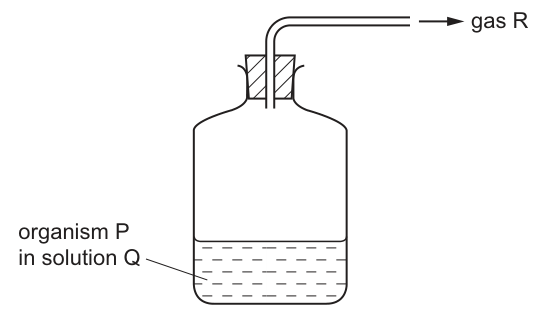
The apparatus, as printed with the question.
Show solution
- 1
Alcohol is made by yeast, which is a fungus. So P is a fungus.
Amylase is an enzyme, not an organism; bacteria and viruses do not make alcohol here.
- 2
The yeast respires glucose, so Q is glucose.
Glucose is the substrate in the respiration equation.
- 3
Anaerobic respiration in yeast gives off carbon dioxide gas, so R is carbon dioxide → C.
Oxygen (A) is not given off; nitrogen and water vapour are not products.
AnswerC
- 1
- 44 marks
A baker says: "I leave my dough by the warm oven, not in the cold kitchen, and I never let it get hot before baking." Use your knowledge of yeast to explain both parts of this advice.
Show solution
- 1
Near the warm oven the yeast's enzymes are close to their optimum temperature, so the yeast respires faster.
Link warmth to enzymes, then to the rate of respiration.
- 2
Faster anaerobic respiration makes more carbon dioxide in the same time, so the dough rises faster.
The product that matters in bread is the gas.
- 3
If the dough gets too hot, the yeast's enzymes are denatured (the active site changes shape) and the yeast is killed …
Too hot is not just 'slower'; the enzymes stop working.
- 4
… so no more carbon dioxide is made and the dough stops rising before it is baked.
Finish the chain back to the dough.
AnswerWarm: enzymes near their optimum, faster anaerobic respiration, more carbon dioxide, dough rises faster. Too hot: enzymes denatured and yeast killed, so no carbon dioxide and the dough stops rising.
- 1
The rest of this note
Can you do all of these?
Explain the role of yeast in bread (anaerobic respiration makes carbon dioxide, which makes the dough rise; baking kills the yeast and evaporates the ethanol) and in ethanol production (yeast ferments plant sugar without oxygen; ethanol used as a biofuel)
Give the four reasons bacteria are useful: rapid reproduction rate, ability to make complex molecules, no ethical concerns, presence of plasmids; explain what a plasmid is and why it is useful
Describe a fermenter and explain how each feature controls temperature, pH, oxygen, nutrient supply and waste products; explain why the contents are sterilised, stirred and cooled
Read fermenter graphs: identify the nutrient, organism and product curves; find the steepest part; calculate percentage increase or decrease using the starting value; compare two curves with figures
Name the enzymes in biological washing powders and what they digest; explain why they work at low temperatures and stop working when too hot; plan an investigation with egg-white cubes or stains
Explain how pectinase increases the volume and clarity of fruit juice, and how lactase makes lactose-free milk (lactose → glucose + galactose); explain the role of a control and of a boiled-enzyme control
Define genetic modification (removing, changing or inserting individual genes) and outline the stages of inserting a gene using a plasmid as a vector; compare it with selective breeding
Put the stages of insulin production by GM bacteria in order, and give its advantages (identical to human insulin, fewer side effects than animal insulin, large amounts, cheaper); know that the patient's DNA is not changed
Outline how GM crops are made resistant to herbicides and insect pests or given extra vitamins, and explain how this can increase yield or nutrition
Discuss advantages and risks of GM crops and bacteria, and tell an advantage from a risk in a list