Populations, communities, ecosystems and biodiversity
“
19.3.1 Describe a population as a group of organisms of one species, living in the same area, at the same time. 19.3.2 Describe a community as all of the populations of different species in an ecosystem. 19.3.3 Describe an ecosystem as a unit containing the community of organisms and their environment, interacting together. 19.3.4 Describe biodiversity as the number of different species that live in an area.
A population is one species; a community is all the populations of different species; an ecosystem is the community plus its non-living environment, interacting together. Biodiversity is not a group of organisms but a number: the number of different species in an area.
Four words, from small to large
Each word is a bigger group than the one before. Learn the syllabus wording — exams put all four side by side as options.
A species is one kind of organism (see the Classification chapter).
| Term | Description to learn | Key words that earn the marks |
|---|---|---|
| Population | A group of organisms of one species, living in the same area, at the same time | one species · same area · same time |
| Community | All of the populations of different species in an ecosystem | all the populations · different species |
| Ecosystem | A unit containing the community of organisms and their environment, interacting together | living (community) + non-living (environment) + interacting |
| Biodiversity | The number of different species that live in an area | number · different species · area |
- Population. Frogs of one species in a pond this year. A different frog species there is a second population.
- Ecosystem. The community plus the non-living environment (water, soil, air, light, temperature), affecting each other: plants take carbon dioxide and water from it; dead organisms decay and return minerals to the soil.
- Biodiversity. Count the species, not the individuals. A wheat field with a million wheat plants has low biodiversity; a rainforest with thousands of species has high biodiversity.
A habitat is only the place where an organism lives.
One pond at each level: frogs of one species = a population; lilies, fish, snails and frogs = the community; community + water, light, temperature and mud = the ecosystem. Four species, so biodiversity = 4.
Telling the four words apart
- A number of species rather than a group of organisms? → biodiversity.
- Includes non-living things (the environment)? → ecosystem.
- Only one species? → population. Many species, living things only → community.
What raises or lowers biodiversity
Anything that removes species or destroys the places they live lowers biodiversity; anything that lets many species survive and return raises it.
| Lowers biodiversity | Raises (or keeps) biodiversity |
|---|---|
| Clearing a forest, or replacing it with one crop (a plantation or monoculture) | Protecting an area so species can live and breed there |
| Building houses, roads and factories on natural land | Stopping or limiting fishing, hunting or logging for some years |
| Pollution of air or water | Replanting land with many native species |
| Fishing methods that damage the seabed; over-fishing and over-hunting | Stopping pollution such as raw sewage reaching the sea |
More individuals of one species does not raise biodiversity — a bigger herd of cows is still one species. Harsh places such as deserts have low biodiversity naturally.
These human effects are taught in detail in "Deforestation", "Over-harvesting and non-native species" and "Conservation and sustainable resources".
A small woodland contains 60 oak trees, 400 bluebell plants, 25 squirrels and 3 owls (nothing else lives there). Soil, rain and light are also present.
(a) Describe the population of squirrels using the key words of the definition.
(b) What makes up the community?
(c) What makes up the ecosystem?
(d) State the biodiversity of the woodland.
Show full working
- 1
(a) The population is the 25 squirrels — one species, living in this woodland, at this time.
"Same area" and "same time" are the words students leave out.
- 2
(b) The community is all four populations: the oaks, the bluebells, the squirrels and the owls.
A community is living things only, so soil, rain and light are not part of it.
- 3
(c) The ecosystem is the community of oaks, bluebells, squirrels and owls together with the soil, rain and light, all interacting.
Only the ecosystem includes non-living parts.
- 4
(d) Count the species: oak, bluebell, squirrel, owl. Biodiversity = 4 species.
Count species, not individuals.
(a) The 25 squirrels — one species, same area, same time. (b) Oaks + bluebells + squirrels + owls. (c) That community plus the soil, rain and light, interacting. (d) 4 species.
Mangrove trees grow in forests that form an important coastal ecosystem.
Mangrove forests have a high biodiversity, with many different animal species found in them.
Describe what is meant by each of the following terms.
(i) ecosystem
(ii) biodiversity
Show full working
- 1
(i) 2 marks: three ideas score 2, any two score 1. Give all three.
"Organisms and their environment" alone loses a mark for missing "interacting".
- 2
Idea 1: the living part — the community of organisms (producers and consumers).
"Organisms" or "community" is accepted; a single species or population is ignored.
- 3
Idea 2: the non-living part — the environment (for example water, soil, climate).
"Abiotic factors" or "environment" is accepted; "habitat" alone, or one named factor, is ignored.
- 4
Idea 3: the two are interacting (affecting each other, working together).
This is the word most often missed.
- 5
(ii) 1 mark: the number of different species in an area.
All three are needed ("ecosystem" or "habitat" is accepted for area; "population" for species is ignored).
(i) An ecosystem is a unit of living organisms (the community) and their non-living environment, interacting together. (ii) Biodiversity is the number of different species that live in an area.
"An ecosystem is where an organism lives."
An ecosystem is the community of organisms and their non-living environment, interacting together.
"Where an organism lives" is a habitat. The mark scheme ignores "habitat" for ecosystem.
"Biodiversity is the number of organisms in an area."
Biodiversity is the number of different species in an area.
The mark scheme needs the word "species"; "population" is ignored.
Your turn
- 14 marks
A coral reef contains 12 species of coral, 80 species of fish, many species of algae, seawater, sand and sunlight. State which of the terms population, community, ecosystem or biodiversity describes each of the following.
(a) all the parrotfish of one species on the reef this year
(b) the corals, fish and algae together
(c) the corals, fish and algae together with the seawater, sand and sunlight
(d) "more than 90 species live on this reef"Show solution
- 1
(a) One species, same area, same time → population.
"Of one species" signals a population.
- 2
(b) Many species, living things only → community.
No non-living parts are listed.
- 3
(c) The living community plus the non-living seawater, sand and sunlight → ecosystem.
Only an ecosystem includes the environment.
- 4
(d) A number of different species → biodiversity.
A count of species is biodiversity.
Answer(a) population; (b) community; (c) ecosystem; (d) biodiversity.
- 1
- 25090/12 M/J 2023 Q391 mark
Which change would lead to an increase in biodiversity in an area?
Options
A building a large number of blocks of family dwellings in a city
B increasing the number of cows in a pedigree herd
C replacing a forest with a large palm oil plantation
D stopping fishing in an area of sea for several yearsStuck? Show hint
Ask "does this change the number of species?"
Show solution
- 1
Ask of each option: does it add species (or let them survive), or remove them?
Only a change in the number of species matters.
- 2
A is wrong: building covers natural land, destroying habitats, so species are lost.
Buildings replace the places where many species lived.
- 3
B is wrong: more cows is more individuals of one species — the number of species does not change.
More organisms is not more species.
- 4
C is wrong: a forest with many species is replaced by one crop species, so biodiversity falls sharply.
A one-crop plantation (monoculture) has very low biodiversity.
- 5
D is correct: with no fishing for several years, fish populations recover and species that had become rare can return, so the number of species increases.
Stopping a harmful activity lets species survive and breed.
AnswerD
- 1
- 35090/21 M/J 2023 Q2(a)(iii)2 marks
Meerkats are small mammals that live in deserts which are dry and open habitats. Deserts are very hot during the day but cold at night.
Fig. 2.1 shows part of a food web from a desert.
Suggest and explain why deserts usually have low biodiversity.
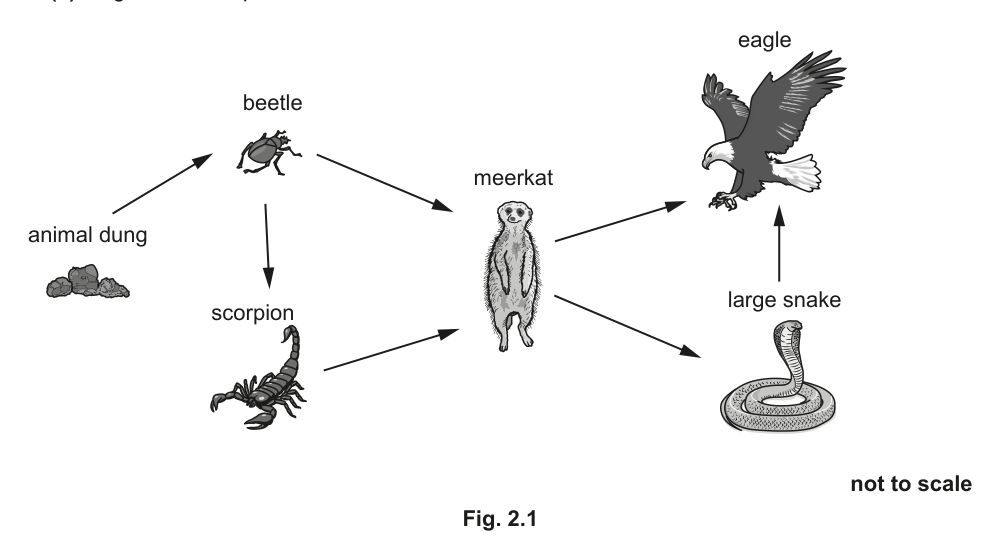
Fig. 2.1
Stuck? Show hint
Use the conditions in the stem, and what they do to the producers.
Show solution
- 1
Deserts are dry and very hot — harsh conditions that few species can survive.
One mark is for the harsh conditions given in the stem.
- 2
So there are few plants (producers) — low numbers or low mass of plants.
Few producers means little food, so few animal species.
- 3
Plants and animals find it difficult to gain enough water (or to avoid losing too much water).
Any two ideas score the 2 marks; soil nutrient points are ignored.
AnswerDeserts are dry and very hot (harsh conditions), so few plants/producers can grow, and organisms find it difficult to get enough water — so only a few species can live there.
- 1
The rest of this note
Can you do all of these?
Describe a population, a community, an ecosystem and biodiversity in the syllabus words, and say whether a change raises or lowers biodiversity
State that the Sun is the principal energy source, and explain why most life depends on photosynthesis
Define producer, consumer, herbivore, carnivore, decomposer and trophic level
Construct a food chain and a food web with arrows from the eaten to the eater, count the food chains in a web, and find organisms at more than one trophic level
Predict a population change after one organism in a web is removed or increases, giving the direction and the reason
Describe energy flow from light, through organisms, to heat in the environment, and explain why it is non-cyclic
Name the ways energy is lost between trophic levels (heat from respiration, egestion, excretion, parts not eaten), and state that photosynthesis is not a loss
Calculate a percentage energy or biomass transfer, and work forwards from a given percentage
Explain why food chains usually have fewer than five trophic levels, and why eating crops is more energy efficient than eating livestock
Construct a pyramid of numbers, biomass or energy, and match a food chain with a large producer or parasites to the right shapes
Outline how fungi and bacteria decompose dead matter, state the conditions that speed up decay, and describe a decay investigation
Name every arrow on a carbon-cycle diagram, and explain seasonal changes in carbon dioxide using photosynthesis and respiration
Name every process on a nitrogen-cycle diagram and say which need bacteria and which do not
State the four factors affecting the rate of population growth and the direction each one changes it; explain a predator–prey graph
Explain how human population growth increases the demand for resources, and calculate repeated doubling
Explain the greenhouse effect, name the sources of carbon dioxide and methane, and give the chain to global warming and its likely effects
Outline the causes of deforestation and explain its effects on biodiversity, extinction, soil, flooding and atmospheric carbon dioxide
Describe the six links of eutrophication in order, and read oxygen and bacteria graphs downstream of a sewage outflow
Explain the harmful effects of insecticides (including bioaccumulation), herbicides and non-biodegradable plastics
Describe the impacts of over-harvesting and of introducing a non-native species
Give reasons for conservation, state the description of a sustainable resource, and explain how each forest and fish conservation method works