Tropisms: growing towards or away from light and gravity
“
15.1.1 Describe gravitropism as a response in which parts of a plant grow towards or away from gravity. 15.1.2 Describe phototropism as a response in which parts of a plant grow towards or away from light.
Phototropism is a response in which parts of a plant grow towards or away from light; gravitropism is a response in which parts of a plant grow towards or away from gravity. Growing towards the stimulus is "positive", growing away is "negative": shoots show positive phototropism and negative gravitropism; roots show positive gravitropism.
Plants respond by growing
A stimulus is a change in the surroundings that a living thing can detect, such as light or gravity. A response is what the living thing does because of it.
An animal can respond by moving its whole body. A plant cannot walk towards the light. Instead, a part of the plant grows in a new direction. Growing takes time, so a plant's response is slow: it takes hours or days to see a shoot bend.
Two of these growth responses are named in the syllabus. The first part of each name tells you the stimulus:
| Name | Stimulus | Definition (learn the syllabus wording) |
|---|---|---|
| Phototropism | light ("photo" = light) | a response in which parts of a plant grow towards or away from light |
| Gravitropism | gravity ("gravi" = gravity) | a response in which parts of a plant grow towards or away from gravity |
A response of this kind — growth towards or away from a stimulus that comes from one direction — is called a tropism (plural tropisms). A response that is "tropic" is a growth response.
Positive and negative
The name alone does not say which way the part grows. We add a word for the direction:
- Positive — the part grows towards the stimulus.
- Negative — the part grows away from the stimulus.
So the full answer always has two pieces: the direction word and the stimulus word. For example, "positive phototropism" means "growing towards light".
| Part of the plant | Response to light | Response to gravity |
|---|---|---|
| Shoot (stem) | grows towards light: positive phototropism | grows up, away from gravity: negative gravitropism |
| Root | — | grows down, towards gravity: positive gravitropism |
Roots grow in the dark soil, so the response of roots that is examined is the response to gravity. (Some roots grow away from light, but questions about roots test gravitropism.)
Gravity always pulls downwards. So "grows down" means towards gravity, and "grows up" means away from gravity.
Left: light from one side — the shoot grows towards the light. Right: a seedling laid on its side in the dark — the shoot curves up and the root curves down.
Why these responses help the plant
Each response puts a part of the plant where it can do its job.
- Shoot towards light (positive phototropism). The leaves get more light, so they can carry out more photosynthesis and make more food.
- Shoot up, away from gravity (negative gravitropism). A seed germinates in the dark, under the soil. The shoot cannot "see" light yet, but by growing upwards it reaches the surface and the light.
- Root down, towards gravity (positive gravitropism). The root grows into the soil. There it anchors the plant and absorbs water and mineral ions — for example magnesium ions (needed to make chlorophyll) and nitrate ions (needed to make amino acids and proteins).
Two traps
- Describe the direction, not just the name. "The root shows gravitropism" is only half an answer. Write "the root grows towards gravity — positive gravitropism".
- Check the stimulus in the question. A plant kept in the dark cannot be responding to light. Any bending it does must be a response to gravity.
Naming four responses
Name the response in each case. Include "positive" or "negative".
(a) A seedling on a windowsill: its shoot bends towards the window.
(b) A bean seedling is laid on its side: its root turns and grows downwards.
(c) A potted plant falls over in a dark cupboard: a few days later its shoot has curved upwards.
(d) A seed germinates 3 cm below the surface of the soil: its shoot grows upwards through the soil.
Show full working
- 1
For each case ask two questions: what is the stimulus (light or gravity)? And does the part grow towards it or away from it?
The stimulus gives the name (photo- or gravi-); the direction gives "positive" or "negative". Answering both questions stops you writing only half an answer.
- 2
(a) Stimulus: light, from the window. The shoot grows towards it → positive phototropism.
Light from one side is the clue for phototropism.
- 3
(b) Stimulus: gravity (it pulls down). The root grows down, towards gravity → positive gravitropism.
"Downwards" always means towards gravity.
- 4
(c) The cupboard is dark, so light cannot be the stimulus. It is gravity. The shoot grows up, away from gravity → negative gravitropism.
This is the common trap: students see a shoot bending and write "phototropism". In the dark, it must be gravity.
- 5
(d) Under the soil there is no light, so again the stimulus is gravity. The shoot grows up, away from gravity → negative gravitropism.
This response is what lets a buried shoot reach the light.
(a) positive phototropism; (b) positive gravitropism; (c) negative gravitropism; (d) negative gravitropism.
Stimulus first (light or gravity), then direction (towards = positive, away = negative).
What is a correct example of phototropism?
Options
A A stem grows away from gravity.
B A root grows towards light.
C A root grows towards gravity.
D A stem grows towards light.
Show full working
- 1
Phototropism is a growth response to light. So the answer must name light as the stimulus. That rules out A and C, which are about gravity.
Check the stimulus first — it removes two options at once.
- 2
A is wrong: a stem growing away from gravity is negative gravitropism.
The stimulus is gravity, not light.
- 3
C is wrong: a root growing towards gravity is positive gravitropism.
Again the stimulus is gravity.
- 4
B is wrong: roots do not grow towards light. The response of roots is to gravity.
B names the right stimulus but describes something roots do not do.
- 5
D is correct: a stem (shoot) growing towards light is positive phototropism.
The right stimulus, and a response that really happens.
D
Photo- = light; gravi- = gravity. Match the stimulus to the name before thinking about direction.
The diagram shows a plant grown on its side without light.
Which row explains the responses shown by the roots and the shoot?
| roots | shoot | |
|---|---|---|
| A | positive gravitropism | positive phototropism |
| B | negative phototropism | positive phototropism |
| C | positive gravitropism | negative gravitropism |
| D | negative gravitropism | positive gravitropism |
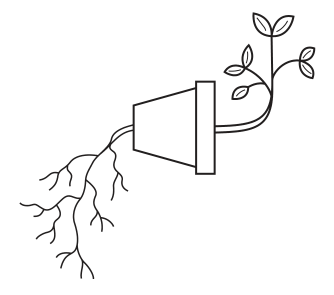
The diagram, as printed with the question.
Show full working
- 1
The plant was grown without light. So neither response can be phototropism. That rules out A and B, which both name phototropism.
No light means light cannot be the stimulus.
- 2
Roots: in the diagram the roots have grown downwards, towards gravity → positive gravitropism.
Read the direction of growth from the diagram: the roots point down.
- 3
Shoot: the pot is on its side, but the shoot has turned and grown upwards, away from gravity → negative gravitropism.
Growing up means growing away from gravity.
- 4
D is wrong: it has both directions reversed. Roots growing down is positive, not negative, and the shoot growing up is negative, not positive.
Towards gravity = positive; away from gravity = negative.
C
"Without light" or "in the dark" in a question means every response you see is gravitropism.
A pea seed is planted in a pot containing soil and provided with the ideal conditions for germination. The pot is left in a dark room for 10 days.
Fig. 1.1 shows the appearance of the germinating seed on different days.
Fig. 1.1 shows that after 10 days the structures labelled X and Y have developed from parts of the seed.
The seed is germinating in darkness.
Explain what causes X and Y to grow in opposite directions.
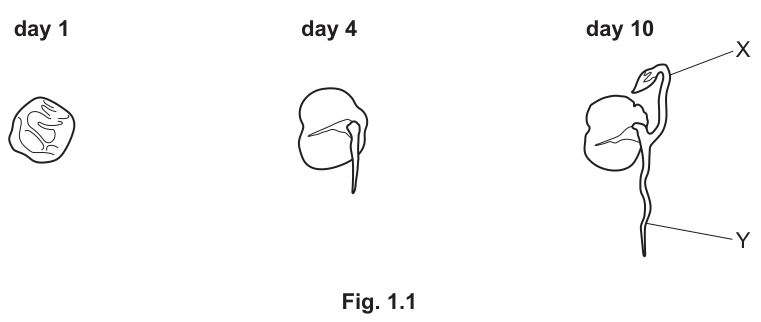
Fig. 1.1
Show full working
- 1
First identify X and Y from Fig. 1.1. X grows up from the seed: it is the young shoot (the plumule). Y grows down: it is the young root (the radicle).
You must say which structure does what, so name them first.
- 2
The seed is in darkness, so the stimulus cannot be light. Both structures are responding to gravity.
"Darkness" in the question is the clue that rules out phototropism.
- 3
X (the shoot) grows away from gravity: this is negative gravitropism.
One mark: the shoot and its response.
- 4
Y (the root) grows towards gravity: this is positive gravitropism.
One mark: the root and its response. The two opposite responses to the same stimulus explain the opposite directions.
X is the shoot (plumule); it shows negative gravitropism — it grows against / away from gravity. Y is the root (radicle); it shows positive gravitropism — it grows towards gravity.
Same stimulus, opposite responses: the shoot and the root both respond to gravity, but in opposite directions.
Compare each of these processes:
phototropism and gravitropism.
Show full working
- 1
"Compare" means give similarities and differences. Four marks means four points; plan two of each.
A list of facts about only one of the two processes cannot earn "compare" marks.
- 2
Similarity 1: both are growth responses of a plant.
Both are tropisms — the plant responds by growing, not by moving.
- 3
Similarity 2: in both, part of the plant grows towards or away from the stimulus.
Both can be positive or negative.
- 4
Difference 1: in phototropism the stimulus is light.
The stimulus is what makes them different.
- 5
Difference 2: in gravitropism the stimulus is gravity.
State both stimuli: each earns its own mark.
Both are plant growth responses; in both, part of the plant grows towards or away from the stimulus. In phototropism the stimulus is light; in gravitropism the stimulus is gravity.
For "compare", write "both…" sentences for similarities and "…whereas…" sentences for differences.
Quick check
- 12 marks
Describe phototropism and gravitropism, using the syllabus wording.
Show solution
- 1
Phototropism: a response in which parts of a plant grow towards or away from light.
Name the stimulus and say "grow towards or away from".
- 2
Gravitropism: a response in which parts of a plant grow towards or away from gravity.
Same wording, different stimulus.
AnswerPhototropism is a response in which parts of a plant grow towards or away from light. Gravitropism is a response in which parts of a plant grow towards or away from gravity.
- 1
- 23 marks
Copy and complete the table.
Part and direction of growth Name of response shoot grows towards light shoot grows upwards in the dark root grows downwards Show solution
- 1
Shoot towards light: stimulus light, towards → positive phototropism.
Towards = positive.
- 2
Shoot upwards in the dark: no light, so the stimulus is gravity; up = away from gravity → negative gravitropism.
"In the dark" rules out phototropism.
- 3
Root downwards: towards gravity → positive gravitropism.
Down = towards gravity.
AnswerPositive phototropism; negative gravitropism; positive gravitropism.
- 1
- 32 marks
Explain how negative gravitropism helps a seedling that has germinated under the soil.
Stuck? Show hint
Where is the light for a buried seed?
Show solution
- 1
Negative gravitropism makes the shoot grow upwards, away from gravity, even in the dark soil.
Under the soil there is no light to respond to, so gravity is the only guide.
- 2
So the shoot reaches the soil surface and the light, and its leaves can start to photosynthesise.
Link the response to the job the shoot must do.
AnswerThe shoot grows upwards, away from gravity, even in darkness, so it reaches the surface and light, where its leaves can photosynthesise.
- 1
- 45090/22 M/J 2023 Q5(b)(i)–(ii)6 marks
Fig. 5.1 is a photomicrograph of the centre of a plant root.
(i) Name the type of response shown by a plant root when it grows down into soil after the seed has germinated.
(ii) Explain how this response shown by the plant root is necessary for the leaves to grow and to appear green.
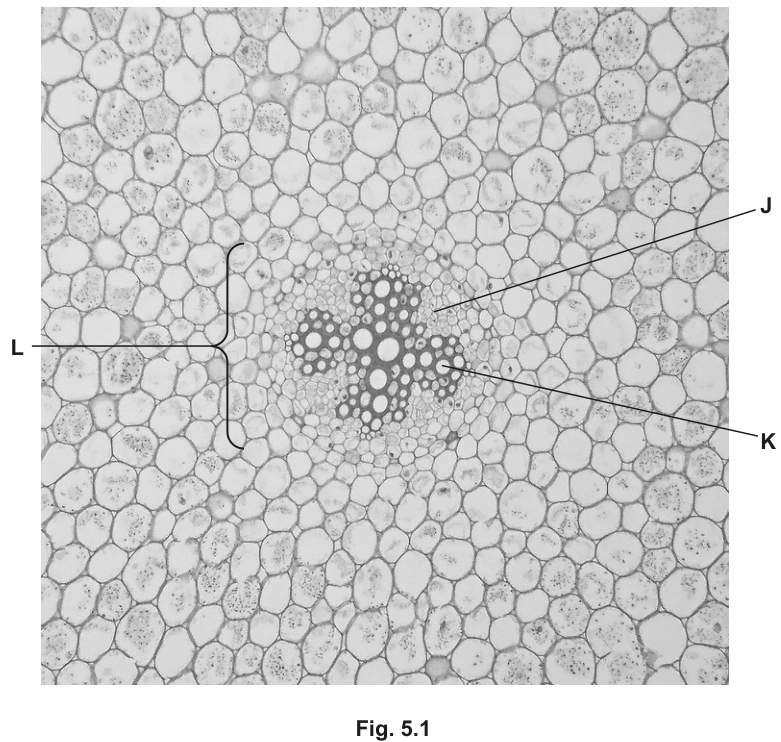
Fig. 5.1
Stuck? Show hint
What does a root take in from the soil? Which two mineral ions do leaves need to grow and to be green? (See Plant Nutrition.)
Show solution
- 1
(i) The root grows down, towards gravity, so the response is positive gravitropism.
Two marks: one for "gravitropism", one for "positive". Writing only "gravitropism" earns one mark.
- 2
(ii) Growing down takes the root into the soil, where it absorbs water.
First mark: water uptake.
- 3
It also absorbs mineral ions from the soil.
Second mark: ions / minerals.
- 4
Water is needed for photosynthesis and for the leaf cells to take in water and elongate (grow).
This links the root's water uptake to leaf growth.
- 5
Magnesium ions are needed to make chlorophyll, so the leaves appear green; nitrate ions are needed to make amino acids / proteins for growth.
Naming the ion and what it makes earns the marks for "green" and "grow". Any four of these six points gain the four marks for (ii).
Answer(i) Positive gravitropism. (ii) Growing down lets the root absorb water and mineral ions from the soil. Water is used in photosynthesis and for cell elongation. Magnesium ions are used to make chlorophyll (green leaves); nitrate ions are used to make amino acids and proteins (growth).
- 1
The rest of this note
Can you do all of these?
Describe phototropism and gravitropism in the syllabus words: parts of a plant grow towards or away from light / gravity
Name any response with its direction word: shoots show positive phototropism and negative gravitropism; roots show positive gravitropism
Explain how each response helps the plant (more light for photosynthesis; the root reaches water and mineral ions)
State the auxin facts: made in the shoot tip, spreads down through the plant from the tip, stimulates cell elongation (not division)
Explain positive phototropism in six links: made in tip → spreads down → more auxin on the shaded side → stimulates elongation → shaded-side cells elongate more → bends towards the light
Explain negative gravitropism in a shoot: more auxin on the lower side, so the lower side elongates more and the shoot curves upwards
Explain cell elongation (water enters the vacuole by osmosis), and compare phototropism with gravitropism, and plant coordination (auxin, slow growth) with the human pupil reflex (nerves, fast muscle action)
Predict the result of shoot-tip treatments (opaque or clear caps, collars, cut tips, permeable and impermeable barriers, tips or agar blocks on one side in the dark) and interpret agar-block auxin readings
Plan phototropism and gravitropism investigations: independent, dependent and controlled variables; a control (light from above, clinostat); darkness for gravity experiments; repeats, means and anomalies