Identifying the forces acting
“
identify the forces acting in a given situation (e.g. by drawing a force diagram).
Before any equation, a Mechanics question asks one thing: what is actually pushing, pulling or resisting here? Get that list right and the rest of the topic is arithmetic; get it wrong — miss a friction force, invent one that is not there — and every later mark is lost too, because it all substitutes into the same diagram.
The syllabus makes one modelling choice that simplifies every diagram you will ever draw: extended bodies are treated as particles. However large or oddly-shaped the "block" or "crate" in a question, every force on it is drawn acting at a single point, not spread across its surface. That is why every force diagram in this note is a handful of arrows radiating from one dot.
Words the questions use
Mechanics questions use a small set of words with exact meanings. Learn them now; each one tells you something about the forces.
- Particle — an object treated as a single point, so all its forces act at that point.
- Magnitude — the size of a force, ignoring its direction (e.g. ).
- Light (string, rod or pulley) — its mass is ignored, so it has no weight to draw.
- Inextensible (string) — it does not stretch.
- Taut — pulled tight, so it has a tension. A slack string has no tension.
- Smooth — no friction at all. Rough — friction can act.
- Coplanar — all the forces lie in one flat plane, so two directions (e.g. horizontal and vertical) are enough to describe them.
- Line of greatest slope — the steepest straight line down an inclined plane, the way a ball would roll straight down it. "Along the plane" in this note means along this line.
- At rest / in equilibrium — the forces balance (§03). Limiting equilibrium, "on the point of slipping", "about to slide" — balanced, but only just: friction is at its maximum (§06).
Force | Symbol | Always acts… | Present when… |
|---|---|---|---|
Weight | vertically downward, through the particle | always — every object with mass has one | |
Normal reaction | (or ) | perpendicular to the surface, pushing away from it | the object touches a surface (it can only push, never pull) |
Tension | along the string, pulling the particle towards the string | a taut string or rod connects the particle to something | |
Thrust | (negative tension) | along the rod, pushing the particle away from the rod | a rod is compressed — unlike a string, a rigid rod can push as well as pull, and that push is called a thrust |
Friction | along the surface, opposing sliding or its tendency | the surface is rough (a smooth surface has none) | |
Applied / pulling force | as named | at whatever angle the question states | the question tells you it is there |
Six names, six rules for direction. A normal reaction that points into the surface, or a tension that points away from the string, has already lost the mark before any numbers appear.
Weight, and the value of g
Every diagram from here on needs a number for weight, so it is worth fixing now even though Newton's second law (which justifies it properly) is a later topic: for a mass of kg, and Paper 4 questions expect , exactly as the syllabus states. A block therefore has weight .
Drawing a force diagram, from scratch
A block of mass rests on a rough horizontal table. A string attached to the block is pulled at above the horizontal, and the block remains at rest. Draw and label a diagram showing all the forces acting on the block.
Show full working
The completed diagram: weight, normal reaction, tension at its stated angle, and friction opposing the pull.
- 1
Weight. The block has mass , so its weight acts vertically downward, through the block, of magnitude
Weight is drawn first because it is never in doubt — every object has exactly one, straight down, regardless of what else is going on.
- 2
Normal reaction. The block sits on a horizontal table, so the contact surface is horizontal. The normal reaction acts perpendicular to that surface — vertically upward, away from the table:
Perpendicular to the surface, not to the block or to any other force — this is the rule that changes on an inclined plane later in this section.
- 3
Tension. The question states the string pulls at above the horizontal. Tension always acts along the string, pulling the block towards wherever the string is being pulled from:
The angle is given, not derived — read it straight off the question, and check whether it is measured from the horizontal or the vertical before using it later.
- 4
Friction. The table is rough, so friction is present. The pull has a horizontal component trying to drag the block in that direction; friction opposes that tendency, so it acts horizontally, in the opposite sense to the pull's horizontal component:
Friction's direction is never guessed — it is read off from which way the object is being pushed or tends to slide, then drawn the other way.
Four forces at the block's centre: down, up, at above the horizontal, and horizontal, opposing the pull.
Count the forces before drawing: 'rough' always adds friction, a string or rod always adds a tension or thrust, and every object gets exactly one weight — no more, no fewer.
A shorter list of forces: a block sliding down a slope
A block of mass slides down a rough plane inclined at to the horizontal, starting from rest. Draw a diagram showing the forces acting on the block.
Show full working
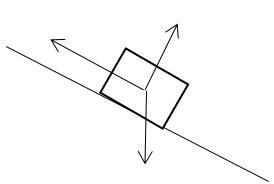
The mark scheme's own answer diagram: three forces only — no applied force was mentioned, so none is drawn.
- 1
Weight. Still vertically downward, regardless of the slope:
The incline changes where the normal reaction and friction point, but weight is always vertical — it never tilts with the slope.
- 2
Normal reaction. The surface here is the sloped plane, not the horizontal, so is perpendicular to the plane — tilted at from vertical, not standing straight up.
This is the detail that separates a flat-ground diagram from an inclined-plane one: 'perpendicular to the surface' now means perpendicular to a tilted line.
- 3
Friction. The plane is rough and the block is sliding down it, so friction opposes that motion by acting up the plane.
Friction opposes the actual motion here, since the block is already sliding — contrast this with a block merely on the point of sliding, in §06, where 'opposing the tendency to move' is the same rule applied before any motion exists.
Three forces: vertically down, perpendicular to the plane, up the plane.
No applied force was mentioned in the question, so none is drawn — never add a force the situation hasn't given you, however tempting it is to 'balance the picture'.
A "rough" surface drawn with no friction force
Rough always means friction is present (even if it turns out to be zero once solved)
Only a surface explicitly described as smooth has no friction — 'rough' is the examiner's signal to draw F.
Tension drawn pointing away from the string, out of the particle
Tension pulls the particle towards wherever the string is anchored or pulled from
A string can only pull, never push — its force on the particle is always directed along itself, towards the far end.
Two separate weight arrows drawn at different points on an extended body
One weight, acting at the single point the body is modelled as
The particle-model convention means every force — weight included — acts at one point, however large the real object is.
Friction drawn in the direction of the applied push or the direction of motion
Friction opposes that motion (or tendency), so it points the other way
Friction is a resistive force by definition — it can never assist the motion it is opposing.
Your turn
For each, list the forces before you draw — name every one, then check its direction against the rules in the table above.
- 1
A book of mass lies at rest on a horizontal table. No other forces act on it. Draw the forces acting on the book.
Stuck? Show hint
With nothing else mentioned, only the two forces every resting object on a surface has are present.
Show solution
- 1
Weight acts down: .
Weight is the one force you can always write down immediately, and it is always a number — mass times g — never left as a symbol once m is given.
- 2
The table is horizontal, so the normal reaction is perpendicular to it: acts vertically upward.
Perpendicular to the surface, and the surface here is horizontal — so on flat ground, and only on flat ground, N is exactly opposite the weight.
- 3
No friction. No horizontal force acts on the book at all, so even if the table were rough there would be nothing for friction to resist. Friction is zero here.
Friction is a response, not a given: it only appears to oppose something. With nothing pushing the book sideways, there is nothing to oppose.
- 4
The book is at rest, so the two vertical forces balance: .
Stating N = W is the equilibrium condition of §03 already in use — every 'at rest' phrase in a question is permission to set the totals in each direction to zero.
AnswerTwo forces: down, up, with .
- 1
- 29709/43 O/N 2020 Q3(a)1 mark
A string is attached to a block of mass which rests in limiting equilibrium on a rough horizontal table. The string makes an angle of above the horizontal and the tension in the string is . Draw a diagram showing all the forces acting on the block.
Stuck? Show hint
"Rough" and "a string is attached" both add a named force to the flat-ground pair from the first exercise.
Show solution
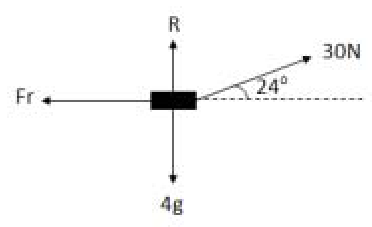
The mark scheme's own answer diagram.
- 1
Weight: down.
Start with the force that is never in doubt, so that the count of remaining forces is what the question's wording has to justify.
- 2
Normal reaction : perpendicular to the horizontal table, so vertically up.
Leave N as a letter, not 40 N — the string's upward pull carries part of the weight, so N is smaller than the weight here, and assuming N = W is the classic error this diagram sets up.
- 3
Tension: , at above the horizontal, pulling the block towards the string.
The arrow points away from the block along the string, towards whoever is pulling — a tension arrow drawn into the block from outside has the direction backwards.
- 4
Friction : the table is rough and "limiting equilibrium" tells you the block is on the verge of sliding in the direction the string's horizontal pull is dragging it, so acts horizontally, opposing that pull.
'Limiting equilibrium' is the phrase that fixes friction's direction: unlike the merely-'stationary' case in the next exercise, there is now a definite way the block is about to go, so friction must point the other way.
AnswerFour forces: down, up, at above the horizontal, horizontal opposing the pull.
- 1
- 39709/41 O/N 2021 Q4(a)1 mark
A particle of mass is stationary on a rough plane inclined at to the horizontal. A force of magnitude , acting parallel to a line of greatest slope, is used to prevent the particle sliding down. The coefficient of friction between the particle and the plane is . Draw a sketch showing the forces acting on the particle.
Stuck? Show hint
The question never says the particle is on the point of slipping — so is definitely small enough that friction has to help it, or could already be doing more than enough on its own?
Show solution
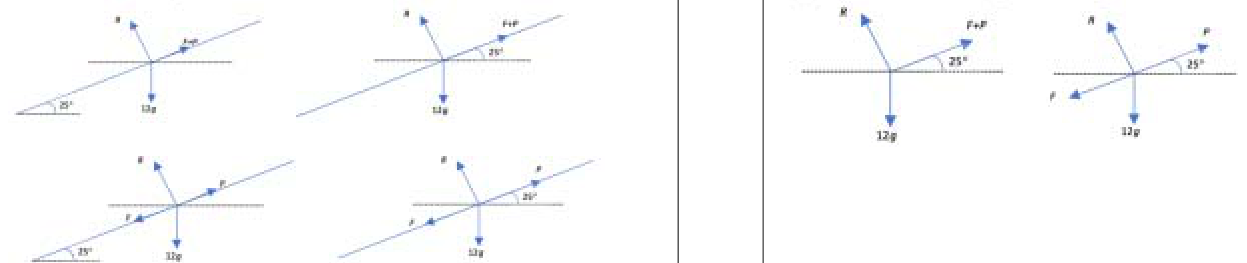
The mark scheme's own answer: four valid diagrams, differing only in the direction of F — direct confirmation that both directions are accepted here.
- 1
Weight down, and normal reaction perpendicular to the plane are certain, as is up the plane (stated in the question).
These three are fixed by the wording; only friction's direction is genuinely open.
- 2
Because the particle is only described as "stationary" — not "in limiting equilibrium" or "on the point of moving" — there is no way to tell from the wording alone whether is exactly enough, too little, or too much to hold the particle without help. Friction adjusts to whichever is needed, so it could act either up the plane (helping resist a weight component that is winning) or down the plane (resisting if alone would push the particle up).
This is the key idea the mark scheme rewards: recognising that friction's direction is not fixed by the geometry alone when a body is merely 'at rest', only when it is explicitly limiting or moving.
AnswerFour forces: down, perpendicular to the plane, up the plane, and along the plane in either direction (both are accepted, since the question does not fix which way the particle would slip without ).
- 1
Vector nature of force: components and resultants
“
understand the vector nature of force, and find and use components and resultants (calculations are always required, not approximate solutions by scale drawing).
A force is not just a size — on its own means nothing without a direction attached. That makes force a vector, and the two things you do with vectors throughout this topic are:
- resolve one force into two perpendicular pieces (its components), and
- combine several forces into one equivalent force (their resultant).
Both are the same skill, run in opposite directions: resolving splits one force into two; finding a resultant recombines two or more forces into one. The syllabus is explicit that this is always done by calculation — resolving with and , never by measuring a scale drawing.
A force F at angle θ above the horizontal, resolved into a horizontal component F cos θ and a vertical component F sin θ.
Why is a force allowed to be replaced by its components at all? Because the two components, acting together, do exactly what the original single force did — they are not an approximation of it, and they are not extra forces added to the diagram. They are the same force, written down a different way.
Take the resultant found further down this section: two perpendicular pulls of and move a particle in precisely the way one single pull at does. Nothing about the particle can tell the two descriptions apart. So you may swap one for the other in either direction, whenever it is convenient — and it is always convenient, because components lie along the two directions you are going to resolve in, so they simply add up as numbers.
That equivalence is what justifies the entire method of this topic. Every "resolve in this direction" instruction from here to the end of Mechanics is really the instruction: rewrite each awkwardly-angled force as the pair of components along my two chosen axes, then add.
Picture the force as the hypotenuse of a right-angled triangle, with the angle measured from the horizontal. The horizontal component is the side adjacent to , and the vertical component is the side opposite it — so, straight from SOH-CAH-TOA (, , ):
Check which side of the angle you are on
and swap over the moment is measured from the vertical instead of the horizontal — the component adjacent to whichever axis the angle is measured from always gets the , and the component opposite always gets the . Before writing either line down, ask: is this angle measured from the horizontal, or from the vertical?
Resolving a single force
A force of magnitude acts at above the horizontal. Find its horizontal and vertical components.
Show full working
- 1
Name what is given. , , measured from the horizontal.
Writing this down first avoids the single most common slip: substituting the wrong angle into the wrong ratio.
- 2
Horizontal component, adjacent to , uses :
Naming the formula before substituting keeps the method visible, rather than jumping straight to a decimal.
- 3
Evaluate:
Check the calculator is in degrees before trusting this: in radian mode cos 40 returns −0.67, and a negative horizontal component here is physically impossible, which is the warning sign to look for.
- 4
Vertical component, opposite , uses :
Same angle, other ratio — decide which ratio from the geometry each time rather than memorising 'horizontal is always cos', which stops being true the moment an angle is measured from the vertical.
- 5
Evaluate:
A quick sanity check: 40° is less than 45°, so the component nearer the angle's own axis (the horizontal one) should be the larger of the two — and 7.66 > 6.43, as expected.
Horizontal component ; vertical component .
Combining several forces into a resultant runs the same idea in reverse: resolve every force into horizontal and vertical components, add the horizontal components together, add the vertical components together, and then rebuild a single resultant force from those two totals — with Pythagoras for its magnitude and for its direction.
Combining two perpendicular forces
Two forces act at a point: horizontally and vertically. Find the magnitude and direction of their resultant.
Show full working
Two forces already at right angles: their components add directly, and the resultant follows from Pythagoras and tan⁻¹.
- 1
These two are already perpendicular, so no further resolving is needed before adding — the horizontal total is simply and the vertical total is .
When forces are already at right angles, the 'resolve each one first' step is trivial — this is the special case, not the general method; the very next example, where a third force sits at 210°, needs the full version.
- 2
Magnitude, by Pythagoras on the two totals:
Pythagoras applies here because the horizontal and vertical totals are, by construction, perpendicular components of the resultant.
- 3
Evaluate:
The resultant must be bigger than either force on its own but smaller than their sum (10 lies between 8 and 14) — a two-second check that catches a square root taken of the wrong thing.
- 4
Direction, measured from the horizontal, using of vertical over horizontal:
tan⁻¹ of (opposite/adjacent) recovers the angle the resultant makes with whichever axis the horizontal total was measured along.
- 5
Evaluate:
A direction is not an answer until it says what it is measured from — '36.9°' alone earns nothing; '36.9° above the horizontal' does.
Resultant , at above the horizontal.
8, 6, 10 is a Pythagorean triple — a clean whole-number answer here is a strong sign the arithmetic went right; on a past-paper question the numbers rarely round so nicely, so don't expect it every time.
The general method: three forces, none of them convenient
Three coplanar forces act at a point: along the positive -axis, along the positive -axis, and in the direction (measured anticlockwise from the positive -axis). Find the magnitude and direction of their resultant.
Show full working
- 1
Fix the two axes first, and a sign convention. Resolve everything into the - and -directions, taking right and up as positive. Every force will now be described by exactly two numbers, and .
Choosing and writing down the positive directions before any trig is what makes the minus signs later a decision rather than a guess — and a resultant question is lost far more often on signs than on trig.
- 2
Resolve the force. It lies along the -axis, so it is already its own -component and has nothing in the -direction:
A force already along an axis still gets written into the table — skipping it because 'it's obvious' is how one of the four or five contributions goes missing from the totals.
- 3
Resolve the force. It lies along the -axis, so it contributes nothing horizontally:
Note this force is at 90° to the 5 N one — that is why the earlier example could go straight to Pythagoras. With a third force at 210°, that shortcut is no longer available, and the general method must be used.
- 4
Resolve the force: the -component. The direction is past the negative -axis, so the force points down-and-left. Its horizontal part is adjacent to that , so it takes , and it points left, so it is negative:
Work with the acute angle 30° against the nearest axis and put the sign in by hand from the picture. Typing cos 210° straight into the calculator also works, but it hides the sign, so a wrong quadrant then goes unnoticed.
- 5
Resolve the force: the -component. The vertical part is opposite the , so it takes , and it points down, so it too is negative:
Same force, second component, done as its own line — resolving one force into both components in a single step is where a stray sign or a swapped ratio usually slips through unseen.
- 6
Sum the -components. Add all three horizontal contributions, signs included:
Adding components is ordinary arithmetic precisely because they all lie along one line — this is the payoff for resolving, and the reason forces at odd angles are never added directly.
- 7
Sum the -components in the same way:
Keep the two totals in separate lines and separate directions: mixing an x-component into the y-sum is the single most costly slip in a resultant question, and it is invisible once the numbers are added.
- 8
Magnitude, by Pythagoras on the two totals:
Pythagoras is legitimate here only because the two totals are perpendicular — which they are by construction, since the axes were chosen at right angles at the start.
- 9
Evaluate:
Sanity check: the 5 N and 3 N forces largely oppose each other horizontally, so a resultant well below 5 N is exactly what should be expected — a resultant of, say, 12 N would mean components had been added without their signs.
- 10
Direction, by of the vertical total over the horizontal total:
It is the two TOTALS that go into tan⁻¹, never an individual force's components — a classic wrong answer here comes from taking tan⁻¹ of one of the three original forces instead.
- 11
Check the quadrant. and , so the resultant points right and up — the first quadrant — and the calculator's is already measured correctly from the positive -axis.
tan⁻¹ only ever returns an angle between −90° and 90°, so it cannot distinguish the first quadrant from the third, or the second from the fourth. When ΣFx is negative, add 180° to the calculator's answer; the signs of the two totals, read off as a direction, are the only reliable guide.
Resultant , at above the positive -axis.
Lay the work out as a two-column table — one row per force, one column for Fx and one for Fy — then add each column. It makes a missing force or a dropped minus sign visible at a glance, which no amount of careful arithmetic in a single line does.
Resolving forces that are not yet at right angles
Two forces of magnitudes and act at a point in the directions shown in the diagram: the force acts at above the positive -axis, and the force acts vertically downwards.
(a) Given that the resultant force has no component in the -direction, calculate the value of .
(b) Given instead that , find the magnitude and direction of the resultant force.
Show full working
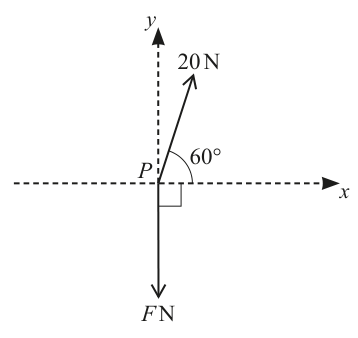
The exam paper's own figure: the 20 N force at 60° above the horizontal, and F N straight down, both acting at P.
- 1
(a) Resolve the force into components. Vertical component (opposite the angle from the horizontal):
The 20 N force is the only one with a horizontal component too, but part (a) only needs the vertical direction, so only the vertical component is written down here.
- 2
Write the vertical resultant as the sum of both forces' vertical parts, and set it to zero (no -component was given). Taking upward as positive:
F acts straight down, so with upward positive its only contribution is ; 'no y-component' then translates directly into this equation. State the convention — the minus sign in front of F is meaningless without it.
- 3
Solve for :
F comes out smaller than 20 N, as it must: it only has to cancel part of the 20 N force, namely its vertical slice.
- 4
(b) With instead, resolve both forces into horizontal and vertical components. Horizontal: only the force has one, . Vertical: upward and downward.
Starting part (b) by re-listing every component (rather than reusing part (a)'s intermediate numbers blindly) avoids carrying over an assumption — here F has changed, so the vertical total has too.
- 5
Add the components to get the resultant's horizontal and vertical totals:
The vertical total is now non-zero — that is the whole difference between part (a) and part (b). In (a) it was forced to zero; here it survives as a genuine component of the resultant.
- 6
Magnitude, by Pythagoras:
Exactly the same Pythagoras step as the invented examples — only now the two totals had to be built from resolving first.
- 7
Evaluate:
Use the unrounded 7.32… from the calculator, not a re-typed 7.32, for every step after this — rounding at an intermediate stage is the standard way to lose the final accuracy mark.
- 8
Direction, by of the vertical over the horizontal total:
Both totals are positive, so the resultant lies in the first quadrant and the calculator's angle needs no adjustment — but say what the angle is measured from, since 'θ = 36.2°' on its own does not name a direction.
(a) . (b) Resultant , at above the positive -axis.
'No component in a direction' always means: write that direction's total as an algebraic sum and set it equal to zero — it is the same move as an equilibrium equation, just for one axis instead of two.
Your turn
- 1
A force of magnitude acts at above the horizontal. Find its horizontal and vertical components.
Stuck? Show hint
Adjacent to the angle gets cos; opposite gets sin.
Show solution
- 1
Name what is given. , , and the angle is measured from the horizontal.
Recording where the angle is measured from is not padding — it is the single fact that decides which of the two components gets cos and which gets sin.
- 2
Horizontal component. The horizontal side of the triangle is adjacent to the , so by CAH it takes :
Write the general form F cos θ before the numbers go in; a line of pure decimals earns no method mark if the final value is wrong.
- 3
Evaluate:
25° is a shallow angle, so most of the force should lie along the horizontal — 13.6 out of 15 is exactly that, and a horizontal component of only 6.3 would be the signal that sin and cos had been swapped.
- 4
Vertical component. The vertical side is opposite the , so by SOH it takes :
Decide the ratio from the geometry each time. 'Horizontal is cos' is true only while the angle is measured from the horizontal, which is a condition, not a rule.
- 5
Evaluate:
Final check: 13.6² + 6.34² = 185 + 40.2 = 225 = 15², so the two components rebuild the original force — the quickest way to confirm a resolving step.
AnswerHorizontal ; vertical .
- 1
- 2
Two forces act at a point: horizontally and vertically. Find the magnitude and direction of the resultant.
Stuck? Show hint
Already perpendicular — go straight to Pythagoras and tan⁻¹.
Show solution
- 1
Find the two totals. The two forces are already along the axes, so no resolving is needed:
This is the special case of the general method, not a different method — the 'resolve each force' stage still happens, it is just that each force is entirely its own component here.
- 2
Magnitude, by Pythagoras on the two totals:
Pythagoras is available only because the two totals are perpendicular. Two forces at, say, 12 N and 5 N at 50° to each other would need resolving first, and √169 would be wrong.
- 3
Evaluate:
13 lies between 12 (the larger single force) and 17 (their sum), as every resultant of two forces must — a resultant of 17 would mean the magnitudes had simply been added.
- 4
Direction, by of the vertical total over the horizontal total:
Vertical over horizontal, in that order — inverting the fraction gives 67.4°, the angle from the vertical, which is a different (and unasked-for) answer.
- 5
Evaluate, and say what the angle is measured from:
The horizontal total is the larger of the two, so the resultant should lie nearer the horizontal than the vertical — an angle under 45° confirms it.
Answerat above the horizontal.
- 1
- 34 marks
Three coplanar forces act at a point: along the positive -axis, along the positive -axis, and a third force of directed into the third quadrant, making equal angles with both negative axes. Show that these three forces have zero resultant.
The three forces drawn to scale: the third force is √2 times as long as the other two, and the two 45° angles it makes with the negative x-axis and the negative y-axis are arced separately, showing directly that they really are equal.
Stuck? Show hint
Resolve the third force into components first — its angle with each axis is 45°, by symmetry.
Show solution
- 1
Find the third force's angle. It makes equal angles with the negative -axis and the negative -axis. Those two angles must add to , so each is .
'Equal angles with both negative axes' is a description of a direction, not a number — convert it into an acute angle against one named axis before any trig is attempted.
- 2
Resolve the third force horizontally. The horizontal part is adjacent to that , so it takes , and it points along the negative -axis, so it carries a minus sign:
The whole question turns on those minus signs: taken as positive, the three forces would sum to something large rather than to zero. Read each direction off the diagram before writing the sign.
- 3
Sum the horizontal components. The along the positive -axis contributes , and the along the -axis contributes nothing horizontally:
Include the vertical 9 N force explicitly as a zero, rather than silently omitting it — on a 'show that' question the examiner wants to see that every force was accounted for.
- 4
Evaluate, using :
Keep the surd exact here. A decimal 12.728 × 0.7071 = 8.9999 leaves you asserting 'approximately zero', which does not prove what a 'show that' question asks for.
- 5
Sum the vertical components in the same way: the along the -axis gives , the horizontal gives nothing, and the third force's vertical part is opposite the and points downwards:
sin here, not cos, because this component is opposite the 45°. The two happen to be equal at 45°, which is convenient — but it makes 45° a poor angle to learn the habit from, so name the ratio anyway.
- 6
Evaluate:
Identical arithmetic to the horizontal sum, by the symmetry of a 45° direction — but it still has to be written out, since 'similarly' is not a shown step.
- 7
Conclude. and , so and the resultant force is zero.
Both totals must be zero, not just one: a resultant is only zero when every component of it vanishes, and a system with ΣFx = 0 but ΣFy ≠ 0 still has a resultant, pointing straight up or down.
AnswerBoth component sums are , so the resultant force is .
- 1
So far, every angle in this section has been handed to you as a number of degrees — , , . The examiner does not have to do that. A question can instead fix the angle indirectly, either by stating a trig ratio directly — e.g. — or by giving the two lengths that define the angle inside a right-angled triangle, such as a strut horizontally from a wall and above it. In every one of these cases you never need to find itself. Pressing is not wrong, but it is an unnecessary detour: it is slower, it swaps an exact fraction for a rounded decimal, and carrying that rounded angle through several more lines of working is exactly what costs an accuracy mark at the end.
Instead, read the ratio (or the two lengths) as two sides of a right-angled triangle, and use Pythagoras to find the third side. Once all three sides are known, every trig ratio the question could possibly need comes straight off the completed triangle — exactly, with no rounding at all.
For example, if , then is the side opposite and is the hypotenuse — that is what means, , so never assume which side a ratio names without checking against the definition first. The third side, adjacent to , follows from Pythagoras:
so the complete triangle has sides , , , and reading straight off it:
A -- triangle — like the more familiar -- — is worth recognising on sight. Triangles like these turn up again and again in this topic precisely because the examiner has chosen a ratio that gives whole-number sides.
Resolving when the angle is given as a ratio
A force of acts at angle to the horizontal, where . Find its horizontal and vertical components.
Show full working
- 1
Read the ratio as two sides of a right-angled triangle. means the side opposite is and the side adjacent to is — that is what means, .
Naming which side is which before doing anything else is the step most often skipped — and skipping it is exactly how sin and cos get swapped two lines later.
- 2
Complete the triangle: find the hypotenuse by Pythagoras.
This is ordinary Pythagoras on a right-angled triangle with legs 5 and 12 — nothing to do with the force yet, just completing the geometry the ratio described.
- 3
Evaluate:
5-12-13 is a Pythagorean triple, so a whole-number hypotenuse here is a sign the working is on track — real bank questions rarely come out this cleanly, but recognising the pattern speeds up the ones that do.
- 4
Read the remaining ratios straight off the completed triangle — no or needed:
Both ratios came from the same triangle as exact fractions — nothing has been rounded, and itself was never found.
- 5
Horizontal component, adjacent to , uses :
Same 'adjacent gets cos' rule as every other resolving example in this section — the only difference here is that cos θ is a fraction instead of a calculator decimal.
- 6
Evaluate:
The 26 cancels neatly against the 13 because 26 = 2 × 13 — worth spotting before multiplying out, since it turns the arithmetic into 2 × 12 rather than a messier decimal multiplication.
- 7
Vertical component, opposite , uses :
Same force, second component, done as its own line — resolving both components in a single step is where a swapped ratio usually slips through unseen.
- 8
Evaluate:
Check: — the two components rebuild the original force exactly, confirming nothing was rounded along the way.
Horizontal component ; vertical component .
Recognise 5-12-13 and 7-24-25 as the two Pythagorean triples that show up again and again in this topic — spotting one on sight saves working out a Pythagoras step you already know the answer to.
Converting into , then rounding and carrying through the rest of the question.
Stay in the triangle: read every ratio you need — , , — directly off the sides , , . Exact fractions, no rounding, and itself is never needed.
Every extra decimal place introduced along the way is a chance to lose an accuracy mark at the end; the exact-fraction route removes that risk completely.
Assuming and describe the same triangle, because the two numbers are the same.
Check which ratio you were actually given before building the triangle. makes the hypotenuse, giving a third side of . instead makes the adjacent side, with the hypotenuse then — a completely different, non-whole-number triangle.
The two ratios look almost identical on the page, but sin and tan put the same two numbers in different roles inside the triangle — confusing them builds the wrong triangle entirely, not just a slightly-off one.
A resultant with the angle given as a ratio
Coplanar forces of magnitudes , and act at a point in the directions shown in the diagram, where .
Find the magnitude and direction of the resultant of the three forces.
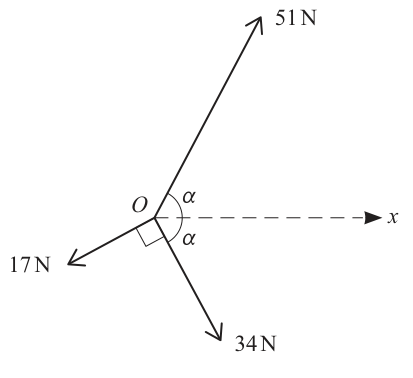
The exam paper's own figure: 51 N at angle α above Ox, 34 N at angle α below Ox, and 17 N perpendicular to them, into the third quadrant.
Show full working
- 1
Convert the given ratio into the two ratios resolving actually needs. means the triangle defining has opposite side and adjacent side . The hypotenuse follows from Pythagoras: so
This is the whole point of the section: α is never found as a number of degrees anywhere in this solution — every sin and cos the resolving below needs comes straight off this 8-15-17 triangle.
- 2
Resolve each force along and , reading each direction from the diagram. Taking right and up as positive: the force (angle above ) has components ; the force (angle below ) has components ; the force (perpendicular to them, into the third quadrant) has components .
This is the same 'resolve every force, one at a time' routine as the three-force example earlier in this section — the only change is that exact fractions stand in for sin α and cos α instead of calculator decimals.
- 3
Sum the -components:
Every term uses only the exact fractions from the triangle above — nothing has been rounded yet, so this line is exact.
- 4
Evaluate:
Each product simplifies to a whole number precisely because 8-15-17 is a Pythagorean triple — a decimal version of α would not have simplified this cleanly.
- 5
Sum the -components in the same way:
Keep this as its own line, entirely separate from the x-sum — mixing a horizontal term into the vertical total is the costliest slip in a resultant question, and it is invisible once the numbers are added.
- 6
Evaluate:
Both totals are positive, which already says the resultant points up and to the right — worth noting now, before the direction is even found.
- 7
Magnitude, by Pythagoras on the two totals:
674 is not a perfect square, unlike the invented example above — real bank numbers rarely land on a clean Pythagorean triple, so don't expect one every time.
- 8
Evaluate:
Keep the unrounded on the calculator for the direction step that follows, rather than re-typing 26.0 — rounding here first is a common way to lose the final accuracy mark.
- 9
Direction, by of the vertical total over the horizontal total:
It is the two TOTALS that go into tan⁻¹, never one of the three original forces — exactly as in the invented three-force example earlier in this section.
- 10
Evaluate, and check the quadrant. and , so the resultant lies in the first quadrant and the calculator's angle needs no adjustment:
A direction is only complete once it says what it is measured from — '15.6°' alone earns nothing; '15.6° above the positive x-axis' does.
, at above the positive -axis.
The ratio-to-triangle conversion is always the first step, done once, before any resolving starts — after that, the rest of the method is identical to every other resultant question in this section.
Your turn: angle given as a ratio or as lengths
In each question, resist the urge to find the angle itself — build the triangle and read the ratios straight off it.
- 1
A force of magnitude acts at angle above the horizontal, where . Find its horizontal and vertical components.
Stuck? Show hint
8 is the side opposite θ, and 17 is the hypotenuse — find the third side first.
Show solution
- 1
Read the ratio as two sides of a right-angled triangle. means the side opposite is and the hypotenuse is — that is what means, .
Checking which side each number names, against the definition of sin, is what stops sin and cos being confused two lines later.
- 2
Complete the triangle: find the adjacent side by Pythagoras.
The hypotenuse is always the longest side, so it is always the one being subtracted from, never the one subtracted — a quick check before evaluating.
- 3
Evaluate:
8-15-17 is another whole-number (Pythagorean) triple, alongside 3-4-5, 5-12-13 and 7-24-25 — recognising it saves re-deriving it under exam pressure.
- 4
Read straight off the completed triangle:
No or anywhere in this solution — every ratio comes from the triangle's sides.
- 5
Horizontal component, adjacent to , uses :
Same rule as every resolving example in this section: adjacent to the angle gets cos.
- 6
Evaluate:
34 = 2 × 17, so this simplifies to 2 × 15 — spot the cancellation before multiplying out the decimal.
- 7
Vertical component, opposite , uses :
Done as its own separate line from the horizontal component, so a swapped ratio would be easy to spot.
- 8
Evaluate:
Check: — the two components rebuild the original 34 N force exactly.
AnswerHorizontal ; vertical .
- 1
- 2
A force of magnitude acts along the straight line , where is horizontally from and vertically below . Find the horizontal and vertical components of the force.
Stuck? Show hint
Use the two given lengths as two sides of a right-angled triangle, and find the length (the hypotenuse) by Pythagoras.
Show solution
- 1
Set up the triangle from the two given lengths. The horizontal leg is and the vertical leg is , so the length of , the hypotenuse, follows from Pythagoras:
Exactly the same move as when the angle is given as a ratio — here the two 'sides of the ratio' are simply given directly as lengths instead.
- 2
Evaluate:
1.5, 2, 2.5 is a 3-4-5 triangle scaled by 0.5 — worth recognising, since it means every ratio below will again come out as a clean fraction.
- 3
Read off the two ratios needed, measuring the angle from the horizontal. The side adjacent to that angle is the leg and the side opposite it is the leg:
The angle itself is never named or found — only the two ratios it would have produced, read straight off the triangle's three known sides.
- 4
Horizontal component, adjacent to the angle, uses :
Same adjacent-gets-cos rule as every other resolving question in this section, whether the angle arrived as degrees, a ratio, or — as here — a pair of lengths.
- 5
Evaluate:
Keep this figure to compare against the vertical component in the next step: since the 2 m vertical leg is longer than the 1.5 m horizontal leg, the force's line of action leans closer to vertical, so the vertical component should come out larger than this one.
- 6
Vertical component, opposite the angle, uses :
Done as its own line, kept separate from the horizontal component above.
- 7
Evaluate:
Check: — the two components rebuild the original 40 N force exactly, and 32 N is correctly the larger component, matching the longer (2 m) leg of the triangle.
AnswerHorizontal ; vertical .
- 1
Equilibrium: the vector sum of the forces is zero
“
use the principle that, when a particle is in equilibrium, the vector sum of the forces acting is zero, or equivalently, that the sum of the components in any direction is zero.
A particle is in equilibrium when it is not accelerating — at rest, or moving at constant velocity. The condition for that is short enough to be misleading:
but a vector equation is not something you can substitute into directly. The syllabus's own equivalent statement is the one actually used on every exam script: the sum of the components in any direction is zero. In practice, that means picking two perpendicular directions (almost always horizontal and vertical, or parallel/perpendicular to a plane) and writing one equation for each:
Two equations, from one physical fact, resolved in two different directions. You will write this pair of equations more than any other in Mechanics — everything else in this note, and everything in the topics after it, eventually comes back to writing these two lines correctly. The syllabus also notes that other methods (a triangle of forces, Lami's theorem) are acceptable if they happen to work, but are not required knowledge and will not be referred to in questions — resolving is the method to learn.
Where ΣF = 0 comes from
Worth being honest about: is asserted here, not derived. It is a consequence of Newton's second law, — if the particle is not accelerating then , so the resultant force must be too. But Newton's laws are a later topic (§4.4), so at this stage you are being asked to take the condition on trust and use it, exactly as was taken on trust in §01. Nothing in this section depends on the derivation; when you meet later, equilibrium is simply its case.
Finding an unknown force from equilibrium
Three forces act at a point and are in equilibrium: acting horizontally, acting vertically, and a third force of magnitude at angle below the horizontal, on the opposite side of both. Find and .
The three forces at the point. Note where θ is measured from — the negative horizontal — since that is what fixes which ratio goes with which equation.
Show full working
- 1
Choose the first direction: horizontal. Take right as positive, and write down which forces have a horizontal component at all.
Naming the direction on its own line, before any algebra, is what stops the two equations being written as one blur — and each resolving equation carries its own method mark.
- 2
List the horizontal contributions. The force is horizontal, so it contributes its whole self, . The force is vertical, so it contributes nothing horizontally. The third force is at to the horizontal, so it contributes a component.
Going force-by-force is the guard against the commonest equilibrium error: resolving in a direction and forgetting a force that does have a component in it.
- 3
Compute the third force's horizontal component. It is the side of the triangle adjacent to , so by CAH it takes :
Adjacent-to-the-angle takes cos — decided from the geometry, not from a memorised 'horizontal is cos', which fails the moment an angle is measured from the vertical.
- 4
Assemble and equate. The third force's horizontal component points opposite the force and equilibrium makes the total zero, so the two balance exactly:
Written as 12 − R cos θ = 0 it says the same thing; rearranged to R cos θ = 12 it is ready to use. Do the rearranging now rather than in the middle of the elimination later.
- 5
Now the second direction: vertical. Take up as positive. Only the force and the third force have vertical components; the force has none.
A second, independent direction is what turns one physical fact into two usable equations — and two unknowns, R and θ, need exactly two equations.
- 6
Compute the third force's vertical component and equate. It is opposite , so by SOH it takes , and it opposes the force:
Same force, same angle, the other ratio — and note it is sin here purely because θ is measured from the horizontal. Measured from the vertical, these two equations would swap over.
- 7
Combine the two equations to eliminate and find , using :
Squaring and adding the two resolved equations is exactly Pythagoras applied to the two component equations — the same move as finding a resultant's magnitude in §02, run here to solve for an unknown instead.
- 8
Evaluate:
R has to be at least as big as either force it is balancing, since it must cancel both at once — 15 > 12 > 9, as required. An R smaller than 12 would mean a sign had gone astray.
- 9
Find by dividing the two original equations, so that cancels:
Dividing is cleaner than substituting R = 15 back in: it keeps θ independent of any rounding in R, so an error in one answer cannot contaminate the other.
- 10
Evaluate:
The 12 N force is the larger, so the balancing force must lean closer to the horizontal than to the vertical — an angle under 45° is the expected shape of the answer.
, .
Coplanar forces in equilibrium
Coplanar forces of magnitudes , and act at a point in the directions shown in the diagram: vertically upward, horizontally, and down and to the left at angle below the negative horizontal axis. The system is in equilibrium. Find the values of and .
Show full working
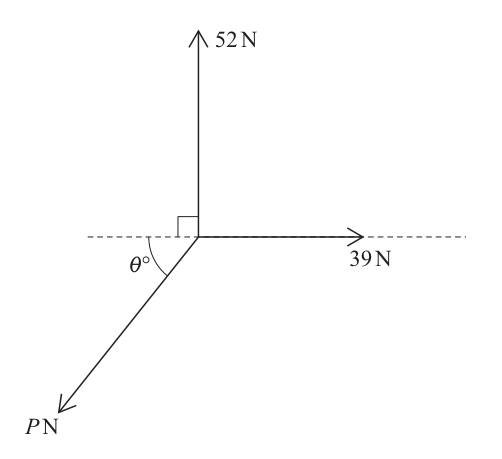
The exam paper's own figure for this question.
- 1
Choose the first direction: horizontal, taking right as positive.
Either direction could come first here, since each of the two equations contains both unknowns — but naming the direction as its own line keeps the two equations from being merged into one.
- 2
List which forces have a horizontal component. The force is horizontal, so all of it counts. The force is vertical, so none of it counts. is at to the horizontal, so part of it counts.
The 52 N force contributing zero horizontally is the fact to state, not skip: forgetting to check whether a force has a component in the direction being resolved is the standard way a term goes missing.
- 3
Compute 's horizontal component. is measured from the horizontal, so the horizontal part is adjacent to it and takes :
Read the angle off the figure and check what it is measured from before choosing the ratio — if the diagram had marked θ from the vertical, this component would be P sin θ instead.
- 4
Assemble the horizontal total and set it to zero:
This is the equilibrium condition itself: the sum of the components in the chosen direction is zero. Everything after it is algebra.
- 5
Rearrange:
Getting the unknown alone on the left now makes the square-and-add step two lines away much tidier.
- 6
Now the second direction: vertical, taking up as positive. The force has no vertical component; the force is entirely vertical; 's vertical part is opposite , so it takes and points downwards:
Exactly the same five moves as the horizontal equation, run in the perpendicular direction — which is why the second one can safely be written more briefly than the first.
- 7
Square and add both equations to eliminate :
This is the same elimination move as the invented example — square each resolved equation, add, and cos²+sin²=1 collapses the left side to P².
- 8
Simplify the left side and evaluate the right:
The left side collapses to P² only because cos²θ + sin²θ = 1 — the identity is doing real work here, so it is worth naming rather than letting θ appear to vanish by magic.
- 9
Solve for :
Take the positive root only: P is a magnitude, and a negative force magnitude is not an answer. (39, 52, 65 is a 3-4-5 triangle scaled by 13 — the exam writer chose these numbers deliberately.)
- 10
Divide the two original equations to find , so cancels:
Vertical equation over horizontal equation gives sin/cos = tan directly. Dividing the other way round gives cot θ, and an angle of 36.9° — the complement of the right answer, and a very easy mark to lose.
- 11
Evaluate:
The vertical force being the larger means P must lean closer to the vertical, so θ measured from the horizontal should exceed 45° — it does, which confirms the fraction was not inverted.
, .
Whenever two of three forces already sit on perpendicular axes, the third force's components are forced to exactly cancel each of the other two — square-and-add for the magnitude, divide for the angle, every time.
Two unknowns need two equations: a particle on two strings
A particle of mass is held in equilibrium by two light inextensible strings, one attached to point and the other to point . The strings go upwards on opposite sides of the particle, making angles of and with the horizontal. Find the tension in each of the two strings.
Show full working
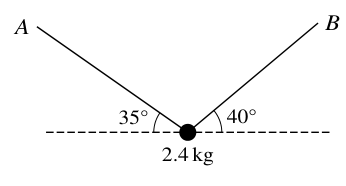
The exam paper's own figure for this question.
- 1
Name the two unknowns. Let be the tension in the string to (at ) and the tension in the string to (at ) — two different unknowns need two different labels, never the same letter for both.
Reusing the same symbol for two genuinely different tensions is one of the most common ways this question type loses marks — the mark scheme requires them distinguishable from the first line.
- 2
Resolve horizontally. The strings leave the particle on opposite sides, so their horizontal components point in opposite directions; the weight is vertical and contributes nothing here. With nothing else horizontal, the two must balance exactly. Each horizontal component is adjacent to its stated angle, so each takes :
This equation exists only because the strings are on opposite sides — that is the geometric fact doing the work. Were both strings on the same side, their horizontal pulls would add rather than cancel, and the whole solution would change.
- 3
Resolve vertically. Both strings pull upward (each at its own angle above the horizontal), so both vertical components are positive, balancing the particle's weight . Each vertical component is opposite its angle, so each takes :
Plus, not minus, between the two terms — the strings oppose each other horizontally but cooperate vertically. Copying the horizontal equation's minus sign into this line is the usual slip.
- 4
Make the subject of the horizontal equation, ready to substitute:
With two unknowns and two equations, the standard move is to isolate one unknown from the simpler equation and substitute it into the other — exactly as with any pair of simultaneous equations.
- 5
Substitute into the vertical equation, so only remains:
One equation, one unknown — which is the point of the substitution. Substituting the other way round (T_B into the vertical equation) works equally well; what matters is that only one letter survives.
- 6
Take out a factor of :
T_B is a common factor of both terms, so the whole trig mess becomes a single number multiplying it — collecting the unknown before touching the calculator keeps the algebra and the arithmetic separate.
- 7
Evaluate the first term in the bracket:
Do this term on its own: it is the only one with a fraction in it, and mis-keying the division (dividing by sin 35° instead of cos 35°, say) is far easier to spot on a line by itself.
- 8
Evaluate the second term:
Trivial, but it belongs on its own line so the addition that follows is visibly an addition of two separately-checked numbers.
- 9
Add them, then divide:
Keep the full 20.3532 on the calculator as well as writing 20.4 — the very next step needs the unrounded value, and this is exactly where the accuracy mark is won or lost.
- 10
Substitute back into the horizontal equation to find , using the unrounded value:
Substitute the unrounded T_B here. Using the rounded 20.4 gives 19.077, which rounds to 19.1 — a different final answer from the mark scheme's 19.0, and the accuracy mark is lost. Round once, at the very end, never in the middle.
Tension in the string ; tension in the string .
Two unknown tensions is the standard signal for this exact shape of question: resolve twice, isolate one unknown from the equation with fewer terms, substitute, solve, then substitute back.
A three-force equilibrium with an unknown mass
A smooth ring , of mass , is threaded on a light inextensible string. A horizontal force of magnitude acts on . The ends of the string are attached to fixed points and on a vertical wall. Part makes with the vertical, part makes with the vertical, and the ring is in equilibrium. Find the tension in the string and the value of .
Show full working
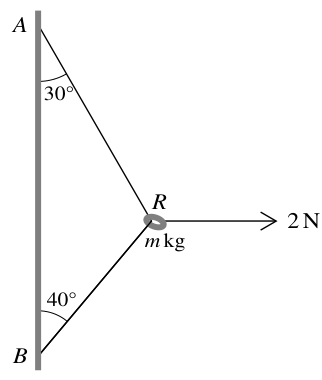
The exam paper's own figure for this question.
- 1
Because the ring is smooth — smooth means frictionless, so the ring cannot grip the string (§05 covers the model properly) — the string slides freely through it, and the tension is therefore the same on both sides, in parts and alike. That is a single unknown, not two.
This is what 'smooth ring' buys you: without it the ring would grip, AR and BR would need separate tensions, and the question would need two unknowns and two equations, just like the two strings in the previous example.
- 2
Resolve horizontally. Both string segments pull the ring back towards the wall — each contributing a horizontal component of — balancing the force pulling it away:
Each segment's angle is measured from the vertical here, so the component towards the wall (horizontal) uses sin, not cos — check this against the diagram before resolving, exactly as the §02 callout warns.
- 3
Take out a factor of , since it is common to both terms:
This is only possible because the tension is the same in both segments — the smooth-ring fact from step 1 is what turns two terms into one unknown times a bracket.
- 4
Evaluate the bracket:
sin 30° = 0.5 exactly, which is worth knowing by heart — it is the one value in this whole note that never needs a calculator.
- 5
Divide to find :
The two segments share the job of holding back a 2 N pull, so each contributes rather less than 2 N horizontally — a T of, say, 4 N would mean the bracket had been used the wrong way up.
- 6
Resolve vertically, taking up as positive. The segment pulls up, the segment pulls down, and the ring's weight acts down. Each angle is measured from the vertical, so each vertical component is adjacent to its angle and takes :
cos here, sin in the horizontal equation — the exact reverse of the usual pattern, purely because these angles are measured from the vertical. This is the §02 callout's warning in action.
- 7
Substitute the value of found above:
T was found from the horizontal equation alone, so it is a known number by the time the vertical equation is used — resolve in the direction with one unknown first, and the second direction becomes a substitution rather than a simultaneous solve.
- 8
Evaluate the upward pull from :
AR is the steeper segment (30° from the vertical against BR's 40°), so it should carry the larger vertical share — 1.516 N confirms that before the subtraction is even done.
- 9
Evaluate the downward pull from :
Same tension, different angle — the two vertical components differ only because the segments are at different angles to the vertical, which is the whole reason the ring has any weight to support.
- 10
Subtract to find the net upward pull, which is what the weight must balance:
The two segments nearly cancel vertically, leaving a small net pull — which is why m comes out tiny. A near-cancellation like this is precisely where rounding too early destroys the answer, so keep full accuracy on the calculator.
- 11
Identify the weight. The ring's weight is , and , so
Writing mg as 10m is the step that turns a physics statement into an equation in m — leaving it as 'mg' and then dividing by 10 without saying so is where the working becomes unfollowable.
- 12
Divide by :
Do not be put off by how small this is: the question asked for a mass in kilograms, and 0.0175 kg (17.5 g) is a perfectly sensible ring. Check the units are kg, not g, before writing the final line.
, .
'Smooth ring threaded on a string' is the standard phrase meaning one tension, not two — read for it before deciding how many unknowns the resolving equations actually need.
The equilibrium condition is tagged more often than any other §4.1 idea, and for good reason: it is the equation every other idea in this note eventually resolves down to. A friction question is an equilibrium question with substituted in; an inclined-plane question is an equilibrium question resolved parallel and perpendicular to the slope instead of horizontally and vertically.
Resolving in one direction and leaving out a force that does have a component in it
Go through the force diagram one arrow at a time, and write a term (or an explicit zero) for every single force before adding up
A force at an angle contributes to BOTH directions — the tempting shortcut is to 'use' each force once and move on, which silently drops half of every angled force from one of the two equations.
Using where belongs, because the angle is measured from the vertical rather than the horizontal
Decide from the triangle each time: the component adjacent to the marked angle takes , the component opposite it takes
'Horizontal is cos' is only true while the angle is measured from the horizontal. The smooth-ring example above measures both angles from the vertical, and every ratio in it swaps over as a result.
Assuming the tensions in two strings are equal when the strings hang at different angles
Equal tensions follow only from a symmetric arrangement — with different angles, use two labels and two equations
Equal tension is a consequence of symmetry (or of a smooth ring or pulley), never of there simply being two strings. At 35° and 40° the tensions genuinely differ, and one label for both makes the problem unsolvable.
Reading "in equilibrium" as meaning the particle must be stationary
Equilibrium means not accelerating — at rest or moving in a straight line at constant speed
A question about a box being dragged at constant speed, or a car travelling at steady speed up a hill, is an equilibrium question word for word: ΣF = 0 applies just as it does to a hanging particle.
Your turn
- 1
Three forces act at a point and are in equilibrium: acting horizontally to the right, acting vertically upward, and a third force of magnitude at angle below the horizontal, pointing down and to the left. Find and .
The same shape as the first worked example, with different numbers — θ is again measured from the negative horizontal.
Stuck? Show hint
Set up horizontal and vertical resolving equations exactly as in the first worked example, then square-and-add.
Show solution
- 1
Resolve horizontally, taking right as positive. The force contributes all of itself; the force is vertical and contributes nothing; the third force's horizontal component is adjacent to , so it takes , and it points left:
Name the direction, then walk the three forces one at a time. Stating that the 24 N force contributes zero horizontally is what stops it being dropped into the wrong equation later.
- 2
Resolve vertically, taking up as positive. The force contributes nothing; the force contributes ; the third force's vertical component is opposite , so it takes , and it points down:
Both of the third force's components come out negative, which is exactly what 'down and to the left' means — if the force were drawn above the horizontal instead, these two equations could not both hold.
- 3
Eliminate by squaring and adding:
Squaring and adding is the move whenever the two equations read 'R cos θ = …' and 'R sin θ = …' — it is the only way to reach R without first knowing θ.
- 4
Use and evaluate:
Positive root only — R is a magnitude. And 30 exceeds both 18 and 24, as it must, since it single-handedly balances the pair of them.
- 5
Find by dividing the vertical equation by the horizontal one, so cancels:
Dividing keeps θ free of any rounding error in R. Dividing the other way round would give 36.9°, the angle from the vertical — a correct number answering a different question.
- 6
Evaluate:
The vertical force is the larger, so the balancing force must lean nearer the vertical — an answer above 45° is the expected shape. (18, 24, 30 is a scaled 3-4-5 triangle.)
Answer, .
- 1
- 2
A particle of weight hangs in equilibrium from two strings, each inclined at to the horizontal, symmetrically either side of the vertical. By symmetry, state why the two tensions are equal, and find their common value.
The symmetric arrangement. The dashed vertical is the mirror line — it is what makes the two tensions equal, and what makes the horizontal equation say nothing.
Stuck? Show hint
With equal angles either side, the horizontal components must already balance for any equal pair of tensions.
Show solution
- 1
By the left–right symmetry of the angles, the situation is a mirror image of itself, so the two tensions must be equal — call the common value .
Spotting symmetry avoids setting up (and solving) two simultaneous equations for a question that only needs one.
- 2
Check the horizontal direction first. Each string's horizontal component is , and the strings lean opposite ways, so the two cancel automatically:
This equation is satisfied for every value of T, so it carries no information — which is precisely why the symmetric case has one unknown instead of two, and why the vertical direction is the one that has to do the work.
- 3
Resolve vertically, taking up as positive. Both strings pull upward, each contributing (opposite the , so ), balancing the weight:
The factor of 2 comes from there being two strings, not from anything about the angle — dropping it is the usual slip in symmetric problems, and it doubles the answer.
- 4
Solve for :
Each string carries more than half the weight (11.7 > 9), because part of each tension is spent pulling sideways rather than up — the shallower the strings, the larger the tensions become.
Answerin each string.
- 1
- 39709/45 O/N 2025 Q15 marks
Coplanar forces of magnitudes , , and act at a point in the directions shown in the diagram: the force at above the positive horizontal axis, along the positive horizontal axis, at above the negative horizontal axis, and at below the negative horizontal axis. The forces are in equilibrium. Find the value of and the value of .
Stuck? Show hint
With four forces, resolve vertically first — only 21 N, 32 N and Q have vertical components, so that equation has one unknown.
Show solution
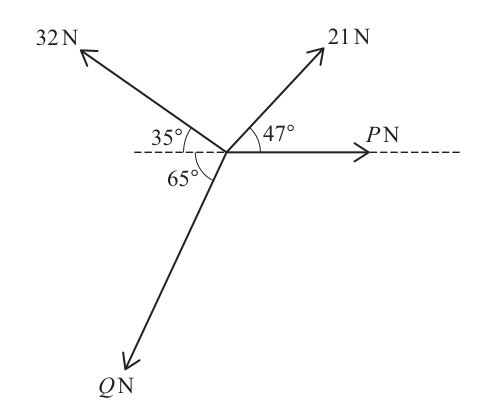
The exam paper's own figure for this question.
- 1
Vertical equilibrium (P has none):
Choosing the direction with fewer unknowns first — here, vertical, since P is purely horizontal — is what keeps a four-force problem manageable.
- 2
Evaluate the first known term:
sin, not cos, because 47° is measured from the horizontal and this is the vertical (opposite) component — check each angle against the figure before choosing the ratio.
- 3
Evaluate the second known term:
The 32 N force leans up and to the LEFT, so its vertical component is still upward and still positive here — only its horizontal component will carry a minus sign, in the next equation.
- 4
Collect the known terms and rearrange so the unknown stands alone:
Q is the only force with a downward component, so it alone has to balance both upward contributions — that is why the two knowns combine into a single number before Q is touched.
- 5
Divide to find :
Divide by sin 65°, do not multiply — Q sin 65° is the component, so Q itself must be the larger number. Keep the unrounded 37.197 for the horizontal equation that follows.
- 6
Now resolve horizontally, taking right as positive. All four forces have a horizontal component this time: entirely, and the other three by of their marked angles, with the two leaning leftwards negative:
Four terms, four forces — the fact that no force is purely vertical is exactly why this equation was left until Q was known.
- 7
Substitute and evaluate each term:
Two negative terms outweigh the one positive one, so P must come out positive and fairly large — a negative P here would mean a direction had been read off the figure backwards.
- 8
Solve for :
Both answers should be quoted to 3 s.f. from unrounded working — using the rounded Q = 37.2 rather than 37.197 shifts P only in the fourth figure here, but on a tighter question it would cost the accuracy mark.
Answer, .
- 1
Contact force: normal and frictional components
“
understand that a contact force between two surfaces can be represented by two components, the normal component and the frictional component.
Whenever two surfaces touch, the surface pushes back on the object in a single combined contact force. That single force always splits cleanly into two perpendicular pieces:
- the normal component, (or ), perpendicular to the surface — it can only push, never pull, and it is what stops the object passing through the surface;
- the frictional component, , along the surface — it resists sliding, or the tendency to slide.
Every "find the normal reaction" or "find the frictional force" question is really just an equilibrium question (§03), with the answer sorted into these two labelled boxes instead of left as a single resultant.
Occasionally a question asks for the total contact force — the single force the surface exerts. Because and are perpendicular, they recombine exactly like the two components in §02, by Pythagoras:
On a smooth surface , so the contact force is just .
The same contact force R, drawn split into N (perpendicular to the surface) and F (along it), on the flat and on a slope.
Finding N: a force with a vertical component
A block of mass rests in equilibrium on a rough horizontal table. A force of is applied to the block at above the horizontal, pulling it. Given that the block remains at rest, find the normal reaction , the frictional force , and the magnitude of the total contact force from the table.
Show full working
- 1
List the forces acting on the block. Weight straight down, the applied pull at above the horizontal, and — because the table is a surface in contact — the two components of the contact force: perpendicular to the table (upwards) and along it.
Writing out the contact force as two separate labelled forces, rather than one vague 'reaction', is what turns this into an ordinary two-direction equilibrium problem — and it stops students forgetting F entirely just because the question did not draw it.
- 2
Resolve vertically. The applied force has an upward component , which reduces how hard the block presses on the table, so:
The pull's vertical component acts with N, not against it, in supporting the weight — that is why N ends up smaller than the full weight, not larger.
- 3
Put a number on the weight. With on Paper 4, .
Doing the g-substitution as its own line stops the classic slip of leaving 3g in the equation and then reading '3' off as the numerical weight.
- 4
Evaluate the pull's vertical component: .
sin 30° = 0.5 exactly, so this term is worth evaluating before solving — it keeps the final line pure arithmetic with no trig left to mis-key.
- 5
Solve for :
Note the answer is 26 N, not 30 N: the pull is taking 4 N of the weight, so the table only has to supply the rest.
- 6
Resolve horizontally. With the block remaining at rest — not accelerating — the horizontal pull is exactly balanced by friction:
This uses only the equilibrium condition, not F = μN — at this stage no coefficient of friction has even been given, so F is found from the balance of forces alone.
- 7
Evaluate:
Round only at this last line — carrying 0.866 forward from an earlier rounding, rather than the full calculator value, is where 3 s.f. answers quietly drift into the wrong final digit on longer questions.
- 8
Recombine and into the total contact force. They are perpendicular, so use Pythagoras:
N and F are not two separate pushes from the table — they are the two components of one contact force, so recombining them is the §02 resultant method run on just two perpendicular pieces.
- 9
Evaluate:
The contact force is a little larger than N, because friction adds a small sideways part. If a question asks for 'the contact force', this is the number it wants, not N on its own.
, , total contact force .
A force applied above the horizontal always reduces N below the full weight; one applied below the horizontal (pushing down and along) would increase it — check the sign of the vertical component before writing the equation.
The same block, the same weight and the same size of force in both panels — only its direction changes. The N arrow is the only other thing that differs, and that is the whole point: a pull takes some of the weight off the surface, a push adds to it.
On an inclined plane, it is not just the applied force that needs resolving — the weight itself must be split into a component along the slope and a component into it, because "vertical" and "perpendicular to the surface" are no longer the same direction.
Weight W, straight down, decomposed into W sin θ parallel to the slope and W cos θ perpendicular to it — with θ appearing twice, once at the base and once between W and the perpendicular.
Why the angle θ shows up twice
In the diagram, appears both where the slope meets the horizontal and between the weight vector and the line perpendicular to the slope — and it is genuinely the same angle both times, not a coincidence to memorise. The perpendicular to the slope and the vertical (the weight's own direction) are rotated relative to each other by exactly the same amount that the slope itself is rotated from the horizontal — so the angle between weight and "straight into the slope" always equals the angle of the incline. This is what justifies writing the components as (along the slope) and (perpendicular to it) directly, without re-deriving the geometry from scratch each time.
Splitting the weight on an inclined plane
A block of mass rests in equilibrium on a rough plane inclined at to the horizontal. Find the normal reaction and the frictional force acting on the block.
Show full working
- 1
Choose the resolving directions before writing anything. Take one axis along a line of greatest slope and the other perpendicular to the plane — not horizontal and vertical.
Aligning the axes with the surface means N sits entirely on one axis and F entirely on the other, so each unknown appears in only one equation. Horizontal/vertical axes would split both N and F across both equations and force you to solve simultaneously for no gain.
- 2
Resolve perpendicular to the plane. With no other force pushing into or out of the slope, the normal reaction exactly balances the perpendicular component of weight:
This is the resolving direction with only one unknown (N), so it is done first — exactly the same 'fewest unknowns first' strategy as the four-force exercise in §03.
- 3
Substitute the values, using so that :
Turning mg into a single number before touching the trig keeps the arithmetic to one multiplication — and makes an unreasonable answer (N bigger than the weight, say) obvious at a glance.
- 4
Evaluate:
Sanity check: N is less than the full weight of 80 N, as it must be on any slope — only on flat ground with no other force does N equal mg.
- 5
Resolve parallel to the plane. With the block in equilibrium (not sliding), friction exactly balances the component of weight pulling it down the slope:
Friction is found from the equilibrium balance here, not from μ — the question gives no coefficient, and 'rests in equilibrium' is not the same as 'on the point of sliding'.
- 6
Substitute and evaluate:
Friction must point up the slope: without it the block would slide down, and friction always opposes that impending motion.
, , acting up the plane.
On a slope, always resolve perpendicular to the plane first to isolate N (weight's only other perpendicular contribution), then parallel to the plane for F — resolving horizontally and vertically instead works but drags both N and F into both equations at once.
The exam version: when something else presses into the plane
A particle of mass is placed on a rough plane which is inclined at an angle of to the horizontal. The particle is kept in equilibrium by a horizontal force of magnitude acting in a vertical plane containing a line of greatest slope (see diagram). The coefficient of friction between the particle and plane is .
Find the least possible value of .
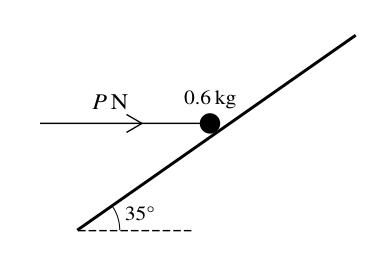
The exam paper's own figure: the force P is horizontal, not along the slope.
Show full working
- 1
Name the four forces, splitting the contact force in two. Weight straight down; the horizontal force ; and the two components of the contact force — perpendicular to the plane and along it.
Everything in this section depends on treating the contact force as two separate labelled forces. Draw it as one slanting 'reaction' arrow and you cannot write either resolved equation.
- 2
Decide which way friction acts. The question asks for the least . Make any smaller and the particle would slide down, so friction must be opposing that — acting up the plane, at the largest value it can reach.
Friction's direction is a decision you make before resolving, from the words, not from the algebra. Get it wrong and every later line is wrong — and 'least possible' is the phrase that settles it here.
- 3
Resolve perpendicular to the plane — the key line. is horizontal, not along the slope, so it has a component pressing into the plane, on top of the weight's :
This is the central point of §04: N is NOT mg cos θ here. Anything with a component into the surface adds to N, and writing N = 0.6g cos 35° loses the mark and wrecks the rest of the question.
- 4
Evaluate what can be evaluated:
N cannot be reduced to a number, because it still contains the unknown P — that is the structural difference from every earlier example in this section, where N could be found on its own first.
- 5
Resolve parallel to the plane. Down the slope pulls ; up the slope act and the frictional component :
P appears in this equation too, with cos rather than sin — a horizontal force on a slope always turns up in both resolved equations, once with each ratio.
- 6
Link the two components. The particle is on the verge of slipping, so friction is at its maximum and with :
This single line is the one piece of §06 machinery the question needs — §06 explains exactly when the equals sign is allowed (here, because 'least possible P' means the particle is limiting). Everything else on this page is §04's two-component decomposition.
- 7
Substitute into , then into the parallel equation:
Substituting the expression for N, not a number, is what keeps the single unknown P — this is a pair of simultaneous equations, solved by elimination like any other.
- 8
Expand:
Both P terms are positive, and both help hold the particle: P pushes it up the slope directly, and by pressing it into the plane P also raises N, so more friction is available up the slope. That is why P comes out so small.
- 9
Collect the terms on the left and the numbers on the right:
Move every P-term to one side before dividing — dividing while a P is still on both sides is the usual slip here.
- 10
Divide:
Say explicitly that this is the least value, as the question asked — the mark scheme withholds the final mark for an answer left as an unqualified number or as 'P ⩾ 1.41' with no least value stated.
The least possible value is (3 s.f.).
The shape to remember: whenever the applied force is not already along the plane, write N as an expression containing that force rather than as a number, and expect to solve two equations together. Spotting that in the first ten seconds is worth more than any amount of careful arithmetic afterwards.
Resolving weight using perpendicular to the plane and along it
It is the other way round: perpendicular, parallel
The angle between the weight and the perpendicular to the slope is θ (as the callout above shows), so the perpendicular component — adjacent to that θ — uses cos, and the parallel one uses sin.
Treating N as always equal to the full weight, even on a slope or with a tilted applied force
N balances only the perpendicular contributions — recompute it whenever the surface tilts or another force has a component into/out of it
N = mg is a special case (flat ground, no other tilted force), not a general rule.
Your turn
- 14 marks
A block of mass rests on a rough horizontal floor. A force of is applied at below the horizontal, pushing down and along the floor, and the block remains at rest. Find and .
Stuck? Show hint
This time the applied force's vertical component pushes down, not up — it adds to the weight rather than relieving it.
Show solution
- 1
Split the applied force into components. At below the horizontal, the force has a horizontal part along the floor and a vertical part pressing downwards.
The angle is measured from the horizontal, so the horizontal component (adjacent to the angle) takes cos and the vertical one takes sin — the same rule as §02, unchanged by the force pointing downwards rather than upwards.
- 2
Resolve vertically. The floor must now support both the weight and the downward push:
A force angled below the horizontal presses the block harder into the floor, so N now exceeds the weight — the opposite effect to the first worked example, where the pull was above the horizontal and N came out smaller.
- 3
Substitute and evaluate:
Check the direction of the answer, not just its size: N has gone up from 20 N, which is what 'pushing down and along' should do.
- 4
Resolve horizontally. The block stays at rest, so friction alone balances the horizontal component of the push:
Again this is pure equilibrium — no coefficient of friction is given, and none is needed, because the question does not say the block is about to slip.
- 5
Evaluate: , acting backwards along the floor, opposing the push.
Friction opposes the direction the block would slide, which is the direction the push is driving it — so F points back along the floor, not forwards.
Answer, .
- 1
- 29709/43 O/N 2022 Q36 marks
A ring of mass is threaded on a smooth circular rigid wire with centre . The wire is fixed in a vertical plane and the ring is kept at rest by a light string connected to , the highest point of the circle. The string makes an angle of to the vertical (see diagram).
Find the tension in the string and the magnitude of the normal reaction of the wire on the ring.
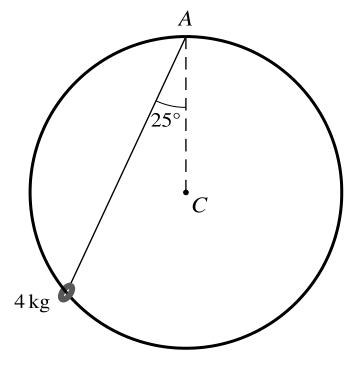
The exam paper's own figure: the ring sits on the circular wire, held by a string running up to A at the top of the circle.
Stuck? Show hint
"Normal" means perpendicular to the surface at the point of contact — and for a circular wire that direction is along the radius, through . Find the angle that radius makes with the vertical first, using the isosceles triangle.
Show solution
- 1
Work out which way the normal reaction points. The wire is circular, so the surface at the ring is curved; perpendicular to it means along the radius, in line with the centre . (The wire pushes the ring outwards, away from — a ring threaded on a wire can be pushed either way, and the equations confirm this choice by giving a positive answer.)
This is the section's definition doing real work: the normal component is perpendicular to the surface, not vertical and not perpendicular to the string. On a flat table those coincide; on a curved wire they do not, which is why this question is worth 6 marks.
- 2
Find the angle that radius makes with the vertical. Let the ring be at . Both and are radii, so triangle is isosceles and angle = angle . The remaining angle gives and since points straight up, the outward radius makes with the downward vertical.
The 50° is not a number you can guess from the picture — it comes from the isosceles triangle, and it is exactly twice the string's 25°. Assuming the reaction is at 25°, or vertical, is the mistake this question punishes.
- 3
Resolve horizontally. The tension pulls the ring towards , at to the vertical; the reaction pushes outwards at to the vertical, on the other side:
Two unknowns and no friction (the wire is smooth), so you need two equations — and horizontal/vertical is the pair that keeps both angles measured from the same reference line.
- 4
Resolve vertically, with the weight : the tension's upward must hold up both the weight and the reaction's downward :
Note the reaction has a downward component here — it points outwards and below the horizontal — so it adds to what the string must support rather than helping it.
- 5
Make the subject of the horizontal equation:
Eliminate whichever unknown is easiest to isolate. The horizontal equation has no constant term, so it gives a clean one-line expression for T in terms of N.
- 6
Substitute into the vertical equation:
Keep four decimal places through this line: the two coefficients nearly cancel to exactly 1, and rounding early would hide that.
- 7
Solve for :
The normal reaction comes out exactly equal to the weight. That is no accident of these numbers: in this ring-on-a-circle set-up it happens for any string angle (the double-angle identity cos 50° = 2cos²25° − 1 makes the bracket exactly 1). You do not need that for Paper 4 — just keep enough decimals that the 1 is visible.
- 8
Back-substitute for :
Use the unrounded 40, and quote 3 s.f. at the end — the mark scheme's value comes from 72.504…
AnswerTension (3 s.f.); normal reaction .
- 1
The smooth contact model, and its limitations
“
use the model of a 'smooth' contact, and understand the limitations of this model.
A surface described as smooth is a modelling idealisation: it is assumed to have no friction at all, so its contact force is entirely normal — always. A rough surface, by contrast, can supply friction up to some maximum, covered fully in §06.
"Smooth" turns up in several disguises across Paper 4: a smooth plane, a smooth peg or pulley (no resistance to the string sliding over it), and a smooth ring or bead threaded on a wire or string (as in §03's ring example).
Smooth: the contact force is entirely normal. Rough: friction can take any value up to μN.
The model's limitation
No real surface is perfectly frictionless — "smooth" is always an approximation, made because it simplifies the algebra when the actual friction is small enough to ignore, or when the question wants to isolate some other effect. The cost of that simplification shows up numerically: in a problem like the ones below — one unknown, balanced by one equation along the surface — a smooth surface allows equilibrium for one exact value of that unknown (angle, force, or mass) rather than a range of values, because there is no friction available to make up the difference between the forces. The examples that follow show exactly this.
In real life, then: a block on a "smooth" slope would actually stay put over a small range of forces, not just one; and a real pulley or peg has a little friction, so the tension on its two sides would differ slightly instead of being exactly equal. If a question asks what the smooth model ignores, the answer is friction, and these are its effects.
What 'smooth' changes: a block held on a smooth slope
A block of mass rests in equilibrium on a smooth plane inclined at to the horizontal. It is held in place by a light string lying along a line of greatest slope. Find the tension in the string and the normal reaction .
Show full working
- 1
List the forces on the block. Weight straight down; the tension up the slope along the string; and the contact force from the plane. Because the plane is smooth, that contact force is entirely normal — there is no frictional component at all, so the only contact force is , perpendicular to the plane.
This is the one modelling decision the whole question turns on. On a rough plane you would have to draw a third force F along the slope, and the question would be unanswerable without more information; 'smooth' is the word that deletes it.
- 2
Resolve along the plane. Along a line of greatest slope the only two forces are (up the slope) and the weight's component down it:
Two terms, not three — exactly because there is no friction term to add. Compare §04's incline example, where friction was what held the block and T did not exist.
- 3
Justify the trig. The angle between the weight and the perpendicular to the plane is also (the callout in §04 shows why), so the component along the slope is the side opposite that angle and therefore takes , not .
Saying which side of the angle you are on, every time, is the habit that stops the single most common error in this whole topic — writing mg cos θ along the slope and mg sin θ into it.
- 4
Solve for , using so :
sin 30° = 0.5 exactly, so T is exactly half the weight — a useful check that the trig was the right way round, since the along-slope pull must be less than the full weight for any angle under 90°.
- 5
Resolve perpendicular to the plane. The string lies along the slope, so it contributes nothing in this direction: only (out of the plane) and the weight's perpendicular component (into it) appear:
This is why a string parallel to the slope is such a friendly case — it stays out of the perpendicular equation entirely, so N can be found on its own without knowing T. A horizontal string, as in exercise 2 below, would appear in both equations.
- 6
Evaluate:
N is smaller than the 50 N weight, as it must be on a slope — if your N ever comes out larger than mg with no force pressing into the plane, the sin and cos have been swapped.
, .
Two equations, one unknown each, and no friction term anywhere — that shape is what 'smooth' buys you. Write 'smooth ⟹ F = 0' at the top of your working before resolving, and the rest follows mechanically.
The same idea at exam standard: only one angle works
Two particles and , of masses and , are attached to the ends of a light inextensible string passing over a fixed smooth pulley at the top of a plane inclined at to the horizontal. lies on the plane; hangs vertically. The string between and the pulley is parallel to a line of greatest slope. Given that the plane is smooth, find the value of for which remains at rest.
Show full working
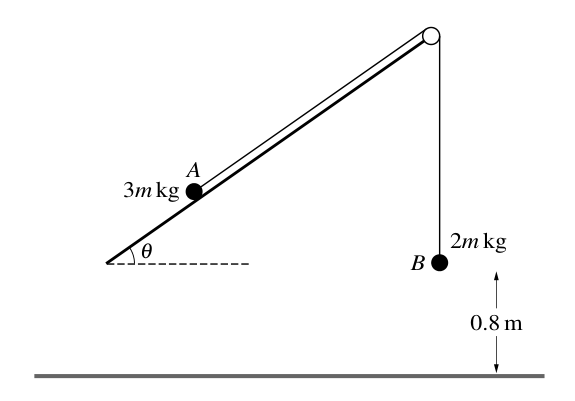
The exam paper's own figure for this question.
- 1
Consider 's equilibrium. Only tension (up) and weight (down) act on :
B hangs freely with nothing else touching it, so its equilibrium equation involves only these two forces — the simplest place to start.
- 2
Consider 's equilibrium, resolved along the plane. Because the plane is smooth, there is no friction term at all — only tension (up the slope) and the component of 's weight (down the slope):
This is where 'smooth' does its work: on a rough plane this equation would have a third term, F, and a whole range of θ could keep A at rest. Here, with only two terms, θ is pinned down exactly.
- 3
Substitute from the first equation:
The string is light and the pulley smooth, so the tension pulling A up the slope is the same T as the one holding B up — that shared T is the only thing linking the two equations, and it is what lets one substitution finish the problem.
- 4
Divide both sides by (it cancels completely, so the answer does not depend on ):
Symbolic masses like 3m and 2m are the paper telling you in advance that m will cancel — if it does not cancel, a term has been dropped somewhere, so this is a free check on the two equations above.
- 5
Solve for :
Leave the inverse sine to the very last line and feed it the exact fraction 2/3, not a rounded 0.67 — rounding before an inverse trig function is where 1 d.p. answers most often come out a tenth wrong.
.
When a plane is smooth, expect the equilibrium equation along it to have exactly two terms, not three — and expect the answer to be a single specific value, not a range, precisely because there is no friction left to absorb any imbalance.
Your turn
- 1
A block rests on a smooth plane inclined at to the horizontal, held by a string parallel to the slope with tension . State the equilibrium equation along the plane, and explain why — unlike on a rough plane — there is only one value of for which the block can be at rest for a given .
Stuck? Show hint
Write the equation with only two forces along the slope, then ask what a third force would have done to it.
Show solution
- 1
Along the plane, the only forces are the tension up the slope and the weight's component down it — no friction term, because the plane is smooth:
Write the equation before the explanation: the argument the question wants is really just a comment on how many terms this equation has.
- 2
Read off the consequence. This is one equation in one unknown, so for a given (and a given mass) it has exactly one solution for . Any other value of would leave a net force along the slope and the block could not stay at rest.
'Only one value works' is not a special law of smooth planes — it is just what one equation in one unknown means. Naming it that way is what makes the contrast with the rough case land.
- 3
Contrast with a rough plane, in words. There, friction is not a fixed quantity: it adjusts itself to whatever value is needed, up to some maximum. So a tension a little smaller than would still hold the block, with friction making up the difference by acting up the slope; a tension a little larger would also hold it, with friction now acting down the slope. A whole band of values works, rather than a single one.
This is the idea, and it can be stated fully without any algebra — §06 is where that maximum gets a formula and the band gets numerical endpoints. Quoting μ here would only hide the reasoning behind symbols you have not met yet.
Answerexactly. On a smooth plane there is no friction to make up any difference, so only this one value of holds the block; on a rough plane, friction could take any value up to its maximum, so a whole range of tensions would work.
- 1
- 25 marks
A particle of mass rests on a smooth plane inclined at to the horizontal, held in equilibrium by a horizontal force of magnitude . Find and the normal reaction .
Stuck? Show hint
Resolve parallel to the plane first — with the plane smooth, that equation has only two terms.
Show solution
- 1
Split into components relative to the plane. is horizontal, not along the slope, so it has a component up the slope and a component pressing into the plane.
A horizontal force on an incline always appears in both resolving equations — this is the step students skip, treating X as though it acted along the slope and losing the X sin 30° term in the second equation.
- 2
Write the equilibrium equation along the plane. The only two along-slope forces are 's component (up) and the weight's component (down); the plane is smooth, so there is no friction term:
Because the plane is smooth, this single equation contains the single unknown X — on a rough plane the unknown F would join it and one equation would no longer be enough.
- 3
Rearrange for :
Rearranging symbolically before substituting keeps the structure visible — and here it shows X = 4g tan 30°, which is a quicker route if you spot it.
- 4
Substitute and the trig values:
Evaluate numerator and denominator separately before dividing: the commonest calculator slip here is typing 40 × 0.5 ÷ cos 30 without brackets and getting the division applied to only part of the numerator.
- 5
Evaluate:
Sanity check: X is less than the 40 N weight but more than the 20 N along-slope pull, because only part of X acts along the slope — the rest is wasted pushing into it.
- 6
Now resolve perpendicular to the plane for . The weight presses in with and presses in too with , so the plane must push back with the sum:
The two terms add here, unlike the §04 example where the pull was above the horizontal and its component subtracted — check which way the force tilts relative to the surface before choosing the sign.
- 7
Substitute and evaluate:
N exceeds the full 40 N weight, which is correct: the horizontal force is squeezing the block against the slope on top of gravity.
Answer, .
- 1
Two connected particles, each on its own surface. So far every example has had one particle with every force drawn on it. Paper 4 also asks about a string with a particle at each end, passing over a smooth pulley — a block on a table pulled by a string that runs over a pulley at the table's edge and down to a hanging mass, say. The two particles sit on different surfaces, pulled in different directions, so there is no single equation for "the system": you cannot resolve a horizontal block and a vertical hanging mass along the same axis at once.
The method is to isolate each particle in turn. Draw a fresh diagram for just one particle, with only the forces acting on that particle — not the other one, not the string's forces on the pulley, nothing else — and write its own equilibrium equation. Then do the same for the second particle, with its own diagram and its own equation.
This only works because of what "light" and "smooth" mean for the string and pulley. The string is light (massless) and inextensible, and the pulley is smooth — frictionless where the string runs over it. A smooth pulley cannot grip the string, so it cannot pull harder on one side than the other; the tension is therefore the same value throughout the whole string, on both sides of the pulley. (A rough pulley could grip the string and resist it slipping over the surface, so the tension could differ on each side — that case does not arise on this syllabus, but it is worth knowing why smooth matters here.) That one shared is what links the two separate equations: it is the unknown that appears in both, and solving them together is what makes the problem solvable at all.
Isolating each particle: a block and a hanging mass over a pulley
A particle of mass hangs freely from a light inextensible string. The string passes over a smooth pulley fixed at the edge of a smooth horizontal table, and its other end is attached to a block of mass resting on the table. The block is held in equilibrium by a horizontal force of magnitude , applied in the vertical plane containing the string. Find the tension in the string, the value of , and the normal reaction between the block and the table.
Show full working
- 1
Isolate the hanging particle first. Draw it on its own: only two forces act on it — its weight downwards, and the tension upwards, where the string leaves the pulley and runs straight down to it.
Start with whichever particle has the fewest forces on it — here the hanging mass, with just two — exactly the 'fewest unknowns first' strategy used throughout this topic. Nothing about the block or the table belongs on this diagram at all.
- 2
Write its equilibrium equation. With nothing else acting on it:
This equation contains only the hanging particle's own mass — the block's 5 kg does not appear here. That is the point of isolating: each particle's equation only ever contains the forces drawn on that particle's own diagram.
- 3
Substitute :
The tension is now a known number before the second particle is even considered — that is exactly why starting with the simpler particle pays off.
- 4
Isolate the block second. Draw it separately: its weight down, the normal reaction up, the applied force horizontal, and the tension — horizontal too, since the string runs along the table to the pulley at the edge, pulling the block towards it.
This is a completely fresh diagram. The hanging particle's weight and the pulley itself do not appear on it — only the forces that act directly on the block.
- 5
Resolve horizontally for the block. pulls the block one way (towards the pulley); must balance it:
The table is smooth, so there is no friction term to include — otherwise a third force would sit in this equation, exactly as in §06.
- 6
Substitute the value of found above:
This is the whole method in miniature: a quantity found from one particle's equation is carried across and substituted into the other's — the shared is the bridge between the two diagrams.
- 7
Resolve vertically for the block, to find . Nothing here pulls the block up or down except its own weight and the table's reaction, since and are both horizontal:
Students often expect the hanging particle's weight to show up somewhere in the block's equations — it does not. Once T is known as a number, the two particles no longer interact except through that number.
- 8
Evaluate:
A quick check: with both T and P horizontal, N here is simply the block's own weight — the same as a block sitting on a table with no vertical pull anywhere, because nothing else has a vertical component to disturb it.
, , .
Draw two diagrams, not one. The particle with fewer forces goes first, its equation is solved completely, and the resulting number is substituted into the second particle's equation — the shared tension T is the only thing that ever crosses from one diagram to the other.
The exam version: three hanging masses linked through two smooth pulleys
Three blocks , and , of masses , and respectively, are held in equilibrium by three light inextensible strings , and . The strings and both pass over small fixed smooth pulleys and respectively, with and hanging vertically below the pulleys. The block hangs vertically below the point . The angle between and the vertical is and the angle (see diagram).
Find the value of and the value of .
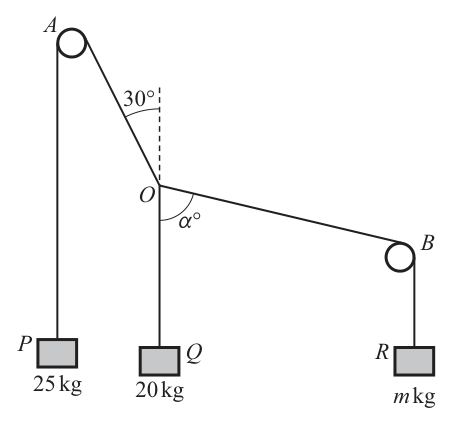
The exam paper's own figure: P and R hang from smooth pulleys A and B, Q hangs directly below the knot O.
Show full working
- 1
Turn each smooth pulley into a known tension. runs over the smooth pulley down to , which hangs freely — so exactly as in the worked example above, the tension throughout equals 's own weight: . In the same way, . needs no pulley at all — it hangs directly from , so immediately.
This is the isolating method from the invented pulley example above, applied twice over, before any resolving happens at all: a smooth pulley converts 'particle hangs freely with weight ' straight into 'tension in that string is ' — no equilibrium equation for P or R needs to be written out separately.
- 2
Treat itself as the object in equilibrium. Three strings meet at , pulling outwards towards , and with the three tensions just found. has no mass of its own, but it is still held in place by three forces, so the same equilibrium idea from §03 applies: the three tensions must balance.
This is the forces-at-a-point case from §03, not a new idea — the only new content here is that two of the three 'forces at a point' are tensions supplied by smooth pulleys rather than given directly.
- 3
Resolve horizontally at . pulls at to the vertical one way; pulls at to the vertical () the other way; itself is vertical and contributes nothing horizontally:
OQ is the one string with no horizontal component at all, since it hangs straight down — that is what keeps this equation to only two terms.
- 4
Resolve vertically at . and both pull upward (towards their pulleys); pulls straight down:
All three strings appear here, because all three have some vertical component — unlike the horizontal equation, nothing drops out for free.
- 5
Substitute the known tensions into the horizontal equation. With and , then divide every term by :
Dividing every term by g turns the equation into pure numbers — a useful check, since m and α cannot depend on the strength of gravity, only on the masses.
- 6
Substitute into the vertical equation, with as well, and divide by again, rearranging so is alone:
Keep the unrounded 1.6506… — it is a small difference of two larger numbers, so early rounding would visibly change α and m.
- 7
Divide the two equations to eliminate :
Dividing a 'sin =' equation by a 'cos =' equation is the standard way to isolate an angle when both its sine and cosine multiples of the same unknown are known — the same trick as finding a resultant's direction in §02.
- 8
Substitute back to find , using either equation (or Pythagoras on the two right-hand sides):
Using the unrounded 1.6506 here, not the rounded 82.5°, keeps the final answer accurate — feeding a rounded α back through sin or cos is where 3 s.f. answers commonly drift.
, (both 3 s.f.).
Two smooth pulleys, two 'tension = weight of the hanging particle' facts, and then an ordinary three-force equilibrium at the knot — the smooth pulleys do all their work in the very first step, before any resolving starts.
A ring or bead threaded on a rod or wire. The exercise in §04 above uses "normal" for a ring on a circular wire, where the normal reaction points along the radius. A ring or bead can also be threaded on a straight rod or wire, and the geometry is simpler but the difficulty moves somewhere else.
"Normal" always means perpendicular to the surface the body is actually touching — for a straight rod, that is perpendicular to the rod itself, whatever direction the rod happens to be fixed in. On a vertical rod, perpendicular to the rod is horizontal, so the normal reaction is horizontal. On a horizontal rod, perpendicular to the rod is vertical, so the normal reaction is vertical — but here a genuine ambiguity appears that a flat table never has.
On a table, the surface can only push one way: up, away from itself. A rod threaded through a ring is different — the rod can push the ring either up or down, because the ring is threaded onto it, not resting on top of it. Which way the rod actually pushes depends on everything else pulling on the ring: if a string or other force pulls the ring down harder than its own weight, the rod must push up to hold it in place; if the vertical pull is upward and larger than the weight, the rod pushes down instead to stop the ring sliding off the top. That sign — up or down — is the whole difficulty of this kind of question, and it usually cannot be seen just by looking at the picture.
The standard way through it: assume a direction for , write the equilibrium equations as normal, and solve. A positive value confirms the assumed direction was right; a negative value means the reaction actually points the other way — the algebra corrects the guess, so there is no need to get the direction right by inspection first.
Real rod questions are almost always rough rather than smooth, so the worked examples that put this geometry to use — a ring on a vertical rod and a ring on a horizontal rod — appear in §06, once limiting friction and are available to actually finish them.
Limiting friction, limiting equilibrium and F = μR
“
understand the concepts of limiting friction and limiting equilibrium, recall the definition of coefficient of friction, and use the relationship F = μR or F ⩽ μR, as appropriate (terminology such as 'about to slip' may be used to mean 'in limiting equilibrium' in questions).
A note on letters first. This note writes for the normal reaction everywhere — it is the normal component of the contact force you met in §04, and the same letter appears in every figure and on the formula sheet. Printed mark schemes almost always call it instead, so expect to see on the page when you check your answers; it is the same quantity under a different name, and either letter earns the marks.
On a rough surface, friction is not fixed — it adjusts itself, up to a maximum, to whatever is needed to keep the object still. That maximum is set by the coefficient of friction (the Greek letter "mu") — a number, usually between and , that measures how grippy the two surfaces in contact are. The bigger , the more friction is available:
For almost every configuration, friction sits somewhere below this ceiling — exactly enough to hold equilibrium, no more. Only at the exact moment the object is on the verge of sliding — called limiting equilibrium, or "about to slip" — does friction reach its maximum. That maximum value, , is called limiting friction, and only then may you write the equation with equality:
Using when the question has not told you the object is limiting is one of the most common ways marks are lost in this topic — check the wording first.
Why the ceiling is proportional to . Friction comes from the two surfaces gripping each other where they touch. The harder they are pressed together, the more grip is available — so the maximum friction is not a fixed number for a pair of surfaces, but scales with how hard they are pressed, which is exactly what measures. Double and you double the maximum friction; lift the object clear of the surface so , and no friction is available at all.
That proportionality is what makes a constant for a given pair of surfaces rather than a number that changes from question to question, and it gives the definition the syllabus asks you to recall: the coefficient of friction is the ratio of the limiting (maximum) frictional force to the normal contact force.
Definition of the coefficient of friction
is the frictional force at limiting equilibrium — the largest friction those two surfaces can supply at that normal reaction. Being a ratio of two forces, has no units.
Same block, same slope — only the impending direction of motion changes which way friction acts.
Choosing friction's direction
Friction always opposes the way the object would move if friction were removed — never the direction of an applied force by itself. Ask: "if there were no friction here, which way would this slide?" — then draw pointing the other way. On a slope with a force pushing up it, that could mean the object would slide up (if the force wins) or down (if weight wins); the question's wording — "on the point of moving up" vs "on the point of moving down" — tells you which.
Finding μ at limiting equilibrium
A block of mass rests in limiting equilibrium on a rough horizontal floor under a horizontal force of . Find the coefficient of friction .
Show full working
- 1
Resolve vertically to find . The applied force is horizontal, so it has no vertical component at all and the normal reaction simply balances weight:
N must be found before μ can be, because μ is defined as a ratio involving N — and N only equals mg because nothing else here has a vertical component. As soon as the applied force is tilted (or the surface is), this line stops being true.
- 2
Resolve horizontally. At limiting equilibrium, friction is at its maximum and exactly balances the applied force:
'Limiting equilibrium' is the phrase that licenses writing F = μN with an equals sign rather than F ⩽ μN.
- 3
Substitute into the definition and solve for :
This is just μ = F_max/N read forwards. The answer has no units, and should almost always come out between 0 and 1 — a μ of 4 or 40 means N and F have been divided the wrong way round.
.
The same idea, on the real exam
A particle of mass lies at rest on a rough horizontal plane. A horizontal force of is applied to . Given that is in limiting equilibrium, find the coefficient of friction between and the plane.
Show full working
- 1
Resolve vertically for :
Masses under 1 kg are where candidates lose marks by forgetting to multiply by g at all and writing N = 0.2 — always convert mass to weight explicitly before it enters the equation.
- 2
Resolve horizontally. "Limiting equilibrium" licenses directly, with equal to the full applied force:
The applied force is horizontal and the plane is horizontal, so the whole 1.2 N is opposed by friction — no resolving of the applied force is needed, which is what keeps this a 3-mark question rather than a 6-mark one.
- 3
Solve for :
Note the answer is bigger than the 0.4 of the invented example even though the force is much smaller — μ compares friction to N, not to anything absolute, so small numbers throughout can still give a large coefficient.
.
Every limiting-friction question resolves to this same two-line shape: find N first, then substitute F = μN into the second resolving equation. (On the printed mark scheme the same lines will be written with R.)
Your turn
- 1
A block of mass rests in limiting equilibrium on a rough horizontal floor under a horizontal force of . Find .
Stuck? Show hint
Find N from vertical equilibrium first, then use F = μN.
Show solution
- 1
Resolve vertically for . The applied force is horizontal, so it contributes nothing vertically and the floor balances the weight alone:
Find N first, always — μ is defined as a ratio involving N, so there is nothing to substitute into until N is known.
- 2
Resolve horizontally for . The block is in equilibrium, so friction exactly balances the applied force:
This is F from the balance of forces, not from μN — that is the honest order. The next step is what connects the two.
- 3
Use the limiting condition. The block is in limiting equilibrium, so this 15 N is the maximum friction available, and the equality may be used:
Without the word 'limiting' all you could write is 15 ⩽ 50μ, which gives a range for μ rather than a value — the word is doing real work in the question, not decorating it.
- 4
Solve for :
Dividing friction by normal reaction (not the other way round) is the definition μ = F_max/N; the answer has no units, and 0.3 is a plausible value for two ordinary surfaces.
Answer.
- 1
- 24 marks
A particle of mass lies on a rough plane inclined at to the horizontal, and is on the point of sliding down. Find the coefficient of friction.
Stuck? Show hint
On the point of sliding down means friction acts up the plane, at its maximum.
Show solution
- 1
Resolve perpendicular to the plane for . Nothing acts on the particle except its weight and the contact force, so the derivation is exactly the one in §04 — the weight's perpendicular component is (the §04 callout explains why the angle appears twice):
No need to re-derive the geometry here: §04 established once and for all that on a plane at θ, the weight splits as mg cos θ perpendicular and mg sin θ parallel. Recognising that this is the same situation, only now with μ asked for, is the point of the exercise.
- 2
Evaluate :
Show this line even though the number itself is never needed: the mark scheme awards a method mark for resolving perpendicular to the plane, and N is about to cancel out of the final answer anyway.
- 3
Resolve parallel to the plane. The particle is on the point of sliding down, so friction acts up the plane at its maximum value, balancing the weight's down-slope pull:
'On the point of sliding' is the trigger phrase for limiting equilibrium, which is what allows μN to be written with an equals sign instead of an inequality.
- 4
Substitute the expression for rather than its number:
Putting the algebra back in, instead of the 28.2, is what makes the next step's cancellation visible — substitute 28.2 here and you get the right answer but miss the general result entirely.
- 5
Cancel the mass and . They appear identically on both sides, so
This is the memorable result: on a plane with no force other than weight and the contact force, limiting equilibrium gives μ = tan θ exactly — the coefficient depends only on the angle, never on the mass. It also means the angle at which an object just begins to slide is a direct measurement of μ.
- 6
Evaluate:
Quote the full resolving working in the exam even if you spot μ = tan θ immediately — the method marks are awarded for the two resolving equations, not for the shortcut.
Answer.
- 1
A harder case: a horizontal force on an inclined plane
A particle of mass is on a rough plane inclined at to the horizontal. A horizontal force of magnitude acts on the particle, which is on the point of moving up a line of greatest slope of the plane. The coefficient of friction between the particle and the plane is . Find the value of .
Show full working
This paper's original question gives no figure — the situation is described in words only, so this sketch is supplied to help visualise it.
- 1
Note that , being horizontal, has a component in both resolving directions — not just along the slope. Resolve perpendicular to the plane first, to find : weight's perpendicular component points into the slope, and so does 's:
This is the key difference from the earlier examples in this section: because P is horizontal rather than already along the plane, it changes N itself, not just the along-plane balance — N can no longer be found on its own before P is known.
- 2
Resolve parallel to the plane. The particle is on the point of moving up, so friction (opposing that impending motion) acts down the plane:
P's along-plane component drives the impending upward slide; it is opposed by both gravity's downslope pull and friction, both now on the same side of the equation.
- 3
On the point of moving means limiting equilibrium, so substitute :
N itself contains P (from the first step), so this single equation now has P appearing on both sides — it needs to be collected, not just substituted.
- 4
Expand the right-hand side, using so :
Multiply the bracket out fully before touching the calculator — the term 0.8P sin 25° is the one that gets lost if you try to evaluate and rearrange in the same move, and losing it makes P come out far too small.
- 5
Evaluate the trig values and the purely numerical terms:
Keep four significant figures in these intermediate coefficients. The final step divides by a small difference (about 0.57), which magnifies any early rounding — work to 2 s.f. here and the answer can be out by several newtons.
- 6
Collect the terms onto one side:
P genuinely appears on both sides because it changes N, which in turn changes the friction — this is an equation to be solved, not a formula to be evaluated, and treating it as the latter is the main reason this question is worth 6 marks.
- 7
Simplify and solve:
P is about twice the particle's 120 N weight, which is reasonable: with μ = 0.8 the surface is very rough, and a horizontal push wastes much of its effort pressing the particle into the slope — making the friction it has to overcome even larger.
.
Whenever an applied force is not already along the plane, expect it to appear in both resolving equations — solve by substituting one equation into the other and collecting every term in the unknown onto one side, exactly as with any pair of simultaneous equations.
The general case: a force at an angle to the slope itself. The example above is really one special case of something more general. On a slope, forces are always resolved along the plane and perpendicular to it — never horizontally and vertically — because that is the choice that keeps sitting on one axis and on the other, with each unknown appearing in only one equation (§04). A horizontal force, like the one above, still has to be broken into those same two slope-relative directions; it just happens to have a fixed angle (the slope angle itself) to the line of greatest slope.
The fully general version drops that restriction. Suppose a force of magnitude is applied at some angle to the line of greatest slope — not necessarily horizontal, not necessarily along the slope, just tilted at to it. Resolve it exactly as you would resolve weight, only measuring from the slope instead of the horizontal:
joins the along-slope equation, alongside weight's and friction, exactly like any force already lying in that direction. joins the perpendicular equation — and that component is the one worth pausing on.
Why the perpendicular component matters more than the along-slope one. changes — and because friction's ceiling is , it changes how much friction is even available. A force tilted away from the surface (angled up and off the slope, as in every example below) lifts the particle slightly, so it is subtracted from weight's own perpendicular component: A force tilted into the surface instead presses the particle harder against the plane, so the two perpendicular components add: Either way, is not here — this is the same warning §04's mistake block gives for a tilted force on flat ground (a pull with an upward component lightens ; a push with a downward one increases it), now carried onto a sloped surface. Get the sign of backwards and every later line — the friction ceiling, the along-slope equation, the final answer — is wrong.
β is measured from the slope, not the horizontal
Read the angle carefully before resolving anything. If a question states the angle to the line of greatest slope (as every example below does), that angle is and / can be written immediately. If instead a question gives the angle to the horizontal, that is not — the angle to the slope is the difference between the force's angle to the horizontal and the slope's own angle (when both are measured on the same side of the slope). Using the horizontal angle directly in place of silently swaps which component gets and which gets , and the error is easy to miss because the equations still look sensible.
A force at an angle to the slope
A block of mass rests on a rough plane inclined at to the horizontal. The coefficient of friction between the block and the plane is . A force of magnitude is applied to the block at an angle of above a line of greatest slope of the plane, and the block is on the point of sliding up the plane. Find .
Show full working
The block on its 25° slope — the applied force P is tilted 20° above the line of greatest slope, so it is not one of the two special cases (along the slope, or horizontal) met so far.
- 1
Resolve into its two slope-relative components. At to the line of greatest slope, has a component along the slope and a component perpendicular to it, pointing away from the surface — the force is angled up and off the plane, not into it.
This is exactly the general resolving rule from the concept box above, applied for the first time: measure β from the slope, not the horizontal, and split P using cos for the along-slope piece and sin for the perpendicular piece.
- 2
Resolve perpendicular to the plane to set up an equation for . Weight presses the block into the surface; 's perpendicular component lifts it away, so the two work against each other:
Because P is unknown, N cannot be found as a plain number yet — this equation has to be carried forward with P still in it, exactly as the earlier horizontal-force example warned.
- 3
Make the subject, substituting :
This is now an expression in P, not a number — it is what gets substituted into the friction ceiling in a later step, so keep four figures in the coefficients to avoid the rounding drift the earlier 6-mark example warned about.
- 4
State that friction is limiting, and fix its direction. The block is on the point of sliding up, so friction is at its maximum value and acts down the slope, opposing that impending motion.
'On the point of sliding up' is the exam phrase for limiting equilibrium (§06's opening definition) — it licenses F = μN with an equals sign, and settles which way F points before any equation is written, exactly as the callout on choosing friction's direction describes.
- 5
Resolve along the plane. 's along-slope component drives the impending upward slide; weight's component and friction both act down the slope, opposing it:
Weight and friction end up on the same side here because both resist the upward slide — this is the along-slope equation the perpendicular equation above was built to feed into.
- 6
Substitute , using the expression for from step 3 — not a number:
N still genuinely contains P, so it is the expression that goes in here, not 36.25 on its own — substituting a number at this stage is the single most common way this question type goes wrong.
- 7
Expand the bracket and evaluate the purely numerical terms, using (4 s.f.):
Multiply the bracket out fully before doing anything else — the term is exactly the one that goes missing if expanding and collecting are attempted together.
- 8
Collect the terms onto one side. Both terms genuinely belong on the left: one from 's own along-slope pull, the other from 's effect on and hence on friction:
This is the step it is easiest to skip straight past — writing 0.9397P = 27.78 − 0.1026P and dividing immediately, without moving the second P-term across first, is where marks are lost even when every equation above was correct.
- 9
Simplify and solve:
A sanity check: P is a little under the block's own 40 N weight, which is reasonable — some of P's effort is going into lifting the block off the surface (which actually helps, by reducing the friction it has to overcome) rather than all of it driving the slide.
.
Whenever a force is given at an angle to the line of greatest slope (rather than along it or horizontal), resolve it as P cos β along the slope and P sin β perpendicular to it, check whether that perpendicular piece adds to or subtracts from N, then follow the same two-equation, collect-the-unknown method as any other tilted-force question.
The real exam version: P at an angle above the slope
A particle of mass is stationary on a rough plane inclined at an angle of to the horizontal. A pulling force of magnitude acts at an angle of above a line of greatest slope of the plane. This force is used to keep the particle in equilibrium. The coefficient of friction between the particle and the plane is .
Find the greatest possible value of .
Show full working
- 1
Fix friction's direction. At the greatest possible , the particle is on the point of sliding up the plane (a larger still would overpower everything else), so friction is at its maximum, acting down the slope.
Exactly the same reasoning as the invented example above: 'greatest possible P' is limiting equilibrium, and the particle's tendency at that extreme fixes which way F points.
- 2
Resolve perpendicular to the plane. The pull is above the slope, so it lifts the particle slightly, reducing below :
Same structure as step 2 of the invented example — only the numbers and the angle β = 8° have changed, not the method.
- 3
Make the subject, with :
Carried forward as an expression in P, exactly as before — P is still the unknown being solved for.
- 4
Resolve along the plane. 's along-slope component drives the particle up; weight's component and friction both resist it:
The mirror image of the invented example's along-slope equation — weight and friction again sit together, opposing P's along-slope pull.
- 5
Substitute with , using the expression for :
The expression for N, not a number — P has not been found yet, so N cannot have been either.
- 6
Expand the bracket and evaluate the numerical terms, using (4 s.f.):
Expand fully before collecting — the small term is easy to lose, and losing it here changes the third significant figure of the final answer.
- 7
Collect the terms onto one side:
The same collecting step as the invented example — do it as its own line, rather than folding it into the division that follows.
- 8
Simplify and solve:
This matches the printed mark scheme exactly. Note how small β = 8° is here compared with the invented example's 20° — even a small tilt still changes N enough to be worth the extra algebra rather than approximating P as acting purely along the slope.
(3 s.f.).
This is the same method as the invented example, just with the numbers supplied by a real paper — spot the phrase 'greatest possible value', decide the direction of impending slipping from it, and the rest is the same two-equation, collect-and-solve routine.
Your turn: a force at an angle to the slope
The first question mirrors the worked examples directly — pulling up and away from the surface, solving for a coefficient instead of a force. The second is a genuine exam-standard stretch: the applied force is angled the other way (into the surface, and down the slope), and everything stays in terms of and throughout.
- 19709/42 M/J 2022 Q56 marks
A block of mass is placed on a plane which is inclined at an angle of to the horizontal. A light string, making an angle of above a line of greatest slope, is attached to the block. The tension in the string is . The coefficient of friction between the block and plane is . The block is in limiting equilibrium and is on the point of sliding up the plane.
Find .
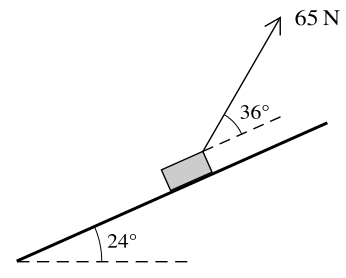
Fig. 5.1, as printed with the question — the block on the 24° slope, with the string's tension at 36° above the line of greatest slope.
Stuck? Show hint
This is the same shape as the two worked examples above, just with T given as a number and μ as the unknown instead of P — resolve perpendicular for N first, since T is already known N comes out as a plain number.
Show solution
- 1
Resolve perpendicular to the plane for . The string pulls up and away from the surface, so its perpendicular component reduces :
Same perpendicular equation shape as both worked examples — only here T = 65 is already a number, so, unlike those examples, N can be evaluated immediately rather than carried as an expression.
- 2
Evaluate:
Keep the unrounded value for the next step — it feeds into both the friction ceiling and, eventually, μ.
- 3
Resolve along the plane. The block is on the point of sliding up, so friction acts down, opposing the string's along-slope pull:
The along-slope equation from both worked examples, reused directly — weight and friction together oppose the applied force's along-slope component.
- 4
Solve for :
F comes out small and positive, which is a reasonable sanity check — the string is only just strong enough to need help from friction at all.
- 5
Use limiting friction to find :
'Limiting equilibrium' licenses F = μN, so this final division is the definition of μ read forwards — exactly as in the very first example of this section.
Answer(3 s.f.).
- 1
- 29709/41 O/N 2025 Q56 marks
A particle of mass is in equilibrium on a rough plane inclined at an angle to the horizontal. The equilibrium of is maintained by a force of magnitude making an angle with a line of greatest slope (see diagram). The coefficient of friction between and the plane is and is on the point of slipping down the plane.
Find the value of .
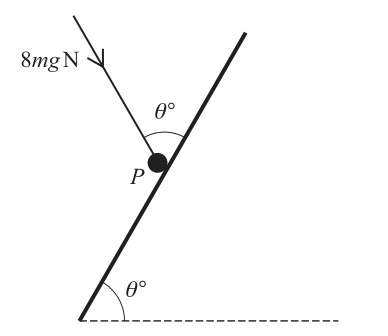
Fig. 5, as printed with the question — this time the applied force is angled the other way from every earlier example: down the slope and into the surface, at angle θ to the line of greatest slope.
Stuck? Show hint
Read the diagram carefully before resolving: here both the weight's and the force's perpendicular components press the particle into the surface (they add), and both along-slope components point down the slope — friction alone, acting up, holds P still. The angle θ appears in every trig term, so it will not cancel out until the very last step.
Show solution
- 1
Read the geometry from the diagram. The force is angled from the line of greatest slope, tilted the opposite way from every earlier example in this section — down the slope and into the surface. It splits into down the slope and into the surface.
The method (resolve at angle θ to the slope, cos along it, sin perpendicular) is unchanged from the concept box above — only the direction of each component has flipped, because this force pushes rather than pulls. Always re-check the diagram's arrow rather than assuming the last example's directions carry over.
- 2
Resolve perpendicular to the plane for . Both weight's component and the force's component now press into the surface, so — unlike every earlier example — they add rather than oppose:
This is the 'into the surface' case from the concept box's second equation, not the 'away from the surface' one every worked example above used — the two perpendicular contributions add because both point the same way.
- 3
Resolve along the plane. is on the point of slipping down, so friction is at its maximum, acting up the slope; both weight's and the force's along-slope components pull down, and friction alone resists them:
This is the mirror image of every earlier along-slope equation in this section: there is no separate applied force to balance against gravity, because the applied force is itself pulling down the slope alongside weight.
- 4
Use limiting friction, with :
'On the point of slipping' licenses the equals sign, exactly as in every limiting-friction example so far — only now every term carries both m and g, since neither was ever given a numerical value.
- 5
Divide every term by , since it appears in all of them:
Neither m nor g was ever going to affect the answer — the particle's mass cancels out of a limiting-friction equation on a slope whenever weight and the applied force are both proportional to it, exactly as μ = tan θ did in an earlier exercise with no applied force at all.
- 6
Collect like terms. Move the terms to one side and the terms to the other:
This is a single equation in one unknown, θ, now that m and g are gone — but with both sin θ and cos θ still present, it needs one more move before it can be solved.
- 7
Divide both sides by to leave a single trig ratio:
Dividing by cos θ turns sin θ / cos θ into tan θ — the standard move whenever an equation mixes sin and cos of the same angle and needs to be reduced to one function before it can be solved.
- 8
Solve for :
Check by substituting back into the divided equation: 8cos 68.2° + sin 68.2° = 2.971 + 0.928 = 3.90, and 0.5cos 68.2° + 4sin 68.2° = 0.186 + 3.714 = 3.90. Both sides agree, so θ = 68.2° is right.
Answer(3 s.f.).
- 1
Friction is not one value — it is a band. Every example so far has asked for a single number: a mass, a force or a at the one moment the object is exactly on the point of slipping. But a huge class of exam questions instead fix the slope, the weight and , and ask for the range of some applied force that keeps the object still. That range exists because of the inequality from the start of this section, — friction is not forced to take one value, it supplies whatever the equilibrium equation needs, up to its ceiling of , and no more.
Think about what happens as is slowly increased from zero, on a slope that would let the object slide down under gravity alone.
- If is too small, gravity's pull down the slope is winning, and even the largest friction available (, acting up the slope to help ) is not enough to hold the object still — it slides down. The smallest for which equilibrium is still just possible is the one where friction is working at its absolute maximum, up the slope, and the object is on the point of sliding down.
- As increases past that point, less help from friction is needed, so friction obligingly supplies less — it is still acting up the slope, but below its ceiling. The object sits in ordinary (non-limiting) equilibrium for a whole stretch of values.
- Eventually becomes so large that it starts to overpower gravity the other way — now the object would tend to slide up the slope if friction vanished, so friction switches to act down the slope, opposing that. As keeps increasing, friction is again pushed harder and harder until it reaches its ceiling once more — this is the largest for which equilibrium is still just possible, with the object on the point of sliding up.
- Push past that, and friction — now at its maximum in the only direction left available to it — still cannot hold the object back, and it slides up.
That gives exactly two limiting cases, one at each end of the band, and they are mirror images of each other:
The two limits, side by side
Least — about to slide down: friction is at its maximum, acting up the slope (helping hold the object up). Resolve along the slope with friction and on the same side, both opposing weight's downslope pull.
Greatest — about to slide up: friction is at its maximum, acting down the slope (now opposing , alongside weight). Resolve along the slope with alone opposing both weight and friction.
Between these two values of , the object is in ordinary equilibrium and friction is somewhere below — its exact value is neither needed nor knowable from the information given, only that it lies within the ceiling.
The band of equilibrium: least and greatest T
A block of mass rests on a rough plane inclined at to the horizontal. The coefficient of friction between the block and the plane is . A force of magnitude acts on the block, up a line of greatest slope of the plane. Find the least and greatest values of for which the block remains in equilibrium.
Show full working
The same block and slope for both limits — only the direction friction acts in changes between them.
- 1
Resolve perpendicular to the plane, once, for . Neither weight's perpendicular component nor (which acts along the slope) is affected by which limit is being considered, so is the same in both cases:
This is worth doing only once: T acts along the plane, so unlike the earlier horizontal-force example, it has no perpendicular component and cannot change N. Both limits below can reuse this line.
- 2
Evaluate :
Keep more figures than this for the working itself (cos 30° = 0.8660…) — round only the final answers, or the two limits can end up inconsistent with each other by a few hundredths.
- 3
Find the friction ceiling, , once:
Both limiting equations below use this same maximum friction — only the direction it acts in differs, so it is worth isolating as its own line rather than recomputing it twice.
- 4
Least : the block is on the point of sliding down. Friction is at its maximum and acts up the slope, helping resist gravity's downslope pull, so resolve along the plane with and friction together balancing weight's component:
This is the smallest T can be before the block starts to slip — any smaller and even the full 8.66 N of friction plus T together could not hold it, so it would slide down. Friction is drawn up the slope because it is helping to prevent that downward slide.
- 5
Substitute the known values and solve for :
Isolate T as its own line rather than combining the substitution and the subtraction — with two numbers this close (10 and 8.66), a slip here is easy to make and hard to spot afterwards.
- 6
Greatest : the block is on the point of sliding up. Now is large enough that, without friction, the block would slide up instead — so friction switches direction, acting down the slope, opposing alongside weight:
This is the mirror image of the previous equation: friction has swapped sides because it now opposes T rather than assisting it. Writing the equation from scratch here (rather than just 're-arranging' the last one) is what stops the direction-flip being missed.
- 7
Substitute and solve for :
This time the two contributions add rather than subtract, because both friction and weight are now working against T — which is exactly why the greatest T is so much bigger than the least T.
- 8
State the result as a band, not two separate answers:
The question asks for equilibrium to be maintained — that is true for every T in this whole interval, not just at its two ends. Quoting only one limit, or quoting both without linking them as a range, is marked as an incomplete answer.
(3 s.f.).
Whenever a question asks for 'least and greatest' values of a force maintaining equilibrium, expect exactly this shape: one N, one μN, then two mirror-image resolving equations — friction up the slope for the least value, friction down the slope for the greatest — never a single equation with F = μN used twice in the same direction.
The real exam version: T at an angle to the slope
A particle of mass lies on a rough plane which is inclined at an angle of to the horizontal. The particle is kept in equilibrium by a force of magnitude . This force acts at an angle of above a line of greatest slope of the plane (see diagram). The coefficient of friction between the particle and the plane is . Find the least and greatest possible values of .
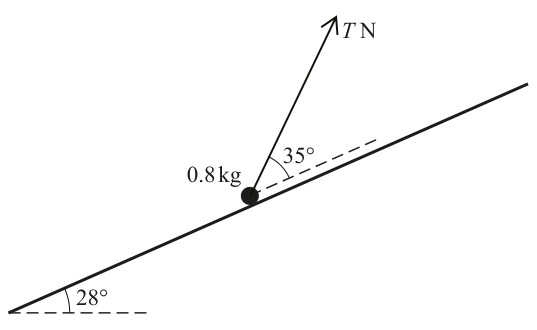
Fig. 5, as printed with the question — the particle on the 28° slope, with T acting 35° above the line of greatest slope.
Show full working
- 1
is not along the slope this time — it is tilted away from it, so, exactly as in the earlier "harder case" example, it has a component perpendicular to the plane as well as along it. That perpendicular component points away from the surface (T is tilted up and off the slope), so it works against weight's perpendicular component rather than adding to it. Resolve perpendicular to the plane:
The same warning as before applies: because T is tilted relative to the line of greatest slope, it changes N itself. N cannot be pinned down as a plain number before T is known — it has to stay as an expression in T.
- 2
Make the subject, evaluating the trig to 4 s.f. so later rounding stays controlled:
This expression, not a single number, is what both limiting equations below need to substitute — carrying it forward symbolically is what makes the rest of the question solvable.
- 3
Resolve parallel to the plane. 's along-slope component, , points up the slope; weight's component, (4 s.f.), points down. Exactly as in the invented example above, whichever way the particle is on the point of sliding fixes which way friction acts — so this splits into the same two mirror-image cases.
Recognising this as the same band structure as the invented example — just with a T-dependent N this time — is the whole point of the question; the algebra is only harder, not the underlying idea.
- 4
Least : on the point of sliding down. Friction is at its maximum, acting up the slope to help resist weight's pull:
Same logic as the invented example's least-T case: with T this small, weight is winning, so friction helps out on the same side as T.
- 5
Substitute and the expression for from step 2:
This is exactly where the 6-mark harder-case example's warning applies again: substitute the expression for N, not a number, because N genuinely still contains T at this point.
- 6
Expand the bracket fully before doing anything else:
The term 0.1147T is the one that goes missing if the bracket and the collecting-of-terms are attempted in the same line — expand first, always.
- 7
Collect the terms on the left and the numbers on the right:
One move per line: gather the T-terms first, then divide in the next line.
- 8
Divide:
This is the smaller of the two answers, as expected: it is the least T needed, with friction doing much of the work of holding the particle up.
- 9
Greatest : on the point of sliding up. Now is large enough to overpower weight, so friction switches direction, acting down the slope, opposing :
The mirror image of the least-T equation, written from scratch rather than by just flipping a sign in the previous line — that is what keeps the direction-flip explicit rather than assumed.
- 10
Substitute and again:
N is still the same expression from step 2 — the physical situation (and hence N's dependence on T) has not changed, only which side of the equation friction sits on.
- 11
Expand the bracket:
Same expansion as the least-T case — the bracket is identical, only its position in the equation has changed.
- 12
Collect the terms on the left:
This time the two T-terms add instead of partly cancelling, which is why the greatest T comes out noticeably larger than the least T.
- 13
Divide:
5.53 N is bigger than the least value 3.33 N, as it must be — if the 'greatest' answer came out smaller, friction's direction has been mixed up between the two cases.
(3 s.f.).
When the applied force is tilted away from the line of greatest slope rather than lying along it, N depends on T — carry N as an expression through both limiting equations, and only turn it into a number once the T terms on each side have been fully collected.
Finding only one of the two values when a question asks for the "least and greatest" (or "range of") force
Set up and solve two separate resolving equations, one for each limit, and quote both as a band
A 'least and greatest' question is really two limiting-equilibrium questions sharing the same N — missing one is a common and costly way to drop half the marks.
Using the same direction for friction in both limiting equations
Friction reverses direction between the two limits — up the slope at the least value, down the slope at the greatest
At the least value the object is about to slide down, so friction (opposing that) points up; at the greatest value it is about to slide up, so friction now points down. Copying the first equation's direction into the second gives an answer for the wrong scenario.
Writing for a body that is simply stated to be 'in equilibrium', with no mention of a least/greatest value or of being on the point of moving
Use : friction is somewhere below its ceiling, and its exact value comes from the equilibrium equation, not from
Only the two extreme values of T (or an explicit 'limiting'/'about to slip') justify the equals sign. For any T strictly between them, F is whatever the resolving equation says it must be to balance the forces, and that will be less than μN.
"Determine whether it moves." A different question shape uses everything above to settle a yes/no question instead of finding a force: a body is placed on a rough surface with a given applied force (or none beyond its own weight), and you are asked to decide whether it actually stays still, or whether it slides. There is no unknown left to solve for — every force is already numbered — so there is nothing to "find". What is being tested is whether you understand as a genuine constraint on what is possible, not just a formula for limiting cases.
The method has three steps, always in this order:
- Work out the friction that would be needed to hold the body in equilibrium, by resolving along the surface exactly as if it were staying still — call this . This step assumes equilibrium; it does not yet check whether that assumption is valid.
- Work out the ceiling, , from resolving perpendicular to the surface. This is the most friction the surface can ever supply, regardless of what is needed.
- Compare the two. If , the surface can supply exactly what equilibrium requires, so the body does stay still. If , no amount of friction is enough — the assumption in step 1 was false, and the body slides.
The mark scheme wants a comparison, not a number
A bare value of or of earns method marks but not the conclusion mark. The expected final line is an explicit comparison and a stated conclusion with a reason — something of the shape "since , the body cannot remain in equilibrium and it slides [up/down] the plane." Stopping after computing both numbers, without writing the comparison and the conclusion in words, is one of the most common ways this question type drops its last mark.
Does it slide? The three steps on invented numbers
A block of mass is placed at rest on a rough plane inclined at to the horizontal. The coefficient of friction is , and no force acts on the block apart from its weight and the contact force from the plane. Determine whether the block stays at rest.
Show full working
- 1
Step 1 — the friction needed. If the block stayed still, friction would have to act up the slope and cancel the weight's component down the slope:
Assume equilibrium just to find out what it would take. Nothing else acts along the slope, so friction alone would have to do all the holding.
- 2
Evaluate:
This is how hard gravity is dragging the block down the slope.
- 3
Step 2 — the ceiling. Resolve perpendicular to the plane for :
No other force has a component into the plane, so N is just the weight's perpendicular component.
- 4
Multiply by :
7.66 N is the most friction this surface can ever supply to this block.
- 5
Step 3 — compare and conclude. The surface cannot supply enough friction, so the block does not stay at rest — it slides down the plane.
The comparison and a sentence of conclusion are both needed. (Quick cross-check: tan 40° = 0.84 is bigger than μ = 0.5, and the earlier exercise showed μ = tan θ at the point of slipping, so a block with no other force on it slides whenever tan θ > μ.)
, so the block slides down the plane.
Determine whether it moves
A block , of mass , lies on a rough inclined plane sloping at to the horizontal. A light rope, inclined at an angle of above a line of greatest slope, is attached to . The tension in the rope is . There is a friction force of acting on (see diagram). The coefficient of friction between and the plane is . Given that and , determine whether will move up the plane.
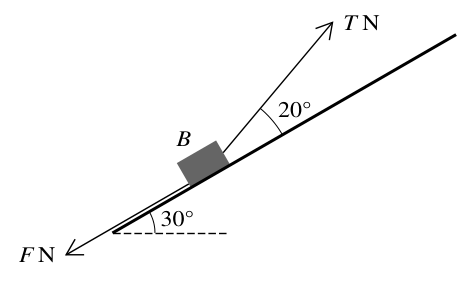
Fig. 6.1, as printed with the question — block B on the 30° slope, with the rope's tension T at 20° above the line of greatest slope.
Show full working
- 1
Resolve perpendicular to the plane for . The rope is tilted above the slope, so — exactly as with in the example above — it pulls slightly away from the surface as well as up the slope:
This is the first step of the three-step 'determine whether it moves' method above: everything else depends on getting N right first, and a tilted rope means weight alone does not determine it.
- 2
Evaluate , now that is a known number:
Because T is given as a specific value here (unlike the band question above, where it was the unknown), N comes out as a plain number straight away.
- 3
Find the friction ceiling:
This is step 2 of the method — the most friction this surface could ever supply, regardless of whether that much is actually needed.
- 4
Find the friction that would be needed to hold in equilibrium, by resolving along the plane as if it were staying still. 's along-slope component pulls up the slope; weight's component pulls down. Friction would have to cancel the difference:
This is step 1 of the method: the net pull from the other two forces along the slope. For B to stay still, friction would have to cancel all of it — so this net pull is the friction needed.
- 5
Evaluate this net pull:
A positive value means the rope is winning over weight — without friction, B would accelerate up the slope. So the friction B actually needs, acting down the slope to cancel this, is 4.10 N: this is F_needed.
- 6
Compare with the ceiling :
This is the comparison the mark scheme specifically wants written out — not just two numbers computed separately, but placed side by side with an inequality between them.
- 7
State the conclusion, with the reason. Since the friction needed is comfortably below the maximum the surface can supply, friction can and does provide exactly the 4.10 N required:
The final mark is for the conclusion together with its reason, in words — quoting the two numbers without this sentence is treated as an incomplete answer.
, so does not move — it remains in equilibrium.
Whenever a question gives you every number and simply asks whether something moves, resist the urge to look for an unknown to solve for — there isn't one. Compute F_needed and μN, compare them, and conclude in words.
Writing whenever a coefficient of friction is mentioned
Only when the question states or implies limiting equilibrium ("about to slip", "on the point of moving", "limiting")
Otherwise the correct statement is only F ⩽ μN — an inequality gives no single equation to solve, so most non-limiting questions instead give you F directly from an equilibrium equation, as in §04.
Assuming friction always acts down a slope (or always opposes the applied force specifically)
Friction opposes whichever way the object would move without it — read the wording for "moving up" vs "moving down"
The direction depends on which of gravity's pull and the applied force would win, not on a fixed rule.
Finding N from weight alone when another force has a component perpendicular to the plane
Include every force's perpendicular component in the equation for N, not just weight's
As the harder example shows, a horizontal or tilted applied force changes N itself, and N must be found with that force included before F = μN can be used.
Back to the ring on a rod. §05 set up the geometry for a ring or bead threaded on a straight rod: "normal" means perpendicular to the rod itself, so a vertical rod gives a horizontal and a horizontal rod gives a vertical — and because the ring is threaded through the rod rather than resting on it, that reaction can push either way, a direction found from the sign of the algebra rather than assumed by eye. Real rod questions are almost always rough, so the worked examples below put that geometry together with limiting friction: first an invented horizontal-rod example where the sign of comes out negative, then an exam question on a vertical rod. The exercises that follow do the same for another horizontal rod, and revisit isolating two connected particles (§05) with friction now added to one of them.
One rule matters once can be negative: the friction ceiling uses the size of . If comes out as , the rod is pushing with the other way, and the ceiling is , not .
A ring on a horizontal rod: when N comes out negative
A ring of mass is threaded on a rough horizontal rod. A light string attached to the ring pulls it with tension at above the horizontal, in the vertical plane containing the rod. The ring is on the point of sliding along the rod. Find the coefficient of friction.
Show full working
- 1
Decide the direction of . The rod is horizontal, so is vertical. We cannot tell by eye whether the rod pushes up or down, so assume acts upwards.
This is the assume-and-check method from §05. The algebra will tell us if the guess was wrong.
- 2
Resolve vertically, taking up as positive. (assumed up) and the string's vertical component act up; the weight acts down:
The string's vertical part is opposite the 60° angle, so it takes sin.
- 3
Make the subject:
One rearrangement, on its own line.
- 4
Evaluate:
3 sin 60° = 3 × 0.8660 = 2.598.
- 5
Interpret the minus sign. is negative, so the assumed direction was wrong: the rod actually pushes the ring downwards, with a force of size .
It makes physical sense: the string pulls up with 2.598 N, more than the 1 N weight, so the rod must hold the ring down. On a table this could never happen — a table cannot pull an object down — but a rod through a ring can.
- 6
Resolve horizontally. The string's horizontal component, adjacent to the , is balanced by friction:
Friction acts along the rod, opposing the direction the string is dragging the ring.
- 7
Use limiting friction with the size of :
'On the point of sliding' licenses the equals sign. Use the size 1.598, not −1.598 — a negative μ is meaningless.
- 8
Divide:
Keep the unrounded 1.5981 on the calculator for this division.
The rod pushes down on the ring with ; (3 s.f.).
Assume a direction for N, solve, and read a negative answer as 'the other way'. Then use the size of N in F = μN.
The exam version: a ring on a vertical rod
A small ring of mass is threaded on a rough vertical rod. A light inextensible string is attached to the ring and is pulled upwards at an angle of to the horizontal. The tension in the string is (see diagram). The ring is in limiting equilibrium and on the point of sliding up the rod. Find the coefficient of friction between the ring and the rod.
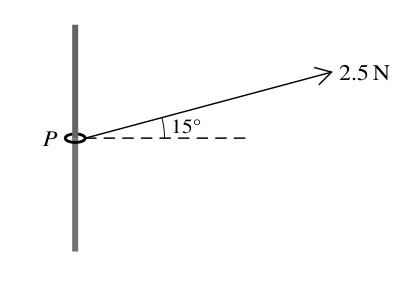
The exam paper's own figure: the string pulls the ring upwards at 15° to the horizontal, off a vertical rod.
Show full working
- 1
Decide what "normal" means here, before anything else. The rod is vertical, so — exactly as in the concept box above — the normal reaction is perpendicular to the rod, which means it is horizontal. The weight and the friction both act along the rod, i.e. vertically.
This single sentence is the whole point of the example: on a vertical rod, N is not up or down at all — it is sideways, balancing whatever horizontal pull is on the ring.
- 2
Split the tension into components. At to the horizontal, the tension has a horizontal component and a vertical component (upwards).
Measuring from the horizontal this time, not from the rod's own direction — the horizontal component is adjacent to the 15°, so it takes cos, matching the horizontal/vertical axes chosen in the step above.
- 3
Resolve perpendicular to the rod (horizontally) to find . The tension's horizontal component is the only horizontal force other than :
There is no ambiguity to resolve by sign here — only one horizontal force exists to balance, so N is pinned down immediately, unlike the up-or-down guess a horizontal rod would need.
- 4
Evaluate:
Keep the unrounded value (2.41481…) for the next line — this N feeds directly into F = μN, so rounding here would carry through to the final answer.
- 5
Resolve along the rod (vertically). The ring is on the point of sliding up, so friction is at its limiting value and acts down, opposing that motion; tension's vertical component must overcome both the weight and friction:
Friction's direction is decided from the words 'on the point of sliding up' before any algebra — the question tells you the impending motion directly, so there is no ambiguity to resolve here either.
- 6
Solve for , using :
F comes out positive and reasonably small, which is a sanity check in itself — a limiting friction force bigger than the tension supplying the motion would be a sign of a sign error above.
- 7
Use limiting friction, :
Only this final division needs limiting friction; everything above it — deciding that N is horizontal on a vertical rod, and which way friction acts — is the rod geometry from §05.
(3 s.f.).
Vertical rod ⟹ horizontal N; horizontal rod ⟹ vertical N — write that translation down first, before resolving anything, and the rest of a ring-on-a-rod question is ordinary equilibrium.
Your turn: a rod, and a linked system, both rough
The first question stays with the ring-on-a-rod geometry above, now on a horizontal rod; the second goes back to isolating two connected particles (§05), with friction added to the one on the slope.
- 19709/41 M/J 2020 Q4(a)4 marks
A ring of mass is threaded on a fixed horizontal rod. The rod is rough and the coefficient of friction between the ring and the rod is . A force of magnitude acts on the ring in a direction at to the rod, downwards in the vertical plane containing the rod. Initially the ring is at rest.
Find the greatest value of for which the ring remains at rest.
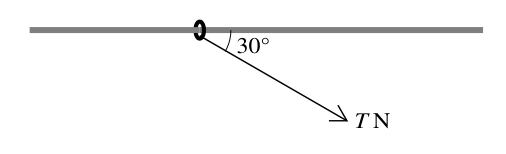
The exam paper's own figure: the force T pulls down and along the horizontal rod at 30° to it.
Stuck? Show hint
The rod is horizontal, so N is vertical — but here weight and the force's vertical component both point the same way, so there is no sign ambiguity to resolve, only a resolving equation to write.
Show solution
- 1
Split into components relative to the rod. At to the (horizontal) rod, has a component along the rod and a component downwards, since the force points down and along.
The angle is measured from the rod itself here, not from the horizontal — the along-rod component is therefore the one that takes cos.
- 2
Resolve perpendicular to the rod (vertically) to find . The rod is horizontal, so perpendicular to it is vertical; both the weight and 's vertical component pull down, so the rod must push up to balance them:
Both contributions point the same way here, which is why this case has no sign ambiguity to resolve — a horizontal rod's N is only genuinely in question when the applied force pulls upward instead, as the concept box above describes.
- 3
Resolve along the rod. The only along-rod force other than friction is ; at the greatest for which the ring stays at rest, it is on the point of sliding, so friction is at its limiting value, opposing the slide:
'Greatest value of T for which the ring remains at rest' is exam language for limiting equilibrium — it licenses F = μN exactly as 'in limiting equilibrium' did in the exercise above.
- 4
Substitute and :
T now appears on both sides — this is expected, since T itself contributes to N through its own vertical component, so the equation must be solved for T rather than read off directly.
- 5
Expand the bracket:
0.8 × sin 30° = 0.8 × 0.5 = 0.4, and 0.8 × 0.1 × 10 = 0.8. Expanding first shows clearly that T sits on both sides.
- 6
Collect the terms on the left:
Both T-terms are gathered on the left before dividing — attempting to isolate T without collecting first is where this kind of equation most often goes wrong.
- 7
Divide:
Keep the unrounded 0.46603 on the calculator for this division.
- 8
Evaluate:
A quick sanity check: T is bigger than the ring's 1 N weight, which makes sense — part of T (T sin 30°) presses the ring into the rod, raising N and so raising the friction that the along-rod part (T cos 30°) has to overcome.
Answer(3 s.f.).
- 1
- 29709/41 O/N 2022 Q6(a)6 marks
Particles and , of masses and respectively, are attached to the ends of a light inextensible string that passes over a small smooth pulley. The pulley is fixed at the top of a plane which is inclined at an angle of to the horizontal. hangs freely below the pulley and is on the inclined plane. The string is taut and the section of the string between and the pulley is parallel to a line of greatest slope of the plane.
It is given that the plane is rough and the particles are in limiting equilibrium.
Find the coefficient of friction between and the plane.
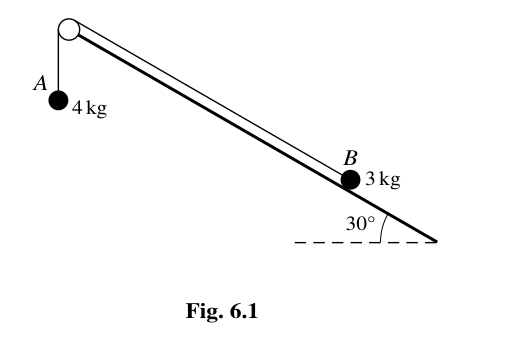
The exam paper's own figure: A hangs freely, B sits on the 30° incline, connected over the pulley at the top.
Stuck? Show hint
Isolate first — its equation gives immediately, with no mention of 's mass or the plane at all. Then isolate and work out which way it tends to slip before assigning friction a direction.
Show solution
- 1
Isolate . Only its weight down and the tension up act on it:
Exactly as in the worked example above — start with the particle that has the fewest forces on it, and its equation is free of the other particle's mass entirely.
- 2
Isolate and decide which way it tends to slip. pulls up the slope; the component of 's own weight down the slope is only . Since the pull up exceeds the pull down, tends to slide up the plane, so limiting friction acts down the slope, opposing that.
This comparison — which pull is bigger — is what decides friction's direction; it cannot be read off the diagram, and getting it backwards flips the sign of F in the next equation.
- 3
Resolve perpendicular to the plane for . Nothing but weight has a component into or out of the plane, since is along the slope:
The tension runs along the slope by construction (parallel to the line of greatest slope), so it has no component perpendicular to the plane and drops out of this equation entirely.
- 4
Evaluate:
Keep this unrounded — it is about to be divided into, and rounding here is where a 3 s.f. answer drifts in the last digit.
- 5
Resolve along the plane for . acts up the slope; 's weight component and friction (now confirmed to act down, opposing the upward tendency) act down:
This is the same 'isolate the second particle' step as the worked example, just with a rough plane — the only change is a third term, F, now sitting in this equation.
- 6
Substitute and , and solve for :
F is found from the balance of forces first; only the next step brings in μ.
- 7
Use limiting friction, since the particles are in limiting equilibrium:
'Limiting equilibrium' is the phrase that licenses F = μN rather than just F ⩽ μN — without it, F = 25 N would be as far as the question could be taken.
Answer(3 s.f.), equivalently .
- 1
Your turn: least/greatest values, on a slope and on the level
All three questions use the least-and-greatest idea from above: the first on a slope, the second on horizontal ground with a tilted force, and the third combines it with a connected system over a pulley.
- 19709/41 O/N 2021 Q4(b)5 marks
A particle of mass is stationary on a rough plane inclined at to the horizontal. A force of magnitude , acting parallel to a line of greatest slope, is used to prevent the particle sliding down. The coefficient of friction is . Find the least possible value of .
Stuck? Show hint
At the least possible P, the particle is on the verge of sliding down, so friction is at its maximum and acts up the plane, helping P.
Show solution
This is the same particle from the §01 exercise — now with a specific, limiting case of friction's direction resolved.
- 1
With the least , weight's down-slope pull is only just held off, so friction is at its maximum, acting up the plane alongside :
This resolves the ambiguity left open in the §01 exercise: 'least possible P' fixes exactly which direction friction must act, because any smaller P really would let the particle slide down.
- 2
Perpendicular to the plane: (4 s.f.).
P acts parallel to the slope, so — unlike the horizontal-force example above — it contributes nothing perpendicular and N can be found on its own first. Always check which of these two situations you are in before writing the N equation.
- 3
Find the friction ceiling with : (3 s.f.).
The equals sign is justified only because 'least possible P' means the particle is on the verge of slipping — friction is at its ceiling. For any larger P, friction would sit below μN and this line would be false.
- 4
Solve for :
Read the arithmetic physically: the slope pulls the particle down with 50.7 N, friction supplies 38.1 N of the holding force for free, and P only has to find the remaining 12.6 N. That is exactly why this is the least P.
Answer.
- 1
- 29709/41 M/J 2022 Q35 marks
A crate of mass is at rest on rough horizontal ground. The coefficient of friction between the crate and the ground is . A force of magnitude , acting at an angle above the horizontal, is applied to the crate, where . Find the greatest value of for which the crate remains at rest.
Stuck? Show hint
Resolve vertically first to get N in terms of X — the tilt of X changes N, exactly like the tilted-T examples above.
Show solution
- 1
Find from . Since :
α itself is never needed, only its sine and cosine — finding cos α this way avoids rounding α ≈ 16.3° and using the rounded angle, which would lose accuracy in the final answer.
- 2
Resolve vertically for , keeping symbolic. The applied force is tilted above the horizontal, so it has an upward component that lightens the load on the ground:
Exactly as with the tilted T on a slope, any force with a vertical component changes N itself — N must stay as an expression in X, not a fixed number, until X is known.
- 3
Write the friction ceiling in terms of :
Still symbolic, for the same reason — it needs X substituted from the horizontal equation next.
- 4
Resolve horizontally. At the greatest , the crate is on the point of sliding, so friction is at its maximum, directly opposing 's horizontal component:
'Greatest X' is the trigger phrase for limiting equilibrium here, exactly as 'least/greatest T' was on the slope — it licenses writing the equals sign.
- 5
Substitute and the expression for :
Both sides now contain only X, so this can be solved like any linear equation.
- 6
Collect the terms on the left:
Adding 0.14X to both sides moves the X from the friction ceiling across to join the pull — one collected X-term, ready to divide.
- 7
Divide:
Rounded to 3 s.f. only at the end. A large answer is sensible: the crate weighs 3000 N and μ = 0.5.
Answer(3 s.f.).
- 1
- 39709/45 M/J 2025 Q7(a)7 marks
Two particles and of masses and respectively are connected by a light inextensible string that passes over a smooth pulley. The pulley is fixed at the top of a rough slope which is at an angle of to the horizontal ground, where . is on the rough slope and hangs below the pulley. The coefficient of friction between the slope and is . Given that the system is in equilibrium, find the set of possible values of .
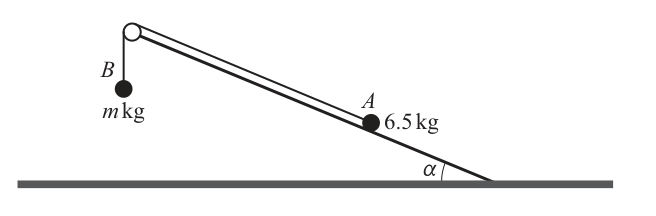
Fig. 7, as printed with the question — A on the rough slope, connected over the pulley to B hanging freely below.
Stuck? Show hint
Find T from B's own equilibrium first (a freely hanging particle on a smooth pulley makes tension equal to its own weight), then treat T as known and apply the least/greatest method to A on the slope.
Show solution
- 1
Find from 's own equilibrium. hangs freely below the pulley with nothing else touching it, so only its weight and the tension act on it, and they must balance directly:
This is the smooth-pulley fact from §05 applied directly: a freely hanging particle in equilibrium has tension equal to its own weight — no separate resolving is needed for B.
- 2
The pulley is smooth, so this same pulls up the slope. therefore has four forces on it: weight , normal reaction , friction , and the tension acting up the line of greatest slope.
A smooth pulley cannot grip the string, so the tension is the same value throughout — the T found from B's equilibrium is exactly the T that acts on A.
- 3
Resolve perpendicular to the plane for . The tension acts along the slope, so it has no perpendicular component, and with this is a 5-12-13 triangle, giving :
Unlike the tilted-T examples above, the string here runs along the line of greatest slope, so N can be found on its own straight away, before T is even known.
- 4
Find the friction ceiling:
Needed for both limiting cases below, so worth isolating as its own line.
- 5
Find weight's component along the slope, using :
This is the down-slope pull that T and friction, between them, must resist for A to stay still.
- 6
Least : on the point of sliding down. With small, is also small, so weight's pull down the slope wins; friction is at its maximum, acting up the slope alongside :
Same band structure as every least/greatest question in this section.
- 7
Convert back into using from step 1:
Only now T itself has to be converted back into m using step 1's relation, as the final move.
- 8
Greatest : on the point of sliding up. With large, overpowers weight, so friction switches to act down the slope, opposing :
The mirror image of the least-m case, exactly as in every other band question — friction has swapped sides because it now opposes rather than assists the tension.
- 9
Convert back into :
Same conversion as the least case, using T = 10m.
- 10
State the result as a set of values:
The system stays in equilibrium for every m in this whole interval, not just at its two ends — that is what 'the set of possible values' is asking for.
Answer.
- 1
Newton's third law
“
use Newton's third law (e.g. the force exerted by a particle on the ground is equal and opposite to the force exerted by the ground on the particle).
Newton's third law says: whenever object exerts a force on object , object exerts a force on that is equal in magnitude, opposite in direction, and of the same type. The syllabus's own example is the clearest one: the force a particle exerts on the ground is equal and opposite to the force the ground exerts on the particle.
The catch — and the reason this idea causes more confusion than its one-line statement suggests — is that not every equal-and-opposite pair is a third-law pair. A genuine third-law pair needs all four of these at once:
Test | Genuine third-law pair | Not a third-law pair |
|---|---|---|
Equal magnitude? | yes | yes (in this specific case) |
Opposite direction? | yes | yes (in this specific case) |
Same type of force? | yes — both contact, or both gravitational | often no — e.g. one is weight (gravity), the other is a normal reaction (contact) |
Acting on different objects? | yes — one on each object | no — both act on the same object |
The third and fourth rows are what actually distinguish a real Newton's-third-law pair from an equilibrium pair — and they are the two conditions a diagram alone (without labels) cannot show you.
A block on the ground: W and N are equal and opposite but act on the same block, so are not a third-law pair. The true pair is the block pushing down on the ground and the ground pushing up on the block.
The classic trap: weight and normal reaction
For a block resting in equilibrium on the ground, weight and normal reaction are equal in magnitude and opposite in direction — but they are not a Newton's-third-law pair. Both act on the same object (the block), and they are different types of force (gravity, and contact) — they fail two of the four tests. They are equal and opposite only because the block happens to be in equilibrium; change the situation (put the block on a slope, or accelerate it) and and stop being equal at all, while the true third-law pair — block-on-ground and ground-on-block — stays equal and opposite regardless, because that equality is guaranteed by the law itself, not by any equilibrium condition.
Putting numbers on the syllabus's own example
A person of mass stands at rest on a horizontal floor. Find the magnitude of the force the person exerts on the floor, and state the force that forms a Newton's-third-law pair with it. Explain why the person's weight is not that pair.
Show full working
- 1
Find the person's weight. With :
Weight is the pull of the Earth on the person — it is the starting number here, but notice it is not yet either of the two forces the question is about.
- 2
Find the floor's push on the person. The person is at rest, so the forces on the person balance. Only two act vertically on the person: the weight down, and the floor's normal reaction up:
This number comes from equilibrium, not from Newton's third law — the two happen to give 600 N here, which is exactly why the two ideas get confused. In a lift accelerating upwards, N would no longer be 600 N.
- 3
Apply Newton's third law to get the person's push on the floor. The floor pushes up on the person with , so the person pushes down on the floor with
This equality is guaranteed by the third law itself, whatever the person is doing — standing, jumping, or riding an accelerating lift. Unlike the previous step, it needs no equilibrium assumption at all.
- 4
Name the pair explicitly. The genuine third-law pair is:
- person on floor: downwards, a contact force acting on the floor;
- floor on person: upwards, a contact force acting on the person.
Equal, opposite, both contact forces, acting on two different objects — all four tests pass.
Naming every force in the form 'A on B' is the single habit that makes these questions safe: as soon as both forces are written that way, you can see at a glance whether they act on different objects.
- 5
Test the weight against the floor's push. The person's weight is downwards, gravitational, and acts on the person. The floor's push is upwards, a contact force, and also acts on the person. Same object, different types — two tests fail, so they are not a third-law pair.
The weight does have a third-law partner, but it is nowhere near the floor: it is the 600 N upward gravitational pull the person exerts on the Earth. Every force has a partner; the trap is assuming it is whichever other force happens to be drawn next to it.
The person exerts downwards on the floor; its third-law pair is the floor's upward push on the person. The person's weight ( down) is not that pair: it acts on the person rather than the floor, and it is gravitational rather than a contact force. Its own partner is the person's gravitational pull on the Earth.
The two numbers are equal here only by coincidence of the situation. Change the situation — stand in an accelerating lift, or lean on a wall — and the floor's push changes while the weight does not; but the person-on-floor and floor-on-person forces stay equal to each other no matter what.
Telling a real pair from an impostor
A book of mass rests in equilibrium on a table. State the force that forms a Newton's-third-law pair with the normal reaction the table exerts on the book, and explain why the book's weight does not.
Show full working
- 1
Identify the normal reaction's own pair using the definition. The table exerts a normal reaction on the book (table acting on book); by Newton's third law, the book must exert an equal and opposite force on the table:
Applying the third law correctly means swapping which object is 'acting' and which is 'reacted upon' — the pair force always acts on the other object from the one you started with.
- 2
Check this pair against all four tests. Equal magnitude: yes. Opposite direction: yes (book pushes down on the table, table pushes up on the book). Same type: yes, both are contact forces. Different objects: yes — one acts on the book, one on the table. All four hold, so this is a genuine third-law pair.
Working through the checklist explicitly, rather than trusting a diagram by eye, is what the exam rewards — a stated reason referencing 'different objects' or 'same type of force' is exactly what the mark scheme looks for.
- 3
Test weight against the same four conditions. The book's weight acts downward on the book; the normal reaction acts upward on the book. They are equal and opposite (since the book is in equilibrium) — but both act on the book, not on two different objects, and they are different types of force (gravitational vs. contact). Two of the four tests fail.
This is the comparison the question is really testing — the diagram alone would look identical whether or not this pair 'counts', so the explanation has to reference the object and the type of force explicitly.
The pair to the normal reaction is the force the book exerts downward on the table (equal, opposite, same type, different objects). The book's weight is not paired with : both act on the book itself, and they are different types of force.
Treating equal tension on both sides of a smooth pulley as an example of Newton's third law
That equal tension comes from the pulley being smooth and the string being light — a separate modelling fact, not Newton's third law
Newton's third law relates a pair of forces on two different objects; the tension either side of a smooth pulley is one continuous string's tension being transmitted without loss, which is a different (though easily confused) idea.
Pairing weight with normal reaction because they are equal and opposite in an equilibrium diagram
Check they act on different objects and are the same type of force before calling them a pair
Equal-and-opposite is necessary but not sufficient — this is the single most examined misconception in this section.
Your turn
- 1
A person pushes horizontally against a wall and the wall does not move. State the Newton's-third-law pair to the force the person exerts on the wall, and explain why the friction force on the person's feet from the ground is not part of that pair.
Three forces, three different objects: the person's push on the wall, the wall's push back on the person, and friction on the person's feet from the ground — only the first two share a common pair of objects.
Stuck? Show hint
Ask which object each force acts on, and whether the two forces are the same type of contact.
Show solution
- 1
The pair to "person pushes on wall" is "wall pushes on person" — equal in magnitude, opposite in direction, same type (contact), and acting on different objects (wall and person respectively).
Build the partner mechanically by swapping the two nouns in 'A on B' — it is always 'B on A', never some other force in the diagram. Note also that the wall not moving is irrelevant: the third law holds whether or not either object is in equilibrium.
- 2
The friction on the person's feet acts on the person, from the ground — a different object pairing entirely (person and ground, not person and wall), and it balances a different force (the horizontal push reaction, in the person's own equilibrium) rather than being paired with the wall force.
This tests the 'different objects' condition precisely — friction-on-feet and push-on-wall share no common object between them at all, so they cannot be a third-law pair by definition, regardless of whether they happen to be equal in size.
AnswerPair: the wall pushes back on the person, equal and opposite. The foot-friction force is not part of that pair because it acts on the person from the ground — a different pair of objects altogether.
- 1
- 2
Two blocks, and , are in direct contact and are pushed together along a smooth horizontal surface by a single external force. State the relationship between the force exerts on and the force exerts on , and say what type of force this is.
Blocks A and B pushed together by P: at the shared face, the push A exerts on B and the equal, opposite push B exerts on A are drawn as two separate arrows, offset vertically, each acting on the block it pushes.
Stuck? Show hint
This is exactly the syllabus's own worded example, applied to two blocks instead of a particle and the ground.
Show solution
- 1
By Newton's third law, the force exerts on is equal in magnitude and opposite in direction to the force exerts on .
This holds even though the blocks are accelerating and A is heavier or lighter than B — the third law says nothing about motion, so no information about the external force or the acceleration is needed to answer this.
- 2
Both are contact (normal) forces, one acting on each block — satisfying all four conditions for a genuine third-law pair.
Because the two forces act on different blocks, they can never cancel each other in any one block's equilibrium or Newton's-second-law equation — which is precisely why you may treat each block separately when you meet connected bodies later.
AnswerEqual and opposite contact forces, one on each block: .
- 1
Everything on one page
Weight
Resolving a force into components
Resultant of several forces ( always means a resultant here — the normal reaction is )
Equilibrium condition (resolved form)
Weight's component perpendicular to a plane inclined at
Weight's component along a plane inclined at (down the slope)
Total contact force from its normal and frictional components
Smooth contact — no friction at all, the contact force is purely normal
Friction and the coefficient of friction ( = normal reaction)
A force at angle to a line of greatest slope
Least/greatest force (up the slope) maintaining equilibrium on a rough plane
Limiting equilibrium on a plane at with no force other than weight, friction and
Newton's third law — the vector identity
All four must hold for a genuine third-law pair
Can you do all of these?
Draw every force acting at a single point (the particle model), and name each one
Add friction whenever a surface is described as rough; add a tension whenever a taut string pulls, or a thrust — a compressed rod's push — whenever a rod is present
Resolve a force into components using cos for the side adjacent to the given angle, sin for the side opposite
Find a resultant by adding components first, then Pythagoras for magnitude and tan⁻¹ for direction
Set up equilibrium as two resolved equations — ΣFx = 0 and ΣFy = 0 — never as a single vector line
With two unknown forces, isolate one from the simpler equation and substitute into the other
On a slope, resolve perpendicular to the plane first (usually the equation with fewest unknowns) for N
Resolve weight on a slope as mg cos θ perpendicular and mg sin θ parallel — never the other way round
Remember a tilted or horizontal applied force changes N too, not just the along-surface balance
Treat 'smooth' as F = 0 exactly, and expect a single exact answer rather than a range
A smooth ring, peg or pulley means one tension throughout the whole string — the same T either side, never two different tensions
With two connected particles, isolate each one on its own diagram and solve its own equilibrium equation — the shared tension is the only thing that crosses between them
When an angle is given as a ratio or as two lengths, build the right-angled triangle and read every ratio off it — never find the angle itself with sin⁻¹/cos⁻¹/tan⁻¹ unless it is actually asked for
Recall the definition the syllabus asks for: μ = limiting (maximum) friction ÷ normal reaction — a ratio of two forces, so it has no units
Only write F = μN when the question states or implies limiting equilibrium — otherwise F ⩽ μN
Choose friction's direction from which way the object would move without it, using the question's wording
For 'least and greatest' questions, write two mirror-image limiting equations — friction reverses direction between them — and quote the result as a band
For 'does it move' questions, compare the friction needed for equilibrium against the ceiling μN and state a conclusion in words — there is no unknown to solve for
A force at angle β to a line of greatest slope resolves as P cos β along the slope and P sin β perpendicular to it — check whether that perpendicular part adds to or subtracts from N
On a rod (not a flat surface), N is perpendicular to the rod and can push either way — assume a direction, solve, and a negative answer means it was backwards; use the size of N in F = μN
Check a Newton's-third-law pair against all four tests: equal, opposite, same type, different objects
Never pair weight with normal reaction — same object, different type of force, so not a third-law pair