Work done by a constant force: W = Fd cos θ
“
understand the concept of the work done by a force, and calculate the work done by a constant force when its point of application undergoes a displacement not necessarily parallel to the force.
In everyday language "work" means effort. In Mechanics it has a precise meaning: a force does work when the object it acts on moves, and the amount of work measures how much the force has pushed the object along. A force on something that does not move does no work at all, however large the force.
The basic rule. When a constant force of newtons acts on an object that moves a distance metres in the direction of the force, the work done by the force is
Work is measured in joules (J). One joule is the work done when a force of moves its point of application , so . Large amounts are given in kilojoules: .
A constant force F pushes a block a distance d in its own direction. The work done by F is F × d.
A force at an angle to the motion. Often the force is not in the direction the object moves — a rope pulling a sledge slopes upwards, but the sledge slides along the ground. Resolve the force into two components (exactly as in §4.1):
- along the direction of motion, where is the angle between the force and the direction of motion;
- perpendicular to the direction of motion.
The object moves a distance along the ground and no distance at all in the perpendicular direction. So the perpendicular component does no work, and only the component along the motion counts:
When the force is along the motion, , and this is just again. The syllabus says you will never need vectors (the "scalar product") for this — resolving and multiplying is all there is.
Work done by a constant force F whose point of application moves a distance d, where θ is the angle between the force and the direction of motion
θ = 0 gives W = Fd. Only the component of the force along the motion does work.
A force F at angle θ above the direction of motion. The component F cos θ acts along the motion and does work; the component F sin θ is perpendicular to the motion and does none.
The same force, first along the motion, then at an angle
A crate rests on horizontal ground. (a) A horizontal force of pushes the crate along the ground. Find the work done by the force. (b) Instead, a rope with tension , inclined at above the horizontal, pulls the crate along the ground. Find the work done by the tension.
Show full working
- 1
(a) Is the force along the motion? Yes: the force is horizontal and the crate moves horizontally, so and
Always check the direction first — it decides whether a cos θ is needed.
- 2
Substitute and :
Force in newtons, distance in metres, so the answer comes out in joules.
- 3
Evaluate:
240 joules of work.
- 4
(b) Identify the angle between the force and the motion. The rope is at above the horizontal and the crate moves horizontally, so .
θ is measured between the force and the direction of travel — here that is the angle the rope makes with the ground.
- 5
Find the component along the motion:
Only this component pushes the crate along. The other component, 40 sin 30° = 20 N, lifts slightly on the crate but moves it nowhere vertically.
- 6
Multiply by the distance:
This is W = Fd cos θ with F = 40, d = 6, θ = 30°.
- 7
Evaluate:
Less than in (a): the same 40 N does less work when part of it is wasted pulling upwards.
(a) . (b) (3 s.f.).
If a force is at an angle, write the component along the motion as its own line before multiplying by d. That line is usually the method mark.
Work done by a pushing force at an angle
A crate is being pushed in a straight line along a horizontal surface by a force of magnitude inclined at above the horizontal. The crate moves a distance of in seconds with constant speed.
Find the work done by the force.
Show full working
- 1
Pick out what this part needs. Force , distance , angle between the force and the motion . The seconds is for the power part of the question, not this one.
The crate moves horizontally and the force is 20° above the horizontal, so θ = 20°.
- 2
Component along the motion:
The vertical component 25 sin 20° does no work, because the crate does not move vertically.
- 3
Work done:
This expression on its own earns the method mark.
- 4
Evaluate:
The mark scheme's value is 281.9077…
.
The mark scheme accepts 25 cos 20 × 12 or 25 sin 70 × 12 — the same number. It does not accept 25 × 12.
Reading the mark-scheme notes in this note
The worked examples often say what the published mark scheme rewards or refuses. The codes are:
- M1 — a method mark, for a correct method (e.g. a work-energy equation with the right number of terms); M0 means it was not earned.
- A1 — an accuracy mark for a correct answer, which normally needs the method mark first; A0 means the answer was wrong or not supported.
- B1 — an independent mark for a correct statement or value (e.g. one kinetic energy term); B0 means not earned. DM1 / DB1 are marks that depend on an earlier mark.
- FT — "follow through": a later mark can still be earned using your own earlier (wrong) value.
- awrt — "answers which round to"; CAO — "correct answer only"; AG — "answer given", so every step must be shown.
- Special case — a limited number of marks (often 2) for a method the question did not ask for, such as using suvat when the question says "use an energy method".
- DF in a mark scheme is simply the driving force.
Unless a question says otherwise, CAIE expects non-exact answers to 3 significant figures, and angles in degrees to 1 decimal place (3 significant figures is also accepted).
Positive, zero and negative work. Look at every force on a moving object and ask how it points compared with the motion:
- along the motion (): the force does positive work — it feeds energy in. A driving force, a pulling rope, a pushing hand.
- perpendicular to the motion (, ): no work. On horizontal ground this is true of the weight and the normal reaction — the object moves sideways, never up or down.
- against the motion (, ): the force does negative work — it takes energy out. Friction, air resistance and "the resistance to motion" always act like this.
Exam questions describe the last case in words rather than with a minus sign: "the work done against the resistance" means the positive amount that the resistance takes out. A resistance of over means of work done against it.
A block moving to the right: the driving force does positive work, friction has work done against it, and the weight and normal reaction do no work because they are perpendicular to the motion.
Every force on a moving sledge
A sledge of mass is pulled across horizontal snow by a rope inclined at above the horizontal. The tension in the rope is and a constant frictional force of opposes the motion. Find the work done by each force acting on the sledge.
Show full working
- 1
List the forces: tension at to the motion; friction against the motion; weight downwards; normal reaction upwards.
Four forces act, so four answers — one for each.
- 2
Tension — component along the motion:
The rope is at 25° to the direction of travel.
- 3
Tension — work done:
Positive work: the rope feeds energy in.
- 4
Friction. It acts exactly against the motion, so the work done against friction is
Equivalently, friction does −600 J of work. Exams almost always ask for the positive 'work done against'.
- 5
Weight and normal reaction. Both are vertical and the sledge moves horizontally, so each does no work: .
cos 90° = 0. The normal reaction is smaller than 120 N here (the rope lifts a little), but that does not matter: it still does no work.
- 6
Net effect. Energy fed in minus energy taken out:
This 306 J is what is left over to speed the sledge up. §05 turns exactly this kind of balance into a speed.
Tension ; work done against friction ; weight and normal reaction .
Work done against a resistance at constant speed. A resistance usually stays the same size, so the work done against it is just resistance × distance. When the object moves at a constant speed for a time , the distance is (§4.2), so
Distance from speed and time, then work
A car of mass is moving on a straight road against a constant force of resisting the motion.
The car moves along a horizontal section of the road at a constant speed of .
Calculate the work done against the resisting force during the first seconds.
Show full working
- 1
Distance travelled in 8 seconds. At constant speed, distance speed × time:
The work formula needs a distance, and the question gives a time — so convert first.
- 2
Work done against the resistance resistance × distance:
The resistance acts directly against the motion, so this is W = Fd with the full 1250 N.
- 3
Evaluate:
The mass (1400 kg) plays no part — work done against a force only needs the force and the distance.
().
Friction when the pulling force is at an angle. If friction is given by the model (§4.1), you need the normal reaction first — and an angled pull changes it. A pulling force at above the horizontal lifts the object slightly, so resolving vertically gives
A force pushing at below the horizontal presses the object into the ground instead, so . Only after finding can you find the friction and then the work done against it.
Pulling at θ above the horizontal: resolving vertically gives R = mg − T sin θ, so the friction μR is smaller than μmg.
Work against friction with an angled pull
A box of mass is pulled along rough horizontal ground by a force of acting at above the horizontal. The coefficient of friction between the box and the ground is . Find the work done against friction.
Show full working
- 1
Resolve vertically (the box does not move up or down, so the vertical forces balance):
Upward: R and the vertical part of the pull. Downward: the weight 20g = 200 N.
- 2
Subtract the vertical part of the pull from the weight:
80 sin 30° = 40. The pull takes 40 N of the box's weight off the ground.
- 3
Friction:
The box is sliding, so friction takes its limiting value μR.
- 4
Work done against friction friction × distance:
Using R = 200 (forgetting the pull) would give 600 J — the single most common error in this kind of part.
.
Friction work when the pull is at an angle
A block of mass is pulled along a rough horizontal road by a constant force of magnitude acting at an angle of above the horizontal. The block moves in a straight line passing through two points and on the road, where . The coefficient of friction between the block and the road is .
Find the work done against friction in moving the block from to .
Show full working
- 1
Resolve vertically:
The mark scheme gives no marks in this part to anyone who uses R = 4g.
- 2
Evaluate the vertical part of the pull:
This is how much of the block's 40 N weight the pull lifts off the road.
- 3
Subtract it from the weight to get :
Keep the unrounded value in the calculator for the next step.
- 4
Friction:
F = μR with μ = 0.4.
- 5
Work done against friction:
Friction × distance AB. This part asks only for friction's work — do not subtract or add the pulling force's work here.
- 6
Round:
The mark scheme accepts 1210 J or 1215 J.
(3 s.f.; ).
Whenever friction appears with an angled force, the first line of working should be the vertical resolution for R.
Working backwards. Because links four quantities, a question can give the work and ask for the angle, the force or the distance. Substitute everything you know and solve for the one unknown. For an angle, you will finish with and use .
Finding an angle from the work done
A rope with tension pulls a box along horizontal ground. The work done by the tension is . Find the angle between the rope and the horizontal.
Show full working
- 1
Write the work formula with the unknown angle:
W = Fd cos θ with F = 40, d = 15 and W = 480.
- 2
Multiply the force by the distance:
40 × 15 = 600: this is the work the rope would do if it were horizontal.
- 3
Divide by 600:
The ratio of actual work to 'horizontal' work is exactly cos θ.
- 4
Inverse cosine:
A cosine between 0 and 1 gives an acute angle, as it must for a rope pulling forwards.
.
Angle from work done on a real paper
A block is pulled for a distance of along a horizontal floor, by a rope that is inclined at an angle of to the floor. The tension in the rope is and the work done by the tension is . Find the value of .
Show full working
- 1
Use :
This equation earns the first two marks.
- 2
Multiply the tension by the distance:
180 × 50 = 9000.
- 3
Divide:
Isolate cos α before taking the inverse.
- 4
Inverse cosine:
24.34… to 3 s.f.
.
Using with the full force when the force is at an angle
Use , where is the angle between the force and the direction of motion
Only the component along the motion does work; the mark scheme gives no marks for 25 × 12 when the force is at 20°.
Taking the normal reaction as when a pulling force is at an angle
Resolve vertically: for a pull above the horizontal, for a push below it
Friction μR, and therefore the work done against friction, depends on the correct R.
Giving "work done against friction" as a negative number
"Work done against" a resistance is the positive quantity
The minus sign is already built into the word 'against'. A final answer of −120 J for work done against a resistance scored A0 in 43 M/J 2025 Q6(b).
Using a time where a distance is needed
At constant speed, convert first:
Work is force × distance, never force × time.
Your turn
For every force, decide first whether it is along, perpendicular to, or against the motion.
- 19709/42 O/N 2012 Q13 marks
A block is pushed along a horizontal floor by a force of magnitude acting at an angle of to the horizontal (see diagram). Find the work done by the force in moving the block a distance of .
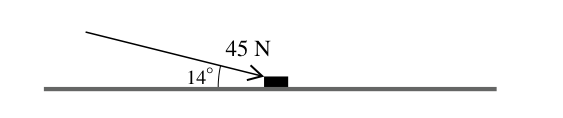
The diagram from the paper: the 45 N force acting at 14° to the horizontal.
Stuck? Show hint
Only the horizontal component of the force does work.
Show solution
- 1
Component along the motion:
The block moves horizontally, so θ = 14°.
- 2
Work done:
W = Fd cos θ.
- 3
Evaluate:
Or 1.09 kJ.
Answer().
- 1
- 29709/43 M/J 2017 Q1(i)2 marks
A man pushes a wheelbarrow of mass along a horizontal road with a constant force of magnitude at an angle of below the horizontal. There is a constant resistance to motion of . The wheelbarrow moves a distance of from rest.
Find the work done by the man.
Stuck? Show hint
"Below the horizontal" still makes an angle of with the direction of motion.
Show solution
- 1
Angle between the force and the motion: (the push is below the horizontal; the motion is horizontal).
Above or below does not change cos θ — it only changes the normal reaction.
- 2
Work done by the man:
Component along the motion × distance.
- 3
Evaluate:
The resistance is irrelevant to this part: it asks only for the man's work.
Answer.
- 1
- 39709/42 M/J 2017 Q13 marks
One end of a light inextensible string is attached to a block. The string makes an angle of with the horizontal. The tension in the string is . The string pulls the block along a horizontal surface at a constant speed of for . The work done by the tension in the string is . Find .
Stuck? Show hint
Find the distance first from the constant speed and the time.
Show solution
- 1
Distance:
Constant speed, so distance = speed × time.
- 2
Work equation:
W = Fd cos θ.
- 3
Multiply the tension by the distance:
20 × 18 = 360: the work the string would do if it were horizontal.
- 4
Divide both sides by 360 to isolate :
Get cos θ on its own before taking the inverse cosine.
- 5
Inverse cosine:
A steep rope: most of its tension is wasted pulling upwards.
Answer.
- 1
- 4
A box of mass is pushed across rough horizontal ground by a force of acting at below the horizontal. The coefficient of friction is . Find (a) the work done by the pushing force, (b) the work done against friction.
Stuck? Show hint
A push below the horizontal presses the box into the ground, so is more than .
Show solution
- 1
(a) Component of the push along the motion:
The angle between the push and the horizontal motion is 20°.
- 2
Work done by the push:
Component along the motion × distance.
- 3
(b) Resolve vertically: upward ; downward and :
The downward part of the push adds to the weight.
- 4
Evaluate :
30 sin 20° = 10.26 N.
- 5
Friction:
F = μR.
- 6
Work done against friction:
Friction × distance.
Answer(a) . (b) .
- 1
The rest of this note
Can you do all of these?
Work done needs a distance: if you are given a time at constant speed, find d = vt first
Only the component of a force along the motion does work: W = Fd cos θ, with θ measured from the direction of motion (the slope, if it moves up a slope)
Weight and normal reaction do no work on a horizontal surface; tension in a pendulum string never does work
With an angled pull and friction, resolve vertically for R before using F = μR
'Work done against' a resistance is a positive number
Change in KE = ½mv² − ½mu², never ½m(v − u)²
GPE uses the vertical height: d sin θ on a slope; convert tan θ to sin θ with a triangle first
Smooth and no resistance: KE + GPE is constant, and for a single object the mass cancels
On a curved track, or when a resistance is described only by its work, use energy — suvat scores nothing
Energy equation: start KE + start GPE + work in = end KE + end GPE + work against resistance
Resistance work uses the distance along the path; GPE uses the height
A fixed amount of work in joules stops the mass cancelling — that is how a mass is found
Rough slope: R = mg cos θ, F = μR, and friction acts over both legs of a round trip
Connected particles: one KE term with the total mass, a separate GPE term for each particle, leave out the tension
In collisions momentum is conserved but kinetic energy is lost: add ½mv² for each particle separately
A bounce: KE after = KE before − energy lost; subtract energy, not speed
Convert kW to W before using P = Fv, and back to kW only if asked
Driving force D = P/v at the speed of that instant; never use the power itself as a force. In the power sections R is the resistance and N the normal reaction
Constant or greatest steady speed means a = 0: D balances R (and mg sin θ on a hill)
After a sudden change of power or slope, the speed has not changed yet — use the old speed
Recalculate a speed-dependent resistance at each speed; reject the negative root of the quadratic
Car and trailer: the system equation gives a, the trailer equation gives T
At constant power over an interval, the engine's work is P × t and the energy equation is the method