Forming the equation
“
formulate a simple statement involving a rate of change as a differential equation. The introduction and evaluation of a constant of proportionality, where necessary, is included.
What a differential equation is
Many quantities are easiest to describe by how fast they change. A population grows faster when there are more animals to breed. A tank empties faster when it is full, because the water pushes harder on the hole. In each case you cannot write down the quantity directly, but you can write down its rate of change.
The rate of change of with respect to time is the derivative
Read it as "how much goes up per unit of time". If at some moment, is increasing at per unit of time at that moment.
- means is increasing.
- means is decreasing.
A differential equation is an equation that contains a derivative like this. Solving it means finding the quantity itself — as a function of — from the information about its rate of change. Since integration undoes differentiation, solving always involves integrating.
A very small example shows the idea. If , then goes up by every unit of time, so integrating gives
Every function of this form has gradient , so the equation alone cannot tell you . You need one extra fact, such as " when ", to pin it down. That pattern — an equation for the rate, a family of solutions, one fact to choose the right one — is the whole topic in miniature.
On Paper 3 every differential equation is first order: the only derivative in it is a first derivative such as , never a second derivative.
Reading the sentence
The first marks in a modelling question are for translating English into an equation. The vocabulary is small enough to learn outright.
The sentence says | It means | In symbols |
|---|---|---|
the rate of increase of (with respect to time) | the derivative of with respect to | |
the rate of decrease of | the same derivative, with a minus sign | |
the gradient of a curve at the point | the derivative of with respect to | |
is proportional to | equals a constant times | |
is inversely proportional to | equals a constant divided by | |
is proportional to the product of and | a constant times times | |
is proportional to the ratio of to | a constant times divided by | |
the amount not yet affected, out of a total | the total minus the amount affected |
Every “proportional” introduces a constant. Call it k, keep it as a letter, and find its value later from the data the question gives you.
Why proportionality brings a constant
" is proportional to " means that is always the same multiple of : double and doubles, halve and halves. The multiple is fixed, but the sentence does not tell you what it is — so you give it a name:
The letter is called the constant of proportionality. The sentence gives you the shape of the relationship; a number elsewhere in the question (a rate at one moment, or a second measurement) gives you the size, which is the value of .
The sign, and the constant
Two marks are routinely lost before any calculus happens.
"Decreases" means the derivative is negative. Write with . (Writing and letting come out negative also works, but you must be consistent.)
Proportional is not equal. "The rate is proportional to " is , never . The is what the data later determines.
Four sentences into four equations
Write each statement as a differential equation.
(a) The number of bacteria, , increases at a rate proportional to .
(b) The temperature, , of a cooling drink decreases at a rate proportional to .
(c) The mass, , of a substance decreases at a rate that is inversely proportional to the time .
(d) In a town of people, the number who have heard a rumour increases at a rate proportional to the product of the number who have heard it and the number who have not.
Show full working
- 1
(a) The quantity changing is , and it changes with time, so its rate of increase is .
Always start by naming which variable is changing and what it changes with respect to — that decides the top and bottom of the derivative.
- 2
"Increases", so the derivative is positive. "Proportional to " means a constant times :
- 3
(b) The temperature changes with time: . It decreases, so a minus sign goes in front.
With k > 0 and θ − 20 > 0, the minus sign makes the derivative negative — which is exactly what “decreases” means.
- 4
"Proportional to " means a constant times the whole bracket:
- 5
(c) The mass changes with time: , with a minus sign because it decreases.
- 6
"Inversely proportional to " means a constant divided by :
Inversely proportional: as t doubles, the rate halves. Dividing by t does exactly that.
- 7
(d) The number who have not heard is the total minus those who have: .
This is the one piece of reasoning in (d) — the other factor is simply x.
- 8
"Proportional to the product" means multiply the two numbers and put a constant in front:
(a) (b) (c) (d) , each with
Three questions, in order, for every sentence: what is changing and against what? increasing or decreasing? proportional to what?
Finding from a rate you are given
Often the question gives you the rate at one particular moment, for example "when , is increasing at per day". That is enough to find :
- Write the equation with in it.
- Substitute the given value of the variable and the given value of the derivative.
- Solve the resulting equation for .
- Put the value of back into the equation and tidy it into the printed form.
Take sentence (d) above. Suppose that when the rumour is spreading at people per day, so when .
- Substitute into : .
- Multiply out: .
- Divide: .
- Put back: , or .
“Show that” means derive, not check
When the equation is printed for you, the mark scheme wants it derived from the sentence. Schemes say "M0 for verification" and "obtain given answer from full and correct working". So you may not substitute the printed answer back in and show it fits. Start from the sentence, introduce , use the data to find it, and arrive at the printed form.
Two good things about a printed ("AG", answer given) equation: you know exactly where your algebra is heading, and the next part can still be attempted even if you cannot do this one, because the equation is on the page.
Finding k from a given rate
In a field there are plants of a certain species, all of which can be infected by a particular disease. At time after the first plant is infected there are infected plants. The rate of change of is proportional to the product of the number of plants infected and the number of plants that are not yet infected. The variables and are treated as continuous, and it is given that and when .
Show that and satisfy the differential equation
Show full working
- 1
The number of plants not yet infected is the total minus the number infected: .
- 2
"Proportional to the product" of the two numbers:
Proportionality introduces k. Everything else in this part is about finding its value.
- 3
Use the rate given at the start: when , and . Substitute both:
- 4
Simplify the right side:
- 5
Divide by :
, so .
- 6
Put back into the equation:
- 7
Multiply both sides by :
The scheme gives M0 for verification — the value of k must come from the data, as here.
shown, with
Given a rate at one moment, substitute the variable AND the derivative, then solve for k.
A ratio, and k from the starting rate
A large plantation of area is becoming infected with a plant disease. At time years the area infected is and the rate of increase of is proportional to the ratio of the area infected to the area not yet infected. When , and .
Show that and satisfy the differential equation
Show full working
- 1
The area not yet infected is the whole plantation minus the infected part: .
- 2
"The ratio of the area infected to the area not yet infected" is . Proportional to it:
“Ratio of A to B” means A divided by B — the first-named quantity goes on top.
- 3
Substitute and :
- 4
Multiply by : . Substitute back:
shown, with
Rate in minus rate out
Tank, pool and balloon questions have two flows: something coming in and something going out. The amount inside changes at the difference of the two:
The rate in is usually a constant ("water is pumped in at per minute"). The rate out usually depends on how much is inside ("leaks at a rate of ", "at a rate proportional to ").
For example, a pond holds of water. Rain adds per day and water soaks away at per day. Then
Notice what this says: when is small, more comes in than goes out and rises; when the two flows balance and stops changing.
The three lines a tank question is marked on: the net flow, the volume formula for the container's shape, and the chain rule that turns a rate for V into a rate for h.
From volume to depth: the chain rule bridge
The flows are rates of change of volume, . But the question usually wants an equation for the depth (or the radius ). The chain rule connects them:
Dividing both sides by :
You find by writing the volume in terms of from the shape of the container, then differentiating.
| container | volume | (or ) |
|---|---|---|
| cuboid or cube with base area | ||
| cylinder of radius (fixed) | ||
| sphere of radius |
When the sides are vertical, the base area is a constant, so is just that constant.
Mark schemes give a separate mark for each of and , and one says both "must be seen". So write each on its own line before combining them.
Rate in minus rate out in a cylinder
A cylindrical tank has radius m. Water is pumped in at per minute and leaks out at a rate of per minute, where m is the depth after minutes. Show that
Show full working
- 1
The flows. In at , out at :
- 2
The shape. A cylinder of radius holding water to depth has volume
- 3
Differentiate with respect to :
4π is a constant, so the derivative of 4πh is just 4π.
- 4
The bridge.
- 5
Multiply both sides by :
shown
Flows, shape, bridge — three lines, every time.
A cuboid tank with a leak
A water tank is in the shape of a cuboid with base area . At time minutes the depth of water in the tank is . Water is pumped into the tank at a rate of per minute. Water is leaking out of the tank through a hole in the bottom at a rate of per minute.
Show that .
Show full working
- 1
The flows. In at , out at :
First mark: the complete net-flow statement.
- 2
The shape. A cuboid has vertical sides, so the volume is base area times depth: , and
- 3
The bridge.
- 4
Multiply both sides by :
- 5
Every term is divisible by . Divide through: , , :
shown
Rate in minus rate out, with k from a given rate
The diagram shows a tank for holding water. The tank is in the shape of a cube of side . At time seconds, the depth of water in the tank is . Water is poured into the tank at a rate of . Water pours out of the tank through a hole in the bottom at a rate proportional to .
When , the depth of the water is increasing at a rate of .
Show that
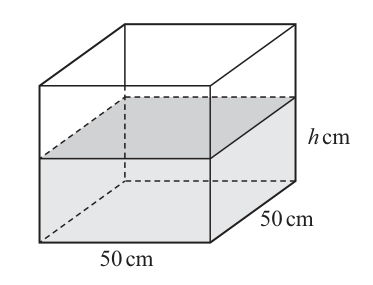
Fig. 2 — the cubical tank of side 50 cm, filled to depth h cm.
Show full working
- 1
The flows. In at a constant ; out at a rate proportional to , so introduce a constant :
The outflow is only known up to a constant — that k is what the data about 0.4 cm/s will pin down.
- 2
The shape. The base is a square, area , and the sides are vertical, so and
- 3
The bridge.
- 4
Find . When , . Substitute both:
- 5
Multiply both sides by :
- 6
Rearrange: , so .
- 7
Substitute :
- 8
Divide top and bottom by :
The scheme wants “a complete statement” at the end — write the full printed equation, not just “as required”.
shown, with
Four marks here: the flow statement, V = 2500h with the chain rule, using the given rate for k, and the final printed line. Lay them out as separate lines.
Outflow only, depending on the volume
A large cylindrical tank is used to store water. The base of the tank is a circle of radius metres. At time minutes, the depth of the water in the tank is metres. There is a tap at the bottom of the tank. When the tap is open, water flows out of the tank at a rate proportional to the square root of the volume of water in the tank.
Show that , where is a positive constant.
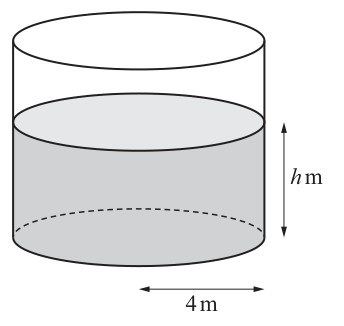
Fig. 2 — the cylindrical tank of radius 4 m, with water to depth h m.
Show full working
- 1
The flows. Nothing comes in, and water leaves at a rate proportional to . The volume is decreasing, so:
- 2
The shape. A cylinder of radius : , so
- 3
The bridge.
- 4
The answer must be in terms of only, so replace by inside the square root:
Leaving V in the answer is a common slip — the equation has to link h and t only.
- 5
Split the square root: . So
- 6
Cancel: and , giving
- 7
The whole of is a fixed positive number, so call it :
The last mark is for saying WHY λ is a constant: it is made only of k and π, both fixed.
shown, with
When the shape changes as it grows
In the examples so far the base area was fixed, so was a number. When the container itself grows — a balloon, or a box whose sides depend on — the volume is a genuine function of the variable and depends on . The method does not change: write in terms of the variable, differentiate, and use the same bridge.
A box whose dimensions change, inversely proportional to t
A container in the shape of a cuboid has a square base of side and a height of . It is given that varies with time, , where . The container decreases in volume at a rate which is inversely proportional to .
When , and the rate of decrease of is .
Show that and satisfy the differential equation
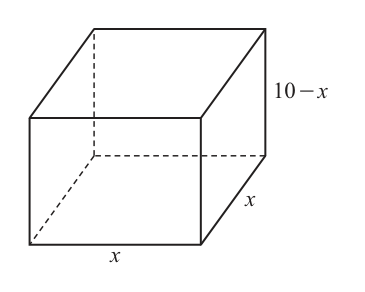
Fig. 2 — the cuboid with square base of side x and height 10 − x.
Show full working
- 1
The shape. Volume = base × height:
- 2
Differentiate term by term with respect to :
One mark on its own. The volume depends on x in a non-linear way, so this derivative is not a constant.
- 3
The rate. The volume decreases at a rate inversely proportional to :
- 4
The bridge.
- 5
Find . "The rate of decrease of is " means .
The scheme withholds the last mark if dx/dt = +20/37 is used — a rate of DEcrease is a negative derivative.
- 6
Work out at : .
- 7
Substitute and this value:
- 8
Both sides have denominator , so compare numerators: , giving .
- 9
Substitute :
shown, with
Your turn
Start with pure translations, then a volume-to-radius bridge for a sphere, and finally a gradient built from geometry. In every “show that”, derive — never substitute the printed answer back in.
- 19709/35 O/N 2025 Q11(a)1 mark
A fungal disease is affecting some of the trees in a forest. The fraction of the trees affected after years is denoted by . The rate of increase of is proportional to the product of the fraction of the trees affected and the fraction of the trees not affected.
Explain why, after years, , where is a constant.
Stuck? Show hint
If x is the fraction affected, what fraction of the whole forest is not?
Show solution
- 1
The whole forest is the fraction . The fraction not affected is what is left when the affected fraction is taken away: .
The mark is for explaining where the factor 1 − x comes from.
- 2
"Proportional to the product" of the two fractions: multiply them and put a constant in front:
Answeraffected and not affected; their product times a constant
- 1
- 29709/33 M/J 2017 Q8(i)1 mark
In a certain chemical reaction, a compound is formed from a compound . The masses of and at time after the start of the reaction are and respectively and the sum of the masses is equal to throughout the reaction. At any time the rate of increase of the mass of is proportional to the mass of at that time.
Explain why , where is a constant.
Stuck? Show hint
Use x + y = 50 to write the mass of B in terms of x.
Show solution
- 1
The rate of increase of the mass of is , and it is proportional to the mass of : .
- 2
The masses always add to : , so .
- 3
Substitute:
Answerand
- 1
- 39709/33 O/N 2022 Q10(a)1 mark
A gardener is filling an ornamental pool with water, using a hose that delivers litres of water per minute. Initially the pool is empty. At time minutes after filling begins the volume of water in the pool is litres. The pool has a small leak and loses water at a rate of litres per minute.
The differential equation satisfied by and is of the form . Write down the values of the constants and .
Show solution
- 1
Rate in minus rate out: .
- 2
Compare with : the constant term is and the coefficient of is .
Answer,
- 1
- 4
A drug is removed from the bloodstream at a rate proportional to the amount present, mg. When , the amount is decreasing at mg per hour. Form a differential equation for in terms of (hours), with no unknown constants.
Stuck? Show hint
Decreasing means a minus sign; then substitute the rate you are given.
Show solution
- 1
Decreasing, proportional to : with .
- 2
"Decreasing at mg per hour" means when . Substitute: .
Both sides negative — the minus signs cancel and k comes out positive, as it should.
- 3
Divide by : . So .
Answer - 1
- 59709/32 O/N 2024 Q10(a)3 marks
A balloon in the shape of a sphere has volume and radius . Air is pumped into the balloon at a constant rate of starting when time and . At the same time, air begins to flow out of the balloon at a rate of . The balloon remains a sphere at all times.
Show that and satisfy the differential equation .
Stuck? Show hint
Flows, shape, bridge — the shape is a sphere, so differentiate 4/3 πr³ with respect to r.
Show solution
- 1
The flows. In at , out at :
- 2
The shape. , so
- 3
The bridge.
- 4
Every term has a factor ; cancel it:
- 5
Multiply top and bottom by to clear the decimal (, , ):
1.25 is chosen because it turns 0.8 into exactly 1.
Answershown
- 1
- 69709/33 M/J 2021 Q7(a)3 marks
For the curve shown in the diagram, the normal to the curve at the point with coordinates meets the -axis at . The point is the foot of the perpendicular from to the -axis. The curve is such that for all values of in the interval , the area of triangle is equal to .
(i) Show that . [1]
(ii) Hence show that and satisfy the differential equation . [2]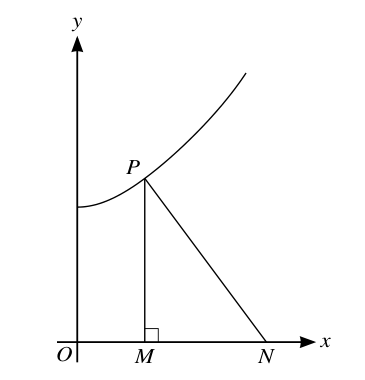
Fig. 7.1 — the curve, the point P(x, y), the foot M and the point N where the normal at P meets the x-axis.
Stuck? Show hint
The normal is perpendicular to the tangent, so its gradient is −1 ÷ (dy/dx). Find the gradient of PN from the triangle.
Show solution
- 1
(i) The tangent at has gradient . The normal is perpendicular to it, so its gradient is .
- 2
Now read the gradient of from the triangle. Going from to , the line drops by while moving right by . So its gradient is .
- 3
These are the same line, so the gradients are equal:
- 4
Remove the minus signs and take the reciprocal of both sides:
- 5
(ii) From (i), . Triangle has a right angle at , so its area is .
- 6
Substitute and :
- 7
The area equals , so
Answershown
- 1
The rest of this note
Can you do all of these?
Name what is changing and against what, then write the derivative
Put a minus sign in for “decreases” or “rate of decrease”
Turn “proportional to” into a constant k times the quantity
Find k from a rate given at one moment by substituting the variable and the derivative
Derive a printed “show that” — never verify it
Write dV/dt (rate in − rate out) and dV/dh as separate lines, then use the chain rule
Replace V by its formula so the final equation links only the two variables asked for
Split the right-hand side into (x-part) × (y-part), using index laws if needed
Separate completely, then integrate each side with respect to its own variable
Include exactly one constant of integration
Substitute the condition straight after integrating, before rearranging
Use the t = 0 condition for c first, then the second condition for k
Remove logs correctly: , never a sum
Stop at the form asked for: y, t, y², a relation, a single log or an exact value
Spot “derivative over function” and 1/(ax + b) logs, including tan and cot
Use a double-angle or reciprocal identity before integrating sin², cos² or 1/(1 + cos 2θ)
Factor out the coefficient of x² before using the inverse tangent result
Split (px + q)/(x² + a²) into a log part and an inverse tangent part
Use partial fractions for a factorising denominator, dividing first if the fraction is improper
Use integration by parts for a product, with u the part that simplifies
Use a derivative proved in an earlier part when the question says “hence”
Work in radians whenever trig values are substituted
Read long-term behaviour from the sign of the power of e, and say why a limit is never reached
Give an exact limit when “exact” is asked for, and a number when a physical value is
Translate events into values (empty means h = 0) and answer in the words of the context