Physical quantities and estimates
“
understand that all physical quantities consist of a numerical magnitude and a unit; make reasonable estimates of physical quantities included within the syllabus
A number of what?
Physics is measurement, and every measurement answers the question "how much of what?". A physical quantity is therefore always two things stapled together: a numerical magnitude (how much) and a unit (of what). The distance to the nearest town is not "" — it is . The current in a wire is not "" — it is . Strip the unit away and the number stops meaning anything: could be , or , and those are three completely different physical situations.
Every quantity in this course is a number of something. In an exam, a missing or wrong unit loses the mark exactly as a wrong number does — an answer of "" to "find the force" is not 90% correct, it is meaningless. Later in this note (see “Checking equations with base units”) you will see that units also do real work: carried through an equation, they catch algebra mistakes before they reach your final answer.
Estimates: anchoring to what you know
Examiners frequently ask for an order-of-magnitude estimate of an everyday quantity — the weight of a person, the pressure of a person standing, the wavelength of ultraviolet light. Nobody memorises these answers. The skill being tested is whether you can anchor to a small set of reference values you do know, and build the wanted quantity from them.
Here are the anchors worth carrying into the exam:
Reference | Value to anchor to |
|---|---|
Mass of an adult | ≈ 70–80 kg |
Height of an adult | ≈ 1.7 m |
Weight of an adult | ≈ 700 N (from ) |
Acceleration of free fall | |
Area under one shoe sole | ≈ 0.025 m² |
Walking speed; a car on a motorway | ≈ 1.5 m s⁻¹; ≈ 30 m s⁻¹ |
Power of an electric kettle | ≈ 2000 W |
Wavelength of visible light | ≈ 4 × 10⁻⁷ m (violet) to 7 × 10⁻⁷ m (red) |
Diameter of an atom | ≈ 10⁻¹⁰ m |
Note the third row: weight is a force, measured in newtons. A "weight of 70" for an adult is a category error — 70 is the mass in kg, and the classic trap in estimate questions.
- 1
Anchor to a reference value you know.
Estimation questions are marked by range, not by an exact figure — an anchor you trust is worth more than a guess at precision.
- 2
Build the wanted quantity from the anchor, using a defining equation where one exists (e.g. weight from , pressure from ).
- 3
Give the answer as a power of ten (or to 1 significant figure) with the correct unit.
An estimate without its unit is not an answer — and the unit often exposes the trap, as the next worked example shows.
A clean demonstration
Estimate, to the nearest power of ten, the weight of a school bag loaded with textbooks.
Step 1 — anchor. A hardback textbook has a mass of about (a phone is about ; the book is five or more of those). An empty bag is about . So the loaded bag has
Step 2 — build the wanted quantity. Weight is a force, so it comes from . Here and :
Step 3 — give the answer as a power of ten. To one significant figure ; as an order of magnitude (the nearest power of ten) it is . Either form, with its unit, is a complete estimate.
Estimating the weight of an adult
What is a reasonable estimate of the weight of an adult human?
Options
A
B
C
D
Show full working
- 1
Read the unit off the options before any arithmetic: every answer is in newtons, — a force. Weight is a force, so the answer must come from a force equation; a bare mass in kilograms cannot be the answer.
The classic trap here is answering 70 — the mass. Checking the unit first (N, not kg) rules that trap out immediately.
- 2
Anchor the estimate: the mass of an adult is .
Anchoring is the whole skill: everything is built from a reference you already know.
- 3
Weight comes from . Identify each piece the formula needs: and , then substitute:
Say what each symbol equals here before multiplying — this is the habit that stops mass and weight being confused.
- 4
Evaluate:
- 5
Express to one significant figure: . The options are spaced by factors of , so only is in the right ballpark — option B.
690 N is N; the neighbouring options and are a hundred times too small and too large.
B — (an adult of mass ≈ 70 kg has weight ).
Convert mass to weight with before comparing options — and read the options' unit first: if it is N, a mass answer cannot be right.
Your turn
The first checks the idea of a physical quantity. The rest are anchor → build → power of ten. If your answer's unit does not match the question's, stop and re-read.
- 19702/14 O/N 2025 Q1
What is essential to accurately represent all physical quantities?
Options
A a base unit and a number
B a unit and a number expressed in standard form (scientific notation)
C a unit and a numerical magnitude
D an SI unit and a numerical magnitudeShow solution
- 1
Recall the idea from the start of this section: every physical quantity is a numerical magnitude together with a unit. That is option C.
- 2
A fails: the unit need not be a base unit (one of the five basic SI units in the next section). A force of is complete, and the newton is not a base unit.
Each wrong option adds an extra condition. Look for the word that makes the condition too strict.
- 3
B fails: standard form is a convenient way to write a number, but is a complete quantity without it.
- 4
D fails: the unit need not be SI. A journey of or is still a physical quantity.
AnswerC — a unit and a numerical magnitude.
- 1
- 29702/13 O/N 2025 Q15
A man of weight stands with both feet flat on the ground.
What is a reasonable estimate of the pressure exerted on the ground by the weight of the man?
Options
A
B
C
DStuck? Show hint
Estimate the total area of both shoe soles first — pressure is force per unit area.
Show solution
- 1
Pressure is force per unit area: . Identify the pieces: the force is the man's weight, (already a force in newtons — no conversion needed), and is the total area in contact with the ground, i.e. both soles.
Two things to get right before any arithmetic: the force is the weight in N, and the area is both feet together, not one.
- 2
Anchor the area: one shoe sole is roughly a rectangle , so Both feet:
- 3
Substitute into the defining equation:
- 4
Evaluate: — an order of magnitude of , option C.
Dividing by 0.05 is the same as multiplying by 20: .
AnswerC — ( for a total sole area of about ).
- 1
- 39702/14 M/J 2025 Q1
The number of atoms in a mobile phone handset may be estimated by dividing the approximate volume of the handset by the approximate volume of an atom.
What is a reasonable estimate of the number of atoms in a mobile phone handset?
Options
A
B
C
DStuck? Show hint
Work in metres throughout. An atom is about across.
Show solution
- 1
Anchor the size of the phone: about long, wide and thick. Write these in metres straight away: , and .
Both volumes must be in the same unit before you divide. Metres avoid any unit-conversion trap.
- 2
Volume of the phone:
- 3
Anchor the atom: its diameter is about . Treat it as a small cube of that side, so
For an order of magnitude, a cube is close enough to a sphere. The cube gives the power: , not .
- 4
Divide:
- 5
Subtract the powers: — option B.
AnswerB — about atoms ().
- 1
- 49702/21 O/N 2019 Q1(a)(i)
Make an estimate of the mass, in g, of a new pencil.
Stuck? Show hint
Anchor to a small mass you know — a sheet of A4 paper has a mass of about 5 g.
Show solution
- 1
Anchor: a sheet of A4 paper has a mass of about . A pencil contains roughly a few sheets' worth of wood plus a thin graphite core, so its mass is a few grams.
Estimation answers are marked by range, not by an exact value — the anchor gets you to the right order of magnitude, which is all that is required.
- 2
A reasonable estimate is therefore about –. The mark scheme accepts anywhere in the range –.
g would be a small apple and g a paperclip — the pencil sits between those neighbouring orders of magnitude.
AnswerAny value in the range – (a typical new pencil is about –).
- 1
- 5
Which of the following is a reasonable estimate for the wavelength of ultraviolet radiation?
Options
A
B
C
DStuck? Show hint
Anchor to the visible spectrum: violet light has a wavelength of about .
Show solution
- 1
Anchor: visible light has wavelengths from about (violet) to (red).
Ultraviolet sits just beyond the violet end of the spectrum — the name literally means "beyond violet", so it must be slightly shorter than violet's m.
- 2
Ultraviolet wavelengths are therefore a little shorter than : an order of magnitude of (ultraviolet runs from about to ) — option B.
The other options are far away: m is the size of a nucleus, m is a microwave and m a radio wave.
AnswerB — (ultraviolet runs from about up to ).
- 1
SI base and derived units
“
recall the following SI base quantities and their units: mass (kg), length (m), time (s), current (A), temperature (K); express derived units as products or quotients of the SI base units and use the derived units for quantities listed in this syllabus as appropriate
Why a system of base units?
Rather than invent an independent unit for every quantity, SI builds everything from a handful of base quantities with agreed base units. Every other unit — newton, joule, volt, ohm — is then derived, meaning it can be written as a product or quotient of base units. Questions such as "determine the SI base units of …" check that you know where a unit comes from, not just its name.
Base quantity | SI base unit |
|---|---|
mass | kilogram (kg) |
length | metre (m) |
time | second (s) |
electric current | ampere (A) |
temperature | kelvin (K) |
Learn these five exactly. Note the kilogram — not the gram — is the base unit of mass. Two further base quantities exist (amount of substance, mole; luminous intensity, candela). Neither is examined directly at AS level — and when the mole does turn up inside an equation later on (ideal gases, at A Level), the method you learn here works on it unchanged.
Base quantity or not?
Only the five quantities in the table are base quantities in this course. Charge, force, energy, weight, speed and pressure are not — each is defined by an equation from other quantities (, , …), so each is derived. The favourite trap is charge: it feels basic, but the base electrical quantity is current, and charge is built from it.
Square brackets around a quantity mean "the base unit of that quantity": is read as "the unit of force". It keeps unit algebra visibly separate from number algebra. Units multiply, divide and cancel exactly like algebraic symbols — , and .
Derived units are built, not memorised
Every other unit in physics is a derived unit: a product or quotient of base units, obtained by writing down the equation that defines the quantity and replacing each quantity by its unit. Build the seven you will meet most often, one line each, straight from the defining equation:
Know the relationships both ways round: sometimes you expand a named unit (the newton into ), sometimes you build an unfamiliar unit from scratch.
- 1
Write the defining equation for the quantity (or rearrange the given equation for it).
Every derived unit traces back to a defining equation — if you do not know the equation, you cannot get the unit.
- 2
Replace each quantity by its unit — a base unit if it has one (kg, m, s, A, K), or an already-known derived unit (N, J, …) that you then expand into base units.
- 3
Simplify with index laws, cancelling anything that appears on top and bottom.
Treat units as algebra: collect the powers of m, of s, and so on, one base unit at a time.
A clean demonstration
Find the base units of density .
Step 1 — defining equation: (density is mass per unit volume).
Step 2 — replace each quantity by its unit: mass carries the base unit kg, volume carries the base unit :
Step 3 — simplify with index laws: dividing by gives
Short, but every step is there: equation → substitution → indices. That is the shape of every question of this type, no matter how buried the quantity is.
Base units of a constant buried inside an equation
A small steel ball of radius and mass falls vertically at terminal speed through oil.
The viscous drag force that acts on the ball is given by
where is a property of the oil called its viscosity.
Determine the SI base units of .
Show full working
- 1
Rearrange for : divide both sides of by :
Show the rearrangement explicitly — everything that follows reads the units off this line.
- 2
The constant is a pure number: it has no units and drops out of the unit analysis entirely.
Only quantities with units contribute. Numbers are unit-free — forgetting this makes candidates try to assign units to 6π.
- 3
Convert to base units now: is a force, so using the build of the newton from earlier in this section.
This conversion is where candidates who skip ahead stall later — leaving newtons unconverted means the final line cannot be finished. Convert to base units at the start, not the end.
- 4
Write down the remaining pieces: is a radius, so ; is a speed, so .
- 5
Substitute all three into the expression for :
This substitution line earns its own mark (C1) on the mark scheme — write it out in full, never jump straight to the simplified result.
- 6
Simplify each base unit with index laws. Length: divided by gives . Time: divided by gives . So
has base units .
Convert every unit into base units before simplifying — a newton left sitting in the final line is the most common way to lose the answer mark here.
Your turn
The first checks the list of base quantities. The rest have the same shape every time: define (or rearrange), substitute units, simplify indices.
- 19702/22 F/M 2024 Q1(a)1 mark
Table 1.1 lists some SI quantities. Complete the table by indicating with a tick (✓) which rows are SI base quantities.
quantity base quantity current energy force mass Show solution
- 1
Check each row against the five base quantities: mass, length, time, current, temperature.
Base quantities are a fixed list to recall, not something you work out.
- 2
Current is on the list: tick.
- 3
Energy is derived (from , unit ): no tick.
- 4
Force is derived (from , unit ): no tick.
- 5
Mass is on the list: tick.
The mark needs current and mass ticked and nothing else — one extra tick loses it.
AnswerTick current and mass only.
- 1
- 29702/13 O/N 2025 Q22
What are the SI base units of stress?
Options
A
B
C
DStuck? Show hint
Stress is defined as force per unit cross-sectional area.
Show solution
- 1
Stress is force per unit cross-sectional area. Write the defining equation:
- 2
Put in the units: (from ) and , so
Expand the newton into base units before simplifying, or the answer cannot be written in base units.
- 3
Simplify the length index only — mass and time carry straight down:
— option B.Mass and time pass through untouched — only the length indices (one on top, two underneath) combine. Option A is the newton itself (the area was forgotten); C divides by m³ instead of m².
AnswerB — (the same as the pascal, built earlier in this section).
- 1
- 39702/12 O/N 2025 Q3
Which physical quantity could have units of ?
Options
A acceleration
B force
C mass
D momentumStuck? Show hint
Expand the newton into base units first, then cancel the powers one base unit at a time.
Show solution
- 1
Expand the newton into base units: , so
Convert the newton first — every cancellation that follows reads straight off that expansion.
- 2
Collect each base unit. Length: — cancels completely. Time: — cancels completely.
- 3
All that survives is — the base unit of mass, option C.
- 4
Check the others against their own base units: acceleration is , force is and momentum is () — none of them is a bare .
Momentum is the tempting distractor because it too can be written with a newton in it (N s), but it keeps one metre and one second that this unit has cancelled away.
AnswerC — mass ().
- 1
- 4
Potential difference is defined by , where is energy and is charge. Express the volt in SI base units.
Stuck? Show hint
You need two expansions from this section: the joule and the coulomb.
Show solution
- 1
From the definition: so the volt must be built from the units of energy and charge.
Both named units on the right must be in base-unit form before dividing — comparing joules and coulombs directly proves nothing.
- 2
Expand the energy unit from its build earlier in this section:
- 3
Expand the charge unit: (from ).
- 4
Substitute both:
- 5
Simplify one base unit at a time. Time: divided by gives . The ampere on the bottom becomes . So
Nothing cancels the ampere, so it stays in the answer with a negative power.
Answer - 1
From 2021 to 2025, 108 question parts on Papers 1 and 2 tested base units, derived units or homogeneity (71 on Paper 1, 37 on Paper 2) — the largest share of this topic. Base units also turn up inside later topics, so this skill is worth making automatic.
Prefixes: pico to tera
“
recall and use the following prefixes and their symbols to indicate decimal submultiples or multiples of both base and derived units: pico (p), nano (n), micro (μ), milli (m), centi (c), deci (d), kilo (k), mega (M), giga (G), tera (T)
Why prefixes exist
Physics numbers span an enormous range — light has wavelengths of a few hundred nanometres, while a power station delivers gigawatts. Prefixes attach a power of ten to a unit so the number in front stays a sensible size. Two skills are examined: rewriting a value with a friendlier prefix, and converting a compound unit (one with a prefix in it, like ) into plain base units. Both reduce to the same move: replace the prefix by its power of ten and let the indices do the work.
Prefix | Symbol | Multiple |
|---|---|---|
pico | p | |
nano | n | |
micro | μ | |
milli | m | |
centi | c | |
deci | d | |
kilo | k | |
mega | M | |
giga | G | |
tera | T |
Case matters: m is milli (10⁻³) but M is mega (10⁶). And μ (micro) is nothing like m (milli) — 1 μm is a thousand times smaller than 1 mm.
The squared-prefix trap
A prefix attaches to the unit, and then any index squares (or cubes) the whole thing:
not . The same applies to , and every other prefixed unit carrying an index — the index acts on the power of ten too.
- 1
Replace each prefix with its power of ten, keeping the unit it is attached to.
One prefix at a time — a value like kN mm⁻² has two independent replacements to make.
- 2
Collect the powers of ten, remembering that any index on the unit applies to its power of ten as well.
This is the squared-prefix trap from the callout: , not .
- 3
Recombine into standard form (a single digit times a power of ten).
Two quick demonstrations
Removing a prefix. Convert the wavelength (nanometres) into metres. Replace n by :
Then write it in standard form (one digit before the point):
A squared prefix. Convert into . Replace c by , then square:
Notice the index acting on the : that is the entire trap in one line.
A compound unit with two prefixes
What is expressed in ?
Options
A
B
C
D
Show full working
- 1
Replace the first prefix: , so
One prefix at a time, exactly as in the method.
- 2
Replace the second: (milli) , so , and therefore
The prefix belongs to the metre, and the index squares the whole — this is the step everything hinges on.
- 3
Simplify that power: , so .
Forgetting to square the power of ten is THE error on this question — taking instead of produces the trap answer .
- 4
Combine both replacements:
- 5
Collect the powers of ten and recombine into standard form:
— option D.
D — ()
Whenever a prefixed unit carries an index, the power of ten gets the same index — , never .
Your turn
- 19702/13 M/J 2024 Q1
What is equal to ?
Options
A
B
C
DShow solution
- 1
Count the places the decimal point must move to put a single digit in front: (six places).
- 2
Match the power of ten to a prefix: is micro, symbol μ. — option C.
mJ is (too big), nJ is (too small), and MJ (capital M) is — the case of the letter matters.
AnswerC —
- 1
- 2
Express the resistance (a) in , (b) in .
Stuck? Show hint
— how many mega-units fit into one giga-unit?
Show solution
- 1
(a) Replace G by :
Going through plain ohms first means you only ever need one prefix at a time.
- 2
One megaohm is , so divide by to count megaohms:
- 3
(b) Straight from the replacement:
Answer(a) (b)
- 1
- 3
A wire has a diameter of . Taking its cross-section to be circular, express its cross-sectional area in .
Stuck? Show hint
— and the squared-prefix trap applies to .
Show solution
- 1
Convert the diameter to metres first:
- 2
Square it, applying the index to the power of ten:
- 3
Substitute into the circle formula :
- 4
Evaluate: (to 2 s.f., matching the data).
Answer - 1
Checking equations with base units
“
use SI base units to check the homogeneity of physical equations
Equations must balance in units too
Units multiply, divide and cancel exactly like algebraic symbols — so an equation has two things to balance: the numbers and the units. An equation whose two sides carry the same base units is called homogeneous. A physically possible equation must be homogeneous: you can never add a velocity to an energy any more than you can add 3 apples to 5 minutes.
This gives you a genuinely useful weapon:
- if an equation is not homogeneous, it is definitely wrong — no exceptions;
- on a multiple-choice paper that alone eliminates options;
- rearranged, it finds the base units of a constant hiding inside an equation (as in the viscosity example in “SI base and derived units”);
- it can find an unknown power in an equation (shown below).
Homogeneity is a one-way test. If both sides match in base units the equation is possible — but it might still be wrong: a factor of in the wrong place, or a where there should be a , survives a units check perfectly. What homogeneity guarantees is only the other direction: not homogeneous = certainly wrong.
- 1
Replace every quantity on both sides by its base units. Pure numbers (, , ) have no units; a named constant may carry units of its own.
Every quantity, on both sides — including anything inside a root or a bracket. Missing one quantity is the usual way this check goes wrong.
- 2
Simplify each side with index laws until each side is a single product like .
If an equation adds terms, each term must be simplified and compared separately.
- 3
Compare the sides. Same base units → homogeneous (possible). Different → the equation is definitely wrong.
A clean demonstration
Check that is homogeneous. (This is an equation of motion from the AS Kinematics note: and are speeds, is an acceleration and is a distance. You only need their units here.)
Left-hand side: .
Right-hand side, term by term (an equation with a needs every term checked against the other side):
- ✓
- : the is a pure number with no units, so ✓
Every term matches , so the equation is homogeneous — it could be correct. (Whether it actually is correct is a matter of physics, not units.)
Which mass-on-a-spring formula could be right?
An object of mass is suspended by a spring from a fixed point. The spring has spring constant , and the object is set into vertical oscillations of period . Which equation for is homogeneous with respect to base units?
Options
A
B
C
D
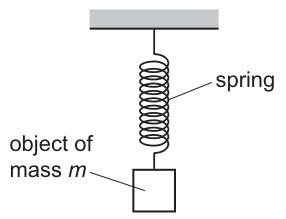
Fig. 1 from the question paper.
Show full working
- 1
The answer must come out in seconds: so whichever combination of and simplifies to is the homogeneous one.
Fixing the target unit first tells you what you are hunting for.
- 2
Find from its defining equation. The spring constant is defined by Hooke's law , so
is not a base quantity — its unit must be built from the equation that defines it, exactly as in “SI base and derived units”.
- 3
Test A: . That is not , so A fails.
- 4
Test B: . Not , so B fails.
Note how close B looks to D — same ingredients, but no square root. Units do not care about closeness: s² ≠ s.
- 5
Test C: simplify the fraction inside the root first, , then take the root: . Not , so C fails.
- 6
Test D: the fraction is again (step 4), and taking the square root gives ✓. This matches , so D is the homogeneous equation.
D — (the only option whose base units simplify to seconds).
When testing roots, simplify the fraction's units first and take the root second — trying to do both at once is where slips happen.
Finding an unknown power
Sometimes the equation contains an unknown power , and you are told the equation is homogeneous. Then the powers of each base unit must be equal on both sides, and that gives an equation for .
Demonstration. The kinetic energy of a moving object is . Find .
Left-hand side: energy is measured in joules, .
Right-hand side: the has no units, so
(the power acts on every unit inside the bracket).
Match the metres: on the left and on the right, so .
Check with the seconds: on the left and on the right ✓. The kilograms already match. So .
Your turn
Build each candidate side term by term; pure numbers never contribute units.
- 19702/12 M/J 2025 Q4
The time period of a pendulum is given by
where is the length of the pendulum and is the acceleration of free fall. The equation is homogeneous. What is the value of ?
Options
A
B
C
DStuck? Show hint
Simplify the units of first, then ask what power turns them into seconds.
Show solution
- 1
The left-hand side is a time: . The is a pure number with no units.
- 2
Units inside the bracket: and , so
The metres cancel, and dividing by is the same as multiplying by .
- 3
Raise to the power :
- 4
Match the powers of seconds on both sides: — option C.
(option B) would give , a frequency, not a time. A power of is a square root, so this is .
AnswerC — , so .
- 1
- 29702/11 O/N 2019 Q2
The speed of a wave in deep water depends on its wavelength and the acceleration of free fall . What is a possible equation for the speed of the wave?
Options
A
B
C
DShow solution
- 1
Write down what the answer must reduce to: . The ingredients are and ; and are pure numbers with no units.
- 2
Test A: ; dividing by changes nothing; taking the square root gives ✓ — A works.
- 3
Test B: the same product , but with no square root this time ✗.
B is A without the root — a reminder that the root is doing real work on the indices, halving both of them.
- 4
Test C: ; square root gives ✗.
The result has no metre in it at all — a speed needs both m and s, so C fails despite looking plausible.
- 5
Test D: again, with no root to fix it ✗.
- 6
Only A reduces to .
AnswerA —
- 1
- 39702/12 M/J 2019 Q3
The Planck constant has SI units J s.
Which equation could be used to calculate the Planck constant?
Options
A where is distance, is energy and is velocity
B where is velocity and is distance
C where is electric field strength
D where is force, is radius and is massStuck? Show hint
Read each option's own definitions before testing it — the in A and the in C are different quantities.
Show solution
- 1
Put the target into base units first: , so
Every option will be reduced to base units, so the target must be in base units too.
- 2
Convert the named derived units option by option. In A, is an energy: . In D, . Also , , and .
Each option supplies its own key — testing all four with one blanket meaning for E would test the wrong physics in C.
- 3
Test A: build up piece by piece.
then divide by :
— matches .Numerator simplified first, then divided — the same two-pass habit as simplifying any algebraic fraction.
- 4
Test B: ✗.
- 5
Test C: here is electric field strength, which is force per unit charge, (you meet it properly later in the course). Build its unit, using :
Inverting, ✗ (the contributes nothing).
Inverting a unit flips the sign of every index — and a negative kilogram index alone already kills it, because h carries kg to the power +1.
- 6
Test D: ; dividing by :
✗The kilograms cancel completely, but needs — so D fails even before you look at the metres and seconds.
AnswerA —
- 1
- 4
The ideal-gas equation is homogeneous. Given , , is an amount in mol and is a temperature in K, determine the base units of .
Show solution
- 1
Rearrange for :
- 2
Combine pressure and volume first:
- 3
Divide by mol and kelvin — neither cancels with anything above:
Mol and kelvin are base units in their own right — nothing upstairs cancels them, so they ride along into the answer.
Answer - 1
Systematic and random errors; precision and accuracy
“
understand and explain the effects of systematic errors (including zero errors) and random errors in measurements; understand the distinction between precision and accuracy
No measurement is perfect
Every reading you take is slightly wrong. What matters — in the exam and in a real experiment — is how it is wrong. Errors come in two kinds that behave very differently, and you must use the four words of this section (random, systematic, precise, accurate) exactly.
Random errors: scatter both ways
A random error makes repeated readings scatter unpredictably on both sides of the true value — sometimes high, sometimes low. Typical causes:
- judging a scale mark with your eye at a slightly different angle each time (parallax that varies),
- human reaction time when timing with a stopwatch,
- fluctuations in the quantity itself (a draught nudging a thermometer).
Random errors reduce precision: the repeats disagree with each other. Their effect shrinks when you average several readings — the highs and lows partially cancel, so the mean lands closer to the truth than any single reading.
Systematic errors: everything shifted the same way
A systematic error pushes every reading the same direction by roughly the same amount. Typical causes:
- a zero error — a balance reading before anything is placed on it, or closed calipers not reading exactly zero,
- a rule worn short at one end,
- a thermometer consistently reading C high.
Because every reading shifts together, repeating and averaging does nothing to a systematic error — the mean of many shifted readings is still shifted. It must be attacked at the source: check the instrument against a known value (calibration), subtract the zero reading, or use a different technique.
Correcting a zero error. Closed calipers read instead of zero. A wire then reads . Every reading is too big, so subtract the zero reading:
If the closed reading were (below zero), you would subtract , which means adding .
Repeated readings plotted against reading number: random errors scatter either side of the true line (averaging helps); a systematic error rides a constant offset above it (averaging changes nothing).
Remember this sentence: taking repeat readings and averaging reduces the effect of random errors only. A systematic error survives averaging perfectly intact — it can only be found by checking against a known value or eliminating the zero.
Precision and accuracy are different words for different things
- Precision describes how close the repeats are to each other — small scatter means precise.
- Accuracy describes how close the mean is to the true value.
The two are independent, and the interesting case is a data set that is precise but inaccurate: a tight cluster sitting in the wrong place. That pattern is the signature of a systematic error — the readings agree beautifully with each other because they are all wrong by the same amount.
Four targets, four diagnoses: precise and accurate (tight cluster centred), precise but inaccurate (tight cluster off-centre — the systematic-error signature), imprecise but accurate on average (wide scatter centred), and neither.
A clean demonstration
A student measures the length of a wire five times with the same rule:
Precision. The spread is . The repeats agree closely with each other, so the set is precise.
Accuracy. The mean is
Now suppose the first of the rule has worn away, and the student lines the wire up with the worn end. The end of the rule is now really at the mark, so every reading comes out too high. The true length is then , and the mean of misses it by : the set is inaccurate despite being precise. Tight cluster, wrong place — the systematic-error signature, exactly as in the targets diagram.
Accurate AND precise? Check them separately
A steel rule can be read to the nearest millimetre. It is used to measure the length of a bar whose true length is . Repeated measurements give the following readings.
| length / mm |
|---|
| 892, 891, 892, 891, 891, 892 |
Are the readings accurate and precise to within ?
Options
| results are accurate to within | results are precise to within | |
|---|---|---|
| A | no | no |
| B | no | yes |
| C | yes | no |
| D | yes | yes |
Show full working
- 1
Precision first — compare the repeats with each other. Spread largest smallest , which is within : the readings are precise.
Precision needs only the spread of the repeats — no mean, no true value yet.
- 2
Now the mean, one piece at a time:
- 3
Accuracy — compare the mean with the true value: which is larger than : the readings are not accurate.
- 4
Conclusion: accurate no, precise yes — option B. The readings form a tight cluster about below the truth, the classic signature of a systematic error such as a zero error shifting every reading down.
The two judgements are independent: choosing D ("both") comes from checking precision and assuming accuracy follows. It never does automatically.
B — not accurate (the mean of is from the true ) but precise (spread of only between repeats).
Always run the two checks separately: spread of repeats for precision, then distance of the mean from the true value for accuracy.
Your turn
For every statement, ask: does this behave differently for random and for systematic?
- 19702/13 M/J 2025 Q3
Which statement about errors in measurements is correct?
Options
A An accurate set of measurements always has a small random error.
B A precise set of measurements always has a small systematic error.
C A random error can be reduced by taking an average of several measurements.
D A systematic error creates a random set of measurements spread out about the true value.Show solution
- 1
A fails: accuracy is about the mean sitting on the true value. A set can scatter widely (large random error) and still average out accurately, so accuracy does not guarantee a small random error.
- 2
B fails: precision is about the spread only. A tightly clustered set sitting far from the true value is precise with a large systematic error — the two ideas are independent.
This is the classic trap: precision says nothing about where the cluster sits, only how tight it is.
- 3
C works: random errors scatter either side of the true value, so averaging lets the highs and lows cancel — the standard remedy.
- 4
D fails: a systematic error moves the whole cluster sideways by the same amount each time; it does not create scatter, and the readings are no longer spread about the true value.
AnswerC — averaging several measurements reduces random errors only.
- 1
- 29702/12 O/N 2025 Q2
What describes a set of data with a high precision?
Options
A data measured using equipment with small scale divisions
B data that is close to the accepted value
C data with each value having a low uncertainty
D data with repeats that are close to each otherShow solution
- 1
High precision means the measured values are close to each other — the spread (scatter) between repeat readings is small. That is option D.
Close to each other, not close to the true value: closeness to the truth is accuracy.
- 2
B fails: close to the accepted value describes accuracy. A and C fail: small scale divisions and low uncertainty describe the instrument's resolution, not how well repeated readings agree.
AnswerD — data with repeats that are close to each other.
- 1
- 39702/21 O/N 2024 Q1(c)
Fig. 1.1 shows a cuboidal glass block.
A student measures the mass of the block and the side lengths , and . The measurements are shown in Table 1.1.
quantity measurement In (b)(i) the density of the glass is determined from these measurements.
The true value of the density of the glass is different from the answer in (b)(i) because of a systematic error in the measurements.
Suggest one possible cause of this systematic error.
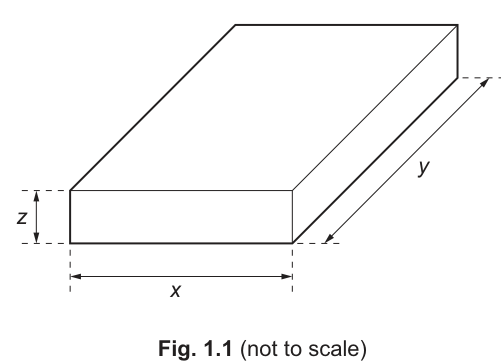
Fig. 1.1 from the question paper: the glass block.
Stuck? Show hint
Density comes from mass ÷ volume — think what a wrongly-zeroed instrument would do to either.
Show solution
- 1
Any instrument reading too high (or too low) by a fixed amount produces exactly this pattern. One sufficient answer: the balance used for the mass had a zero error, reading a small mass before the block was placed on it.
A zero error shifts every mass reading by the same amount, shifting the calculated density the same way every time.
- 2
Equally acceptable: calipers measuring the block's dimensions with a zero error, or any wrongly-calibrated instrument (e.g. a balance reading consistently high against a known mass).
AnswerA zero error on the balance (or calipers), or a wrongly-calibrated instrument — any fixed offset applied to every reading.
- 1
- 4
A top-pan balance always reads too high. A student weighs one object ten times and averages. State and explain the effect of the fault on (a) the accuracy of the mean, (b) the precision of the readings.
Stuck? Show hint
Ask what the fault does to the whole set of readings, and what it leaves alone.
Show solution
- 1
(a) Every reading is inflated by the same , so the mean is also too high: the result is inaccurate.
A fixed offset passes straight through averaging — this is precisely why repetition cannot cure a systematic error.
- 2
(b) The fault adds the same amount to every reading, so differences between readings are unchanged: the scatter stays as it was, so the precision is unaffected — the readings keep the same spread, just around a value too high.
Precision depends only on how the readings differ from each other, and a fixed offset does not change any difference.
Answer(a) The mean is too high — inaccurate. (b) Scatter unchanged — still precise.
- 1
Uncertainty in a derived quantity
“
assess the uncertainty in a derived quantity by simple addition of absolute or percentage uncertainties
A result without an uncertainty is incomplete
Almost no quantity in physics is measured directly: density comes from a mass and three lengths, resistance from a voltmeter reading and an ammeter reading. Each measured input carries an uncertainty, and the calculated result inherits one. This section gives the rules for working out how big that inherited uncertainty is. You need it to decide whether two results agree with each other, or with an accepted value.
Three ways to quote the same uncertainty
Take a length quoted as .
- Absolute uncertainty — same units as the value itself. For a single reading it is usually taken as half the resolution (smallest scale division) of the instrument; for repeat readings, half the range of the repeats.
- Fractional uncertainty (about of the value).
- Percentage uncertainty .
All three carry exactly the same information; the combining rules below simply work more naturally in one form or the other.
Where the rules come from: worst-case reasoning
Rather than memorising rules, derive them once with invented numbers — then you can always rebuild them.
Rule for sums and differences: add absolute uncertainties. Suppose and , so . In the worst case, and are both high at once:
That is : the uncertainty of the sum is . The worst case on the low side () agrees. Subtraction behaves identically ( has worst cases and : again ), because subtracting a too-low inflates the result just as much.
Rule for products and quotients: add percentage uncertainties. Take and , so . Worst case high:
That is above , i.e. . The worst case low (, about down) agrees. So
A quotient works the same way: dividing by a number whose value might be low costs the same as multiplying by one high.
Rule for powers: multiply by the power. If , then , and the product rule adds the same percentage uncertainty to itself: . In general gives . A squared quantity's fractional uncertainty counts twice, a cubed one's three times.
Constants carry nothing. A number like or is exact — it contributes zero uncertainty. So if , the percentage uncertainty of equals that of , and the absolute uncertainty is halved along with the value: gives .
Sum or difference → add ABSOLUTE uncertainties
Product or quotient → add PERCENTAGE (fractional) uncertainties
Power n → multiply the percentage uncertainty by n
Pure numbers contribute nothing
Converting back, and rounding
Once the percentage uncertainty of the result is known, convert back to absolute form when asked:
Then round using two rules:
- quote the uncertainty to 1 significant figure (at most 2);
- make the last significant figure of the value match the uncertainty: becomes , never .
Do two results agree? Turn each into a range: runs from to , and runs from to . The ranges overlap (between and ), so the two results could be the same quantity. If the ranges do not overlap, the results disagree.
- 1
Write the equation the quantity is calculated from.
- 2
Label each measured quantity with its percentage uncertainty (convert from absolute if necessary).
- 3
Add the percentages, first multiplying by any power each quantity is raised to. Constants contribute nothing.
- 4
Convert back to absolute if asked: multiply the total percentage by the calculated value, then round to 1 s.f.
The question says "absolute uncertainty" — do not stop at the percentage.
A clean demonstration
Given and , find with its absolute uncertainty.
Value:
Percentage uncertainty, piece by piece: enters once, carrying ; is squared, so its counts twice:
Convert back:
So . Notice how every rule appeared once: product (add percentages), power (double the contribution), constant-free arithmetic, then round.
Combining three percentage uncertainties with a square
A quantity relating to the motion of the balloon is calculated from three measured quantities , and using the formula
The percentage uncertainties in the measured quantities are given in Table 1.2.
| measured quantity | percentage uncertainty |
|---|---|
The calculated value of is .
Determine the absolute uncertainty in .
Show full working
- 1
Deal with the constant first: the in the numerator is exact and contributes no uncertainty.
Clearing constants out of the way stops them being counted later — a common slip.
- 2
is squared, so its percentage uncertainty counts twice:
This doubling is the step most easily forgotten — the square applies to the uncertainty as well as to the value. The mark scheme's first mark is for 5 + 3 + (2 × 4).
- 3
Add the three contributions:
- 4
Convert back to absolute: identify the pieces — total percentage , value — then substitute:
- 5
Round to 1 significant figure and match the value to it:
0.288 becomes 0.3, and the value stays at 1.8 — one decimal place, matching the uncertainty's.
(from a total percentage uncertainty of ), giving .
Write each variable's contribution on its own line before adding — squares doubled, constants skipped.
Resistivity: four measurements and a squared diameter
A student uses a circuit containing an ammeter, a voltmeter and a cell to take measurements to determine the resistance of a length of nichrome wire.
The student also measures the length and the diameter of the wire. Table 5.1 shows the measurements recorded for each quantity.
| quantity | measurement |
|---|---|
| length | |
| diameter | |
| voltmeter reading | |
| ammeter reading |
In earlier parts the resistance and the resistivity of the nichrome are calculated, where is the cross-sectional area; together these give .
Calculate the percentage uncertainty in .
Show full working
- 1
and are exact constants — they contribute nothing.
- 2
Fractional uncertainty in (enters once):
- 3
Fractional uncertainty in : But is squared, so this counts twice:
The diameter enters squared — forgetting to double its fractional uncertainty is THE mark-dropper here.
- 4
Fractional uncertainty in (enters once, on the bottom):
- 5
Fractional uncertainty in (once, on the bottom):
- 6
Add all four contributions:
- 7
Convert to a percentage:
Percentage uncertainty in .
Division costs exactly what multiplication costs — quantities on the bottom of a fraction add their percentage uncertainties just the same.
Your turn
The first item is a difference, so it adds absolute uncertainties. The rest use the method above: equation → label percentages → add (doubling or cubing where powered) → convert back.
- 19702/14 M/J 2025 Q3
Calipers are used to determine the thickness of the wall of a glass tube. The following measurements are made.
internal diameter of the tube
external diameter of the tubeWhat is the thickness of the wall of the tube?
Options
A
B
C
D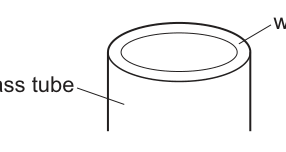
Fig. 1 from the question paper: the glass tube.
Stuck? Show hint
The difference of the diameters is the wall counted twice — once on each side of the tube.
Show solution
- 1
Difference of the diameters: This covers the wall on both sides of the tube.
A diameter crosses the tube, passing through the wall twice. Forgetting this gives options C and D.
- 2
Uncertainty of a difference: add the absolute uncertainties. so the difference is .
Subtracting never reduces uncertainty: in the worst case one diameter is high and the other low.
- 3
Halve to get one wall. Dividing by the exact number halves the value and its absolute uncertainty:
The percentage uncertainty stays 10%, so the absolute uncertainty halves with the value. Keeping ±0.2 gives the trap answer B.
- 4
So — option A.
AnswerA — .
- 1
- 29702/13 O/N 2025 Q2
Two quantities are measured.
and are related to by the equation shown.
What is the calculated value and uncertainty of ?
Options
A
B
C
DStuck? Show hint
Convert both absolute uncertainties to percentages before combining — and remember is squared.
Show solution
- 1
Calculate the pieces of the value first:
- 2
Substitute and evaluate:
Keep a spare figure (45.8) until the uncertainty is known — the final rounding depends on it.
- 3
Percentage uncertainty in :
- 4
Percentage uncertainty in : and since is squared this counts twice: .
- 5
Add:
- 6
Convert back to absolute:
- 7
Round the value to match: — option D.
A and B keep 45.8 with far too small an uncertainty; C forgets to double the uncertainty in T for the square.
AnswerD —
- 1
- 39702/22 F/M 2025 Q1(b)(ii)
Two solid cubes, A and B, are measured to determine the density of their materials.
Table 1.1 shows the measurements for cube A.
quantity measurement length of side mass Calculate the percentage uncertainty in the density of the material of cube A.
Stuck? Show hint
Density = mass ÷ volume, and the volume of a cube of side is .
Show solution
- 1
Write the equation: so the mass enters once and the side length is cubed.
- 2
Percentage uncertainty in the mass:
- 3
Percentage uncertainty in the side length: The side is cubed (), so this counts three times: .
Cubed, not squared — count the exponent carefully before multiplying.
- 4
Add:
The mark scheme quotes 4% — uncertainties are conventionally given to 1 significant figure, so round the 3.56% at the end rather than part-way through.
Answer(, quoted as ).
- 1
- 49702/22 F/M 2025 Q1(b)(iii)
(Continuing the previous question: the calculated density of the material of cube A is , with the percentage uncertainty of found above.)
The density of the material of cube B is determined to be .
State and explain whether cube A and cube B could be made from the same material.
Stuck? Show hint
Work out the range each density could span, then look for overlap.
Show solution
- 1
Range of cube A: of is , so
- 2
Range of cube B: of is , so
- 3
Compare ranges: A reaches up to and B reaches down to , so they overlap between and .
Overlap is precisely the criterion: within their uncertainties the two results agree, so the same metal is possible.
- 4
Therefore yes — the two cubes could be made of the same material, because their ranges of possible density overlap.
AnswerYes — A spans – and B spans – (both ); the ranges overlap, so the densities agree within uncertainty.
- 1
- 59702/12 O/N 2025 Q4
A ball is released from rest. The distance the ball falls and the time the ball takes to fall that distance are both measured.
The percentage uncertainty in the measured distance is negligible. The percentage uncertainty in the measured time is .
The distance and the time are then used to calculate the acceleration of free fall.
Air resistance is negligible.
What is the percentage uncertainty in the calculated value of the acceleration of free fall?
Options
A
B
C
DStuck? Show hint
For an object falling from rest, (an equation of motion from the AS Kinematics note).
Show solution
- 1
Find the equation first. For a fall from rest, , so rearranging for :
The question does not give the equation — you must supply it. You meet it properly in the AS Kinematics note; here you only need to see that t is squared.
- 2
The is an exact constant and the uncertainty in is stated negligible — both contribute nothing.
- 3
is squared, so its counts twice: — option C.
AnswerC —
- 1
- 69702/14 O/N 2025 Q3
A stone is released from rest and falls vertically to the ground.
The time taken to fall to the ground and the distance travelled are measured. The measurements are used to determine the acceleration of free fall.
The percentage uncertainty in the measured time is . The percentage uncertainty in the measured distance fallen is .
What is the percentage uncertainty in the calculated value of the acceleration of free fall?
Options
A
B
C
DShow solution
- 1
Same equation as the previous question: from rest, , so
- 2
enters once, carrying .
- 3
is squared, so its counts twice: .
- 4
Add: — option B.
AnswerB —
- 1
Scalars and vectors; adding vectors
“
understand the difference between scalar and vector quantities and give examples of scalar and vector quantities included in the syllabus; add and subtract coplanar vectors
Direction changes everything
A scalar is a quantity with a magnitude and a unit — and nothing more. A vector is a quantity with a magnitude, a unit and a direction. That one extra piece of information changes how the quantity combines: two forces pointing the same way make a resultant (the resultant is the single vector with the same effect as the two together), but pointing opposite ways they make zero. Every mechanics topic that follows uses vectors.
Scalars (magnitude + unit) | Vectors (magnitude + unit + direction) |
|---|---|
distance | displacement |
speed | velocity |
mass, time, temperature | acceleration |
energy, charge | force |
pressure, density | momentum |
wavelength, potential difference | — |
Learn both columns. Every vector's "magnitude only" cousin is a scalar (distance ↔ displacement, speed ↔ velocity) — but many scalars (energy, charge, temperature) have no vector partner at all.
The two classic classification traps
Energy and charge are scalars, even though they feel directional in use — a charge "flows" one way, energy is "transferred" somewhere, but neither quantity itself carries a direction. And speed is a scalar while velocity is a vector: a car going round a roundabout at a steady has constant speed but constantly changing velocity, because its direction changes. Note also that scalars and vectors both have a magnitude and a unit — the presence of a direction is the only difference.
Adding coplanar vectors: head-to-tail
Vectors in the same plane add by the head-to-tail construction:
- Draw the first vector to scale, in its own direction.
- From the head (arrow end) of , draw the second vector to scale, in its direction.
- The resultant runs from the tail of to the head of .
The order does not matter () — either order closes the same triangle.
Head-to-tail addition: draw a, then b from a's head; the resultant runs from a's tail to b's head, closing the triangle.
Two vectors and an angle: the cosine rule
Place the two vectors tail-to-tail with the angle between them, then slide along so its tail sits on the head of , completing the head-to-tail triangle. At that corner, still makes the angle with the line of carried on, so the triangle's inside angle between sides and is (angles on a straight line add to ). The ordinary cosine rule for sides , with included angle is
Here , so
and since :
Special cases worth knowing on sight:
- (same direction): , so — plain addition.
- : , so — Pythagoras.
- equal vectors at : , so .
- equal vectors at : , so .
A and B drawn tail-to-tail with angle θ between them; B slid to the head of A closes the triangle. The inside angle at that corner is 180° − θ, which turns the cosine rule's minus sign into the plus sign of R² = A² + B² + 2AB cos θ.
Subtracting vectors: add the reverse
Reversing a vector flips its direction while keeping its magnitude, so subtraction becomes another head-to-tail addition — with 's arrow turned round.
The most common use is a change in a vector quantity: change = final − initial. For a velocity that changes from to , the change in velocity is .
Subtraction as addition of the reversed vector: a − b is drawn by flipping b end-for-end and adding it head-to-tail to a.
A clean demonstration
Addition at . Two forces act at a point: east and north. Perpendicular vectors, so and the cosine rule collapses to Pythagoras:
Subtraction. Let east and east. Then means plus west:
If instead west, then east east east. Same subtraction, opposite result — the direction of the vector being subtracted matters at every stage.
Resultant of two equal forces at 60°
The diagram shows two forces of acting on an object. The angle between the lines of action of the two forces is .
What is the magnitude of the resultant force?
Options
A
B
C
D
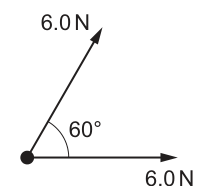
Fig. 1 from the question paper.
Show full working
- 1
Two vectors with a stated angle between them → cosine rule form:
Identify the pieces: , , .
The angle between the vectors is used exactly as given — the 180° − θ conversion is already built into the formula, so do not apply it again.
- 2
Substitute each piece:
- 3
Evaluate term by term: and ; , so the cross term is :
- 4
Take the square root: — option C.
The tempting wrong answer 12 N (option D) comes from just adding the magnitudes, which is only valid when the vectors point the same way (θ = 0). And 6.0 N (option A) would be the resultant if the angle were 120° rather than 60° — equal vectors at 120° give R = A. The angle of 60° must shrink the answer below 12 but keep it well above 6 — 10 N is exactly that.
C — (, so ).
For any two vectors, the resultant always lies between |A − B| and A + B — use that to sanity-check any option list.
Your turn
- 19702/22 M/J 2025 Q1(a)
Table 1.1 lists some physical quantities. Identify with ticks (✓) which quantities are vectors and which are scalars.
quantity scalar vector acceleration displacement gravitational potential energy speed temperature Show solution
- 1
Acceleration — a rate of change of velocity, which carries a direction: V.
- 2
Displacement — distance in a stated direction: V.
- 3
Gravitational potential energy — energy is a scalar, whatever its origin: S.
The energy trap from the callout: it feels directional but carries no direction of its own.
- 4
Speed — the magnitude-only cousin of velocity: S.
- 5
Temperature — no direction attaches to it: S.
Answeracceleration V; displacement V; gravitational potential energy S; speed S; temperature S.
- 1
- 29702/23 M/J 2021 Q1(a)(ii)
A property of a vector quantity, that is not a property of a scalar quantity, is direction. For example, velocity has direction but speed does not.
State two properties that are possessed by both scalar and vector physical quantities.
Show solution
- 1
Both have a magnitude (a number).
- 2
Both have a unit.
The question deliberately asks for what is shared, not what differs — direction belongs to vectors only, so it must not appear in the answer.
AnswerA magnitude and a unit.
- 1
- 39702/22 O/N 2024 Q1(a)
State what is meant by a vector quantity.
Show solution
- 1
A vector quantity has both magnitude and direction (and, like every physical quantity, a unit).
AnswerA quantity with both magnitude and direction.
- 1
- 4
A rower rows at relative to the water, aiming straight across a river. The water itself flows parallel to the bank at . Find the magnitude of the rower's resultant velocity and the angle it makes with the rower's intended direction.
Stuck? Show hint
The two velocities are perpendicular — which special case of the cosine rule applies?
Show solution
- 1
The two velocities are perpendicular (), so and the cosine rule reduces to Pythagoras:
Both are velocities in m s⁻¹, so they can be combined; the right angle is what allows Pythagoras.
- 2
Identify the pieces, and , and substitute:
- 3
Direction: the component along the bank () is perpendicular to the intended direction, so the angle between the resultant and the intended (straight-across) direction satisfies
The resultant is dragged 53° away from where the rower is aiming — which is why aiming straight across a flowing river never gets you straight across.
Answer, at from the intended direction (i.e. to the bank).
- 1
- 59702/11 M/J 2024 Q3
The velocity of an object changes from an initial velocity to a final velocity . The vectors represent these velocities.
Which single vector represents the change in velocity of the object?
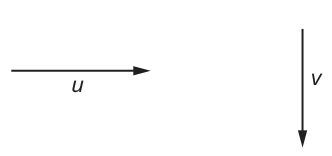
Fig. 1: the initial velocity u and the final velocity v.
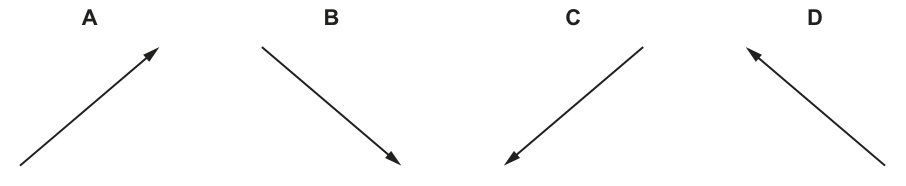
Options A to D.
Stuck? Show hint
Change = final − initial, and subtracting means adding turned round.
Show solution
- 1
Write the change:
Final minus initial. Doing u − v instead gives the reversed arrow, which is option A.
- 2
Read the directions from Fig. 1: points to the right, points straight down. So points to the left.
- 3
Add head-to-tail: draw (down), then from its head draw (left). The resultant runs from the start of to the end of : it points down and to the left.
- 4
Only option C points down and to the left.
B points down-right (that is v + u, an addition). D points up-left and A up-right: each has at least one direction backwards.
AnswerC — the arrow pointing down and to the left ().
- 1
Resolving into perpendicular components
“
represent a vector as two perpendicular components
Why resolve? Because perpendicular directions are independent
Addition combines two vectors into one. Resolution runs the film backwards: it splits one vector into two perpendicular components that add back to it. Why do this? Motion or forces along perpendicular directions do not affect each other, so one awkward 2-D problem becomes two easy 1-D problems. Horizontal and vertical, or along a slope and perpendicular to it: the mechanics topics that follow use this all the time.
Where cos and sin come from
Draw the vector at angle to the -direction and drop a perpendicular from its head onto the -axis. The vector is the hypotenuse of a right-angled triangle whose two legs are the components: along (adjacent to ) and perpendicular to (opposite ). Right-angle trigonometry says
Multiplying both sides of each equation by :
The cos goes with the adjacent side — the component along the direction you measured from. A two-second check that never fails: put . The vector then points entirely along , and indeed while . Any cos/sin assignment that fails this check is backwards.
Resolving F at angle θ to the x-direction: the adjacent leg is F cos θ, the opposite leg is F sin θ. The check θ = 0 (all of F along x) confirms which trig function goes where.
Recombining components
Given the components, the original vector is recovered by adding them head-to-tail. They are perpendicular, so Pythagoras applies (the case in “Scalars and vectors; adding vectors”):
The magnitude comes from Pythagoras and the direction from the tangent — the angle measured from the same axis the components were taken along. A good habit: recombine at the end of a long calculation to confirm you land back on the original vector.
Recombining: components Rx and Ry rebuild a resultant of magnitude √(Rx² + Ry²) at angle tan⁻¹(Ry/Rx) to the x-direction.
- 1
Sketch the vector at its angle, roughly to scale.
- 2
Mark from a defined axis — say explicitly which direction you measured the angle from.
cos and sin swap depending on which axis θ is measured from; pinning the axis down prevents the swap.
- 3
Adjacent side gets cos, opposite side gets sin, relative to that angle.
- 4
Sanity-check with or : at everything lies along the axis, at nothing does.
Two seconds of checking catches a cos/sin swap, the most common slip when resolving.
A clean demonstration
A ball is thrown with speed at above the horizontal. Resolve it.
Horizontal component — adjacent to the angle, so cos:
Vertical component — opposite the angle, so sin:
Sanity check. is closer to than to , so the horizontal component should be the larger — and ✓.
Recombine to close the loop:
Components of a kicked ball's velocity
A child kicks a ball so that it leaves horizontal ground with a velocity of at an angle of to the horizontal, as shown in Fig. 1.1.
Air resistance is negligible. The ball leaves the ground at time .
Calculate the horizontal component and the vertical component of the velocity of the ball immediately after it has left the ground.
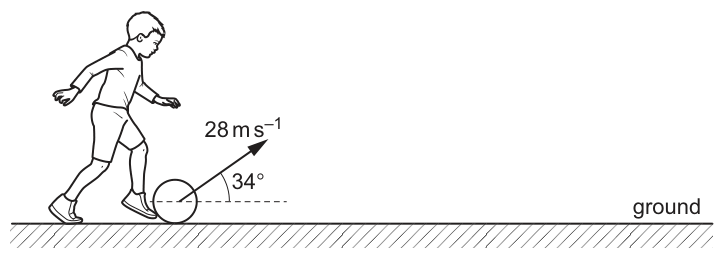
Fig. 1.1 from the question paper.
Show full working
- 1
The angle is measured from the horizontal, so the horizontal component is the adjacent one and takes cos:
Say which axis the angle is from before choosing cos or sin — that single sentence prevents the swap.
- 2
Evaluate: (2 s.f., matching the data).
- 3
The vertical component is the opposite one, so sin:
- 4
Evaluate:
- 5
Sanity check: is less than , so the horizontal component should dominate — ✓.
Quoting 23 and 16 (not 23.2 and 15.7) is deliberate: the inputs have 2 s.f., so the answers must too.
, .
Angle from the horizontal → horizontal takes cos. Angle from the vertical → vertical takes cos. Always identify the adjacent side first.
Displacement from perpendicular components
An object is projected horizontally at a speed of from a slope, as shown in Fig. 2.1.
The slope is at an angle to the horizontal. Air resistance is negligible.
The object lands on the slope a time of later and stops without rolling or bouncing.
(Earlier parts of the question find the horizontal distance travelled, , and the vertical distance travelled, .)
Determine the magnitude of the displacement of the object from its original position.
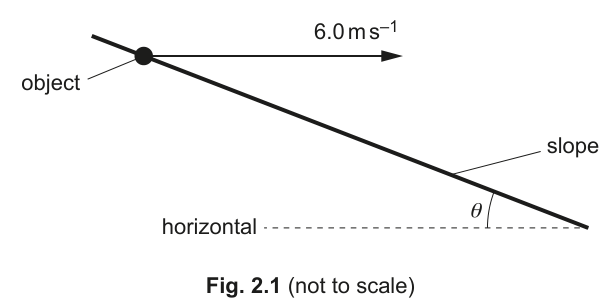
Fig. 2.1 from the question paper.
Show full working
- 1
Displacement is a vector. Its two components — horizontally and vertically — are perpendicular, so the magnitude comes from Pythagoras, not from addition.
This is the whole point of the question: adding 4.3 + 2.5 = 6.8 m treats the components as scalars and throws away their directions.
- 2
Substitute into :
- 3
Evaluate each square first: and , so
- 4
Take the root and round: (2 s.f. to match the data).
(from ; the mark scheme accepts or ).
Whenever a question asks for displacement (or any vector) from two perpendicular pieces, Pythagoras is the reflex — never plain addition.
Your turn
- 19702/14 M/J 2025 Q4
The diagram shows two fixed pins, Y and Z. A length of elastic is stretched between Y and Z and around pin X, which is attached to a trolley.
X is at the centre of the elastic and the trolley is to be propelled in the direction P at right angles to YZ. The tension in the elastic is .
What is the force accelerating the trolley in the direction P when the trolley is released?
Options
A
B
C
D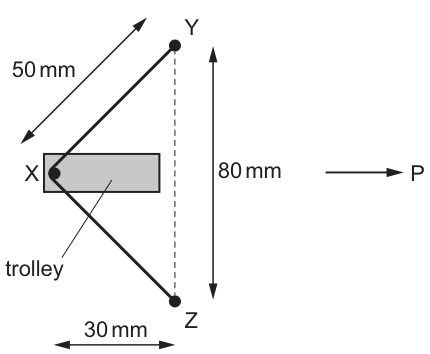
Fig. 1 from the question paper.
Stuck? Show hint
First find the angle each 50 mm segment makes with P from the printed geometry: 30 mm along P, 50 mm of segment.
Show solution
- 1
Geometry first. Drop a perpendicular from X to the midpoint of YZ: it runs along direction P, and the segment itself is long. So for the angle between a segment and P:
The angle is not given as a number — it has to be earned from the printed lengths before any resolving can happen.
- 2
Resolve one tension along P (the adjacent component, so cos):
- 3
The components perpendicular to P from the two segments are equal and opposite — they cancel by symmetry. Only the components along P add, and there are two segments:
— option C.Forgetting the factor of 2 (both segments pull) gives 2.4 N, option A. Using sin instead of cos gives 4.0 × 0.8 = 3.2 N per segment, which leads to options B and D.
AnswerC — along P (, with the perpendicular components cancelling).
- 1
- 2
A sledge is pulled by a force of along a rope held at above the horizontal. (a) Calculate the horizontal and vertical components of the force. (b) The sledge slides along the ground: state which component pulls it forward and which tends to lift it.
Show solution
- 1
(a) The angle is measured from the horizontal, so the horizontal component is adjacent and takes cos:
- 2
The vertical component is opposite and takes sin:
- 3
(b) The horizontal component () acts along the ground and does the pulling forward; the vertical component () points upward and tends to lift the sledge, slightly reducing its contact force with the ground.
(b) is the reason resolving is useful: along-the-ground and up-and-down effects can be analysed separately, because perpendicular components are independent.
Answer(a) horizontal, vertical. (b) Horizontal pulls it forward; vertical tends to lift it.
- 1
- 3
A walker's displacement consists of east followed by north. Find the magnitude and direction of the single displacement that has the same effect.
Stuck? Show hint
East and north are perpendicular — Pythagoras for the size, tan for the direction.
Show solution
- 1
The two legs are perpendicular, so the resultant has magnitude
- 2
Direction: measure the angle from the easterly direction (the adjacent side):
- 3
So the single displacement is at north of east.
"North of east" names the reference axis — the angle is measured starting from east and rotating toward north. A direction without its reference is incomplete.
Answerat north of east.
- 1
- 4
Two forces act at a point: along the -direction, and at to the -direction. Find the resultant force by resolving both forces into - and -components, adding the components, and recombining. Check your answer with the cosine rule.
Stuck? Show hint
The force has no -component. Resolve only the force.
Show solution
- 1
Components of the force: it lies along , so
- 2
-component of the force (angle measured from , so cos):
- 3
-component of the force (sin):
- 4
Add the components along each direction separately:
Components along the same direction add like ordinary numbers. Never add an x-component to a y-component.
- 5
Recombine the magnitude with Pythagoras:
- 6
Direction from the -direction:
- 7
Check with the cosine rule, , , angle : so ✓.
Both methods give the same answer. Components are easier when there are three or more vectors; the cosine rule is quicker for exactly two.
Answerat to the -direction.
- 1
The weight of a person is .
.
kg is a mass unit and N a force unit; weight needs the ×g conversion every time.
.
.
The index squares the power of ten along with the unit — the same applies to mm², cm³ and every prefixed unit carrying an exponent.
Precise data is accurate data.
Precision is the scatter between repeats; accuracy is closeness of the mean to the true value — a systematic error produces tight, wrong data.
The two words answer different questions: how well do repeats agree with each other, versus how close is the result to the truth.
Add the percentage uncertainties of a sum.
Sums and differences add ABSOLUTE uncertainties; products and quotients add PERCENTAGE uncertainties.
Using the wrong rule loses the uncertainty marks — check which operation combines the quantities before choosing.
The resultant of two forces is , so two forces at give .
Use the cosine rule: , so .
Plain addition only works when the vectors point the same way (θ = 0); any other angle needs the cosine rule.
sin goes with the horizontal component.
cos goes with the adjacent side — the component along the direction the angle is measured from. Check: at θ = 0 the whole vector lies along the axis, and cos 0 = 1.
Which function goes where depends on which axis θ was measured from, not on "horizontal" or "vertical" as words — the θ = 0 check settles it every time.
On 9702 Papers 1+2 (2021–2025) this topic supplied 351 marks across 271 question parts in 37 sittings of Papers 1 and 2 — roughly 9 or 10 marks a sitting — and its techniques (base units, uncertainty rules, component resolution) come back inside later topics. Return to this note whenever a later topic assumes one of those skills.
Everything on one page
Components of a vector F at angle θ to the x-direction
Recombining perpendicular components into a resultant
Resultant of two vectors with angle θ between them (cosine-rule form)
Change in a vector: final minus initial, i.e. add the reversed initial vector
Prefixes (recall): pico, nano, micro, milli, centi, deci, kilo, mega, giga, tera
The five SI base quantities and units (recall)
Combining uncertainties: sums/differences add absolute uncertainties; products/quotients add fractional (percentage) ones; a power n multiplies by n; exact constants add nothing
Derived units expressed in base units (each built from its defining equation)
Can you do all of these?
State that every physical quantity is a magnitude with a unit, and make order-of-magnitude estimates anchored to known reference values
Recall the five SI base quantities (kg, m, s, A, K) — charge, force and energy are NOT base quantities — and express derived units as products/quotients of base units
Convert between prefixed units from pico to tera, including squared/cubed prefixes and compound units
Check the homogeneity of an equation in base units, find the base units of a constant, and find an unknown power by matching indices
Distinguish systematic (including zero) errors from random errors, correct a zero error, and tell precision from accuracy
Combine absolute uncertainties for sums/differences and percentage uncertainties for products/quotients, multiplying by n for powers
Quote a derived value with its uncertainty rounded to 1 significant figure, the value's last figure matching; compare two results by checking whether their ranges overlap
Classify quantities as scalars or vectors, and add/subtract coplanar vectors head-to-tail or with the cosine rule; find a change in velocity as v − u
Resolve a vector into perpendicular components with cos/sin, add vectors component by component, and recombine with Pythagoras and tan