The α-particle scattering experiment
“
infer from the results of the α-particle scattering experiment the existence and small size of the nucleus; describe a simple model for the nuclear atom to include protons, neutrons and orbital electrons
The atom before the experiment
In 1909 the atom was imagined as a plum pudding: a ball of positive charge, roughly m across, with electrons dotted through it like fruit in a pudding. Mass and charge were spread thinly through the whole ball, so nothing inside it was concentrated enough to push hard on a fast particle. Hans Geiger and Ernest Marsden, working with Ernest Rutherford, fired α-particles (fast, positively charged particles given out by some radioactive materials) at a thin gold foil. The plum-pudding model predicted only tiny deflections. Instead, a few α-particles came backwards. This section builds, one observation at a time, the model of the atom that replaced the pudding.
The apparatus
The experiment has three moving parts:
- an α-particle source emitting a narrow beam of α-particles — fast, relatively heavy, positively charged projectiles;
- a thin gold foil target, only a few hundred atoms thick, so an α-particle passing through meets the atoms effectively one at a time;
- a movable detector — a zinc sulphide screen viewed through a microscope — which flashes when an α-particle strikes it, and which can be swung round the foil to count arrivals at any angle from 0° (straight through) to 180° (straight back).
Gold is the ideal target twice over: it can be beaten thinner than almost any other metal, and its nuclei are among the heaviest and most highly charged — so if a concentrated positive charge exists anywhere, gold gives it the best chance to show what it can do.
Source, foil and movable detector. The count at each angle is the experiment's data — most angles collect almost nothing, and the pattern of what does arrive is the evidence.
Observation | Inference |
|---|---|
Most α-particles pass straight through, undeflected. | The atom is mostly empty space — over nearly all of its volume there is nothing dense enough to deflect a fast, heavy α-particle. |
Some α-particles are deflected through small angles. | The atom contains a concentrated positive charge: the positively charged α-particle is repelled by electrostatic (Coulomb) repulsion as it passes near it. |
A very small minority are deflected through more than 90° — they rebound backwards. | The charge, and most of the mass, are concentrated in a tiny, heavy, positively charged nucleus — only a centre both highly charged and massive can turn a fast α-particle round. |
Large deflections are very rare. | The nucleus is very small compared with the atom — an α-particle almost never passes close enough for a large deflection. |
The experiment's logic: each observation buys exactly one inference. 'State what may be inferred' marks are these rows.
From these observations you infer the existence of the nucleus — a region carrying all the positive charge and nearly all the mass of the atom — and its small size: large deflections need close approaches, and close approaches are vanishingly rare, so the nucleus must occupy a minute fraction of the atom.
Reading the paths
The α-particle carries charge and the gold nucleus carries , so every deflection in the experiment is Coulomb repulsion: a push directed along the line joining the two, growing rapidly as their separation shrinks. That one fact fixes every path shape:
- a distant pass feels a weak force the whole way — the path bends only slightly;
- a close pass feels a force that strengthens sharply at nearest approach — the path swings round the outside of the nucleus, and the closer the pass, the larger the deflection;
- a head-on approach climbs the repulsion until the α-particle momentarily stops, then rebounds straight back along its original path — deflected through 180°.
The paths also come in mirror pairs: two α-particles aimed to pass on opposite sides of the nucleus at the same closest distance feel the same repulsion, reflected — so their paths are mirror images of each other.
Closer aim, stronger repulsion, bigger deflection. The head-on path rebounds through 180°; grazing paths bend a little. Every curve bends away from the nucleus, never towards it.
The rebound moves the nucleus — but barely
A head-on rebound is also a momentum statement. Follow a head-on encounter: the α-particle decelerates as it climbs the repulsion, stops instantaneously at closest approach, then rebounds the way it came. At the stopping instant, the α-particle's momentum has all been handed to the gold nucleus, so conservation of momentum gives
where and are the masses of the α-particle and the gold nucleus, and , their speeds. Nuclear masses are measured in the unified atomic mass unit, u (explained in the next section; a proton or a neutron has a mass of about 1 u). These masses are approximately u and u, so
For an α-particle arriving at m s⁻¹, the gold nucleus recoils forwards at only about m s⁻¹ — the same momentum as the α-particle, but 49 times less speed, because it is 49 times more massive. The collision does move the nucleus; it just barely moves it.
What the experiment does NOT tell you
The α-particles probe only what they collide with: a concentration of charge and mass. Three things are often offered as conclusions but are not deducible:
- that the nucleus contains protons — the scattering sees a total charge, not the particles carrying it;
- that the nucleus contains neutrons — an uncharged particle leaves no electrostatic fingerprint at all;
- anything about the arrangement of the electrons — they are far too light to deflect an α-particle, and the α-particles effectively never meet them.
"Which conclusion cannot be drawn from this experiment?" is a common Paper 1 question. The credited inferences are the four rows of the table above — nothing else.
The simple nuclear model
The pudding is replaced by the model every later topic sits on:
- a nucleus at the centre, made of protons (charge each) and neutrons (no charge), packed into a region of radius about m — it holds essentially all of the atom's mass and all of its positive charge;
- electrons (charge each) orbiting the nucleus at radii of about m — they occupy the atom's volume, carry its negative charge, and have negligible mass.
The atom is neutral because the counts match: a neutral atom has equal numbers of protons and electrons. And the experiment's headline number is the size ratio: m against m makes the nucleus about times smaller in radius than the atom. If the nucleus were a pea 1 cm across, the electrons would be orbiting about a kilometre away — the atom is almost entirely empty space with a speck of concentrated matter at its heart.
The nuclear atom: protons and neutrons in a minute central nucleus; electrons orbiting at roughly 100 000 times the nuclear radius. Not to scale — if it were, the nucleus would be invisible.
Completing the scattering paths
Fig. 6.1 shows four α-particles, W, X, Y and Z, moving towards a gold nucleus in a thin gold foil. The paths of particles X and Z are shown.
(i) Complete Fig. 6.1 to show possible paths for particles W and Y. [3]
(ii) Describe what may be inferred about the structure of an atom from the path of particle X. [1]
(iii) When a beam containing many α-particles is incident on the foil, nearly all of the α-particles follow paths similar to the path of particle Z. Describe what may be inferred from this about the structure of an atom. [1]
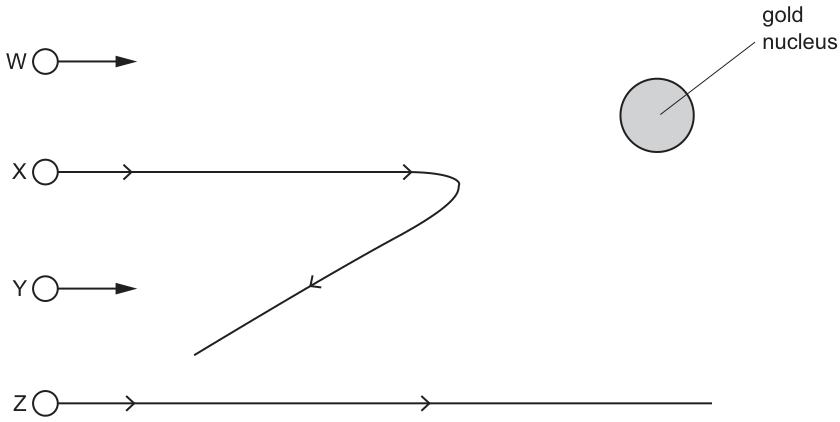
Fig. 6.1 — four α-particles W, X, Y and Z moving towards a gold nucleus.
Show full working
- 1
(i) Start with Z, whose answer is printed: it is aimed to pass far from the nucleus, the repulsion it feels is negligible all the way, and it travels straight on undeflected.
Coulomb repulsion weakens rapidly with distance — a distant pass is effectively a free pass
- 2
X is aimed to pass close to the nucleus, so the repulsion strengthens sharply at nearest approach and bends the path round the outside of the nucleus until the α-particle heads back — deflected through more than 90°.
the hairpin shape is the signature of a close approach to a concentrated positive charge
- 3
W is aimed to pass the nucleus on the other side, at the same closest distance as X, so its path is X's mirror image: it swings round and returns deflected upwards, above its original line.
MS B1: W deflects upwards; MS B1: W's deflection is the mirror image of X's — same closest approach, reflected
- 4
Y is aimed below the nucleus but further out than X, so it feels the same kind of repulsion more weakly: it is deflected downwards, but less than X — its return path sits between X's and Z's (running parallel to Z also scores).
MS B1: Y deflects downwards less than X, or runs parallel to Z — farther aim, smaller deflection
- 5
(ii) X is turned through a large angle by a single encounter. Something with enough charge to repel it that hard, and enough mass not to simply be knocked out of the way, must be concentrated there: the atom has a charged nucleus carrying most of its mass.
MS B1: the nucleus has most of the mass of the atom, or the nucleus is charged — either statement scores
- 6
(iii) Nearly every α-particle sails through undeflected, so nearly every α-particle misses the concentrated centre entirely: most of the atom is empty space, and the nucleus occupies a very small proportion of it.
MS B1: the atom is mostly empty space, or the nucleus occupies a very small proportion of the space in the atom
(i) W returns above its original line, as the mirror image of X's path; Y is deflected downwards, less than X (or runs parallel to Z). (ii) The nucleus is charged and carries most of the atom's mass. (iii) The atom is mostly empty space — the nucleus occupies a very small fraction of it.
Symmetry earns half the drawing marks: the same closest approach on the other side of the nucleus means the mirror-image path. And keep every curved path bending away from the nucleus — a path curving inwards is repulsion running backwards.
Test yourself
Attempt each one before revealing the solution. For the inference questions, write your answers as full sentences — one-phrase answers struggle to earn "describe" marks.
- 19702/13 M/J 2021 Q391 mark
A beam of α-particles is incident on a thin gold foil. One α-particle collides head-on with a gold nucleus and is deflected back along its original path.
Which statement could explain why the recoil speed of the gold nucleus is small compared with the recoil speed of the α-particle?
A Most α-particles are only slightly deflected as they pass through the gold foil.
B The α-particle and the gold nucleus repel each other.
C The mass of the gold nucleus is much greater than the mass of the α-particle.
D The momentum of the α-particle decreases as it approaches the gold nucleus.Stuck? Show hint
At the head-on closest approach the α-particle is momentarily at rest. Where is all its momentum at that instant — and what does that mean for the gold nucleus's speed?
Show solution
- 1
At the head-on closest approach the α-particle is instantaneously at rest, so all of the momentum now belongs to the gold nucleus: .
momentum is conserved throughout the encounter — it cannot disappear
- 2
So : equal momentum, but a much smaller speed for the much more massive nucleus.
same p, bigger m → smaller v — this is option C
- 3
A is an observation, not an explanation of the recoil speed. B and D are both true (the two repel, so the α-particle slows down as it approaches), but they would be true whatever the masses — neither explains why the nucleus ends up so much slower.
eliminate the distractors for a stated reason, not just by feel
AnswerC — the mass of the gold nucleus is much greater than the mass of the α-particle.
- 1
- 29702/12 O/N 2022 Q381 mark
In the α-particle scattering experiment, a beam of α-particles is aimed at a thin gold foil. Most of the α-particles go straight through or are deflected by a small angle. A very small proportion are deflected by more than 90°, effectively rebounding towards the source of the α-particles.
Which conclusion about the structure of atoms cannot be drawn from this experiment alone?
A Most of the atom is empty space.
B Most of the mass of an atom is concentrated in the nucleus.
C The nucleus contains both protons and neutrons.
D The nucleus is charged.Stuck? Show hint
The α-particles only ever meet a concentration of charge and mass. Can any collision tell them what is inside that concentration?
Show solution
- 1
A is deduced from the majority: most α-particles pass straight through, so most of the atom offers nothing to collide with.
straight-through majority → mostly empty space
- 2
D is deduced from the rebounds: an α-particle can only be turned back through more than 90° by a strong repulsion acting at close range, and that repulsion is electrostatic — so the centre of the atom carries charge.
back-scattering needs electrostatic repulsion → the nucleus is charged
- 3
B is deduced from the same rebounds: the centre is not knocked aside by the α-particle, so it must be far more massive than the α-particle — most of the atom's mass sits there.
the centre recoils negligibly → it holds most of the mass
- 4
C overreaches: the experiment senses only the total charge and mass of the nucleus, not what it is built from. A scattering pattern cannot count or identify the particles inside — the neutron was not even discovered until Chadwick's work twenty years later.
scattering sees the whole nucleus; it cannot resolve its internals
AnswerC — that the nucleus contains both protons and neutrons cannot be drawn from the scattering experiment alone.
- 1
- 33 marks
In an α-particle scattering experiment, a beam of α-particles is directed at a thin metal foil. Two of the results are:
- result 1: most of the α-particles pass through the foil with little or no deflection;
- result 2: a very small minority of the α-particles are scattered through angles greater than 90°.
State what may be inferred about the structure of the atom from result 1, and what may be inferred from result 2.
Stuck? Show hint
One inference for result 1, two for result 2 — result 2 needs both a charge statement and a mass statement.
Show solution
- 1
Result 1: most α-particles pass straight through, so most of the atom contains nothing capable of deflecting them — most of the atom is empty space (equivalently: the nucleus is very small compared with the atom).
one credited inference here: empty space, or a nucleus small relative to the atom
- 2
Result 2, first inference: a rebound through more than 90° needs a strong repulsion acting at close range, so the atom must contain a concentrated charge — the nucleus is charged.
first mark for result 2: the nucleus is charged
- 3
Result 2, second inference: the rebound fails to knock the centre out of the way, so that nucleus must be heavy — most of the atom's mass is in the nucleus.
second mark for result 2: most of the mass is in the nucleus
AnswerResult 1: the atom is mostly empty space (the nucleus is very small compared with the atom). Result 2: the nucleus is charged, and most of the atom's mass is concentrated in it.
- 49702/13 O/N 2021 Q381 mark
When -particles are fired at a thin metal foil, most of the particles pass straight through but a few are deflected by a large angle.
Which change would increase the proportion of -particles deflected by a large angle?
A using -particles with greater kinetic energy
B using a double thickness foil
C using a foil made of a metal with fewer protons in its nuclei
D using a source emitting more -particles per unit timeStuck? Show hint
A large deflection needs a close pass by a nucleus. Which change gives each α-particle more nuclei to pass close to?
Show solution
- 1
B: a foil twice as thick has twice as many layers of nuclei in the path of each α-particle, so each α-particle has more chances of a close pass. The proportion deflected through large angles increases.
large deflections need close approaches; more nuclei in the way means more close approaches
- 2
A: faster α-particles are harder to turn round, so they are deflected less. C: fewer protons means a smaller nuclear charge and weaker repulsion, so deflections are smaller.
both of these weaken the effect of the repulsion compared with the α-particle's motion
- 3
D: more α-particles per second increases the number deflected each second, but not the proportion — each α-particle has the same chance as before.
read 'proportion' carefully: a count and a fraction are different things
AnswerB — using a double thickness foil.
- 1
The rest of this note
Can you do all of these?
I can state the four observations of the α-scattering experiment and the inference from each
I can say which conclusions the experiment does NOT support (no protons, no neutrons, no electron orbits)
I can read and find protons, neutrons and electrons in atoms and ions
I can define isotopes and spot them in a table of nucleon/proton counts
I can reproduce the mass and charge of α, β⁻, β⁺ and γ in u and in terms of e, and count α-particles from a beam current
I can state what an antiparticle is and give the mass and charge of any particle's antiparticle
I know β⁻ emits an antineutrino and β⁺ emits a neutrino, and why the β spectrum is continuous but the α spectrum is not
I can use a β energy spectrum to explain why another particle must be emitted
I can convert between u and kg, and between J and MeV, and find a kinetic energy or a speed
I can balance any α or β decay equation using nucleon-number and charge conservation
I can count the αs and β⁻s in a decay chain between two given nuclides
I can find the recoil speed of a daughter nucleus using nucleon numbers in place of masses
I can recall all six quark flavours and their charges, and build a baryon or meson to a target charge
I can classify any particle as baryon, meson, hadron or lepton — and say which are fundamental
I can state the quark-level change in β⁻ decay (d → u) and β⁺ decay (u → d)