Photon energy E = hf and the electronvolt
“
understand that electromagnetic radiation has a particulate nature; understand that a photon is a quantum of electromagnetic energy; recall and use E = hf; use the electronvolt (eV) as a unit of energy
Light meets its own graininess
Every description of light met so far — reflection, refraction, diffraction, interference, polarisation — treats it as a wave: a continuously varying disturbance that can carry any amount of energy, so long as the source is made brighter or dimmer. That picture is not wrong; Young's double-slit fringes and diffraction gratings are proof it works. But a handful of stubborn observations — how a metal surface releases electrons when light shines on it (§03–§05 of this note tell that story properly, with the actual evidence) — refused to fit a purely continuous wave at all. The resolution physics settled on is not that the wave picture was wrong, but that it was incomplete: electromagnetic radiation also behaves, in the right experiment, as a stream of individual particle-like packets. This section introduces the vocabulary for that packet and the single equation that says how much energy each one carries. The evidence for why this is necessary comes later — but the equation itself is needed everywhere from here on, including inside the evidence itself.
The photon
A photon is a single quantum of electromagnetic energy — one indivisible "packet" of energy carried by the radiation. "Quantum" here means exactly what it sounds like: a smallest indivisible amount. A beam of light does not deliver its energy in any size parcel you like; it delivers it in whole photons, and a detector sensitive enough (a single retinal cell in the dark, a photomultiplier tube) really does register light arriving one photon at a time, not as a smooth continuous trickle.
Every photon of a given frequency carries exactly the same energy as every other photon of that same frequency — that fixed amount is the entire content of the next equation.
E = hf — the energy of one photon
The frequency in this equation is nothing new — it is the same wave frequency already met in AS Waves: the number of complete oscillations the associated electromagnetic wave performs every second, in hertz. What is new is the claim that a single photon of that frequency carries a fixed, non-negotiable energy proportional to it:
where is the Planck constant, — a fixed number of nature, given on the data sheet. Doubling the frequency doubles the energy of each photon; the light does not get "brighter" in the everyday sense, each individual photon simply carries more energy.
Photon energy — h = 6.63×10⁻34 J s (Planck constant, given on the data sheet), f in Hz.
From frequency to wavelength: E = hc/λ
Wavelength, not frequency, is very often the quantity actually given — from a diffraction grating, a spectrometer, or a stated colour. Getting from to a wavelength form is a short substitution, not a new law.
Start from the wave equation relating speed, frequency and wavelength (AS Waves), true for every electromagnetic wave in free space:
Rearrange for frequency:
Substitute this expression for into :
Nothing here is a separate law to memorise on top of — it is the same relation, written with whichever of or a question happens to give.
Photon energy from wavelength — reached by substituting f = c/λ into E = hf. c = 3.00×10⁸ m s⁻¹ (given).
A unit sized for the atom: the electronvolt
A photon energy computed from or for visible light or X-rays comes out as a number like or joules — correct, but an awkward size to write and easy to lose a power of ten in. Physicists working at atomic and photon scales use a differently-sized unit instead: the electronvolt (eV), defined as the energy transferred to a single electron accelerated through a potential difference of exactly 1 volt.
Recall from AS Electricity that the work done moving a charge through a potential difference is
Set the charge equal to the charge on a single electron, :
Let the potential difference be exactly , and evaluate:
That single number is the whole content of the unit: "an energy of 1 eV" just means "", nothing more exotic. Any energy in electronvolts converts to joules by multiplying by , and any energy in joules converts to electronvolts by dividing by the same number — always as its own explicit step, since the eV is not an SI unit and cannot be substituted into a formula such as alongside quantities in metres, seconds and kilograms until it has been converted.
The electronvolt — energy gained by ONE electron accelerated through a p.d. of exactly 1 V. Not an SI unit; convert to J before combining with anything else.
Not on the data sheet
The data sheet gives the constants , and as numbers — it does not give the equations , , or , or any other quantum-physics relation in this note. Every equation connecting these constants has to be recalled from memory in the exam; candidates used to looking mechanics equations up on the front page can freeze exactly here, because this topic's own relations are never printed.
Invented demo — one photon of visible light, in J and in eV
Visible light near the middle of the spectrum has wavelength approximately . Calculate the energy of one photon of this light, (a) in joules, (b) in electronvolts.
Show full working
- 1
Convert the wavelength to metres:
The nm must become m before any SI formula can use it — writing this out as its own step is what prevents a stray factor of 10⁹ later.
- 2
(a) Find the frequency, using :
Going via f and E = hf here, rather than jumping straight to E = hc/λ, keeps every substitution visible — both routes give the same answer.
- 3
Apply :
A direct substitution of the value of h given on the data sheet and the frequency just found.
- 4
(b) Convert this energy to electronvolts:
Dividing by the eV-to-J conversion factor, as its own final step — this is the size of number the electronvolt unit exists to produce.
E ≈ 3.98×10⁻19 J = 2.49 eV.
This same photon returns in §02 to find its momentum — keep both the 3.98×10⁻19 J and the 5.00×10⁻7 m results on hand.
The same spectrum met in AS Waves, now read through E = hc/λ: every step from radio towards gamma is a step to SHORTER wavelength, and therefore — inversely — to LARGER photon energy. A single gamma-ray photon can carry many billions of times the energy of a single radio photon, even though both travel at the same speed c.
A linked real question — definition, wavelength, and photon rate
A laser emits red light of a single wavelength. The light is produced when electrons move from a higher energy level to a lower energy level. The difference in energy between the two levels is .
(a) State what is meant by a photon. [2]
(b)(i) Calculate the wavelength of the light. [3]
(b)(ii) The power of the beam emitted by the laser is . Calculate the number of photons emitted per unit time by the laser. [1]
Show full working
- 1
(a) A photon is a quantum of energy of electromagnetic radiation.
The mark scheme awards one mark for 'quantum of energy' and a separate second mark for 'of electromagnetic radiation' — both halves of the definition are needed, not just the word 'packet'.
- 2
(b)(i) Convert the given energy to joules:
The energy was given in eV, but E = hc/λ needs SI joules — converting is always the first move, before any other substitution.
- 3
Rearrange for :
Naming the rearrangement as its own step, before any numbers go in, keeps the algebra separate from the arithmetic that follows.
- 4
Substitute:
Every value plugged in directly — h and c from the data sheet, E from the previous step — with nothing simplified yet.
- 5
Evaluate:
6.3×10⁻7 m (630 nm) sits comfortably in the red part of the visible spectrum, matching the question's own description of the laser as 'red light' — a good consistency check on the arithmetic.
- 6
(b)(ii) Name the relation between power and photon rate:
Power is energy delivered per second; since every photon here carries the same fixed energy E, dividing the total energy-per-second by the energy of ONE photon gives the number of photons arriving per second — the 'discrete lumps' idea from earlier in this section, put to work.
- 7
Substitute and evaluate:
A genuinely enormous number — a reminder of just how small a single photon's energy is, and part of why the electronvolt exists as a more human-sized alternative.
(a) A photon is a quantum of energy of electromagnetic radiation. (b)(i) λ = 6.3×10⁻7 m. (b)(ii) N/t = 3.2×10¹⁶ s⁻¹.
Whenever a question gives an energy in eV and later needs a rate (photons per second, or — see §02 — a force), convert to joules FIRST and carry that joule value through every later part. Converting twice, or forgetting the first conversion, is the most common way marks bleed out of a linked multi-part question like this one.
A real 'show that' — minimum X-ray wavelength from an accelerating voltage
Many electrons are accelerated from rest from plate X to plate Y in Fig. 6.1, through a potential difference of . When the electrons hit plate Y, the absorption of their kinetic energies results in the emission of electromagnetic waves.
Show that the minimum wavelength of these electromagnetic waves is .
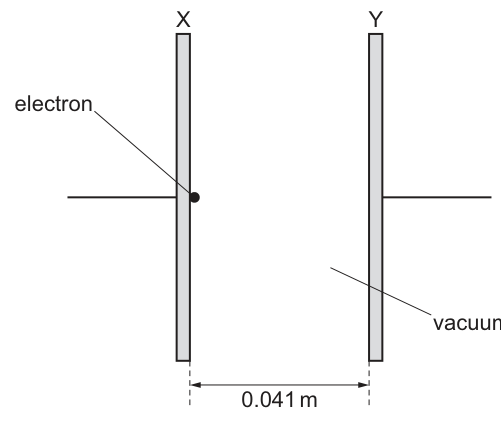
Fig. 6.1 from the question paper: two parallel plates X and Y in a vacuum, separated by 0.041 m, with an electron at rest at the centre of plate X. A p.d. of 58 kV accelerates the electron from X towards Y; later in the same question, many such electrons are fired at plate Y and their kinetic energy is converted into electromagnetic radiation on impact.
Show full working
- 1
Identify what "minimum wavelength" means here: the SHORTEST wavelength corresponds to the HIGHEST-energy photon that can be produced, and the highest-energy photon possible is made when a SINGLE electron gives up ALL of its kinetic energy — the energy it gained from the accelerating p.d. — to ONE photon in a single event.
This is the physical reasoning a 'show that' question hides behind the equation — without stating it, it is not obvious why the accelerating p.d. alone fixes a minimum wavelength.
- 2
Equate that maximum photon energy to the electron's kinetic energy, , and to the photon-energy formula:
eV here is the standard work-energy relation for an accelerated charge from AS Electricity; the right-hand side is this section's own E = hc/λ. Setting them equal is the one physical idea in the whole question.
- 3
Rearrange for :
Isolating λ before any numbers go in, exactly as in the worked example above.
- 4
Substitute the given accelerating voltage, , and the constants from the data sheet:
The kV → V conversion is written out explicitly as part of the substitution — a silent ×1000 error here is exactly the kind of slip a 'show that' question is designed to catch.
- 5
Evaluate numerator and denominator separately, then divide:
Splitting the fraction into its top and bottom before dividing keeps each power-of-ten calculation small and checkable, rather than risking an error buried inside one long division.
- 6
Convert to picometres to compare with the given answer:
1 pm = 10⁻¹² m, so shifting the decimal point three places converts m to pm — carrying the extra figure (21.4) before rounding is what makes a 'show that' answer trustworthy rather than a suspiciously exact match.
λ = hc/(eV) = 21 pm (2 s.f.), as required.
'Minimum wavelength' in an X-ray / accelerated-electron context always means 'maximum photon energy', which always means 'one electron's entire kinetic energy converted into one photon' — recognising that physical statement is the real content of these questions; the algebra afterwards is routine.
Adding or comparing an energy given in eV directly with one already in J, e.g. writing "total energy = ".
Convert the eV value to joules FIRST (multiply by ), and only then combine it with any quantity already in SI units.
eV and J are different-sized units for the same physical quantity — treating the raw numbers as directly comparable is exactly like adding a distance in miles to one in metres without converting.
Trying to recall by looking for it on the data sheet, or misremembering it as or .
— and every other quantum-physics equation in this note — must be memorised. The data sheet supplies only the constants , , , never the relations between them.
This is a genuine, recurring trap: candidates used to looking equations up on the front page can freeze exactly here, because this topic's own relations are never printed.
Substituting a wavelength given in nm directly into without converting to metres first, e.g. using instead of .
Convert nm to m as an explicit first step () — write it out before it goes anywhere near the formula.
This produces an energy that is out by a factor of 10⁹ — a wildly wrong but still numerically 'plausible-looking' answer that is easy to miss without a sanity check.
Your turn
A routine E = hc/λ calculation with an eV conversion, a real accelerating-voltage question, and an invented comparison across the EM spectrum.
- 14 marks
A sodium street lamp emits yellow light of wavelength . Calculate the energy of one photon of this light, giving your answer in both joules and electronvolts.
Stuck? Show hint
Convert the wavelength to metres first, then use before converting the result to eV.
Show solution
- 1
Convert the wavelength:
Written out before the formula, exactly as the mistakes box above warns.
- 2
Apply :
Substituting h and c straight from the data sheet, and the converted λ from the previous step.
- 3
Evaluate:
A result the same order of magnitude as the §01 demo photon (500 nm), as expected for two nearby visible wavelengths.
- 4
Convert to eV:
Dividing by the eV-to-J conversion factor, as its own final step.
AnswerE = 3.38×10⁻19 J = 2.11 eV.
- 1
- 29702/41 M/J 2024 Q8(c)(i)1 mark
Fig. 8.1 shows a tube in which X-rays are produced at a metal target. Electrons are accelerated from a heated filament to the target by a constant high voltage applied across terminals X and Y.
For an accelerating voltage of , determine the maximum energy, in MeV, of an X-ray photon produced at the target.
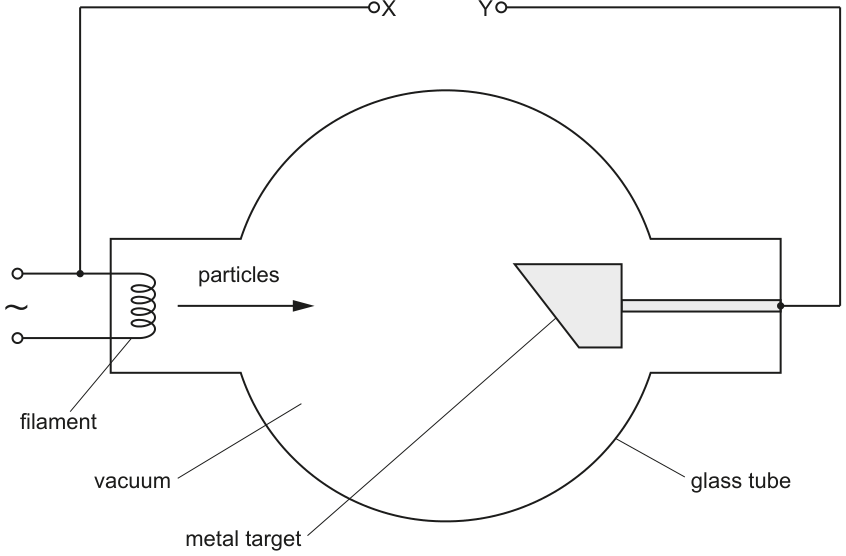
Fig. 8.1: an X-ray tube. A heated filament emits electrons, which are accelerated across a vacuum by the high voltage between terminals X and Y towards an angled metal target, the whole assembly enclosed in a glass tube.
Stuck? Show hint
The maximum photon energy equals the full kinetic energy gained by one electron, — then convert from J to MeV.
Show solution
- 1
Apply for the maximum-energy electron (all of the accelerating p.d.'s energy given to a single electron):
The same reasoning as the worked X-ray example above — the MAXIMUM photon energy corresponds to an electron losing its ENTIRE kinetic energy in one collision.
- 2
Evaluate in joules:
Kept in joules for now, since the conversion factor to MeV is itself defined via joules.
- 3
Convert to MeV, using :
MeV is simply a larger multiple of the eV — one million electronvolts — used because X-ray and nuclear energies are awkwardly large numbers of eV, just as eV itself is a more convenient size than joules.
AnswerE = 0.032 MeV.
- 1
- 34 marks
A gamma-ray photon emitted by a cobalt-60 source has energy . A radio-station transmitter emits photons of frequency ().
Calculate the energy, in joules, of one photon of each type, and state the ratio of the gamma-ray photon energy to the radio photon energy.
Stuck? Show hint
Convert the gamma energy from MeV to J directly; find the radio photon's energy from its frequency using .
Show solution
- 1
Gamma photon — convert MeV to J:
1 MeV = 1.60×10⁻13 J — the same conversion factor used in the exercise above, just applied to a different starting unit.
- 2
Radio photon — apply directly, since the frequency is already given:
No wavelength conversion needed here — the frequency was given directly, so E = hf is the more direct route than E = hc/λ.
- 3
Form the ratio:
Dividing the two energies found above makes the enormous span of photon energies across the EM spectrum concrete: a single gamma photon here carries over a trillion times the energy of a single radio photon.
AnswerEγ = 2.13×10⁻13 J; Er = 6.63×10⁻26 J; ratio ≈ 3.2×10¹².
- 1
The rest of this note
Can you do all of these?
E = hf is NOT given on the data sheet — only h, c and e are provided as constants; the equation itself must be recalled every time
Convert eV to J with 1 eV = 1.60×10⁻19 J as its OWN step before mixing with any other SI energy — never combine eV and J directly
p = E/c is a separate relation for a MASSLESS photon — never derive it from p = mv, and never use it for an electron or any particle with mass
Threshold frequency f0 (or threshold wavelength λ0) is defined by Φ = hf0 = hc/λ0 — the photon energy that leaves an electron with EXACTLY zero kinetic energy, the boundary case
Below the threshold frequency, NO photoelectrons are emitted no matter how intense the light — intensity cannot compensate for too little energy per photon
Intensity changes the RATE of photon arrival, so it changes the photoelectric CURRENT (electrons per second) — it does NOT change KEmax, which depends only on frequency
Frequency changes the ENERGY per photon, so it changes KEmax — a brighter but lower-frequency source below f0 still emits nothing
vmax in hf = Φ + ½mv²max belongs to the FASTEST photoelectrons only — those emitted from the very surface, losing no energy escaping; slower ones lost energy on the way out
eVS = ½mv²max converts the equation into VS = (h/e)f − Φ/e — a straight line in VS against f, with gradient h/e, y-intercept −Φ/e, and x-intercept exactly f0
The photoelectric effect is evidence for the PARTICLE nature of light; diffraction and interference are evidence for its WAVE nature — never cite one experiment as evidence for the other
Electron diffraction (rings from a thin crystal/graphite film) is the standard qualitative evidence for the WAVE nature of matter — know the observation (rings, not spots or a single bright patch) as well as the conclusion
λ = h/p is inversely proportional: DOUBLING momentum HALVES wavelength — check any 'what happens to λ if...' answer against this direction before writing it down
Accelerating a charge through p.d. V is a chain: eV = ½mv² → v → p = mv → λ = h/p — each arrow is its own step, never compressed into one line
A specific transition's photon energy is the MAGNITUDE |E1 − E2|; energy levels themselves are conventionally negative (bound states), but the emitted/absorbed photon energy is always quoted positive
An emission spectrum shows BRIGHT lines (photons actually reaching the detector); an absorption spectrum shows DARK lines on an otherwise continuous background, at the SAME wavelengths as the emission lines from those same transitions
With n discrete energy levels, count ALL pairwise transitions if asked how many spectral lines are possible — not just transitions to/from the ground state
[Legacy, pre-2021] Conductors have overlapping or partially-filled energy bands, so electrons move freely with almost no energy cost
[Legacy, pre-2021] Insulators have a full valence band separated from an empty conduction band by a LARGE forbidden gap; semiconductors have the same structure with a SMALL gap, so a few electrons cross it thermally