The language of oscillations
“
understand and use the terms displacement, amplitude, period, frequency, angular frequency and phase difference in the context of oscillations, and express the period in terms of both frequency and angular frequency; understand that simple harmonic motion occurs when acceleration is proportional to displacement from a fixed point and in the opposite direction
Why wobbles get their own chapter
Nudge anything away from a stable equilibrium — pull a pendulum bob sideways, compress a car's suspension, pluck a guitar string — and the restoring effect of the equilibrium takes over: the system returns, overshoots, returns again. One repeated journey there and back is one oscillation (or one complete vibration), and an astonishing range of systems perform oscillations that are geometrically identical: same-shaped graph, same equations, different labels on the axes. That shared shape is worth a chapter of its own, because the examiner can test it with a mass on a spring one year and a vibrating crystal the next and mark both with the same scheme.
The workhorse picture for this section is a cart of mass sitting on a frictionless surface between two springs, drawn below. Its equilibrium position is where it rests when undisturbed — the springs neither stretched nor compressed, net force zero. Every quantity defined below is measured from that position, and forgetting so is the topic's most common unit-level error.
The workhorse oscillator: a cart of mass m between two springs. Displace it either side of equilibrium and the spring force always aims back at the centre while growing with distance — F ∝ −x, hence acceleration a ∝ −x. That double condition is simple harmonic motion, defined in full later this section.
The six words the examiner owns
Displacement, : the distance of the mass from its equilibrium position, including direction — positive on one side, negative on the other. Displacement is not distance travelled: a mass mid-swing on the left-hand side has negative displacement even though it may have travelled far. It changes continuously throughout the oscillation.
Amplitude, : the maximum displacement — the size of the excursion to either side, always written as a positive quantity. If the cart swings between and , the amplitude is , not 6 cm: amplitude is measured from the middle, never peak-to-peak.
Period, : the time for one complete oscillation — from some state, around the whole journey, back to the same state moving the same way.
Frequency, : the number of complete oscillations per unit time. Frequency and period are reciprocals: 50 oscillations per second means each one lasts .
Angular frequency, : the oscillation rewritten in radians. Imagine the oscillation as the shadow of steady circular motion (§02 makes this literal): is the rate at which the corresponding angle advances, , in rad s⁻¹. It earns its own name because is unreadable without it.
Phase difference: how far two oscillations of the same frequency are out of step, expressed as a fraction of a cycle. If two carts cross the centre apart, their phase difference is , in radians — one full period of delay being a full of phase.
quantity | symbol | definition | unit |
|---|---|---|---|
displacement | x | distance from the equilibrium position, signed | m |
amplitude | x₀ | maximum displacement from equilibrium | m |
period | T | time for one complete oscillation | s |
frequency | f | number of oscillations per unit time | Hz |
angular frequency | ω | rate of advance of the oscillation, ω = 2πf | rad s⁻¹ |
phase difference | φ | out-of-step fraction of a cycle, φ = 2πΔt/T | rad |
Six terms, examined verbatim. 'Per unit time' does the work in the frequency definition — 'per second' loses the mark when the unit of time is not seconds.
Displacement measures distance from equilibrium; amplitude is its maximum; and the three time descriptors lock together as T = 1/f = 2π/ω.
Expresses the period in terms of BOTH frequency and angular frequency — exactly what the syllabus outcome demands. Given any one of T, f, ω you own the other two.
Phase difference between two identical oscillations whose matching events are delayed by Δt. Answer in radians — the syllabus never asks for degrees here.
What makes an oscillation simple harmonic
Now the condition that separates the special case the whole course studies from wobbles in general. Displace the cart to the right: both springs now push or pull it back towards equilibrium — a restoring force, always aimed at the fixed central point. Close to equilibrium, this force grows in proportion to how far you have displaced the cart (Hooke's law behaviour from AS Deformation). Force gives mass acceleration, so the acceleration obeys the same pattern: proportional to the displacement, and pointing the opposite way.
That double condition defines simple harmonic motion, and the definition is asked verbatim for two marks, paid clause by clause:
acceleration is (directly) proportional to the displacement from a fixed point (B1);
the acceleration acts in the opposite direction to the displacement — i.e. towards the fixed point (B1).
Both clauses are load-bearing. Drop "proportional" and any wobble qualifies; drop "opposite" and you have described a runaway, not an oscillation — a force pointing along the displacement would fling the cart away, not bring it home. In symbols the pair collapses to one line, , which §03 upgrades to . Everything else in this note is consequences of that minus sign.
Invented demo — one oscillation, four descriptors
A child on a swing completes 45 full oscillations in 60 s, swinging between points 0.25 m either side of the vertical.
Determine the amplitude, the period, the frequency and the angular frequency of the swing, and verify that your values satisfy .
Show full working
- 1
Amplitude first: the swing travels 0.25 m to either side of the vertical (the equilibrium position), so
Measured from the MIDDLE, not peak-to-peak: the total travel is 0.50 m, but amplitude counts one arm only.
- 2
Period: 45 complete oscillations take 60 s, so one oscillation takes
'Complete oscillation' means back to the same state moving the same way — one full there-and-back.
- 3
Frequency: the reciprocal,
f = 1/T run forwards: 45 oscillations divided by 60 s. Same numbers, either direction.
- 4
Angular frequency:
Radians per second: each oscillation carries the phase through 2π rad, 0.75 times per second.
- 5
Check: ✓ — the three descriptors agree.
Ten seconds of checking that locks in which formula converts which pair — the reflex every later section assumes.
x₀ = 0.25 m; T = 1.33 s; f = 0.75 Hz; ω = 4.7 rad s⁻¹, and 2π/ω returns the period.
Whatever else an oscillation question hands you, immediately convert to all three of T, f and ω — later parts almost always want ω.
Reporting the amplitude as the peak-to-peak travel (6 cm for a swing between ±3 cm).
Amplitude is the maximum DISPLACEMENT from equilibrium: 3 cm.
Amplitude is measured from the middle of the motion. Peak-to-peak is twice it — a guaranteed lost mark when the value feeds a later part.
Quoting ω in hertz, or f in rad s⁻¹.
f is in hertz (oscillations per second); ω = 2πf is in rad s⁻¹.
They differ by a factor of 2π ≈ 6.28 — large enough to wreck every downstream calculation while looking superficially plausible.
Defining SHM as "acceleration is proportional to the force".
Acceleration is proportional to the DISPLACEMENT from a fixed point and opposite in direction to it.
The scheme pays for displacement language. Restating Newton's second law instead of the defining condition earns nothing.
Writing only half the definition: "acceleration is proportional to displacement".
Both clauses: proportional AND in the opposite direction (towards the fixed point).
Two clauses, two B1s. Without the direction clause the statement describes a system that accelerates away and never oscillates.
Your turn
A one-mark definition the bank reprints, the full two-mark SHM definition, and a phase-difference calculation.
- 19702/44 O/N 2025 Q4(a)1 mark
Define frequency of an oscillation.
Stuck? Show hint
It is a count per something.
Show solution
- 1
The frequency is the number of oscillations per unit time (B1).
One clause, one mark. 'Number of oscillations per second' over-specifies — the unit of time need not be the second until the unit of f is attached.
AnswerThe number of oscillations (complete cycles) per unit time.
- 1
- 22 marks
State what is meant by simple harmonic motion.
Stuck? Show hint
Two clauses: what the acceleration is proportional to, and which way it points.
Show solution
- 1
Clause one: the acceleration is (directly) proportional to the displacement from a fixed point (B1);
'From a fixed point' locates the measurement — displacements are measured from equilibrium, nowhere else.
- 2
Clause two: the acceleration is in the opposite direction to the displacement — i.e. directed towards the fixed point (B1).
The direction clause is what turns proportionality into an oscillation. Omit it and the answer scores one of the two marks.
AnswerMotion in which acceleration is directly proportional to displacement from a fixed point and is directed opposite to the displacement (towards the fixed point).
- 1
- 39702/42 M/J 2022 Q4(b)(iii)2 marks
A heavy pendulum and a light pendulum are suspended from the same piece of string, which is secured at each end to fixed points. Both pendulums have the same natural frequency. The heavy pendulum is set oscillating and, as it oscillates, it causes the light pendulum to oscillate. Fig. 4.2 shows the variation with time of the displacements of the two pendulums for three oscillations. The displacement of the light pendulum is given by (with in centimetres and in seconds), from which an earlier part establishes the period .
Determine the magnitude of the phase difference between the oscillations of the light and heavy pendulums. Give a unit with your answer.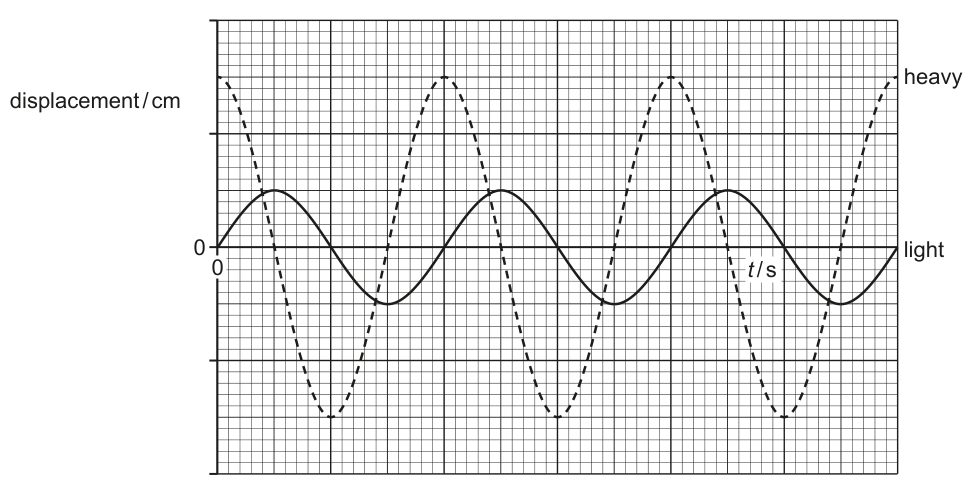
Fig. 4.2 from the question paper: displacement against time for the heavy pendulum and the light pendulum over three oscillations. Matching features of the two traces are offset by a quarter of a period.
Stuck? Show hint
Read the time offset Δt between matching points of the two traces, then φ = 2πΔt/T — and remember the unit.
Show solution
- 1
Read the offset from Fig. 4.2: matching features of the two traces (for example, corresponding upward zero-crossings) are separated by a quarter of a cycle, i.e.
Read a gap between LIKE features — same kind of point, same direction of motion — or the offset picks up an extra half-cycle.
- 2
Substitute into the phase rule (C1):
Δt is the delay between matching events; T converts that delay into a fraction of a full 2π cycle.
- 3
Evaluate (A1):
A quarter of a period behind is a quarter of 2π. Quoting '1.6' without its unit forfeits the mark — the question says 'give a unit'.
- 4
Because the oscillations repeat every cycle, the same offset may equally be measured the other way round, :
— the scheme accepts 1.6 rad or 4.7 rad, provided the unit appears.
Both descriptions are true of repeating motion; examiners credit either, which is why the scheme lists both answers.
Answerφ = 2π × 0.10/0.40 ≈ 1.6 rad (equivalently 2π × 0.30/0.40 ≈ 4.7 rad), unit rad.
- 1
The rest of this note
Can you do all of these?
Define SHM word-perfectly: acceleration directly proportional to displacement from a fixed point AND in the opposite direction to the displacement
Define frequency as the number of oscillations per unit time, and convert both ways along T = 1/f = 2π/ω
Derive x = x₀ sin ωt by projecting uniform circular motion, and read amplitude and angular frequency straight off any x(t) expression
Recognise SHM from an a–x graph: straight line through the origin (a ∝ x) with negative gradient (a opposite to x); the gradient equals −ω²
Compute a(max) = ω²x₀ and place it correctly: maximum at the extremes, zero at the centre
Quote v₀ = ωx₀ at the centre and evaluate v = ±ω√(x₀² − x²) at any other displacement
State the phase facts: velocity leads displacement by a quarter of a cycle; acceleration is antiphase (π rad out of step) with displacement
Read amplitude, period and phase off x–t, v–t and a–t graphs — counting zero crossings without halving gives a factor-of-two trap
Describe the KE↔PE interchange in clauses: KE maximum at zero displacement, PE maximum at maximum displacement, sum constant when undamped
Recall and use E = ½mω²x₀², including deducing m, ω or x₀ from pairs of graphs
Define damping word-perfectly (loss of energy of oscillations due to resistive forces) and sketch light, critical and heavy damping on x–t axes
Define resonance word-perfectly (maximum amplitude when driving frequency = natural frequency) and sketch how increased damping lowers, flattens and broadens the resonance curve
Convert units before substituting: cm → m, mm → m, μs → s — the arithmetic is easy; the powers of ten are where marks go missing