The gravitational field and field lines
“
understand that a gravitational field is an example of a field of force and define gravitational field as force per unit mass; represent a gravitational field by means of field lines
Action without contact
The Earth pulls the Moon through ninety-five million metres of empty space. No rope, no spring, no contact — yet the pull is real, measurable, and predictable. Physics describes this with a field: the Earth fills the region around itself with a field of force, meaning that any mass placed anywhere in that region experiences a force. The field is the middleman — the Moon never touches the Earth; it interacts with the field the Earth has set up.
The definition the exam wants is one clause long, and it earns a mark in almost every sitting — 9702/41 O/N 2025 Q3(a) was typical:
The gravitational field at a point is the force per unit mass placed at that point (B1).
Divide the force on any test mass by the size of the test mass and you get a property belonging to the point, not to the test mass — exactly parallel to how density belongs to the material, not to the sample. That ratio is the gravitational field strength, given the symbol :
Gravitational field strength = force per unit mass. Units: N kg⁻¹ — dimensionally identical to acceleration (m s⁻²), which is why 9.81 N kg⁻¹ and 9.81 m s⁻² are the same fact seen twice.
g is a vector: it has the direction of the force on a positive test mass — for gravity, always towards the mass creating the field.
Field lines — drawing an invisible thing
A field fills space, so we picture it with field lines. The rules are few and absolute:
- A field line shows the direction of the force on a small test mass placed at that point (B1).
- Because gravity always attracts, gravitational field lines point towards the mass creating the field — never away (B1).
- Around an isolated sphere (or point mass) the pattern is radial: straight lines running in to the centre, equally spaced in every direction.
- Spacing encodes strength: where lines crowd together the field is stronger; where they spread apart it is weaker. Farther from the mass the same fan of lines covers more area, so the field weakens — a geometric preview of the inverse-square law coming in §02.
Mark schemes pay two marks for the drawing itself, every time it appears: at least four straight radial lines, equally spaced (B1), and arrows pointing along the lines towards the mass (B1). Learn it as a procedure, not a picture.
Left: the radial field outside an isolated sphere — straight, evenly spaced lines pointing inwards. Right: zoomed in near the surface the fan looks parallel and even — the local field is (almost) uniform, which is why g barely changes for small height changes (§03).
Drawing the field of a point mass
The point P in Fig. 1.1 represents a point mass. On Fig. 1.1, draw lines to represent the gravitational field around P. [2]
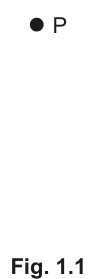
Fig. 1.1 — the printed diagram: an open frame with a dot P representing a point mass.
Show full working
- 1
Decide the geometry first. The force on a test mass anywhere points along the line towards P, so the lines must be straight and radial — drawn as if they would pass through P itself:
"Radial" is the load-bearing word: each line lies along a radius from the mass. Curved lines or circles lose the mark instantly.
- 2
Add the sense. Gravity attracts, so every arrowhead sits ON a line and points INWARDS, along the line towards P (B1).
Arrows belong on the lines, not floating between them — and they must terminate at the mass, since the force on a test mass points at it.
- 3
Check spacing. Keep neighbouring lines roughly the same angle apart — even spacing says the field is being drawn symmetrically (B1).
Crowding lines on one side accidentally claims the field is stronger there. Symmetric mass, symmetric pattern.
At least four straight radial lines through P, evenly spaced in angle, each carrying an arrowhead pointing towards P.
Two marks, ten seconds, every sitting that asks it. The failure modes are all artistic: curved lines, missing arrows, arrows outward, clumped lines.
Drawing field lines pointing away from the mass, "because fields push things away".
Gravity only attracts: every gravitational field line points towards the mass producing the field.
The line shows the direction of the FORCE on a test mass — for gravity, always inward. (Electric fields can point either way; gravitational ones cannot.)
Drawing smooth curved arcs looping around the mass.
Straight radial lines running into the centre of the mass.
The force acts along the line joining the masses, so field lines are radial. Curves claim the force twists sideways somewhere — wrong physics.
Defining gravitational field as "the region where gravity acts".
Force per unit mass (placed at that point).
That sentence defines what a field IS generically; the syllabus definition quantifies it. 'Region' answers score zero — the mark needs the ratio.
Saying field-line spacing means nothing — "they're just a picture".
Closer spacing means a stronger field; the radial fan spreads, showing g weakening with distance.
Field lines carry quantitative content: equal numbers of lines through any closed surface around the mass is the geometric reason the field obeys an inverse-square law.
A gravitational field line shows the direction of the force on a test mass — always towards the mass creating the field — and its spacing shows the strength: crowded means strong, spread out means weak.
Your turn
The verbatim definition, the full drawing procedure on a real past-paper figure, and the spacing argument turned into an explanation.
- 19702/41 O/N 2025 Q3(a)1 mark
Define gravitational field at a point.
Stuck? Show hint
One clause: force divided by what?
Show solution
- 1
Force per unit mass (B1) — placed at that point.
One mark, one phrase. 'Force per unit mass' must appear word-for-word; 'region of influence' scores nothing.
AnswerThe gravitational field at a point is the force per unit mass placed at that point.
- 1
- 29702/42 M/J 2025 Q2(a)(ii)2 marks
The Earth may be considered as a uniform sphere, as shown in Fig. 2.1. On Fig. 2.1, draw field lines to represent the Earth's gravitational field outside the Earth.
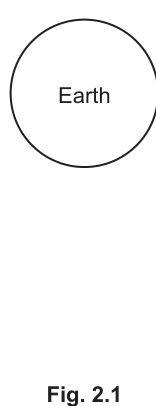
Fig. 2.1 — the printed circle representing the Earth, with blank space around it.
Stuck? Show hint
Same two marking points as every field-line drawing: geometry first, then arrowheads.
Show solution
- 1
Geometry: draw at least four straight radial lines starting from the Earth's surface, equally spaced around it (B1).
Radial because the pull is along the line to the centre; equally spaced because the sphere is symmetric — no direction is special.
- 2
Sense: add arrowheads on the lines pointing towards the Earth (B1).
Attraction again. Arrows away from the Earth forfeit the second mark no matter how beautiful the rest is.
AnswerAt least four straight, evenly spaced radial lines from the surface, with arrows pointing inwards towards the Earth.
- 1
- 39702/42 M/J 2025 Q2(c)(i)2 marks
Use your field-line drawing to explain why the observed gravitational field of the Earth does not vary around the surface.
Stuck? Show hint
Look at two features of the lines just above different parts of the surface: how far apart are they, and what angle do they make with the surface?
Show solution
- 1
Around the surface the lines are evenly spaced (B1) — the same crowding everywhere means the same strength everywhere.
Spacing encodes magnitude: equal spacing ⇒ equal |g| at every point of the surface.
- 2
The lines are perpendicular to the surface (pointing straight down at every point) (B1) — the direction of the field is the same relative to the ground everywhere too.
Both parts of the field — size and direction — are unchanging around the globe, which is what 'does not vary' asks you to justify.
AnswerThe lines are evenly spaced around the surface (same strength) and perpendicular to it, pointing downwards (same direction).
- 1
The rest of this note
Can you do all of these?
Define gravitational field verbatim: force per unit mass (placed at that point)
Draw field lines the mark scheme's way: at least four straight radial lines, equally spaced, arrows pointing towards the mass
State what a field line shows: the direction of the force on a test mass placed at that point
Explain constant g near the surface in two clauses: height change negligible compared with the radius, so the field lines are effectively parallel ((R+h)² ≈ R²)
State Newton's law verbatim: force proportional to the product of the masses, inversely proportional to the square of their separation
Treat any uniform sphere as a point mass at its centre — but only for points outside it; r is always centre-to-centre
Derive g = GM/r² on demand: write F = GMm/r², then divide by the test mass m
Write GMm/r² = mv²/r as its own line before any algebra in orbit questions; cancel m first, then multiply by r
Convert orbital periods to seconds before substituting into T or ω — 24 h = 86 400 s
Quote all four geostationary conditions: fixed point above the surface, period 24 h, west to east, directly above the Equator
Know the Earth result cold: geostationary orbit radius 4.2 × 10⁷ m, height above the surface 3.6 × 10⁷ m
Define gravitational potential verbatim: work done per unit mass in bringing a small test mass from infinity to the point
Justify φ < 0 in two clauses: potential is zero at infinity; the gravitational force is attractive, so potential falls as you come closer
Use E_P = φm, and ΔE_P = GMm(1/r₁ − 1/r₂) for a move between radii — magnitudes first, sign decided last
Keep powers of ten on separate named lines: product of masses, then division, then any root — one operation per line