Radians and angular displacement
“
define the radian and express angular displacement in radians
Why circles get their own angle unit
Spin anything — a wheel, a hard-disk platter, a planet — and every point on it sweeps out an angle. For rotating motion the angle is the natural quantity to track, exactly as displacement is for straight-line motion. The familiar degree, though, is an arbitrary unit (360 of them, chosen for ancient star calendars), and it makes every circle formula clumsy. Physics uses the radian, and the syllabus asks you to define it — this exact sentence earned its mark in 9702/41 M/J 2025 Q1(a):
The radian is the angle subtended at the centre of a circle when the arc length equals the radius (B1).
One radian is about . A full revolution takes the point round an arc equal to the whole circumference, , so a full revolution is radians — that single sentence converts between revolutions, degrees and radians forever after.
One radian: the arc s has the same length as the radius r, so θ = s/r = 1. A full revolution sweeps an arc of 2πr, hence 2π rad.
Angle in radians = arc length ÷ radius. Both are lengths, so the ratio needs no unit — but both must be in the SAME length unit before you divide.
s = rθ only speaks radians. An angle in degrees must be converted first, every time.
Angular displacement
The angular displacement is the angle swept out about the axis of rotation. Unlike a straight-line distance, it has a natural direction sense: sweeping (anticlockwise, by convention) lands you somewhere different from (clockwise), so the sign carries real information, just as and do for straight-line motion. In this topic most angles are quoted as magnitudes; the sign matters when you track how much a body has turned.
The conversions worth having cold:
angle | in radians | as a fraction of a revolution |
|---|---|---|
revolution | ||
Degrees → radians: multiply by π/180. Revolutions → radians: multiply by 2π.
A radian is the angle whose arc equals the radius (); one revolution is rad. Every circular-motion formula in this topic assumes radians — convert before anything else.
Rolling wheel: from distance travelled to angle swept
A bicycle wheel of radius rolls forward along a straight road without slipping. Calculate
(i) the angle through which the wheel has turned, in radians,
(ii) the number of revolutions this represents.
Show full working
- 1
Name the pieces. Because the wheel rolls without slipping, the arc of rim that unwinds equals the distance travelled along the road:
"Without slipping" is the licence for arc = road distance. If the wheel skidded, the two would differ and this example would break.
- 2
Apply :
Both lengths are already in metres — same unit, so the ratio is legal. Radians come out automatically because s/r IS the definition of angle in radians.
- 3
Convert to revolutions. One revolution is rad, so
Dividing by the number of radians per revolution converts the unit — the same move as dividing metres by metres-per-mile.
(i) . (ii) revolutions.
s = rθ speaks radians only. An angle arriving in degrees must be converted before it touches the formula — that one habit is most of §01's marks.
Using when the angle is .
Convert first: , so .
Degrees overstate an angle by a factor of , because a degree is of a turn but a radian is of a turn.
Treating 1 revolution as 360 rad.
One revolution is .
Revolutions and degrees share the 360 habit; radians do not. Mixing rev with rad poisons every ω calculation in §02.
"The radian must cancel out of equations like a proper unit."
The radian is dimensionless — a ratio of two lengths — so it never blocks an equation, but you still quote it when stating an angle.
This is why ω can carry units rad s⁻¹ yet behave like a pure number times s⁻¹ in algebra.
Your turn
The definition verbatim, an arc length hiding a cm→m trap, and a degrees-to-radians chain into arc length.
- 19702/42 M/J 2025 Q1(a)1 mark
Define the radian.
Stuck? Show hint
It is a ratio of two lengths measured in the same circle — which two?
Show solution
- 1
The radian is the angle subtended at the centre of a circle when the arc length is equal to the radius (B1).
Three load-bearing phrases: at the centre, arc length, equals the radius. Dropping any one loses the mark — learn the sentence verbatim.
AnswerThe angle subtended at the centre of a circle when the arc length equals the radius.
- 1
- 2
The tip of a robot arm of length swings through an angle of . Calculate the distance travelled by the tip along its arc, giving your answer in metres.
Stuck? Show hint
The arm's length is the radius — but not in the unit the answer needs.
Show solution
- 1
Convert the radius to SI before anything else:
s = rθ needs both lengths in the same unit, and the answer is wanted in m — doing the conversion now stops a ×100 slip.
- 2
Apply :
θ is already in radians, so no angle conversion is needed — substitute the two named pieces directly.
Answer.
- 1
- 3
A point on the rim of a wheel of radius sweeps through an angle of .
(i) Express in radians.
(ii) Calculate the arc length the point travels.Stuck? Show hint
(i) Multiply by π/180. (ii) Then use s = rθ with θ from (i).
Show solution
- 1
(i)
Multiply by π/180 because 180° is π rad; 240/180 simplifies to 4/3.
- 2
(ii) Name the pieces: , , then
Substituting the converted angle — using 240 here would give an answer 57× too large, the classic degree slip.
Answer(i) (). (ii) .
- 1
Angular speed
“
understand and use angular speed; recall ω = 2π/T and v = rω, with unit conversions
From angle swept to rate of turning
Straight-line motion has velocity — displacement per unit time. Rotation gets the same treatment: angular speed is the angular displacement swept out per unit time,
measured in radians per second (). The symbol is the Greek omega, and it runs through every remaining page of this note.
For steady rotation — equal angles in equal times, the rotational twin of constant velocity — one full revolution sweeps rad in one period :
Angular speed for steady rotation:
If you know the frequency (revolutions per second) instead of the period, remember from AS waves that , giving the equivalent form . A spin quoted in rpm ("revolutions per minute") is a frequency in disguise: divide by 60 to get rev per second first.
Angular speed in rad s⁻¹ from the period T (time for one revolution) or frequency f (revolutions per second).
Deriving v = rω — the bridge between rotation and speed
A spinning rigid body carries many points at once: hub, rim, everything between. How fast does a particular point move along its arc? Take a point fixed at radius on a steadily rotating body. In time it sweeps an arc of length , and §01's relation says
Divide every term by the same time :
Read each piece. On the left, is distance travelled along the arc per unit time — the point's constant speed . On the right, is angle swept per unit time — the angular speed . So:
Now the punchline examiners love to test. Every point of a rigid body completes a revolution together — same , hence the same everywhere. But means the speed grows in proportion to radius: a rim point races while a point halfway out plods at half the speed. Angular speed belongs to the whole body; linear speed belongs to each radius.
Speed of a point moving on a circle of radius r with angular speed ω. Check the units: m × rad s⁻¹ → m s⁻¹.
Two points on one rigid disc turn in step: same T, same ω — but the outer point sweeps a longer arc per revolution, so v = rω grows with r.
- 1
List the data with units: what is given (, or , or rpm; the radius ) and what is wanted (, or , or ).
Half the errors in this topic are the wrong quantity in the wrong slot — naming them first stops that.
- 2
Convert the time unit to seconds: hours , minutes , rpm to get revolutions per second.
Every formula here needs SI seconds. Unconverted times cause the most common lost mark in the topic.
- 3
Pick the formula: (or ) to get rotation into ; then to get a speed.
ω = 2π/T always comes first when a period is given — v = rω cannot be used until ω exists.
- 4
Substitute and simplify, checking units at the end: gives .
Keep the substitution as its own written line — C1 marks are paid for exactly this line.
A point on the Equator — Earth's spin, end to end
The Earth may be modelled as a sphere of radius that rotates once in . For a point on the Equator, calculate
(i) the angular speed of the rotation,
(ii) the speed of the point due to the rotation.
Show full working
- 1
List the data: radius , period ; want then .
Step 1 of the routine — two givens, two wants, both formulas visible before any arithmetic.
- 2
Convert the period to seconds:
The explicit hours→seconds step. Skipping it makes ω too small by a factor of 3600 — and every later answer inherits the error.
- 3
Apply :
One revolution = 2π rad swept per period T. The tiny size is normal for astronomical rotation — a full turn takes a day.
- 4
Apply :
Both pieces exist now: r from the stem, ω from step 3. Substituting on one line is fine HERE because each piece was computed separately above.
(i) . (ii) .
463 m s⁻¹ is real — anyone standing on the Equator moves that fast, yet feels nothing. Constant speed hides the acceleration; §03 shows where it has been hiding.
Your turn
A real planet-spin calculation that previews §04's idea, an rpm drill, and the ω-same-everywhere distinction in words.
- 19702/42 M/J 2021 Q1(b)(ii) and (b)(iii)3 marks
An object rests on the equator of a planet of radius . The planet rotates about its axis with a period of . For the object, calculate, to three significant figures:
(i) the centripetal acceleration;
(ii) the force per unit mass exerted on the object by the surface of the planet, given that the gravitational field strength at the surface is .Stuck? Show hint
(i) Build ω first, then use a = rω². (ii) Gravity pulls toward the centre, the surface pushes away — their resultant accelerates the object.
Show solution
- 1
(i) Convert the period to seconds:
Hours→seconds, written out — the conversion is graded inside the scheme's method line.
- 2
Apply :
Rotation rate first — a = rω² needs ω, and only ω can be built from T.
- 3
Name the pieces of : and . Substitute:
Square ω BEFORE multiplying by r; forgetting the square is the standard slip here.
- 4
(ii) Two radial forces act on the object: gravity, per kg toward the centre, and the surface's push away from the centre. Their resultant supplies the centripetal acceleration:
This previews §04: the resultant of real forces IS the centripetal force. Push and pull oppose, so subtract.
- 5
Solve for the surface force per unit mass:
The surface pushes almost as hard as gravity pulls — the small shortfall is exactly what keeps the object on its circular path.
Answer(i) . (ii) .
- 1
- 2
A hard-disk platter spins at (revolutions per minute). A read head sits over a point from the spindle.
(i) Calculate the angular speed of the platter in rad s⁻¹.
(ii) Calculate the speed of the point under the head.Stuck? Show hint
rpm is per minute: ÷60 gives revolutions per second, then ω = 2πf.
Show solution
- 1
(i) Convert rpm to revolutions per second:
rpm is a frequency wearing the wrong time unit — ÷60 converts minutes to seconds.
- 2
Apply :
Each revolution is 2π rad, so 120 turns per second sweeps 120 × 2π radians per second.
- 3
(ii) Convert the radius: . Name the pieces of : , . Substitute:
cm→m before substituting. The edge of a hard disk outruns a racing cyclist — small radius, enormous spin rate.
Answer(i) . (ii) .
- 1
- 3
A fly sits on the rim of a bicycle wheel and a second fly sits on a spoke, halfway from the axle to the rim. The wheel spins steadily about its axle. Explain which fly has the greater speed along its path, and why the two flies have the same angular speed.
Stuck? Show hint
What does "rigid body" say about the time each fly takes for one revolution?
Show solution
- 1
Same revolution, same time. The wheel is rigid: every point on it completes one revolution in the same period . Since , both flies share the same angular speed.
Rigidity is the whole argument — no point may lag behind another in angle, or the wheel would deform.
- 2
But speeds scale with radius. By with the SAME , speed is proportional to . The rim fly's radius is twice the spoke fly's, so the rim fly moves at twice the speed.
Same ω, different v — the exact distinction this section exists to teach. Quote v = rω by name when explaining.
AnswerThe rim fly has the greater speed (twice the spoke fly's), because v = rω and its radius is larger; the two have the same angular speed because a rigid body turns through the same angle in the same time at every point.
- 1
Centripetal acceleration
“
understand that a force of constant magnitude perpendicular to motion causes centripetal acceleration, and that this produces circular motion at constant angular speed; recall and use a = rω² and a = v²/r
Why steady circular motion is accelerated AT ALL
Velocity is a vector: it has a magnitude (the speed) and a direction. Uniform circular motion holds the magnitude perfectly constant but changes the direction from instant to instant — the velocity vector swings round like a compass needle, always pointing along the tangent to the circle. A changing velocity is an acceleration, whatever the speedometer says. That is the whole conceptual jump of this section: constant speed does not mean zero acceleration.
Which way does this acceleration point? Geometry answers, not opinion: to change only the direction of and never its size, the change added each instant must be perpendicular to itself — nudging the arrow sideways without lengthening it. Perpendicular to the tangent means along the radius, toward the centre. The name says so: centripetal is Latin for centre-seeking. (The outward push you feel on a roundabout is your body insisting on straight-line motion; there is no outward force — §08 lists how examiners punish that one.)
Deriving a = v²/r — no calculus, just similar triangles
Take two nearby points and on the circle, reached a short time apart. At the velocity is ; at it is . Both have the same length , but their directions differ by the angle swept between the points (each velocity is perpendicular to its radius, so rotating the radii through rotates the velocities through too).
Now subtract the vectors nose-to-tail: closes a narrow isosceles triangle whose equal sides are and , with apex angle . Compare it with the triangle formed by the two radii ( and ) and the chord : also isosceles, also apex angle . Similar triangles, so corresponding ratios match:
For a tiny angle the chord is almost the arc, and the arc is the distance travelled at speed : . Substitute:
And its direction: as the little arrow sits exactly perpendicular to , aimed at the centre. Magnitude constant (because and are), direction forever turning but always inward.
The derivation in one picture: radii OA, OB separated by Δθ; tangential velocities v_A, v_B; the velocity triangle (sides v, v, Δv) is similar to the central triangle (sides r, r, chord Δs) because both are isosceles with the same apex angle.
Centripetal acceleration: magnitude v²/r, direction always toward the centre, perpendicular to the velocity.
The ω form, built by substitution
Experiments often hand you , not . Substitute the §02 bridge into the result above:
There is also a hybrid worth knowing. Since and , replace just the piece:
One result, three interchangeable forms — pick whichever matches the data you have. And notice what "uniform" buys you: constant (with constant ) gives a centripetal acceleration of constant magnitude, which is exactly the syllabus's claim that a perpendicular force of constant magnitude produces circular motion at constant angular speed.
use when you know the speed
use when you know ω (or T)
the hybrid — examiner's favourite show-that
A vinyl record groove — clean numbers through the whole chain
A point on a vinyl record sits from the spindle. The record plays at . Calculate
(i) the period of the rotation,
(ii) the angular speed of the point,
(iii) the centripetal acceleration of the point, stating its direction.
Show full working
- 1
(i) revolutions take one minute, so the time for ONE revolution is
Period = time per revolution: divide the minute by the number of revolutions in it.
- 2
(ii) Apply :
The period exists now (step 1), so ω follows directly.
- 3
(iii) Name the pieces of : , . Square first, then multiply:
Two separate multiplications shown — squaring ω and then multiplying by r. Doing both in one breath is where arithmetic slips breed.
- 4
Direction: the acceleration points toward the spindle — the centre of the record — at every instant of the rotation.
Magnitude alone earns part of the credit; centripetal questions nearly always ask for the inward direction too.
(i) . (ii) . (iii) , directed toward the spindle.
Describing uniform circular motion for full marks
In terms of velocity and acceleration, describe uniform circular motion. [2]
Show full working
- 1
Clause 1: the velocity and the acceleration both have constant magnitude (B1).
"Uniform" means constant speed — and since and are fixed, has fixed size too. The mark pays for saying BOTH magnitudes stay constant.
- 2
Clause 2: the velocity is always perpendicular to the acceleration (B1).
runs along the tangent, runs along the radius toward the centre — tangent ⊥ radius. The scheme's second B1 is this perpendicularity, not merely "acceleration toward the centre".
The velocity and acceleration each have constant magnitude, and the velocity is always perpendicular to the acceleration (velocity tangential, acceleration directed toward the centre).
Two-clause description questions want two independent statements. Write them as separate sentences so each can collect its own B1.
"The speed is constant, so the acceleration is zero."
Constant speed, changing direction ⇒ changing velocity ⇒ acceleration of magnitude toward the centre.
Acceleration is the rate of change of the VECTOR velocity. This single sentence is examined again and again as a 1–2 mark state-and-explain.
Drawing the acceleration pointing away from the centre ("outward pull").
The acceleration — and the resultant force behind it — points INWARD, toward the centre of the path.
The outward sensation on a roundabout comes from your own inertia; no outward force acts. Examiners penalise an outward arrow.
Quoting ω = 33.3 rad s⁻¹ directly from 33⅓ rpm.
rpm must become rev per second (), then radians via : here .
ω lives exclusively in rad s⁻¹. rpm is neither radians nor seconds — two conversions, not zero.
Your turn
One real derivation, one brutal rpm number that shows what washing machines do, and one definition mark.
- 19702/41 O/N 2025 Q1(b)(ii)2 marks
By eliminating the radius between and , show that the centripetal acceleration may be written as .
Stuck? Show hint
Rearrange v = rω for r first — then feed it into a = rω².
Show solution
- 1
Start from the ω form and quote the elimination: from , rearrange for :
so
The scheme pays C1 for assembling the substitution — write r = v/ω explicitly rather than silently swapping.
- 2
Simplify the powers of ω:
One power of ω cancels. Two lines, two marks — derivations are free marks when every line is shown.
Answer.
- 1
- 2
A washing-machine drum spins at with clothes pressed against its wall at a radius of . Calculate the centripetal acceleration of the clothes in m s⁻², and express it as a multiple of .
Stuck? Show hint
1200 rpm = 20 revolutions per second. Build ω before anything else.
Show solution
- 1
Convert the spin rate:
The rpm double conversion (÷60, ×2π) in one written line — both halves visible.
- 2
Apply :
ω² first — kept unrounded from ω = 125.66… so ω² = 15 791 — THEN ×0.25. The answer is enormous — check against intuition: 125.7 rad s⁻¹ is 20 full turns a second.
- 3
Express as a multiple of g:
Dividing by g converts any acceleration into 'how many weights of gravity'. 400g is why water leaves wet clothes through the drum holes: nothing can supply the huge inward force the water would need.
Answer; (about 400g).
- 1
- 39702/42 O/N 2021 Q1(a)1 mark
State what is meant by centripetal acceleration.
Stuck? Show hint
Where does it point, relative to the velocity?
Show solution
- 1
An acceleration perpendicular to the velocity of the body — i.e. directed toward the centre of the circular path (B1).
The scheme's B1 keys on the perpendicularity; 'toward the centre' is the accepted equivalent. Either wording collects the mark — say one clearly.
AnswerAn acceleration acting perpendicular to the velocity — directed toward the centre of the circular path.
- 1
Centripetal force
“
recall and use F = mrω² and F = mv²/r; identify which real force provides the centripetal force in a given situation
Newton's second law, aimed at the centre
§03 found that circular motion at constant speed carries an acceleration toward the centre. Now apply the lesson of AS note 03: is a vector equation, true component by component. Along the radius, where the acceleration is , the resultant force toward the centre must therefore be
That is the entire physics of this section. The subtlety is what this is — and getting that wrong costs marks year after year.
There is no fifth force of nature called "centripetal force". It is the resultant of the real forces — weight, tension, normal contact, friction, gravity, magnetism — resolved toward the centre of the path. On a free-body diagram you draw only the real forces; the centripetal force is what their sum turns out to be. When an examiner asks "identify the force providing the centripetal force", the answer is a REAL force, named.
The resultant force TOWARD THE CENTRE needed for circular motion. Not a new force — the net inward effect of whatever real forces act.
Naming the provider
Every situation has its own provider, and "name it" questions are banked by the dozen:
| situation | provider of the centripetal force |
|---|---|
| ball whirled on a string | the tension in the string |
| satellite or moon in orbit | gravity (the planet's pull) |
| car on a flat bend | friction between tyres and road |
| rider against a loop-the-loop wall | the normal contact force |
| electron crossing a magnetic field | the magnetic force |
Direction-drawing questions add one more trap. The arrow must point at the centre of the path, which is not always the most obvious centre. A person standing on the spinning Earth travels a small circle drawn around the rotation axis through their latitude — so their centripetal direction is horizontal, toward the axis. It points at the Earth's centre only for someone standing on the Equator. The worked example below pays several marks for exactly this distinction.
A ball whirled on a string: velocity v along the tangent, string tension along the string toward the centre. The tension IS the centripetal force — there is no extra 'centripetal' arrow to draw.
- 1
Identify the ONE body moving in the circle and the centre of its actual path (for a spinning planet: on the rotation axis, not at the planet's centre).
applies to a single body; mixing two bodies' forces is the classic disaster.
- 2
Draw its free-body diagram — real forces only: weight, tension, normal contact, friction… No "centripetal" arrow.
The free-body diagram is the language every later line is written in; an invented force corrupts it.
- 3
Resolve the real forces toward the centre of the path (components along the radius; anything perpendicular to the radius belongs to a different axis).
Only the radial component contributes to the centripetal effect.
- 4
Set the resultant equal to (or ) and write the equation before substituting numbers.
The equation line earns the C1 even if the arithmetic later fails.
- 5
Solve, converting all units to SI first (hours→seconds, cm→m).
Unconverted units are this topic's biggest single mark thief — see §08.
Whirling a bob — one clean pass through F = mrω²
A bob of mass is whirled on a string in a horizontal circle of radius , completing revolutions every second. Calculate
(i) the angular speed of the bob,
(ii) the centripetal force acting on the bob.
Show full working
- 1
(i) Revolutions per second first, radians second:
rev s⁻¹ is not rad s⁻¹ — the ×2π bridge must appear before any force formula can be used.
- 2
(ii) Name the pieces of : , , and (kept unrounded from ). Substitute:
Square ω first, then multiply the three numbers left to right. The provider here is the string tension — name it if the question asks.
- 3
Cross-check by the speed route: using the same unrounded ω, , so
Both formula forms must give the same force — small differences would be rounding, not physics. Two routes agreeing is the cheapest error-check there is.
(i) . (ii) , provided by the tension in the string.
A student standing on the spinning Earth — the capstone question
The Earth is a uniform sphere of radius that rotates once in . Cambridge lies at latitude north of the Equator, as shown in Fig. 1.1, and so moves in a circle parallel to the Equator but of smaller radius.
(i) Show that the radius of the circle around which Cambridge moves is . [1]
(ii) Calculate the speed at which Cambridge moves around the circle. [3]
A student of mass stands on horizontal ground in Cambridge.
(iii) Determine the magnitude of the resultant force that acts to cause the circular motion of the student. [2]
(iv) On Fig. 1.2, draw an arrow to show the direction of the resultant force that acts on the student. [1]
(v) On Fig. 1.3 (an identical copy of Fig. 1.2), draw labelled arrows from the student to show the directions of the forces that act on the student to cause the resultant force in (iv). [2]
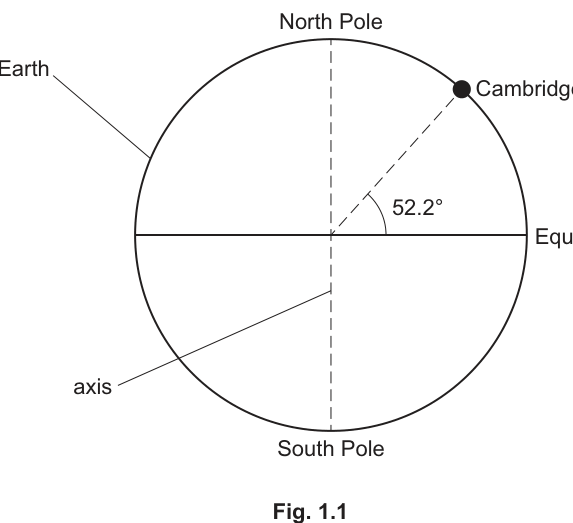
Fig. 1.1 — Cambridge at latitude 52.2° N on the Earth, a uniform sphere of radius 6.37 × 10⁶ m spinning about the axis through the poles.
Show full working
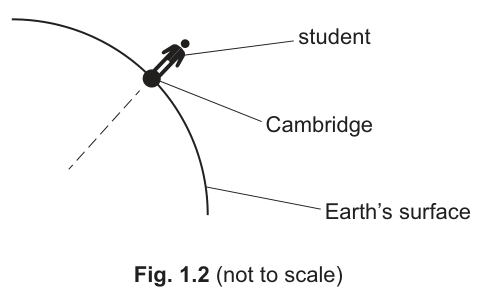
Fig. 1.2 — a cross-section of the Earth's surface at Cambridge, with the student and the dotted line toward the axis of rotation. Fig. 1.3 in the paper is an identical copy of this figure.
- 1
(i) The student's path is a circle around the rotation axis, so its radius is the distance from the axis to the student — writing for the Earth's radius:
(A1)The latitude angle sits between the student's radius line and the equatorial plane, so the axis-to-student distance is the ADJACENT leg: cos. Using sin is the planted slip.
- 2
(ii) Convert the period first:
Hours→seconds as its own marked step — the scheme pays C1 for exactly this line.
- 3
Apply :
One circumference () per period. The scheme quotes 280 m s⁻¹ (2 s.f.) — carry 280 forward, as the scheme does.
- 4
(iii) Name the pieces of : , , . Substitute (C1):
Tiny — about 0.2% of the student's 575 N weight. That smallness is the sanity check: the Earth spins slowly, so little inward force is needed.
- 5
(iv) On Fig. 1.2, draw a single arrow from the student pointing horizontally toward the rotation axis — on the printed figure that is horizontally to the left (B1). It is NOT along the dotted line to the Earth's centre.
Two centres are in play: the sphere's centre (where weight points) and the path's centre (on the axis). Only at the Equator do they coincide, so the arrow must be horizontal, not radial.
- 6
(v) On Fig. 1.3, draw exactly two labelled arrows from the student: the weight, along the dotted line toward the Earth's centre (B1); and the contact force, upward but tilted slightly — to the left of the normal (the dotted line reversed) and above the tangent to the surface (B1).
Drawing contact exactly opposite to weight would leave zero resultant. Tilting it is what leaves the small horizontal 1.2 N resultant toward the axis — that tilt is the second B1.
(i) . (ii) . (iii) . (iv) An arrow from the student pointing horizontally toward the rotation axis. (v) Weight along the dotted line toward the Earth's centre, plus a contact force tilted up and slightly toward the axis — their resultant is the horizontal centripetal force.
Spinning-planet questions live or die on distinguishing the centre of the PLANET from the centre of YOUR PATH. Aim every centripetal statement at the path's centre.
Your turn
The equator version of the worked example (both forces named), then a fairground ride built from clean numbers.
- 19702/42 O/N 2022 Q1(c)(i) and (c)(ii)5 marks
An object rests on the ground at the Equator. The radius of the Earth is and the period of the Earth's rotation is .
(i) Determine the centripetal acceleration of the object.
(ii) Describe how TWO forces acting on the object give rise to this acceleration.Stuck? Show hint
(i) Substitute ω = 2π/T into a = rω² and watch it become 4π²r/T². (ii) Name both forces, note their directions, credit their resultant.
Show solution
- 1
(i) Convert the period:
Same conversion ritual — seconds before any substitution.
- 2
Build the acceleration from into :
Substituting ω = 2π/T into a = rω² gives the scheme's printed form 4π²r/T² — show the substitution, not just the destination.
- 3
Name the pieces and evaluate: , :
At the Equator the path's centre IS the Earth's centre, so the full radius enters — compare the worked example's cos-latitude geometry at other latitudes.
- 4
(ii) The two forces are the gravitational force of the Earth pulling the object toward the centre, and the normal contact force of the ground pushing away from the centre. They act in opposite directions along the same line, and their resultant — the small difference between them — is the centripetal force causing the acceleration.
Three clauses earn the mark: both forces named, directions noted as opposed, resultant credited as the acceleration's cause.
Answer(i) . (ii) Gravity (toward the centre) and the normal contact force (away from it) oppose each other; their resultant provides the centripetal force for the acceleration.
- 1
- 2
A fairground "rotor" is a cylindrical drum of radius spinning about its vertical axis. A rider of mass stands with their back against the wall. The drum completes one revolution in .
(i) Calculate the angular speed of the drum.
(ii) Calculate the horizontal force the wall exerts on the rider.
(iii) Explain why the rider does not slide down the wall.Stuck? Show hint
(iii) The rider has no vertical acceleration — what must balance the weight?
Show solution
- 1
(i)
Period straight from the stem; ω = 2π/T directly.
- 2
(ii) The wall's horizontal push is the only horizontal force, so it alone must BE the centripetal force. Name the pieces of : , , and (kept unrounded from ). Substitute:
This is the naming-the-provider habit from the concept block: here the provider is the normal contact force of the wall.
- 3
(iii) The rider has zero vertical acceleration, so vertical forces balance: the upward friction between the rider's back and the wall equals the rider's weight. Friction can hold them because the large normal contact force () presses them hard against the wall.
Two perpendicular jobs, two different forces: the wall pushes horizontally (centripetal), friction acts vertically (balances mg). Confusing the two is the standard error.
Answer(i) . (ii) horizontally inward. (iii) Vertical friction balances the weight; the wall's normal force supplies the centripetal force that keeps friction possible.
- 1
Horizontal circles — resolving
“
apply the centripetal force relations to motion in a horizontal circle: resolve the real forces, balance vertically, aim the resultant inward
The two-equation pattern
A body moving in a horizontal circle at constant speed has an acceleration that points horizontally, at the centre — never vertically. Two consequences, one per axis:
Vertical: zero vertical acceleration means the vertical forces balance exactly. This is ordinary equilibrium — nothing new.
Horizontal: the horizontal forces must NOT balance. Their unbalanced remainder points at the centre and is the centripetal force, .
For a body whirled on a string that sits at angle to the vertical, the tension does both jobs at once — its components split the labour:
Two equations, and nearly every horizontal-circle question is solved by writing them down and eliminating what you don't want — usually by dividing one by the other, which cancels entirely:
Balance vertically (), aim the leftover horizontally (). Divide the pair to eliminate the tension: .
The resolving picture: tension F_T along a string at θ to the vertical, resolved into F_T cosθ balancing mg vertically and F_T sinθ pointing at the centre of the radius-r circle.
Conical pendulum — the two equations on clean numbers
A conical pendulum consists of a bob of mass swinging in a horizontal circle at the end of a string whose upper end is fixed. The string makes a constant angle of with the vertical. Calculate
(i) the radius of the circle,
(ii) the tension in the string,
(iii) the centripetal acceleration of the bob,
(iv) the period of the rotation.
Show full working
- 1
(i) The radius is the horizontal projection of the string:
Angle to the vertical ⇒ horizontal leg uses sin — sketch the triangle and mark the angle before choosing.
- 2
(ii) Vertical balance:
Equation first, pieces next (mg = 1.18 N, cos30° = 0.866), division last — the C1-A1 shape.
- 3
(iii) The horizontal component per unit mass:
— equivalently , agreeing to 2 s.f.
Two routes, one answer: the direct Newton's-law route and the divide-the-equations route cross-check each other.
- 4
(iv) From :
so
Acceleration → ω via a = rω², then period via T_p = 2π/ω. Renamed T_p keeps it clear of the tension.
(i) . (ii) . (iii) . (iv) .
Every conical-pendulum question opens the same way: write F_T cosθ = mg and F_T sinθ = mv²/r before touching any number.
Sphere on a spring, swung in a circle — five linked parts
A steel sphere of mass hangs from the lower end of a vertical spring attached to a rigid support. With the sphere at rest, the centre of the sphere is below the support (Fig. 2.1).
The sphere is now taken to one side and swung in a horizontal circle of radius at constant speed. The spring makes a constant angle of with the vertical and its length is then (Fig. 2.2).
(a) Explain why the spring is longer when the sphere is moving in the circle than when it hangs at rest. [3]
(b) Show that the radius of the circle is . [1]
(c) Calculate the tension in the spring. [2]
(d) Calculate the centripetal acceleration of the sphere. [2]
(e) Calculate the period of the rotation. [2]
Notation warning: the paper calls the tension and also asks for the period . To keep them apart this working writes the tension as and the period as — renaming symbols before calculating is always worth doing when two quantities share a letter.
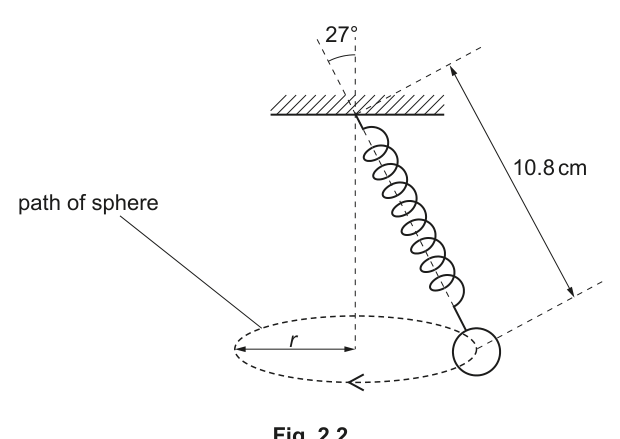
Fig. 2.2 — the sphere whirling in a horizontal circle; the spring makes 27° with the vertical and has length 10.8 cm; the circle's radius r is marked.
Show full working
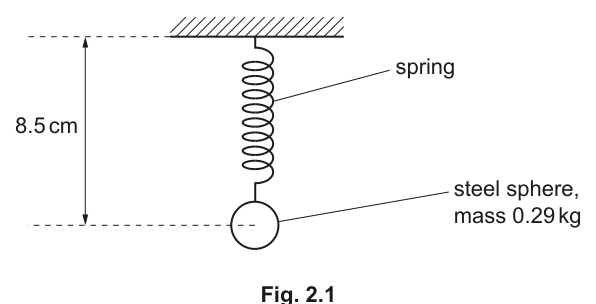
Fig. 2.1 — the same sphere hanging at rest on the spring, 8.5 cm below the support.
- 1
(a) The sphere moves in a horizontal circle, so it needs a horizontal resultant force toward the centre to provide its centripetal acceleration. That force can only come from the horizontal component of the spring's tension (B1).
First clause of three: name WHY extra pull is needed at all — the circular motion demands an inward resultant.
- 2
Vertically the sphere does not accelerate, so the vertical component of the tension balances the weight: . One tension must supply both components, so its magnitude exceeds the weight alone (B1).
Second clause: components combine to a tension greater than mg — this is the two-equation pattern doing explanatory work.
- 3
A greater tension stretches the spring further (Hooke's law, AS note 06), so the spring is longer during the motion (B1).
Third clause closes the chain from physics to observation. Three clauses, three B1s — write all three.
- 4
(b) The spring is the hypotenuse of a right triangle: length at to the vertical, so the radius is the side opposite the angle:
Angle measured from the VERTICAL ⇒ horizontal leg uses sin. Using cos here poisons every later part.
- 5
(c) Write the vertical-balance equation first:
with , so
Equation line first (that is the C1), then compute each piece: mg as its own number, cos27° as its own number, only then divide.
- 6
(d) The centripetal force is the horizontal component (C1):
Newton's second law along the radius: a = F/m with F the inward component. (Equivalently a = g tan27° — dividing the two equations — same answer.)
- 7
(e) Link acceleration to rotation with , using :
then convert to a period:
cm→m before substituting. And note the renamed symbols at work: ω² = a/r gives ω = 10.1 rad s⁻¹, and T_p = 2π/ω — no clash with the tension anywhere.
(a) Inward horizontal component provides the centripetal force; vertical component balances the weight; combined components exceed the rest tension, so the extension grows. (b) . (c) . (d) . (e) .
Dividing the two equations kills the tension: tanθ = v²/(rg). When a question hands you the angle and asks about speed or period without mentioning the force, that division is the fast route.
Ball circling inside a smooth cone
A steel ball moves in a horizontal circle of radius on the smooth inner surface of a hollow cone, as shown in Fig. 1.1. The sides of the cone make an angle of with the horizontal and there is no friction between ball and cone.
(a) Fig. 1.2 shows a cross-section through the cone and the ball. On Fig. 1.2, draw labelled arrows to show the two forces acting on the ball. [1]
(b) Explain how these two forces cause the ball to have a centripetal acceleration. [2]
(c) Show that the speed of the ball is about . [3]
(d) Calculate the angular speed of the ball. [2]
(e) The speed of the ball is now increased. Explain what happens to the radius of the circle. [1]
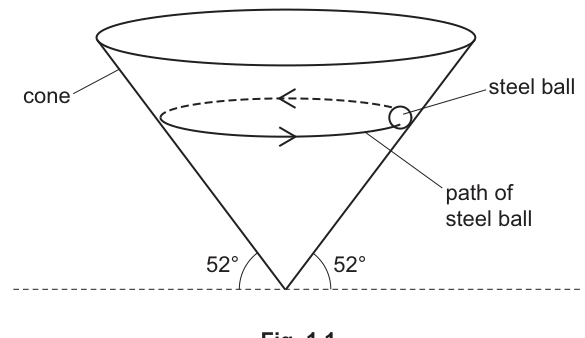
Fig. 1.1 — a steel ball moving in a horizontal circle inside a smooth hollow cone whose sides make 52° with the horizontal.
Show full working
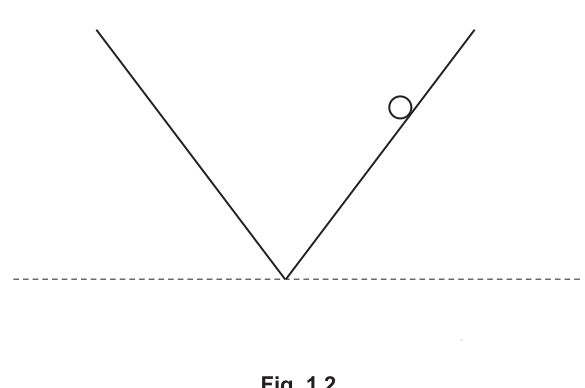
Fig. 1.2 — a cross-section through the cone and the steel ball, the figure part (a) asks you to draw the two force arrows on.
- 1
(a) On Fig. 1.2, draw exactly two labelled arrows from the ball: the weight, vertically down; and the normal contact force, perpendicular to the slanting cone surface, pointing inward and upward (B1).
"Smooth" rules out friction — exactly two forces. "Perpendicular to the surface" is the wording the B1 pays for.
- 2
(b) The vertical component of the contact force balances the weight, so there is no vertical acceleration (B1). Its horizontal component is unbalanced and points toward the axis — this resultant provides the centripetal acceleration (B1).
The two-equation pattern described in words — the standard 2-mark explanation for any ball-on-a-surface question.
- 3
(c) Resolve the contact force : vertically ; horizontally . Divide the second by the first:
Dividing cancels N — the force itself never needs to be found. The leftover ratio IS the acceleration.
- 4
Evaluate the acceleration:
Each piece computed separately: tan52° = 1.280, times g. This a-line is the scheme's second C1.
- 5
Rearrange for the speed and substitute:
"Show that … about 1.4": your unrounded 1.37 rounds to the printed value — quote 2 s.f. and move on.
- 6
(d) Rearrange for angular speed and substitute using from (c):
Same formula as §02, used in reverse: the speed around the circle divided by the radius gives the rate of turning.
- 7
(e) The cone's fixed surface angle fixes the ratio of the components of , so the acceleration available is — the same at every radius. With fixed, gives : increasing the speed therefore increases the radius of the circle (A1).
The ball climbs the slope until the geometry supplies an inward component large enough for its new speed — proportionality, not equality, is the answer.
(c) Dividing by gives , so . (d) . (e) Since is fixed, : faster speed ⇒ larger radius.
On any smooth surface (cone, bowl, banked track), the surface angle fixes the ratio of the two components of N. Divide the two equations FIRST — the normal force almost never needs computing.
Taking the radius of the circle to be the spring's length ().
Project onto the horizontal: .
The string/spring is the hypotenuse; the circle lies flat below it. Every later part inherits the radius, so this slip wrecks the whole question.
Balancing the whole tension against the weight ().
Only the vertical COMPONENT balances: ; the horizontal component is deliberately left over to be the centripetal force.
If tension equalled the weight exactly there would be no horizontal resultant and no circle at all.
Using cos where the angle is measured from the vertical (or sin where it is from the horizontal).
Angle to the VERTICAL ⇒ horizontal component uses sin, vertical uses cos. Angle to the HORIZONTAL ⇒ the other way round.
Both conventions appear in exam stems (the cone question uses 52° to the horizontal, the sphere question 27° to the vertical). Sketch the triangle and label the angle before choosing.
Your turn
A real bowl question that runs the divide-the-equations route, then a tethered aeroplane that flips the angle convention.
- 19702/41 O/N 2014 Q2(a)(i) and (b)5 marks
A small ball moves in a horizontal circle of radius on the smooth inner surface of a hemispherical bowl. The reaction of the bowl on the ball acts at to the horizontal. The ball has weight and the horizontal centripetal force on it is .
(i) By resolving into components, show that .
(ii) Hence calculate the speed of the ball.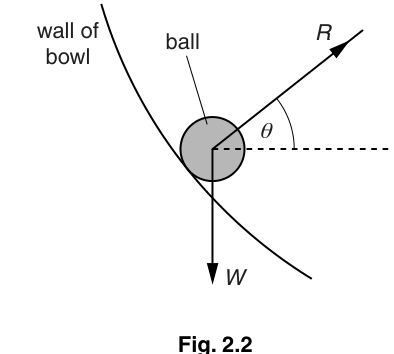
Fig. 2.2 — the forces on the ball: its weight W vertically down and the normal reaction R of the bowl at angle θ to the horizontal.
Stuck? Show hint
(i) Horizontal component = R cos28°, vertical = R sin28° — the angle is to the horizontal. Then divide. (ii) Put F = mv²/r and W = mg into your result.
Show solution
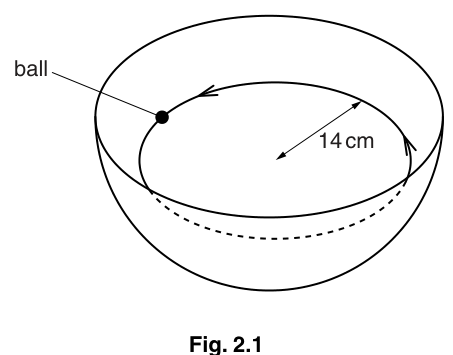
Fig. 2.1 — the ball following its horizontal circular path of radius 14 cm inside the hemispherical bowl.
- 1
(i) Resolve — the angle is to the horizontal, so the horizontal (adjacent) component carries cos:
Two named components: the horizontal one IS the centripetal force F, the vertical one balances the weight W.
- 2
Divide the second equation by the first — cancels:
The division is the whole derivation — one line, no algebra beyond cancelling R.
- 3
(ii) Substitute and :
Name the pieces: m will cancel — the answer cannot depend on mass, which is worth noticing before you compute.
- 4
Solve for v² and evaluate: cancel , multiply through by :
cm→m first (0.14 m); tan28° = 0.532 computed as its own piece; square root last. The MS pays C1 C1 A1 across these lines.
Answer(i) , ; dividing gives . (ii) .
- 1
- 26 marks
A model aeroplane of mass flies in a horizontal circle at constant speed on the end of a taut wire of length attached to a fixed point. The wire makes a constant angle of with the horizontal.
(i) Calculate the radius of the aeroplane's circular path. [1]
(ii) Calculate the tension in the wire. [2]
(iii) Show that the speed of the aeroplane is about . [3]Stuck? Show hint
The angle is to the HORIZONTAL this time: the vertical component carries sin, the horizontal one cos. Write the two balance equations before any number.
Show solution
- 1
(i) The wire is the hypotenuse and its angle is to the horizontal, so the radius is the adjacent leg:
Convention flip on purpose: an angle to the horizontal puts cos on the horizontal leg — exactly the swap the mistake card above warns about.
- 2
(ii) Vertical balance — the tension's vertical component holds the weight:
Equation first, then pieces (mg as its own number, sin18° as its own), division last — the same shape as every part above.
- 3
(iii) Divide the horizontal equation by the vertical one — the tension cancels:
so — the printed value.
Divide first and the tension never needs computing; the bowl's result v² = rg/tan(angle) reappears with a different label. Same surface geometry, same physics.
Answer(i) . (ii) gives . (iii) Dividing the two equations gives , so .
- 1
Vertical circles
“
apply the centripetal force relations to motion in a vertical circle, including the minimum-speed contact condition v_min = √(gr)
When gravity joins the radial game
Round a vertical loop the weight stops being polite background furniture. At the top of the circle it points straight at the centre; at the bottom it points straight away; at the sides it acts along the path itself (tangential), contributing nothing toward the centre. So the share of the centripetal force that weight supplies changes around the loop — and therefore so must the contact force or tension that makes up the difference.
Two further consequences follow, and both are examined constantly:
- The speed changes too. Climbing from bottom to top costs kinetic energy ( becomes ); descending pays it back. The fastest point of the loop is the bottom.
- Contact forces vary hugely — smallest at the top, largest at the bottom. Build both results now and the exam questions become bookkeeping.
At the top: contact is lost when the surface would have to pull
At the top of the loop the centre is below the body, so both forces acting point inward (downward): the weight , and — for a car on a track, or water in a bucket — the normal contact force pushing down from the surface above. Newton's second law toward the centre:
Watch what happens as the car rounds the top more slowly: smaller , smaller . The limit of staying on the circle is — the surface is touching but exerting no force:
Below this speed, gravity alone would supply MORE than the required — the surface would need to pull inward to keep the body on the circle, which contact cannot do. The body leaves the circle and becomes a projectile.
At the bottom: the largest force of the loop
At the bottom the centre is above, so the contact force points inward (up) while the weight points outward (down):
Both effects pile up here: is largest at the bottom (energy conservation) AND the weight must be overcome before any resultant remains. This is why your stomach complains most in the dip of a rollercoaster, not over the crest.
Between the two stations, energy conservation prices the speed change. For height climbed :
Top: , so contact fails when , i.e. below . Bottom: — the loop's largest force. Link speeds with .
A vertical loop of radius r: at X (bottom) the normal force exceeds the weight and their difference is the centripetal force; at Y (top) weight AND normal force both point down toward the centre, and contact is lost if N would have to be negative.
A bucket of water — the minimum-speed limit, then the bottom of the loop
A bucket containing of water is swung in a vertical circle of radius . Take .
(i) State the condition that applies at the top of the circle when the bucket moves at the minimum speed for which the water stays in it.
(ii) Calculate that minimum speed.
(iii) The bucket passes the top at exactly this speed. Calculate the speed of the water at the bottom of the circle.
(iv) Calculate the upward force of the bucket's base on the water as it passes the bottom.
Show full working
- 1
(i) At the minimum speed the water is just maintaining contact: the normal reaction of the base on the water is zero, , and the weight alone acts as the centripetal force.
N can only PUSH (downward on the water at the top). As speed falls, N falls with it (); the floor N = 0 marks the limit — below it the water leaves the bucket.
- 2
(ii) With , write Newton's second law toward the centre:
Cancel and solve:
Name each piece before substituting: g = 9.81 m s⁻², r = 0.80 m. The mass never appears — a full bucket and a nearly-empty one share the same minimum speed.
- 3
(iii) Energy conservation carries the speed from top to bottom — height fallen :
½mv² rearranged with height change 2r: the 2 from squaring and the 2r combine into 4gr = 31.39. Descending pays back what climbing charged — the fastest point of any vertical loop is its bottom.
- 4
(iv) Newton's second law at the bottom, taking upward (toward the centre) as positive — rearrange for N before substituting, using the unrounded :
The base must both support the weight AND supply the centripetal resultant — that double job is why forces peak at the bottom. Compare: 29 N against the water's 4.9 N weight.
(i) — the weight alone supplies the centripetal force. (ii) . (iii) , so . (iv) .
Toy car on a loop-the-loop — does it stay on?
A toy car of mass moves on a track that includes a vertical circular loop of diameter . Point X is the lowest point of the loop and point Y the highest point.
(a) State what is meant by centripetal acceleration. [1]
(b) The car moves around the inside of the loop.
(i) State and explain what happens to the magnitude of the centripetal acceleration as the car moves from X to Y. [1]
(ii) While the car is in contact with the track at Y, its centripetal acceleration is greater than . Explain why. [2]
(c) The speed of the car at X is . Determine by calculation whether the car remains in contact with the track at Y. [3]
(d) The experiment is repeated using a car of mass moving at the same initial speed. State and explain the effect, if any, this has on the answer to (c). [1]
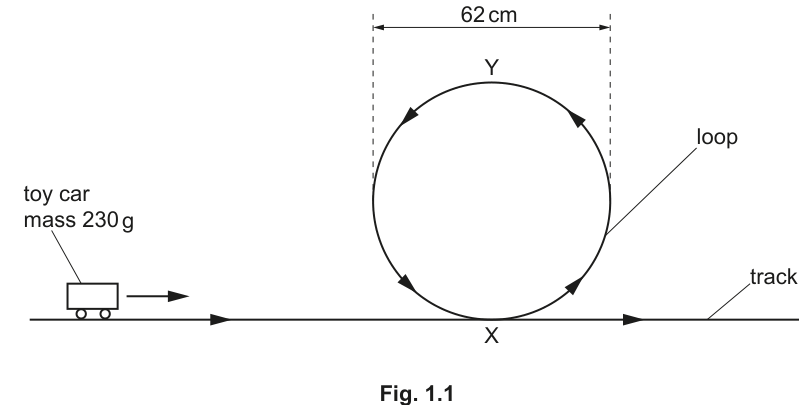
Fig. 1 — a toy car of mass 230 g on a track with a vertical circular loop of diameter 62 cm; X marks the bottom and Y the top of the loop.
Show full working
- 1
(a) An acceleration acting perpendicular to the velocity — directed toward the centre of the circular path (B1).
This is exactly §03's definition exercise — the same mark reappears here inside a bigger question, which is typical.
- 2
(b)(i) It decreases from X to Y: the car climbs and loses speed, and falls as falls (B1).
"State and explain" wants the change AND its reason in one breath — the mark pays for the causal link, not the bare direction.
- 3
(b)(ii) If the track exerted no force at Y, the only inward force on the car would be its own weight — providing an acceleration of exactly (B1). Since the required acceleration is GREATER than , the track must push downward on the car too: the normal contact force makes up the shortfall (B1).
Two clauses, two B1s: weight alone gives only g; anything beyond g needs extra inward force, which for a contact situation can only come from the track.
- 4
(c) Write the energy statement for the climb from X to Y — height climbed diameter :
Kinetic energy at X minus the gravitational potential gained on the climb. Keep the mass visible one line longer — watching it cancel is instructive, not wasteful.
- 5
Solve for :
Each piece computed separately: , then , then subtract. The mass cancelled — notice it go.
- 6
Test the contact condition at Y: the loop radius is half the diameter, . Divide using the unrounded :
This is LESS than , so the required inward acceleration is smaller than the weight alone provides. The track would have to PULL the car inward to keep it on the circle — impossible for a contact force — so the car does not remain in contact at Y (A1).
Guard digits matter at the division: rounding to 2.28 first would print 7.4. Compare with (b)(ii)'s logic run in reverse: a < g means weight over-supplies, N would be negative, contact fails.
- 7
(d) No effect (B1). In BOTH the energy equation and the mass cancels, so the outcome is independent of the car's mass. A heavier car arrives at Y with exactly the same speed, and every force in the argument scales with by the same factor — so the verdict cannot change.
contains no m; neither does . Mass-independence is worth stating explicitly — examiners reward the sentence.
(c) , giving : the car does NOT remain in contact at Y. (d) No difference — mass cancels from both the energy equation and a = v²/r.
Every 'does it stay in contact?' question reduces to ONE comparison at the top: required a = v²/r against g. Greater ⇒ in contact (track pushes); less ⇒ contact lost.
Your turn
A pilot pulling a loop at constant speed — both seat forces, then the comparison the examiner asks for.
- 16 marks
A pilot of mass flies an aircraft through a vertical circle of radius at constant speed . Take .
(i) Calculate the force exerted by the seat on the pilot at the TOP of the circle. [3]
(ii) Calculate the force exerted by the seat on the pilot at the BOTTOM of the circle. [2]
(iii) State and explain at which of these two positions the seat force is greater.Stuck? Show hint
At each position write Newton's second law toward the centre first: N_top + mg = mv²/r and N_bottom − mg = mv²/r. Rearrange before substituting.
Show solution
- 1
Required centripetal acceleration (both positions):
Constant speed means this value holds at top AND bottom.
One shared piece computed once. At constant speed there is no energy exchange to worry about — the two positions differ only in force, not in a.
- 2
(i) At the top both the seat force and the weight point toward the centre (down), using the unrounded :
The seat pushes DOWN here — without it the pilot would fly out of the seat along a tangent. The rearrangement isolates N so no sign slip can hide.
- 3
(ii) At the bottom the seat pushes up (toward the centre) while the weight points away from it:
The double job again: support the weight AND supply the resultant. Same a as the top, yet the force is over half as large again.
- 4
(iii) The seat force is greater at the bottom: there the seat must provide the centripetal force AND balance the weight acting opposite to it; at the top the weight helps by pointing toward the centre, so the seat supplies less (B1).
State the position, then carry the reason in terms of what the weight contributes — the standard 1-mark state-and-explain shape.
Answer(i) downward. (ii) upward. (iii) Bottom — the seat does the centripetal job plus the weight's job instead of the weight helping.
- 1
Where circular motion meets the fields
“
equate a given field force (gravitational GMm/r², magnetic F = Bqv handed over) to the centripetal force for orbits and charged particles
The pattern that runs Paper 4
The biggest circular-motion marks on Paper 4 hide inside Gravitational Fields and Magnetic Fields questions, and they all run the same three-line play:
- Identify the field force acting as the provider of the centripetal force.
- Set it equal to .
- Solve for whatever is wanted.
This section runs that play twice with the field formula handed to you — you have not yet met gravity's inverse-square law or the magnetic force rule in A Level depth (they live in their own notes), but you can already execute the circular-motion half, which is where most of the marks sit. Learn the pattern now and both fields topics get cheaper.
Toy satellite — the three-line play on clean powers of ten
A satellite of mass is in a circular orbit of radius about a planet of mass . The gravitational force on the satellite has magnitude , where . Calculate the orbital speed of the satellite.
Show full working
- 1
Line up the play: set the field force equal to the centripetal force:
The equation line comes first even when nothing is marked for it yet — every later step reads off it.
- 2
Cancel and solve: cancel , multiply by :
The satellite's own mass drops out — orbital speed is a property of the orbit, not the satellite.
- 3
Compute the pieces, square root last:
Index arithmetic shown as its own line, division as its own, root last — three small computations instead of one frightening blob.
(about 5.8 km s⁻¹).
Orbit speeds always land near km per second — if your answer is metres per year or kilometres per hour squared, re-check the powers of ten.
A moon in orbit — gravity as the provider
A moon of mass is in a circular orbit of radius about a planet of mass . The gravitational force on the moon has magnitude , where .
(a) Explain why the moon's path is circular. [2]
(b) Calculate the orbital speed of the moon. [3]
Show full working
- 1
(a) The gravitational force on the moon acts along the line to the planet — perpendicular to the moon's velocity at every instant — and provides exactly the centripetal force needed for a circle (B1). Its magnitude is constant, because the orbit radius never changes (B1).
The scheme accepts any two of three clauses: provides the centripetal force; constant magnitude; perpendicular to velocity. All three written = safe. This is §03's description question wearing orbital clothes.
- 2
(b) Line up the pattern: set the field force equal to the centripetal force:
This one-line equation is the load-bearing wall of every orbit question — write it before any algebra.
- 3
Simplify: cancel from both sides, then multiply both sides by :
Show each cancellation: m goes (orbital speed does not depend on the moon's mass), one power of r goes.
- 4
Compute the pieces:
then
GM as its own step, GM/r as its own step, square root last — the name-the-pieces discipline again. The scheme quotes 7500 m s⁻¹.
(a) Gravity is perpendicular to the velocity with constant magnitude and provides the centripetal force. (b) .
is worth carrying into the Gravitational Fields note — but derive it on demand: "show that" versions pay for the two-line algebra.
Electrons bent by a magnetic field — the semicircle geometry
A beam of electrons, each moving at , enters a uniform magnetic field at point X. Inside the field, each electron experiences a magnetic force of constant magnitude , directed perpendicular to its velocity throughout its motion. The electrons leave the field a distance from the entry point X. The electron mass is .
(i) State the direction of the centripetal acceleration of an electron at X. [1]
(ii) Calculate the distance . [3]
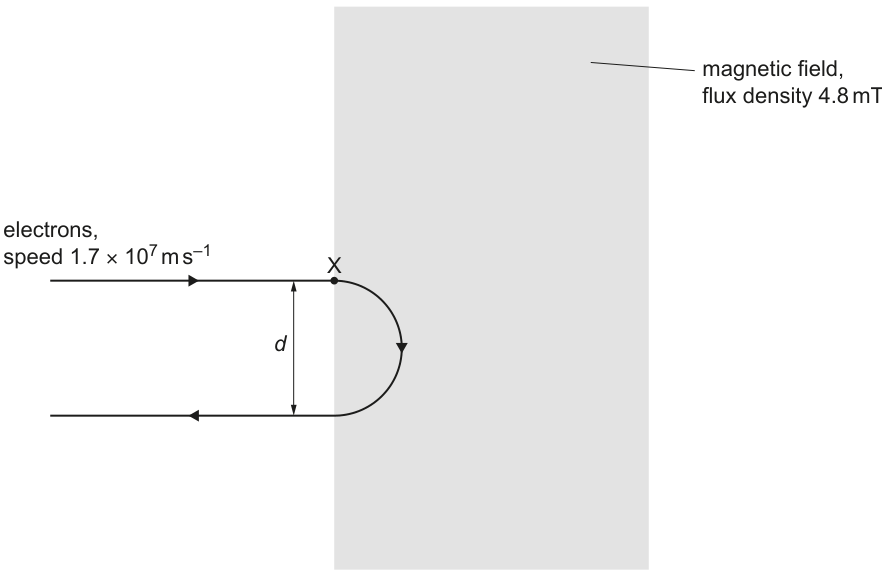
Fig. 6 — electrons moving at 1.7 × 10⁷ m s⁻¹ enter a uniform magnetic field at X and leave it a distance d away, having travelled a semicircular path.
Show full working
- 1
(i) At X the acceleration points toward the centre of the semicircular path — downward on the figure, perpendicular to the incoming beam (B1).
A constant-magnitude force always perpendicular to the velocity produces exactly centripetal acceleration — aimed at the centre of the arc, not along the beam.
- 2
(ii) The magnetic force IS the provider here, so set it equal to the centripetal force and rearrange for the radius:
Same pattern as the orbit, different force. Rearranged BEFORE substituting so the target quantity leads.
- 3
Compute the pieces:
Square v first, multiply by m second, divide by F last — three separate operations, three separate numbers.
- 4
Read the geometry: the path inside the field is a SEMICIRCLE, so the entry and exit points are the two ends of a diameter:
The physics found r; converting r into d is a geometry step — and it is where careless candidates lose the final mark.
(i) Toward the centre of the semicircle (down the page at X). (ii) , so .
In magnetic-field questions the field supplies the force and circular motion sizes the orbit. Expect roughly half the marks from each topic.
Your turn
One real derivation that Paper 4 reuses constantly — the orbital kinetic energy result.
- 19702/42 F/M 2021 Q1(c)(ii)2 marks
A rock of mass is in a circular orbit of radius about a planet of mass . The gravitational force on the rock has magnitude . Show that the kinetic energy of the rock is
Stuck? Show hint
Start from force = centripetal force, solve for v², then feed v² into E_k = ½mv².
Show solution
- 1
Gravity provides the centripetal force:
The pattern line once more — the scheme's M1 is paid for precisely this equation.
- 2
Solve for : cancel , multiply both sides by :
Substitute into :
Two short lines, no gaps: cancel, multiply, substitute, tidy the ½ into the denominator. Exactly the printed result.
AnswerFrom : , so .
- 1
- 24 marks
A beam of protons, each moving at , enters a uniform magnetic field at right angles to its velocity. Inside the field, each proton experiences a magnetic force of constant magnitude , directed perpendicular to its velocity. The proton mass is .
(i) State the direction of the acceleration of a proton as it enters the field. [1]
(ii) Calculate the radius of its circular path. [3]Stuck? Show hint
(i) A force always perpendicular to the velocity steers the body toward a centre — aim the acceleration there. (ii) Set F = mv²/r with F the magnetic force.
Show solution
- 1
(i) The acceleration points toward the centre of the circular path — perpendicular to the velocity, along the magnetic force (B1).
A constant-magnitude force always perpendicular to the velocity produces exactly centripetal acceleration: aimed at the centre of the arc, never along the beam.
- 2
(ii) The magnetic force IS the provider, so set it equal to and rearrange for :
Compute the pieces:
Same play as the electron example — different particle, same three-line structure. Square v first, multiply by m second, divide by F last.
Answer(i) Toward the centre of the path, perpendicular to the velocity. (ii) .
- 1
How the examiner marks it
This topic's schemes use the same three currencies as the rest of Paper 4. B1 pays statements: definitions (radian, centripetal acceleration), descriptions (uniform circular motion), explanations of which force provides what. C1 pays method lines — and in this topic they cluster on three moves: converting a period to seconds, writing the resolving pair, and setting a resultant (or field) force equal to . A1 pays the evaluated answer with its unit. Structure your working so each currency lands on its own line: equation first, substitution second, answer-with-unit third — a merged blob can only ever collect the A1.
"The centrifugal force throws the body outward."
In a stationary (inertial) frame there is no outward force. The single resultant acts INWARD — it is what bends the path.
Examiners penalise inventing an outward force. The outward sensation on a roundabout is your own inertia resisting the turn.
Drawing a "centripetal force" arrow on the free-body diagram alongside weight, tension and normal contact.
Draw only the real forces; the centripetal force is the RESULTANT of them toward the centre.
Counting it as an extra force double-counts and wrecks every equation downstream. Name the real provider instead.
Using degrees in , or quoting in degrees per second.
Radians only: convert degrees with , revolutions with , before any substitution.
Every formula in this topic is built on the radian definition. Degrees overstate angles by a factor of 57.3.
Substituting into when the period is 24 h.
Convert FIRST: , then substitute.
Unconverted times (hours, minutes, days) cost the most A1s in this topic — the planted wrong answers always include the unconverted ones.
Answering "identify the force providing the centripetal force" with "".
Name the real force: weight, tension, normal contact, friction, gravity or the magnetic force.
is the SIZE of the resultant, not a force you can point to. The question wants the provider's name.
Using the loop's diameter as in .
Halve it first: a 62 cm loop has .
Diameter-vs-radius is the quiet arithmetic killer — it survives into a, then F, then the contact verdict.
formula | reach for it when… |
|---|---|
an angle in radians and a radius need turning into a distance along the path | |
a period, frequency or rpm is given — rotation becomes rad s⁻¹ (convert the time unit first) | |
you have ω and a radius and need a real speed | |
you need the centripetal acceleration — pick the form whose inputs you already have | |
you need the force — always the resultant of the real forces toward the centre | |
a horizontal circle: balance vertically, aim the leftover inward; divide to eliminate the tension | |
a vertical loop: contact is lost at the top when N would have to pull | |
the largest force of the loop — and the usual final part of a vertical-circle question |
The whole topic in eight lines. Every one of them is a resultant statement — never a new force.
Motion in a Circle carried 220 marks across 111 question parts in 33 Paper-4 sittings between 2021 and 2025 — about 44 marks a year, rising to 66 in 2025. Its own rank sounds modest, but its techniques power the two biggest topics on the paper, whose hardest marks are all "set a field force equal to " questions wearing different clothes. Master this note once and those marks are already yours.
Exam-day order of battle
Convert every time to seconds and every length to metres BEFORE the first line of physics. Decide the centre of the actual path (on the rotation axis for a spinning planet; the loop's centre for a vertical circle). Draw the free-body diagram with real forces only, resolve toward that centre, and write the resultant-equals- equation as its own line. For horizontal circles write the pair — vertical balance, horizontal resultant — and divide. For vertical loops compare with at the top. Finish every answer with a unit and a direction where one exists.
Everything on one page
arc length from angle — θ in radians (1 rev = 2π rad; degrees × π/180)
angular speed in rad s⁻¹ from period T or frequency f — convert hours/minutes to seconds and rpm to rev s⁻¹ first
speed of a point at radius r; ω is shared by a whole rigid body, v belongs to each radius
centripetal acceleration — magnitude constant, direction always toward the centre, ⊥ v
centripetal force — the resultant of the real forces toward the centre, never a new force on its own
minimum top-of-loop speed for contact (from N_top = 0 at the top)
vertical-loop contact forces: smallest at the top, largest at the bottom
the horizontal-circle resolving pair — balance vertically, aim the leftover at the centre
Can you do all of these?
Define the radian verbatim: the angle subtended at the centre of a circle when the arc length equals the radius
Work in radians everywhere: × π/180 from degrees, × 2π from revolutions, before s = rθ or any ω
Convert every period to seconds before substituting — hours ×3600, minutes ×60, rpm ÷60 for rev s⁻¹
Compute ω = 2π/T then v = rω; state that ω is the same for every point of a rigid body while v grows with radius
Describe uniform circular motion for its two marks: constant magnitudes of velocity and acceleration, velocity ⊥ acceleration
Derive a = v²/r by similar triangles if asked, and move fluently between a = v²/r, a = rω² and a = vω via v = rω
Never draw a 'centripetal force' arrow or invent an outward 'centrifugal' one — name the real force whose resultant provides mv²/r
Horizontal circles: write F_T cosθ = mg and F_T sinθ = mv²/r, then divide to get tanθ = v²/(rg) when the tension is not wanted
Vertical circles: compare required a = v²/r with g at the top — greater means contact holds, less means contact lost
Quote the vertical-loop results: N_top = mv²/r − mg with v_min = √(gr); N_bottom = mv²/r + mg as the loop's largest force
Price the speed change round a loop with energy conservation: ½mv_top² = ½mv_bottom² − mgh (h the height climbed)
Orbits and charged particles: set the field force equal to mv²/r and solve — v = √(GM/r) and r = mv²/F fall out in two lines
For spinning-Earth questions aim the centripetal direction horizontally at the rotation axis, not at the planet's centre (they coincide only at the Equator)