What a capacitor is; capacitance defined
“
define capacitance, as applied to both isolated spherical conductors and to parallel plate capacitors; recall and use C = Q / V
A component that banks charge
A battery is a steady but feeble pump: it delivers energy at a rate its chemistry can sustain, no faster. Plenty of real jobs need the opposite — a slow trickle saved up, then paid out in one violent burst. A defibrillator charges for several seconds and then dumps hundreds of joules through the chest in milliseconds. A camera flash fires a current spike no battery could deliver directly. A touch sensor detects the tiny capacitor formed by your fingertip and the screen. And in almost every mains-powered device, a capacitor smooths a wobbly rectified voltage into something steady (§07).
The component doing all of this is the capacitor: two conductors separated by an insulator (air, paper, plastic, or just a vacuum — the insulator itself is not on your syllabus; only its job of keeping the charges apart matters). Nothing crosses the gap. What a capacitor stores is separated charge, and with it energy in the electric field between the plates.
Building the parallel-plate picture
Connect a battery across two parallel metal plates. The battery does not create charge — it pumps it. Electrons are pushed onto one plate, making it negative, and pulled off the other, leaving it positive. The pump runs until the p.d. between the plates equals the battery's e.m.f., at which point the flow stops and the capacitor is fully charged: plate one carries , plate two carries , and the p.d. between them is .
Two details here are worth their weight in marks:
- The charge stored means the charge on ONE plate — not the two added together. The plates carry equal and opposite charges and , and adding them gives zero, which would be a useless definition of "stored". What is stored is the separation: the work the battery did moving charge from one plate to the other.
- The p.d. is measured between the plates — the potential of one plate minus that of the other.
Charging a parallel-plate capacitor. The battery pumps electrons onto one plate and pulls them off the other, leaving charges −Q and +Q. The stored charge Q is the magnitude on ONE plate; V is the p.d. between the plates; a uniform electric field fills the gap.
The definition, word-perfect
Different capacitors hold different amounts of charge at the same p.d., just as different buckets hold different volumes of water at the same level. The property that measures the bucket size is the capacitance , defined by the syllabus for both parallel-plate capacitors and isolated spherical conductors:
capacitance = charge / potential difference (M1) — where the charge is the charge on one plate, and the potential is the p.d. between the plates (A1).
Both clauses earn marks separately. Writing only "charge per unit voltage" scores the first mark and quietly loses the second, because it never says which charge or which p.d. The scheme's own model answer (O/N 2024) is exactly: charge is the charge on one plate, and the p.d. is between the plates. Rearranged into its working form:
The unit is the farad (F): a capacitor of 1 farad stores 1 coulomb at a p.d. of 1 volt. One farad is enormous — a single farad capacitor is the size of a drink can. Real capacitors are rated in microfarads (µF, F), nanofarads (nF, F) or picofarads (pF, F).
Capacitance = charge on ONE plate ÷ p.d. BETWEEN the plates. Unit: farad, F = C V⁻¹. Practical capacitors: µF (×10⁻⁶), nF (×10⁻⁹), pF (×10⁻¹²).
- 1
Spot the prefix and write its power of ten: µ → ×10⁻⁶, n → ×10⁻⁹, p → ×10⁻¹².
The single most-tagged technique in this topic (a dozen-plus scheme tags in the 2021–2025 window) — and the most common silent killer, because the arithmetic that follows a missed conversion still produces a plausible-looking number.
- 2
Replace the prefixed value in the formula with value × power of ten, e.g. 470 µF → 470 × 10⁻⁶ F.
Write the substitution with the power of ten visible. A bare '470' in a formula is where wrong units hide.
- 3
Multiply the number parts and ADD the exponents at the end, quoting the answer in standard form.
Prefactors and exponents handled separately never go wrong: 24 × 470 = 11 280, then ×10⁻⁶, then round to 2–3 sf.
Invented demo — one capacitor, three questions
A capacitor is charged until the p.d. between its plates is .
(i) Calculate the charge on one plate.
(ii) A student says the capacitor must now store , "because both plates are charged". Explain the error.
(iii) Express the capacitance in farads and in nanofarads.
Show full working
- 1
(i) Name the relation and convert first: with and .
Definition rearranged for charge; the µF becomes ×10⁻⁶ BEFORE anything is multiplied — the conversion habit from the method box above.
- 2
Substitute and simplify:
Prefactor 100 × 12 = 1200, then ×10⁻⁶. Quoting the mJ-style shorthand (1.2 mC) keeps the size of the answer visible.
- 3
(ii) The plates carry charges and . Their sum is zero — adding them measures nothing stored. The stored charge is defined as the charge on one plate: the separated charge the battery pumped across.
The 'both plates' error doubles every charge in the topic. What is stored is separation, not net charge — the capacitor as a whole is still neutral.
- 4
(iii) .
Going down to nano means multiplying by : .µ→F shifts six places down; F→nF shifts nine places up, i.e. three up from µ. Prefix ladders are climbed in steps of 10³.
(i) Q = CV = 1.2×10⁻³ C. (ii) Q is defined as the charge on ONE plate — the plates carry +Q and −Q, which sum to zero; the stored quantity is the separated charge. (iii) 1.0×10⁻⁴ F = 1.0×10⁵ nF.
Whenever a question says 'the charge on the capacitor', it means the magnitude on one plate. Every formula in this note uses that Q.
Charging a real capacitor on a real circuit
A capacitor of capacitance is connected to a battery of electromotive force (e.m.f.) in the circuit shown. The two-way switch S is initially at position X, so the capacitor is fully charged.
Calculate the charge on the capacitor at time .
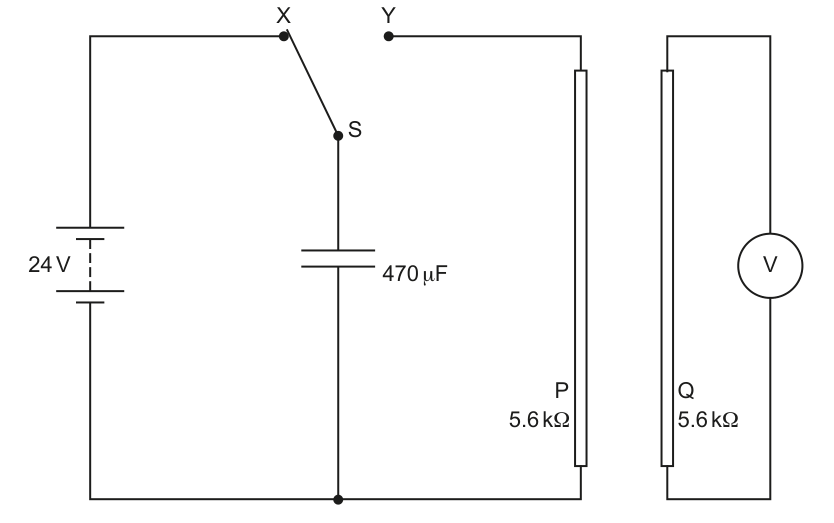
Fig. 5.1 from the question paper: a 24 V battery and a 470 µF capacitor connected through two-way switch S. Position X charges the capacitor; position Y connects it to two long wires P and Q (each 5.6 kΩ), with Q wired to a voltmeter.
Show full working
- 1
Name the relation: the defining equation solved for charge,
Quoting the definition first keeps the substitution mark safe even if the arithmetic slips — and names which idea does the work.
- 2
Identify the pieces with units converted: and, because the capacitor is fully charged across the battery, .
'Fully charged' means the plate p.d. has risen to equal the e.m.f. — that is the licence to use 24 V here. The µF conversion is written out, never done in the head.
- 3
Substitute and evaluate:
24 × 470 = 11 280, then ×10⁻⁶. Two significant figures match the data — and match the scheme's own answer, 0.011 C.
Q₀ = CV = 24 × 470×10⁻⁶ F × V = 0.011 C.
Later parts of this same question discharge the capacitor through the wires and time it — this Q₀ is the x₀ that starts every exponential in §05.
Doubling Q "because both plates are charged": Q = 2CV.
Q is the charge on ONE plate; the plates carry +Q and −Q.
The definition's first clause names the charge on one plate. Doubling it poisons C = Q/V, every energy formula and every discharge calculation downstream.
Substituting 470 for a 470 µF capacitor, as if the unit were farads.
470 µF = 470 × 10⁻⁶ F, converted before substituting.
The number that survives a missed conversion still looks plausible — which is exactly why schemes tag the conversion separately and refuse the final mark without it.
Defining capacitance as "charge per unit voltage".
Charge ÷ p.d., where the charge is on one plate and the p.d. is between the plates.
The M1/A1 split in the scheme pays one mark for the ratio and a separate one for the one-plate/between-plates precision. Loose wording strands the second mark.
Your turn
One routine Q = CV drill, one conversion workout, and the real two-mark definition from O/N 2024.
- 13 marks
A capacitor is charged to a p.d. of .
(i) Calculate the charge on one of its plates, giving your answer in µC.
(ii) The p.d. is doubled to . State the new charge, without recomputing from scratch.Stuck? Show hint
Convert nF first; then for (ii) ask how Q responds when V doubles at fixed C.
Show solution
- 1
(i) Convert: .
nano → ×10⁻⁹, written before the multiplication.
- 2
Apply Q = CV:
470 × 9.0 = 4230, then ×10⁻⁹. Converting the exponent to µC at the end (×10⁶) keeps the answer at a readable size.
- 3
(ii) with unchanged: , so doubling doubles :
Proportional reasoning finishes in one line — and shows understanding, which 'I typed it into the calculator again' does not.
Answer(i) 4.2 µC. (ii) 8.4 µC — Q ∝ V at fixed C, so it doubles.
- 1
- 24 marks
(i) Express in farads: , , .
(ii) A capacitor carries a charge of . Calculate the p.d. across it.Stuck? Show hint
For (ii), the definition rearranged: V = Q/C — with both values in farads and coulombs.
Show solution
- 1
(i) ; ; .
Three prefixes, three powers of ten: −6, −9, −12. This ladder is worth memorising outright.
- 2
(ii) Rearrange the definition: with and :
Both values are prefixed, so both get converted — a µ over a µ would have cancelled, but only by luck; convert by habit, not by luck.
- 3
The powers of ten cancel exactly, leaving 50/10. A clean answer like this is a sign the conversions were right.
Answer(i) 2.2×10⁻⁵ F; 1.0×10⁻⁷ F; 4.7×10⁻¹² F. (ii) V = Q/C = 5.0 V.
- 1
- 39702/42 O/N 2024 Q7(a)2 marks
Define the capacitance of a parallel-plate capacitor.
Stuck? Show hint
Two clauses, two marks: the ratio, then the precision about which charge and which p.d.
Show solution
- 1
Clause 1: capacitance = charge ÷ potential difference (M1).
The ratio itself is the first mark — charge per unit p.d.
- 2
Clause 2: the charge is the charge on one plate, and the potential is the p.d. between the plates (A1).
The scheme's model answer is exactly this: 'charge is charge on one plate, and potential is p.d. between the plates'. The precision is the second mark.
AnswerCapacitance = charge ÷ p.d., where the charge is the charge on one plate and the p.d. is between the plates.
- 1
The rest of this note
Can you do all of these?
Define capacitance word-perfectly: charge ÷ p.d., where the charge is on ONE plate and the p.d. is BETWEEN the plates — both clauses are marked separately
Convert µF/nF/pF to farads BEFORE any substitution — the most-tagged technique in the topic
Derive the series and parallel rules from C = Q/V (same charge + p.d.s add; same p.d. + charges add), not just quote them
Remember the combination rules are the OPPOSITE of the resistor rules — and that two equal capacitors in series give C/2
Track charge-sharing: charge is conserved, the final p.d.s are equal, and stored energy DROPS (heat in the wires)
Pick the right energy form: ½CV² when the p.d. is fixed, ½Q²/C when the charge is fixed; for a change use ΔE = ½C(V₂²−V₁²)
Explain the discharge shape as a feedback chain: V_C = V_R, I ∝ V, I is the rate charge leaves, so as Q falls the current falls
Derive dQ/dt ∝ −Q ⇒ exponential, and state τ = RC as 'falls to x₀/e ≈ 0.37 x₀ in one time constant'
Solve for time with t = −RC ln(x/x₀) — ln of the ratio, never ln of individual values first
Read ln x–t graphs: straight line, gradient −1/RC, intercept ln x₀; use a large triangle for the gradient
For ripple read-offs, take both coordinate pairs from INSIDE one discharge segment
Quote 'show that' answers to 3+ significant figures before comparing with the printed value