The chemist's toolkit — reading the map
Groups are places, reagents are roads
Think of the AS organic reactions as a map. Each functional group is a place: alkene, halogenoalkane, alcohol, aldehyde, ketone, carboxylic acid, nitrile, ester, amine. Each reagent with its conditions is a road from one place to another: steam with a phosphoric acid catalyst is the road from alkene to alcohol; hot concentrated acidified is the road from alkene to carbonyl compounds and acids; is the road from carboxylic acid back to alcohol. Every road on the map was taught in an earlier AS note (the figure below collects the main ones), so if a road looks unfamiliar, go back to that note rather than learning it here.
The exam asks you to use the map in four ways, one per section of this note:
- Find where you are — name the functional groups of a molecule from its test results (“Identifying functional groups — the test table”);
- Predict — say what a molecule with several groups does with a reagent (“Predicting reactions of molecules with several groups”);
- Plan a route — find two or three steps that lead from a start to a target (“Devising multi-step routes”);
- Check a route — for each step of a given route, name the reaction type, the reagent and conditions, and any by-products (“Auditing a finished route: types, by-products, yield”). The example below is a first go at this.
In a few places the same reagent gives different products, and the conditions decide which. Route questions test these four forks again and again:
- fork: dissolved in water (aqueous), heated → substitution ( replaces the halogen, alcohol made). dissolved in ethanol (ethanolic), heated → elimination (HX lost, alkene made). Same reagent, different solvent, different product.
- Dichromate fork: acidified with a primary alcohol — distil the product off as it forms → aldehyde; heat under reflux → carboxylic acid. A secondary alcohol gives a ketone either way; a tertiary alcohol is not oxidised.
- Cyanide fork: to substitute a halogenoalkane, use in ethanol (it supplies ions); to add across a , use with a little as catalyst. Either way the chain gains one carbon.
- Permanganate fork: cold, dilute, acidified adds two groups across a (a diol); hot, concentrated, acidified breaks the completely, giving ketones and/or carboxylic acids.
The AS reaction map: each functional group is a place, and each road is labelled with its reagent and conditions and coloured by reaction type (addition, substitution, elimination, oxidation/reduction, hydrolysis/condensation). Starred roads are the four forks where the conditions decide the product; the reduction roads back to alcohols are listed under the key.
Six reactions of 1-bromobutane
Some reactions based on 1-bromobutane, , are shown in Fig. 3.1.
For each of the reactions state the reagent(s), the particular conditions required, if any, and the type of reaction.
For the type of reaction choose from the list. Each type may be used once, more than once or not at all. Each reaction may be described by more than one type.
elimination · hydrolysis · substitution · oxidation · addition · condensation
| reaction | reagent(s) and conditions | type(s) of reaction |
|---|---|---|
| 1 | ||
| 2 | ||
| 3 | ||
| 4 | ||
| 5 | ||
| 6 |
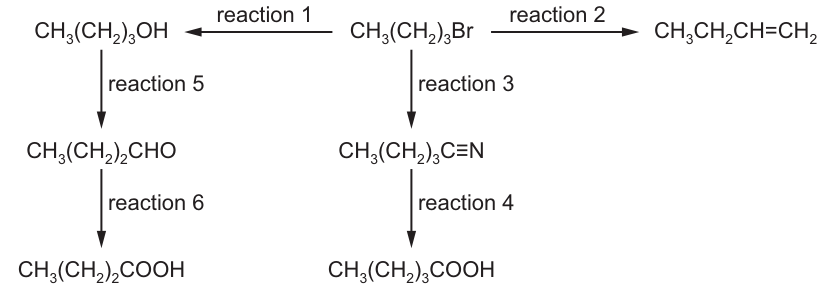
Fig. 3.1 as printed with the question.
Show full working
- 1
Read each arrow by the group it ENDS at. The product's new functional group tells you which road was used; the map then gives the reagent, the conditions and the type.
Starting from the product is quicker than starting from the reagent list: only one or two roads on the map arrive at each group.
- 2
Reaction 1 — Br replaced by OH. Product: butan-1-ol, an alcohol. Road: aqueous (or dilute) , heated. Type: substitution (the mark scheme also accepts hydrolysis, because the C–Br bond is broken by reaction with water/).
Write 'aqueous' or '(aq)'. 'NaOH' alone could mean the ethanolic reagent of reaction 2, which gives a different product.
- 3
Reaction 2 — an alkene appears. Product: but-1-ene. Road: (or KOH) dissolved in ethanol, heated. Type: elimination (HBr is removed).
This is the NaOH fork from the idea box above: same reagent as reaction 1, but the solvent is ethanol, so the product is the alkene.
- 4
Reaction 3 — a nitrile appears and the chain grows from 4 C to 5 C. Product: pentanenitrile. Road: (or ) in ethanol, heated. Type: substitution ( replaces ).
One extra carbon is the clue: at AS only cyanide adds a carbon to a chain. The CN group goes onto the carbon that held the Br.
- 5
Reaction 4 — nitrile to carboxylic acid. Product: pentanoic acid, still 5 C. Road: heat under reflux with dilute acid, e.g. or . (Heating with NaOH(aq) and then acidifying also works.) Type: hydrolysis (the mark scheme also accepts substitution or addition–elimination).
The nitrile carbon becomes the COOH carbon, so the carbon count does not change here. Counting carbons along the scheme checks that you are on the right row.
- 6
Reaction 5 — primary alcohol to aldehyde. Product: butanal. Road: acidified , warm, and distil the aldehyde off as it forms. Type: oxidation (the mark scheme also accepts elimination, since two H atoms are removed).
The mark scheme says 'NOT reflux' here. Distilling removes the aldehyde before it can be oxidised further; under reflux it would become butanoic acid.
- 7
Reaction 6 — aldehyde to carboxylic acid. Product: butanoic acid. Road: acidified , heated under reflux; Tollens' or Fehling's reagent also oxidises an aldehyde to the acid. Type: oxidation.
Reactions 5 and 6 use the same reagent. The condition (distil or reflux) decides whether you stop at the aldehyde or go on to the acid.
1 NaOH(aq), heat — substitution or hydrolysis · 2 ethanolic NaOH, heat — elimination · 3 KCN in ethanol, heat — substitution · 4 dilute or HCl, reflux — hydrolysis · 5 acidified , distil — oxidation · 6 acidified , reflux (or Tollens'/Fehling's) — oxidation
For each arrow: name the product's group, find the road on the map that ends there, and write the reagent WITH its deciding condition (aqueous/ethanolic, distil/reflux).
Your turn
Both practise reading a route: product first, then reagent and conditions, then every type that fits the step.
- 13 marks
For each step of the route below, state the reagent(s) and conditions, and give EVERY reaction type from the list {addition, substitution, elimination, hydrolysis, oxidation, condensation} that describes the step.
Stuck? Show hint
(b) and (c) use the same oxidant — the difference is glassware. Ask of each step which bonds broke.
Show solution
- 1
(a) Bromoethane → ethanol: the Br is replaced by OH. Reagent and conditions: aqueous , heat. Type: substitution, and also hydrolysis (the C–Br bond is broken by reaction with water/).
Same as reaction 1 of the example above. Write 'aqueous': NaOH in ethanol would give ethene instead.
- 2
(b) Ethanol → ethanal: a primary alcohol to an aldehyde. Reagent and conditions: acidified , warm, and distil the ethanal off as it forms. Type: oxidation (elimination is also accepted, as two H atoms are removed).
The word 'distil' earns the condition mark. Without it the ethanal stays in the flask and is oxidised on to ethanoic acid.
- 3
(c) Ethanal → ethanoic acid. Reagent and conditions: acidified , heat under reflux (or warm with Tollens' or Fehling's reagent). Type: oxidation.
An aldehyde is easy to oxidise, so even the mild oxidants Tollens' and Fehling's turn it into the acid. That is why they are used to tell aldehydes from ketones.
Answer(a) NaOH(aq), heat — substitution and hydrolysis (b) acidified , warm, distil — oxidation (c) acidified , reflux (or Tollens'/Fehling's) — oxidation
- 1
- 23 marks
But-1-ene is the only organic starting material. Give the reagent(s) and conditions for converting it into:
(i) butane
(ii) 1,2-dibromobutane
(iii) butan-2-ol as the major product
and name the type of reaction in each case.
Stuck? Show hint
All three roads start at the alkene. Which reagent adds what, and in (iii) which carbon does the OH go to?
Show solution
- 1
(i) Reagent and conditions: with a nickel catalyst, heat. Type: addition (it is also a reduction: the alkene gains hydrogen).
Give both parts: the gas and the heated Ni catalyst. 'Hydrogen' alone does not score the conditions mark.
- 2
(ii) Reagent and conditions: at room temperature, in the dark. Type: addition — one Br adds to each carbon of the old , giving .
No UV light: UV would start free-radical substitution of C–H bonds instead of addition across the C=C.
- 3
(iii) Reagent and conditions: steam, , with a phosphoric acid () catalyst, heat. Type: addition. The OH goes onto the carbon with fewer H atoms (C2), so butan-2-ol is the major product and butan-1-ol the minor one.
Markovnikov's rule: the H adds to the carbon that already has more H atoms, because this route goes through the more stable secondary carbocation.
Answer(i) /Ni, heat — addition (reduction) (ii) , rtp, no UV — addition (iii) steam/, heat — addition (hydration), Markovnikov major butan-2-ol
- 1
The rest of this note
Can you do all of these?
Functional groups are places, reagents are roads — every answer in this topic uses reactions from the earlier AS organic notes
The four condition forks: NaOH aqueous vs ethanolic; dichromate distil vs reflux; KCN (substitution) vs HCN with KCN catalyst (addition to C=O); cold dilute vs hot concentrated
Test table: dichromate (1°/2° alcohol or aldehyde), (aq) decolourised (C=C), 2,4-DNPH (any aldehyde or ketone), Tollens'/Fehling's (aldehyde only), alkaline ( or ), Na (alcohol AND acid), (acid only), in ethanol (which halogen)
Molecules with several groups: each group reacts on its own; a reagent changes every group in its reach; count O–H groups for Na(s) and halve for moles of H₂
+1 carbon = cyanide: halogenoalkane + KCN in ethanol → nitrile → hydrolysis, or C=O + HCN with KCN catalyst → hydroxynitrile → hydrolysis — never HCN alone for substitution
Plan routes BACKWARDS: ask 'what single step makes the target?' until you reach the given start; count carbons first
Ester targets: make the acid and the alcohol from separate portions of the start, then join them with a concentrated H₂SO₄ catalyst
Analysing a route: one step can have SEVERAL type names; inorganic by-products (NaBr, …) are usually left off schemes; organic by-products come from competing elimination, over-oxidation, Markovnikov minor products and further substitution by amines
Yields multiply across steps: three 80% steps give 0.80³ ≈ 51% overall