Reading an infrared spectrum
“
analyse an infrared spectrum of a simple molecule to identify functional groups (see the Data section for the functional groups required)
The instrument that names functional groups
You have an unknown organic liquid. Is it an alcohol, a carboxylic acid, an ester, a nitrile? Chemical tests take reagents and time; an infrared spectrometer answers in minutes.
The spectrometer passes infrared radiation through the sample and records which wavenumbers are absorbed. A covalent bond behaves like a spring joining two atoms: it vibrates (stretches and bends) at frequencies fixed by the bond's strength and the masses of the two atoms. A bond absorbs infrared whose frequency matches its vibration. So each type of bond absorbs at its own characteristic wavenumbers: C=O near 1700 cm⁻¹, O–H near 3300 cm⁻¹, C≡N near 2220 cm⁻¹. Look up the positions in the Data Booklet table and you know which bonds, and so which functional groups, the molecule contains.
Three things about how spectra are printed:
- Positions are given as wavenumbers, in cm⁻¹ (wavenumber = 1 ÷ wavelength). A larger wavenumber means a higher frequency.
- The vertical axis is usually % transmittance (how much radiation gets through). An absorption therefore shows as a dip in the line, not an upward peak. When a question says "peak", it means one of these dips.
- The horizontal axis runs from 4000 on the left down to about 500 on the right, the opposite way to most graphs.
Below about 1500 cm⁻¹ is the fingerprint region: many overlapping absorptions that together are unique to one molecule. It can show that two samples are the same compound, but it is too crowded to name individual bonds. So identify bonds mainly from absorptions above 1500 cm⁻¹. The one exception you need is C–O at 1040–1300 cm⁻¹, which is in the Data Booklet table. When a question says "referring only to absorptions above 1500 cm⁻¹", it is telling you where to look.
Read the absorption's wavenumber, find the table row whose range contains it, and name the bond. Only then put the bonds together into a functional group. Several groups share ranges (three C=O ranges, two O–H ranges), so one absorption often narrows the choice without deciding it. The deciding evidence is often an absorption that is missing.
bond | functional group containing the bond | characteristic absorption / cm⁻¹ |
|---|---|---|
C–O | hydroxy, ester | 1040–1300 |
C=C | aromatic compound, alkene | 1500–1680 |
C=O | amide / carbonyl, carboxyl / ester | 1640–1690 / 1670–1740 / 1710–1750 |
C≡N | nitrile | 2200–2250 |
C–H | alkane | 2850–2950 |
N–H | amine, amide | 3300–3500 |
O–H | carboxyl / hydroxy | 2500–3000 / 3200–3650 |
The infrared table as printed in recent question papers. Some papers print the hydroxy O–H range as 3200–3600 and C–H as 2850–3100; always use the table printed in your paper. Two things to learn: O–H has two ranges (carboxyl 2500–3000, broad; hydroxy 3200–3650), and C=O has three ranges (amide 1640–1690; carbonyl and carboxyl 1670–1740; ester 1710–1750) that overlap.
A computed spectrum of a simple carboxylic acid: absorptions are downward dips; the wavenumber axis runs from 4000 down to 500; the broad carboxyl O–H dip covers 2500–3000 (with the sharper C–H dips on top of it), the sharp C=O dip is near 1715, the C–O dip is inside 1040–1300, and the fingerprint region lies below 1500.
- 1
Look above 1500 cm⁻¹ first. Ignore the fingerprint region, except for C–O at 1040–1300. For each remaining absorption, note its position and its shape (broad or sharp).
Shape is evidence: a hydrogen-bonded O–H gives a broad dip hundreds of cm⁻¹ wide, while C=O gives a narrow, deep dip.
- 2
Match each absorption to the table. Write down every row whose range contains it. An absorption at 1720 cm⁻¹ fits both carboxyl (1670–1740) and ester (1710–1750).
If you jump to one group when another group shares the range, a second absorption can prove you wrong.
- 3
Use other absorptions to decide. An ester has C=O (1710–1750) and C–O (1040–1300) but no O–H. A carboxylic acid has the broad O–H at 2500–3000 as well as C=O. An alcohol has O–H at 3200–3650 and C–O, but no C=O.
A functional group is a set of bonds. Finding all the bonds in the set, and none of a rival's, is much stronger evidence than one absorption.
- 4
Use absences. No dip at 2200–2250 means no C≡N. No dip at 1640–1750 means no C=O of any kind. No dip at 3200–3650 means no hydroxy O–H.
"No absorption at …, so no … bond, so not a …" is a complete, creditable argument.
- 5
Write the bond with its range. For example: "absorption at 1710–1750 cm⁻¹ shows C=O".
Mark schemes give credit for the bond and its range together; the bond name alone, or the number alone, can lose the mark.
A functional group from two absorptions
A liquid's infrared spectrum shows a very broad absorption across 2500–3000 cm⁻¹, a sharp strong absorption at 1715 cm⁻¹, an alkane C–H absorption at 2900 cm⁻¹, and nothing else above 1500 cm⁻¹.
Identify the functional group present, explaining each assignment.
Show full working
- 1
Absorption 1: broad, 2500–3000 cm⁻¹. The table lists O–H twice: carboxyl 2500–3000 and hydroxy 3200–3650. This absorption is in 2500–3000, so it is the carboxyl O–H. Hydrogen bonding between acid molecules is what makes it so broad.
Read the range, not just "there is an O–H": 2500–3000 means acid, 3200–3650 would mean alcohol.
- 2
Absorption 2: sharp, 1715 cm⁻¹. This is inside 1670–1740 (carbonyl, carboxyl) and inside 1710–1750 (ester). So there is certainly a C=O, but this absorption alone can't say which kind.
Don't decide yet. The next step settles it by looking at both absorptions together.
- 3
Combine them. Carboxyl O–H plus C=O is the –COOH group: a carboxylic acid. It cannot be an ester, because an ester has no O–H.
The O–H decided which kind of C=O this is.
- 4
Check the absences. No dip in 3200–3650 → no hydroxy O–H, so not an alcohol. None in 2200–2250 → no C≡N. The C–H at 2900 is present in almost every organic compound, so it identifies nothing.
Ruling out the other groups turns "consistent with an acid" into "is an acid".
carboxylic acid — broad O–H at 2500–3000 cm⁻¹ (carboxyl) plus C=O at 1715 cm⁻¹; no other group above 1500 cm⁻¹ is present
The C–H absorption at 2850–2950 cm⁻¹ appears in almost every organic spectrum and names no functional group. Use it only if a question asks why it is not useful.
Reading S and T off a printed spectrum
Compound W, CH₂=CHCN, is used to make an addition polymer which is present in carbon fibres.
Fig. 6.3 shows the infrared spectrum of W, CH₂=CHCN.
Table 6.1
| bond | functional groups containing the bond | characteristic infrared absorption range (in wavenumbers) / cm⁻¹ |
|---|---|---|
| C–O | hydroxy, ester | 1040–1300 |
| C=C | aromatic compound, alkene | 1500–1680 |
| C=O | amide / carbonyl, carboxyl / ester | 1640–1690 / 1670–1740 / 1710–1750 |
| C≡N | nitrile | 2200–2250 |
| C–H | alkane | 2850–2950 |
| N–H | amine, amide | 3300–3500 |
| O–H | carboxyl / hydroxy | 2500–3000 / 3200–3600 |
Use Table 6.1 to identify the bonds responsible for the absorptions marked S and T on Fig. 6.3.
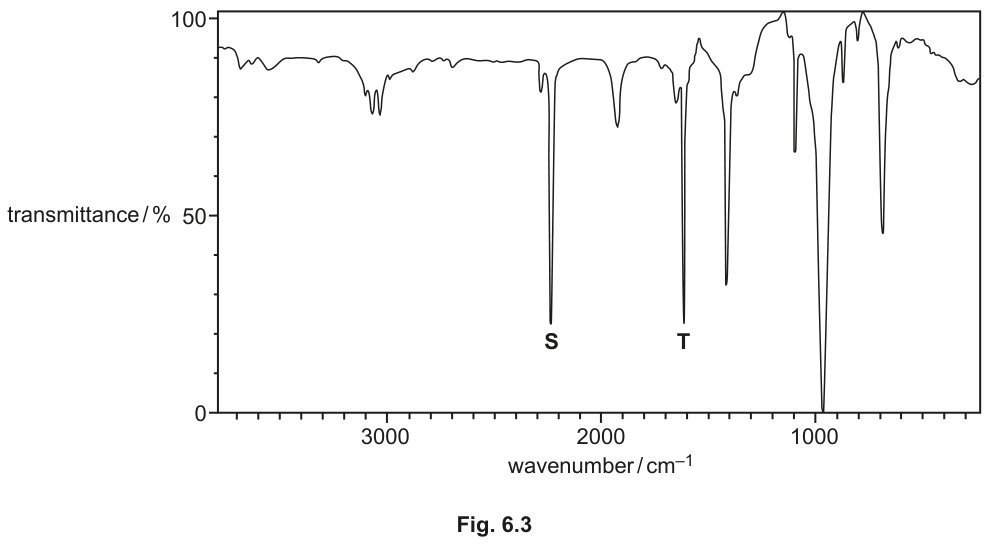
Fig. 6.3 as printed with the question.
Show full working
- 1
Absorption S. S is just above 2200 cm⁻¹, inside 2200–2250. Only one row has this range: C≡N (nitrile). The formula CH₂=CHCN does contain C≡N. ✓
Check against the structure: a molecule with a CN group must show the C≡N absorption.
- 2
Absorption T. T is inside 1500–1680, the C=C row (alkene or aromatic). W has no ring, but CH₂=CH– contains a C=C. ✓
The table row covers alkenes and aromatic rings; the formula tells you which.
- 3
Answer. S = C≡N; T = C=C.
The mark needs both bonds, each matched to the right letter; swapping them scores nothing.
S = C≡N (within 2200–2250 cm⁻¹); T = C=C (within 1500–1680 cm⁻¹)
Your turn
Use the method above: match each absorption to the table, then use the empty ranges.
- 13 marks
Compound V gives an infrared spectrum with a strong, broad absorption covering 3200–3650 cm⁻¹ and a strong absorption at 1080 cm⁻¹. There is no absorption anywhere between 1500 and 1800 cm⁻¹, and none between 2100 and 2300 cm⁻¹.
Name the functional group present in V, justifying your answer with the ranges you used and the absences you relied on.
Stuck? Show hint
Match each absorption to a table row first; then use the two empty ranges to rule out other groups.
Show solution
- 1
Broad 3200–3650 cm⁻¹ → hydroxy O–H. The other O–H range (carboxyl, 2500–3000) does not reach 3200. [1]
Give the range with the bond; "O–H" on its own is only half the answer.
- 2
1080 cm⁻¹ → C–O (1040–1300). With the O–H, this suggests a hydroxy compound such as an alcohol. [1]
C–O supports the answer but does not prove it: esters also have C–O. The next step deals with that.
- 3
Use the absences. Nothing in 1500–1800 → no C=O of any kind, so V is not an acid, ester, aldehyde, ketone or amide. Nothing at 2100–2300 → no C≡N. So V is an alcohol. [1]
The empty C=O range rules out every carbonyl-containing group at once.
Answeralcohol (hydroxy group) — O–H at 3200–3650 cm⁻¹ with C–O at 1080 cm⁻¹, and no C=O anywhere in 1500–1800 cm⁻¹ rules out acid, ester and carbonyl rivals
- 1
- 29701/11 O/N 2021 Q301 mark
The infra-red spectra of three organic compounds are shown.
What could the three compounds be?
spectrum 1 spectrum 2 spectrum 3 A propanoic acid propanone propan-2-ol B propanone propanoic acid propan-2-ol C propanone propan-2-ol propanoic acid D propan-2-ol propanoic acid propanone 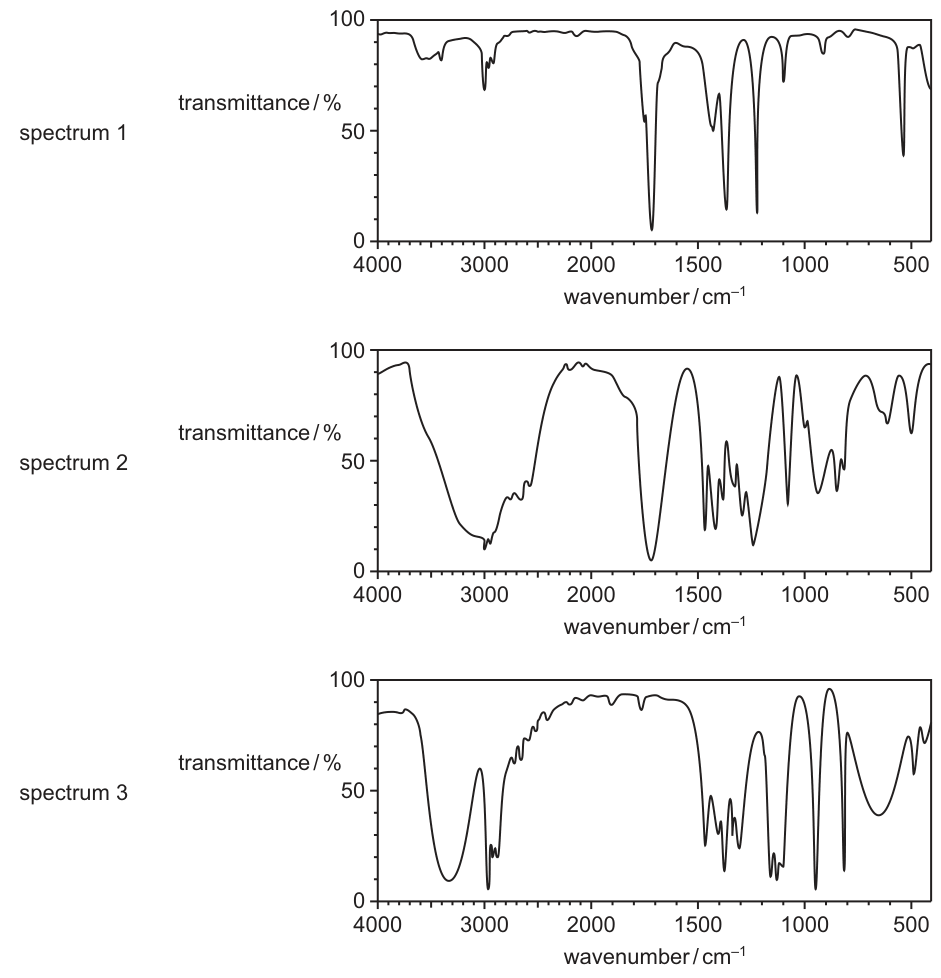
The three infra-red spectra as printed with the question.
Stuck? Show hint
Decide what type of compound each spectrum shows before looking at the options: is there a C=O dip near 1700 cm⁻¹, and which O–H range (if any) has a dip?
Show solution
- 1
Spectrum 1. A sharp, strong dip near 1715 cm⁻¹ and no O–H dip → C=O without O–H → a ketone.
Name the type of compound for each spectrum first; then the question is just matching names to rows.
- 2
Spectrum 2. A very broad dip across roughly 2500–3300 cm⁻¹ plus a strong dip near 1710 cm⁻¹ → carboxyl O–H with C=O → a carboxylic acid.
The broad dip reaching down to 2500 is the carboxyl O–H; an alcohol's O–H does not go below 3200.
- 3
Spectrum 3. A broad dip centred near 3350 cm⁻¹ (inside 3200–3650) and no strong dip at 1650–1750 cm⁻¹ → hydroxy O–H without C=O → an alcohol.
No C=O dip rules out the acid and the ketone.
- 4
Match to the names. Ketone = propanone, acid = propanoic acid, alcohol = propan-2-ol. So spectrum 1 → propanone, 2 → propanoic acid, 3 → propan-2-ol: row B.
Row A puts propanoic acid on spectrum 1, which has no O–H dip at all; the other rows swap the acid and alcohol O–H ranges.
AnswerB — propanone (C=O only), propanoic acid (broad 2500–3000 O–H + C=O), propan-2-ol (O–H at 3200–3650, no C=O)
- 1
The rest of this note
Can you do all of these?
Identify bonds from absorptions above 1500 cm⁻¹ (plus C–O at 1040–1300), giving each bond with its range.
Tell the two O–H ranges apart: broad 2500–3000 cm⁻¹ = carboxylic acid; 3200–3650 cm⁻¹ = alcohol.
Claim an ester only with C=O (1710–1750) and C–O (1040–1300) and no O–H.
Use empty ranges to rule groups out, and use bonds on only one side of an equation to follow a reaction.
Calculate Aᵣ from a spectrum, dividing by the total of the abundances; recognise 2+ ions at half mass.
Find Mᵣ from the molecular ion peak, and use it to turn an empirical formula into a molecular formula.
Write fragments with their + charge (C₂H₅⁺), and check that fragment + lost piece = Mᵣ.
Count carbons: [M+1]⁺ ÷ M⁺, × 100, ÷ 1.1, round to a whole number.
Name the halogen from the M+2 pattern: 3 : 1 chlorine, 1 : 1 bromine; 9 : 6 : 1 two Cl, 1 : 2 : 1 two Br; the lighter peak is M⁺.
To identify an unknown, check the final formula against every piece of evidence: infrared, M⁺, [M+1]⁺, [M+2]⁺ and fragments.