Mathematics 9709/51 — October/November 2025
Cambridge AS Level · Probability & Statistics 1 · worked solutions for every part, with the mark scheme
Topics Discrete Random Variables · Probability · The Normal Distribution · Representation of Data · Permutations and Combinations
The random variable takes the value with probability , where is a constant and takes the values only.
Draw up the probability distribution table for , giving the probabilities as numerical fractions.
Approach
Use the fact that the probabilities in any distribution must sum to 1 to find . Then substitute back into for each value of to complete the table.
Working
The probabilities for each value of are:
Because the probabilities must sum to 1:
Substituting into each probability gives the completed distribution table:
Answer
; the table is , , , .
k = 1/18; P(X=-2)=4/18, P(X=1)=1/18, P(X=2)=4/18, P(X=3)=9/18
Walkthrough
We are told that takes the value with probability , where is restricted to the set . The first step is to substitute each value of into the formula to write the four probabilities in terms of the unknown . Because is squared, and both give , the value gives , and gives .
A probability distribution must assign non-negative probabilities to every possible value, and the total of all these probabilities must equal 1. We therefore set up the equation . The left side simplifies to , which gives . This is the unique value of that makes the four probabilities both non-negative and summing to exactly 1.
Finally we substitute back into each of , , , and to obtain respectively. These are the entries of the probability distribution table.
Key Takeaways
- The sum of all probabilities in a probability distribution must equal 1; this is the basic consistency condition used to determine any unknown constant.
- The formula is applied to each value of in the support of to give the corresponding probability.
- The completed table is the source of all other calculations involving , including expectation, variance, and conditional probabilities.
Common Mistakes
- Forgetting to square the values when forming the probabilities; in particular, the value gives , not .
- Omitting one of the four values when summing the probabilities; the value is easy to miss because it has the smallest contribution.
- Setting the sum equal to 0 instead of 1.
Things to Be Careful About
- The distribution includes a negative value (); this is perfectly valid and causes no issues at this stage.
- The probabilities can be left as fractions with denominator 18, although the equivalents and are also acceptable.
Approach
Use the definition of expectation for a discrete random variable, , applied to the distribution from part (a) where takes values with probabilities respectively.
Working
Answer
.
E(X) = 14/9 ≈ 1.56
Walkthrough
The expectation of a discrete random variable is the probability-weighted average of its values. For each in the support, we multiply by its probability from the table and then add the four products together. For our distribution the four products are
Adding these gives . The two middle terms ( and ) cancel, leaving the simple sum .
Key Takeaways
- is computed by multiplying each -value by its probability and summing.
- A negative -value contributes a negative term to the sum; this is the only complication that arises when the support includes negative numbers.
Common Mistakes
- Using the wrong value of (for example, writing instead of ).
- Forgetting to include the term in the sum, which has a small contribution and is easy to miss.
- Arithmetic slips when combining the four products.
Things to Be Careful About
- The mark scheme allows both and the decimal (or ); either is acceptable, but the exact fraction is preferred.
- The mark scheme awards a follow-through (FT) mark here, so even an incorrect value of from part (a) will still allow the method mark to be earned provided the working is otherwise correct.
- The expectation does not have to lie between the smallest and largest in general, although for this distribution it does.
Approach
Using the distribution from part (a) (where takes values with probabilities ), restrict attention to the values that satisfy and then apply the conditional probability formula with and .
Working
The values of with are , so
Within this restricted set, the values that also satisfy are and , so
Applying the conditional probability formula:
Answer
.
P(X ≠ 2 | X > 0) = 5/7 ≈ 0.714
Walkthrough
The condition is a filter that restricts to the values , excluding the value . So the conditioning event has probability
The event by itself would also include , but we only want values of that lie in both and simultaneously. So corresponds to , with probability
The conditional probability formula then gives
Key Takeaways
- The conditional probability formula applies to any events, including those described in terms of a discrete random variable.
- For a discrete random variable, both and are obtained by adding up the relevant probabilities from the distribution table.
- The conditioning event acts as a filter: only values of satisfying the condition are allowed to contribute to either the numerator or the denominator.
Common Mistakes
- Computing on its own (which would be , also the wrong answer for the denominator) and using it as the numerator instead of restricting to values with .
- Swapping the numerator and denominator.
- Forgetting to include (the largest value) when computing .
Things to Be Careful About
- The 'and' in is essential; it requires both conditions to hold simultaneously, so the value is excluded from the numerator even though it satisfies .
- The mark scheme accepts either or for the method mark, but the final answer must be simplified to to earn the accuracy mark.
- The fraction must be simplified to to earn the final accuracy mark.
A fair six-sided dice with faces labelled 1, 2, 3, 4, 5, 6 is thrown repeatedly until a 6 is obtained.
Approach
This is a geometric distribution problem. For the first 6 to occur on the 8th throw, throws 1 to 7 must all be non-6, and throw 8 must be 6. Because the throws are independent, multiply the probabilities.
Working
Let be the probability of throwing a 6 and be the probability of not throwing a 6.
Answer
(3 s.f.) or
0.0465 (3 s.f.) or 78125/1679616
Walkthrough
We are looking for the first success (a 6) to happen on the 8th throw. That means throws 1 to 7 must all fail (not be 6), and throw 8 must succeed. Each throw is independent, so we multiply the probability of failure seven times and then the probability of success once. This is exactly the geometric distribution formula .
Key Takeaways
- Recognise "first success on the nth trial" as a geometric distribution problem.
- The probability of failure is .
- Use for the first success on the nth trial.
Common Mistakes
- Using instead of .
- Forgetting that the first 7 throws must all be failures.
- Rounding to fewer than 3 significant figures.
Things to Be Careful About
- The exponent on is 7, not 8, because the 8th throw is the success.
- The exact fraction is acceptable, and the decimal should be given to at least 3 significant figures.
Approach
For the third 6 to occur on the 7th throw, there must be exactly two 6s in the first six throws, and the 7th throw must be a 6. Choose which two of the first six throws are 6s: ways. Then multiply the probability of that arrangement by the probability that the 7th throw is 6.
Working
The probability of exactly two 6s and four non-6s in the first six throws is
The 7th throw must then be 6, with probability , so
Answer
(3 s.f.) or
0.0335 (3 s.f.) or 3125/93312
Walkthrough
We want the third 6 to occur on the 7th throw. This means that in the first 6 throws there must be exactly two 6s, and then the 7th throw must be a 6. First count the number of ways to choose which two of the first six throws are 6s: . For any one of these arrangements, the probability is for the first six throws, and then for the 7th throw. Multiply by 15 to account for all arrangements. This gives the required probability.
Key Takeaways
- A "kth success on the nth trial" problem requires exactly successes in the first trials and a success on the nth trial.
- Use combinations to count the positions of the successes.
- Multiply the probabilities of the independent events.
Common Mistakes
- Choosing positions among all 7 throws instead of only the first 6.
- Using or .
- Forgetting the factor .
- Treating the 7th throw as one of the variable positions.
Things to Be Careful About
- The 7th throw is fixed as a 6, so only the first 6 throws can vary.
- The exponent of is 3: two 6s in the first six throws plus the 7th throw.
- The exponent of is 4: four non-6s in the first six throws.
- The exact answer is or , and the decimal is to 3 significant figures.
The back-to-back stem-and-leaf diagram shows the annual salaries, in dollars, of 27 employees at each of two companies, Browns and Greens.
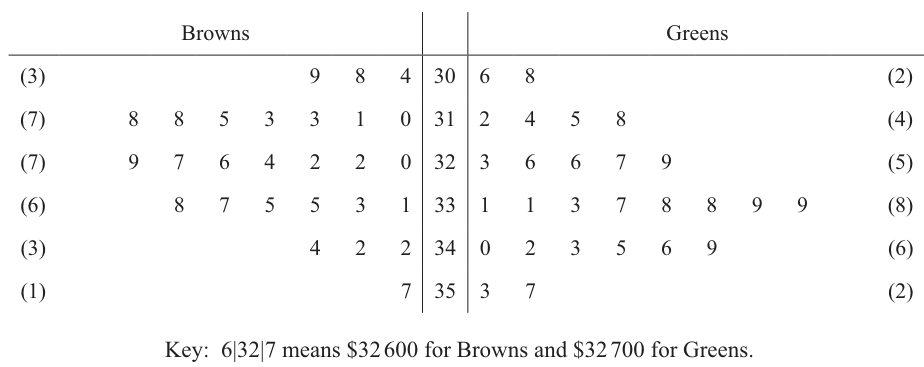
Find the median and interquartile range for the annual salaries of employees at Browns.
Approach
Read the Browns leaves from the stem-and-leaf diagram. Each row's stem gives the thousands digit, and each leaf gives the hundreds digit (in dollars), so the 27 Browns salaries in dollars are the values listed below. Order them, then locate the median and the two quartiles to find the IQR.
Working
Listing Browns salaries in order (in dollars):
- Stem 30, leaves 4, 8, 9: $30,400, $30,800, $30,900 (3 values)
- Stem 31, leaves 0, 1, 3, 3, 5, 8, 8: $31,000, $31,100, $31,300, $31,300, $31,500, $31,800, $31,800 (7 values)
- Stem 32, leaves 0, 2, 2, 4, 6, 7, 9: $32,000, $32,200, $32,200, $32,400, $32,600, $32,700, $32,900 (7 values)
- Stem 33, leaves 1, 3, 5, 5, 7, 8: $33,100, $33,300, $33,500, $33,500, $33,700, $33,800 (6 values)
- Stem 34, leaves 2, 2, 4: $34,200, $34,200, $34,400 (3 values)
- Stem 35, leaf 7: $35,700 (1 value)
Total = values. ✓
There are values, so the median is the th value in the ordered list.
Counting through:
So the median (14th value) is
For the IQR, use the lower and upper halves of the data (13 values each, with the median removed):
- Lower quartile is the median of the bottom 13 values, i.e. the 7th value: $31,300.
- Upper quartile is the median of the top 13 values, i.e. the 21st value: $33,500.
Hence
Answer
Median = $32 400, IQR = $2 200
Walkthrough
The stem-and-leaf diagram is read row by row. For Browns, the leaves are read from right to left (the leaf closest to the stem is the smallest, so reading right to left already gives ascending order within each row). The key tells us the leaves represent the hundreds digit in dollars, so a stem of 32 and a leaf of 4 means $32,400.
We collect all 27 Browns values and order them. With an odd number of observations (), the median sits exactly at the middle position, which is the th value. Counting through the ordered list, the 14th entry is $32,400.
For the quartiles, the standard convention with an odd is to remove the median and split the remaining 26 values into two halves of 13 each. The lower quartile is the median of the lower half (the 7th value overall) and the upper quartile is the median of the upper half (the 21st value overall). Reading from the ordered list, these are $31,300 and $33,500. The IQR is the difference.
Key Takeaways
- Back-to-back stem-and-leaf diagrams display each company's distribution on opposite sides of a common stem; leaves on the left (Browns here) are conventionally read right-to-left for ascending order.
- For a data set of size :
- Median position = (if odd) or mean of the and values (if even).
- and are the medians of the lower and upper halves (with the median removed when is odd).
- IQR = ; it is a measure of spread that ignores the extreme 25% on each end.
Common Mistakes
- Reading the Browns leaves in the wrong order (left-to-right instead of right-to-left), which would scramble the sorted list and give the wrong median.
- Using instead of for the median position with odd , leading to the 13th or 15th value.
- Computing and from the whole data set (positions 7 and 21 here are correct; some textbooks use different conventions, so always state the method).
- Forgetting the leaf multiplier — the key tells us leaves are in hundreds, so a leaf of 4 with stem 32 is $32,400, not $324.
Things to Be Careful About
- The mark scheme allows in the range $31,300–$31,500 and in the range $33,500–$33,700, so the IQR $2,200 (from $33,500 − $31,300) is the CAO answer.
- If you compute using thousands of dollars throughout, convert back to dollars for the final answer (or state the units clearly).
The annual salary of an employee at Browns is denoted by thousand dollars and the annual salary of an employee at Greens is denoted by thousand dollars. It is given that, for the 27 employees at each of the companies,
Find the mean and standard deviation of the annual salaries of these 54 employees.
Approach
Treat the 54 employees as a single combined sample. The combined mean is the total of all salaries divided by 54, and the combined variance uses
applied to the pooled sums. Convert between thousands and dollars only at the end.
Working
Mean.
Add the two totals and divide by 54:
So the mean salary is
(equivalently $32,866.67 to the nearest cent).
Variance.
Apply the formula with the pooled sums:
Standard deviation.
So
Answer
Mean = $32 900, standard deviation = $1 360
Walkthrough
The 54 employees are pooled into one combined sample. The combined mean is the total of all salaries divided by the total number of employees, . The data are given in thousand dollars, so adding the two sums and dividing by 54 gives the mean in thousand dollars, which we then convert to dollars.
For the standard deviation we use the algebraic identity
This identity avoids recomputing the mean of the squares by hand. Because the data are pooled, the total of squares is just , and the mean is the combined mean we already found. Substituting gives a variance of about in (thousand dollars), and taking the square root gives the standard deviation in thousand dollars, which we then convert to dollars.
Key Takeaways
- For two combined data sets of sizes with sums and sums of squares :
- Keep the data in their given units (here, thousands of dollars) until the very end, then convert.
- Standard deviation is the square root of the variance; do not report as the final answer.
Common Mistakes
- Dividing each company's mean by 27 and then averaging them; the correct combined mean is the overall total divided by 54 (here the two methods happen to give the same value, but they are not equivalent in general).
- Forgetting to square the mean when computing the variance, or subtracting the mean from instead of subtracting its square.
- Reporting the variance as the standard deviation.
- Leaving the answer in thousands without stating it (the mark scheme accepts and in thousands but requires the conversion to dollars for the CAO answers).
Things to Be Careful About
- The mark scheme allows $32,866.67 to 3 or more significant figures for the mean, but the B-mark answer is $32,900 to the nearest $100.
- The mark scheme accepts the variance as or as an un-simplified value, but the standard deviation must be explicitly labelled (sd, , etc.) and not just the variance's square root left unattributed.
- The standard deviation is $1,360, not $1,360^2 — units are dollars, not dollars squared.
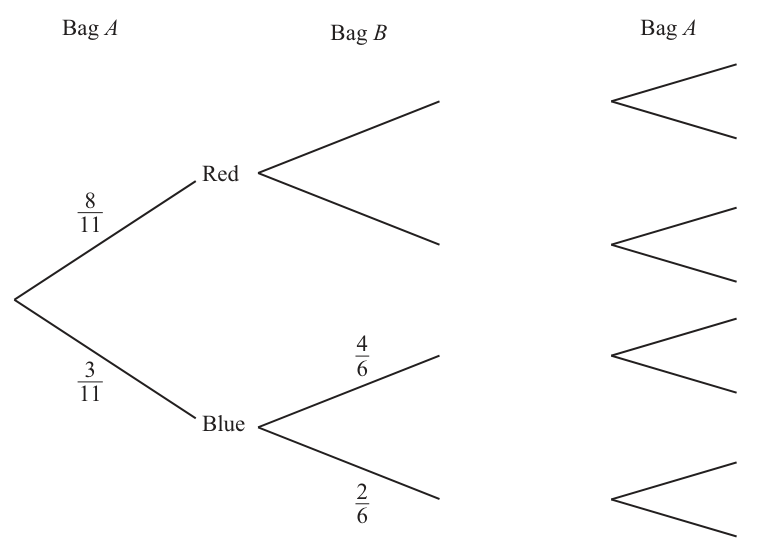
Bag contains 8 red marbles and 3 blue marbles. Bag contains 4 red marbles and 1 blue marble.
A marble is chosen at random from bag . If the marble chosen is red, it is discarded. If the marble chosen is blue, it is placed in bag .
A marble is then chosen at random from bag . If the marble chosen is red, it is discarded. If the marble chosen is blue, it is placed in bag .
A marble is now chosen at random from bag .
Complete the tree diagram below by entering all the remaining outcomes and probabilities.
Approach
Track the contents of Bag A and Bag B after each marble is drawn and either discarded or transferred. At each stage, the probability of drawing Red or Blue depends on the current composition of the relevant bag.
Working
Stage 1 — Draw from Bag A (8 Red, 3 Blue, total 11):
-
If Red is drawn (prob ): it is discarded.
- Bag A now has 7 Red, 3 Blue (10 total).
- Bag B is unchanged: 4 Red, 1 Blue (5 total).
-
If Blue is drawn (prob ): it is placed in Bag B.
- Bag A now has 8 Red, 2 Blue (10 total).
- Bag B now has 4 Red, 2 Blue (6 total).
Stage 2 — Draw from Bag B:
From the Red branch (Bag B has 4R, 1B = 5):
-
If Red is drawn (prob ): it is discarded.
- Bag A remains: 7 Red, 3 Blue (10 total).
- Bag B now has 3 Red, 1 Blue (4 total).
-
If Blue is drawn (prob ): it is placed in Bag A.
- Bag A now has 7 Red, 4 Blue (11 total).
- Bag B now has 4 Red, 0 Blue (4 total).
From the Blue branch (Bag B has 4R, 2B = 6):
-
If Red is drawn (prob ): it is discarded.
- Bag A remains: 8 Red, 2 Blue (10 total).
- Bag B now has 3 Red, 2 Blue (5 total).
-
If Blue is drawn (prob ): it is placed in Bag A.
- Bag A now has 8 Red, 3 Blue (11 total).
- Bag B now has 4 Red, 1 Blue (5 total).
Stage 3 — Draw from Bag A:
From path (Red, Red): Bag A has 7R, 3B (10 total):
From path (Red, Blue): Bag A has 7R, 4B (11 total):
From path (Blue, Red): Bag A has 8R, 2B (10 total):
From path (Blue, Blue): Bag A has 8R, 3B (11 total):
Answer
The completed tree diagram has the following branch probabilities:
- Stage 1: Red , Blue
- Stage 2 from Red: Red , Blue
- Stage 2 from Blue: Red , Blue
- Stage 3 from (R,R): Red , Blue
- Stage 3 from (R,B): Red , Blue
- Stage 3 from (B,R): Red , Blue
- Stage 3 from (B,B): Red , Blue
Stage 2 from Red: R=4/5, B=1/5; Stage 2 from Blue: R=4/6, B=2/6. Stage 3 from (R,R): R=7/10, B=3/10; from (R,B): R=7/11, B=4/11; from (B,R): R=8/10, B=2/10; from (B,B): R=8/11, B=3/11.
Walkthrough
The key to this problem is tracking how the contents of each bag change after every draw. We proceed stage by stage.
Stage 1: Bag A starts with 8 Red and 3 Blue (11 total). Drawing Red (probability ) means it is discarded, leaving Bag A with 7R, 3B. Drawing Blue (probability ) means it goes into Bag B, so Bag A becomes 8R, 2B and Bag B becomes 4R, 2B.
Stage 2: We now draw from Bag B. If we came from the Red branch, Bag B still has 4R, 1B (5 total), giving probabilities and . If we came from the Blue branch, Bag B has 4R, 2B (6 total), giving and . Again, Red is discarded and Blue is transferred to Bag A, which changes Bag A's composition for the next stage.
Stage 3: We draw from Bag A again. The composition depends on the path taken:
- Path (R,R): Bag A has 7R, 3B → probabilities ,
- Path (R,B): Bag A has 7R, 4B → probabilities ,
- Path (B,R): Bag A has 8R, 2B → probabilities ,
- Path (B,B): Bag A has 8R, 3B → probabilities ,
Each branch probability is simply the number of marbles of the desired colour divided by the total number of marbles in the relevant bag at that stage.
Key Takeaways
- When objects are transferred between containers, the probabilities at subsequent stages depend on the entire history of previous draws.
- Always update the contents of each container after every action (discard or transfer) before computing the next probability.
- A tree diagram is an effective tool for visualising sequential conditional probabilities.
Common Mistakes
- Forgetting to update the bag contents after a marble is transferred or discarded, leading to incorrect denominators in later stages.
- Assuming the bag contents remain constant throughout the problem.
- Omitting the Red/Blue labels on branches, which costs a mark even if the probabilities are correct.
Things to Be Careful About
- The problem states "If the marble chosen is red, it is discarded. If the marble chosen is blue, it is placed in bag B" (and vice versa for the second draw). This directional transfer matters — do not confuse which bag gains or loses a marble.
- When a marble is placed into a bag, the total count in that bag increases by 1, and the count of the other bag decreases by 1.
- Always verify that branch probabilities from a single node sum to 1 (e.g., and ).
Approach
All three marbles being the same colour means either all three are Red (path R→R→R) or all three are Blue (path B→B→B). These two outcomes are mutually exclusive, so we add their probabilities.
Working
Path RRR:
Path BBB:
Total probability (all same colour):
Simplify each fraction:
Find a common denominator. Since and , the LCM is :
As a decimal:
Answer
1307/3025 (or 0.432)
Walkthrough
The question asks for the probability that all three marbles chosen are the same colour. There are exactly two ways this can happen:
- All three are Red: this follows the path Red (from Bag A) → Red (from Bag B) → Red (from Bag A again).
- All three are Blue: this follows the path Blue (from Bag A) → Blue (from Bag B) → Blue (from Bag A again).
These two events are mutually exclusive — they cannot both happen — so we use the addition law: .
For each path, we use the multiplication law, multiplying the branch probabilities along the path using the values computed in part (a):
Adding these with a common denominator of 3025 gives .
Key Takeaways
- When asked for 'all the same' or 'all different' outcomes in sequential draws, identify the specific paths on the tree that satisfy the condition.
- Mutually exclusive outcomes are combined using the addition law; sequential events along a path are combined using the multiplication law.
- Simplifying fractions before adding can make the arithmetic easier, but finding a common denominator is essential.
Common Mistakes
- Including paths like RRB or BBR — the question asks for ALL THREE to be the same colour, not just two.
- Forgetting that RRR and BBB are mutually exclusive and trying to multiply them together instead of adding.
- Arithmetic errors when adding fractions with different denominators.
Things to Be Careful About
- The decimal answer is given to 3 significant figures in the mark scheme; the exact answer is preferred.
- Do not confuse this with 'at least two the same colour' — the question is strict about all three being identical.
On any given day, Cooper either wears a blue jumper or he wears a green jumper or he does not wear a jumper. The probability that he wears a blue jumper is 0.6 and the probability that he wears a green jumper is 0.3. Whether Cooper wears a jumper of either colour, or does not wear a jumper, on any day is independent of his choice on any other day.
Find the probability, that in a week (7 days), Cooper wears a blue jumper on at least 5 days.
Approach
Let be the number of days in a week on which Cooper wears a blue jumper. Each day is independent and the probability of a blue jumper is constant at , so
We need .
Working
For ,
With , and :
Answer
0.420
Walkthrough
First identify the random variable. Since each day is independent and the probability of wearing a blue jumper is always , the number of blue-jumper days in a 7-day week follows a binomial distribution, . The phrase “at least 5 days” means exactly 5, 6 or 7 days. Use the binomial formula for each of these values and add the three probabilities. The total is approximately .
Key Takeaways
- A binomial model applies when there are a fixed number of independent trials, two outcomes per trial, and a constant probability of success.
- “At least 5” includes 5, 6 and 7, not just values greater than 5.
- The binomial coefficient counts the number of ways to choose which days are blue-jumper days.
Common Mistakes
- Forgetting to include the term.
- Using instead of .
- Using as the success probability instead of .
- Writing only the final decimal without showing the unsimplified binomial sum, which is required for the method and accuracy marks.
Things to Be Careful About
- Keep enough decimal places in intermediate terms; the final answer should round to .
- The mark scheme allows a final probability in the range to .
- Make sure the binomial coefficient and powers are written correctly for each term.
Use a suitable approximation to find the probability that, in any 150-day period, Cooper does not wear a jumper on fewer than 22 days.
Approach
Let be the number of days in the 150-day period on which Cooper does not wear a jumper. Since the three daily choices are mutually exclusive and exhaustive,
Thus . Because and are both greater than 5, use the normal approximation.
Working
For a binomial distribution,
So . The event “fewer than 22 days” is , i.e. . Applying the continuity correction,
From the normal distribution table,
Answer
0.962
Walkthrough
First find the probability that Cooper does not wear a jumper on a given day. The three outcomes are mutually exclusive and cover all possibilities, so . Let be the number of no-jumper days in 150 days. Then . Since and are both comfortably greater than 5, the normal approximation is suitable. Compute the mean and variance using and . The event “fewer than 22 days” means . Because the normal distribution is continuous, apply a continuity correction and use as the upper boundary. Standardise using , then read the cumulative probability from the normal table to obtain .
Key Takeaways
- The normal approximation to the binomial is appropriate when and are both greater than 5.
- The mean and variance of are and .
- A continuity correction is needed when approximating a discrete distribution by a continuous one.
- For , the continuity-corrected boundary is .
Common Mistakes
- Using 22 instead of 21.5 in the standardisation formula.
- Using no continuity correction at all.
- Confusing the variance with the standard deviation; the denominator must be .
- Forgetting to check that the normal approximation is valid before using it.
- Reading the wrong tail of the normal distribution; here we need , not .
Things to Be Careful About
- “Fewer than 22” means 21 or fewer, so the continuity-corrected boundary is .
- The final answer should be AWRT .
- Keep the standard deviation as , not .
- The normal approximation is suitable here because is large and is not too close to 0 or 1.
A factory produces chocolate bars. The weights of the bars are normally distributed with mean and standard deviation . A random sample of 350 of these bars is chosen.
How many of these 350 bars would you expect to weigh between and ?
Approach
Standardise the two weight bounds to -scores, find the probability that lies between them using the standard normal table, then multiply by the sample size 350.
Working
Let be the weight of a bar. Then .
Standardise:
For :
For :
So:
From the standard normal table:
Expected number in sample:
Answer
236 or 237 bars
Walkthrough
We are told the weights are normally distributed with mean 155 g and standard deviation 6 g, and we want the proportion of bars between 148 g and 160 g. Since we cannot look up probabilities for a normal distribution with mean 155 and sd 6 directly, we standardise: convert each boundary into a Z-score using . For 148 g we get , and for 160 g we get . Then .
To find this probability, we use the symmetry of the normal curve: the area between and equals . Why? Because gives the area to the left of . The area to the left of is , and the area to the left of is . So the area between them is .
From the standard normal table, and . So the probability is .
Finally, since we have 350 bars, the expected number weighing between 148 g and 160 g is , which is approximately 236 or 237 bars.
Key Takeaways
- Standardising a normal variable with lets us use the standard normal table.
- The probability between two values is found by combining cumulative probabilities, using symmetry where needed.
- The expected count in a sample is the probability multiplied by the sample size.
Common Mistakes
- Using instead of in the standardisation formula.
- Forgetting to handle the negative Z-score correctly (e.g. using directly instead of ).
- Not multiplying the probability by 350.
- Rounding the probability too early, leading to a wrong expected count.
Things to Be Careful About
- The marking scheme requires the standardisation formula to be shown, with not or .
- No continuity correction is used here because we are dealing with a continuous normal distribution directly.
- The final answer must be a single integer; both 236 and 237 are accepted.
A second factory also produces chocolate bars. The weights of these bars are normally distributed with mean and standard deviation . Tests show that of the bars weigh more than and weigh less than .
Find the value of and the value of .
Approach
Convert each percentage to the corresponding -value, write two standardisation equations in and , then solve them simultaneously.
Working
Let be the weight of a bar from the second factory, .
Given , so:
The -value with 0.08 in the upper tail is (since ).
So:
Given , so:
The -value with 0.20 in the lower tail is (since ).
So:
Subtract the second equation from the first:
Substitute back:
Check with the other equation:
Answer
μ = 105 g, σ = 6.45 g
Walkthrough
We are given two facts about the second factory: 8% of bars weigh more than 114.0 g, and 20% weigh less than 99.5 g. We need to find and .
First, convert each percentage to a Z-score. For , we need the Z-value such that the area to its right is 0.08, i.e. the area to its left is 0.92. From the standard normal table, , so . For , we need the Z-value such that the area to its left is 0.20, which is (since ).
Now write the standardisation equations:
These give two linear equations in and :
Subtract the second from the first to eliminate :
so .
Then substitute back to find (approximately). We can check with the other equation: .
Key Takeaways
- Percentages can be converted to Z-scores using the inverse of the standard normal cumulative function.
- Each condition gives one equation in and ; two conditions give two equations to solve simultaneously.
- The elimination method is a clean way to remove and solve for first.
Common Mistakes
- Using the percentage directly (e.g. 0.08) instead of the corresponding Z-score.
- Mixing up which tail the percentage belongs to (e.g. using a positive Z for a lower-tail probability).
- Using or in the standardisation formula.
- Arithmetic errors when subtracting the two equations.
Things to Be Careful About
- The Z-values must be read accurately from the table: (not or rounded too coarsely) and .
- The mark scheme accepts between 104.5 and 105.5, and between 6.44 and 6.475.
- A continuity correction of is condoned, but not required here.
Approach
Use the formula for arrangements of a word with repeated letters: divide the total factorial by the factorials of the repeated letter counts.
Working
The word SEYCHELLES has 10 letters:
- S appears 2 times
- E appears 3 times
- L appears 2 times
- Y, C and H appear once each
So the number of distinct arrangements is:
Compute:
Answer
151200
Walkthrough
The word SEYCHELLES contains 10 letters, but some letters are repeated: S twice, E three times and L twice. If all 10 letters were different, there would be arrangements. However, swapping two identical Ss does not create a new arrangement, so we must divide by for the Ss. Similarly, divide by for the Es and by for the Ls. This gives the number of distinct arrangements.
Key Takeaways
- When arranging items with repetitions, divide by the factorial of each repeated count.
- The formula is .
Common Mistakes
- Forgetting to divide by all repeated letters, for example only dividing by for the Ss.
- Treating identical letters as distinct.
Things to Be Careful About
- Count every repeated letter exactly once. Here S, E and L all repeat.
- The denominator is the product of factorials, not the sum.
How many different arrangements are there of the 10 letters in the word SEYCHELLES in which there are exactly two letters between the Ss and one of these two letters is C?
Approach
Fix the two Ss with exactly two letters between them. One of the two middle letters must be C. Arrange the remaining seven non-C, non-S letters in the seven remaining slots, then choose which middle slot holds C and which gap the Ss occupy.
Working
There are 7 possible pairs of positions for the two Ss with exactly two letters between them:
positions .
After placing the Ss, one of the two middle positions is C. The other middle position and the six outside positions are filled by the 7 letters other than S and C:
E, E, E, Y, H, L, L
Arrange these 7 letters in the 7 available slots:
Choose which of the two middle positions contains C: ways.
Choose which of the 7 gaps the Ss occupy: ways.
Total:
Answer
5880
Walkthrough
We need exactly two letters between the two Ss, and one of those two letters must be C. First choose the positions of the Ss. With 10 positions, the first S can be in positions 1 through 7, so there are 7 possible gaps. Once the Ss are placed, there are two slots between them. One is C; the other, together with the six remaining outside slots, must be filled by the seven letters that are neither S nor C: E, E, E, Y, H, L, L. Arranging these seven letters in those seven slots gives . Then choose which of the two middle slots contains C, giving 2 choices. Multiplying by 7 for the possible positions of the Ss gives the total.
Key Takeaways
- Positional restrictions can be handled by fixing positions first.
- Repeated letters still require division by factorials.
- Independent choices multiply.
Common Mistakes
- Forgetting to multiply by 7 for the possible positions of the Ss.
- Forgetting to multiply by 2 for which middle slot contains C.
- Treating the repeated Es or Ls as distinct when arranging.
Things to Be Careful About
- The seven letters used for the middle-and-outside slots are the letters other than S and C; they include repeats.
- The 7 positions for the Ss are , not 8, because .
How many different arrangements are there of the 10 letters in the word SEYCHELLES in which there is an S at the beginning, an S at the end and the three Es are not all next to each other?
Approach
Fix S at both ends. Count all arrangements of the middle 8 letters, then subtract those where the three Es are together as a block.
Working
With S at the beginning and S at the end, the middle 8 letters are:
E, E, E, Y, C, H, L, L
Total arrangements of these middle letters:
Now count the arrangements where the three Es are all next to each other. Treat the block EEE as one unit. The units are:
EEE, Y, C, H, L, L
so there are 6 units, with L repeated twice:
Therefore the number with the three Es not all together is:
Answer
3000
Walkthrough
Fix S at both ends. The middle 8 positions contain E, E, E, Y, C, H, L, L. Count all arrangements of these middle letters: . This includes cases where the three Es are together. To exclude those, treat the block of three Es as a single unit, leaving 6 units: EEE, Y, C, H, L, L. Arrange these 6 units with L repeated twice: . Subtract this from the total.
Key Takeaways
- "Not all together" is often easiest by total minus the complementary case.
- Treating a block as one unit handles consecutive arrangements.
Common Mistakes
- Forgetting to subtract the Es-together cases.
- Counting the Es-together block as arrangements inside the block; since Es are identical, there is no extra factor.
- Forgetting L is repeated when arranging the 6 units.
Things to Be Careful About
- The Ss at the ends are fixed, so only the middle 8 letters are arranged.
- The block EEE is one unit, not three.
5 letters are selected at random from the 10 letters in the word SEYCHELLES.
Find the probability that these 5 letters include the three Es.
Approach
Count the favourable selections, which must contain all three Es plus any two of the remaining seven letters, and the total selections of 5 letters from 10, then form the probability.
Working
The three Es must all be chosen. The remaining two letters are chosen from the 7 letters that are not E:
S, S, Y, C, H, L, L
Favourable selections:
Total selections of 5 letters from 10:
Probability:
Answer
1/12
Walkthrough
We select 5 letters at random. Favourable selections must contain all three Es. Once those are chosen, we need 2 more letters from the remaining 7 letters: S, S, Y, C, H, L, L. This gives favourable selections. The total number of selections of 5 letters from 10 is . The probability is the ratio of favourable to total selections.
Key Takeaways
- Probability with selections is favourable combinations divided by total combinations.
- If certain items must be included, choose them first, then choose the rest.
Common Mistakes
- Using permutations instead of combinations; order of selection does not matter.
- Forgetting that after choosing the three Es, only 2 more letters are needed.
- Not reducing the fraction.
Things to Be Careful About
- The 10 letters are treated as distinct positions when using combinations; this is the standard model for random selection from a word with repeated letters.
- The remaining 7 letters after the Es include the two Ss and two Ls.