Mathematics 9709/42 — October/November 2025
Cambridge AS Level · Mechanics · worked solutions for every part, with the mark scheme
Topics Kinematics of Motion in a Straight Line · Forces and Equilibrium · Newton's Laws of Motion · Energy, Work and Power · Momentum
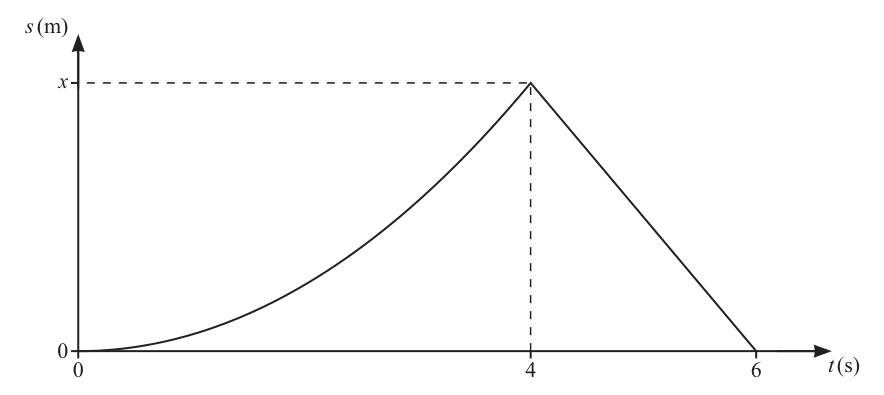
The diagram shows the displacement-time graph for the motion of a particle. The particle starts from rest at a point and travels with constant acceleration , taking to move a distance of . The particle then returns to with constant speed of , over a period of .
Find the value of and the value of .
Approach
Use the second phase of motion (constant speed return) to find the displacement at s. Then use the first phase of motion (constant acceleration from rest) with the found value of to determine the acceleration .
Working
During the return phase, the particle travels from displacement back to at a constant speed of m s over s. The distance covered is:
Since the particle returns to the origin , the displacement at the end of the first phase must be m.
For the first phase, the particle starts from rest (), travels with constant acceleration , and takes s to cover a displacement m. Using the constant acceleration formula:
Substitute the known values:
Answer
x = 80, a = 10
Walkthrough
First, analyze the second part of the journey where the particle returns to the origin. It moves at a constant speed of 40 m/s for 2 seconds. Multiplying speed by time gives the total distance covered, which is 80 m. Because it ends up back at the starting point , the maximum displacement reached at s must be exactly 80 m. Thus, .
Next, analyze the first part of the journey. The particle starts from rest, meaning initial velocity . It accelerates uniformly at for 4 seconds to reach a displacement of 80 m. Substituting , , and into the kinematic equation allows us to solve directly for , yielding .
Key Takeaways
- Distance equals speed multiplied by time when speed is constant.
- The displacement-time graph's peak value corresponds to the total distance covered during the accelerating phase if the particle returns to the start.
- The suvat equation is useful when time, displacement, and initial velocity are known.
Common Mistakes
- Assuming the speed at the end of the first phase is needed before finding . The mark scheme allows condoning this assumption, but it is simpler to find directly from the return phase.
- Forgetting that the particle returns to , meaning the displacement at is equal to the distance covered in the return phase.
- Using without first finding , leading to two unknowns ( and ) and an unsolvable system without additional steps.
Things to Be Careful About
- Ensure units are consistent (meters and seconds are already used).
- The mark scheme notes that getting an equation relating and earns a method mark, but the final answers must be explicitly stated as and .
- When using the return phase, remember it is constant speed, not constant acceleration, so simple applies.
A railway locomotive of mass is towing a coach of mass down a hill inclined at an angle of to the horizontal. The driving force produced by the locomotive is and there are resistances to motion of on the locomotive and on the coach. The coupling between the locomotive and the coach is light, rigid and parallel to the hill.
Find the acceleration of the locomotive and the tension in the coupling.
Approach
Take the positive direction down the hill. Resolve the weight of each vehicle along the hill using , so the downhill component of each weight is . Apply Newton's second law separately to the locomotive and the coach, with the tension opposing the locomotive's motion and pulling the coach downhill. Eliminate by adding the equations to find , then substitute back to find .
Working
Let be the acceleration down the hill and be the tension in the coupling. Use .
For the locomotive:
For the coach:
Add the two equations:
So
Substitute into the coach equation:
So
Answer
Acceleration down the hill; tension in the coupling .
a = 1.54 m s^-2, T = 56100 N
Walkthrough
The locomotive and coach move together down the hill, so they have the same acceleration. Choose downhill as positive. Since the angle is given by , the component of each weight along the hill is . The driving force acts downhill on the locomotive; the resistances oppose motion and act uphill. The tension in the coupling is an internal force: it pulls the coach downhill and pulls the locomotive uphill.
For the locomotive, the downhill forces are the driving force and the component of its weight; the uphill forces are its resistance and the tension. Newton's second law gives:
which simplifies to .
For the coach, the downhill forces are the tension and the component of its weight; the uphill force is its resistance:
which simplifies to .
Adding the two equations eliminates , because it appears with opposite signs. This gives , so . Substituting this value into the coach equation gives , so to 3 significant figures .
Key Takeaways
- On an inclined plane, the component of weight along the plane is .
- Apply Newton's second law separately to each connected body; the internal tension cancels when the whole system is considered.
- Use a consistent positive direction and treat forces opposing motion as negative.
- When a quantity such as tension appears with opposite signs in two equations, adding the equations eliminates it.
Common Mistakes
- Using instead of the component , or mixing up and .
- Forgetting one of the resistances, especially the resistance on the coach.
- Giving the tension the same sign in both equations, so it does not cancel when the equations are added.
- Using only the total-mass equation and then failing to consider one body separately to find the tension.
- Omitting the Newton's second law equation and jumping straight to an answer; the mark scheme requires a correct number of terms in the equation before solving.
- Using a rounded value of when calculating can give slightly different but accepted values: using gives from the coach equation or from the locomotive equation; using gives or . Using the exact fraction avoids this ambiguity.
Things to Be Careful About
- The mark scheme uses ; state this assumption if it is not given.
- The angle is , so exactly; there is no need to find the angle itself.
- The coupling is light and rigid, so the tension is the same throughout and both vehicles have the same acceleration.
- Check the direction of each force: driving force and motion are downhill, resistances are uphill, and tension pulls the coach downhill while pulling the locomotive uphill.
- The final answers are and , to 3 significant figures.
A car of mass travelling on a straight horizontal road accelerates uniformly from a speed of to over a distance of .
Approach
Since the car accelerates uniformly, its average speed over the is the mean of the initial and final speeds. Use
with , and , then solve for .
Working
Answer
10 s
Walkthrough
The car is accelerating uniformly, so the speed changes linearly from to . The average speed during this time is therefore
The car travels at this average speed, so . Solving gives . This uses the formula , which avoids needing to find the acceleration separately.
Key Takeaways
- For uniform acceleration, average speed equals the average of the initial and final speeds.
- If displacement and initial/final speeds are known, time can be found directly from .
Common Mistakes
- Dividing incorrectly: , not .
- Using before finding ; this adds unnecessary work and can introduce errors.
- Forgetting that the formula uses the average, so forgetting to divide by 2.
Things to Be Careful About
- The formula is only valid when acceleration is constant; the question states this.
- Ensure all speeds are in and distances in metres before substituting.
- The final answer must have units: , not just 10.
There is a constant resistance force of to the motion of the car.
Use an energy method throughout to find the average power of the car’s engine as the speed increases from to .
Approach
Use the work-energy principle. The work done by the engine is used to increase the kinetic energy of the car and to overcome the constant resistance. Average power is the total work done divided by the time taken from part (a).
Working
Change in kinetic energy:
Work done against resistance:
Work done by the engine:
Average power:
Answer
26250 W
Walkthrough
Because the question requires an energy method, do not use Newton's second law. The engine does work to increase the car's kinetic energy and to overcome the constant resistance.
Change in kinetic energy:
Work done against resistance:
So the total work done by the engine is
The average power is total work divided by the time taken from part (a), :
This can also be written as .
Key Takeaways
- The work-energy principle for a car on level ground: work done by engine = increase in kinetic energy + work done against resistance.
- Change in kinetic energy is the difference of two kinetic-energy terms, not the kinetic energy of the change in speed.
- Average power over a time interval = total work done divided by total time.
Common Mistakes
- Using for the kinetic energy change. This is wrong; change in KE is .
- Omitting the work done against resistance, or adding it with the wrong sign.
- Dividing by the distance instead of the time; average power is work per unit time.
- Starting with Newton's second law; since the instruction is "use an energy method throughout", the N2L approach scores at most 2 marks.
Things to Be Careful About
- Use the value of from part (a), , when converting work to average power. If was recalculated correctly, the mark scheme allows following that value.
- All quantities must be in SI units: mass in kg, speeds in , force in N, distance in m, so energy is in J and power is in W.
- The answer may be given as or ; both are acceptable with units.
Find the steady speed that the car could maintain on the horizontal road if the engine is working at the power found in (b)(i).
Approach
At steady speed there is no acceleration, so the resultant horizontal force is zero. Therefore the engine's driving force equals the constant resistance, . With the engine working at the power from part (b)(i), use to find the speed.
Working
At constant speed, driving force satisfies
Using with :
As an exact fraction,
Answer
32.8125 m/s
Walkthrough
Once the speed is steady, acceleration is zero. Newton's second law then says the net horizontal force on the car is zero. The two horizontal forces are the driving force forwards and the resistance backwards, so the driving force must be .
Power is the product of driving force and speed for motion in the direction of the force:
Using and gives
This is the steady speed the engine's power can sustain against the constant resistance.
Key Takeaways
- Constant or steady speed means zero acceleration, hence zero resultant force.
- For a vehicle moving in the direction of its driving force, links engine power, driving force and speed.
- The resistance force fixes the driving force needed at steady speed.
Common Mistakes
- Trying to use a nonzero acceleration with ; at steady speed , so there is no net force.
- Using the mass of the car in ; power depends on force and speed, not mass.
- Using the power as instead of would give a speed 1000 times too small. Always use watts.
Things to Be Careful About
- If the rounded value is carried from part (b)(i), the speed becomes , which the mark scheme allows as an alternative from that rounded power.
- The exact expected speed is , or .
- Include units in the final answer.
A particle of mass is projected vertically upwards with speed from horizontal ground. At the same instant a particle of mass is projected vertically upwards with speed from a height of above the ground. and move in the same vertical line.
Approach
Write the height of each particle above the ground as a function of time using the suvat equation with . Equate the two heights, solve for the collision time , then substitute back to find the height.
Working
Take and upward as positive.
For , projected from the ground with :
For , projected from height with , its height above the ground is:
The particles collide when their heights above the ground are equal:
The terms cancel:
Substitute into :
Answer
19.6875 m (or 315/16 m, or 19.7 m to 3 s.f.)
Walkthrough
The key idea is to write down the height of each particle above the ground as a function of time, then set them equal because the collision happens when both are at the same height.
For particle , it starts at ground level with speed upwards. The suvat equation gives the displacement. Since the acceleration is downwards, we take . So .
For particle , it starts above the ground. Its displacement from its starting point is , so its height above the ground is .
When they collide, . The terms are identical on both sides and cancel, leaving a simple linear equation , giving .
Finally, substitute into either expression to get the height. Using : .
Key Takeaways
- The suvat equation describes displacement under constant acceleration.
- When two particles are at the same position, their displacement expressions can be equated.
- The initial height offset must be added to the displacement of the particle that starts above the ground.
Common Mistakes
- Forgetting to add the initial height for .
- Using instead of (or inconsistent signs).
- Thinking the collision time requires solving a quadratic — the terms cancel because both particles have the same acceleration.
Things to Be Careful About
- Use a consistent sign convention (upward positive, ).
- Both particles accelerate at the same rate , so the quadratic terms cancel.
- The mark scheme requires showing the suvat equation used (M1) and equating heights (DM1); unsupported answers are not credited.
When and collide, they coalesce.
Find the speed of the combined particle at the instant that it reaches the ground.
Approach
First find the velocities of and just before the collision using . Then apply conservation of linear momentum for the coalescing collision to find the speed of the combined particle. Finally, use to find the speed of the combined particle when it reaches the ground.
Working
At , using with :
Both particles are moving upwards. Since they coalesce, momentum is conserved:
The combined particle is at height with speed upwards. To find its speed when it reaches the ground, use with displacement downwards:
Answer
20.9 m/s (or 2√109 m/s)
Walkthrough
First, find how fast each particle is moving at the instant of collision. Use with : and , both upwards.
When the particles coalesce, it is a perfectly inelastic collision, so momentum is conserved: total momentum before equals total momentum after. , giving upwards.
Now the combined particle (mass ) is at height moving upwards at . It will rise a little more, then fall back to the ground. To find its speed at the ground, use with the displacement being downward. Taking upward as positive, and , so . Therefore .
Alternatively, you could first find the extra height gained above : , so the maximum height is , then , giving the same result.
Key Takeaways
- Conservation of linear momentum applies to collisions; for coalescing particles, the combined mass moves with a common velocity.
- The velocities used in momentum must be the velocities at the instant of collision, not the initial velocities.
- suvat can be applied to the combined particle after the collision to find its final speed.
Common Mistakes
- Using the initial speeds ( and ) instead of the speeds at collision ( and ) in the momentum equation.
- Sign errors in the momentum equation (all velocities are upward here, so signs are consistent, but it is easy to slip).
- Using weight instead of mass in the momentum equation — the mark scheme explicitly disallows this.
- Forgetting that the combined particle rises before falling, or mishandling the sign of the displacement.
Things to Be Careful About
- The momentum equation must use masses ( and ), not weights.
- The mark scheme awards the B1 for the velocity expressions only if the M marks in part (a) were awarded.
- The final speed is a magnitude; the direction is downward but the question asks for speed.
- Use consistently.
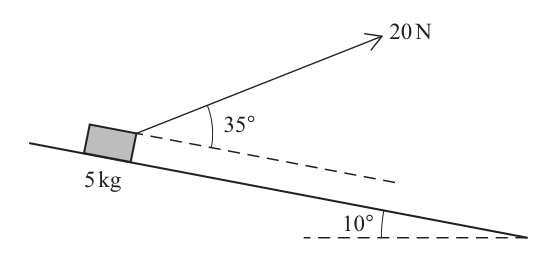
A block of mass is being pulled straight down a line of greatest slope of a rough plane by a force of magnitude . The plane is inclined at an angle of to the horizontal and the force acts at an angle of above the line of greatest slope of the plane (see diagram). The coefficient of friction between the block and the plane is . The speed of the block when it passes a point is .
Find the speed of the block when it has moved down the plane from .
Approach
Resolve the forces acting on the block perpendicular to the plane to find the normal reaction force . Then resolve the forces parallel to the plane (down the line of greatest slope) to find the acceleration using Newton's second law. Finally, use the constant acceleration formula to find the final speed.
Working
Let be the normal reaction force, be the frictional force, and be the acceleration down the plane. The block moves down the plane, so friction acts up the plane.
Resolving perpendicular to the plane:
The forces perpendicular to the plane are the normal reaction (upwards), the component of weight (downwards into the plane), and the perpendicular component of the pulling force (upwards away from the plane).
Finding the frictional force:
Since the block is moving, we use the limiting friction model :
Resolving parallel to the plane (down the slope):
The forces acting down the slope are the component of weight and the parallel component of the pulling force . The frictional force acts up the slope.
Finding the final speed:
Using the constant acceleration formula with , , and :
Answer
The speed of the block when it has moved 3 m down the plane is approximately .
3.99 m s^-1
Walkthrough
First, we identify all the forces acting on the 5 kg block. The weight acts vertically downwards. The pulling force of 20 N acts at an angle of 35° above the line of greatest slope. The plane is inclined at 10° to the horizontal. Friction opposes the motion, so it acts up the slope.
We resolve the forces perpendicular to the inclined plane to find the normal reaction force . The component of weight perpendicular to the plane is acting into the plane. The pulling force has a component acting away from the plane. Setting the sum of forces perpendicular to the plane to zero gives . Substituting gives N.
Next, we calculate the frictional force using N.
Then, we resolve the forces parallel to the plane down the line of greatest slope. The component of weight down the slope is . The component of the pulling force down the slope is . The frictional force acts up the slope. Applying Newton's second law, , we solve for the acceleration m s.
Finally, we use the kinematic equation with initial speed m s, acceleration m s, and distance m to find the final speed m s.
Key Takeaways
- Resolving forces perpendicular to an inclined plane is essential to find the normal reaction force when there are applied forces at an angle to the plane.
- The limiting friction model must be used when an object is moving on a rough surface.
- Newton's second law is applied parallel to the direction of motion to find acceleration.
- Constant acceleration kinematic equations can then be used to find final velocities over a given distance.
Common Mistakes
- Forgetting to include the perpendicular component of the applied 20 N force when resolving perpendicular to the plane, leading to an incorrect normal reaction .
- Using the wrong component of the 20 N force (using sine instead of cosine for the parallel component).
- Forgetting that friction acts up the slope when the block moves down the slope.
- Using or without checking if the mark scheme expects a specific value (here is standard unless specified).
Things to Be Careful About
- Ensure all force components are correctly identified as acting into or away from the plane.
- The angle 35° is measured from the line of greatest slope, so the parallel component uses and the perpendicular component uses .
- When using , ensure the signs of and are consistent with the direction of motion. Here, both are positive down the slope.
- The mark scheme allows for a work-energy approach as an alternative, which involves calculating the work done by each force and equating it to the change in kinetic energy.
A particle starts from rest at a point . The acceleration of the particle at time after leaving is , where
for .
Find the distance that the particle travels from until the time at which its acceleration is zero.
Approach
The acceleration is variable, so use integration. Since , integrate with respect to to find , using the initial condition that the particle starts from rest ( when ). Then integrate with respect to to find displacement , using when (or a definite integral from to the required time). First find the time when .
Working
Set :
Integrate to find velocity:
Using at :
So
Integrate to find displacement:
Using at :
So
Distance from until :
Since for , distance travelled equals displacement.
Answer
13/6 m or 2.17 m
Walkthrough
We are told the acceleration is and the particle starts from rest at . The question asks for the distance travelled up to the moment when acceleration is zero.
First find the time when acceleration is zero. Set . Rearranging: , so . Squaring gives , so . This is the upper limit of the motion we need.
Because the acceleration is not constant, the constant-acceleration (suvat) equations cannot be used. Instead, use , so . Integrate: . The particle starts from rest, so when . Substitute: , so . Hence .
Next, displacement is . Integrating: . Since the particle starts at , when . Substitute: , so .
Now evaluate at : .
We should check whether the particle reverses direction before . Since for (because ), the velocity is increasing from , so throughout. Therefore the distance travelled equals the displacement, m.
Key Takeaways
- When acceleration depends on time, integrate to get velocity and integrate again to get displacement.
- Initial conditions (rest at O) are used to find constants of integration.
- The time when acceleration is zero is found by solving , not by guessing.
- Distance equals displacement only if the particle does not change direction; here velocity stays positive on the interval.
Common Mistakes
- Mark scheme: treating as or dropping the scores no marks for the first step.
- Using or : these are only valid for constant acceleration, so they score M0.
- Forgetting the constant of integration, or setting without using at .
- Forgetting that when , not , when evaluating the lower limit.
- Using the wrong time; the upper limit must be the value of found from .
Things to Be Careful About
- The mark scheme says the acceleration-zero step is CWO (correct working only): you must show the rearrangement to and .
- For the integration method marks, the scheme requires an attempt of the form with for velocity, and a similar form for displacement.
- If no integration of is seen, only a special-case mark for 2.17 is available, so full working must be shown.
- Check units: the final distance is in metres.
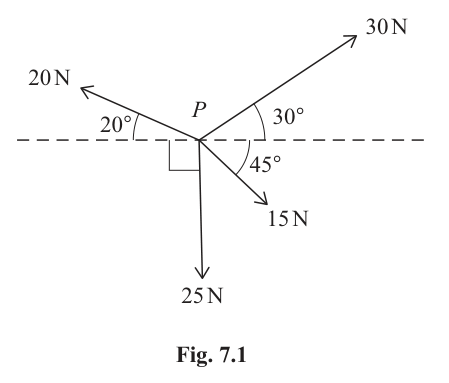
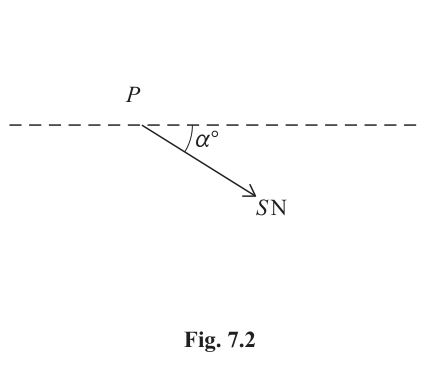
Four coplanar forces of magnitudes , , and act at a point in the directions shown in Fig. 7.1. The forces act in a vertical plane. The resultant of these forces has magnitude and acts at an angle below the horizontal as shown in Fig. 7.2.
Approach
Resolve each of the four forces into horizontal and vertical components, sum them separately, then use Pythagoras' theorem to find and the inverse tangent to find .
Working
Take the positive -direction to the right and the positive -direction upward.
Horizontal component
Vertical component
The negative sign means the vertical component is downward.
Magnitude of the resultant
Angle below the horizontal
Answer
S = 22.5 N, α = 37.7°
Walkthrough
The four coplanar forces act at a single point , so the resultant is found by vector addition. The standard approach is to resolve each force into its horizontal and vertical components, add all horizontal components together, add all vertical components together, and then combine these two perpendicular components to get the resultant.
When resolving a force of magnitude at an angle above the horizontal, the horizontal component is and the vertical component is . If the force is below the horizontal, the vertical component becomes . If the force points to the left, the horizontal component becomes .
For the force at above horizontal pointing to the right: horizontal = , vertical = .
For the force at below horizontal pointing to the right: horizontal = , vertical = .
For the force at above horizontal pointing to the LEFT: horizontal = , vertical = .
For the force pointing straight down: horizontal = , vertical = .
Summing horizontally: to the right.
Summing vertically: (i.e., downward).
The magnitude of the resultant is found using Pythagoras' theorem:
The angle below the horizontal is found using the inverse tangent of the ratio of the (absolute) vertical to horizontal components:
Key Takeaways
- To find the resultant of multiple coplanar forces, resolve each into horizontal () and vertical () components.
- The sign of each component depends on the direction of the force (right/left for horizontal, up/down for vertical).
- The magnitude of the resultant is found using Pythagoras' theorem, and the angle is found using inverse trigonometric ratios.
- The angle is found by because the resultant is below the horizontal (so the vertical component is negative).
Common Mistakes
- Mixing up sine and cosine when resolving forces at an angle to the horizontal.
- Forgetting to consider the direction of each force (e.g., treating the force as if it points to the right).
- Using the wrong sign convention, leading to an incorrect magnitude or angle.
- Computing the angle as instead of , which would give a different (complementary) angle.
Things to Be Careful About
- Be careful with the direction of each force when setting up the sign convention.
- The force is to the LEFT, so its horizontal component is negative.
- The force is BELOW the horizontal, so its vertical component is negative.
- The force is DOWNWARD, so its vertical component is negative.
- The angle is measured from the positive -axis (horizontal) downward, so it is in the fourth quadrant.
- The horizontal and vertical components are perpendicular, so Pythagoras' theorem applies.
A small ring of mass is threaded on a rough straight horizontal wire. The four forces shown in Fig. 7.1 act on the ring and are in the same vertical plane as the wire. The ring starts from rest and takes to travel a distance of along the wire.
Find the coefficient of friction between the ring and the wire.
Approach
Use the constant acceleration (suvat) formula with the given , , and to find the acceleration. Then apply Newton's second law along the wire to find the friction force, use vertical equilibrium to find the normal reaction, and finally use to find .
Working
Step 1: Find the acceleration
Using with , , and :
Step 2: Apply Newton's second law along the wire
The horizontal component of the applied forces (from part (a)) is in the direction of motion. Friction acts opposite to the motion (backwards).
Step 3: Find the normal reaction using vertical equilibrium
The ring is on a horizontal wire, so the normal reaction is vertical. The vertical forces on the ring are:
- The vertical component of the applied forces: downward
- The weight of the ring: downward
- The normal reaction: upward
For vertical equilibrium:
Using :
Step 4: Apply the friction model
Using :
Answer
μ = 0.892 (using g = 9.8 m/s²)
Walkthrough
The ring is on a horizontal wire, so we treat the motion as one-dimensional along the wire. The first step is to find the acceleration using the given information that the ring starts from rest () and travels in . Using , we get .
Next, we apply Newton's second law along the wire. The horizontal component of the four applied forces (from part (a)) is in the direction of motion. Friction acts opposite to the motion. So , giving .
Then, we apply vertical equilibrium. The wire is horizontal, so the normal reaction is vertical. The vertical forces on the ring are: the vertical component of the applied forces ( downward), the weight of the ring ( downward), and the normal reaction upward. For vertical equilibrium:
With , .
Finally, we use the friction model to find:
(Note: If is used instead, and .)
Key Takeaways
- This problem combines kinematics (suvat), Newton's second law, vertical equilibrium, and the friction model .
- The horizontal component of the applied forces is the same as the value from part (a).
- The normal reaction is found by balancing the vertical forces (including the weight of the ring).
- The friction force opposes the motion and is the only unknown horizontal force besides .
- The acceleration comes from the kinematic data, not from the force analysis.
Common Mistakes
- Forgetting to include the weight of the ring in the vertical equilibrium.
- Treating the vertical component of the applied forces as upward (it is downward).
- Using the wrong sign for friction in Newton's second law (it opposes motion, so it should be subtracted).
- Forgetting to find the acceleration first using the suvat equation.
- Using the wrong value of (the Cambridge standard is or ).
Things to Be Careful About
- The vertical component of the applied forces is downward, not upward.
- The weight of the ring () adds to the normal reaction, not subtracts from it.
- The acceleration is positive (in the direction of motion), so (the applied force is greater than friction).
- The value of used (typically or ) affects the final answer; using gives .
- The mark scheme uses the student's value of and from part (a) with follow-through, so a sign error in part (a) can still earn marks in part (b) if the method is correct.