Mathematics 9709/25 — October/November 2025
Cambridge AS Level · Pure Mathematics 2 · worked solutions for every part, with the mark scheme
Topics Integration · Logarithmic and Exponential Functions · Algebra · Trigonometry · Differentiation · Numerical Solution of Equations
Find .
Approach
Use the double-angle identity to rewrite in terms of , then integrate each term separately.
Working
Multiply by 6:
Integrate term by term:
So:
Answer
3x - (3/2) sin 2x + c
Walkthrough
The integrand contains , which is not one of the basic integrals we know directly. We use the double-angle identity to rewrite . This converts the integrand into a constant plus a cosine term, both of which we can integrate immediately.
Multiplying by 6 gives . Then integrating term by term:
Adding the constant of integration gives .
Key Takeaways
This question tests the use of trigonometric identities to make an integrand integrable. The double-angle identity is essential for integrating or . It also tests the standard integral .
Common Mistakes
- Forgetting to divide by the coefficient of inside when integrating, giving instead of .
- Using the wrong identity, e.g. writing (that is for ).
- Omitting the constant of integration; the mark scheme condones this, but it is safer to include it.
Things to Be Careful About
- Ensure the identity is applied correctly: .
- When integrating , the factor must appear because of the chain rule in reverse.
- The mark scheme allows omission of , but including it is always correct.
Solve the equation .
Approach
Let . Then the equation becomes a quadratic in . Solve the quadratic, use the fact that to keep the positive root, and take natural logarithms to find .
Working
Let . Then
Expanding and rearranging to zero:
Factorising:
So or .
Since for all real , reject . Therefore
Taking natural logarithms:
Hence
Numerically, . There is no other real solution.
Answer
x = (1/2) ln 12 (≈ 1.24)
Walkthrough
We first notice that the variable appears in both the factor outside and the bracket. Replacing it by a single letter, say , turns the equation into a familiar quadratic. Expanding gives , and moving everything to one side gives . This factorises as , so the possible values are and .
Now we return to the meaning of . Since and an exponential function is always positive, cannot occur for any real ; we ignore it. Thus . Taking the natural logarithm of both sides uses the fact that , giving . Dividing by 2 gives . There is exactly one real solution.
Key Takeaways
- Recognising a hidden quadratic by substitution is a powerful technique for equations of the form .
- Exponentials are always positive, so only positive solutions of the quadratic can correspond to real values of .
- To undo , apply and use .
Common Mistakes
- Forgetting to reject and offering an impossible solution.
- Factoring incorrectly because the equation was not rearranged to zero first.
- Writing instead of after .
- Stopping at without solving for , which would not earn the final mark.
Things to Be Careful About
- The exponential function is positive for all real ; this domain fact justifies rejecting the negative root.
- Use the natural logarithm, not a logarithm of a different base, when solving equations involving .
- The mark scheme requires an explicit final value of and no extra solutions; give both the exact form and, if useful, the decimal approximation.
Approach
The equation is true when the expressions inside the modulus bars are equal, or when one is the negative of the other. Solve the two resulting linear equations.
Working
Case 1: .
Subtract from both sides and subtract from both sides:
Case 2: .
Add to both sides and add to both sides:
Answer
x = -5/3 or x = 1/7
Walkthrough
We solve by removing the modulus signs. The absolute value of an expression equals the absolute value of another when the expressions are equal or when they are negatives of each other. This gives two linear equations.
For , rearranging gives , so .
For , expanding the bracket gives , so and .
Both values satisfy the original equation, so the solution set is or .
Key Takeaways
This question tests the ability to solve a modulus equation by considering the two possible sign cases. The key skill is recognising that is equivalent to or .
Common Mistakes
A common mistake is to only solve and forget the case where the two sides have opposite signs, losing the solution . Another common mistake is to mishandle the negative sign when expanding .
Things to Be Careful About
When using the case method, always solve both cases and check that each answer satisfies the original equation. If using the squaring method, remember that squaring can introduce extra solutions, so verify each result.
Approach
Use the result of part (a) by substituting . Solve the two possibilities for , reject any impossible value, then convert to and find the angle in the interval .
Working
From part (a), gives
Putting :
Since , the value is impossible. Therefore
Taking reciprocals:
Let the reference angle be . In the interval , is negative in the third quadrant, so
Answer
theta = 4.07 radians (3 s.f.)
Walkthrough
Part (b) is designed to be solved using the answer to part (a). If we let , then the equation has exactly the same form as . Therefore must be one of the two values found in part (a): or .
The value is impossible because and , so . Hence only is possible.
Taking reciprocals gives . We need the angle in the interval where cosine is negative. In this interval, cosine is negative only in the third quadrant. The reference angle is radians, so the third-quadrant angle is radians, which is to 3 significant figures.
Key Takeaways
This question links a modulus equation with trigonometric functions. It shows how a substitution such as can reuse an earlier algebraic result. It also reinforces the range of and the importance of choosing the correct quadrant when solving .
Common Mistakes
A common mistake is to keep and try to solve , which has no solution. Another common mistake is to choose the second-quadrant angle instead of the third-quadrant angle , forgetting the interval . Some students also give the answer in degrees or fail to round to 3 significant figures.
Things to Be Careful About
The mark scheme allows the working to be done in degrees for the angle-finding method, but the final answer must be in radians because the interval is given in radians. Always check that the final angle lies in the required interval. Also remember that cannot take values between and , so one of the part (a) values must be rejected.
Solve the equation for .
Approach
Let . Rewrite as and use the compound angle formula for . This gives an equation in only, which simplifies to a quadratic. Solve the quadratic, then find the angles in the given range.
Working
Let . Since , the compound angle formula gives
Also, . Substituting into the equation:
Multiplying by :
Rearranging:
Using the quadratic formula:
So
Both values are positive and less than , so both give angles in , which is inside the required range. Therefore
There are no other solutions in .
Answer
θ = 12.8° or 32.2° (12.764...°, 32.235...°)
Walkthrough
We need to solve an equation that mixes and . The key is to express everything in terms of one trigonometric ratio, . Let .
First, . This is the definition of cotangent.
Next, use the compound angle formula for tangent:
With and , and knowing , this becomes
Substitute both expressions into the original equation:
Multiplying by removes the denominators. It is important to multiply correctly: . Expanding gives , and rearranging gives
Now solve the quadratic in . Using the quadratic formula,
Both roots are positive and less than , so both are valid for in the range ; in fact both lie in . Taking inverse tangent gives the two final angles.
Key Takeaways
- Cotangent can always be rewritten as .
- The compound angle formula for tangent is essential when an angle like appears.
- After substitution, many trigonometric equations reduce to a quadratic in .
- Always check that each solution lies in the given interval and that no denominator is zero at the solution.
Common Mistakes
- Forgetting that and therefore miswriting the compound angle formula.
- Making a sign error when expanding or rearranging the quadratic.
- Stopping after solving for instead of finding .
- Omitting one of the two solutions because the quadratic has two positive roots.
- Not showing the initial attempt to express the equation in terms of only; the mark scheme requires this method mark.
Things to Be Careful About
- The denominator must not be zero; would make undefined, but neither solution is .
- Since the range is , both positive roots are valid. If the range were different, extra solutions from adding might also need consideration.
- Use degrees mode on your calculator when finding from .
- Give final answers to the accuracy requested; the mark scheme accepts and , or greater accuracy.
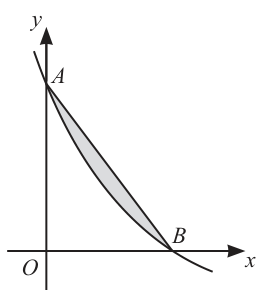
The diagram shows the curve with equation . The curve meets the axes at the points and . The shaded region is bounded by the curve and the line segment .
Approach
Point lies on the -axis, so its -coordinate is . Setting in gives an exponential equation which we solve for using logarithm laws.
Working
Take the natural logarithm of both sides:
Using :
Answer
x = 6 ln 2
Walkthrough
Since point is where the curve meets the -axis, its -coordinate must be . We substitute into the equation of the curve to get an equation purely in .
After moving the to the right-hand side, we divide by to isolate the exponential term . At this point, the equation is in the form where is a constant, so we take the natural logarithm of both sides. The key identity is , which lets us remove the exponential on the left.
The result simplifies to . We use the logarithm power law to write . Multiplying both sides by gives the required .
Key Takeaways
- A point on the -axis has , so substituting into the curve equation gives the -intercept.
- Equations of the form (with ) are solved by taking natural logarithms.
- The logarithm power law is used to express in terms of .
Common Mistakes
- Forgetting to apply the negative sign when moving across the equals sign.
- Writing as instead of (a misuse of logarithm laws).
- Forgetting to multiply by at the final step, leaving the answer as rather than .
Things to Be Careful About
- The question is a "show that", so every step must be clearly visible. In particular, the mark scheme requires explicit use of for the A1 mark.
- The exponential and the negative coefficient both matter; a sign error will give an incorrect final sign.
Find the area of the shaded region. Give your answer in the form , where and are positive integers.
Approach
First identify the coordinates of and from the curve and the axes. The shaded region lies between the curve and the line segment , so its area equals the area of triangle minus the area under the curve from to .
Working
Coordinates of and :
At (where the curve meets the -axis), :
So .
From part (a), .
Area of triangle :
Area under the curve from to :
Integrate term by term:
Apply the limits:
Shaded area:
Answer
27 ln 2 - 14
Walkthrough
The shaded region is bounded above by the line segment and below by the curve. A useful technique when the bounding line is straight is to find the area of the larger triangle (here ) and subtract the area under the curve.
First we identify point by setting in the curve equation, which gives . The point is the -intercept, already found in part (a) to be . With at the origin, triangle has legs of length (along the -axis) and (along the -axis).
To integrate the curve, recall the rule . With and coefficient , the antiderivative of is . The antiderivative of is .
When evaluating at , the term . This is the key step that produces a clean numerical answer.
At , the antiderivative is , so subtracting this value adds to the result.
Finally, the area under the curve is subtracted from the triangle's area to give the shaded region. Combining the terms gives , and the constant becomes .
Key Takeaways
- The area between a straight line and a curve can be found by subtracting the area under the curve from the area of the corresponding triangle.
- For an integrand of the form , the antiderivative is , including the sign of .
- The relationship is essential for evaluating such integrals at limits that involve logarithms.
Common Mistakes
- A common error is integrating as itself, forgetting the factor.
- Forgetting the negative sign on the constant term when integrating; its antiderivative is , not .
- Sign errors when applying the limits of a definite integral: the lower-limit value is subtracted from the upper-limit value.
- Computing incorrectly; this equals , not .
Things to Be Careful About
- The mark scheme awards a mark for attempting the area of the triangle minus the area under the curve; it is acceptable to use a decimal approximation for the triangle area () only at this step, and the form should be used in the final answer.
- The final answer is of the form ; ensure both and are positive integers (, ).
A curve has parametric equations
for .
Approach
For parametric equations, use
Differentiate and with respect to , then divide and simplify using and .
Working
Differentiate term by term. The derivative of is , and by the chain rule the derivative of is .
Therefore
Using :
Answer
dy/dx = 6 cos^5 θ - 5 cos^3 θ
Walkthrough
We are given parametric equations, so the slope of the curve is found by dividing the derivative of with respect to the parameter by the derivative of with respect to the parameter.
First differentiate : the derivative is . Then differentiate . The first term gives . For the second term, use the chain rule: the derivative of is , so the derivative of is .
Now divide by . Since , dividing by is the same as multiplying by . This makes the expression depend only on after using . Expand and simplify to obtain the required result.
Key Takeaways
- For parametric curves, .
- The chain rule is needed for powers of trigonometric functions.
- The identity lets us rewrite everything in terms of .
- When a question says "show that", every simplification step must be shown.
Common Mistakes
- Forgetting to divide by , or dividing by it incorrectly.
- Differentiating as without multiplying by .
- Stopping before fully simplifying to the target expression.
- The mark scheme says AG - necessary detail needed, so an unsupported answer is not enough.
Things to Be Careful About
- Keep the parameter in radians throughout.
- Remember , so dividing by multiplies by .
- Watch the sign when expanding : it becomes , so .
Find the equation of the normal to the curve at the point where it crosses the -axis. Give your answer in the form , where and are exact constants.
Approach
The curve crosses the -axis where . Find the corresponding value of , then evaluate at that point using part (a). The normal has gradient equal to the negative reciprocal of the tangent gradient, and passes through the crossing point.
Working
Set :
Since , , so
Thus
and the crossing point is
From part (a), the gradient of the tangent at is
Since ,
So the gradient of the normal is the negative reciprocal:
The normal passes through , so its equation is
Answer
y = √2 x - √2
Walkthrough
The curve crosses the -axis where . Substitute and factor. Since is in the first quadrant, is not zero, so the factor must be zero. This gives , and because is acute, .
At that point, , so the point is . Use the derivative from part (a) to find the tangent gradient. Substitute : , so the gradient is .
The normal is perpendicular to the tangent, so its gradient is the negative reciprocal: . Using the point , the equation is , which simplifies to .
Key Takeaways
- A curve crosses the -axis where .
- The normal gradient is the negative reciprocal of the tangent gradient.
- To find the equation of a line, use the point-gradient form .
Common Mistakes
- Forgetting to find the -coordinate of the crossing point before writing the normal equation.
- Using the tangent gradient instead of its negative reciprocal for the normal.
- Answering with in degrees; the mark scheme requires radians here.
- Not simplifying the gradient expression correctly when substituting .
Things to Be Careful About
- The domain means , so the solution is unique; other solutions such as are outside the domain.
- The final answer must have exact constants; leave rather than a decimal.
- The normal passes through the point where the curve crosses the -axis, not through the origin.
The polynomial is defined by
where is a constant. It is given that is a factor of .
Approach
Use the factor theorem: since is a factor, . Substitute into , set the result equal to zero and solve for .
Working
Substitute :
Simplify:
Since is a factor, :
Answer
k = 4
Walkthrough
Because is a factor of , the factor theorem says is a root, so . Substitute into the polynomial. Each term simplifies: , , , , and the constant is . Adding gives . Setting this equal to zero gives .
Key Takeaways
The factor theorem links a linear factor to a root: if is a factor, then substituting must give zero. This turns a polynomial condition into an equation for an unknown constant.
Common Mistakes
- Forgetting to apply the factor theorem and trying to divide first.
- Sign errors when substituting negative values, especially and .
- Arithmetic slips when combining , and .
Things to Be Careful About
- Powers of negative numbers: even powers are positive, odd powers are negative.
- The factor theorem requires the polynomial to equal zero at , not at .
It is given that the equation has exactly two real roots, denoted by and , where is an integer and is not an integer.
State the value of and show that satisfies the equation .
Approach
Use the factor theorem to identify the integer root . Then divide by to obtain the cubic factor, set it equal to zero and rearrange to the required form.
Working
With :
Since is a factor, is a root, so
Divide by :
Therefore gives or
The non-integer real root satisfies this cubic. Rearrange:
Answer
alpha = -2 and beta satisfies x = cube root(-2x - 4.5)
Walkthrough
With , the polynomial is . Since is a factor, one real root is , so . Divide by . Synthetic division with gives quotient and remainder , so . The other real root must satisfy . Rearrange: , divide by 2, then take cube roots: .
Key Takeaways
Polynomial division reduces a quartic to a cubic once a linear factor is known. The remaining roots come from the quotient. Rearranging a cubic into the form is the basis for an iterative formula.
Common Mistakes
- Forgetting to include the zero term when dividing; the quotient must be .
- Stopping after finding and not deriving the cubic equation for .
- Rearranging incorrectly: from , divide by 2 before taking cube roots.
Things to Be Careful About
- The problem says the equation has exactly two real roots; is the integer root and is the non-integer root of the cubic.
- The equation is equivalent to the cubic only for real cube roots.
Approach
Define . Since satisfies , is a root of . Evaluate at and and look for a sign change.
Working
At :
At :
Since is continuous and changes sign between and , its root lies in that interval.
Answer
-1.4 < beta < -1.0
Walkthrough
Since satisfies , define . Then is a zero of . Evaluate at the two endpoints. For , the cube root is , so . For , , so . A continuous function changing sign between and has a root in that interval.
Key Takeaways
A sign change over an interval locates a root of a continuous equation. The function chosen can be the rearranged equation or the original cubic.
Common Mistakes
- Evaluating only or only the cube root instead of the difference.
- Using the wrong interval endpoints or substituting instead of .
- Not giving numerical values, so no sign change is demonstrated.
Things to Be Careful About
- Cube roots of negative numbers are negative.
- Need both endpoint values with opposite signs and a conclusion that a root lies between them.
Use an iterative formula, based on the equation in part (b), to find the value of correct to 3 significant figures. Give the result of each iteration to 5 significant figures.
Approach
Use the iterative formula with starting value . Iterate, recording each value to 5 significant figures, until consecutive values agree to that precision.
Working
| (5 s.f.) | |
|---|---|
| 0 | -1.2000 |
| 1 | -1.2806 |
| 2 | -1.2469 |
| 3 | -1.2612 |
| 4 | -1.2552 |
| 5 | -1.2577 |
| 6 | -1.2567 |
| 7 | -1.2571 |
| 8 | -1.2569 |
| 9 | -1.2570 |
| 10 | -1.2570 |
Since and are both to 5 significant figures, the iteration has converged. Thus
Correct to 3 significant figures:
Answer
beta = -1.26
Walkthrough
Use the iterative formula from part (b): . Starting from , each iteration produces a new approximation. The table shows values rounded to 5 significant figures. After several iterations the values settle at to 5 significant figures. Therefore , which is correct to 3 significant figures.
Key Takeaways
Iterative formulae of the form can be used to refine approximations. Convergence is shown when consecutive values agree to the required precision. Intermediate values should be kept to more significant figures than the final answer.
Common Mistakes
- Rounding every intermediate value too early, causing the iteration to drift.
- Giving the final answer as instead of (correct to 3 significant figures).
- Stopping after one or two iterations without showing convergence.
Things to Be Careful About
- The question asks for each iteration to 5 significant figures, so display intermediate values to 5 s.f.
- The final answer must be to exactly 3 significant figures: .
- Use full precision in the calculation and round only when recording values.
The equation of a curve is .
Find the exact coordinates of the stationary point of the curve.
Approach
Use the product rule to differentiate . Set , divide out the non-zero exponential factor, solve for , then substitute back to find the exact -coordinate.
Working
Let
Then
By the product rule,
At a stationary point, :
Since , divide by it:
Multiply through by :
Substitute into :
Answer
x = 7/12, y = 2√3 e^(-1/6)
Walkthrough
This question asks for the stationary point, so the key step is to find where the gradient is zero. The curve is a product of two functions, and , so we need the product rule. Each factor also needs the chain rule.
First write the square root as a power: . Let and . The derivative of is , because the derivative of is . The derivative of is , because the derivative of is .
Then apply the product rule: . This gives the two terms shown in the working. At a stationary point the gradient is zero, so set the whole expression equal to zero.
Because is never zero, it can be divided out safely. This leaves an equation with powers of . Multiplying by clears the negative fractional power and gives a simple linear equation, . Solving gives .
Finally substitute this value back into the original equation for . The exponent simplifies to , and the square root becomes . Multiplying by gives .
Key Takeaways
- The product rule is essential when a function is written as a product of two simpler functions.
- Composite functions such as and require the chain rule.
- The exponential function is never zero, so it can be cancelled from equations safely.
- Stationary points are found by solving , then substituting to find the corresponding -coordinate.
- Exact answers should be left in simplified surd/exponential form.
Common Mistakes
- Forgetting the inner derivative when differentiating or .
- Mixing up the order or signs in the product rule.
- Attempting to divide by without handling the fractional power correctly.
- Finding but failing to substitute back to obtain the -coordinate.
- The mark scheme requires the derivative to be written in the form ; omitting either term loses credit.
Things to Be Careful About
- The domain is because of the square root. The stationary point lies in this domain, so it is valid.
- The factor is positive for , so multiplying the equation by it does not change the solution set at the stationary point.
- Simplify correctly to , not or .
- Keep the answer exact: do not replace or with decimals unless asked.
- Check that the exponent is computed correctly: at , it is .