Mathematics 9709/23 — October/November 2025
Cambridge AS Level · Pure Mathematics 2 · worked solutions for every part, with the mark scheme
Topics Integration · Logarithmic and Exponential Functions · Algebra · Trigonometry · Differentiation · Numerical Solution of Equations
Find .
Approach
Use the double-angle identity to rewrite the integrand as a sum of a constant and a cosine term, then integrate term by term.
Working
Simplify the integrand:
So
Integrate term by term:
Therefore
Answer
3x - (3/2) sin(2x) + c
Walkthrough
This integral looks like it needs a trigonometric identity because is not one of the basic integrands we know directly. The double-angle formula can be rearranged to give . Substituting this into the integral turns into , which is much easier to integrate.
Now integrate each term separately. The constant integrates to . For , recall that , so with the integral is . Adding the two results gives .
Key Takeaways
The key idea is to rewrite unfamiliar powers of trigonometric functions using identities so that the integrand becomes a sum of terms with known antiderivatives. This question also reinforces the general rule , where the factor appears because of the chain rule in reverse.
Common Mistakes
- Using the wrong sign in the identity: instead of .
- Forgetting the factor when substituting the identity, which would give incorrectly.
- When integrating , forgetting to divide by , giving instead of .
- Omitting the constant of integration. The mark scheme condones its omission, but it is safer to always include .
Things to Be Careful About
The coefficient must be multiplied by the from the identity, giving . Also, the derivative of is , so the antiderivative of must include the factor . Keep the constant of integration unless the question asks for a definite integral.
Solve the equation .
Approach
Let so the equation becomes a quadratic in . Solve it by factorisation, then use the fact that to discard the negative root and take natural logarithms to find .
Working
Let . Then:
Expanding:
So:
Factorising:
Hence:
Since for all real , the root is impossible. Therefore:
Taking natural logarithms:
So:
Answer
There is no other solution, because is impossible.
x = (1/2) ln 12 ≈ 1.24, no other solution
Walkthrough
The equation contains the same exponential expression twice, so it is natural to treat it as a single variable. Let . Then the product becomes , and the equation is . Expanding gives , so . This quadratic factorises as , giving or .
The key step is to remember that is always positive for real . Therefore cannot occur, and the only valid possibility is , i.e. . To undo the exponential, take the natural logarithm of both sides: . Then divide by 2 to get , which is approximately 1.24.
Key Takeaways
This question tests the ability to recognise a quadratic structure inside an exponential equation, to solve that quadratic, and to use the positivity of the exponential function to reject an extraneous root. It also reinforces that for any real , so taking natural logarithms is the correct inverse operation to solve for the exponent.
Common Mistakes
- Forgetting to reject ; since is never negative, this root must be discarded.
- Stopping at without taking logarithms to find .
- Making a sign error when rearranging to .
- Giving only the decimal answer without the exact form, or giving an incorrect approximation.
Things to Be Careful About
The natural logarithm is only defined for positive inputs, so the negative root must be removed before taking logs. Use as the exact answer, or give the decimal to an appropriate degree of accuracy, such as 1.24. There is no other solution, so do not include a second value for .
Approach
For an equation of the form , either or . Split the modulus equation into these two linear cases and solve each.
Working
Now take the case where the two sides have opposite signs:
Answer
x = -5/3 or x = 1/7
Walkthrough
We are solving . The absolute value of two quantities is equal when the quantities themselves are equal, or when one is the negative of the other. This gives two separate linear equations.
The first equation is . Rearranging gives , so .
The second equation is . Expanding the bracket gives . Adding to both sides gives , then adding gives , so .
Both values can be checked by substituting back into the original modulus equation; each satisfies it.
Key Takeaways
A modulus equation of the form is equivalent to or . This often produces two solutions. The method avoids considering separate sign cases for because both sides are already non-negative after applying the modulus.
Common Mistakes
- Forgetting the second case and giving only one solution.
- Making a sign error when expanding .
- If using the squaring method, failing to expand correctly or not showing the resulting quadratic equation.
The mark scheme requires an attempt at both cases: the first solution can be awarded directly, but the second requires showing the different-sign equation.
Things to Be Careful About
When solving , the negative sign applies to both terms inside the bracket. Always check the final answers in the original equation. If using the alternative squaring method, the full quadratic solution must be shown.
Approach
Use the result of part (a) with . The solutions are or . The second is impossible because it would require , so only remains. Convert this to and find the angle in the interval .
Working
From part (a), with :
Since would mean , which is impossible, discard it.
For , cosine is negative only in the third quadrant. Let .
Thus
Answer
θ = 4.07 rad (3 s.f.)
Walkthrough
The word 'Hence' tells us to reuse the result of part (a). If we let , then the equation has exactly the same form as part (a). Therefore must be one of the two values found in part (a).
The value is impossible because , so it would mean . Since is always between and , this cannot happen. So only remains.
Taking reciprocals gives . We need the solution in . In this interval, cosine is negative only in the third quadrant, between and . The reference angle is radians, so the third-quadrant angle is radians, which is to 3 significant figures.
Key Takeaways
This question combines modulus equations with reciprocal trigonometric functions. It shows how a result obtained for a general variable can be transferred to . It also reinforces that , so is immediately invalid, and that solving requires choosing the correct quadrant for the given interval.
Common Mistakes
- Keeping as a valid possibility instead of discarding it.
- Choosing the wrong quadrant: would give a positive cosine and is not a solution.
- Giving the answer in degrees. The interval is given in radians, so the final answer should be in radians.
- Rounding incorrectly: rounds to , not or .
Things to Be Careful About
The mark scheme allows working in degrees for the method mark, but the final answer must be correct in radians to 3 significant figures. Remember that , and that cannot equal . Within , the third quadrant is the only place where is negative.
Solve the equation for .
Approach
Let . Rewrite as and use the compound angle formula for to express the equation in terms of . Then solve the resulting quadratic equation and take inverse tangent, keeping only values in .
Working
Let . Since ,
Since ,
Multiply both sides by :
Rearrange:
Solve using the quadratic formula:
Thus
Taking inverse tangent:
Both values lie in , and there are no others in the range.
Answer
θ = 12.8° and 32.2°
Walkthrough
The equation mixes and . The key is to write everything in terms of . Let . Since , replace it by . For the compound angle, use
With , , and , this gives . Substituting gives .
Now multiply both sides by . This is valid because means , and the roots will not make . This gives , so .
Apply the quadratic formula:
Since both values are positive, each gives exactly one angle in the first quadrant. Taking inverse tangent gives approximately and , both in the required range .
Key Takeaways
- .
- Compound angle formula for tangent: .
- A trigonometric equation can often be reduced to a quadratic by substituting .
- After solving for , use inverse tangent and check the domain.
Common Mistakes
- Using the wrong sign in the denominator of the tangent compound angle formula; it is , not .
- Forgetting that .
- Making a sign error when rearranging ; the correct quadratic is .
- Stopping at values of without converting to angles, or giving angles outside the specified range.
- The mark scheme requires a method and a three-term quadratic; an unsupported answer is not enough.
Things to Be Careful About
- Work in degrees throughout, since the angle is given as and the range is in degrees.
- Check that multiplying by is legitimate: in this domain and the roots are not , so no solution is lost or introduced.
- The tangent function has period , so each value of would normally give infinitely many angles; only the two in are required.
- Give final answers to an appropriate accuracy; the mark scheme accepts and , or greater accuracy and .
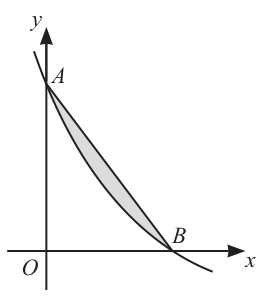
The diagram shows the curve with equation . The curve meets the axes at the points and . The shaded region is bounded by the curve and the line segment .
Approach
Point is where the curve meets the -axis, so its -coordinate is . Set in the equation of the curve and solve the resulting exponential equation for , using the laws of logarithms.
Working
Set in :
Isolate the exponential term:
Take natural logarithms of both sides:
So , giving .
Using the law of logarithms :
Answer
x = 6 ln 2
Walkthrough
Point lies on the -axis, so its -coordinate is . We substitute into the equation to get an equation in alone. Rearranging gives . Because the variable is in the exponent, we take logarithms of both sides to bring it down. The rule turns into a linear expression. The negative sign on both sides cancels, leaving . Multiplying by gives , and applying the power law for logarithms yields the final form .
Key Takeaways
- The -intercept of a curve is found by setting and solving for .
- To solve an equation of the form , take natural logarithms.
- The power law is essential for simplifying.
Common Mistakes
- Forgetting to take the negative of (i.e. writing but not handling the sign correctly).
- Not explicitly showing the use of — the mark scheme requires this detail to award the final mark.
Things to Be Careful About
- The mark scheme insists on seeing the use of a logarithm property such as or before awarding the conclusion mark.
Find the area of the shaded region. Give your answer in the form , where and are positive integers.
Approach
First find the -coordinate of (where ), so we know the triangle whose area can be computed. The shaded region is the area of triangle minus the area under the curve from to . Integrate the curve, evaluate at the limits, and combine with the triangle area.
Working
Step 1: Find point .
Set in :
So and from part (a), .
Step 2: Area of triangle .
With , , :
Step 3: Integrate the curve.
Step 4: Evaluate between and .
At :
At :
Area under the curve:
Step 5: Shaded area = triangle − area under curve.
Answer
27 ln 2 - 14
Walkthrough
We start by reading point off the graph: it is the -intercept, obtained by setting , which gives . Together with and the origin , triangle is a right triangle with legs of length and , so its area is .
The shaded region sits between the straight line and the curve. Because the curve is convex, it dips below the line, and the shaded region equals the area of triangle minus the area under the curve from to .
To find the area under the curve we integrate . The antiderivative of is obtained by dividing the coefficient by , giving , and the antiderivative of is . So the antiderivative is .
Evaluating at uses , which simplifies the exponential to . Evaluating at gives . Subtracting gives for the area under the curve.
Finally, shaded area .
Key Takeaways
- The area between a curve and a chord is often computed as (area of a convenient triangle or trapezoid) − (area under the curve).
- When integrating , divide the coefficient by in the antiderivative.
- When evaluating at a logarithmic limit, use the rule .
Common Mistakes
- Sign error when integrating (forgetting the term) or when integrating (writing instead of ).
- Forgetting to multiply by when converting to in the evaluation step.
- Adding the triangle area and the curve area instead of subtracting.
- Miscomputing — this is a common slip; it should be , not .
Things to Be Careful About
- The mark scheme allows decimals for the triangle-area step but requires an exact value for the final answer, so do not switch to decimals partway through.
- The shaded area must be expressed in the form with both and positive integers — the answer satisfies this.
- The expression is a key simplification step; show it explicitly.
A curve has parametric equations
for .
Approach
We have parametric equations with parameter . To find , differentiate and with respect to , then use
Then simplify using to express the result only in terms of .
Working
Differentiate :
Differentiate :
Therefore
Using :
Answer
dy/dx = 6cos^5(theta) - 5cos^3(theta)
Walkthrough
We are given a curve in parametric form, so and are both functions of the parameter . To find the gradient , we cannot differentiate directly with respect to . Instead we use the chain rule in the form
First differentiate . The derivative of is . Then differentiate term by term. The derivative of is . For , use the chain rule: the derivative of is , so the derivative is . Hence .
Dividing by is the same as multiplying by . This gives . The question wants the answer only in terms of , so replace using . Expanding gives .
Key Takeaways
This question tests parametric differentiation: differentiating both coordinates with respect to the parameter and then dividing. It also tests the chain rule for a power of a trigonometric function and the Pythagorean identity used to rewrite an expression in a single trigonometric function.
Common Mistakes
- Forgetting to divide by and instead writing .
- Differentiating incorrectly, e.g. writing without the extra factor from the chain rule.
- Stopping at without using the identity to express the answer in terms of only. The mark scheme says AG (answer given), so all necessary detail must be shown.
Things to Be Careful About
- Since the question says 'Show that', the final line must be reached explicitly; an unsupported answer is not enough.
- Keep the parameter domain in mind, although it is not needed in part (a) except to ensure the curve is defined.
- Use radians; the parameter is measured in radians.
Find the equation of the normal to the curve at the point where it crosses the -axis. Give your answer in the form , where and are exact constants.
Approach
The curve crosses the -axis where . Solve this for , substitute into to find the point, and use the result from part (a) to find the gradient of the curve there. The normal has gradient equal to the negative reciprocal of this gradient.
Working
Set :
Since , , so
Hence
At this point,
So the curve crosses the -axis at .
From part (a), the gradient of the curve at is
Since ,
Thus
The normal gradient is the negative reciprocal:
Using the point :
Answer
y = sqrt(2)x - sqrt(2)
Walkthrough
The curve crosses the -axis where . Substitute . Factor as . Since , is not zero, so . This gives , and within the given interval .
At this parameter value, , so the point is .
To find the gradient of the curve at this point, substitute into the result from part (a):
Since , this evaluates to . The normal is perpendicular to the tangent, so its gradient is the negative reciprocal of the tangent gradient, which is .
Finally, use the point-slope form of a straight line through with gradient :
so .
Key Takeaways
This part combines solving a trigonometric equation, evaluating a parametric derivative at a specific point, and using the perpendicular-gradient condition for a normal. It shows how to move from a parameter value to a Cartesian point and line equation.
Common Mistakes
- Dividing by without noting that could be zero; here the domain rules it out, but the reason should be stated.
- Forgetting to find the -coordinate of the crossing point.
- Using the tangent gradient instead of taking the negative reciprocal for the normal.
- Using degrees for the final answer; the mark scheme allows degrees when solving for initially, but the parameter value must be in radians, and the final line should use exact values.
Things to Be Careful About
- The mark scheme says 'Allow if degrees used' for the first method mark of solving , but the final must be in radians.
- The gradient from part (a) must be evaluated exactly, not as a decimal.
- The normal equation must be given in the requested form with exact constants and .
The polynomial is defined by
where is a constant. It is given that is a factor of .
Approach
Use the factor theorem: since is a factor of , we must have . Substitute into and solve the resulting linear equation for .
Working
Substitute into :
Since is a factor, , so
Simplify:
Answer
k = 4
Walkthrough
The factor theorem says that if is a factor of , then is a root, so . This turns the problem into a simple substitution.
Substitute into every term of :
Evaluate each power:
Combine the constant terms and the -terms :
Solve:
Key Takeaways
- The factor theorem links a linear factor to the condition .
- Substituting a known root into a polynomial with an unknown coefficient gives a linear equation for that coefficient.
Common Mistakes
- Forgetting to evaluate all powers correctly, especially and .
- Sign errors when combining and the constants.
- Not setting before solving.
Things to Be Careful About
- Use brackets when substituting negative values: , not .
- The factor theorem applies only when the polynomial is exactly divisible by the linear factor, so the remainder is zero.
It is given that the equation has exactly two real roots, denoted by and , where is an integer and is not an integer.
State the value of and show that satisfies the equation .
Approach
With , write down . Since is a factor, one real root is , so . Divide by to find the remaining cubic factor. The non-integer real root satisfies this cubic equation, which can be rearranged into the required form.
Working
With ,
Since is a factor, .
Divide by using synthetic division with divisor :
So
The equation therefore has roots from and from
The integer root is , and the non-integer real root satisfies the cubic.
Rearrange the cubic:
Taking cube roots gives
Hence satisfies the required equation.
Answer
alpha = -2; beta satisfies x = cube root(-2x - 4.5)
Walkthrough
First use the value found in part (a). The factor tells us immediately that is a root, and because is the integer real root, .
To find the other factor, divide the quartic by . Synthetic division with gives quotient and remainder . Therefore
The non-integer root must come from the cubic factor, so it satisfies . Rearranging isolates on one side:
Taking the cube root of both sides gives exactly the required form. This form is useful because it can be used as an iteration formula in part (d).
Key Takeaways
- A factor of a polynomial gives a root directly.
- Polynomial division reduces a quartic to a cubic and a linear factor.
- Rearranging an equation into the form prepares it for iterative solution.
Common Mistakes
- Dividing incorrectly and missing the term in the quotient.
- Forgetting that is the integer root.
- Rearranging the cubic incorrectly, e.g. dividing only one term by .
Things to Be Careful About
- The quotient is , not ; the term is zero.
- When taking cube roots, no sign ambiguity arises: the cube root is defined for negative values too.
- The equation is an AG (answer given) form, so show the rearrangement clearly.
Approach
Use the cubic . Evaluate at the endpoints and . If the signs are different, the continuous function has a root between them; since is the real root of this cubic, this locates .
Working
Let
Evaluate at :
Evaluate at :
There is a sign change:
Since is continuous, its root lies between and . Hence
Answer
-1.4 < beta < -1.0
Walkthrough
The cubic factor is . A continuous function that changes sign between two points must cross zero somewhere between them. So evaluate at the two proposed bounds.
At :
At :
The signs are opposite, so the root lies in .
Key Takeaways
- Sign change on a continuous function is a standard way to locate a root.
- The cubic has only one real root, so the sign change identifies specifically.
Common Mistakes
- Evaluating incorrectly (it is negative).
- Using the quartic instead of the cubic factor.
- Forgetting to state the conclusion that the sign change implies the root is in the interval.
Things to Be Careful About
- The function must be continuous; polynomials are continuous everywhere.
- Use enough decimal places to make the sign clear.
- A sign change is sufficient for at least one root; here the cubic has exactly one real root, so it is .
Use an iterative formula, based on the equation in part (b), to find the value of correct to 3 significant figures. Give the result of each iteration to 5 significant figures.
Approach
Use the iterative formula obtained in part (b):
Start with a value in the interval , for example . Iterate until successive values agree to 5 significant figures, then round the final value to 3 significant figures.
Working
Take . The first iteration is
Continuing:
To 5 significant figures, the iteration has converged to . Therefore, correct to 3 significant figures,
Answer
beta = -1.26 (3 s.f.)
Walkthrough
The equation is already in the form , so we can iterate:
Choose , which lies in the interval found in part (c). Substitute into the formula to get , then use to get , and so on. The table shows the sequence settling down. When two consecutive values agree to 5 significant figures, the iteration has converged to that accuracy. The stable value is to 5 s.f., so rounding to 3 s.f. gives .
Key Takeaways
- An equation rewritten as can be solved by repeated substitution.
- Iterations should be continued until successive approximations agree to the required precision.
- Rounding should be done only at the final stage, not to the intermediate iterates.
Common Mistakes
- Rounding each iterate too early; the question asks for 5 significant figures for each result, so keep enough digits.
- Using the wrong iterative formula, e.g. forgetting the minus signs.
- Stopping after one or two iterations, which is not enough to justify the final answer.
Things to Be Careful About
- The cube root of a negative number is negative, so the iterates stay negative.
- The final answer must be given to exactly 3 significant figures: , not .
- Show enough iterations to justify convergence; the mark scheme requires evidence such as agreement to 5 s.f. or a sign change in the interval .
The equation of a curve is .
Find the exact coordinates of the stationary point of the curve.
Approach
Write the square root as a power, differentiate using the product rule, then set the derivative to zero and solve for . Finally substitute back into to find the exact -coordinate.
Working
Let
Differentiate using the product rule:
At a stationary point, :
Factor out the common non-zero factor :
So
Substitute into :
Answer
The stationary point is
(7/12, 2√3e^(-1/6))
Walkthrough
We need the stationary point, so we must differentiate with respect to and set the derivative equal to zero.
First, rewrite the square root as a power: . This lets us apply the power rule cleanly.
The expression is a product of and , so we use the product rule:
The derivative of is because the chain rule multiplies by . The derivative of is because the chain rule multiplies by .
This gives
Setting this equal to zero, we factor out , which is never zero for . This leaves
Solving gives , so . Finally, substitute this value into the original equation to obtain the exact -coordinate:
Key Takeaways
This question tests the product rule, the chain rule for exponential functions, and the chain rule for powers of linear expressions. It also requires solving an equation where a common non-zero factor can be cancelled, and then evaluating a composite expression exactly.
Common Mistakes
- Forgetting the chain rule when differentiating : the derivative must include the factor .
- Forgetting the chain rule when differentiating : the derivative must include the factor .
- Applying the product rule incorrectly, for example differentiating the whole product as a single power.
- Dividing by without noting it is non-zero for . This is acceptable here because the stationary point is not on the boundary of the domain.
- Leaving the -coordinate as instead of solving fully for .
Things to Be Careful About
The domain of the original curve is , i.e. . The derivative is undefined at because of the negative power, but the stationary point found is , which is inside the domain.
The mark scheme allows unsimplified derivatives, but the final coordinates must be exact. Be careful to simplify to and to combine it correctly with the factor .