Mathematics 9709/22 — October/November 2025
Cambridge AS Level · Pure Mathematics 2 · worked solutions for every part, with the mark scheme
Topics Logarithmic and Exponential Functions · Trigonometry · Algebra · Differentiation · Integration · Numerical Solution of Equations
Solve the equation . Give your answer in an exact form.
Approach
Use the quotient law of logarithms to combine the two logarithms into one, then exponentiate both sides to remove the logarithm. Solve the resulting linear equation for and express the answer exactly.
Working
Combine the logarithms using :
Exponentiate both sides:
Multiply through by :
Expand and collect the -terms:
Divide by and simplify the signs:
Since and this value is greater than , the solution is in the domain of the original logarithms.
Answer
x = (2e^4 + 5)/(e^4 - 3)
Walkthrough
Start by checking the domain: we need and , so . This ensures both logarithms are defined.
The equation has two logarithms subtracted. The quotient law of logarithms says , so combine the left-hand side into a single logarithm:
This is the first mark: applying the logarithm property correctly.
Next, because and are inverse functions, exponentiate both sides. Raising to each side removes the logarithm:
This gives the equation without logarithms and earns the second mark.
Now solve this equation. Multiply both sides by to clear the fraction:
Expand the right-hand side and collect the -terms on one side:
Finally divide by . Multiplying top and bottom by gives the cleaner form:
This exact value is the final answer. We should check it satisfies the domain. Since , , which is greater than , so it is valid.
Key Takeaways
This question tests the quotient law of logarithms, the inverse relationship between and , and solving a linear equation. It also reminds us to keep answers exact when requested and to be aware of the domain of logarithmic functions.
Common Mistakes
- Using instead of the quotient law. The correct property is .
- Forgetting to exponentiate both sides properly, for example writing instead of .
- Making a sign error when moving terms: , not on the right before simplifying.
- Giving a decimal approximation instead of the exact form required.
- Forgetting to check the domain, which can lead to accepting an extraneous solution.
Things to Be Careful About
The domain condition is important. If the final answer were less than or equal to , the original equation would be undefined. The mark scheme requires the equation without logarithms to be correct, and the final answer must be exact. A sign slip in solving is condoned only if the method is otherwise correct, but the final exact form should be .
Solve the equation for .
Approach
The equation involves both and . Use the Pythagorean identity to rewrite in terms of , forming a quadratic equation in . Solve the quadratic, convert to , and find all angles in the range .
Working
From the identity, . Substitute into the equation:
Expand and rearrange:
Let :
Factorise:
So or .
Case 1: , so .
Case 2: , so .
All four values lie within the interval .
Answer
θ = ±66.42°, ±104.48°
Walkthrough
We need to solve for . The equation mixes two trigonometric functions, and . To solve it, we want to express everything in terms of a single function. The Pythagorean identity links these two functions, so rearranging it to lets us replace every with an expression in .
Substituting gives , which expands to and simplifies to . This is a quadratic equation in . Setting makes it easier to solve: .
Factorising, , so or . Converting back with , we get or .
For , the principal value is . Because cosine is even, , so is also a solution. Both lie in the interval.
For , the principal value is , and by evenness is also a solution. Both lie in the interval.
Thus the four solutions are .
Key Takeaways
- The Pythagorean identity (equivalently ) lets you rewrite a trigonometric equation in terms of a single function.
- A quadratic in is solved by factorising, then converted back using .
- The cosine function is even, so a solution in always has a matching negative solution in .
Common Mistakes
- Using the identity incorrectly, e.g. writing instead of .
- Forgetting to distribute the factor of 2 when substituting .
- Only finding the positive angles and omitting the negative ones.
- Not checking that all solutions lie within the given interval.
Things to Be Careful About
- The interval is , a strict open interval. All four angles satisfy this.
- When , the solutions lie in the second and third quadrants; since the interval is symmetric about , they are written as rather than and .
- The mark scheme requires the identity step (M1), the correct quadratic (A1), solving the quadratic (DM1), and then the angles — show each step to earn full marks.
Approach
Since both sides of the inequality are non-negative, square both sides to remove the modulus signs and solve the resulting quadratic inequality.
Working
Expand both sides:
Bring all terms to the left-hand side:
Factorise:
The critical values are and . Since the quadratic has a positive leading coefficient, it is negative or zero between these roots:
Answer
-1/5 ≤ x ≤ 9
Walkthrough
We need to solve . Because both sides are absolute values, they are never negative, so squaring both sides does not change the inequality. Squaring removes the modulus signs and gives .
Expanding gives . Moving everything to one side gives . This quadratic factorises as , so the critical values are and .
Since the coefficient of is positive, the quadratic is negative between its roots and positive outside them. Therefore the solution is .
Key Takeaways
This question tests how to handle a modulus inequality. Squaring is valid because both sides are non-negative. It also tests solving a quadratic inequality by factorising and interpreting the sign of the quadratic.
Common Mistakes
- Forgetting that squaring both sides is only valid when both sides are non-negative; here it is valid because absolute values are always non-negative.
- Making a sign error when expanding or .
- Misidentifying the interval: for a positive quadratic, the inequality holds between the roots, not outside them.
- Using strict inequalities instead of at the endpoints.
Things to Be Careful About
The endpoints and must be included because the original inequality allows equality. The final answer must use , not . Also, when factorising , check that expands correctly.
Approach
Let . Use the result from part (a): the modulus inequality is equivalent to . Since is always positive, the lower bound is automatically satisfied, so only the upper bound needs to be solved with logarithms.
Working
From part (a),
Since , the left inequality is automatic. Therefore:
Take logarithms of both sides:
Evaluate:
The largest integer satisfying this is:
Answer
112
Walkthrough
Part (a) showed that is equivalent to . In part (b), the expression plays the role of .
So we need . Since is always positive, the lower bound is automatically true. The only real restriction is .
Take natural logarithms: . Dividing by the positive gives . Evaluating gives approximately , so the largest integer is .
Key Takeaways
This part shows how to use logarithms to solve an inequality with the unknown in the exponent. It also demonstrates the importance of using the result from a previous part: the modulus inequality is translated directly into a simple exponential inequality.
Common Mistakes
- Forgetting the lower bound from part (a); here it is automatic because the exponential is positive, but it should still be recognised.
- Rounding up to instead of down to .
- Using base 10 logarithms inconsistently; any base works as long as it is used on both sides.
- Dividing by a negative quantity without reversing the inequality; here and are positive, so no reversal is needed.
Things to Be Careful About
The question asks for the largest integer , so after obtaining , choose , not . If using trial and improvement, you must check both and : and .
The polynomial is defined by
Approach
Use polynomial long division to divide by . Because the divisor is quadratic, the quotient will be quadratic; continue until the remainder has degree less than 2.
Working
Divide the leading term:
Multiply and subtract:
Divide the new leading term:
Multiply and subtract:
Divide the new leading term:
Multiply and subtract:
Therefore the quotient is and the remainder is .
Answer
Quotient = x^2 - 10x + 17; remainder = -11
Walkthrough
We need to divide by . Since the divisor is quadratic, the quotient will be quadratic. Start with the highest power: . Multiply the divisor by and subtract from ; this removes the term and leaves a cubic. Then divide the new leading term by to get , multiply and subtract again. Finally divide by to get , multiply and subtract. The final leftover is , so the quotient is and the remainder is . This confirms the result.
Key Takeaways
Polynomial division by a quadratic follows the same pattern as numeric long division: divide leading terms, multiply, subtract, repeat. The identity is useful; here .
Common Mistakes
- Stopping too early: must continue until the degree of the remainder is less than the degree of the divisor.
- Sign errors when subtracting, especially with .
- For "show that" questions, an unsupported statement of the remainder may not earn the final mark; show the division or multiplication.
Things to Be Careful About
- The divisor is , not ; keep signs correct.
- When subtracting, subtract the whole product, not just the leading term.
- The mark scheme requires necessary detail to confirm the remainder is .
Approach
From part (a), write in factorised form using the quotient and divisor. Then solve the resulting equation, remembering that only real roots are required.
Working
From part (a):
Therefore:
The factor is always positive for real , so it gives no real roots. Solve the quadratic factor:
Using the quadratic formula:
These are the only real roots.
Answer
x = 5 + 2√2, x = 5 - 2√2
Walkthrough
From part (a), . Therefore . Setting this equal to zero gives two factors. The factor is always positive for real , so it contributes no real roots. Solve using the quadratic formula. The discriminant is , so , and . These are the only real roots.
Key Takeaways
A factorised polynomial equation can be solved by setting each factor to zero. A quadratic with positive leading coefficient and no real roots, such as , can be ignored when only real roots are required. Exact surd answers should be simplified.
Common Mistakes
- Trying to solve the quartic directly instead of using the factorisation.
- Forgetting that has no real solutions.
- Giving or other unsimplified or incorrect forms; the mark scheme requires or .
- Not simplifying to before dividing by 2.
Things to Be Careful About
- The mark scheme says "Do not ISW" (ignore subsequent working), so an incorrect final form cannot be rescued by later correct work.
- "Exact form" means leave surds, not decimals.
- Since for all real , there are exactly two real roots, not four.
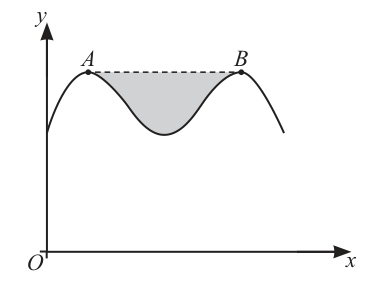
The diagram shows the curve with equation for . The maximum points on the curve are denoted by and , and the shaded region is bounded by the line segment and the curve.
Approach
To find the maximum points on the curve, differentiate with respect to , set , and solve the resulting trigonometric equation using the double angle identity . Then verify which solutions correspond to maximum points by checking the -values or the second derivative.
Working
Given:
Differentiate with respect to :
Set :
Apply the double angle identity :
Factorise:
This gives two cases:
For :
- or
Now find the -coordinates at each critical point:
At :
At :
At :
Since at , the points and are maximum points, and is a local minimum.
Therefore:
Answer
A = (π/6, 6) and B = (5π/6, 6)
Walkthrough
Step 1: Differentiate the curve equation.
We are given . To find stationary points, we need . Using the standard derivatives of and along with the chain rule for :
Step 2: Set the derivative to zero and apply a double angle identity.
Setting gives . The term prevents direct solving, so we use the double angle identity to express everything in terms of :
Step 3: Factorise and solve.
Factoring out gives . This splits into two simple equations: and . Within , these yield , , and .
Step 4: Find -coordinates and identify maxima.
Substituting each -value back into the original equation gives , , and respectively. The points with are the maxima (A and B), while gives a local minimum.
Key Takeaways
- Differentiating trigonometric functions requires the chain rule and standard derivative formulas.
- When a double angle term appears in a derivative, applying often allows factorisation.
- Always check all critical points and substitute back to determine which are maxima versus minima.
Common Mistakes
- Forgetting the chain rule when differentiating , giving instead of .
- Not using the double angle identity and attempting to solve directly without converting to a single angle.
- Finding all critical points but failing to distinguish maxima from the local minimum at .
- Using degrees instead of radians for the angles.
Things to Be Careful About
- The domain is , so only solutions within this range are valid.
- Angles must be expressed in radians as specified in the mark scheme.
- All three critical points (, , ) must be evaluated; omitting and incorrectly claiming the others are the only stationary points loses marks.
Approach
The shaded region is bounded above by the horizontal line segment (at ) and below by the curve , between and . The area can be found by computing the area of the rectangle with width and height , then subtracting the area under the curve between these -limits.
Working
Area under the curve from to :
Integrate term by term:
Evaluate at the upper limit :
Evaluate at the lower limit :
Area under the curve:
Area of the rectangle bounded by and the -axis:
The width is and the height is :
Shaded area:
Answer
4π - 6√3
Walkthrough
Step 1: Set up the integral for the area under the curve.
The curve runs from at to at . The area under the curve in this interval is:
Step 2: Integrate.
Using standard integration rules:
So the antiderivative is .
Step 3: Evaluate at the limits.
At : and , giving .
At : and , giving .
The area under the curve is .
Step 4: Find the shaded area by subtraction.
The shaded region lies between the horizontal line (the line segment ) and the curve. The rectangle from to with height has area . Subtracting the area under the curve:
Key Takeaways
- Integration of gives and integration of gives .
- When finding the area between a curve and a horizontal line, compute the rectangle area and subtract the area under the curve.
- Careful evaluation of trigonometric values at non-standard angles (like and ) is essential.
Common Mistakes
- Incorrect integration signs: , not .
- Sign errors when evaluating (second quadrant, cosine is negative).
- Forgetting to subtract the area under the curve from the rectangle area, giving as the final answer instead of .
- Using degrees instead of radians when evaluating trigonometric functions in the definite integral.
Things to Be Careful About
- The curve dips below between and , so the shaded area is the rectangle minus the area under the curve, not the other way around.
- Both -coordinates of and must be equal (both are ) for the horizontal line segment to form a proper rectangle with the -axis.
- The final answer is positive since and , confirming the area is valid.
Approach
Integrate the exponential terms term by term, evaluate the definite integral between the limits and , set the result equal to 5, then rearrange to isolate using the inverse relationship between and .
Working
Integrate each term:
Apply the limits and :
Set this equal to 5:
Take natural logarithms of both sides:
Answer
a = (1/2) ln(10 + (1/2)e^(-a) + (1/2)e^(-4a))
Walkthrough
We are told that the definite integral of from to equals 5, and we must show this leads to the given formula for .
First, integrate each term separately. Recall that . For , the factor from integration is , so we get . For , integration gives .
Next, evaluate the antiderivative at the upper limit and the lower limit , and subtract. At the upper limit we get . At the lower limit we get , because and . Subtracting, we must be careful with the minus sign: .
Combining like terms gives . Setting this equal to 5 and rearranging, we isolate , then multiply by 2 to get . Finally, since and are inverse functions, taking natural logs gives , and dividing by 2 gives the required expression.
Key Takeaways
This question tests integration of exponential functions of the form , the careful evaluation of definite integrals with limits involving a parameter, and the use of logarithms to solve for an unknown in an exponent. Understanding that is essential for the final step.
Common Mistakes
- Writing instead of — forgetting to divide by the coefficient of in the exponent.
- Sign errors when substituting the lower limit, especially for the term.
- Forgetting to distribute the minus sign when computing , which would give the wrong combination of terms.
- Not dividing by 2 at the end after taking logarithms.
Things to Be Careful About
- , not .
- The lower-limit substitution changes the sign of the term: contains , so subtracting contributes to the difference, which combines with the from the upper limit.
- Since this is a 'show that' question, all working must be shown — the mark scheme requires the necessary detail.
Approach
Define the function , obtained by rearranging the result of part (a). Evaluate at and . A change of sign between these values shows that the root lies between them.
Working
Evaluate at :
Evaluate at :
Since and , there is a change of sign, so the root lies between and .
Answer
1.0 < a < 1.2
Walkthrough
Part (a) established that the value of satisfies . To locate the root, define . The root is a zero of .
Evaluate at the two endpoints and . At , the value is approximately , which is negative. At , the value is approximately , which is positive. Since is continuous and changes sign between and , the zero (the value of ) must lie strictly between them.
Key Takeaways
This part applies the sign-change criterion for locating roots: if a continuous function takes opposite signs at two points, it has at least one root between them. This is the foundational idea behind numerical root-finding.
Common Mistakes
- Using the wrong function, e.g. evaluating at the two points without comparing to .
- Arithmetic errors when evaluating the exponentials.
- Concluding the result without showing both values and their signs.
Things to Be Careful About
- The mark scheme allows either the form above or comparing with ; both are acceptable.
- You must state that a change of sign justifies the conclusion that .
Use the iterative formula
to find the value of correct to 4 significant figures. Give the result of each iteration to 6 significant figures.
Approach
Apply the iterative formula repeatedly, starting from a value inside the interval found in part (b), such as . Record each iterate to 6 significant figures. Stop when successive iterates agree to the required 4 significant figures.
Working
Start with .
First iteration:
Second iteration:
Third iteration:
The iterates are , , (each to 6 significant figures). Since and agree to 4 significant figures, the value of correct to 4 significant figures is .
Answer
a = 1.159
Walkthrough
We use the iterative formula to refine the approximation of . A sensible starting value inside the interval is .
Substituting gives . Substituting this into the formula gives . One more iteration gives . The successive iterates are converging: , , .
To report the answer to 4 significant figures, we compare consecutive iterates. and both round to at 4 significant figures, so we conclude correct to 4 significant figures.
Key Takeaways
This part demonstrates how an iterative formula of the form produces a convergent sequence of approximations to a root, and how to decide when to stop iterating: when successive values agree to the required precision.
Common Mistakes
- Not showing enough iterations to justify the final answer (the mark scheme requires sufficient iterations or a sign change in ).
- Giving the answer to the wrong number of significant figures.
- Rounding intermediate values too aggressively, which can change the final digits.
Things to Be Careful About
- Each iteration result must be given to 6 significant figures as instructed.
- The final answer must be given to exactly 4 significant figures: .
- To be safe, iterate until two consecutive values agree to at least 4 significant figures, or verify a sign change in the interval .
A curve has equation .
Find an expression in terms of and for and hence find the gradient of the curve at the point for which .
Approach
Differentiate both sides of the curve equation implicitly with respect to , using the product rule for and the chain rule for . Then solve for . To find the gradient when , first substitute into the original equation to find the corresponding -value, then evaluate the derivative.
Working
Differentiate each term. For :
For :
Differentiating the whole equation:
Collect the terms:
Hence
When , substitute into the original equation:
So . Now substitute , into the derivative:
Answer
dy/dx = (7 - 10xy)/(5x^2 + 8e^(2y)); gradient at y = 0 is 1/4
Walkthrough
The curve is defined implicitly, so we differentiate both sides with respect to rather than trying to rearrange for first. The term is a product of and , so it needs the product rule: differentiate to get , keep , then keep and multiply by because is a function of . The term needs the chain rule: the derivative of with respect to is , and multiplying by gives . Differentiating gives , and the constant differentiates to . Collect all terms on one side and factor them out. Then divide by the coefficient to get the required expression.
To find the gradient at , first find the corresponding -value by substituting into the original equation. This gives , so . Then substitute and into the derivative: the numerator is , the denominator is , so the gradient is .
Key Takeaways
Implicit differentiation is needed when is not written explicitly in terms of . Remember to multiply by whenever you differentiate a term containing . The product rule and chain rule often appear together in implicit differentiation. To evaluate a derivative at a point, you may need to find the missing coordinate from the original equation.
Common Mistakes
- Forgetting the factor when differentiating terms involving , especially .
- Using the product rule incorrectly on ; some candidates differentiate as if it were .
- Substituting into the derivative without first finding the corresponding -value.
- Sign errors when collecting terms: the derivative equation should give .
Things to Be Careful About
- The mark scheme requires evidence of implicit differentiation, so show the factors explicitly.
- When , , not .
- The final gradient must be simplified; should be written as .
Show that there is no point on the curve at which the tangent is parallel to the -axis.
Approach
A tangent parallel to the -axis is vertical, so would be undefined. This happens only if the denominator of the derivative expression is zero. Show that the denominator can never be zero.
Working
From part (a),
For a vertical tangent, the denominator must be zero:
But for all real and ,
Therefore
for all real and . The denominator is never zero, so is always defined and the tangent is never parallel to the -axis.
Answer
There is no point on the curve at which the tangent is parallel to the -axis, because for all real and .
No such point exists, since 5x^2 + 8e^(2y) > 0 for all real x and y.
Walkthrough
A tangent parallel to the -axis is vertical, meaning its gradient is infinite, i.e. is undefined. From the derivative expression, this can only happen when the denominator is zero. We examine this expression. The term is a square multiplied by a positive constant, so it is always greater than or equal to zero. The term is always strictly positive because the exponential function is positive for every real input. Therefore their sum is always strictly positive, never zero. Since the denominator can never vanish, the derivative is always finite and no vertical tangent exists.
Key Takeaways
A vertical tangent corresponds to an undefined derivative, which for a quotient expression means the denominator is zero. Exponential functions are always positive, and squares are always non-negative. Combining these facts can prove that an expression is never zero.
Common Mistakes
- Trying to set the numerator equal to zero instead of the denominator; that would find horizontal tangents, not vertical ones.
- Forgetting that is strictly positive for all real .
- Assuming could make the denominator zero; even if , the term remains positive.
Things to Be Careful About
- The mark scheme says the argument must use the denominator of the derivative, not the derivative evaluated at . The statement must hold for all points on the curve.
- If a candidate had a different but equivalent denominator of the form with , the same positivity argument applies.