Mathematics 9709/21 — October/November 2025
Cambridge AS Level · Pure Mathematics 2 · worked solutions for every part, with the mark scheme
Topics Integration · Logarithmic and Exponential Functions · Algebra · Trigonometry · Differentiation · Numerical Solution of Equations
Find .
Approach
Use the double-angle identity to rewrite in the form , then integrate each term.
Working
Start from the identity:
Rearrange to make the subject:
Multiply by 6:
Therefore:
Integrate term by term:
Answer
3x - (3/2) sin 2x + c
Walkthrough
We need to integrate . There is no direct standard integral for , so we rewrite it using the double-angle identity.
The identity can be rearranged to give
Multiplying by 6 gives
This is exactly the form required by the mark scheme. Now we integrate each term separately:
and
Adding the constant of integration gives
The mark scheme awards M1 for using the identity, A1 for obtaining , and A1 for the final integrated form.
Key Takeaways
- The identity is essential for integrating .
- When integrating , the result is .
- Always include the constant of integration for indefinite integrals, even though the mark scheme condones its omission here.
Common Mistakes
- Using the incorrect identity, such as .
- Forgetting to divide by 2 when integrating , giving instead of .
- Omitting the constant of integration; this is condoned by the mark scheme but is still a common error in other contexts.
- Sign errors when rearranging the identity.
Things to Be Careful About
- The factor of 2 inside must be accounted for during integration.
- The mark scheme condones omission of , but including it is always safer.
- Make sure the integrand is fully simplified to before integrating.
Solve the equation .
Approach
Let . Since for all real , any valid solution must have . Substitute into the equation to obtain a quadratic in , solve it, reject the negative root, and then take natural logarithms to find .
Working
Let . Then
Expand and rearrange:
Factorise:
Hence
Since , the solution is impossible. Therefore
Take natural logarithms of both sides:
So
Approximately, . There is no other solution, because cannot equal .
Answer
x = (1/2) ln 12 ≈ 1.24
Walkthrough
We start by noticing that the equation contains in two places: once as a factor and once inside the bracket. This suggests treating as a single unknown. Let . Then the equation becomes , which is a quadratic equation in .
Expand to get . Factorising gives , so the possible values are and . However, is always positive because an exponential function with base is positive for every real input. Therefore is impossible, and we keep only .
Now solve . Taking the natural logarithm of both sides gives , so . This is approximately .
Key Takeaways
This question tests the ability to recognise a quadratic in an exponential equation. The key idea is to substitute , solve the resulting quadratic, and then use logarithms to solve for . It also reinforces the important fact that is never zero or negative, so any negative solution for the exponential term must be rejected.
Common Mistakes
- Forgetting to reject . This would lead to attempting , which has no real solution.
- Solving and writing instead of . The factor of in the exponent must be divided out.
- Making a sign error when expanding: gives , not .
- Giving only a decimal approximation without the exact logarithmic form. The mark scheme requires the exact answer .
Things to Be Careful About
- Remember that for all real , so negative values of are impossible.
- When taking natural logarithms, apply them correctly: , because and are inverse functions.
- The final answer should be , with the decimal given only as an approximation.
- If factorisation is not obvious, the quadratic formula could also be used, but factorising is the most direct way to earn the marks.
Approach
The modulus equation has two cases: the expressions inside the moduli may be equal, or they may be opposites. Solve each linear equation, then check that the values satisfy the original equation.
Working
Case 1: the expressions are equal.
Subtract from both sides:
Subtract 2:
So
Case 2: the expressions are opposites.
Add to both sides:
Add 3:
So
Both values satisfy the original equation.
Answer
x = -5/3 or x = 1/7
Walkthrough
Start by recognising that the absolute value of two expressions is equal when the expressions themselves are equal or when they are negatives of one another. In Case 1, set , solve for and obtain . In Case 2, set , which gives . Both values can be substituted back into the original modulus equation to confirm they work. This case-splitting method avoids the need to square both sides and keeps the working simple.
Key Takeaways
A modulus equation of the form can be solved by writing or . Each linear equation gives a candidate solution. This is one of the core techniques for solving modulus equations.
Common Mistakes
A common error is to solve only and forget the opposite-sign case . Another common error is to make a sign error when expanding . It is also easy to state approximate decimals when exact fractions are expected.
Things to Be Careful About
Always use both modulus cases. After solving, check each candidate by substitution, although for simple linear cases and no squaring both candidates are normally valid. Keep the answer in exact form, or , unless an approximation is requested.
Approach
Use the values of found in part (a) with . This gives possible values of ; convert them to using , reject impossible values, then find the unique angle in .
Working
From part (a), or . Let . Then
Using , the first possibility gives
and the second gives
This second equation has no real solution because .
So solve
for . The reference angle is
In the interval , is negative only in the third quadrant, so
Correct to 3 significant figures,
Answer
theta = 4.07 radians (3 s.f.)
Walkthrough
The original equation in part (b) is exactly the same modulus equation as in part (a) if we set . Therefore the possible values of are and . Since , these become and . The second is impossible because cosine must lie between and . For , take the reference angle radians. In the interval , cosine is negative only in the third quadrant, so the required angle is , which is approximately radians, rounded to .
Key Takeaways
When an equation is obtained by substituting a trigonometric function for a variable, the same algebraic roots are used. The reciprocal identity changes the equation into a standard cosine equation. A solution such as must be rejected using the range of cosine. The interval determines which quadrant gives the final angle.
Common Mistakes
A common mistake is to try to solve instead of rejecting it. Another is to forget that the interval is and give the principal solution radians, which is not in the interval. Some students also finish with an exact expression instead of a value correct to 3 significant figures, or give the angle in degrees. The mark scheme condones degrees only for the process mark, but the final answer must be in radians.
Things to Be Careful About
Use the result from part (a) correctly: stands for , so the candidates are and . Check the range of before continuing. Determine the correct quadrant: in , is negative only in the third quadrant. Round only at the end, to 3 significant figures, giving .
Solve the equation for .
Approach
Use and the compound-angle formula for to rewrite the equation in terms of only. Then solve the resulting quadratic for and find the corresponding angles in the given range.
Working
Let . Since and
the equation becomes
Multiplying by :
Using the quadratic formula:
Thus
Both values are positive, so both give angles in :
Answer
θ = 12.8° and 32.2° (no others in the given range)
Walkthrough
Start by rewriting as , because the equation mixes cotangent and tangent. Then use the compound-angle formula for :
Since , this substitution is straightforward. Substituting into the original equation gives an equation only in . Let and multiply through by to clear denominators. The result is a quadratic . Solve it with the quadratic formula. Both roots are positive, so both correspond to angles in the first quadrant. Take inverse tangent to get the two angles. Because is one-to-one on , each positive value of gives exactly one solution, so there are no additional solutions.
Key Takeaways
This question tests rewriting trigonometric functions in terms of a single function, using compound-angle identities, and solving a quadratic in . It also reinforces that within a restricted range, each value of corresponds to exactly one angle.
Common Mistakes
- Forgetting and mishandling the compound-angle formula.
- Incorrectly simplifying the fraction .
- Making a sign error when multiplying out .
- Forgetting to check that both roots of the quadratic give angles in the specified range.
- Using degrees/radians mode incorrectly when computing inverse tangent. Since the question is in degrees, the calculator must be in degree mode.
Things to Be Careful About
- The original equation is undefined when or when is undefined (i.e. ). The obtained roots avoid these values, so no solutions are lost or introduced.
- The mark scheme requires showing the quadratic equation before solving; an unsupported answer would not earn full marks.
- Give answers to the required accuracy: and (or better).
- Since the range is , the tangent function is positive and one-to-one, so there are exactly two solutions.
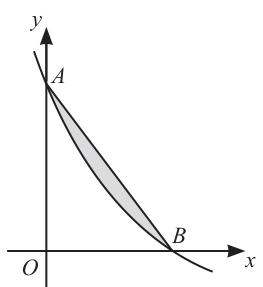
The diagram shows the curve with equation . The curve meets the axes at the points and . The shaded region is bounded by the curve and the line segment .
Approach
Since lies on the -axis, its -coordinate is . Set the curve equation equal to and solve for by isolating the exponential and then applying the natural logarithm, using the law to simplify.
Working
Set :
Add to both sides and divide by :
Take natural logarithms of both sides:
Hence:
Apply the law :
Multiply through by :
Answer
x = 6 ln 2
Walkthrough
Point is the -intercept of the curve, so we need the value of that makes . We begin by setting the equation and rearranging until the exponential stands alone on one side. This gives . To peel away the exponential we take the natural logarithm of both sides; the rule lets us strip the left side down to , and on the right we have . Multiplying through by then gives . Finally, the power law for logarithms, , converts to , so .
Key Takeaways
- An -intercept is found by setting in the curve's equation.
- Isolating and then taking of both sides is the standard way to solve an exponential equation.
- The law is used to tidy up integer powers inside the logarithm.
Common Mistakes
- Forgetting to apply the minus sign correctly when writing instead of .
- Forgetting the power-of-2 step and leaving the answer as rather than the required .
- Dividing by incorrectly (e.g. dropping the sign) and obtaining a negative .
Things to Be Careful About
- Because the question says "show that", the working must explicitly display the use of (or an equivalent such as ) — the mark scheme requires this step to be visible for full credit.
- Make sure the chain of equals signs is complete: is the cleanest form to write.
Find the area of the shaded region. Give your answer in the form , where and are positive integers.
Approach
Find the -intercept to locate . The shaded region is the part of triangle lying above the curve, so its area is the area of triangle minus the area under the curve from to . Integrate the curve using the standard result .
Working
Locate by setting in the curve equation:
So and . The line together with the two axes forms the right-angled triangle with legs and . Its area is:
Integrate the curve. With :
Evaluate from to :
Simplify the exponential term using :
This is the area under the curve from to . The shaded region (the part of the triangle above the curve) is the triangle area minus the curve area:
Answer
27 ln 2 - 14
Walkthrough
First identify the two vertices of the shaded region. Point is the -intercept: substitute into the curve to get , so . Point was found in part (a) as . The straight line together with the two coordinate axes encloses a right-angled triangle whose legs are and , giving triangle area .
The shaded region is the small lens-shaped area between the chord and the curve. Because the curve is convex (it bends upward), it lies below the straight line on . Therefore the shaded area is the area of triangle minus the area between the curve and the -axis. The latter is found by definite integration of from to .
The integral uses the standard rule with , giving ; combined with the antiderivative is . Substituting the upper limit produces , so that term becomes . Combined with and subtracting the lower-limit value , the area under the curve evaluates to .
Subtracting: , which has the required form with and .
Key Takeaways
- For a convex curve beneath a chord, the area between chord and curve equals (area under chord) (area under curve). Here "area under the chord" is the triangle area because the chord meets the axes.
- The standard integral is the workhorse; remember the division by the coefficient in the exponent.
- (and ) is the key simplification when limits involve expressions.
Common Mistakes
- Integrating as (forgetting the division by ) and getting the wrong antiderivative.
- Treating the shaded area as the area under the curve rather than the area between the curve and the line , which would give the wrong sign.
- Evaluating incorrectly (e.g. as instead of ).
- Forgetting to subtract the lower-limit contribution, dropping the term and obtaining as the final answer instead of just an intermediate value.
Things to Be Careful About
- The mark scheme explicitly states the integration step and the substituted form must be shown; skipping these intermediate lines loses method marks.
- The final answer must be left in the form with positive integers and — a decimal answer is acceptable for working but not for the final box.
- The triangle-area mark (M1) may be earned with decimal equivalents (e.g. ) but the final simplification must be exact.
A curve has parametric equations
for .
Approach
Differentiate and with respect to the parameter , then use
and simplify using .
Working
Differentiate :
Differentiate :
Therefore,
Using :
Hence,
Answer
dy/dx = 6 cos^5 theta - 5 cos^3 theta
Walkthrough
We are given and in terms of the parameter , so we first differentiate both with respect to .
For , the derivative is .
For , differentiate term by term. The derivative of is . For , apply the chain rule:
So .
The parametric formula is
Dividing by is the same as multiplying by , which gives . To write this in terms of only, replace with . Expanding gives , as required.
Key Takeaways
This question tests parametric differentiation, the chain rule, and the Pythagorean identity . You should be comfortable differentiating , and powers of , and then converting a parametric derivative into a single-variable expression.
Common Mistakes
- Forgetting to divide by when forming .
- Differentiating incorrectly, for example omitting the factor or the factor .
- Stopping at without using the identity to reach the requested form. Since this is a show that question, the mark scheme requires the necessary simplification detail.
Things to Be Careful About
- The derivative formulae for trigonometric functions assume is measured in radians.
- The range means is positive, but the simplification here does not depend on that sign.
- Do not quote the final answer without showing the intermediate step .
Find the equation of the normal to the curve at the point where it crosses the -axis. Give your answer in the form , where and are exact constants.
Approach
Find the value of where , substitute it into and into , then use the negative reciprocal of the gradient for the normal.
Working
On the -axis, :
Since , , so
Thus .
At this point,
so the point is .
From part (a),
At , with :
The gradient of the normal is the negative reciprocal of the curve gradient:
Using with :
Answer
y = sqrt(2)x - sqrt(2)
Walkthrough
The curve crosses the -axis where . Factorise as . Since , is never zero, so the only possibility is . This gives , and in the given range .
Substitute into to get , so the crossing point is .
Use the derivative from part (a) to find the gradient of the curve at this point. Since , the gradient is .
The normal is perpendicular to the tangent, so its gradient is the negative reciprocal, . Finally, use the point-slope form with to get .
Key Takeaways
This question combines parametric differentiation with curve analysis: finding where a parametric curve crosses an axis, evaluating the gradient at that point, and using perpendicular gradients to find a normal.
Common Mistakes
- Forgetting that in the given range and incorrectly taking as a solution.
- Using degrees for when substituting into the derivative. The mark scheme allows degrees when first solving , but the final value must be converted to radians before differentiating.
- Using the curve gradient instead of its negative reciprocal for the normal.
- Forgetting to find the -coordinate of the point.
Things to Be Careful About
- The exact value must be used carefully with powers: and .
- The final equation must be in the form with exact constants, so write rather than a decimal approximation.
- The normal gradient is , not .
The polynomial is defined by
where is a constant. It is given that is a factor of .
Approach
Since is a factor of , the factor theorem gives . Substitute into the polynomial and solve for .
Working
Answer
k = 4
Walkthrough
Because is a factor, the factor theorem says . Substitute into every term: , , , , and the constant . Setting the sum equal to zero gives , which simplifies to . Solving gives .
Key Takeaways
This part tests the factor theorem: if is a factor of a polynomial , then . Substituting the root turns the factor condition into an equation for an unknown coefficient.
Common Mistakes
- Substituting instead of .
- Making sign errors with and .
- Not simplifying the constants correctly before solving for .
Things to Be Careful About
The factor theorem requires , not . Keep the signs of the powers of separate: even powers are positive, odd powers are negative.
It is given that the equation has exactly two real roots, denoted by and , where is an integer and is not an integer.
State the value of and show that satisfies the equation .
Approach
With , factorise using the known factor . The integer root is . Divide the quartic by to obtain a cubic, then rearrange the cubic to the required form.
Working
Since ,
Because is a factor, one real root is , so
Divide by :
Thus the remaining roots satisfy
Rearrange:
So satisfies the required equation.
Answer
alpha = -2; beta satisfies x = cube root(-2x - 4.5)
Walkthrough
With found in part (a), the polynomial is . Since is a factor, is a root, so . To find the other factor, divide the quartic by . The quotient is , so . The remaining roots satisfy . Rearranging, , then , and finally .
Key Takeaways
This part combines the factor theorem with polynomial division. Once a linear factor is known, dividing gives the remaining polynomial factor. It also practices rearranging a cubic equation into an iterative form.
Common Mistakes
- Forgetting that is the integer root already given by the factor.
- Making errors in polynomial division, especially because the quotient has no term.
- Not showing the full rearrangement to the cube-root form; this is an answer-given question, so all necessary detail must be shown.
Things to Be Careful About
When dividing, the and terms cancel, so the quotient is , not . Also, dividing the whole equation by 2 gives , not .
Approach
Let . Since is a root of , evaluate at and ; a sign change between these values locates the root.
Working
Since is continuous and , the root lies in the interval .
Answer
-1.4 < beta < -1.0
Walkthrough
We know satisfies . To show lies between and , evaluate at both ends. and . Since is a polynomial, it is continuous, so a sign change over the interval guarantees at least one root between and . Therefore .
Key Takeaways
The sign-change rule is a quick way to locate a real root of a continuous function. A polynomial is always continuous, so a sign change between two values is sufficient to conclude a root lies between them.
Common Mistakes
- Evaluating at instead of .
- Using incorrectly.
- Concluding a root exists without stating that the function is continuous.
Things to Be Careful About
Keep the signs correct: is negative. The sign change must be between the two specified endpoints, and the conclusion should state that the root lies in the interval.
Use an iterative formula, based on the equation in part (b), to find the value of correct to 3 significant figures. Give the result of each iteration to 5 significant figures.
Approach
Use the fixed-point iteration , starting from from part (c). Iterate until successive values agree to 5 significant figures, then round the converged value to 3 significant figures.
Working
Let
Starting with :
| (5 s.f.) | |
|---|---|
| 0 | |
| 1 | |
| 2 | |
| 3 | |
| 4 | |
| 5 | |
| 6 | |
| 7 | |
| 8 | |
| 9 |
The iterates converge to (5 s.f.), so correct to 3 significant figures:
Answer
beta = -1.26
Walkthrough
Use the iterative formula from part (b), , with a starting value in the interval found in part (c), say . Repeatedly apply the formula, keeping each result to 5 significant figures. The values settle around to 5 s.f. Since the successive 5 s.f. values agree, the iteration has converged sufficiently. Rounding to 3 significant figures gives .
Key Takeaways
This part tests fixed-point iteration: rearranging an equation as and repeatedly applying . The iteration converges when successive approximations agree to the required precision.
Common Mistakes
- Rounding each iteration to too few figures, which can prevent convergence to the required accuracy.
- Stopping before consecutive 5 s.f. values agree.
- Giving the final answer to 5 s.f. instead of 3 s.f.
Things to Be Careful About
Use the exact iterative formula from part (b). The final answer must be exactly 3 significant figures: . Show enough iterations to justify the convergence.
The equation of a curve is .
Find the exact coordinates of the stationary point of the curve.
Approach
Use the product rule to differentiate . The first factor is and the second is ; both need the chain rule. Set the derivative equal to zero, solve for , then substitute back to find .
Working
Let
Differentiate using the product rule:
Simplify:
At a stationary point, :
Since , divide through by and multiply by :
Substitute into :
Answer
x = 7/12, y = 2 sqrt(3) e^(-1/6)
Walkthrough
This question asks for the stationary point of a curve, so the key idea is that at a stationary point the gradient is zero: .
The function is a product of two functions of : and . Therefore the product rule is the natural first step. Because the exponent and the expression are not simply , each factor must also be differentiated using the chain rule.
Differentiating gives . Differentiating gives . Multiplying by the factor 4 gives the second term .
Setting the derivative to zero, the factor is never zero, so it can be cancelled. The remaining equation involves powers of . Multiplying through by clears the negative power and gives a simple linear equation. Solving gives , so .
Finally, substitute this -coordinate into the original equation to find the exact -coordinate. The exponential simplifies to and the square root simplifies to , giving .
Key Takeaways
- A stationary point occurs where .
- The product rule is needed when differentiating a product of two functions.
- The chain rule is needed for composite functions such as and .
- Exact values often require simplifying powers and exponentials carefully.
Common Mistakes
- Forgetting the chain rule when differentiating or .
- Missing the factor when differentiating the product, or dropping the factor from the derivative of .
- Trying to set ; this exponential is never zero.
- Stopping after finding and not substituting back to find the -coordinate.
- Giving a decimal instead of the exact form required.
Things to Be Careful About
- The derivative must be written as a sum of two terms; both terms must be present.
- When solving, multiply by rather than dividing by to avoid sign errors.
- Check that at the stationary point; here , so the square root is real.
- The final coordinates must be exact, using and , not rounded decimals.