Mathematics 9709/15 — October/November 2025
Cambridge AS Level · Pure Mathematics 1 · worked solutions for every part, with the mark scheme
Topics Quadratics · Coordinate Geometry · Series · Trigonometry · Differentiation · Integration · +2 more
A circle has centre and radius 10.
Approach
The equation of a circle with centre and radius is
Substitute the given centre and radius into this standard form.
Working
The centre is and the radius is , so
Expanding gives the equivalent form:
Answer
(Equivalently, .)
(x-2)^2 + (y-6)^2 = 100
Walkthrough
A circle is the set of all points that are exactly a distance from its centre . If a point is on the circle, the distance from to is , so the equation is
Here we are told the centre is and the radius is , so , and . Substituting these values gives
That is the standard equation, and the mark scheme accepts it in this form, or expanded as
Key Takeaways
- The general equation of a circle requires the centre and the radius.
- The right-hand side is , not .
- The signs inside the brackets are opposite to the coordinates of the centre.
- Expanding the completed-square form must produce matching coefficients for , and the constant.
Common Mistakes
- Writing instead of on the right-hand side.
- Using or instead of and .
- Expanding incorrectly: for example, writing as instead of .
- Omitting the -coordinates entirely.
Things to Be Careful About
The radius must be squared. When expanding, the constant is , so the equation becomes
which simplifies to
The mark scheme gives B1 for two correct components and B2 for all three components of the equation.
Approach
A point lies on the circle exactly when its coordinates satisfy the circle equation. Substitute and into the equation from part (a) and solve the resulting equation for .
Working
The circle equation is
Substitute :
Simplify:
Subtract :
Take square roots:
Therefore
(Expanding gives , i.e. , leading to the same values.)
Answer
k = 14 or k = -2
Walkthrough
We know that lies on the circle, so its coordinates must satisfy the circle equation from part (a):
Substitute and :
The first term is , so:
Subtract from both sides:
Taking square roots, remember that both positive and negative square roots are possible:
Therefore
Geometrically, the vertical line meets the circle in two points: one above the centre and one below it.
Key Takeaways
- A point is on a curve only if its coordinates satisfy the curve's equation.
- Substituting a known coordinate gives an equation in the unknown coordinate.
- Solving requires the sign, producing two values.
- The two answers correspond to the two intersections of the vertical line with the circle.
Common Mistakes
- Forgetting to square the radius: using is correct, not .
- Taking only the positive square root and missing .
- Rearranging incorrectly: , not with only one sign.
- If using expansion, making a sign error in forming .
Things to Be Careful About
Since is a square, can be or . This gives two different points on the same vertical line. If you write only the two answers without any working, the mark scheme awards only SC B2 for part (b), so show the substitution and the simplification to gain the method marks.
A geometric progression has first term and second term .
Find the common ratio of the geometric progression. Give your answer in the form , where is an integer to be found.
Approach
The common ratio of a geometric progression is the quotient of any term by the previous term: . The denominator contains a surd, so rationalise it by multiplying numerator and denominator by the conjugate , then simplify to the required form.
Working
Let the first term be and the second term be .
Rationalise the denominator:
Expand the numerator:
Expand the denominator using the difference of two squares:
Therefore
So .
Answer
r = sqrt(2) - 1, p = -1
Walkthrough
We are given the first two terms of a geometric progression. In a geometric progression, each term is obtained from the previous one by multiplying by a fixed common ratio . Therefore the common ratio is found by dividing the second term by the first term: .
The denominator is a surd, so the answer has not yet been written in a useful form. To simplify it, multiply both the numerator and denominator by the conjugate of the denominator, . This uses the identity , so the denominator becomes .
The numerator expands term by term: , , , and . Adding these gives .
Since the denominator is , the whole fraction simplifies to , which is more neatly written as . Comparing this with gives .
Key Takeaways
- The common ratio of a geometric progression is found by dividing any term by the previous term.
- Rationalising a denominator with a surd means multiplying top and bottom by the conjugate.
- The difference of two squares is the key to removing a surd from a denominator such as .
Common Mistakes
- Multiplying only the numerator by the conjugate and not the denominator; this changes the value.
- Sign errors when expanding , not .
- Forgetting that the denominator is negative, so the final simplification is , not with the wrong sign.
- Not showing the rationalisation process clearly; the mark scheme requires the process to be visible.
Things to Be Careful About
- The answer must be exact and in the required form , so ensure the final fraction has been fully simplified.
- Check the sign carefully when simplifying ; each term is divided by .
Approach
A geometric progression has a sum to infinity only when . Its sum is . Here and from part (a). Substitute these values and rationalise the result.
Working
Check that the series converges:
Substitute into the formula for the sum to infinity:
Rationalise by multiplying numerator and denominator by :
Expand the numerator:
Expand the denominator:
Therefore
Answer
7 + 11√2/2
Walkthrough
For a geometric progression, the sum to infinity exists only if the common ratio satisfies . Here , and since , , which is less than . Therefore the series converges.
The sum to infinity formula is , where is the first term. Substituting and gives
It is essential to keep the brackets around : . If the brackets are missed, the expression becomes , which is wrong.
The resulting fraction has a surd in the denominator, so multiply numerator and denominator by the conjugate . The numerator becomes and the denominator becomes . Hence
which is equivalent to .
Key Takeaways
- A geometric progression has a finite sum to infinity only when the common ratio satisfies .
- The formula for the sum to infinity is .
- Rationalising is also useful when applying the sum-to-infinity formula if the common ratio contains a surd.
Common Mistakes
- Forgetting to check whether before using the sum-to-infinity formula.
- Omitting the brackets in , which changes the denominator from to .
- Making sign errors when rationalising ; the result is not negative.
- Not simplifying the final answer to the printed equivalent forms or .
Things to Be Careful About
- The mark scheme allows follow-through from part (a), but only if has been evaluated and satisfies .
- Do not condone missing brackets unless the substitution correctly uses them later in the calculation.
- Equivalent answers are accepted, but it is safest to write the form with the rationalised denominator.
Approach
Complete the square on . Because the coefficient of is , factor out of the and terms before completing the square inside the brackets.
Working
Complete the square inside the bracket:
Therefore,
Thus
Answer
with , and .
a = 4, b = 5/4, c = -1/4
Walkthrough
We need to rewrite the quadratic in completed-square form. Because the leading coefficient is , we cannot simply take half of ; instead, factor out of the and terms first. This leaves inside the bracket. To complete the square, use
so
Multiplying by the outer gives . Adding the original constant gives
Thus the required constants are , and .
Key Takeaways
Completing the square reorganises a quadratic into a perfect square plus a constant. When the coefficient of is not , factor it out before completing the square. The constants , and can then be read directly from the final form.
Common Mistakes
- Forgetting to factor out the leading coefficient before halving the coefficient of , which gives the wrong value of .
- Sign errors when subtracting the squared half-coefficient inside the bracket.
- Arithmetic errors when combining and .
- Not simplifying to a single rational constant for .
Things to Be Careful About
The bracket must contain , not . Also, expanding the final answer is a quick way to catch sign mistakes. Decimals are allowed by the mark scheme, but exact fractions are safer.
The curve with equation and the line have exactly one point of intersection.
Using your answer to part (a) or otherwise, state the value of the constant .
Approach
The completed-square form shows the curve is a parabola with vertex at and minimum value . A horizontal line has exactly one intersection with the parabola precisely when it passes through the vertex. Therefore equals the minimum value.
Working
From part (a),
Since
the minimum value of is , occurring at .
The horizontal line meets the curve exactly once when it touches the vertex, so
Answer
k = -1/4
Walkthrough
From part (a), the curve can be written as . Because a square cannot be negative, the smallest possible value of is , which occurs when . Therefore the lowest point on the parabola has -coordinate .
A horizontal line intersects the curve at points satisfying
i.e.
The left-hand side is zero only at the vertex; on either side of the vertex it is positive and gives two intersections. Hence there is exactly one intersection exactly when , so .
Key Takeaways
The completed-square form immediately identifies the vertex of a parabola. For a positive leading coefficient, the constant term in is the minimum value. A horizontal line meets a parabola exactly once only when it touches the vertex.
Common Mistakes
- Stating instead of : the question asks for the -value of the line, not the -coordinate of the point.
- Using an incorrect value of from part (a) without following through.
- Thinking the line must have gradient or involve .
Things to Be Careful About
The phrase "exactly one point of intersection" means the line is a tangent at the vertex for this curve, so is the minimum value of . If part (a) was answered with a different completed-square form, should be the corresponding constant. The answer may also be written as .
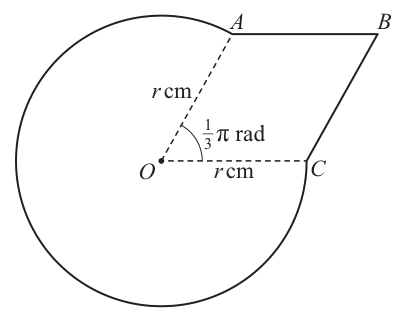
The diagram shows the design for a company’s new logo. The sector of the circle, centre , has radius . The acute angle radians. The quadrilateral is a rhombus.
Approach
The perimeter of the design is the major arc together with the two sides and of the rhombus. Find the reflex angle at , apply the arc length formula , then add the two rhombus sides (each of length because all four sides of a rhombus are equal).
Working
The reflex angle at — the central angle subtended by the major arc — is:
The length of the major arc is:
Since is a rhombus, all four sides are equal. The two radii and both have length , so:
The perimeter of the design is the major arc plus sides and :
Answer
5πr/3 + 2r cm
Walkthrough
The design's boundary has three parts: the major arc , side , and side . The key recognition is that the major (long) arc is the one on the boundary, not the minor arc.
The minor sector at has central angle , so the major sector (and its arc) corresponds to the reflex angle:
The arc length formula (with in radians) gives the major arc length:
Because is a rhombus, all four sides are equal. The two radii and are both length , so the remaining sides and also have length . Adding the three pieces of the boundary:
Key Takeaways
- The major arc corresponds to the reflex angle at the centre.
- In a rhombus, all four sides are equal.
- The arc length formula requires the angle in radians.
Common Mistakes
- Using the acute angle for the arc length instead of the reflex angle — that would compute the minor arc.
- Forgetting to add both rhombus sides and .
- Treating and as part of the design's boundary — only the major arc (not the radii) is on the boundary.
Things to Be Careful About
- The final answer must be exact (in terms of and ), not a decimal approximation.
- Reflex angles are minus the acute angle, since angles around a point sum to .
It is now given that the perimeter of the design is .
Find the area of the design. Give your answer to 3 significant figures.
Approach
Set the perimeter expression from part (a) equal to and solve for . Then the design's area is the sum of two pieces: the major sector (with central angle ) and the entire rhombus . The rhombus area is found by splitting the rhombus along diagonal into two congruent triangles, each with two sides of length and included angle .
Working
Setting the perimeter equal to :
Solving for :
Major sector area (central angle ):
Rhombus area (split by diagonal into triangles and , each with sides , and included angle ):
Total design area:
To significant figures:
Answer
2660 cm² (3 s.f.)
Walkthrough
With the perimeter expression from part (a), we first recover the radius :
The design consists of two pieces: the major sector of the circle (with central angle ) and the entire rhombus . The two pieces share the chord as a common edge, but the chord is interior to the design (the boundary consists only of the major arc and the two rhombus sides , ). Adding the two areas gives the design's area.
Major sector area. Using with :
Rhombus area. A rhombus can be split along a diagonal into two congruent triangles. The diagonal produces triangles and , each with two sides of length and the included angle (the angle at in the rhombus and the equal opposite angle at ). Each triangle has area , so the rhombus area is:
Total. Adding the two pieces:
Key Takeaways
- The major sector area uses the reflex angle in .
- A rhombus with side and interior angle has area (or equivalently, two triangles each of area split along a diagonal).
- is an exact value that should be used.
- The design consists of the major sector plus the entire rhombus; the chord lies inside the design.
Common Mistakes
- Using instead of for the central angle of the major sector.
- Confusing with .
- Only adding the triangle (the half of the rhombus outside the circle) and ignoring the triangle that lies inside the major segment, giving instead of .
- Forgetting to round the final answer to significant figures.
Things to Be Careful About
- The reflex angle of the major sector is , not .
- The rhombus consists of two triangles: (inside the circle) and (outside the circle). Both must be included because the design's interior extends across the chord — the part of the disk in the major segment is in the design, and the triangle sticking out of the circle is also in the design.
- The final answer must be given to significant figures, as the question explicitly requires.
Solve the equation
Approach
Multiply both sides by to clear the fraction, then treat the result as a quadratic in . Factorise to find , then take cube roots to recover .
Working
Since , multiply each term by :
Let . Then:
Factorise:
So or . Replacing with :
Taking cube roots:
Answer
x = 1 or x = 3
Walkthrough
The equation contains the reciprocal term , which makes it awkward to solve directly. The first step is to multiply every term by ; this is valid because (otherwise the fraction would be undefined). After multiplication the equation becomes the polynomial .
Notice that this is really a quadratic in disguise: if we let , then . Substituting gives , a standard quadratic we can solve. Factorising: , so and .
Finally, undo the substitution. Since was , we solve and . The real cube root function is one-to-one, so each equation gives exactly one real value: and .
Key Takeaways
This question shows how to recognise an equation that is quadratic in a function of : after multiplying by , the expression is a quadratic in . The substitution turns it into a familiar quadratic. It also reinforces that taking cube roots is a safe step for real numbers because every real number has exactly one real cube root.
Common Mistakes
- Failing to multiply every term by , especially the constant term , giving an incorrect equation such as .
- Not recognising the quadratic-in- structure and trying to solve the original equation by inspection.
- Omitting the factorisation step; the mark scheme requires a valid method for solving the quadratic (factorisation, formula, or completing the square).
- Writing or ; for real equations with cube terms there are no negative roots because has only the real root .
Things to Be Careful About
- Since appears in the denominator, is not in the domain; multiplication by is still valid.
- When substituting , remember to convert back from to ; do not stop at and .
- The mark scheme awards the final mark for the correct values and with valid working ( means 'with wrong working'), so show all steps clearly.
Approach
Use the identity to rewrite , then multiply through by . Apply and rearrange into the required quadratic form.
Working
Start with
Since , the equation becomes
Multiply through by :
Use :
Expand and simplify:
Rearrange:
Answer
6cos^2θ - cosθ - 2 = 0
Walkthrough
We are given the equation and asked to show it can be written in a quadratic form in . The first step is to rewrite as , using . This puts the equation in terms of sine and cosine only.
Next, multiply every term by to clear the denominators. This is valid because the original equation is only defined when .
Then use the Pythagorean identity to replace with . This is the key step that changes the equation into one involving only .
Finally, expand the bracket, simplify, and rearrange to obtain the required form.
Key Takeaways
- The identity lets us rewrite tangent in terms of sine and cosine.
- The identity is used to convert between sine-squared and cosine-squared.
- Multiplying through by a denominator is a standard way to clear fractions.
Common Mistakes
- Writing incorrectly as instead of .
- Forgetting to multiply every term by , leaving an incomplete equation.
- Making a sign error when rearranging into the final quadratic form.
Things to Be Careful About
- The final answer is given, so every step must be shown; an unsupported jump would not earn the marks.
- The mark scheme requires the method: using the identity for and multiplying by , then using , then simplifying.
- Since appears in denominators, the excluded values are not solutions of the original equation.
Approach
Use the result from part (a), factorise the quadratic in , solve for the two values of , then find all angles in the interval .
Working
From part (a),
Factorise:
So
Hence
For :
Cosine is positive in the first and fourth quadrants, so
For :
Since , the reference angle is . Cosine is negative in the second and third quadrants, so
Answer
θ = 48.2°, 120°, 240°, 311.8°
Walkthrough
After part (a), we have the quadratic . Factorise it into two linear factors. Setting each factor to zero gives the two possible values of : and .
For , take the inverse cosine to find the principal angle . Since cosine is positive in the first and fourth quadrants, the other solution is .
For , use the exact value . Cosine is negative in the second and third quadrants, so the angles are and .
Finally, list all four angles in ascending order.
Key Takeaways
- A quadratic equation in can be factorised and solved like an ordinary quadratic.
- The equation has two solutions in unless .
- The sign of determines which quadrants contain the solutions.
- Use inverse cosine for non-special values and exact reference angles for special values.
Common Mistakes
- Giving only the principal value and missing .
- For , incorrectly giving or instead of and .
- Mixing degrees and radians, or leaving the calculator in the wrong mode.
- Not checking that all answers lie in the required interval .
Things to Be Careful About
- The original equation has in the denominator, so are excluded; none of the four solutions are these values.
- The mark scheme awards B1 for any two correct angles and B1 for all four correct angles with no extra values in the range.
- If working in radians, the equivalent answers are approximately , , , and .
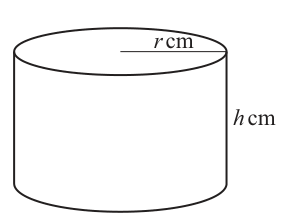
A manufacturer wishes to design an open cylindrical tank, as shown in the diagram. The tank will have a base but no top. The outside of the tank will have a fixed surface area of . The radius and height of the tank can vary.
Approach
The outside of the open cylindrical tank consists of a circular base (area ) and a curved side (area ). The top is open, so it contributes nothing. Setting the total outside area equal to gives an equation in and . Solve for , then substitute into .
Working
Total outside surface area of the open tank:
Solve for :
The volume of a cylinder is . Substituting the expression for and cancelling one factor of :
Answer
V = πr(600 − r²)/2
Walkthrough
The outside of the tank is made of two surfaces: a curved side and a circular base. The top is open, so it contributes no area. The curved side has area and the base has area , so the total outside area is
The problem states this must equal :
We want as a function of alone, so we isolate . Move to the right and divide by :
Every term on the right has a factor of , and these s cancel:
The volume of a cylinder is . Substituting our expression for and cancelling a factor of :
This matches the required expression, completing the derivation.
Key Takeaways
- An 'open' cylinder has only the curved side and one circular face, so the surface area is — not .
- The cylinder volume formula combined with a constraint lets you eliminate one variable.
- 'Show that' questions require every algebraic step, not just the final expression.
Common Mistakes
- Including the top in the surface area calculation.
- Sign errors when rearranging the constraint equation.
- Forgetting to cancel the when substituting into , leaving the result unsimplified.
- Losing a factor when dividing.
Things to Be Careful About
- The problem says explicitly that the tank has a base but no top.
- The constraint is in , so and are in and ends up in .
- Each factor of in the constraint and in the formulae must be tracked carefully.
Approach
Expand as a polynomial in , differentiate using the power rule, set to find the stationary point, and solve for . Take the positive root (since is a radius) and confirm it is a maximum.
Working
Expand the expression for :
Differentiate with respect to using the power rule:
Set . Since :
(We take the positive root because .)
To confirm this is a maximum, the second derivative is
For , , so is concave down here and the stationary point is a maximum.
Answer
r = 10√2 cm
Walkthrough
The expression is a cubic in (after expanding the product). To find its maximum, treat as a function of and apply the standard stationary-point procedure.
First, expand to make differentiation easier:
Differentiate term by term using the power rule . The constant factors and pass through differentiation unchanged:
A stationary point occurs when . The constant is non-zero, so we only need to solve :
Since is a radius, it must be positive. Hence .
To check the nature of the stationary point, examine the second derivative:
For this is negative, so the curve of against is concave down here — confirming a maximum.
(Alternative method: a useful shortcut is to recognise that for an open cylinder with fixed surface area, the volume is maximised when the height equals the radius, . Substituting into the surface area constraint gives , so and .)
Key Takeaways
- The power rule is the key technique: .
- Constant factors (like ) pass through differentiation unchanged.
- Physical constraints (here ) determine which root to take.
- The second derivative test confirms whether a stationary point is a maximum () or minimum ().
Common Mistakes
- Differentiating as (forgetting the negative sign).
- Dividing by incorrectly, e.g. giving or .
- Stopping at and not taking the square root.
- Including , which has no physical meaning for a radius.
- Failing to confirm the stationary point is a maximum — it could in principle be a minimum.
Things to Be Careful About
- The mark scheme accepts either or as the exact value.
- The derivative must be in the form (e.g. ), not in a form that hides the quadratic structure.
- The alternative shortcut at the maximum is only valid for an open cylinder; for a closed cylinder the optimum is at .
Approach
Substitute from part (b) into the expression and simplify. The exact answer is ; a 3-sf approximation is .
Working
Compute each piece:
Substitute back:
Numerically:
Answer
V = 2000π√2 ≈ 8890 cm³
Walkthrough
We have from part (a), and from part (b) the value of that gives the maximum volume is . Substituting:
Compute the inner pieces in the right order. First, , so . Then:
Equivalently, expanding first:
Numerically, , which rounds to (3 significant figures).
Key Takeaways
- 'Hence' in the question tells you to reuse the result of the previous part directly.
- Simplify cubes of surds carefully: .
- The exact form is preferred when the answer should be exact; a 3-sf approximation is appropriate for a numerical answer.
Common Mistakes
- Confusing with .
- Arithmetic slip in or in the final division by 2.
- Forgetting units: the answer is in , not or .
- Not converting the exact answer to a decimal when the mark scheme asks for a numerical value.
Things to Be Careful About
- The mark scheme accepts either the exact form or the 3-sf form ; give the form requested by the question.
- 'Hence' means the answer must follow from part (b); you should not re-derive from scratch here.
- The cube has three factors of and three factors of : and .
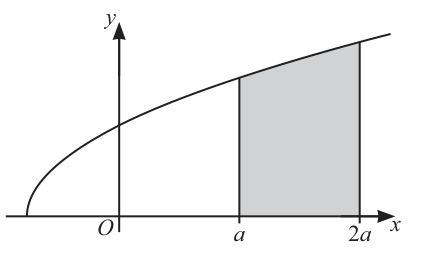
The diagram shows the curve with equation . The shaded region is bounded by the curve, the -axis and the lines and , where is a positive constant.
The shaded region is rotated through about the -axis to form a solid. The solid has volume, , such that .
Approach
The volume of a solid formed by rotating a region about the x-axis is given by . Since , we have . We integrate from to , evaluate the definite integral, and use the condition to obtain the required inequality.
Working
The volume of revolution is:
Substitute :
Integrate:
Substitute the upper limit :
Substitute the lower limit :
Subtract lower from upper:
Given :
Divide both sides by :
This is the required result.
Answer
(shown as required)
9a^2 + 5a - 46 >= 0
Walkthrough
The volume of a solid of revolution about the x-axis is . Here the curve is , so squaring gives , which is a simple linear expression. The shaded region lies between and , so these are our limits of integration.
We compute the integral , then evaluate at the upper limit to get , and at the lower limit to get . The difference is . Multiplying by gives . Setting this and dividing through by yields .
Key Takeaways
- The volume of revolution about the x-axis uses , not .
- Squaring removes the square root and gives a polynomial to integrate.
- Always substitute both limits carefully and subtract (upper − lower).
Common Mistakes
- Forgetting the factor in the volume formula.
- Integrating instead of .
- Sign errors when subtracting the lower limit evaluation from the upper limit evaluation.
- Forgetting to divide by when simplifying .
Things to Be Careful About
- The mark scheme awards B1 for the correct integral setup with and correct limits (CAO SOI). Ensure is present and limits are to .
- The final answer is marked A1 AG (answer given), so the working leading to it must be complete and clear.
- Do not skip the step of substituting both limits — this is where DM1 is awarded.
Approach
From part (a), we have the inequality . Solve the corresponding quadratic equation to find the roots, determine which intervals satisfy the inequality (since the coefficient of is positive, the quadratic is outside the roots), and then apply the condition that is a positive constant () to select the valid range.
Working
Solve .
Using the quadratic formula:
So:
Since the coefficient of is , the parabola opens upwards, so when:
The problem states that is a positive constant, so . This eliminates the interval .
Therefore:
Answer
a >= 2
Walkthrough
From part (a), we need to solve . First, find the roots of using the quadratic formula. The discriminant is , giving roots and .
Since the leading coefficient is positive, the quadratic is non-negative outside the roots: or . The problem states is a positive constant, so , which eliminates the negative interval. The final answer is .
Key Takeaways
- For a quadratic with , the solution is smaller root or larger root.
- Always apply any given domain restrictions (here ) to the final answer.
- The quadratic formula is reliable when factorisation is not obvious.
Common Mistakes
- Writing instead of — the mark scheme explicitly says "Don't allow ".
- Forgetting to apply the condition and giving both intervals.
- Sign errors in the quadratic formula, particularly with when is negative.
Things to Be Careful About
- The final answer must be in terms of , not .
- The mark scheme awards B1 WWW (without warning) for the final answer, so the reasoning must be clear.
- Condone absence of in the working, but the final answer must correctly restrict to .
In the expansion of , the coefficient of is equal to the coefficient of . The constants and are both positive.
Approach
Write the expansion of using the binomial theorem, identify the coefficients of and , equate them, and simplify the resulting ratio.
Working
The binomial expansion is
The coefficient of is and the coefficient of is . Equating them gives
Since and are positive, , so divide both sides by :
Thus
so the ratio is
Answer
p : q = 3 : 2
Walkthrough
The binomial expansion of is
Here and . The term containing comes from , so its coefficient is . The term containing comes from , so its coefficient is . Because the coefficient of is equal to the coefficient of , we set these expressions equal:
The constants and are positive, so is not zero and we may divide by safely. This gives , or equivalently . In simplest ratio form this is .
Key Takeaways
This question tests binomial coefficients and how to interpret the coefficient of a particular power of . Once the coefficients are written correctly, equating them gives a simple linear relation between and . The positivity of the constants justifies cancellation without worrying about zero division.
Common Mistakes
- Forgetting the binomial coefficients and , and writing incorrect terms such as and .
- Failing to square the when forming the term: the term is , not .
- Simplifying to but then writing the ratio in the wrong order, e.g. .
- Not simplifying the ratio, e.g. leaving instead of .
Things to Be Careful About
The question asks for , so the final ratio must have first and second. Because and are positive, dividing by is valid. Make sure the final ratio is in simplest form and contains no powers of .
Approach
Find the coefficient of in the binomial expansion, set it equal to 486, substitute the relation from part (a), and solve for the positive values of and .
Working
The term in in is
so its coefficient is . Given the coefficient of is 486,
From part (a), , so
Substitute into the coefficient equation:
Simplify:
Since , take the positive fourth root:
Then
Answer
p = 9/2, q = 3
Walkthrough
From part (a), the binomial expansion already gives the relation . We now use the information about the term. In the expansion, the term in is
so its coefficient is . The condition says this coefficient is 486:
To solve for and , use from part (a). Substituting gives
This simplifies to , so . Since is positive, , not . Finally, substituting into gives .
Key Takeaways
This part combines the result of part (a) with another binomial coefficient. It also shows the importance of the positivity condition: solving gives both and , but only the positive value is valid. The final step is substitution to find the other unknown.
Common Mistakes
- Using the wrong coefficient for ; the correct coefficient is .
- Forgetting to use part (a), or substituting the ratio backwards as .
- Taking as well as when the constants are stated to be positive.
- Dividing incorrectly when simplifying ; note that .
Things to Be Careful About
Since and are both positive, reject the negative fourth root. The answer should be given as exact values: and . Show the substitution step clearly because the mark scheme gives credit for substituting the part (a) relation. If answers are given without working, the mark scheme only awards a special case mark, so full working is needed.
The function is defined by
for .
Approach
Given the equation for , substitute and set the result equal to . Solve the resulting linear equation for , then check that the value lies in the domain .
Working
Since ,
Subtract from both sides:
Multiply both sides by :
Therefore
The value , so it is valid.
Answer
a = 9
Walkthrough
The question asks for the input that produces the output for the function . We set and substitute into the function definition. This gives a simple equation with in the denominator. Subtract from both sides to isolate the fraction, then multiply through by to solve for . Finally, check that the value is greater than , since the function is only defined for .
Key Takeaways
- To find an input from a given output, substitute the output into the function equation and solve.
- A rational function may require multiplying through by the denominator to solve the equation.
- Always check the solution lies in the function's domain.
Common Mistakes
- Forgetting to subtract before dealing with the fraction.
- Multiplying only one side by .
- Not checking that the solution satisfies .
Things to Be Careful About
- The mark scheme awards a method mark for forming the equation , so show this equation.
- The domain restriction must be respected; is valid, but the check should be visible.
Approach
Write and swap and , then rearrange to make the subject. The domain of the inverse is the range of . For , the fraction is positive and tends to as increases, so the range is all values greater than .
Working
Let
Swap and :
Subtract from both sides:
Take reciprocals:
Add :
Hence
The domain of is the range of . Since , , so and . As , , so the range is . Therefore the domain of is .
Answer
f^{-1}(x) = 2 + 7/(x-3), domain x > 3
Walkthrough
To find the inverse, start by writing the function as . The standard method is to swap and , then rearrange to make the subject. This gives , which is the inverse function. The domain of the inverse is the range of the original function. For , the denominator is positive, so is positive. As approaches from above, the fraction becomes arbitrarily large; as increases without bound, the fraction tends to . Hence takes all values greater than , so the inverse is defined for .
Key Takeaways
- The inverse is found by swapping the variables and rearranging.
- The domain of the inverse equals the range of the original function.
- For a rational function of the form , the horizontal asymptote gives the boundary of the range.
Common Mistakes
- Forgetting to swap and before rearranging.
- Stopping at without adding .
- Writing the domain of the inverse as instead of ; the domain of the inverse is the range of , not the domain of .
- Not writing or ; the mark scheme requires one of these forms.
Things to Be Careful About
- The inverse may also be written as , but is usually easier to relate to the range.
- One algebraic slip can lose the final mark, so show each stage clearly.
- The domain statement must involve ; an equivalent such as is acceptable.
Approach
Substitute the expression for into to form . Then simplify the compound fraction in the denominator to show that reduces to .
Working
Since and ,
Simplify the denominator:
Therefore
So , and the constant is .
Answer
k = 2
Walkthrough
This part asks for the composition , which means evaluate at . Start with and replace with . The denominator becomes , a compound fraction. To simplify it, subtract by writing it with the common denominator : . The numerator becomes , so . Dividing by this fraction is equivalent to multiplying by its reciprocal, so . Adding gives , so and .
Key Takeaways
- Composition means substitute into .
- Simplifying compound fractions requires a common denominator.
- The identity sign means the expression is true for all in the domain.
Common Mistakes
- Forgetting the when subtracting from .
- Inverting the fraction incorrectly: , not .
- Stating without showing the algebra; the mark scheme requires supporting working.
Things to Be Careful About
- The domain of is , but the composition remains valid on that domain.
- Keep the simplification of the compound fraction explicit to earn the method mark.
- The final answer must identify after the algebra, not just state it.
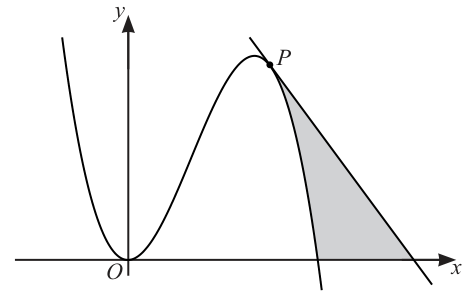
The diagram shows the curve with equation and the tangent to the curve at the point . The point has -coordinate 3.
Find the equation of the tangent to the curve at the point . Give your answer in the form .
Approach
Differentiate the curve equation to find the gradient function, evaluate it at to get the gradient of the tangent, find the -coordinate of , and then use the point-gradient form to find the tangent equation.
Working
The curve is .
Differentiate with respect to :
At , :
Find the -coordinate of by substituting into the curve equation:
So is .
The gradient of the tangent is . Using the point-gradient form :
Answer
y = -3x + 18
Walkthrough
First, we find the gradient function by differentiating the curve equation with respect to , giving . Next, we evaluate this gradient at to find the slope of the tangent at point , which is . We then find the -coordinate of by substituting into the original curve equation, yielding . With the point and gradient , we use the point-gradient form to derive the tangent equation .
Key Takeaways
To find the equation of a tangent to a curve at a given point, differentiate to find the gradient function, evaluate it at the given -coordinate, find the corresponding -coordinate on the curve, and apply the point-gradient formula.
Common Mistakes
- Forgetting to find the -coordinate of the point by substituting into the curve equation.
- Sign errors when expanding .
- Incorrect differentiation, such as differentiating as instead of .
Things to Be Careful About
Ensure the final equation is in the requested form . Double-check arithmetic when evaluating the gradient and coordinates at .
The shaded region is bounded by the curve, the -axis and the tangent to the curve at .
Find the exact area of the shaded region.
Approach
The shaded region is bounded by the curve , the -axis, and the tangent . First, find the -intercepts of the curve and the tangent to determine the boundaries. The curve meets the -axis at (since ). The tangent meets the -axis at (since ). The shaded region can be found by calculating the area under the tangent from to and subtracting the area under the curve from to .
Working
Find the -intercept of the tangent :
Find the -intercept of the curve :
The area under the tangent from to is a triangle with base and height at :
Alternatively, using integration:
Now find the area under the curve from to :
Substitute the limits:
The shaded area is the area under the tangent minus the area under the curve:
Answer
95/12
Walkthrough
The shaded region is bounded above by the tangent and the curve, and below by the -axis. The tangent intersects the -axis at , and the curve intersects the -axis at . From to , the area under the tangent forms a triangle with area . From to , the area under the curve is found by integrating , giving . Subtracting the area under the curve from the area under the tangent yields the shaded area .
Key Takeaways
To find the area of a region bounded by a curve, a line, and the -axis, identify the -intercepts of all boundaries. Calculate the total area under the upper boundary and subtract the area under any lower boundaries within the region.
Common Mistakes
- Using incorrect limits of integration.
- Forgetting to subtract the area under the curve from the area under the tangent.
- Arithmetic errors when evaluating fractions.
Things to Be Careful About
Ensure the limits of integration match the actual boundaries of the shaded region. The curve and tangent only bound the region between and , while the tangent extends to . The final answer must be exact.
The graph of is transformed by a stretch of scale factor in the -direction. The point is the image of under this transformation. The transformed shaded region is bounded by the transformed curve, the -axis and the tangent to the transformed curve at .
Find the equation of the transformed curve in the form , where and are integers to be found.
Approach
A stretch of scale factor in the -direction transforms to . Substitute for in the original curve equation and expand to find the transformed equation.
Working
The original curve is .
Apply the transformation :
Answer
y = 36x^2 - 27x^3
Walkthrough
A horizontal stretch by scale factor replaces with in the function equation. Substituting into gives , which simplifies to .
Key Takeaways
For a horizontal stretch by scale factor in the -direction, replace with in the function equation. Here, , so replace with .
Common Mistakes
- Replacing with instead of .
- Forgetting to cube the term correctly.
Things to Be Careful About
Ensure the equation is fully expanded and in the form as requested.
Approach
The point is the image of under a stretch of scale factor in the -direction. Multiply the -coordinate of by to find the coordinates of . The area of the transformed region is scaled by the horizontal scale factor.
Working
Point is . Under a stretch of scale factor in the -direction:
The area of the original shaded region is . A horizontal stretch by scale factor scales the area by the same factor:
Answer
Coordinates of :
Area:
Q(1, 9), Area = 95/36
Walkthrough
The point is transformed by multiplying its -coordinate by , giving . The area of the shaded region is scaled by the horizontal scale factor , so the new area is .
Key Takeaways
Under a horizontal stretch by scale factor , the -coordinates are multiplied by while -coordinates remain unchanged. Areas are scaled by the same horizontal scale factor.
Common Mistakes
- Forgetting to scale the area by the transformation factor.
- Incorrectly transforming the coordinates of .
Things to Be Careful About
Ensure the area scaling is applied correctly. Only the horizontal dimension is scaled, so the area scales by the horizontal factor alone.