Mathematics 9709/13 — October/November 2025
Cambridge AS Level · Pure Mathematics 1 · worked solutions for every part, with the mark scheme
Topics Functions · Series · Differentiation · Coordinate Geometry · Quadratics · Trigonometry · +2 more
Approach
Use the binomial theorem to expand up to the term in . Write the first four terms with .
Working
Answer
64 - 96x + 60x^2 - 20x^3
Walkthrough
We need the terms up to in the binomial expansion of . The binomial theorem states that . Here , , and . We only need because higher values of produce powers of above . For each term, substitute the values into the formula and simplify the coefficient.
The term is . The term is . The term is . The term is . Combining them gives the expansion up to .
Key Takeaways
This question tests the binomial expansion formula and the ability to handle a negative fractional term. It also reinforces that the binomial coefficient must be multiplied by the correct powers of and .
Common Mistakes
- Forgetting that the second term is , not , so the signs of odd-power terms are negative.
- Using incorrect binomial coefficients, e.g. writing instead of .
- Not simplifying the coefficients fully, e.g. leaving instead of .
- Stopping at too few terms or including terms beyond when the question only asks up to .
Things to Be Careful About
The mark scheme allows the unsimplified expansion to earn the method mark, but the final simplified terms must be correct. Watch the sign of each term: terms with odd powers of are negative because of the factor. Also, be careful with the arithmetic when simplifying fractions such as .
Approach
Use the expansion from part (a). To find the coefficient of in the product, multiply each term of by the term from the expansion that makes the total power , then sum the contributions.
Working
The relevant products are:
Adding these gives:
So the coefficient of is .
Answer
8
Walkthrough
We already have . To find the coefficient of in , multiply each term of by a term from the expansion whose powers of add to .
- times the term from the expansion: .
- times the term: .
- times the constant term: .
Adding these gives , so the coefficient is .
Key Takeaways
This is a coefficient-extraction problem. When multiplying two polynomials, the coefficient of is the sum of all products of terms whose exponents add to . It is important to identify all relevant pairings, not just the most obvious one.
Common Mistakes
- Missing one of the three contributing products, especially the term.
- Using the wrong term from the expansion, e.g. using or confusing with .
- Forgetting the negative sign in .
- Adding only the coefficients without attaching the correct powers of .
Things to Be Careful About
The question says "hence", so you should use your expansion from part (a). The mark scheme expects you to select the correct products using your expansion. Be careful with signs: the term in the expansion is , and the multiplier makes the second contribution negative. The final coefficient is , not , although is accepted as the term.
Approach
Apply the inverse tangent by taking the tangent of both sides, then solve the resulting linear equation.
Working
Since , take tangent of both sides:
Using the exact value and the odd property of tangent,
So:
Answer
x = 2/5
Walkthrough
The equation says that the inverse tangent of equals . Taking the tangent of both sides undoes the inverse tangent, giving . Since and tangent is an odd function, . Solving gives . Because is a one-to-one function, this is the only solution.
Key Takeaways
- The notation means the inverse tangent, not the reciprocal of tangent.
- Taking the tangent of both sides isolates the input of the inverse function.
- Exact values for special angles, including negative angles, are needed.
Common Mistakes
- Writing instead of because the negative sign is missed.
- Treating as and trying to use reciprocals.
- Not simplifying the equation after taking tangent of both sides.
Things to Be Careful About
- Use the exact value ; a calculator decimal is not needed.
- The inverse tangent has a restricted range, but here the equation is linear, so no extra solutions arise.
- The final answer may be written as or .
Approach
Use the Pythagorean identity to obtain a quadratic in , factorise and solve it, then find all solutions in the interval .
Working
Start from:
Replace with :
Expand and collect all terms on one side:
Factorise:
So:
For , the principal value is radians. In the interval , the solution is:
For , the solution in the interval is:
Answer
theta = 2.94, 4.71
Walkthrough
The equation mixes and , so use the Pythagorean identity to write everything in terms of . Substituting gives . Expanding and rearranging gives the three-term quadratic , which factorises as . Hence or .
For , the calculator principal value is about radians, which is outside the interval . Since sine is positive in the second quadrant, the required solution is . For , the solution in the interval is .
Key Takeaways
- The identity converts a mixed trigonometric equation into a quadratic.
- A quadratic in can be factorised and solved like an ordinary quadratic.
- After solving for , use the symmetry of the sine graph and the given interval to find every valid angle.
Common Mistakes
- Forgetting to replace with , or making a sign error when rearranging to .
- Factorising incorrectly; the mark scheme requires the three-term quadratic to be formed.
- Giving only the principal value for , which is outside the interval.
- Including solutions outside or omitting .
Things to Be Careful About
- The interval is in radians: and .
- For , the other standard solution gives a negative sine, so it is not valid here.
- is exact and is accepted in place of ; is an approximate value (AWRT).
- Ignore answers outside the given range; repetition of is condoned but no other values within the range may be added.
The equation of a curve is , where . The following points lie on the curve. Non-exact values of the -coordinates are given correct to 6 decimal places.
Approach
The point lies on the curve , so its -coordinate is found by substituting into . Round the result to 6 decimal places.
Working
Substituting :
Evaluate the parts:
So:
Answer
72.030004
Walkthrough
The point is on the curve . A point on a curve satisfies the equation of the curve, so the -coordinate equals — we substitute into the given expression.
The substitution gives . The bracket is computed directly as .
For we use that , and write . Then . Using a calculator (or a binomial estimate) gives . Multiplying by and then by yields .
Key Takeaways
- Substituting an -value into gives the -coordinate of the corresponding point on the curve.
- Knowing helps evaluate the function near .
- Precision matters: keep full accuracy until the final rounding.
Common Mistakes
- Rounding the intermediate value too early, which distorts the 6-decimal-place answer.
- Forgetting the factor in the expression.
- Mishandling the index (forgetting it applies only to , not to ).
Things to Be Careful About
- The mark scheme requires the exact answer (CAO) — approximations are not accepted.
- Carry full calculator precision through the multiplication and round only at the end.
The table below shows the gradients of the chords and , given correct to 4 decimal places.
| Chord | |||
|---|---|---|---|
| Gradient of chord | 30.0039 | 30.0388 |
Find the gradient of the chord . Give your answer correct to 4 decimal places.
Approach
The gradient of the chord is the difference quotient . Use and and round to 4 decimal places.
Working
Rounding to 4 decimal places:
Answer
30.3888
Walkthrough
The gradient of the chord joining two points and is given by the difference quotient — the change in divided by the change in . Here and .
Apply the formula: the numerator is and the denominator is . Dividing gives . Since the table rounds to 4 decimal places, we write .
Key Takeaways
- The gradient of a chord is the average rate of change between the two points.
- This difference quotient is exactly the quantity that tends to the derivative as the second point approaches .
Common Mistakes
- Using the wrong order: would still give the same value, but mixing coordinates wrongly (e.g. putting over ) changes the sign.
- Dividing by the wrong difference in (some might use incorrectly as ).
- Rounding incorrectly: to 4 dp is .
Things to Be Careful About
- The final answer must be correct to 4 decimal places: (CAO, not approximate).
- Keep the full value before rounding.
Approach
The gradient of a chord between and a nearby point on the curve approximates the gradient of the curve at , i.e. . As the second point moves closer to , the chord gradients tend to a limiting value, which is .
Working
From the table (and part (b)):
As approaches 8 from above (the second point moves from to to ), the gradients approach 30. These gradients approximate the gradient of the tangent at , so .
Answer
30 (approximately)
Walkthrough
Each chord joins to a point on the curve with -coordinate slightly greater than 8. The gradient of such a chord is the average rate of change of with respect to over that interval, i.e. .
As the second point moves closer to (from at to at to at ), the chord gradients are , , . They are clearly approaching 30. The limit of these difference quotients as is exactly the derivative — the gradient of the tangent at . Hence the table suggests .
Key Takeaways
- The derivative at a point is the limit of the gradient of chords (the difference quotient).
- Numerical chord gradients give an excellent way to estimate the gradient of a tangent.
- All the values here come from the right-hand side (), giving a right-hand estimate approaching 30.
Common Mistakes
- Quoting one of the chord gradients (e.g. 30.0039) as instead of the limiting value 30.
- Thinking the derivative is exactly one of the table values rather than the value they approach.
Things to Be Careful About
- The mark scheme accepts only 30 (or 30.0) with words like 'approximately' or 'around' — it must clearly be the limiting value.
- This is an estimate from the right; the exact derivative is not computed here.
The first, second and third terms of a progression are 20, and respectively.
Approach
For an arithmetic progression, consecutive terms differ by a constant . Find from the second and third terms, then use .
Working
The common difference is
The first term is . For the 30th term, :
Answer
-125
Walkthrough
We are told the progression is arithmetic, so the difference between consecutive terms is constant. The first two terms are and , and the second and third terms are and . The common difference is therefore . The cancels, leaving . The first term is . The 30th term is found by adding the common difference 29 times to the first term, which is exactly what the formula does: .
Key Takeaways
- In an arithmetic progression, the common difference is the difference between any two consecutive terms.
- The nth term formula gives the term at position .
- Here the cancels when finding , so the value of is not needed.
Common Mistakes
- Using as the multiplier instead of .
- Forgetting that is negative, which changes the sign of the final answer.
- Confusing the first term with the second term .
Things to Be Careful About
- The common difference is , not .
- The 30th term requires 29 steps from the first term, not 30.
- The question only asks for the 30th term, so no sum formula is needed.
Approach
For a geometric progression, the ratio of consecutive terms is constant. Write the common ratio using the first two terms and using the last two terms, equate them, solve for , then use the sum-to-infinity formula.
Working
The common ratio is
Cross-multiply:
So . Hence
Since , the sum to infinity exists:
Answer
40
Walkthrough
In a geometric progression, the ratio of any term to the previous term is constant. Using the first two terms gives . Using the second and third terms gives . Since both expressions represent the same ratio, set them equal: . Cross-multiplying gives , which simplifies to . This is a perfect square, , so . Substituting back gives . Because , the geometric series converges, so the sum to infinity is .
Key Takeaways
- A geometric progression has a constant ratio between consecutive terms.
- Equating two expressions for the common ratio turns the problem into a quadratic equation.
- The sum to infinity of a geometric progression exists only when .
Common Mistakes
- Forgetting to equate the two ratio expressions and only using .
- Making a sign error when cross-multiplying or rearranging the quadratic.
- Using the finite sum formula instead of the sum-to-infinity formula.
- Forgetting to check that before applying the sum-to-infinity formula.
Things to Be Careful About
- The quadratic has a repeated root, so is the only solution.
- With , the series converges, so the infinite sum is finite.
- The first term is , not or .
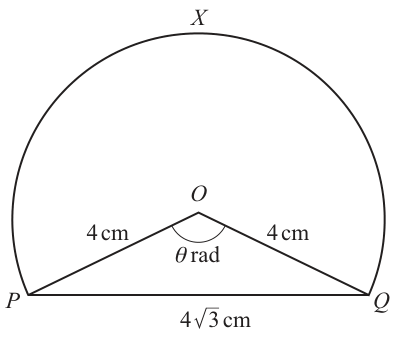
The diagram shows part of a circle with centre and radius . The chord is of length and angle radians. The point lies on the circle.
Approach
Triangle is isosceles with and . Drop the perpendicular from to the midpoint of . This perpendicular bisects both the chord and the angle . In the right triangle , use the sine ratio to find .
Working
The perpendicular from meets at its midpoint , so:
In the right-angled triangle , the angle at is , so:
Since , we have , so .
Answer
θ = 2π/3
Walkthrough
The triangle has two equal sides (the radii) of length , and a base (the chord) of length . This is an isosceles triangle.
In an isosceles triangle, the perpendicular from the apex to the base has two useful properties: it bisects the base, and it bisects the angle at the apex. Here, the apex is and the base is . So the perpendicular from to hits at the midpoint , and the angle at in the right triangle is exactly .
The half-chord is , and the hypotenuse is the radius . The sine of the half-angle is the ratio of the opposite side to the hypotenuse, giving .
We recognise the exact value . Since , the only solution is , hence .
Key Takeaways
- A perpendicular from the vertex of an isosceles triangle to the base creates two congruent right triangles.
- The relationship is a key result in circle geometry.
- The exact value is required.
Common Mistakes
- Writing as the final answer without doubling to .
- Using instead of for the half-chord.
Things to Be Careful About
- Ensure the answer is in radians, not degrees.
- The half-chord is half the chord length, not the full chord.
Approach
Since lies on the major arc, the segment is the major segment. The area of the major segment equals the area of the major sector plus the area of the triangle :
Working
The major sector has angle and radius .
Area of major sector:
Area of triangle using with the two radii as the two sides and the included angle :
Area of segment :
Answer
(32π/3 + 4√3) cm²
Walkthrough
The point lies on the major arc, so the segment (bounded by the chord and the arc through ) is the major segment — the larger of the two segments cut off by the chord .
A useful identity is:
This works because the major sector (the pie slice with the reflex angle) does not include the triangle , but together the major sector and the triangle exactly fill the major segment.
Major sector area: The reflex angle is . Using the formula with the reflex angle:
Triangle area: Using with (the two radii) and the included angle :
Sum: .
An equivalent approach is:
Both methods give the same final answer.
Key Takeaways
- A segment is the region between a chord and an arc.
- The major segment can be computed as the major sector plus the central triangle, or as the whole circle minus the minor segment.
- Sector area: (with in radians).
- Triangle area: .
Common Mistakes
- Confusing the major and minor segments. The point on the major arc tells us the segment includes the major arc, so it is the major segment.
- Subtracting the triangle from the major sector instead of adding it (this would give a different region, not the major segment).
- Computing the sector area with the smaller angle instead of the reflex angle .
- Getting the sign of wrong (it is positive , not negative).
Things to Be Careful About
- The exact value is positive (not negative).
- The sector area formula requires the angle in radians.
- The final answer should be in exact form, not decimal approximation.
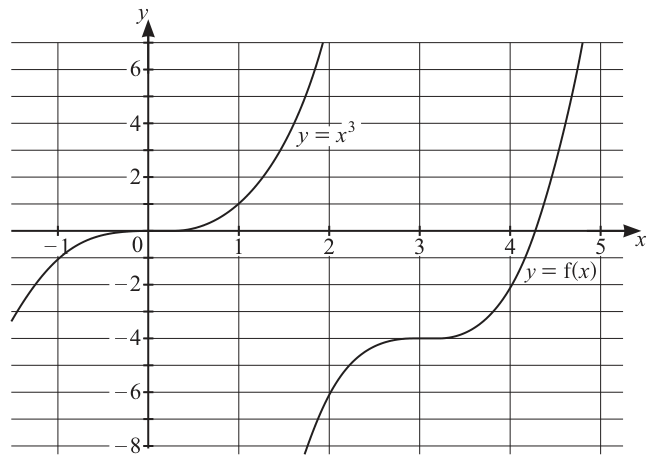
The diagram shows the graphs of and . The graph of is transformed to the graph of by a sequence of transformations.
Describe fully a suitable sequence of transformations. Make clear the order in which the transformations are applied.
Approach
Compare key points on the graph of with corresponding points on the graph of . The point of inflection on is at . On , the point of inflection is at . We also check another point: on , is on the curve. On , is on the curve.
Working
Method 1: Stretch then Translation
-
Apply a stretch parallel to the -axis with scale factor to :
The point maps to . The point of inflection remains at . -
Apply a translation by the vector (i.e., in the -direction and in the -direction):
The point maps to , which matches the graph. The point of inflection maps to , which also matches.
Sequence:
- Stretch parallel to the -axis (or -axis invariant) with scale factor .
- Translation by vector (or in the -direction and in the -direction).
Alternative Method: Translation then Stretch
-
Apply a translation by vector to :
The point maps to . -
Apply a stretch parallel to the -axis with scale factor (or -axis invariant):
The point maps to , which matches the graph.
Sequence:
- Translation by vector (or in the -direction and in the -direction).
- Stretch parallel to the -axis (or -axis invariant) with scale factor .
Answer
A suitable sequence is:
- Stretch parallel to the -axis with scale factor .
- Translation by vector .
(Alternatively: Translation by followed by stretch parallel to the -axis with scale factor .)
Stretch parallel to y-axis by scale factor 2, then translation by vector (4, -4).
Walkthrough
First, identify the key features of the original graph . The point of inflection is at , and it passes through and .
Next, identify the corresponding features on the transformed graph . The point of inflection is at . The curve passes through and .
To find the transformations, we can compare how the points move.
Method 1: Stretch then Translation
If we stretch parallel to the -axis by a scale factor of , the new equation is . The point becomes . The point of inflection is still at .
Now we need to move to and to . This is a translation of in the -direction and in the -direction, which is the vector .
Applying this translation to gives .
Method 2: Translation then Stretch
If we translate first, we must translate the point to a position that, when stretched vertically by , lands on . The -coordinate before stretching must be . The -coordinate is unaffected by a vertical stretch, so it must be . Thus, must be translated to .
This translation is in the -direction and in the -direction, which is the vector .
Applying this translation gives . Then applying the vertical stretch by gives .
Key Takeaways
- Transformations can be applied in different orders (stretch then translate, or translate then stretch), but the translation vector will be different depending on the order.
- A stretch parallel to the -axis by scale factor transforms to .
- A translation by vector transforms to .
- Always check your answer by applying the transformations to a known point on the original graph and verifying it lands on the transformed graph.
Common Mistakes
- Incorrect order or vector: Applying a translation of after a stretch is different from applying it before. If you translate by first, you get , and then stretching gives , which is incorrect.
- Wrong stretch direction: A stretch parallel to the -axis would change the -coordinates, not the -coordinates. Here, the -values are scaled, so it must be parallel to the -axis.
- Forgetting to specify the axis invariant: When describing a stretch, it is important to state that the -axis is invariant (or that it is parallel to the -axis) to be fully correct.
Things to Be Careful About
- Order of transformations: The mark scheme accepts two main sequences. If you use a translation before a stretch, the -component of the translation must be half the final -displacement because the stretch will double it. Specifically, the -displacement is , so the pre-stretch translation must be .
- Notation: Use vector notation or clearly state the and directions. Avoid ambiguous terms like 'right' and 'down' without specifying the axes, although some leniency may apply if the intention is clear.
- Final equation check: Always derive the final equation and verify it matches the given points on the graph.
Approach
From part (a), we determined that the function is . We are given the form . We can match the constants directly.
Working
The equation derived from the transformations is:
Comparing this with the given form:
We can identify the constants by matching the corresponding parts:
- The coefficient of the cubic term is , so .
- The term inside the cube is , which matches , so .
- The constant term is , so .
Answer
a = 2, b = -4, c = -4
Walkthrough
In part (a), we found the equation for to be . The question asks us to state the values of , , and for the form .
We simply equate the two expressions:
By comparing the coefficients and constants:
- is the multiplier outside the cube, which is .
- is the value added to inside the cube. Since we have , this is , so .
- is the constant added at the end, which is .
Key Takeaways
- The form represents a cubic function with a vertical stretch by , a horizontal translation by , and a vertical translation by .
- Be careful with the sign of . The term means a translation to the left by if , or to the right by if . Here, means .
Common Mistakes
- Sign error for b: Writing instead of because they see and assume . Remember the form is , so .
- Confusing c with the y-coordinate of the inflection: While is indeed the y-coordinate of the point of inflection for this form (since the inflection is at ), it's important to extract it directly from the equation.
Things to Be Careful About
- Individual values vs. equation: The mark scheme states that individual values are considered the final answer. Ensure you clearly state , , and rather than just writing the full equation, although the equation implies the values.
- Form matching: Ensure the given form matches your derived equation exactly. If the given form was , then would be . Always check the sign in the given form.
The function is defined by for , where is a positive constant.
Find and hence verify that if then .
Approach
Set and rearrange to make the subject. Interchange and to obtain , then substitute into both and and simplify to confirm the two functions are identical.
Working
Let :
Subtract and multiply through:
So
Since ,
Therefore
and
Now interchange and , so
or equivalently
Verify for :
which is exactly when . Hence when .
Answer
With , .
g^-1(x) = 4/[a(2x - 1)] + 3/a; when a = 6, g^-1(x) is identically equal to g(x).
Walkthrough
Start by writing the defining equation with in place of :
This is the required first step because an inverse is found by solving for .
Subtract from both sides and multiply by . This moves the denominator out of the fraction:
Next isolate by dividing by :
Notice that is not a simple denominator, so rewrite it as . Dividing by this fraction means multiplying by its reciprocal, giving:
Now make the subject by adding 3:
Then divide by to make the subject:
Finally, swap the roles of and . The resulting expression is the inverse:
This can also be written as a single fraction:
For the verification, put into :
But the right-hand side is exactly with :
Therefore when .
Key Takeaways
The central skill is reversing a function by algebra: write , rearrange to make the subject, then interchange and . You must also be comfortable simplifying compound fractions such as . Finally, verifying equality of functions requires substituting the given parameter value and simplifying until both sides look exactly the same.
Common Mistakes
- Not showing the initial step and the rearrangement. Mark scheme requires method; an unsupported inverse is not accepted.
- Losing when dividing by in the final step. Always divide the whole right-hand side by .
- Forgetting to swap and after making the subject.
- Treating as ; this is not valid. The whole denominator must be used.
- Not simplifying the verification far enough to observe that the expression matches .
Things to Be Careful About
The domain restriction ensures , so the fraction is defined for the original function. The inverse expression is equivalent in either form, but if you use the single-fraction form , take care that when substituting values. For the substitution , show the final simplification clearly to earn the dependent verification mark.
The points and lie at the opposite ends of a diameter of a circle.
Approach
The centre of a circle is the midpoint of a diameter, and the radius is the distance from this centre to any endpoint. So we use the standard form .
Working
The centre of the circle is the midpoint of and :
Using the endpoint , the radius squared is:
So the equation of the circle is:
Answer
(x - 2)^2 + (y - 4)^2 = 25
Walkthrough
The endpoints of the diameter are and . The centre of the circle is exactly halfway between them, so we find the midpoint by averaging the -coordinates and the -coordinates:
Once the centre is known, the radius is the distance from the centre to any point on the circle. Using :
So . Since the circle has centre and radius , its equation is:
Key Takeaways
The centre of a circle is the midpoint of any diameter. The equation of a circle with centre and radius is . To find the radius, use the distance from the centre to a known point on the circle.
Common Mistakes
- Forgetting to halve the coordinates when finding the midpoint, so using the diameter endpoints as the centre.
- Using the full diameter length as the radius instead of the distance from the centre to a point.
- Mixing up the signs in the standard equation: uses the coordinates of the centre.
Things to Be Careful About
The radius is squared in the equation, so it is enough to compute directly. The centre must be the midpoint of the diameter, not one of the endpoints. The standard form is accepted, but an expanded form such as is also correct.
There are two tangents to the circle which have gradient .
Find the exact values of the -coordinates of the points at which these tangents touch the circle.
Approach
The tangent at a point on a circle is perpendicular to the radius at that point. Since the tangent has gradient , the radius has gradient . The points of tangency lie on this normal line through the centre, so we find where this line meets the circle.
Working
The gradient of the normal is:
The normal line through the centre is:
which simplifies to .
Substitute into the circle equation:
Since :
So:
Taking square roots:
Therefore:
Answer
x = 2 + sqrt(5) or x = 2 - sqrt(5)
Walkthrough
At the point where a tangent touches a circle, the tangent is perpendicular to the radius. The tangent has gradient , so the radius has gradient , because the product of perpendicular gradients is .
The radius through the centre therefore has equation:
which simplifies to . The points where the tangent touches the circle are exactly the points where this normal line meets the circle. Substituting into the circle equation gives:
Since , this becomes
so
Taking square roots gives , so the two -coordinates are and .
Key Takeaways
For a circle, the tangent at a point is perpendicular to the radius at that point. The product of the gradients of two perpendicular lines is (unless one is vertical). To find where a tangent with a given gradient touches the circle, find the normal line through the centre and intersect it with the circle.
Common Mistakes
- Using the tangent gradient instead of the normal gradient when forming the line through the centre.
- Forgetting to take the reciprocal when finding the perpendicular gradient.
- Losing the when solving .
- Giving decimal answers instead of exact surds.
Things to Be Careful About
The normal line must pass through the centre of the circle, not through the diameter endpoints. When substituting , note that , which simplifies the algebra. The final answer must be exact: and .
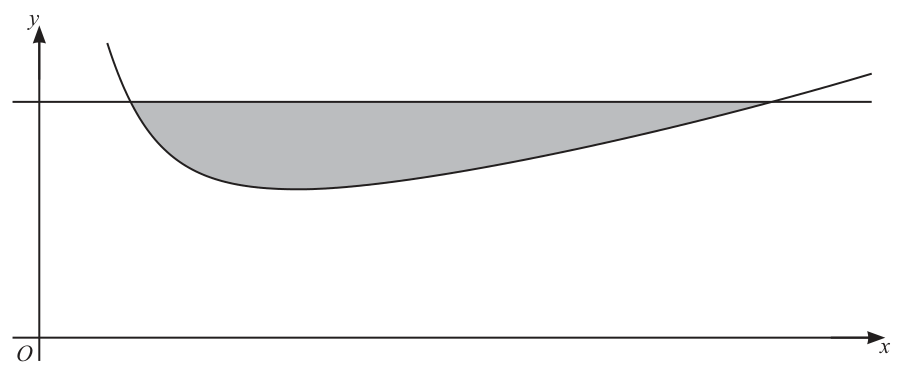
The diagram shows part of the curve with equation and the line .
Find the exact volume of the solid formed when the shaded region is rotated through about the -axis.
Approach
The shaded region is bounded above by the line and below by the curve . When rotated about the -axis, the solid formed is a washer shape at each cross-section. The volume is found by subtracting the volume generated by the curve from the volume generated by the line, between the -coordinates of their intersection points.
First, find the intersection points by equating the two equations. Then set up the volume integral using the formula , where is the outer radius and is the inner radius.
Working
Step 1: Find the limits of integration
Equate the curve and the line:
Multiply through by to clear denominators:
Rearrange into a quadratic equation:
Factorise:
So the limits are and .
Step 2: Set up the volume integral
Using the washer method, the volume is:
Step 3: Expand the integrand
First, expand :
Now substitute back into the integrand:
Simplify:
Step 4: Integrate
Step 5: Evaluate at the limits
At :
At :
Subtract the lower limit value from the upper limit value:
Step 6: Final volume
Multiply by :
Answer
343pi/6
Walkthrough
The problem asks for the volume of a solid of revolution. The shaded region is bounded above by the horizontal line and below by the curve . When this region is rotated about the -axis, each vertical slice forms a washer (a disc with a hole). The volume of such a solid is found by integrating the area of the washer cross-sections along the -axis.
Step 1: Find the limits of integration.
The region is bounded between the two points where the line and the curve intersect. We find these by setting the equations equal: . Multiplying by gives , which rearranges to . Factoring yields , so the limits are and . These are the -coordinates of the left and right edges of the shaded region.
Step 2: Set up the volume integral.
The formula for the volume of a solid of revolution using the washer method is , where is the outer radius (distance from the axis of rotation to the outer boundary) and is the inner radius (distance to the inner boundary). Here, the outer boundary is the line , so . The inner boundary is the curve , so . Thus, .
Step 3: Expand and simplify the integrand.
We need to square the curve equation: . Subtracting this from gives . This is the expression we will integrate.
Step 4: Integrate term by term.
Using the power rule for integration: for , and . We get . Note that the integrates to .
Step 5: Evaluate at the limits.
Substitute : . Substitute : . Subtract: . Finally, multiply by to get .
Key Takeaways
- The volume of a solid of revolution about the -axis between two curves and (where ) is .
- Finding the limits of integration often requires solving an equation formed by equating the two bounding curves.
- Expanding squared binomial fractions like carefully is essential to avoid algebraic errors.
- Integrating negative powers of (like ) requires the power rule: , which flips the sign.
Common Mistakes
- Forgetting to square the -values in the volume formula. Students sometimes integrate instead of .
- Incorrectly expanding . A common error is writing , missing the middle term .
- Sign errors when integrating . The integral is , not .
- Arithmetic mistakes when evaluating fractions at the limits, especially finding common denominators for .
- Omitting the factor in the final answer.
Things to Be Careful About
- The limits of integration must be the -coordinates of the intersection points, not the -coordinates. Here, and are positive, which is consistent with the diagram showing the region in the first quadrant.
- Ensure the outer radius is the larger -value. In the shaded region, the line is above the curve, so and . Reversing these would give a negative volume.
- The question asks for the exact volume, so the answer must be left in terms of as a fraction (), not as a decimal approximation.
- When multiplying through by to solve the intersection equation, remember that in this region, so no extraneous solutions are introduced by this operation.
A function is defined by for , where and are constants.
It is given that and .
Approach
Complete the square by factoring out the coefficient of , then completing the square in the bracket and adding a constant.
Working
Given .
Complete the square for :
Substitute back:
Answer
f(x) = 2(x+1)^2 + 8
Walkthrough
We start with . To complete the square, factor out the from the quadratic and linear terms: . Inside the bracket, is completed by writing , because . Multiplying by 2 gives , and adding 10 gives . Thus , , .
Key Takeaways
Completing the square makes a quadratic easier to analyse, revealing its vertex and minimum or maximum value. The key is to factor out the leading coefficient before completing the square, then adjust the constant term correctly.
Common Mistakes
- Forgetting to multiply the whole bracket by the leading coefficient when expanding .
- Adding 1 instead of subtracting 1 when completing the square inside the bracket.
- Making arithmetic errors when simplifying .
Things to Be Careful About
The leading coefficient must be applied to both the squared term and the constant term. The final form is , not .
Approach
Use the completed square form to identify the minimum value. Since a square is always non-negative, the function takes all values from that minimum upwards.
Working
From part (a):
For all real ,
so
and therefore
Hence the range is all values greater than or equal to 8.
Answer
f(x) >= 8
Walkthrough
The completed square form shows that the vertex is at . The squared term is always non-negative, so its minimum value is . Therefore the minimum value of is . Since the coefficient of the square is positive, the parabola opens upwards and takes every value above 8. Thus the range is .
Key Takeaways
For a quadratic written as with , the range is . If , the range is . The completed square form directly gives the range.
Common Mistakes
- Stating instead of ; the range refers to output values, not input values.
- Writing the range as all real numbers because the domain is all real numbers.
- Forgetting that the minimum value is the constant term , not the coefficient .
Things to Be Careful About
Use the correct variable when stating the range: write or , not . The minimum occurs at , but the range is the set of resulting -values.
It is given instead that and the roots of are and , where is a constant.
Find the values of and .
Approach
Since the roots are and , write as . Expand and compare coefficients with to obtain equations in and , then solve.
Working
With :
Because the roots are and , we can write
Expand:
Compare coefficients with .
Coefficient of :
Constant term:
Since , we have :
Then
Answer
p = 9, m = 1/9
Walkthrough
We know that if a quadratic has roots and , it can be written as . Expanding gives . This must equal . Comparing the coefficient of gives , so . Comparing the constant terms gives , or . Since , we have , so , hence . Then . The solution is , .
Key Takeaways
This question tests the relationship between roots and coefficients. If the roots are and , the quadratic can be written as , and comparing coefficients gives equations linking the roots and the parameters.
Common Mistakes
- Forgetting the factor when expanding .
- Sign error with the constant term: the constant is , so equating it to gives , not .
- Dividing by without noting ; here already ensures .
Things to Be Careful About
Compare the coefficient of and the constant term separately. Keep track of : it is not the same as . Also, is impossible because . The final values can be checked by substituting into .
The equation of a curve is .
Find the coordinates of the point at which the tangent to the curve at the point intersects the line .
Approach
Differentiate the curve to obtain the gradient function , evaluate it at to find the gradient of the tangent, write the equation of the tangent at , then substitute to find the intersection.
Working
Use the chain rule on each term of :
At , the gradient is:
The tangent at :
Intersection with :
Multiply by 2:
Then .
Answer
(5, -40)
Walkthrough
We need the tangent line to the curve at and its intersection with . Start by differentiating. Each term is a constant times a linear expression raised to the power , so the chain rule applies: the outer derivative contributes the power as a multiplier, and we must also multiply by the derivative of the inside — for and for . This gives the gradient function .
Next, substitute into , because a tangent's gradient equals the curve's gradient at the point of contact. This yields .
A straight line through with gradient has equation , which we rearrange to .
Finally, the intersection with is found by equating the two -expressions. Solving then gives and hence .
Key Takeaways
This problem ties together differentiation (chain rule on rational functions), gradient evaluation, and straight-line geometry. The key skill is recognising that once the gradient is found, everything else is a standard line equation and a linear solve.
Common Mistakes
- Forgetting the factor (the derivative of ) when differentiating — the mark scheme awards a mark for each correctly differentiated element, so a missing factor costs a mark.
- Substituting into the original rather than into to obtain the gradient.
- Sign slips when forming the tangent: from the constant simplifies to .
- When intersecting, forgetting to replace by .
Things to Be Careful About
- The chain-rule factors: and .
- Verify the point: at , the curve value is , matching the given point.
- The final answer must be given as coordinates ; the mark scheme accepts this form.
Approach
Stationary points occur where the gradient function is zero. Set , clear the fractions to obtain a quadratic, and solve for the -coordinates.
Working
The gradient function is:
Set it equal to zero:
Cross-multiply:
Divide by 6:
Taking square roots (keeping the ):
With the plus sign:
With the minus sign:
(Equivalently, expanding gives , i.e. , with roots and .)
Answer
x = 2 and x = 6
Walkthrough
Stationary points are places where the gradient is zero. Using the gradient function, set . Move one fraction to the other side and cross-multiply to clear denominators, obtaining , then divide by 6 to get . Taking square roots introduces a , giving two linear equations. Solving and yields and . Expanding instead gives the quadratic , with the same roots.
Key Takeaways
- A stationary point satisfies .
- When clearing fractions, multiply both sides by the denominators without losing the squared structure.
- When taking square roots, the must be included to capture both stationary points.
Common Mistakes
- Omitting the when taking square roots — the mark scheme only allows this method if the is present, otherwise solutions are lost.
- Sign errors when expanding : be careful with .
- Stopping after one root instead of giving both and .
Things to Be Careful About
- Neither denominator is zero at the found points: and for , so no extraneous roots.
- When using the square-root method, keep the two cases separate and solve each.
- The mark scheme awards the final A1 only for both values.
Approach
Differentiate the gradient function to obtain , then evaluate it at each stationary point and use its sign to classify each point.
Working
Differentiate :
At :
Since , the stationary point at is a maximum.
At :
Since , the stationary point at is a minimum.
Answer
At the stationary point is a maximum, and at it is a minimum.
x = 2 is a maximum; x = 6 is a minimum
Walkthrough
To classify each stationary point we look at the sign of the second derivative. First find by differentiating each term of using the chain rule again. The term differentiates to , and the term differentiates to . So .
At , the denominators are and , so . A negative second derivative means the curve is concave down — a maximum.
At , the denominators are and , so . A positive second derivative means concave up — a minimum.
Key Takeaways
- The second derivative test: indicates a maximum and a minimum.
- Differentiating negative-power expressions requires multiplying by the exponent (which changes the sign) and by the derivative of the inner function.
Common Mistakes
- Forgetting the factor when differentiating , which would give the wrong coefficient in .
- Sign errors: the first term's exponent multiplies to give ; the second term's multiplies to give .
- Evaluating at the wrong or swapping the two stationary points.
Things to Be Careful About
- At , and — handle the sign carefully.
- At , , which is small but positive.
- The mark scheme requires you to state the sign condition ( for max, for min) explicitly.