Mathematics 9709/12 — October/November 2025
Cambridge AS Level · Pure Mathematics 1 · worked solutions for every part, with the mark scheme
Topics Differentiation · Quadratics · Series · Functions · Integration · Trigonometry · +2 more
Approach
Factor the leading coefficient from the first two terms, then complete the square inside the bracket, remembering to adjust the constant term.
Working
Complete the square inside the bracket:
So the expression is , giving , and .
Answer
with , , .
p = 9, q = -2, r = -28
Walkthrough
The aim is to rewrite the quadratic in vertex form . Start by factoring out of the and terms only: . Inside the bracket, complete the square for : half of is , so . Multiplying back by gives , and adding the original gives . Thus , , .
Key Takeaways
This question tests completing the square when the coefficient of is not . Factor out the coefficient before completing the square, and carefully combine the constant terms. The completed-square form is useful for finding minimum or maximum values and for solving equations.
Common Mistakes
- Forgetting to multiply the subtracted constant inside the bracket by the factored coefficient ; this changes the constant term.
- Writing instead of because the form is .
- Losing the when completing the square.
Things to Be Careful About
The expression is , so with the value of is , not . Also ensure the final constant is , not or .
Approach
Use the completed-square form to identify the minimum value of . The equation has no real roots exactly when the constant is below this minimum.
Working
From part (a),
Since for all real , the minimum value of the left-hand side is . The equation has no real roots when the horizontal line lies below this minimum:
Answer
k < -28
Walkthrough
From part (a), the quadratic can be written as . The squared term is always non-negative, so the smallest possible value of the whole expression is , occurring at . The equation asks for the -values where the quadratic equals . If is less than the minimum value, the horizontal line never meets the upward-opening parabola, so there are no real roots. Hence the set of values is .
Key Takeaways
The completed-square form immediately gives the vertex and therefore the minimum or maximum value of a quadratic. Comparing a constant with this extremum determines whether the equation has real roots.
Common Mistakes
- Writing instead of . At there is one repeated root, so it is excluded.
- Using the original constant instead of .
Things to Be Careful About
The condition is strict: . When , the equation becomes , which has the real root . Also note that the mark scheme allows follow-through from the value of found in part (a).
Approach
Substitute into the completed-square form, isolate , and take square roots to obtain the exact roots.
Working
Set the expression equal to :
Add to both sides:
Divide by :
Take square roots:
Therefore
Answer
or equivalently .
x = 2 + sqrt(13)/3 or x = 2 - sqrt(13)/3
Walkthrough
Use the completed-square form from part (a): . Add to both sides to get . Dividing by gives . Taking square roots introduces the sign, giving . Finally add to both sides to obtain , which is the same as .
Key Takeaways
Completing the square turns a quadratic equation into a simple squared-bracket equation. Taking square roots of both sides is a quick way to solve it exactly, provided the surd is simplified correctly.
Common Mistakes
- Forgetting the when taking the square root.
- Making a sign error when moving to the other side.
- Not simplifying to if exact roots are required.
- Using decimals instead of exact surd forms; the mark scheme requires exact roots.
Things to Be Careful About
The roots can be written as or ; these are equivalent. The mark scheme accepts any equivalent exact form. If decimals are given after exact answers, ignore subsequent working (ISW).
Find the term independent of in the expansion of
Approach
Use the binomial theorem to write the general term of the expansion, then identify the term where the power of is zero, and evaluate it.
Working
The general term in the expansion of is:
The power of in this term is:
For the term to be independent of , set this power to zero:
So the relevant term is:
Since , this becomes:
Now evaluate each factor:
So:
Answer
4860
Walkthrough
We need to expand the binomial and find the term that has no in it. The binomial theorem states that each term in the expansion of is of the form . Here, and , with .
The general term is . We need the value of that makes the power of equal to zero. The factor contributes , and the factor contributes . So the total power of is . Setting gives .
Now substitute into the general term: the binomial coefficient is . Then and . The and cancel, leaving .
Key Takeaways
- The key idea is to find the term independent of by setting the total power of in the general term to zero and solving for .
- This requires careful handling of the exponents from both parts of the binomial.
- The binomial coefficient can be evaluated using symmetry, e.g., .
Common Mistakes
- Forgetting the from the factor when computing the total power of .
- Miscomputing the exponent: the power is , not .
- Forgetting that is positive because the exponent is even.
Things to Be Careful About
The exponent of must be set to zero, not the coefficient. The final answer is a positive number with no factor. The mark scheme also accepts .
The graph of is transformed to the graph of .
Describe fully the two transformations which have been combined to give the resulting graph.
Approach
Compare the given equation with the original and identify each change separately. The argument affects the horizontal direction, and the constant affects the vertical direction.
Working
Starting from :
The change from to replaces by . For the same output value, the new -coordinate satisfies , so . Hence the graph is stretched by scale factor parallel to the -axis (horizontally).
The adds 2 to every -value, so the graph is translated by 2 units in the positive -direction. This is a translation by the vector:
Answer
The two transformations, combined in the order they appear, are:
- A stretch with scale factor parallel to the -axis (horizontal stretch).
- A translation by 2 units in the -direction, i.e. by the vector .
Stretch with scale factor 1/3 parallel to the x-axis, and translation by 2 units in the y-direction (vector (0, 2)).
Walkthrough
We are told that the graph is transformed to , and we must describe the two transformations.
First, focus on the argument of the function. In , the input is multiplied by 3 before the function is applied. To obtain the same output as before, the new -coordinate must be one third of the original. So the graph is compressed horizontally — a stretch by scale factor parallel to the -axis. A common mistake is to think stretches by factor 3, but it actually compresses by factor .
Second, the outside the function adds 2 to every output value. This shifts the whole graph upward by 2 units, a translation by the vector , i.e. in the -direction.
The order of the two transformations follows the structure of the equation: the stretch acts on the argument, and the translation acts on the output.
Key Takeaways
- The transformation is a horizontal stretch by scale factor .
- The transformation is a vertical translation by units.
- Always state both the scale factor and the direction of a stretch, and the direction and amount of a translation.
Common Mistakes
- Thinking is a stretch by scale factor 3 instead of .
- Describing the translation as 'up' without specifying the direction — the mark scheme requires 'parallel to the -axis', 'in the -direction', or 'vertically'.
- Omitting the direction of the stretch (parallel to the -axis).
Things to Be Careful About
- The translation must be described as being in the -direction (or parallel to the -axis), not just 'up'.
- The stretch must be given with its scale factor () and its direction (parallel to the -axis).
- The mark scheme awards B1 for the translation and B2 for the stretch; partial credit is available if two of the three components of the stretch are correct.
A different graph has equation . This graph is stretched by scale factor 3 in the -direction and then reflected in the -axis.
Write down the equation of the transformed graph in terms of the function .
Approach
Apply the transformations to in the order given: first the stretch by scale factor 3 in the -direction, then the reflection in the -axis.
Working
Start with .
A stretch by scale factor 3 in the -direction multiplies the output by 3:
A reflection in the -axis replaces by :
Answer
The equation of the transformed graph is .
y = 3g(-x)
Walkthrough
The graph is transformed in two steps.
First, a stretch by scale factor 3 in the -direction multiplies every -value by 3, so the function becomes .
Second, a reflection in the -axis maps each point to , so we replace by in the function: .
The order matters: we stretch first, then reflect. In this case the algebra works out the same either way because the stretch factor is outside and the reflection is inside, but we must apply the transformations in the order stated.
Key Takeaways
- A vertical stretch by scale factor multiplies the function by : .
- A reflection in the -axis replaces by : .
- Apply transformations in the order given and combine them correctly.
Common Mistakes
- Reflecting in the -axis instead of the -axis (replacing by instead of by ).
- Putting the stretch factor inside the function (e.g. ) instead of outside.
- Adding an extra transformation not asked for, such as a translation.
Things to Be Careful About
- The scale factor 3 must appear outside the function: .
- The reflection must appear as inside the function.
- The mark scheme awards B1 for a single correct component (either the 3 outside or the inside) but B2 only for both.
- The final answer must be written in terms of , not .
The equation of a curve is such that
where is a constant. The curve passes through the point and the gradient of the curve at is .
Approach
At the point , the gradient is the value of when . Substitute into the given derivative, set it equal to the stated gradient, and solve for .
Working
The gradient at is
Since and the gradient is :
Subtract from both sides:
Hence
Answer
k = 4
Walkthrough
The derivative is the gradient function: substituting the -coordinate of a point gives the gradient of the curve there. Here the point is , so substitute into . This gives . The question states that the gradient at is , so set these equal and solve for : first subtract to get , then divide by to obtain .
Key Takeaways
The derivative of a curve is a gradient function. To find the gradient at a particular point, evaluate the derivative at the point's -coordinate, not at its -coordinate. You should also be comfortable solving linear equations containing fractions.
Common Mistakes
A common error is to use the -coordinate in the derivative expression; it is not needed here. Another possible mistake is an arithmetic slip when subtracting from , so always rewrite both fractions with a common denominator.
Things to Be Careful About
The point has two coordinates, but the gradient condition only uses . The -coordinate is used later in part (b) when finding the constant of integration, not in part (a).
Approach
Use from part (a). Integrate the derivative term by term and add a constant of integration . Then use the point to find . Finally, substitute into the equation of the curve to find .
Working
With , the gradient is
Integrate using the power rule for :
Use , so and :
Thus
Therefore the curve is
At , substitute :
Answer
t = 4
Walkthrough
First rewrite as so both terms are powers of . Integrate to get , and integrate using the power rule: increase the exponent by (from to ) and divide by the new exponent, giving , which is . Since this is an indefinite integral, add a constant . The point lies on the curve, so substitute and into . This gives , so . The full equation is . Finally, put to get .
Key Takeaways
To recover a curve from its gradient, integrate the derivative and include an arbitrary constant . A point on the curve supplies enough information to determine . Once the equation of the curve is known, its -coordinate at any -value can be found by substitution. This question also reinforces integrating negative powers by the same power rule.
Common Mistakes
- Forgetting the constant of integration; without it is impossible to use and the final answer would be wrong.
- Writing ; this is incorrect because the power is , not . The power rule applies for every exponent except .
- A sign error when integrating to : because the new exponent is negative, the coefficient is divided by , giving a negative term.
- Substituting into the derivative instead of the integrated expression; the point must be used after integration.
Things to Be Careful About
Use the correct value of from part (a), . Be careful at : the term becomes , so . The original derivative is undefined at , but the points given have and , so there is no issue here. When finding , show both the substitution and the resulting equation to ensure the mark for using the point is awarded.
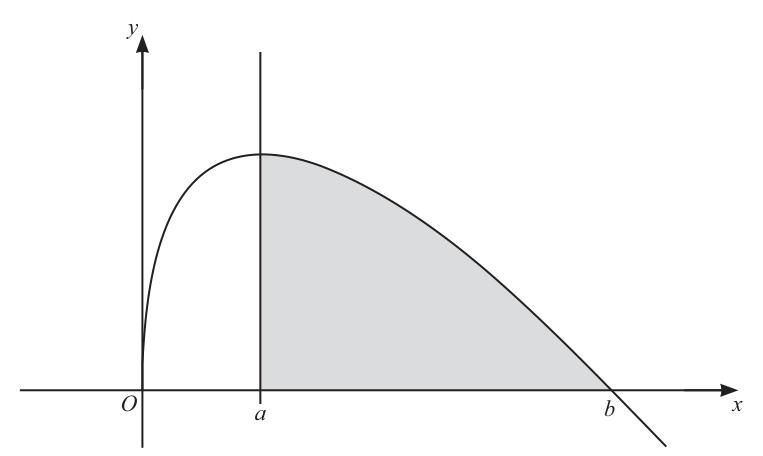
The equation of a curve is . The curve has a maximum point when and crosses the -axis at the point with coordinates , where . The shaded region is bounded by the curve, the line and the -axis (see diagram).
Approach
To find the x-coordinate of the maximum point, differentiate the curve equation and set the derivative equal to zero, then solve for .
Working
Differentiate with respect to :
Set to find the stationary point:
Since the curve has a maximum at this point, .
Answer
a = 4
Walkthrough
The problem asks for the x-coordinate of the maximum point on the curve . At a maximum (or minimum) point, the gradient of the curve is zero, so we differentiate with respect to and set the result equal to zero.
First, differentiate using the power rule: . For , the derivative is . For , the derivative is . So .
Setting this equal to zero gives , which rearranges to . Taking the reciprocal of both sides gives , and squaring both sides yields . This is the x-coordinate of the maximum point, so .
Key Takeaways
- At a stationary point (maximum or minimum), the first derivative equals zero.
- The power rule applies to fractional powers as well.
- Solving equations involving fractional powers may require taking reciprocals and squaring.
Common Mistakes
- Forgetting the negative sign when differentiating .
- Incorrectly applying the power rule to , e.g., writing instead of .
- Making algebraic errors when solving , such as forgetting to invert both sides.
- Not verifying that the stationary point is indeed a maximum (though in this context, the question states it is).
Things to Be Careful About
- The mark scheme condones sign errors in the step from to , so small sign slips here may not cost marks if the method is clear.
- Ensure the final answer is clearly stated as , not just .
Approach
The shaded region is bounded by the curve , the vertical line , and the x-axis. To find its area, first determine the x-intercept by setting , then evaluate the definite integral .
Working
Find by setting :
Factor out :
This gives or , so or . Since , we have .
Integrate the curve:
Evaluate the definite integral from to :
Substitute the upper limit :
Substitute the lower limit :
Subtract:
Answer
88/3
Walkthrough
The shaded region lies between and , bounded above by the curve and below by the x-axis. We need to find first, then integrate.
Finding : Set : . Factor out to get . This gives (the origin) or . Since , we take .
Integrating: Use the power rule for integration: . For , the integral is . For , the integral is . So the antiderivative is .
Evaluating: Substitute and into the antiderivative and subtract. Note that and . This gives for the upper limit and for the lower limit. The difference is .
Key Takeaways
- The x-intercepts of a curve are found by setting and solving.
- Integration with fractional powers follows the same power rule as integer powers.
- When evaluating definite integrals, always compute where is the antiderivative.
- Fractional powers like can be evaluated as for simplicity.
Common Mistakes
- Forgetting to find before setting up the integral.
- Incorrect integration of , e.g., writing without simplifying to .
- Arithmetic errors when evaluating or .
- Forgetting to subtract the lower limit evaluation from the upper limit evaluation.
- Giving a decimal answer instead of the exact fraction .
Things to Be Careful About
- The answer must be exact: or . Do not give a decimal approximation.
- The mark scheme requires for full marks on the substitution step; if the limits are in the wrong order, the method mark may be lost.
- Allow missing brackets if they can be recovered in subsequent working.
- The value must be explicitly shown in part (b) even if found in part (a).
Approach
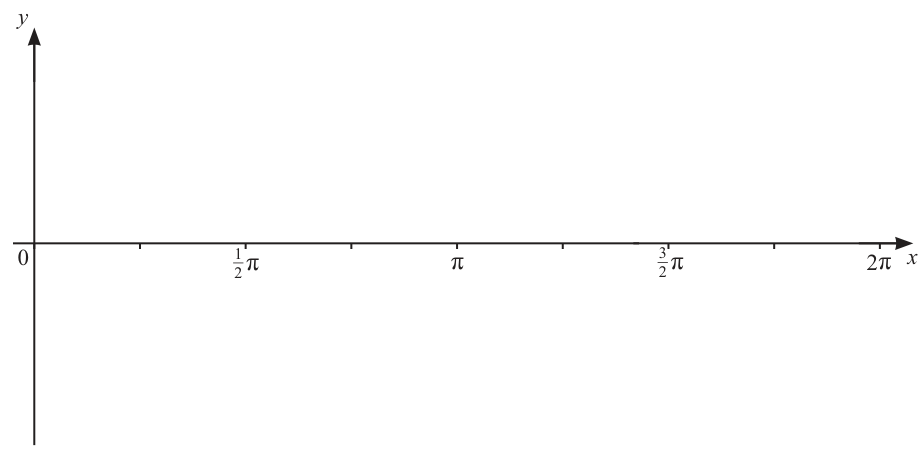
The graph of is a transformation of : vertically stretched by a factor of (amplitude becomes ) and translated upwards by units. The period remains . We identify the key points at the quarter-period intervals and sketch one full cycle on .
Working
The midline is and the amplitude is , so the maximum value is and the minimum value is .
Key points on the curve:
- At : (start at the midline going up).
- At : (maximum).
- At : (back to midline going down).
- At : (minimum).
- At : (back to midline going up).
The -axis is labelled with , , and , and the -axis is labelled with , , , and . The curve crosses the -axis between and and again between and .
Answer
The sketch is a sine curve with maximum , minimum , passing through and .
Sine curve: max (π/2, 5), min (3π/2, −1), through (0, 2) and (2π, 2).
Walkthrough
The function is built from in two stages. First the amplitude is multiplied by , so the curve oscillates between and instead of between and . Then the whole graph is shifted up by units, which moves the midline from to , the maximum from to , and the minimum from to . The period is unchanged at since the coefficient of inside the sine is still .
For the sketch we only need the values at the quarter-period marks: . Substituting gives . The curve must start at going up, reach the maximum , return to the midline at going down, reach the minimum , and finish at going up. The mark scheme requires these key values (or clear indications of them) on the y-axis and a curve that is horizontal only at the maximum and minimum points.
Key Takeaways
- The graph of has amplitude , midline , and the same period as .
- A sketch over one full period only requires the five key points at multiples of .
Common Mistakes
- Drawing a curve that starts at the origin or ends at — these score zero, since the curve must start at .
- Forgetting the vertical shift and drawing instead of (max would be , min would be ).
- Labelling the maximum and minimum at the wrong -values (e.g. max at and min at ).
Things to Be Careful About
- The maximum and minimum must be horizontal tangents at and respectively; the mark scheme requires the curve to be flat only at these two points.
- The -axis does not need to be to scale, but the values , and must be clearly indicated.
Determine the number of solutions in the interval of each of the following equations.
Approach
The number of solutions of in equals the number of intersections of and in this interval. We track the sign of at a few key points.
Working
At : , so the curve lies above the line.
At : , so the curve lies below the line.
Since the difference changes sign only once and the oscillating curve stays between and while grows steadily from to , the two graphs cross exactly once in .
Answer
solution.
1
Walkthrough
We need to count how many times the graph meets the straight line on the interval . The line starts at the origin and ends at . The sine curve oscillates between and and finishes at . At the curve sits at above the line, and at the curve sits at well below the line. The line is steep enough that once it overtakes the curve it stays above it, so exactly one crossing occurs.
Key Takeaways
- Equations of the form can be solved graphically by counting intersections of the two graphs.
- A useful trick is to evaluate at a few key points; every sign change indicates a crossing.
Common Mistakes
- Forgetting that reaches at the right end of the interval, well above the maximum of the sine curve, and concluding there might be multiple crossings.
- Counting the starting point as a solution: the equation is , which at gives , so is not a solution.
Things to Be Careful About
- The mark scheme says to "ignore any working out seen or graphs drawn" — the answer is awarded purely for the correct number .
Approach
The number of solutions of in equals the number of intersections of and in this interval. We track the sign of at the key points .
Working
At : (line above curve).
At : (curve above line). Sign change — first intersection.
At : (curve above line). No new intersection yet.
At : (line above curve). Sign change — second intersection.
At : (curve above line). Sign change — third intersection.
Three sign changes in total, giving three intersections.
Answer
solutions.
3
Walkthrough
We count intersections of (oscillating between and ) with the line (passing through and ). The line is decreasing with slope , so it cuts through the oscillating region of the sine curve multiple times.
We use the equivalent test on , which has the same zeros as . A sign change of between two consecutive test points means the graphs cross somewhere in between.
- : line above curve.
- : curve above line. One crossing in .
- : curve still above line; no crossing in .
- : line above curve. Second crossing in .
- : curve above line again. Third crossing in .
Three crossings in total.
Key Takeaways
- When counting solutions graphically, sample the difference at every quarter-period; between any two consecutive samples the curve cannot have more than one crossing if the two graphs are a slowly varying line and an oscillation.
- A line with slope that starts above the maximum of the oscillation and ends well below the curve must cross three times.
Common Mistakes
- Stopping after a single sign change and reporting one intersection.
- Forgetting that the line at is at , which is below the minimum of the curve, so the line must cross the curve a third time on the way back up.
Things to Be Careful About
- The mark scheme simply awards one mark for the number ; no working is required to earn it.
Approach
Use the Pythagorean identity to convert the equation into a quadratic in , solve the quadratic, and then find the corresponding -values in .
Working
Substitute :
Expand and simplify:
Rearrange into a three-term quadratic in :
Factorise the quadratic:
So either
or
Case 1: .
The principal value is . In the solutions are
Case 2: .
In this gives .
All three values lie in the required interval.
Answer
(AWRT .)
x = 0.4115, 2.7301, 3π/2 (AWRT 0.41, 2.73, 3π/2)
Walkthrough
The equation mixes and , so we use the Pythagorean identity to express everything in terms of . This turns the equation into a quadratic in , which we can solve with the usual methods.
After substitution, the equation becomes , i.e. . This factors cleanly as , giving and .
For , the principal value is . Since sine is positive in both the first and second quadrants, there is a second solution at . For , the only solution in is . All three values lie in the required interval.
Key Takeaways
- The identity is the standard tool for converting an equation in both and into a single-variable equation in .
- Each value of (with ) generally yields two solutions in — one in the first or second quadrant and one in the supplementary position.
- has the unique solution in .
Common Mistakes
- Forgetting to substitute the on the right-hand side, giving an equation of degree one in . The mark scheme notes that candidates who omit the can still earn M1 DM1 but no accuracy marks.
- Finding only the principal value of and missing the second solution in the second quadrant.
- Using with the wrong sign, which is a sign-error trap when not using the squared version of the identity.
Things to Be Careful About
- Final answers must be AWRT (within or so) of , and . The mark scheme accepts any equivalent forms such as , , or fractions of with denominator (e.g. ).
- A degree sign written alongside a radian answer can be ignored.
- Any value outside should be ignored (and is silently discarded by the mark scheme).
The coordinates of the points and are and respectively. The line segment forms a diameter of a circle.
Approach
Since is a diameter, the centre of the circle is the midpoint of , and the radius is half the length of . Substitute the centre and radius into the general equation of a circle.
Working
The centre is the midpoint of and :
The squared length of the diameter is
The radius is half the diameter, so the radius squared is
Therefore the equation of the circle is
Expanding gives the equivalent form
Answer
The equation of the circle is
or .
(x-4)^2 + (y-6)^2 = 34
Walkthrough
The line segment is given as a diameter, so the centre of the circle is exactly halfway between and . Find the midpoint by averaging the -coordinates and the -coordinates, giving .
The radius is half the length of the diameter. Rather than finding the length itself, work with squared lengths to avoid square roots. The squared length of the diameter is
so the squared radius is .
The general circle with centre and radius is . Substitute , , to obtain the required equation.
Key Takeaways
The centre of a circle through two endpoints of a diameter is the midpoint of those endpoints. The radius is half the diameter. Always identify the centre and radius before writing the equation of a circle.
Common Mistakes
- Using or as the centre of the circle.
- Using the full length of as the radius instead of half of it.
- Writing instead of .
- Giving the final answer in the form or , which is not accepted by the mark scheme.
Things to Be Careful About
The radius may be left unsimplified during working, but the final equation should be exact. Because , the correct squared radius is . If you prefer the expanded form, expand carefully:
gives
so .
Approach
The radius to has the same gradient as . The tangent at is perpendicular to this radius, so use to find the gradient of the tangent, then write the line through .
Working
The gradient of is
For perpendicular lines, , so the gradient of the tangent is
Using the point , the tangent has equation
Rearranging,
so
Equivalently,
Answer
The equation of the tangent at is
or .
y = -3/5 x + 76/5
Walkthrough
The centre of the circle is , so the radius to is the line segment from the centre to . This radius lies along the same straight line as , so its gradient is the gradient of :
A tangent to a circle at a point is perpendicular to the radius at that point. Therefore the tangent's gradient is the negative reciprocal of , namely . Use the point-slope form with :
Then rearrange to the simplified form .
Key Takeaways
The tangent to a circle is perpendicular to the radius at the point of contact. This fact lets you find the tangent gradient from the radius gradient with .
Common Mistakes
- Using the radius gradient as the tangent gradient instead of taking its negative reciprocal.
- Forgetting the negative sign when applying .
- Substituting the coordinates of the centre instead of the point of tangency into the line equation.
- A sign error when simplifying to .
Things to Be Careful About
The mark scheme accepts the tangent equation in any equivalent form, such as or . If you use implicit differentiation of the circle equation, substitute and into
and solve for , which also gives .
The other point on the circle with -coordinate 7 is .
Find the coordinates of the point of intersection of the tangent at with the tangent at .
Approach
Substitute into the circle equation to find the two points on the circle with that -coordinate. One is and the other is . Then find the tangent at , and solve it simultaneously with the tangent at from part (b).
Working
Substitute into :
So or . Since is , the other point is
The radius to has gradient
so the tangent at has gradient . Its equation is
or
The tangent at is . Equating the two tangents:
Substitute into the tangent at :
Answer
The point of intersection is
or , .
(46/3, 6)
Walkthrough
The circle has equation , or expanded as . To find points with -coordinate , substitute into the expanded form:
This simplifies to , which factorises as . Hence the two points with are , which is , and , which is .
The tangent at is perpendicular to the radius , where . The gradient of is
so the tangent at has gradient . Its equation through is
or .
Now solve the two tangent equations together. Since the point of intersection lies on both lines, set the two expressions for equal:
This gives , so . Substitute back into either tangent to get .
Key Takeaways
When a line meets a circle at two points, substituting one coordinate gives a quadratic whose two roots are the two possible values of the other coordinate. Tangents to a circle are perpendicular to the radius at the point of contact. The intersection of two tangent lines is found by solving their line equations simultaneously.
Common Mistakes
- Choosing as instead of ; is the other point with .
- Using the same gradient for both tangents. The tangent at has gradient and the tangent at has gradient .
- Forgetting to substitute the -value back into one of the tangent equations to find .
- Simplifying incorrectly; it equals .
Things to Be Careful About
The point is , so when the quadratic gives and , the other point is . The tangent at must be perpendicular to the radius through , not to . When solving the two tangent equations, both gradients must be different for the lines to meet in a single point. The final coordinates may be left as or as , ; is acceptable as an approximate check but the exact form is preferred.
The first three terms of a geometric progression are , and respectively, where , and are positive constants. The first three terms of an arithmetic progression are , and respectively.
Approach
Use the fact that the three terms belong to a geometric progression to write an equation connecting , and . Then use the fact that the same three letters form the first three terms of an arithmetic progression to write a second equation. Eliminate to obtain the required equation in and .
Working
Let the common ratio of the geometric progression be . Since , , are consecutive terms,
so
For the arithmetic progression, the common difference is constant:
Rearrange:
Substitute this expression for into :
Multiply out:
Expand and simplify:
Answer
a^2 - 10ac + 9c^2 = 0
Walkthrough
The geometric progression condition gives because the ratio between consecutive terms is constant. The arithmetic progression condition gives , because the common difference is constant. Rearranging the second equation expresses in terms of and . Substituting this into eliminates , leaving an equation involving only and . Expanding and simplifying gives the required result.
Key Takeaways
- Recognising the defining property of a geometric progression (common ratio) and an arithmetic progression (common difference).
- Eliminating a variable by substitution to obtain a relationship between the remaining variables.
- Expanding squared binomials carefully.
Common Mistakes
- Using only one progression and forgetting to combine both conditions.
- Sign errors when rearranging ; the correct rearrangement is .
- Not showing the expansion of ; the mark scheme requires a convincing proof (AG.
Things to Be Careful About
- Since , , are positive, the common ratio of the GP is positive, though this is not needed in part (a.
- The mark scheme awards B1 for one correct equation connecting , , only, M1 for forming an equation in and only, and A1 for the final convincing proof.
It is now given that and takes the smaller of its two possible values.
Approach
Substitute into the equation from part (a, solve the resulting quadratic for , and choose the smaller positive value. Use the geometric progression property to find the common ratio , then apply the sum-to-infinity formula for a convergent geometric progression.
Working
With , the equation becomes
Divide by :
Factorise:
so or . The smaller value is .
Since , with and ,
and , so . Therefore the common ratio of the GP is
(Alternatively, , and gives .
Since , the sum to infinity exists:
Answer
27/2
Walkthrough
Substitute into the equation from part (a. This gives a quadratic in . Factorising gives two possible values, and ; the question specifies that takes the smaller value, so . Then use to find , because is positive. The common ratio is . Since , the geometric progression converges, and the sum to infinity is .
Key Takeaways
- Solving a quadratic equation by factorisation.
- Using the positivity of terms to choose the correct sign of the common ratio.
- Applying the sum-to-infinity formula only when .
Common Mistakes
- Forgetting that must take the smaller of its two values; including as an additional solution is condoned, but the final answer must use .
- Using ; since , , are positive, the common ratio must be positive.
- Applying the sum-to-infinity formula without checking that .
Things to Be Careful About
- The mark scheme allows the extra solution for the B1 mark, but any error that leads to costs that B1.
- The mark for finding may be implied by writing , , or .
- The sum-to-infinity mark requires use of the correct formula with and their ; extra working with a negative is ignored.
- Do not give an extra final answer; the A1 mark does not allow an additional incorrect answer.
Approach
Use the values , and to write down the first three terms of the arithmetic progression. Find its common difference, then apply the formula for the sum of the first terms.
Working
The first three terms of the AP are
Hence the common difference is
Using with , and :
Answer
-960
Walkthrough
With , the first three terms of the arithmetic progression are , , and . The common difference is . Then substitute , , into the sum formula . This gives .
Key Takeaways
- The formula for the sum of the first terms of an arithmetic progression: .
- Finding the common difference from consecutive terms.
- Substituting carefully, including handling a negative common difference.
Common Mistakes
- Using the wrong sign for the common difference; here , not .
- Forgetting to multiply by .
- Using instead of .
Things to Be Careful About
- The mark scheme awards B1 for stating (or equivalent), M1 for using a correct sum formula with , and their non-zero , and A1 for the final answer .
- The common difference can be implied by quoting the correct formula then substituting; it does not have to be stated separately.
The function is defined by for .
Find an expression for and hence determine whether is an increasing function, a decreasing function or neither.
Approach
Rewrite the terms as powers of , differentiate using the chain rule, then use to determine the sign of .
Working
Let , so and .
For , , so both terms are negative; hence for every in the domain. A function with a negative derivative on its whole domain is decreasing.
Answer
and is decreasing.
f'(x) = -24/(3x-6)^3 - 9/(3x-6)^4; f is decreasing.
Walkthrough
The expression is written with powers of : and . Each term is a composite function of the form , so differentiating uses the chain rule: differentiate the outer power and multiply by the derivative of , which is . Thus the first term contributes and the second contributes . Both contributions are negative for because . A negative derivative on the whole domain means the function is decreasing.
Key Takeaways
The chain rule is needed for powers of a linear expression. The sign of on the domain tells whether is increasing, decreasing, or neither.
Common Mistakes
Forgetting the factor from the derivative of is the most common error. Sign errors in the exponents also occur. The decreasing mark is only awarded if the derivative is written in the form with positive and , so keep the negative coefficients visible.
Things to Be Careful About
Use the domain : it makes positive, so both terms of are negative. Do not try to find stationary points; the question only asks for the sign of the derivative.
Approach
A function has an inverse exactly when it is one-to-one. Since is decreasing on its whole domain, it is one-to-one.
Working
From part (a), for all , so is decreasing. A decreasing function passes the horizontal line test: each horizontal line meets the graph at most once. Therefore exists.
Answer
Yes, exists because is decreasing (one-to-one) on .
Yes, f^-1 exists because f is decreasing (one-to-one).
Walkthrough
A function has an inverse exactly when it is one-to-one: each output comes from only one input. From part (a), is decreasing on its entire domain, so its graph passes the horizontal line test. Therefore exists.
Key Takeaways
Monotonic functions are one-to-one. Existence of an inverse is a property of the function being one-to-one, not of the formula alone.
Common Mistakes
Answering only "yes" without a reason loses the mark. Saying "because it is decreasing" is acceptable, as is saying "one-to-one" or "passes the horizontal line test".
Things to Be Careful About
The inverse exists as a function from the range of to the domain . You do not need to find a formula for .
Approach
is linear with positive slope, so its range is determined by the strict lower bound on .
Working
For , multiplying by and subtracting preserves the inequality:
As can be arbitrarily large, can be arbitrarily large. Thus the range is .
Answer
or equivalently .
g(x) > 4a - 3, i.e. (4a - 3, ∞)
Walkthrough
is a linear function with positive slope, so it is increasing. If , then multiplying by and subtracting gives . Because has no upper bound, can be made arbitrarily large. Hence the range is all values greater than .
Key Takeaways
For an increasing linear function on an open interval, the endpoint of the range is open and corresponds to the endpoint of the domain.
Common Mistakes
Writing instead of includes the endpoint incorrectly. Writing a numerical range without is also wrong.
Things to Be Careful About
The condition is , not , so is not included. The range can be written as or .
Approach
For to exist, every value taken by must lie in the domain of , so for all .
Working
Since and , the range of is . We need this range to be contained in the domain :
so . Hence . If , then for every , so the endpoint is allowed.
Answer
or equivalently .
a ≥ 5/4, i.e. [5/4, ∞)
Walkthrough
For to exist, every output of must be an allowed input of . The domain of is , so we need for every . Since is increasing and , the smallest values of approach but never reach it; the range is . This range must lie inside , so . Solving gives . If , then for all , so the endpoint is allowed. Conversely, if , values of just above give , so the composite would not be defined for those .
Key Takeaways
A composite function exists exactly when the range of is a subset of the domain of . Strict inequalities must be handled carefully at endpoints.
Common Mistakes
Using and excluding is a common endpoint error. Using , , or in the initial inequality is not accepted unless a correct inequality is later reached. Forgetting that the condition must hold for all , not just at one value, is also a mistake.
Things to Be Careful About
The mark scheme accepts both and , but the exact set of values is because the range of is open at its lower end.
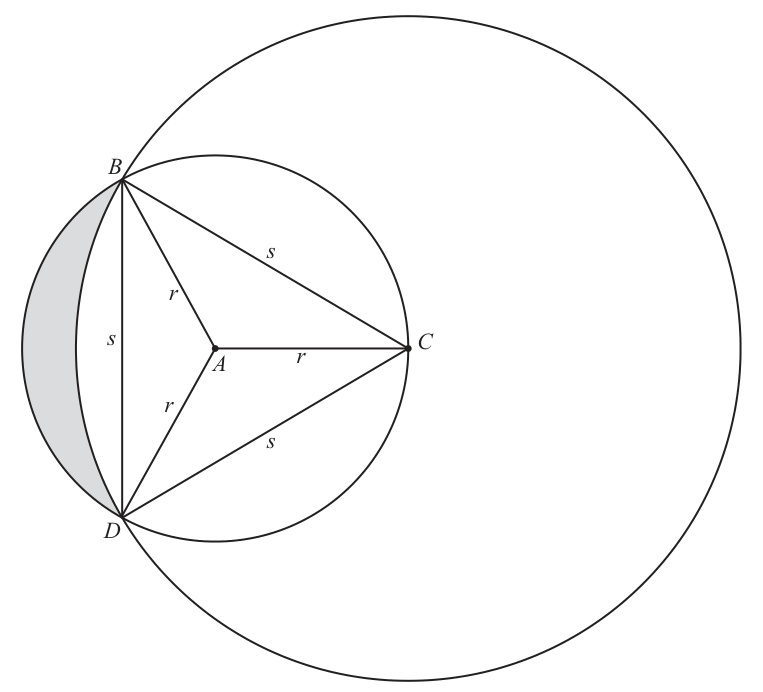
The diagram shows a circle with centre and radius passing through points , and . A larger circle of radius has centre and passes through and . The length is also .
Approach
Since , triangle is equilateral, so . Because lies on the smaller circle with centre , the inscribed angle theorem gives the central angle . Apply the cosine rule in the isoceles triangle (where ) to find in terms of .
Working
Since , triangle is equilateral, so
lies on the smaller circle, so is the inscribed angle subtending chord . By the inscribed angle theorem, the central angle subtending the same arc is twice the inscribed angle:
In triangle , (both radii of the smaller circle) and . Apply the cosine rule:
Therefore
Answer
s = √3 r
Walkthrough
The first thing to notice is that , so triangle is equilateral. This means each interior angle in the triangle is (or ).
The next step uses the fact that lies on the smaller circle with centre . The angle is an inscribed angle in this circle, subtending the chord . The inscribed angle theorem tells us that the central angle subtending the same arc (the arc that does not contain ) is twice the inscribed angle. So .
Now we have a triangle with and . We want to find . The cosine rule is the right tool here:
Substituting the values and using the exact trigonometric value , we get:
Taking the positive square root (since is a length), .
Key Takeaways
- Recognise when a triangle is equilateral (all three sides equal).
- The inscribed angle theorem: the central angle subtending an arc is twice the inscribed angle subtending the same arc.
- The cosine rule is a powerful tool for finding an unknown side of a triangle when you know two sides and the included angle (or any other combination).
- Memorise exact values of and for special angles like .
Common Mistakes
- Forgetting that the inscribed angle theorem relates the inscribed angle to the central angle subtending the same arc (the arc that does not contain the inscribed angle's vertex).
- Sign errors: , not .
- The cosine rule gives , so we must take the positive square root to find .
- Using degrees instead of radians in the cosine rule, or vice versa.
Things to Be Careful About
- The "show that" question requires a clear, complete derivation. State the inscribed angle theorem and the cosine rule explicitly.
- Make sure to identify the correct angle: the central angle, not the inscribed angle.
- Keep calculations in exact form throughout to avoid losing accuracy.
Find an expression for the area of the shaded region. Give your answer in the form , where and are constants to be found.
Approach
The shaded region lies between the left arc of the larger circle and the left arc of the smaller circle, on the same side of the chord . Compute the area of each segment (sector minus triangle), then subtract to obtain the shaded area.
Working
From part (a), , so .
Central angles:
- (from part a).
- (equilateral triangle ).
Sector areas:
Triangle areas:
Segment areas (left of ):
Each segment is bounded by the chord and the corresponding left arc. The smaller circle's left arc bulges further to the left (away from the chord ) than the larger circle's left arc, so the smaller circle's left segment contains the larger circle's left segment. The shaded region is the difference:
Answer
with and .
(√3/2 − π/6) r²
Walkthrough
The shaded region is a crescent between the two left arcs of the circles (both arcs lie on the same side of the chord , away from the centres and ). To find its area, we compute the area of each segment (the region between a chord and its arc) and subtract.
Step 1: Identify the central angles.
- — central angle of the smaller circle subtending chord (from part a).
- — central angle of the larger circle, equal to the angle of the equilateral triangle at vertex .
Step 2: Compute the sector areas.
The sector area formula is , where is the central angle in radians.
(We substituted from part a.)
Step 3: Compute the triangle areas.
The triangle area formula uses the included angle .
For isoceles triangle with two sides of length and included angle :
For equilateral triangle with side :
Step 4: Recognise the shaded region as a difference of segments.
This is the key step. The shaded region is the crescent between the two left arcs. A segment of a circle is the region between a chord and an arc. Both circles have a left segment (the region between chord and the left arc).
In this configuration, the smaller circle's left arc bulges further to the left than the larger circle's left arc. You can verify this with a quick calculation: the chord is at perpendicular distance from the centre of the smaller circle, and at perpendicular distance from the centre of the larger circle. Since the smaller circle has radius and the larger has radius , the chord sits at half the smaller radius but at a much greater fraction of the larger radius. This means the larger circle's left arc is more "flat" near the chord, while the smaller circle's left arc extends out further to the left.
The shaded region is bounded by the smaller circle's arc (further to the left) and the larger circle's arc (closer to the chord). So the shaded region is the part of the smaller circle's left segment that is NOT in the larger circle's left segment:
Step 5: Compute the difference.
Subtracting:
This is in the form with and .
Key Takeaways
- Sector area = , where is the central angle in radians.
- Triangle area (using two sides and the included angle) = .
- Segment area = sector area − triangle area (for a minor segment).
- When a region is bounded by two arcs of different circles on the same side of a chord, it is the difference of two segments. Identify which arc is further from the chord (this segment contains the other).
- Exact trigonometric values for special angles (e.g. ) are essential.
Common Mistakes
- Forgetting to use radians. The sector area formula requires the angle in radians. Mixing degrees and radians will give the wrong answer.
- Sign errors with trig values. (positive in the second quadrant), but (negative in the second quadrant).
- Subtracting the segments in the wrong order. Make sure to identify which segment is "outer" (further from the chord) and which is "inner". The shaded region is outer minus inner.
- Not substituting . The mark scheme explicitly requires simplification in terms of at intermediate steps.
Things to Be Careful About
- The question requires the answer in the form . Make sure to write it in this exact form, with the constants and clearly identified.
- The angle in the larger circle is the central angle of the arc on the left of (the arc not containing ). It equals , the angle of the equilateral triangle at .
- Verify the final answer is positive: and , so the answer is positive. ✓