Mathematics 9709/11 — October/November 2025
Cambridge AS Level · Pure Mathematics 1 · worked solutions for every part, with the mark scheme
Topics Quadratics · Series · Trigonometry · Functions · Differentiation · Integration · +2 more
Find the set of values of the constant for which the quadratic equation
has two distinct real roots.
Approach
For a quadratic equation , two distinct real roots occur when the discriminant is positive:
Here , , . Substitute these into the discriminant and solve the resulting quadratic inequality.
Working
The given quadratic is
So , , . For two distinct real roots:
Simplify:
Expand :
Factor the quadratic:
The critical values are and . Since the quadratic opens upwards, the inequality is satisfied outside the interval between the roots:
Answer
The set of values of is
k < 4 or k > 16
Walkthrough
We need the quadratic equation to have two distinct real roots. For a quadratic , the discriminant determines the number of roots:
gives two distinct real roots.
Here , , and . Substituting into the discriminant gives
Simplify the expression. Expand to get , and compute . Then:
Factor the quadratic:
The critical points are and . The product is positive when both factors have the same sign. Test the intervals:
- For , both and are negative, so the product is positive.
- For , one factor is negative and one is positive, so the product is negative.
- For , both factors are positive, so the product is positive.
Therefore the solution is or . The endpoints and are excluded because the discriminant is zero there, giving one repeated root rather than two distinct real roots.
Key Takeaways
- The discriminant is the key tool for determining the nature of roots of a quadratic equation.
- Two distinct real roots require a strictly positive discriminant.
- Solving a quadratic inequality involves finding the roots and testing the sign in each interval.
- The leading coefficient of the quadratic in is positive, so the inequality is satisfied outside the interval between the roots.
Common Mistakes
- Using or instead of strict or . The mark scheme explicitly gives B0 if the endpoints are included.
- Incorrectly computing as instead of .
- Expanding incorrectly as instead of .
- Failing to factor the quadratic correctly or misidentifying the sign intervals.
Things to Be Careful About
- The discriminant must be strictly greater than zero; equal to zero gives a repeated root.
- The critical values and are not included in the answer.
- If , the equation is not quadratic, but is not in the solution set, so no separate exception is needed.
- The answer must be written as two separate strict inequalities, not as a single combined interval.
A geometric progression has first term and common ratio , where . It is given that the second term is 8 and the fifth term is .
Approach
Write the second and fifth terms of the geometric progression as and , where . Dividing the terms eliminates and gives an equation for . Solve for using the inverse cosine in the given interval.
Working
Let . The second term is
and the fifth term is
Dividing the fifth term by the second term:
so
Taking cube roots:
Since ,
Therefore
Correct to 3 significant figures, radians.
Answer
θ = 1.32 radians (3 s.f.)
Walkthrough
In a geometric progression, the th term is . Here , so the second term is and the fifth term is . The question tells us these are and .
Dividing the fifth term by the second term removes the unknown first term :
.
Taking the cube root gives , so . Since , the angle is in the first quadrant and there is only one solution. Therefore radians, which is to 3 significant figures.
Key Takeaways
- The th term of a GP is .
- Dividing two terms of a GP can eliminate the first term and leave an equation for the common ratio.
- To solve , take the cube root before applying the inverse cosine.
- The given interval determines which trigonometric solution is valid.
Common Mistakes
- Giving the answer in degrees, e.g. , is not accepted because the interval is in radians.
- Dividing the wrong way round: the fifth term divided by the second term gives , not .
- Forgetting to take the cube root and treating as if it were .
- Rounding too early, instead of keeping exactly for part (b).
Things to Be Careful About
- The interval is in radians, so the final answer must be in radians.
- The angle is acute, so the inverse cosine is unique in this interval.
- The mark scheme allows greater accuracy such as , but the 3 significant figure answer is .
Approach
Use the exact value from part (a) and the given second term to find . Then apply the sum-to-infinity formula for a geometric progression, valid because .
Working
From part (a), . The second term is , so
and hence
Since , the sum to infinity exists and is
Answer
S∞ = 128/3
Walkthrough
From part (a), the common ratio is exactly . The second term of the GP is , so with we have , giving .
A geometric progression has a sum to infinity only when . Here , so . Substituting and gives .
Key Takeaways
- The sum to infinity formula is and requires .
- Once the common ratio is known, the first term can be found from any given term.
- Using exact values throughout gives an exact final answer.
Common Mistakes
- Using an approximate value of instead of the exact , which may lose the exact fraction in the final answer.
- Substituting into without checking that .
- Arithmetic errors when dividing by : .
Things to Be Careful About
- The mark scheme allows an attempt using an approximate value of , but the exact final answer requires using .
- The fraction should be simplified: is already in simplest form.
- The final answer is , not an unsimplified expression such as .
In the expansion of
the coefficient of is 216.
Find the value of the positive constant .
Approach
Expand each binomial using the binomial theorem, extract the terms that give , combine their coefficients, and solve the resulting quadratic in .
Working
For , the general term is
The power of is . To obtain , take :
For , the general term is
The power of is
To obtain , solve , so :
The second bracket is subtracted, so the contribution to the coefficient of is .
Therefore the total coefficient of is
Divide by 3:
Let . Then
Factorise:
So or . Since , only is valid:
Because is positive,
Answer
p = 2
Walkthrough
We need the coefficient of in the whole expression.
For , the binomial theorem gives terms of the form . The power of is , so to get we need . This gives , so the coefficient of the first bracket is .
For , the general term is . Its power of is . Setting this equal to 4 gives , and the term is . Since the second bracket is subtracted, the coefficient contributed is .
Adding the two coefficients and setting the total equal to 216 gives . Rearranging and dividing by 3 gives . Letting turns this into a quadratic in : , which factorises as . Thus or . Since cannot be negative, only is possible, so because is positive.
Key Takeaways
- The binomial theorem lets us choose any individual term by selecting the appropriate value of .
- When an expansion is subtracted, the sign of every coefficient in that expansion is reversed.
- An equation such as is quadratic in ; substitute to solve it.
- Reject roots that are impossible for the given conditions, such as a negative value of .
Common Mistakes
- Writing the coefficient of from the first expansion without the factor of 3, or using an unsimplified binomial coefficient such as .
- Forgetting the minus sign before the second bracket, which would incorrectly give .
- Treating the equation as quadratic in rather than in .
- Forgetting to reject and therefore reporting a non-real or negative value.
Things to Be Careful About
- Check the exponent of in each general term before selecting : it is in the first expansion and in the second.
- The second bracket contributes , not .
- Since is specified to be positive, only is accepted, not .
- Show the full factorisation or quadratic formula step, because the mark scheme requires a valid method for solving the quadratic in .
Approach
Complete the square on by first taking out a factor of from the -terms.
Working
Complete the square inside the bracket:
Therefore:
So and .
Answer
a = 10, b = 3
Walkthrough
We need to write in the form . The expression has a negative term, so first take out from the terms involving : . Inside the bracket, complete the square: . Substituting back gives . Comparing with gives and .
Key Takeaways
Completing the square works even when the coefficient of is negative: factor out the negative sign first and complete the square inside the bracket. The form is useful for identifying transformations.
Common Mistakes
Forgetting to multiply the constant by the factor when removing the bracket, leading to instead of . Also, a sign error in : since the bracket is , , not .
Things to Be Careful About
The form is , so the sign inside the bracket is already included. Check by expanding .
The graph of is transformed to the graph of by a reflection followed by a translation of . Give details of the reflection and determine the values of and .
Approach
Reflect the graph of in the -axis, then apply the translation vector. Compare the resulting equation with the completed-square form from part (a).
Working
Reflecting in the -axis gives:
Translating by gives:
From part (a), the target is:
Comparing:
So , giving , and .
Answer
Reflection in the -axis, followed by translation by .
So and .
Reflection in x-axis; m = -3, n = 10
Walkthrough
Start with . A reflection in the -axis changes to , so the graph becomes . Then a translation by moves the graph units horizontally and units vertically. For , this translation gives , so here . We want , which from part (a) is . Compare with . The brackets match when , so , and the vertical shift is . Therefore the required transformation is a reflection in the -axis followed by translation by .
Key Takeaways
Transformations of graphs are applied in the order stated. A translation vector replaces by and adds to the function. The completed-square form makes the translation visible.
Common Mistakes
Getting the sign of wrong: a translation by moves the graph right if and left if , but the equation uses . Since the target has , we need . Also, applying the translation before the reflection would give a different result; the order matters.
Things to Be Careful About
The reflection must be stated as "in the -axis". The translation vector is ; note the horizontal component is negative. If part (a) had a different value of or , the mark scheme allows follow-through for and .
Approach
Express as , combine the two terms over the common denominator , then use the Pythagorean identity to simplify the numerator to .
Working
Start from the left-hand side:
Combine over the common denominator :
Factorise the numerator as a difference of two squares:
Since :
Now substitute :
Therefore:
Answer
tan^4 θ - 1 ≡ (1 - 2cos^2 θ) / cos^4 θ
Walkthrough
The goal is to prove the identity . The key strategy is to express everything in terms of only.
First, write as using the definition . Then combine the two terms over the common denominator , giving .
The numerator is a difference of two squares: with and . This factorises to . The second factor equals 1 by the Pythagorean identity, leaving .
Finally, replace with (again using the Pythagorean identity) to get . This gives the required result.
Key Takeaways
The Pythagorean identity is the fundamental tool for converting between sine and cosine. The difference-of-squares factorisation is extremely useful when working with even powers of trigonometric functions. Identity proofs require showing every step clearly, since the answer is given in the question.
Common Mistakes
- Omitting intermediate steps. Since this is an "AG" (answer given) question, the marking scheme requires "necessary detail" — a B1 for the initial substitution, M1 for combining into a single fraction, and A1 for the final confirmation.
- Working on both sides of the identity simultaneously without reaching a common correct expression — the mark scheme limits credit in this case.
- Forgetting that raised to the fourth power gives .
Things to Be Careful About
The identity must be proven in full; simply stating the result earns no marks. The mark scheme accepts working from either side (LHS to RHS or RHS to LHS) for full marks. An alternative valid approach is to start from the RHS: .
Approach
Substitute the identity from part (a) into the equation, simplify to obtain a value for , then take square roots and find all solutions in the interval .
Working
Using the identity from part (a):
Cancel from numerator and denominator:
Multiply through by :
Collect terms:
Take square roots:
For , in :
For , in :
Answer
θ = 70.5° and θ = 109.5°
Walkthrough
The equation uses the expression , which we proved in part (a) equals . Substituting this in:
The in the numerator cancels with part of the in the denominator, leaving .
Multiplying through by (valid since in the given interval — at the original expression would be undefined) gives , which rearranges to , so .
Taking square roots, . In the interval , cosine is positive in the first quadrant and negative in the second. So gives the acute angle , and gives the second-quadrant angle .
Key Takeaways
When solving , always consider both . In the interval , a positive cosine value gives one solution in the first quadrant, and the corresponding negative value gives one solution in the second quadrant ( minus the acute angle). The identity from part (a) was essential to convert the equation into a form solvable for .
Common Mistakes
- Forgetting the negative square root: also gives a valid solution.
- Including as a solution. If the equation is written as , one might incorrectly conclude gives a solution — but makes the original expression undefined (division by zero), and the mark scheme awards A0 in this case.
- Giving answers in radians when the question specifies degrees. The mark scheme gives only B1 (instead of A1) for and only.
Things to Be Careful About
The interval is strict: , so and are excluded. Both solutions and lie strictly inside the interval. The mark scheme accepts greater accuracy ( and ). When simplifying to , the multiplication by requires , which holds throughout the interval except at — and at that point the original equation is not satisfied anyway.
Functions and are defined by
Approach
For , the squared term is always non-negative and is smallest when . Substituting this gives the minimum value of , so the range is all values from that minimum upwards.
Working
Since , we have , so
Therefore
As increases without bound, increases without bound, so the range is all values at least .
Answer
f(x) >= -3
Walkthrough
The function is , but its domain is restricted to . Although the vertex of the parabola is at , that value is not in the domain. On , the smallest possible value of is , so the smallest value of is . Therefore the smallest value of is . As gets larger, gets larger without bound, so the range is .
Key Takeaways
The range of a quadratic function depends on its domain. When the domain excludes the vertex, the minimum or maximum may occur at an endpoint of the domain. Here the squared term is smallest at , not at .
Common Mistakes
- Stating instead of ; the range is about output values, not input values.
- Using instead of ; because is included, is actually achieved.
- Assuming the vertex gives the minimum without checking whether it lies in the domain.
Things to Be Careful About
The mark scheme requires the inequality to be , not , and the variable in the range statement must be or , not .
Approach
To find the inverse, write and rearrange to make the subject. Because the domain is , the expression is positive, so we take the positive square root. Finally, interchange and to express the inverse in terms of .
Working
Let
Add to both sides:
Since , we have , so
Hence
Interchanging and gives the inverse function:
Answer
f^{-1}(x) = -3 + sqrt(x+12)
Walkthrough
Start by setting . To reverse the operations, add to isolate the squared bracket, then take square roots. The domain tells us is positive, so only the positive square root is valid. After solving for in terms of , swap the variable names to obtain .
Key Takeaways
An inverse function reverses the original function. For a quadratic, the domain must be restricted to make the function one-one, and that same restriction tells you which square-root sign to choose when finding the inverse.
Common Mistakes
- Writing in the final answer; the domain forces the positive square root.
- Stopping at without swapping variables; the final expression must be in terms of .
- Making a sign error when rearranging, such as .
Things to Be Careful About
The mark scheme allows the final answer written as , but not with a sign. The rearrangement must be a genuine attempt to make the subject; sign errors are the only errors condoned at the method mark.
Approach
Form the composite function by substituting into . Set the resulting expression equal to and solve the quadratic equation. Finally, check that any solution lies in the domain of .
Working
First form the composite:
Set this equal to :
Solve:
So
Since the domain of is , discard .
Answer
x = 4
Walkthrough
To find , apply to the output of . Since , replace with . Simplify to . Setting this equal to gives a quadratic equation in . Solve by isolating the squared bracket and taking square roots, or by expanding and factorising. The two algebraic solutions are and , but is only defined for , so only is valid.
Key Takeaways
Composite functions are evaluated by substituting the inner function into the outer function. After solving an equation involving a composite function, always check the domain of the inner function, because extraneous solutions may be introduced by the algebra.
Common Mistakes
- Forming in the wrong order, e.g. substituting into instead of into .
- Forgetting to check the domain and giving both and ; the mark scheme awards the final mark only for .
- Making a sign error when simplifying .
Things to Be Careful About
The composite must be , not (the is inside the bracket and must also be multiplied by ). The final answer must be only ; is not in the domain of .
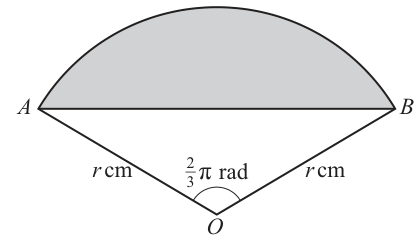
The diagram shows a sector of a circle with centre and radius cm. The shaded region is bounded by the chord and the arc . The size of angle is radians.
Approach
The shaded region is a circular segment. Its area equals the area of the sector OAB minus the area of the triangle OAB.
Working
Area of sector OAB:
Area of triangle OAB:
Area of shaded region:
Calculating the numerical coefficient:
Therefore:
Answer
0.614r^2
Walkthrough
The shaded region in Fig. 7.1 is a circular segment — the region between the chord AB and the arc AB. To find its area, we subtract the area of triangle OAB from the area of sector OAB.
Step 1: Sector area. The formula for the area of a sector with radius and angle (in radians) is . Substituting gives .
Step 2: Triangle area. The formula for the area of a triangle with two sides and included angle is . Since , the triangle area is .
Step 3: Segment area. Subtracting the triangle area from the sector area gives . Evaluating the constant factor numerically yields approximately .
Key Takeaways
- The area of a circular segment equals the sector area minus the triangle area: .
- Always ensure angles are in radians when using sector formulae.
- The sine formula is essential for finding the triangle area when two sides and the included angle are known.
Common Mistakes
- Using degrees instead of radians in the sector area formula.
- Forgetting that , not .
- Adding the sector and triangle areas instead of subtracting.
Things to Be Careful About
- The mark scheme accepts greater accuracy such as , but is the required answer to 3 significant figures.
- Units are cm², which should be stated in the final answer.
It is given that the radius of the circle is increasing at a rate of 0.4 cm s.
Find the rate of increase of the area of the shaded region at the instant when . Give your answer correct to 2 significant figures.
Approach
Use the result from part (a), , to find . Then apply the chain rule with and .
Working
From part (a):
Differentiate with respect to :
At :
Apply the chain rule:
Rounding to 2 significant figures:
Answer
9.8 cm^2 s^{-1}
Walkthrough
We are given that the radius is increasing at cm s⁻¹ and need to find how fast the shaded area is increasing when .
Step 1: Differentiate the area formula. From part (a), . Differentiating with respect to gives .
Step 2: Evaluate at . Substituting gives cm² per cm of radius increase.
Step 3: Apply the chain rule. Since changes with time, we use . Multiplying gives cm² s⁻¹.
Step 4: Round to 2 significant figures. The answer is cm² s⁻¹.
Key Takeaways
- The chain rule connects rates of change: .
- When the area is given as a function of , differentiate with respect to first, then multiply by .
- Always check units: here the result is in cm² s⁻¹.
Common Mistakes
- Forgetting the chain rule and using directly as the answer.
- Using instead of .
- Rounding too early, which can affect the final answer.
Things to Be Careful About
- The mark scheme awards a mark for stating or implying (or greater accuracy), then for applying the chain rule correctly.
- The answer must be given to 2 significant figures: , not or .
- Using the exact value instead of gives a slightly more accurate intermediate result but the final answer to 2 s.f. is the same.
Find the rate of increase of the length of the arc . Give your answer correct to 2 significant figures.
Approach
Use the arc length formula to express the length of arc AB in terms of , differentiate with respect to , then apply the chain rule with .
Working
Length of arc AB:
Differentiate with respect to :
Apply the chain rule:
Calculating:
Rounding to 2 significant figures:
Answer
0.84 cm s^{-1}
Walkthrough
We need to find how fast the arc length AB is increasing. The arc length depends on the radius and the angle , which is constant.
Step 1: Arc length formula. For a circle of radius and angle in radians, the arc length is . Here .
Step 2: Differentiate. Since is constant, .
Step 3: Chain rule. cm s⁻¹.
Step 4: Round to 2 significant figures. The answer is cm s⁻¹.
Key Takeaways
- Arc length is where is in radians.
- When only one variable () changes and is constant, is simply .
- The chain rule applies identically: .
Common Mistakes
- Forgetting that the angle is constant, so , not a function of .
- Using the wrong angle (e.g., degrees instead of radians).
- Not applying the chain rule and giving as the final answer.
Things to Be Careful About
- The mark scheme accepts any method that differentiates correctly and applies the chain rule.
- The answer must be to 2 significant figures: , not or .
- Units are cm s⁻¹, not cm² s⁻¹.
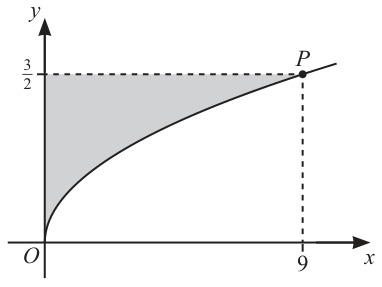
The diagram shows the curve with equation and the point with coordinates . The shaded region is bounded by the curve and the lines and .
Approach
The shaded region is bounded by the -axis (), the horizontal line , and the curve . We can find the area by calculating the area of the rectangle bounded by , , , and subtracting the area under the curve from to . Alternatively, we can express in terms of and integrate with respect to .
Working
Method 1: Integrate with respect to
The area of the rectangle from to and to is:
The area under the curve from to is:
Evaluating at the limits:
The shaded area is the rectangle area minus the area under the curve:
Method 2: Integrate with respect to
From , we have , so .
The shaded region is bounded by on the left and on the right, for from to .
Evaluating at the limits:
Answer
9/2
Walkthrough
The shaded region is bounded on the left by the -axis, on the top by the horizontal line , and on the right/bottom by the curve .
Method 1 (integrating with respect to ): We can find the area by taking the total area of the bounding rectangle (from to and to ) and subtracting the area under the curve. The rectangle has area . The area under the curve is found by integrating from to , which gives . Subtracting this from the rectangle area gives .
Method 2 (integrating with respect to ): We can also integrate the horizontal width of the shaded region. Solving for gives . The width at height is simply . Integrating this from to gives .
Key Takeaways
- Area between a curve and the -axis can be found by integrating with respect to .
- Alternatively, area can be found by subtracting the area under the curve (integrated with respect to ) from the bounding rectangle.
- When integrating powers, remember to add to the exponent and divide by the new exponent.
Common Mistakes
- Forgetting to subtract the area under the curve from the rectangle area when using Method 1.
- Incorrectly integrating ; the integral is , so .
- Using the wrong limits of integration.
Things to Be Careful About
- Ensure the limits of integration match the variable you are integrating with respect to. For , limits are to ; for , limits are to .
- The shaded region is above the curve, not below it, when integrating with respect to .
The shaded region is rotated through about the -axis.
Find the exact volume of the solid produced.
Approach
When a region is rotated about the -axis, the volume of the solid produced is given by . We must express in terms of and determine the limits of integration for .
Working
From the equation of the curve , we solve for :
Squaring this expression gives:
The shaded region extends from to . The volume of revolution about the -axis is:
Integrating:
Evaluating at the limits:
Calculate :
Substitute back:
Answer
243pi/10
Walkthrough
The shaded region is rotated about the -axis. The formula for the volume of revolution about the -axis is .
First, we need in terms of . From , we get , so .
The limits of integration are the -values that bound the shaded region, which are from (at the origin) to (at point ).
We set up the integral . Integrating gives . Evaluating this from to gives . Multiplying by gives the final volume .
Key Takeaways
- Volume of revolution about the -axis requires integrating with respect to .
- Always express the function in the form when rotating about the -axis.
- Remember to square the expression for before integrating.
Common Mistakes
- Attempting to integrate (which is for rotation about the -axis) instead of .
- Forgetting to square when setting up the integral (i.e., using instead of ).
- Omitting the factor in the final answer.
Things to Be Careful About
- Ensure you are using the correct volume formula for the axis of rotation. About the -axis, it is .
- The limits must be in terms of , not .
An arithmetic progression has first term 2 and common difference . The sum of the first terms is denoted by .
It is given that , , are the first three terms of a second arithmetic progression.
Find the value of .
Approach
Write , and in terms of using the sum formula for the first terms of an arithmetic progression with first term :
Since these three values form the first three terms of a second arithmetic progression, the middle value is the average of the outer two, so . Solving the resulting linear equation gives .
Working
The first progression has and common difference , so
For :
Therefore
For :
For :
Since , , are the first three terms of an arithmetic progression, the middle term is the mean of the outer two:
Substitute the expressions in terms of :
Simplify:
Answer
d = -1/5
Walkthrough
This part gives an arithmetic progression with first term 2 and common difference , and asks for given that three particular sums form the first three terms of another arithmetic progression.
Step 1: Recall the sum formula. For an arithmetic progression the sum of the first terms is
With this becomes
Step 2: Compute each needed sum. For : , so . For : . For : . Every quantity is now written in terms of the unknown .
Step 3: Use the AP condition. Three numbers , , are in arithmetic progression precisely when the middle is the average of the outer two, i.e. . Applying this:
Step 4: Solve. Substitute and simplify:
The key step is translating "first three terms of an arithmetic progression" into the double-the-middle condition, which turns the problem into a single linear equation in .
Key Takeaways
- The sum formula for an arithmetic progression must be applied with the correct first term and common difference.
- Three consecutive terms of an AP are equally spaced: twice the middle term equals the sum of the two outer terms; this is the condition that links the given sums.
- Expressing every unknown piece in terms of one parameter () reduces the problem to a linear equation.
Common Mistakes
- Forgetting to subtract 1 from , producing the wrong first term instead of .
- Misapplying the sum formula, e.g. omitting the factor of 2 in front of the first term or using the wrong multiplier for .
- Setting up the wrong linkage equation, such as arranging the middle and outer terms in the wrong order.
- Arithmetic slips when evaluating and .
Things to Be Careful About
- The mark scheme awards A1 for the simplified forms of , and (namely , and ); unsimplified forms can be implied by later work but may lose the mark.
- The condition that the three values form an AP must be written as ; stating it correctly earns DM1.
- Watch the sign of : losing the negative sign in is a common way to reach the wrong .
Hence find the difference between the values of the 15th terms of the two arithmetic progressions.
Approach
Use the nth term formula for an arithmetic progression:
Apply it to both progressions. For the first progression use and the value of found in part (a). For the second progression, identify its first term and its common difference from the three given terms, then compute its 15th term. Finally take the difference between the two 15th terms.
Working
First progression: , .
Second progression: the first term is and the common difference is the gap between consecutive terms, .
15th term of the second progression:
Difference between the two 15th terms:
Answer
59.6
Walkthrough
This part reuses from part (a) to compare the 15th terms of the two progressions.
Step 1: 15th term of the first progression. Apply the nth term formula
with and :
Step 2: Identify the second progression. Its first term is the first of the three given values:
Its common difference is the constant gap between consecutive given values:
Step 3: 15th term of the second progression. Apply the same formula:
Step 4: Difference.
The word "hence" signals that the answer from part (a) must be carried through, so no new value of should be introduced.
Key Takeaways
- The nth term of an AP is obtained from its first term and common difference via the formula , which applies identically to any AP.
- A second progression is fully determined from just three contained values: the first term is the first value and the common difference is the constant gap between consecutive values.
- "Difference between values" means the positive (absolute) difference of the two 15th terms.
Common Mistakes
- Introducing a new value of instead of using from part (a).
- Taking the second progression's first term as instead of .
- Using the wrong common difference for the second progression, e.g. instead of .
- Using the wrong index when forming the 15th term, e.g. adding 15 differences instead of 14.
Things to Be Careful About
- The B1 for the second progression's first term () or common difference (4) is only credited if it follows from the correct .
- Use exactly for the 15th term — index errors here cost the mark.
- The final answer is the absolute difference ; giving or stopping at loses the last mark.
A circle has equation and a straight line has equation . The line intersects the circle at two points.
Approach
Substitute the linear equation into the circle equation to eliminate one variable, forming a quadratic equation. Solve the quadratic, then substitute back to find the corresponding coordinates.
Working
From the line equation , express in terms of :
Substitute into the circle equation :
Expand:
Collect like terms:
Divide through by 5:
Factorise:
So or .
Substitute back into :
For : .
For : .
Answer
The two points of intersection are and .
(3, 2) and (5, -2)
Walkthrough
We need to find the points where the line and the circle meet. Both equations must be satisfied at the same time. Since the line is linear, we express in terms of from the line equation () and substitute into the circle equation. This produces a quadratic in . Solving it gives the -coordinates of the two intersection points. Substituting each -value back into the line equation gives the matching -coordinates.
Key Takeaways
- To solve a linear and a quadratic equation simultaneously, substitute the linear expression into the quadratic.
- The intersection points of a line and a circle are the simultaneous solutions of their equations.
- Factorising a quadratic is the quickest way to find its roots.
Common Mistakes
- Sign errors when expanding .
- Forgetting to substitute the -values back to find the -coordinates.
- Not simplifying the quadratic before factorising.
Things to be Careful About
- The substitution must come from the line equation: .
- Both -values must be used to find both -values.
- Write the answers as ordered pairs .
The circle has centre and the two points of intersection are denoted by and .
Find the area of the triangle .
Approach
Complete the square on the circle equation to find the centre . Since and are points on the circle, , so the perpendicular from to the chord bisects . Using the midpoint of to find the perpendicular height, then compute the area as .
Working
Complete the square on the circle equation:
So the centre is and the radius is 5.
From part (a), and .
The midpoint of is:
The length of is:
The height of the triangle is the distance from to :
Therefore the area is:
Answer
The area of triangle is square units.
10
Walkthrough
First, find the centre of the circle by completing the square. The -terms become . So the circle equation becomes , which is the standard form. The centre is and the radius is 5.
Now consider triangle . Since and are on the circle, , so the triangle is isosceles. The perpendicular from the centre to the chord bisects the chord. Therefore the foot of the perpendicular is the midpoint of , which is .
The base has length and the height is also . The area is .
Key Takeaways
- Completing the square reveals the centre and radius of a circle.
- The perpendicular from the centre of a circle to a chord bisects the chord.
- The area of a triangle is .
Common Mistakes
- Sign errors when completing the square (e.g., getting the centre as ).
- Using the radius as the height of the triangle.
- Forgetting that the foot of the perpendicular is the midpoint of the chord.
Things to be Careful About
- The centre is , not .
- The height of the triangle is the perpendicular distance from to , which equals , not the radius 5.
- The area is square units.
A curve passes through the point and is such that
Approach
The gradient of the curve at is found by substituting into . The normal is perpendicular to the tangent, so its gradient is the negative reciprocal of the tangent gradient. Then use the point to write the equation of the normal.
Working
The gradient of the curve at is
The normal has gradient
Using with :
Answer
y = -10x + 43
Walkthrough
The derivative gives the gradient of the curve at any point. To find the gradient at , substitute . Since the normal is perpendicular to the tangent, its gradient is the negative reciprocal of the tangent gradient. Finally, use the point-slope equation of a straight line and rearrange to the form .
Key Takeaways
- The gradient of a curve at a point is found by substituting the -coordinate into .
- The normal at a point is perpendicular to the tangent, so its gradient is .
- The equation of a line with gradient through is .
Common Mistakes
- Using the tangent gradient instead of the normal gradient.
- Forgetting to take the reciprocal of the gradient.
- Arithmetic errors when simplifying to .
Things to Be Careful About
- The mark scheme requires the gradient of the curve at to be shown as .
- The normal gradient must be , not .
- Give the final answer in the requested form .
Approach
The rate of change of the gradient of the curve is the second derivative . Differentiate term by term, then substitute .
Working
Differentiate with respect to :
At :
Answer
7/100
Walkthrough
The rate of change of the gradient is the derivative of the gradient, i.e. . Differentiate term by term. For , use the chain rule: the derivative of is , so the whole term becomes . Then substitute and simplify the fractions.
Key Takeaways
- The rate of change of the gradient is the second derivative.
- Differentiating powers of uses .
- The chain rule is needed for terms like .
Common Mistakes
- Forgetting the chain-rule factor of when differentiating .
- Sign errors when differentiating the negative coefficient .
- Incorrect arithmetic when combining and .
Things to Be Careful About
- The second derivative must be found before substituting .
- At , , so the denominator becomes .
- The final answer is a rate, , not a point or equation.
Approach
Integrate to obtain as a function of , including a constant of integration. Use the point to determine that constant, then substitute to find .
Working
Integrate term by term:
Use :
So . Hence
At :
Answer
q = 11
Walkthrough
To find from , integrate each term. The integral of is , and the integral of is ; this follows because differentiating gives . Remember to include the constant . Use to find , then substitute to obtain .
Key Takeaways
- Integration reverses differentiation and introduces a constant of integration.
- For , integrate by increasing the power by and dividing by the new power and by .
- A given point on the curve is used to find the constant of integration.
Common Mistakes
- Omitting the constant of integration.
- Incorrectly integrating : the factor of must appear.
- Substituting into instead of into .
Things to Be Careful About
- The final answer must be , not .
- When substituting , , so the term becomes .
- The mark scheme requires the integrated expression to be shown before substituting the point.