Mathematics 9709/45 — May/June 2025
Cambridge AS Level · Mechanics · worked solutions for every part, with the mark scheme
Topics Energy, Work and Power · Kinematics of Motion in a Straight Line · Newton's Laws of Motion · Forces and Equilibrium · Momentum
A box of mass is pulled up a rough plane inclined at an angle of to the horizontal. The box moves up a line of greatest slope against a frictional force of . The force pulling the box is parallel to the line of greatest slope. The box starts from rest and has speed at the end of the .
Find the work done by the pulling force.
Approach
Use the work-energy principle. The work done by the pulling force is used to increase the box's gravitational potential energy, increase its kinetic energy, and overcome friction. The height gained is .
Working
Gain in gravitational potential energy:
Using :
Gain in kinetic energy:
Work done against friction:
Therefore the work done by the pulling force is:
Answer
1090 J
Walkthrough
The problem asks for the work done by the pulling force, not the size of the force itself. Since the box starts from rest and reaches a given speed after moving up a slope against friction, the most direct method is the work-energy principle.
Step 1: Identify the energy changes. As the box moves up a plane inclined at , its vertical height increases by . The gain in gravitational potential energy is . Using , this is .
Step 2: Find the gain in kinetic energy. It starts from rest, so initial kinetic energy is zero. Final kinetic energy is .
Step 3: Account for friction. Friction opposes motion, so the pulling force must also do work equal to the frictional force times the distance moved along the plane: .
Step 4: Add the three contributions. The total work done by the pulling force equals the total energy transferred: , which rounds to .
Key Takeaways
- The work-energy principle is useful when a force moves an object and energy is transferred between forms.
- On a slope, the vertical height gained is , where is the distance along the slope and is the angle of inclination.
- Work done against a constant frictional force is .
- Work done by a force can be found from energy changes without first finding the force itself.
Common Mistakes
- Forgetting to include the work done against friction.
- Using the distance along the slope as the vertical height in ; the height gain is , not .
- Using the final speed as if the box started with that speed; since it starts from rest, initial kinetic energy is zero.
- Mixing up and when finding the height gain.
- Stating the work done as ; that value is the pulling force, not the work done.
Things to Be Careful About
- Use the correct value of ; the mark scheme uses , giving .
- The final answer should be rounded to a sensible degree of accuracy: (or –).
- All energy terms here are positive because the box is gaining gravitational potential energy and kinetic energy while losing energy to friction; sign errors are common.
- Work is force times distance, so do not confuse the pulling force with the work done by that force.
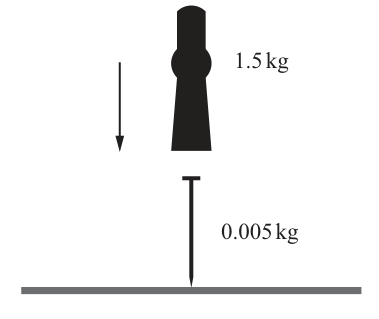
A machine for driving a nail into a block of wood causes a hammerhead to drop vertically onto the top of the nail. The mass of the hammerhead is and the mass of the nail is (see diagram). The hammerhead hits the nail with speed and remains in contact with the nail after the impact.
Calculate the speed with which the combined hammerhead and nail move immediately after the impact. Give your answer correct to 3 decimal places.
Approach
Use the principle of conservation of linear momentum. The total momentum of the system (hammerhead and nail) immediately before the impact must equal the total momentum immediately after the impact, since there are no external horizontal forces and the impact is instantaneous.
Working
Let be the speed of the combined hammerhead and nail immediately after the impact.
Momentum before impact:
Momentum after impact:
Equating momentum before and after:
Solving for :
Rounding to 3 decimal places as required:
Answer
31.894
Walkthrough
The problem describes a direct impact where two objects (hammerhead and nail) stick together after collision. This is a perfectly inelastic collision, and the key principle to use is the conservation of linear momentum. Since the impact is instantaneous, we can ignore external forces like gravity during the collision itself.
- Calculate initial momentum: The hammerhead is moving downwards at with mass . The nail is stationary () with mass . Total initial momentum is simply .
- Calculate final momentum: After impact, the two masses move together as a single combined mass of . Let their common velocity be . The final momentum is .
- Equate and solve: By conservation of momentum, . Solving this gives .
Key Takeaways
- In direct impact problems where objects stick together, total linear momentum is conserved.
- The combined mass after impact is the sum of the individual masses.
- Always ensure units are consistent and round the final answer to the specified number of decimal places.
Common Mistakes
- Forgetting to add the mass of the nail to the hammerhead mass in the final momentum term (using instead of ).
- Including the weight () in the momentum equation during the impact phase. Momentum conservation applies to the instantaneous collision, where impulsive forces dominate and external forces like gravity are negligible.
- Rounding too early in the calculation, which can lead to errors in subsequent parts.
Things to Be Careful About
- The question asks for the answer correct to 3 decimal places. Ensure you keep full precision during calculation and only round at the final step.
- The nail is initially stationary, so its initial momentum is zero.
- Direction matters in momentum, but since all motion is vertically downwards, we can treat downward as positive and ignore vector notation for this 1D problem.
There is a constant force resisting the motion of magnitude .
Calculate the distance the nail is driven into the wood.
Approach
After the impact, the combined hammerhead and nail move downwards into the wood. There are two forces acting on the combined mass: its weight acting downwards and the constant resistive force from the wood acting upwards. Use Newton's second law to find the deceleration, then use the constant acceleration formulae (suvat) to find the distance driven into the wood.
Working
Step 1: Find the acceleration using Newton's second law
Let the downward direction be positive. The combined mass is .
Forces acting on the system:
- Weight downwards: (using )
- Resistive force upwards:
Resultant force
Using :
The negative sign indicates the acceleration is upwards (deceleration), which is expected as the nail is slowing down.
Step 2: Use suvat equations to find the distance
We know:
- Initial velocity (from part a)
- Final velocity (the nail comes to rest)
- Acceleration
- Distance
Using the equation :
Rounding to 3 significant figures (or appropriate precision):
Answer
0.0306
Walkthrough
Once the hammer and nail are moving together, they act as a single body of mass penetrating the wood. We need to find how far they travel before stopping.
- Identify forces: The body is subject to gravity pulling it down () and the wood's resistance pushing up (). Since the resistance is much larger than the weight, the net force is upwards, causing deceleration.
- Calculate acceleration: Apply Newton's second law (). Taking downward as positive, the resultant force is . With , . Net force . Acceleration .
- Apply kinematics: Use . The initial speed is the speed calculated in part (a), . The final speed is (it stops). Solve for .
- Calculate distance: . Solving gives .
An alternative method is to use the work-energy principle: the change in kinetic energy equals the work done by the net force. , which yields the same result.
Key Takeaways
- Newton's second law can be used to find acceleration when forces are known.
- The suvat equations link velocity, acceleration, and displacement.
- Sign conventions are crucial: if downward is positive, upward forces and deceleration are negative.
- The weight of the object is often negligible compared to large resistive forces, but it must still be included for correctness.
Common Mistakes
- Omitting the weight term () in the force calculation. The mark scheme notes that omitting weight gives and results in zero marks for the method.
- Using the wrong mass (e.g., using only instead of the combined ).
- Sign errors in the acceleration or in the suvat equation (e.g., without adjusting signs correctly).
- Using the pre-impact speed () instead of the post-impact speed () for the deceleration phase.
Things to Be Careful About
- Use the value of consistent with your exam board (here is implied by the mark scheme values).
- Carry forward the unrounded value from part (a) or use at least 3 significant figures to avoid compounding errors. The mark scheme allows but penalizes using only 3sf if it leads to incorrect intermediate steps in some methods, though here gives which is accepted.
- Ensure units are consistent: mass in kg, force in N, distance in m.
A train travels between two stations, and . The train starts from rest at and accelerates at a constant rate until it reaches a speed of . It then travels at this constant speed for seconds, before decelerating at a constant rate, coming to rest at . The total time for the journey is .
Find the value of and hence find the distance moved by the train while travelling at the constant speed of .
Approach
Convert the total distance to metres and split the journey into three phases: acceleration, constant speed and deceleration. Use for the phases where the speed changes, and for the constant-speed phase. Then add the three displacements and use the total time to eliminate the unknown acceleration and deceleration times.
Working
Let be the accelerating time, the constant-speed time and the decelerating time. The total time is
For the accelerating phase, from rest to :
For the constant-speed phase:
For the decelerating phase, from to rest:
The total distance is , so
Factor the first and last terms:
Since :
Simplify:
Distance travelled at constant speed:
Answer
and the distance travelled at constant speed is (or ).
T = 140 s; distance at constant speed = 4200 m (4.2 km)
Walkthrough
The journey has three distinct phases: speeding up from rest to , travelling at a steady for seconds, and slowing down to rest. We do not know the acceleration, the deceleration, or the times of the first and last phases, but we do know the total time and the total distance.
For a phase in which speed changes uniformly, the displacement is the average speed multiplied by time. Since the train starts at and reaches , the average speed during acceleration is , so . Similarly, during deceleration from to , the average speed is again , so . During the middle phase the speed is constant at , so .
Adding these gives the total distance in metres. The total time tells us that . Substituting this into the distance equation removes the two unknown times and leaves a simple equation in . Solving it gives . Finally, multiplying by gives the distance covered at constant speed.
Key Takeaways
The key idea is that the total distance is the sum of the displacements of the separate phases, and the total time is the sum of the times of the separate phases. Using for uniformly accelerated motion avoids needing the actual acceleration values. Alternatively, this problem can be viewed as the area under a speed-time graph: the graph is a trapezium with height , bottom base and top base , so its area is .
Common Mistakes
- Using the same variable for all three times. The mark scheme specifically says the same variable must not be used for all three phases.
- Forgetting to convert to before forming the equation.
- Writing the middle-phase distance as ; that would be the distance if the whole remaining time were at constant speed, but the first and last phases are not at constant speed.
- Assuming the acceleration and deceleration are equal; this is not given and is not needed.
Things to Be Careful About
- Keep all distances in the same units. Use metres throughout.
- Remember that , so , not .
- The distance at constant speed is , not the total distance.
- If using the trapezium method, the bases are and , and the height is ; equating the area to gives the same equation.
- After finding , the mark scheme allows follow-through: distance .
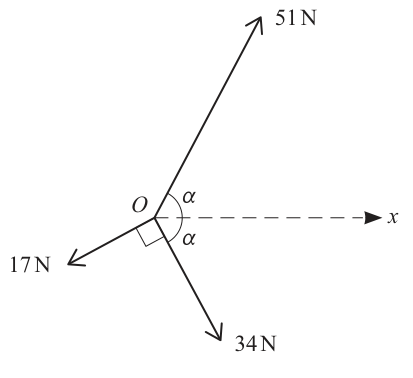
Coplanar forces of magnitudes , and act at a point in the directions shown in the diagram, where .
Approach
Resolve each of the three forces into horizontal () and vertical () components. Use the given to find and . Sum the components to find the resultant vector, then calculate its magnitude and direction.
Working
From , we can construct a right-angled triangle with opposite side and adjacent side . The hypotenuse is .
Thus, and .
Resolve forces horizontally (positive to the right):
Resolve forces vertically (positive upwards):
Calculate the magnitude of the resultant :
Calculate the direction of the resultant with respect to the positive -axis:
Answer
The magnitude of the resultant is (or ), and its direction is above the positive -axis.
26.0 N at 15.6° above the positive x-axis
Walkthrough
First, we determine the exact values of and from the given . By drawing a right triangle with opposite side 15 and adjacent side 8, the hypotenuse is 17, giving and .
Next, we resolve each force into horizontal () and vertical () components. The 51 N force has a positive -component () and a positive -component (). The 34 N force has a positive -component () and a negative -component (). The 17 N force is perpendicular to the 34 N force and points into the third quadrant; its -component is negative () and its -component is negative ().
Summing the -components gives N, and summing the -components gives N. The magnitude of the resultant is found using Pythagoras' theorem: N. The direction is found using above the positive -axis.
Key Takeaways
- When given , always find and using a right triangle or identities before resolving forces.
- Careful attention to the signs of components based on the quadrant each force lies in is essential.
- The resultant magnitude and direction are found using and .
Common Mistakes
- Forgetting to find and and trying to use directly in component equations.
- Sign errors when resolving components, especially for the 17 N force which is in the third quadrant.
- Mixing up sine and cosine for the 17 N force; remember its angle with the horizontal is , so its horizontal component uses and vertical uses .
Things to Be Careful About
- Ensure all forces are resolved into the same two perpendicular directions (usually horizontal and vertical).
- The direction of the resultant must be specified clearly, e.g., ' above the positive -axis', to avoid ambiguity.
The force of magnitude is replaced by a force of magnitude acting in the same direction. The resultant of the three forces now acts in the positive -direction.
Find the value of .
Approach
The force is replaced by a force of magnitude in the same direction. For the resultant to act in the positive -direction, the vertical () component of the resultant must be zero. Set the sum of the vertical components to zero and solve for .
Working
The vertical components of the three forces are:
- force: (upwards)
- force: (downwards)
- force: (downwards)
Set the sum of vertical components to zero:
Simplify the equation:
Answer
43.1
Walkthrough
For the resultant to act purely in the positive -direction, there must be no net force in the vertical () direction. This means the sum of all vertical components must equal zero.
The vertical component of the new force is upwards. The vertical component of the 34 N force is downwards. The vertical component of the 17 N force is downwards.
Setting the sum to zero: , which gives . Solving for yields .
Key Takeaways
- If a resultant is specified to act in a particular direction, the components perpendicular to that direction must sum to zero.
- This reduces a vector problem to a simple scalar equation in one unknown.
Common Mistakes
- Including the horizontal components in the equation when only the vertical condition is needed.
- Sign errors when setting up the vertical equilibrium equation.
Things to Be Careful About
- Ensure that only the components perpendicular to the required resultant direction are set to zero. The horizontal components will sum to the magnitude of the new resultant, but that is not required here.
A car of mass is travelling along a straight horizontal road.
It is given that there is a constant resistance to motion. The engine of the car is working at while the car is travelling at a constant speed of . The power is now increased to .
Find the acceleration of the car at the instant it is travelling at a speed of .
Approach
At constant speed the resultant force is zero, so the driving force equals the resistance. Use to find the resistance from the initial power and speed. Then, after the power is increased, find the new driving force at and apply Newton's second law to find the acceleration.
Working
Initially the car travels at constant speed, so the driving force balances the resistance .
Therefore
After the power is increased to , at speed the driving force is
Apply Newton's second law:
Answer
The acceleration of the car is
a = 1/54 m s^-2 (0.0185 m s^-2)
Walkthrough
The car is initially travelling at constant speed, so its acceleration is zero and the driving force must exactly balance the resistance. The engine power and speed are given, so the driving force can be found from : . Substituting and gives the resistance as .
When the power is increased to , the driving force at the instant the speed is is , which is larger than the resistance. The resultant force is therefore . Newton's second law, , gives . Substituting the values and solving gives .
Key Takeaways
- The relationship connects engine power, driving force and speed.
- Constant speed means zero resultant force, so driving force equals resistance.
- Newton's second law is used to relate the net force to acceleration.
- All quantities must be in SI units: watts, newtons, kilograms and metres per second.
Common Mistakes
- Forgetting to convert kilowatts to watts, e.g. using instead of .
- Using the initial speed when calculating the new driving force after the power increase.
- Making sign errors in Newton's second law. The mark scheme allows sign errors for the method mark, but the final acceleration must have the correct sign.
- Omitting the mass from the equation.
Things to Be Careful About
- The resistance remains constant in this part because it is stated to be constant.
- The driving force is evaluated at the instant the speed is , not at the original speed.
- The final answer can be given as or ; both are accepted.
- Use the exact fraction to avoid rounding errors in later working.
It is given instead that the resistance to the motion of the car is when the speed of the car is .
When the engine is working at , the car is travelling at constant speed.
Find this constant speed.
Approach
At constant speed the resultant force is zero, so the driving force equals the resistance. Use with to form an equation in . Solve the resulting quadratic and choose the positive speed.
Working
Let the constant speed be . At constant speed, driving force equals resistance:
The engine power is , so using :
Rearrange into a quadratic equation:
Divide by 4:
Factorise:
Therefore
Since speed cannot be negative,
Answer
The constant speed is .
40 m s^-1
Walkthrough
Because the car travels at constant speed, its acceleration is zero and the driving force must equal the resistance. The resistance is given as a function of speed, . The power equation then becomes . Expanding gives a quadratic equation. Rearranging and dividing by gives , which factorises as . The two solutions are and . A speed cannot be negative, so the constant speed is .
Key Takeaways
- At constant speed, driving force equals resistance.
- Power, force and speed are related by .
- When resistance depends on speed, substituting into produces a quadratic equation.
- Physical constraints, such as speed being non-negative, are used to select the correct root.
Common Mistakes
- Not converting to . The mark scheme allows using for the method marks, but the correct final answer requires the correct units.
- Making a sign error when rearranging the quadratic.
- Forgetting to reject the negative root .
- Using or instead of .
Things to Be Careful About
- The quadratic has two roots; only the positive one is physically possible.
- The final answer must be exactly ; no other speed is accepted.
- If using the quadratic formula, ensure the discriminant is computed correctly.
- The resistance is in newtons when is in metres per second.
A particle moves in a straight line starting from a point . At time after leaving , the velocity, , of is given by
Approach
Since the velocity is given as a function of time, set and solve for . Taking square roots will produce two linear equations.
Working
Set the velocity equal to 100:
Take square roots:
If :
If :
Answer
t = 2.5 or t = 12.5
Walkthrough
We need to find the times at which the velocity is . The velocity function is , so we replace by and solve
The left-hand side is a square, so can be either or . Solving each of these linear equations gives a different time. The two answers correspond to the particle having velocity on two separate occasions.
Key Takeaways
A squared velocity expression can be equated to a number and solved for time. When a squared quantity equals a positive number, both the positive and negative square roots must be considered. This produces two possible times.
Common Mistakes
- Taking only the positive square root and missing .
- Expanding and making an algebra error before solving.
- Forgetting to include units or mixing up seconds with other units.
Things to Be Careful About
When , the quantity may be . Both equations must be solved. The accepted answers are or , equivalently or .
Show that there is a particular value of for which the velocity and acceleration of the particle are both zero.
Approach
Acceleration is the derivative of velocity with respect to time. Differentiate , then solve the equations and and show that they give the same time.
Working
Differentiate with respect to :
This is often written as
Set :
Set :
Therefore the same value makes both the velocity and the acceleration zero.
Answer
t = 7.5
Walkthrough
Acceleration is obtained by differentiating velocity with respect to time. Using the chain rule on ,
Setting gives , so . To prove the velocity is also zero at this time, we solve :
Because both equations give the same value of , this is the required particular value.
Key Takeaways
The acceleration is the derivative of the velocity with respect to time. A square can only be zero when its base is zero. Showing that two equations share the same solution establishes that both velocity and acceleration vanish at the same time.
Common Mistakes
- Using : this is not the correct way to find acceleration from a variable velocity and scores no method mark.
- Finding only from and not verifying that at that time.
- Expanding the velocity incorrectly before differentiating.
Things to Be Careful About
The acceleration is after simplification, but any equivalent expression such as is acceptable. The final value must be exactly. When solving , only is needed because the square is zero only when its base is zero.
Find the displacement of from at the time that the velocity and acceleration of the particle are both zero.
Approach
Displacement is obtained by integrating velocity with respect to time. Since the particle starts from , when , so the constant of integration is zero when the polynomial form is used. Then evaluate the displacement at from part (b).
Working
Expand the velocity:
Integrate to obtain displacement:
Because at , . At :
Evaluate the terms:
So
Therefore the displacement from is m.
Answer
s = 562.5 m
Walkthrough
Displacement is the integral of velocity with respect to time. We first expand the velocity:
Integrating term by term gives
Because the particle starts from , the displacement is zero when , so . We then substitute , the time found in part (b), into this expression. The arithmetic gives m.
Equivalently, integrating directly using the reverse chain rule gives
and at the first term is zero, so the same answer is obtained.
Key Takeaways
Integrating velocity gives displacement. A definite integral from the starting time to the required time gives the displacement from the starting point. The constant of integration is determined by the initial condition when .
Common Mistakes
- Using for a non-constant velocity; this is incorrect and scores no method mark.
- Leaving a non-zero constant of integration in the final answer; the mark scheme does not allow the final A1 if is still present.
- Making sign errors when using the reverse chain rule form .
- Forgetting to use the value of from part (b), or using the wrong limit.
Things to Be Careful About
The displacement is measured from , so the lower limit is . In the expanded form the constant is zero; in the directly integrated form the constant is . Both approaches give the same final displacement. The units are metres, so the final answer should be quoted as m or m.
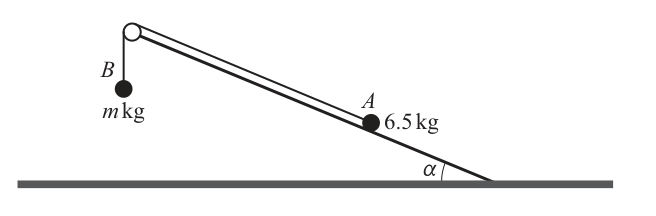
Two particles and of masses and respectively are connected by a light inextensible string that passes over a smooth pulley. The pulley is fixed at the top of a rough slope which is at an angle of to the horizontal ground, where . is on the rough slope and hangs below the pulley (see diagram). The coefficient of friction between the slope and is .
Approach
From , we identify and using a 5-12-13 right triangle.
Set up equilibrium equations for both particles. Since friction can act in either direction along the rough slope, there are two limiting cases: A about to slide down (friction acts up the slope) and A about to slide up (friction acts down the slope). The system is in equilibrium for all values of between these two limits.
Working
Trigonometric values:
Forces on particle B (hanging, equilibrium):
Forces on particle A (on the slope):
Component of weight down the slope:
Normal reaction (perpendicular to slope):
Limiting friction:
Case 1: A is about to slide down the slope (friction acts up the slope)
Resolving along the slope (up positive):
Case 2: A is about to slide up the slope (friction acts down the slope)
Resolving along the slope (up positive):
For the system to remain in equilibrium, must lie between these two limiting values:
Answer
0.1 ≤ m ≤ 4.9
Walkthrough
Step 1: Determine trigonometric values.
We are given . This corresponds to a right triangle with opposite side 5, adjacent side 12, and hypotenuse . Therefore:
Step 2: Analyse forces on particle B.
Particle B hangs vertically and is in equilibrium. The only forces acting on it are its weight downward and the tension upward. Equilibrium gives:
Step 3: Analyse forces on particle A on the slope.
Particle A has mass 6.5 kg on a rough slope at angle . The forces are:
- Weight acting vertically downward, resolved into:
- Component down the slope: N
- Component perpendicular to the slope: N
- Normal reaction N perpendicular to the slope (outward)
- Tension up the slope
- Friction along the slope (direction depends on impending motion)
Step 4: Calculate limiting friction.
Step 5: Consider the two limiting equilibrium cases.
Since the system is in equilibrium but friction can act in either direction, we need both cases:
-
Case 1 (m small): B is light, so A tends to slide down. Friction acts up the slope to oppose this. Resolving along the slope:
-
Case 2 (m large): B is heavy, so A tends to slide up. Friction acts down the slope to oppose this. Resolving along the slope:
Step 6: Combine into a range.
For equilibrium, must not be so small that A slides down, nor so large that A slides up. Therefore:
Key Takeaways
- When a system is in equilibrium on a rough surface, friction can act in either direction, giving two limiting cases.
- Always resolve weight into components parallel and perpendicular to the inclined plane.
- The normal reaction equals the perpendicular component of weight (when no other perpendicular forces act).
- Limiting friction is where is the normal reaction.
- The range of values for equilibrium is found by considering both limiting friction directions.
Common Mistakes
- Forgetting that friction can act in both directions, leading to only one value of instead of a range.
- Using or without substituting the actual numerical values from .
- Incorrectly resolving the weight component: the component down the slope is , not .
- Forgetting to multiply by when converting mass to weight (though some mark scheme entries allow leaving in, the final numerical values require it).
- Not expressing the final answer as an inequality or interval.
Things to Be Careful About
- The coefficient of friction applies at limiting equilibrium. For values of strictly between 0.1 and 4.9, the actual friction is less than and the system is in stable equilibrium.
- Always verify that (particle A remains in contact with the slope), which is satisfied here since N.
- The answer must be expressed as or equivalent interval notation . Writing just or alone is incomplete.
It is given instead that and the particles are released from rest with the string taut.
Use an energy method to find the speed of the particles when each particle has moved . You may assume that this occurs before reaches the pulley or reaches the ground.
Approach
Since (from part a), particle B is heavier than the maximum mass for equilibrium. When released, B will descend and A will move up the slope. Use the work-energy principle for the system: the net loss in gravitational potential energy equals the gain in kinetic energy plus the work done against friction.
Working
Direction of motion:
Since , particle B descends and particle A moves up the slope by m.
Change in gravitational potential energy:
Particle B descends m:
Particle A moves up the slope by m, rising vertically by m:
Net change in PE of the system:
Work done against friction:
Friction acts down the slope (opposing A's upward motion):
Change in kinetic energy:
Both particles start from rest and reach speed :
Work-energy equation:
Loss in PE = Gain in KE + Work done against friction:
Answer
2.15 m/s
Walkthrough
Step 1: Determine direction of motion.
From part (a), the system is in equilibrium for . Since , particle B is too heavy and will descend, pulling particle A up the slope. Both particles move with the same speed (inextensible string) and the same acceleration.
Step 2: Calculate the change in gravitational potential energy.
Particle B (mass 12 kg) descends m:
Particle A (mass 6.5 kg) moves up the slope by m. The vertical height gained is:
Step 3: Calculate work done against friction.
Friction acts down the slope (opposing A's upward motion). The friction force is:
Work done against friction over distance m:
Step 4: Apply the work-energy principle.
For the system, the net loss in gravitational potential energy equals the gain in kinetic energy plus the work done against friction:
Step 5: Solve for v.
Key Takeaways
- When using the work-energy principle for a system of connected particles, treat the entire system together rather than individual particles (unless tension is needed).
- The change in PE for a particle on an inclined plane depends on the vertical height change, which is where is the distance moved along the slope.
- Work done against friction is always positive (energy is lost from the mechanical system).
- The total KE of the system is since both particles have the same speed.
Common Mistakes
- Getting the direction of motion wrong: if A moves up the slope, friction acts down the slope, adding to the energy loss.
- Forgetting that particle A also gains PE when moving up the slope (only accounting for B's PE loss).
- Using the wrong component: the vertical rise is , not .
- Including tension in the energy equation: tension does equal and opposite work on the two particles, so it cancels out for the system.
- Sign errors in the energy equation: be consistent about what is a gain and what is a loss.
Things to Be Careful About
- The question specifically asks for an energy method. Using Newton's second law to find acceleration first, then kinematics, would not earn full marks for this method requirement (though alternative methods are accepted in the mark scheme, the primary method expected is direct energy).
- The work done against friction must use the correct friction value ( N), not a variable expression.
- The distance m is the distance each particle moves along its path (along the slope for A, vertically for B), not a vertical distance for A.
- The answer should be given to 3 significant figures: m/s.