Mathematics 9709/25 — May/June 2025
Cambridge AS Level · Pure Mathematics 2 · worked solutions for every part, with the mark scheme
Topics Logarithmic and Exponential Functions · Integration · Algebra · Differentiation · Trigonometry · Numerical Solution of Equations
Show that
where is an integer to be found.
Approach
Integrate with respect to using the standard result . Then evaluate the definite integral between the given limits and simplify using logarithm laws.
Working
The integral is
Since ,
Apply the limits:
Use :
Finally, use :
Answer
so .
a = 25
Walkthrough
The definite integral asks for the exact value of . Because the denominator is a linear expression , this is an integral of the form , whose antiderivative is . Here , so . Multiplying by 8 gives .
Once the antiderivative is found, substitute the upper limit 11 and lower limit 2:
.
The two logarithms have the same coefficient 2, so factor it out and use the subtraction law :
.
Finally, use the power law to write . Therefore the integral equals , so .
Key Takeaways
- The integral of is , not just .
- Definite integration uses the antiderivative evaluated at the upper limit minus the lower limit.
- Logarithm laws allow the difference of logarithms to be combined into a single logarithm.
- The final form shows the value as a single logarithm with integer argument.
Common Mistakes
- Forgetting the factor when integrating , which would give instead of .
- Substituting the limits incorrectly, especially evaluating and .
- Stopping at instead of converting it to ; the question asks for the form with integer .
- Using rather than .
Things to Be Careful About
- The interval from 2 to 11 makes positive, so no absolute-value signs are needed in the antiderivative.
- The mark scheme awards B1 for the antiderivative , M1 for applying limits and using at least one logarithm law, and A1 for the simplified result .
- Keep the coefficient 2 outside the logarithms until the subtraction law has been applied; combining too early can lead to arithmetic errors.
Approach
The graph of is V-shaped: it has a vertex where , and two straight arms of slopes and . The graph of is a straight line with slope and -intercept . Draw both on the same axes, marking the vertex and the intersection of the line with the left arm of the modulus graph.
Working
For the modulus graph:
So the vertex is .
For , (slope ).
For , (slope ).
The line has slope , so it is steeper than either arm. It meets the left arm where:
So the line crosses the left arm at .
Answer
Draw the V-shaped graph with vertex , and the line through with slope , crossing the left arm at .
V-shaped graph with vertex at (9/2, 0), and line y = 4x - 5 crossing its left arm at (7/3, 13/3)
Walkthrough
The modulus function can be thought of as two half-lines. The expression inside the modulus is zero at , so the vertex is . To the right of this point, is positive, so the graph is the line with slope . To the left, is negative, so the graph is , with slope . This gives the V shape.
The line is a straight line with slope and -intercept . It is steeper than both arms of the V. To place it accurately, find where it meets the left arm of the V by setting . This gives and , so the line crosses the V at that point.
Key Takeaways
A modulus graph has a vertex where , and its two arms have slopes and . A straight line can be sketched accurately by locating its intercept and any intersection with the modulus graph.
Common Mistakes
- Drawing the vertex at instead of .
- Drawing the modulus graph as a smooth curve rather than a V with two straight arms.
- Drawing the line with the wrong slope or intercept.
Things to Be Careful About
The mark scheme awards one mark for the V shape with vertex on the positive -axis and one mark for the line correctly placed relative to the modulus graph. The line must be steeper than the arms of the V, so its slope should be visibly greater than .
Approach
Use the reflected branch of the modulus (where ) to find the intersection of the line with the V-shaped graph. The inequality holds where the line lies above the modulus graph. Solve the linear equation with opposite signs, then give the interval.
Working
For :
The boundary of the inequality is when the line meets this branch:
For , the line is above the reflected branch, so:
For , the modulus is , and:
so every also satisfies the inequality. Combining the two regions gives:
Answer
x > 7/3
Walkthrough
The inequality asks for the values of for which the line is above the V-shaped graph . The boundary occurs where the two graphs meet. Since the line meets the left arm of the V, use the reflected branch for . Set to find . To the right of this intersection the line is above the V, so the inequality is true. Check the right branch separately: for , the inequality becomes , which simplifies to , so all values in that region also work. The union is .
Key Takeaways
Solving a modulus inequality can be done by considering the reflected branch where the modulus expression is negative, finding the boundary intersection, and then deciding which side satisfies the inequality. The graph from part (a) makes the direction clear.
Common Mistakes
- Forgetting to consider the right branch .
- Writing instead of .
- If squaring both sides, forgetting that must be positive, which can introduce the extra region .
Things to Be Careful About
The mark scheme accepts the answer as , or interval notation . If using the squaring method, solve and then impose to remove the spurious region . Also note the inequality is strict, so is not included.
Find the coordinates of the stationary points of the curve with equation
Approach
Differentiate the rational term using the quotient rule, then differentiate the remaining linear terms. Set and solve the resulting quadratic equation for . Finally substitute each -value into the original equation to obtain the corresponding -coordinates.
Working
Using the quotient rule on :
Therefore
At a stationary point, :
So
Now find the corresponding -coordinates.
For :
For :
Answer
The stationary points are
(-1/2, 6) and (-5/2, 30)
Walkthrough
A stationary point of a curve is a point where the gradient is zero, so the first step is to differentiate the given equation.
The function has three terms: , and . The first term is a quotient, so use the quotient rule. For and , we have and . The quotient rule gives
so
The derivative of is simply , so
To find stationary points, set this derivative equal to zero:
Rearrange to get . Taking square roots gives , so or . These give and .
Finally, substitute each -value back into the original equation to find the -coordinate. For , the value is ; for , the value is . Therefore the stationary points are and .
Key Takeaways
- Stationary points occur where .
- The quotient rule is needed when differentiating a fraction such as .
- Solving requires taking both positive and negative square roots.
- After finding the -coordinates, always substitute into the original equation to obtain the -coordinates.
Common Mistakes
- Forgetting to differentiate the part; this would give an incomplete derivative.
- Making a sign error in the quotient rule numerator. The terms cancel, leaving .
- Taking only the positive square root and missing .
- Substituting the -values into the derivative instead of the original equation when finding .
- Swapping the and values in the final coordinates.
Things to Be Careful About
- The denominator cannot be zero, so is not in the domain. Neither stationary point has this value.
- The mark scheme allows an unsimplified derivative, but the final coordinates must be exact.
- When solving , multiply both sides by before dividing; this avoids sign errors.
- The stationary points must be written as coordinate pairs, not just the -values.
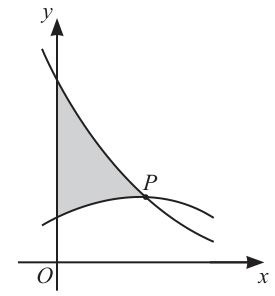
The diagram shows parts of the curves with equations and . Point is a point of intersection of the curves, and the shaded region is bounded by the two curves and the -axis.
Approach
At the point of intersection , the -values of both curves are equal. Equate the two expressions for , then rearrange the equation to isolate using logarithms.
Working
Set the equations equal at point :
Divide both sides by 4:
Take the natural logarithm of both sides:
Divide by :
This confirms the required equation.
Answer
The equation is shown as required.
Shown as required
Walkthrough
First, we recognize that at any point of intersection between two curves, their -coordinates must be equal. We set . To isolate , we divide by 4 to get . Taking the natural logarithm removes the exponential, giving . Finally, dividing by yields the desired form .
Key Takeaways
When finding intersections of curves involving exponentials and trigonometric functions, equating them and using logarithms is a standard technique to isolate the variable.
Common Mistakes
- Forgetting to divide by 4 before taking the logarithm.
- Sign errors when dividing by .
Things to Be Careful About
Ensure all algebraic steps are shown clearly as the mark scheme requires 'necessary detail' for the mark. The final expression must match exactly.
Use an iterative formula, based on the equation in part (a), to find the -coordinate of correct to 4 significant figures. Use an initial value of 0.5 and give the result of each iteration to 6 significant figures.
Approach
Use the iterative formula starting with . Calculate successive values to 6 significant figures until the answer stabilizes to 4 significant figures.
Working
Given :
The values and both round to to 4 significant figures.
Answer
0.4912
Walkthrough
We use the formula from part (a) as an iterative process: . Starting with , we plug in the value to get , then plug in to get , and so on. We continue until two consecutive values agree to the required precision (4 significant figures). Here, and both round to .
Key Takeaways
Iterative formulas converge to a root when the function is well-behaved. Always show enough iterations to justify the final answer to the required number of significant figures.
Common Mistakes
- Using radians instead of degrees for the sine function (calculator mode error).
- Rounding intermediate values too early, which can lead to an incorrect final answer.
Things to Be Careful About
The mark scheme requires showing iterations to 6 significant figures. Ensure your calculator is in radian mode since the argument is (not ).
Hence find the area of the shaded region. Give your answer correct to 2 significant figures.
Approach
The shaded region is bounded above by and below by , from to (the -coordinate of from part (b)). The area is given by the definite integral of the upper curve minus the lower curve.
Working
Integrate each term:
So the antiderivative is:
Apply the limits from to :
Evaluate at upper limit :
Evaluate at lower limit :
Subtract lower limit value from upper limit value:
Rounding to 2 significant figures:
Answer
0.61
Walkthrough
The area between two curves (upper) and (lower) from to is . Here, , , , and . We integrate term by term: the integral of is , the integral of is , and the integral of is . We then substitute the upper and lower limits and subtract.
Key Takeaways
When finding the area between curves, always subtract the lower curve from the upper curve. Be careful with the signs when integrating trigonometric functions like , which gives .
Common Mistakes
- Integrating as instead of .
- Forgetting to evaluate the lower limit and subtract it.
- Using the wrong value for the upper limit (must use the answer from part (b)).
Things to Be Careful About
Ensure you use the unrounded value from part (b) if possible, or at least the 4 significant figure value . The final answer must be given to 2 significant figures as stated in the question.
The polynomial is defined by
where and are constants. It is given that and are factors of .
Approach
Use the factor theorem: if is a factor of , then ; if is a factor, then . This gives two linear equations in and , which can be solved simultaneously.
Working
Substitute :
Multiplying by 16:
Substitute :
Dividing by 27:
Solve simultaneously. From , . Substitute into :
Then:
Answer
a = 2, b = -7
Walkthrough
The factor theorem states that if is a factor of , then substituting the root must make . Similarly, if is a factor, then . We substitute both values into to create two equations involving and .
For , evaluate each power and combine the constant terms. The constants simplify to . Multiplying the whole equation by 16 clears the denominators and gives .
For , the constant terms combine to 27, so . Dividing by 27 gives .
Now solve the simultaneous equations. From , write . Substitute into to get , so . Then .
Key Takeaways
The factor theorem turns a known factor into a root condition. Substituting that root gives an equation linking the unknown coefficients. With two factors, we get two equations, which can be solved simultaneously.
Common Mistakes
A common error is using the wrong root for : the root is , not or . Another common error is making arithmetic mistakes when combining fractions; multiplying by 16 avoids this. Also, do not forget to divide the second equation by 27 before solving.
Things to Be Careful About
When multiplying by 16, multiply every term. Equivalent forms such as and are acceptable. The final values must satisfy both original equations; checking by substitution is a good safeguard.
Approach
With and , multiply the known linear factors to obtain the quadratic divisor , then divide by this quadratic to find the remaining factor.
Working
The product of the given factors is:
Divide by :
Check by expanding:
Hence:
Answer
p(x) = (2x - 1)(x - 3)(x^2 + 5)
Walkthrough
With and , the polynomial is . The two known factors multiply to . Since this quadratic is a factor of , divide by it to find the remaining factor.
The division gives the quotient . To check, expand :
This matches , so the factorisation is correct.
Key Takeaways
Multiplying known linear factors gives a quadratic divisor. Polynomial division or inspection then reveals the remaining factor. Always verify by expanding the factorised form.
Common Mistakes
A common mistake is dividing by only one linear factor and stopping with a cubic factor. Another is losing the quadratic factor in the final answer. Sign errors can occur if the divisor is written incorrectly.
Things to Be Careful About
The quotient cannot be factorised further over the real numbers. The fully factorised form must show all three factors: .
Approach
From the factorisation, the real zeros of are and , since has no real zeros. Therefore requires or . Solve each equation and choose the least positive value of .
Working
For :
where is an integer.
The least positive value is obtained with :
For :
The least positive value is:
The smaller value comes from .
Answer
That is, radians.
theta = 0.161 radians (0.1609...)
Walkthrough
From the factorised form, when , , or . Since has no real solutions, the only real roots are and .
For , the value of must be one of these roots. So solve and .
For , use . The principal solution is , so radians. Adding multiples of to gives larger positive values.
For , , so the least positive value is radians.
The smaller of these is , so the least positive value is radians.
Key Takeaways
means that must equal a real root of . A cotangent equation can be converted to a tangent equation by taking reciprocals. The tangent function has period , so the general solution includes ; choose the smallest positive value.
Common Mistakes
A common mistake is forgetting that is also possible. Another is solving for and forgetting to halve it to get . Also, giving the answer in degrees instead of radians loses the required form.
Things to Be Careful About
The question asks for radians, so the answer is approximately radians, not (which would be ). Compare both possible roots to justify that is the least positive value. The general solution is ; with the smallest positive is obtained.
A curve has equation .
Approach
Substitute into the curve equation. Since , the equation reduces to a quadratic in . Show that this quadratic has no real roots by evaluating its discriminant.
Working
Substitute :
Using :
Simplify:
The discriminant is:
Since , the quadratic has no real solutions for . Therefore no point on the curve has -coordinate .
Answer
There is no real satisfying the equation when , so no such point exists on the curve.
No point exists on the curve with y-coordinate e^-1.
Walkthrough
The curve is given implicitly. To test whether a point with -coordinate exists, substitute into the equation. Because and are inverse functions, . This turns the equation into a quadratic in . For a point to exist, this quadratic must have at least one real solution for . We check the discriminant: if it is negative, no real satisfies the equation, so no such point lies on the curve.
After substitution, the equation becomes . Its discriminant is , which is negative. Therefore the quadratic has no real roots, and the required conclusion follows.
Key Takeaways
- for any real .
- A point on a curve exists only if the corresponding -value is real.
- A negative discriminant means a quadratic equation has no real solutions.
Common Mistakes
- Forgetting that , or incorrectly writing it as .
- Making a sign error when expanding ; the correct expansion is .
- Not showing the discriminant calculation. This part is an AG (answer given) result, so necessary detail must be shown.
Things to Be Careful About
- The quadratic can be written as , so , , .
- Alternatively, completing the square gives , which also shows there are no real roots.
- State clearly that a negative discriminant means no real exists.
Find the equation of the tangent to the curve at the point . Give your answer in the form , where and are exact constants.
Approach
Differentiate the curve equation implicitly with respect to , using the product rule on . Substitute and to find , then use the point-gradient form of a line to write the tangent.
Working
Differentiate both sides with respect to :
Using the product rule on :
At the point , , and . Substituting:
So the gradient of the tangent is . The tangent passes through :
Answer
y = -14e^2 x + 29e^2
Walkthrough
Differentiate both sides of the curve equation with respect to . The term is a product of and , so it requires the product rule. The derivative of is , and the derivative of is because depends on . The derivative of is , and the derivative of the constant is .
This gives . To find the gradient at the given point, substitute and . Since , the equation becomes , so .
Finally, use the point-gradient form with and . Expanding gives the tangent in the required form .
Key Takeaways
- In implicit differentiation, every term containing is differentiated with an extra factor .
- The product rule is needed when a term is a product of a function of and a function of .
- The gradient of a tangent at a point is the value of at that point.
- The equation of a line can be written using .
Common Mistakes
- Forgetting to include when differentiating .
- Omitting the term when differentiating .
- Making a sign error when solving for .
- Not substituting both and ; the mark scheme requires an attempt at substitution.
- Using an approximate value such as instead of the exact value .
Things to Be Careful About
- At , and .
- The final answer must be in the form with exact constants.
- When expanding , the constant term is ; adding gives .
Approach
Expand using the compound angle formula, then apply the double angle formulae to rewrite the expression in terms of and . Finally, express in the form by comparing coefficients.
Working
Expand using the compound angle formula:
Substitute into the given expression:
Apply the double angle formulae and :
Now express in the form :
Comparing coefficients with :
Therefore:
Answer
2cos(2θ - 60°) + 1
Walkthrough
This problem asks us to transform into the form . The target form involves , but we start with and . This tells us we need to use the double angle formulae at some point.
Step 1 — Expand the compound angle. The expression contains . We use the compound angle formula with and . This gives . Multiplying by distributes the factor and gives .
Step 2 — Convert to double angles. Now we have terms involving and . The double angle formulae tell us and . So and . Substituting: .
Step 3 — R-form. We now have . The constant is our . We need to write as . Expanding: . Comparing with , we get and . Squaring and adding: , so . Dividing: , so (within the given range ).
Key Takeaways
- The compound angle formula allows us to expand expressions like .
- The double angle formulae and convert products of and into functions of .
- The R-form is found by expanding and comparing coefficients with , giving and (where is the coefficient of and is the coefficient of ).
Common Mistakes
- Incorrectly applying the double angle formula: , not .
- Mixing up which coefficient is and which is — this leads to the wrong value of .
- Forgetting the constant in the final answer.
- Taking the negative square root for (the problem states ).
Things to Be Careful About
- The domain ensures is the correct choice (not or ).
- The mark scheme requires exact coefficients at each stage — do not round to a decimal.
- The "FT" (follow through) marks in the mark scheme mean that even if you make an earlier error, you can still earn later marks if your method is correct.
Approach
Substitute into the result from part (a), scale the equation to match the coefficient 12, then solve the resulting trigonometric equation within the domain .
Working
From part (a), with :
Multiply both sides by 3:
Set this equal to 5:
The domain gives , so .
First solution:
Second solution, using the symmetry of cosine about :
Both values lie within . Since spans an interval of width (exactly one full period of cosine), there are no other solutions.
Answer
φ = 32.6° or φ = 87.4°
Walkthrough
This part asks us to use the result from part (a) to solve a trigonometric equation.
Step 1 — Apply the part (a) result. The expression is exactly 3 times the expression from part (a) with replaced by . From part (a), . Substituting : .
Step 2 — Scale and solve. Multiplying by 3: . Setting this equal to 5: , so .
Step 3 — Find solutions. The domain means , so . We need where . The principal value is . The two solutions in our range are (first quadrant) and (fourth quadrant, where cosine is also positive). Converting back: and .
Step 4 — Verify the domain. Both and lie within . Since the range of spans exactly one full period of cosine (360°), there are exactly two solutions and no others.
Key Takeaways
- The result of part (a) can be reused by substitution — this is a common "hence" question pattern.
- Solving requires finding ALL solutions in the relevant range, using the symmetry .
- The domain of the original variable must be translated into a domain for the transformed variable.
Common Mistakes
- Forgetting to multiply by 3 when applying the part (a) result.
- Only finding the principal value solution and missing the second one.
- Not checking whether the solutions fall within the given domain.
- Using degrees vs radians inconsistently (here everything is in degrees).
Things to Be Careful About
- The mark scheme states "no others between 0 and 90" — you must verify there are exactly two solutions in the domain.
- The range of is — this is exactly one full period, so there are exactly two solutions of in this range.
- The final answers should be given to an appropriate degree of accuracy (the mark scheme accepts 32.6 and 87.4, or greater accuracy).