Mathematics 9709/23 — May/June 2025
Cambridge AS Level · Pure Mathematics 2 · worked solutions for every part, with the mark scheme
Topics Integration · Algebra · Differentiation · Logarithmic and Exponential Functions · Trigonometry · Numerical Solution of Equations
Show that , where is an integer to be found.
Approach
Use the standard integral to integrate . Then substitute the upper and lower limits and simplify the resulting logarithms using the laws of logarithms.
Working
Substitute the limits:
Use the logarithm law :
Convert the coefficient to a power:
Answer
So .
a = 25
Walkthrough
The integral is of the form , whose antiderivative is . Here and the numerator is , so the integral becomes .
After integrating, we evaluate the antiderivative at the upper limit and the lower limit , subtracting the lower value from the upper value. This gives .
To combine these logarithms, we use the law . This gives . Finally, we use to write . Therefore .
Key Takeaways
This question tests the integration of , which produces a natural logarithm. It also tests the laws of logarithms, especially combining terms like and moving a coefficient into the argument as a power.
Common Mistakes
- Forgetting the factor when integrating . Here the correct antiderivative is , not incorrectly simplified.
- Applying the limits incorrectly, such as evaluating at only one limit or subtracting in the wrong order.
- Stopping at instead of simplifying to when the question asks for the answer in the form .
- Using an incorrect logarithm law, such as writing .
Things to Be Careful About
- On the interval , the expression is always positive, so no absolute value sign is needed in the final answer.
- The mark scheme awards B1 for integrating to , M1 for applying limits and using at least one relevant logarithm property, and A1 for the final simplified answer .
- Since the question asks for with an integer, the final answer must be written as , not just .
Approach
Locate the vertex of the modulus graph, then sketch its two linear branches. Sketch the straight line using its gradient and intercept.
Working
For , the vertex is where , so and .
For :
For :
The line has gradient and -intercept .
Answer
A V-shaped graph with vertex at and a straight line of gradient crossing the -axis at .
A V-shaped graph with vertex at (4.5, 0) and the line y = 4x - 5.
Walkthrough
The modulus function is V-shaped. It changes behaviour at the value of that makes , namely . To the right of this point the expression inside the modulus is positive, so the graph is the line ; to the left it is negative, so the graph is the reflected line . The vertex is at .
The line is a straight line with gradient and -intercept . It is steeper than either branch of the modulus graph. Drawing both on the same axes lets you see where the modulus graph lies below the line, which is useful for part (b).
Key Takeaways
A modulus graph of the form is V-shaped, with its vertex at the root of . The two branches have gradients and . A linear graph is determined by its gradient and intercept.
Common Mistakes
- Drawing the modulus graph as a smooth curve instead of two straight lines meeting at a vertex.
- Placing the vertex at the wrong point; the vertex is at , not at .
- Drawing the line with the wrong gradient or intercept.
Things to Be Careful About
The vertex must be on the positive -axis. The line has gradient , so it must be steeper than the modulus branches, which have gradients .
Approach
Split the modulus into its two cases according to the sign of . Solve the resulting linear inequality in each case, then combine the intervals.
Working
The modulus changes sign at .
Case 1: . Then , so
Solving:
With , this gives
Case 2: . Then , so
Solving:
Since this is automatically true for , the whole interval is included.
Combining the two cases:
Answer
x > 7/3
Walkthrough
The inequality cannot be solved by simply removing the modulus sign, because the sign of changes at . Split the problem into two cases.
For , is negative, so . The inequality becomes . Rearranging gives , so . Since we are in the case , this gives .
For , is non-negative, so . The inequality becomes , which simplifies to . Every already satisfies this, so all of is included.
Taking the union of the two intervals gives .
Key Takeaways
To solve a modulus inequality, identify the critical point where the expression inside the modulus changes sign, solve the inequality separately on each side, and then combine the solution sets. The graph from part (a) confirms the answer: the modulus graph is below the line exactly when .
Common Mistakes
- Forgetting to split into cases and simply writing .
- Losing the restriction in the first case, which would give the wrong final interval.
- Choosing the wrong direction of the inequality after rearranging, e.g. writing .
Things to Be Careful About
The final answer must be strict, since the original inequality is strict. The boundary point is not included. Also, when combining cases, remember that the second case contributes the whole interval , not just a small part of it.
Find the coordinates of the stationary points of the curve with equation .
Approach
Differentiate the equation term by term, using the quotient rule for the rational term. Set the derivative equal to zero and solve for , then substitute back to find the corresponding -coordinates.
Working
Let
Differentiate the first term using the quotient rule:
Therefore
At a stationary point, :
Expanding and rearranging gives , so
Hence
Substitute into :
For :
For :
Answer
The stationary points are
(-5/2, 30) and (-1/2, 6)
Walkthrough
We want the points where the curve is stationary, i.e. where . The expression has two parts: a rational term and a polynomial term . Differentiate the rational term with the quotient rule. With and , we have and , so
Then the derivative of is just , so
Set this equal to zero and rearrange:
Taking square roots gives , so or . Finally, substitute these values back into the original equation for . For , ; for , . Thus the stationary points are and .
Key Takeaways
This question tests the quotient rule for differentiating a rational function, the fact that stationary points occur where , and solving the resulting equation. It also reminds you to substitute back into the original function to find the -coordinates.
Common Mistakes
- Forgetting the derivative of is , not zero.
- Making a sign error in the quotient rule numerator: the correct numerator is , not .
- Solving by only taking the positive square root, losing .
- Substituting the -values into instead of the original equation when finding the -coordinates.
- Not showing the quadratic equation or equivalent rearrangement, which is needed for the method mark.
Things to Be Careful About
- The derivative may be left unsimplified and still earns the first accuracy mark, but simplifying to makes the next step clearer.
- The denominator is never zero at the stationary points found, since is not among them; however, the original function is undefined at , so that value must be excluded.
- When giving final coordinates, use exact fractions, not decimals, unless the question asks otherwise.
- Both -values must be found; finding only one stationary point loses the final accuracy mark.
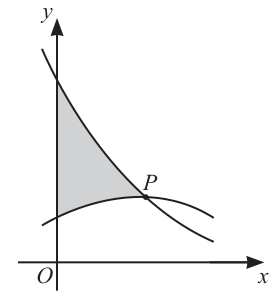
The diagram shows parts of the curves with equations and . Point is a point of intersection of the curves, and the shaded region is bounded by the two curves and the -axis.
Approach
At point the two curves share the same -value. Equate the two expressions, isolate the exponential term, then take the natural logarithm of both sides to remove the exponential.
Working
At :
Divide both sides by 4:
Take the natural logarithm of both sides:
Solve for :
Answer
The -coordinate of satisfies the equation , as required.
x = -0.5 ln(0.25 + 0.125 sin 3x) (shown)
Walkthrough
At a point of intersection, both curves have the same -coordinate at the same -coordinate. So the first step is to set the two given expressions for equal to each other.
Once we have , the next step is to get the exponential on its own on the left side. Dividing through by 4 gives .
To remove the exponential we take the natural logarithm: , so . This produces a linear equation in which we solve by dividing by .
Key Takeaways
- The first step in any intersection problem is equating the two expressions in .
- The natural logarithm is the inverse of the exponential function , so .
- This is an 'AG' (Answer Given) question, so the working must end at the stated form.
Common Mistakes
- Forgetting to divide both sides of the equation by 4.
- Dropping the minus sign when solving for .
- Trying to take the logarithm before isolating the exponential.
Things to Be Careful About
- All algebraic steps must be shown because this is an 'AG' question.
- The final form is , not .
Use an iterative formula, based on the equation in part (a), to find the -coordinate of correct to 4 significant figures. Use an initial value of 0.5 and give the result of each iteration to 6 significant figures.
Approach
The equation in part (a) has the form . Apply the iteration , starting from , and continue until the iterates have stabilised to 6 significant figures.
Working
The iterates have stabilised to 6 significant figures. The final value lies in the interval , confirming the result.
Answer
x = 0.4912
Walkthrough
The equation from part (a) is in the form , where . Such an equation is solved numerically using a fixed-point iteration .
For the first iterate, : compute , then , then , then , and finally . Rounded to 6 significant figures, .
For , repeat with in place of : , , , , giving to 6 s.f.
Continue with and similarly. By and the iterates have essentially stabilised. Rounding to 4 significant figures gives .
Key Takeaways
- A fixed-point iteration solves by repeatedly applying .
- Iterates should be recorded to one more significant figure than the final answer requires, so that the convergence can be verified.
- The iteration must be applied using the previous value, never the value two steps back.
Common Mistakes
- Using too few iterations, so the answer is not actually stable to 6 s.f.
- Rounding intermediate values too early, which can shift the final answer.
- Confusing the iteration with and using the wrong rearrangement.
Things to Be Careful About
- The angle in is in radians (no degree symbol is given).
- Each iteration must use the previous iterate, not the value two steps back.
- The mark scheme also accepts a sign-change check in as alternative justification.
Hence find the area of the shaded region. Give your answer correct to 2 significant figures.
Approach
From the diagram, the upper curve is and the lower curve is on the interval . The shaded area is therefore the integral of (upper) (lower) from to .
Working
Find the antiderivative of each term:
- , so
- , so
Combining the three pieces:
Substitute the upper limit :
Using and :
Substitute the lower limit :
Subtract (upper lower):
Answer
0.61
Walkthrough
The shaded region in Fig. 1 is bounded above by and below by , on the interval . The area is therefore the integral of (upper lower) across this interval.
Each term integrates using a standard rule:
- , so .
- .
- , so . The factor in the integrand then turns this into in the antiderivative.
After combining the three antiderivatives, substitute the upper and lower limits. At the upper limit , we need the numerical values of and , which come from a calculator. At the lower limit , and are exact.
Subtracting the two substituted values gives , which rounds to to 2 significant figures.
Key Takeaways
- The area between two curves on is .
- Each term of an integrand is integrated separately, using standard rules for exponentials and trigonometric functions.
- The question's 'hence' links part (b) to part (c), so the answer from part (b) is used as the upper limit.
Common Mistakes
- Forgetting the sign when integrating , or confusing the sign of the term because of the in the integrand.
- Mixing up which curve is on top — the diagram is the reference, not the equations alone.
- Using the wrong limits, e.g. not using the answer from part (b) as the upper limit.
- Forgetting to subtract the two substituted values; some students only evaluate at the upper limit.
Things to Be Careful About
- The value from part (b) is approximate, but we use it as the upper limit because that is what 'hence' implies.
- Keep enough decimal places in intermediate steps so the final answer is reliable to 2 s.f.
- The question asks for 2 s.f. — round accordingly.
The polynomial is defined by
where and are constants. It is given that and are factors of .
Approach
Since and are factors, and . Substitute these values into to obtain two linear equations in and , then solve them.
Working
Substitute :
Multiply by :
Substitute :
Divide by :
Solve the simultaneous equations:
From the second, . Substitute into the first:
Then .
Answer
a = 2, b = -7
Walkthrough
Because is a factor, is a root, so . Similarly is a root, so . Substitute these values into the polynomial. For , the powers are , , and . Combine the constant terms: . So ; multiplying by gives . For : ; dividing by gives . Solve: from , . Substitute into : , so , giving , then .
Key Takeaways
The factor theorem turns a known factor into a root condition. Substituting roots produces equations in unknown coefficients. Clearing fractions and dividing common factors simplifies solving.
Common Mistakes
- Forgetting that the factor gives the root , not or .
- Arithmetic errors when combining constants at and .
- Not simplifying the equations before solving.
- Solving simultaneous equations incorrectly; check by substituting back.
Things to Be Careful About
The factor theorem says if is a factor; for , set , so . When simplifying, divide both sides by common factors correctly. Keep exact fractions rather than decimals.
Approach
Multiply the two known linear factors to form the quadratic divisor , then divide by this quadratic to find the remaining quadratic factor.
Working
Divide by :
So
Since has no real roots, this is the fully factorised form.
Answer
p(x) = (2x-1)(x-3)(x^2+5)
Walkthrough
We already know two factors. Multiplying them gives . Since has degree 4, the remaining factor must be quadratic. Divide by . The leading term divided by gives . Multiplying the divisor by gives ; subtracting leaves . Then divided by gives ; multiplying the divisor by gives , which subtracts to zero. So the quotient is . Therefore . Since cannot be factored into real linear factors, this is the fully factorised form.
Key Takeaways
Polynomial division by a quadratic factor is efficient when two linear factors are known. Checking coefficients can also be used. A quadratic with no real roots remains as an irreducible factor over the reals.
Common Mistakes
- Dividing incorrectly; keep track of subtraction signs.
- Stopping at the quotient without writing the full factorisation.
- Trying to factor over the reals; it has no real roots.
- If using synthetic division by the two linear factors, forgetting the leading coefficient and writing ; the final factorised form must be .
Things to Be Careful About
The divisor should be the product of the two known factors. Ensure quotient times divisor equals the original polynomial. "Fully factorise" over the reals means leaving as it is.
Approach
Use the factorised form of . Since , one of the factors must be zero. The quadratic factor gives no real solution, so solve and , then choose the least positive .
Working
So requires:
For :
For :
The smaller positive value is .
Answer
θ ≈ 0.161 radians
Walkthrough
Since is factorised, when any factor is zero. The factor cannot be zero for real , so ignore it. The linear factors give or , i.e. or . Because and are reciprocals, these become and . For the least positive , take the smallest positive angle : or . Then is half of that. The values are approximately and ; the least is , so radians.
Key Takeaways
Factorised polynomials let us solve composite equations by setting each factor to zero. Cotangent is the reciprocal of tangent. The least positive solution comes from the smallest positive principal angle.
Common Mistakes
- Forgetting the root gives another possible value of ; but the least positive angle still comes from .
- Writing instead of for .
- Solving for and forgetting to halve to get .
- Not checking which of the two solutions is smaller.
Things to Be Careful About
has no real solutions, so it contributes no values of . Answer in radians. The final answer is radians (3 s.f.), or if more accuracy is required. General solutions add multiples of to , which increase , so they are not needed for the least positive value.
A curve has equation .
Approach
Substitute the given -coordinate into the curve equation, simplify using , and show that the resulting quadratic has no real roots by evaluating its discriminant.
Working
The curve is
Put :
Since ,
Simplify:
Equivalently,
The discriminant is
Since the discriminant is negative, the quadratic has no real solutions for . Therefore there is no point on the curve with -coordinate .
Answer
Substitution gives , with discriminant , so no real exists.
No real x exists; discriminant is -8.
Walkthrough
We want to know whether any point on the curve has -coordinate . A point lies on the curve exactly when its coordinates satisfy the curve equation, so we substitute and see whether the resulting equation can be solved for a real value of .
First use the logarithm fact . This is because and are inverse functions: for any real . This turns the equation into a quadratic in .
After simplifying, we get , or equivalently . To check whether real solutions exist, calculate the discriminant . Here , , , so
A negative discriminant means the quadratic has no real roots. Therefore no real can satisfy the equation when , so there is no such point on the curve.
Key Takeaways
- The inverse relationship between and gives .
- A quadratic equation has no real roots exactly when its discriminant is negative.
- Substituting a candidate coordinate into an equation is a standard way to test whether a point lies on a curve.
Common Mistakes
- Writing incorrectly; it is , not or .
- Making a sign error when expanding ; it becomes .
- Stating the discriminant is negative without showing the calculation. Because the question says 'Show that', the working must be shown.
Things to Be Careful About
- The discriminant must be computed from the simplified quadratic; using gives , , and the same discriminant .
- An alternative acceptable method is completing the square: , which also has no real solution.
- Since the question is 'Show that', a bare statement such as 'no real roots' without supporting detail may not earn full marks.
Find the equation of the tangent to the curve at the point . Give your answer in the form , where and are exact constants.
Approach
Differentiate the curve equation implicitly with respect to , using the product rule for . Substitute the coordinates of the given point to find the gradient, then write the equation of the tangent in the form .
Working
Differentiate both sides of
with respect to :
At , we have , and . Substituting:
So
The gradient of the tangent is . Using :
Expand:
Answer
y = -14e^2 x + 29e^2
Walkthrough
The curve is defined by an equation involving both and , so we differentiate implicitly with respect to . This means every time we differentiate a term containing , we multiply by .
The term is a product of and , so we use the product rule:
The derivative of is , and the derivative of the constant is . This gives the differentiated equation.
Next, substitute the point . Here , , and . Substituting gives an equation that can be solved for , which is the gradient of the curve at that point.
Finally, use the point-gradient form of a straight line:
Expanding and collecting the constant terms gives the tangent in the required form .
Key Takeaways
- Implicit differentiation: differentiate both sides with respect to and multiply any -derivative by .
- The product rule is needed when a term is a product of a function of and a function of .
- The gradient of the tangent at a point is the value of at that point.
Common Mistakes
- Forgetting the factor when differentiating .
- Applying the product rule incorrectly; both terms and must appear.
- Substituting as instead of .
- Losing the constant when differentiating .
- Forgetting to add to when forming the term.
Things to Be Careful About
- The mark scheme allows follow-through on the derivative of , so a small error in the product rule may still gain later method marks if the substitution and tangent method are correct.
- The final answer must be in the form with exact constants; do not round .
- Check the sign: the gradient is negative, so the tangent slopes downward.
Approach
Expand using the compound angle formula, rewrite the product using double-angle identities to obtain an expression in and , then express the result in the form by comparing coefficients.
Working
Expand using :
Multiply by :
Apply the double-angle identities and :
Therefore:
Now express in the form :
Comparing coefficients with :
Compute :
Compute :
Hence:
Answer
2cos(2θ - 60°) + 1
Walkthrough
The goal is to rewrite in the form . The expression contains a product of and , and the target form involves with a double angle. The strategy proceeds in four stages.
Stage 1 — Expand the compound angle. Use with and . This gives . This expands the compound angle into single-angle terms.
Stage 2 — Multiply by . Distributing gives . This is the form that the mark scheme requires.
Stage 3 — Apply double-angle identities. The term equals , so . The term equals since . This converts everything to double angles.
Stage 4 — Express in R-form. We now have . The constant is the in the target form. The remaining part needs to be written as . Using , we compare coefficients: (coefficient of ) and (coefficient of ). Then and , giving since both and are positive.
Key Takeaways
- The compound angle formula allows us to expand expressions like .
- Double-angle identities and convert single-angle products into double-angle terms.
- The R-form with and (careful with quadrant) is a powerful tool for simplifying trigonometric expressions.
Common Mistakes
- Forgetting the constant term: includes a that must be carried through to the final answer.
- Mixing up coefficients: when comparing with , make sure matches the coefficient and matches the coefficient.
- Using the wrong quadrant for : since both and are positive, must be in the first quadrant.
Things to Be Careful About
- The mark scheme requires exact coefficients ( and ) — do not use decimal approximations.
- The angle must satisfy , which confirms the first-quadrant choice.
- When the mark scheme says "follow through", it means later marks can still be earned even if an earlier step had an error, as long as the method is correct.
Approach
Substitute into the result from part (a), scale the equation to match the given coefficient of 12, then solve the resulting trigonometric equation within the domain .
Working
From part (a), with :
The given equation is . Since , multiply the result from part (a) by 3:
Set this equal to 5:
The domain is , so and hence .
The principal value is . The solutions of in the range are:
First solution:
Second solution:
Both values lie in , and there are no other solutions in this range.
Answer
φ = 32.6° or φ = 87.4°
Walkthrough
The equation is a scaled version of the expression from part (a) with replaced by .
Stage 1 — Substitute the result from part (a). From part (a), . Setting gives .
Stage 2 — Scale to match the equation. The given equation has coefficient 12 on the left, which is . So we multiply both sides of the substituted result by 3: .
Stage 3 — Solve for the cosine. Setting the right side equal to 5: , so , giving .
Stage 4 — Determine the domain. Since , we have , so . This is the range in which we must find solutions for .
Stage 5 — Find all solutions. The principal value is . The general solution of is . In the range :
- (from )
- (from )
The value is below and is above , so these are excluded.
Stage 6 — Solve for .
- gives , so .
- gives , so .
Both values lie in , so both are valid solutions.
Key Takeaways
- A result from one part of a question can be reused in a later part — this is a common exam pattern.
- When solving over a domain, the general solution is , and you must check which values fall in the domain.
- The domain of a transformed variable (here ) is different from the domain of the original variable (), and must be computed carefully.
Common Mistakes
- Forgetting to multiply the constant term by 3: , not .
- Only finding the principal value solution and missing the second solution in the fourth quadrant.
- Not checking that both solutions are within .
Things to Be Careful About
- The mark scheme explicitly requires "no others between 0 and 90" — you must verify that no additional solutions exist in the domain.
- The domain of is , which is wider than — be careful about solutions near the boundaries.
- The mark scheme accepts and to 1 decimal place, or greater accuracy and .