Mathematics 9709/22 — May/June 2025
Cambridge AS Level · Pure Mathematics 2 · worked solutions for every part, with the mark scheme
Topics Integration · Algebra · Differentiation · Logarithmic and Exponential Functions · Trigonometry · Numerical Solution of Equations
Show that , where is an integer to be found.
Approach
Recognise that is a constant multiple of , so integrate to a natural logarithm of the linear denominator. Then substitute the limits and use the logarithm property to express the answer as a single logarithm.
Working
Integrate:
Apply the limits:
Use the logarithm law :
Rewrite in the form :
Answer
a = 25
Walkthrough
We need to evaluate the definite integral . The integrand is a constant multiple of the reciprocal of a linear function, so the antiderivative is . The factor comes from dividing by the derivative of , which is : .
Next, substitute the upper limit and the lower limit into and subtract. This gives . Since both terms have the same coefficient , factor it out and use the logarithm law to combine them: .
Finally, write as so the answer has the required form . Therefore .
Key Takeaways
This question tests the standard integral and the laws of logarithms. It also shows how to combine logarithms after applying limits. The key skill is recognising the constant factor needed to integrate a reciprocal linear function.
Common Mistakes
- Forgetting the factor when integrating ; here that factor is , so becomes .
- Omitting the logarithm law and leaving the answer as instead of simplifying to .
- Incorrectly applying the limits by subtracting in the wrong order, which would give the wrong sign.
- Writing instead of .
Things to Be Careful About
- The mark scheme requires the antiderivative to be shown explicitly.
- At least one relevant logarithm property must be used when applying the limits.
- The final answer must be a single logarithm with integer ; here .
- Since is positive on the interval , no absolute value signs are needed.
Approach
Sketch the V-shaped modulus graph and the straight line on the same axes, marking the vertex and the intersection point.
Working
For , the vertex occurs when , so and .
For , ; for , .
The line has gradient and -intercept .
The intersection is on the left branch, so solve
Then
So the graphs meet at .
Answer
Draw the V-shaped graph with vertex at , and the line , with intersection at .
V-shaped graph with vertex at (9/2, 0) and line y = 4x - 5, intersecting at (7/3, 13/3)
Walkthrough
We need to sketch two graphs on the same diagram. The graph of is V-shaped because the modulus changes the sign of when it is negative. The vertex is found by setting , giving and . For , the graph is the line ; for , it is the line . The graph of is a straight line with gradient and -intercept . To mark the intersection accurately, solve the equation of the left branch with the line; the right branch does not meet the line in its region. The intersection is at .
Key Takeaways
- The modulus graph is V-shaped with vertex where .
- The left branch has gradient and the right branch has gradient .
- A straight line is determined by its gradient and intercept.
Common Mistakes
- Drawing the modulus graph as a single straight line instead of a V-shape.
- Putting the vertex at the wrong point, such as .
- Using the wrong gradient for one of the branches.
- Forgetting to show the intersection point on the sketch.
Things to Be Careful About
- The vertex is at , not at .
- The left branch has gradient and the right branch has gradient .
- The line is steeper than either branch of the modulus graph.
- Only the left-branch intersection is valid; the right-branch equation gives , which is not in the region .
Approach
Split the modulus into its two cases according to the sign of , solve the resulting linear inequality in each case, then combine the valid intervals.
Working
The critical value is .
Case 1: . Then , so
With , this gives .
Case 2: . Then , so
With , this gives .
Combining both cases:
which is simply
Answer
x > 7/3
Walkthrough
The inequality contains a modulus, so the expression inside the modulus can be positive or negative. The sign changes at . Split into two cases.
For , the modulus is . Substitute this into the inequality and solve:
Add and to both sides:
so . Since this case already requires , the solutions in this case are .
For , the modulus is . Then
Subtract from both sides:
Add : , so . Since this case requires , every value in this case satisfies the inequality. Therefore the second case contributes .
Taking the union of the two intervals gives . This matches the graph from part (a): the line is above the modulus graph for all .
Key Takeaways
- To solve a modulus inequality, split at the point where the expression inside the modulus is zero.
- Solve each linear inequality separately and intersect with the case condition.
- The final answer is the union of the valid intervals.
Common Mistakes
- Solving only one case and ignoring the other.
- Forgetting to intersect the solution of each case with its case condition.
- Writing the answer as instead of an inequality.
- Reversing the inequality sign when no multiplication or division by a negative number has occurred.
Things to Be Careful About
- The critical value is , not ; is the boundary of the solution.
- The solution includes both the interval and the interval .
- The mark scheme also accepts interval notation such as .
Find the coordinates of the stationary points of the curve with equation .
Approach
Differentiate the rational term using the quotient rule, then differentiate the linear terms, set the derivative equal to zero, solve the resulting quadratic, and substitute back to find the -coordinates.
Working
Let
Then
Using the quotient rule,
Therefore
Set :
Multiply through by :
Divide by 6 and expand:
Factorise:
So
For :
For :
Answer
The stationary points are
(-5/2, 30) and (-1/2, 6)
Walkthrough
We need the points where the curve has zero gradient. A stationary point occurs where , so the first task is to differentiate .
The term is a quotient, so we use the quotient rule:
Here and , so and . Substituting gives the numerator , so the derivative of the quotient is . The derivative of is just , because the derivative of a constant is zero and the derivative of is . Hence
Next, set this equal to zero. Multiplying through by removes the denominator and gives a quadratic equation. Expanding and simplifying leads to , which factorises as . Therefore the two -coordinates are and .
Finally, substitute each -value back into the original equation to find the corresponding -coordinate. This gives the two stationary points and .
Key Takeaways
- Stationary points are found by solving .
- The quotient rule is the correct tool when differentiating a fraction such as .
- After differentiating, solving the resulting quadratic may require expansion and factorisation.
- Always substitute the -values back into the original curve to get the -coordinates.
Common Mistakes
- Forgetting to differentiate the part of the expression.
- Making a sign error in the quotient rule: the formula is , not .
- Losing one root when solving ; remember that can be or .
- Stopping after finding the -values and not finding the corresponding -coordinates.
- Not showing the quotient rule working; the mark scheme requires a visible method.
Things to Be Careful About
- The denominator is never negative and is zero only at , which is a vertical asymptote and not a stationary point. Multiplying by is valid for all other .
- When substituting , note that , so the fraction becomes . Watch the signs carefully.
- The mark scheme awards marks for the method: an unsupported answer is not sufficient. Show the quotient rule, the derivative, the equation set to zero, and the substitution back.
- State the final answers as coordinate pairs.
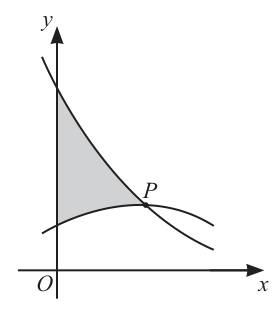
The diagram shows parts of the curves with equations and . Point is a point of intersection of the curves, and the shaded region is bounded by the two curves and the -axis.
Approach
Since P lies on both curves, the y-coordinates are equal. Equate the two expressions and use the inverse relationship between the exponential and natural logarithm to obtain the required form.
Working
At point P:
Divide both sides by 4:
Take the natural logarithm of both sides:
Divide by :
Answer
x = -0.5ln(0.25 + 0.125 sin 3x)
Walkthrough
We need to show that the x-coordinate of P satisfies the given equation. The key fact is that P lies on both curves, so its coordinates satisfy both equations. This means the y-coordinates are equal: .
To get from this equation to the required form, we want to isolate x. The challenge is that the exponential contains x, and also contains x. So we have a transcendental equation.
The trick is to isolate the exponential on one side. We can do this by dividing both sides by 4:
Now, the natural logarithm is the inverse of the exponential function. Taking of both sides eliminates the exponential:
Finally, divide by to get alone:
This matches the required form.
Key Takeaways
- When solving equations involving both exponential and trigonometric terms, isolate the exponential first.
- The natural logarithm is the inverse of the exponential function: .
- Watch out for the negative sign when dividing by .
Common Mistakes
- Forgetting to divide by 4, leading to a coefficient other than 0.25.
- Not taking the logarithm of both sides correctly, or missing the negative sign.
- Errors in the coefficients (0.25 vs 0.5, 0.125 vs 0.25) when dividing.
Things to Be Careful About
- The required form must match exactly. Pay attention to coefficients (0.25, 0.125, -0.5).
- Make sure the logarithm is the natural log (), not log base 10.
Use an iterative formula, based on the equation in part (a), to find the -coordinate of correct to 4 significant figures. Use an initial value of 0.5 and give the result of each iteration to 6 significant figures.
Approach
Rearrange the equation from part (a) into the form and iterate from until the value stabilises to 4 significant figures.
Working
The iterative formula is:
Starting with :
Since and both lie in the interval , the value has stabilised to 4 significant figures.
Answer
x = 0.4912
Walkthrough
The equation from part (a) gives us an iterative formula directly: . This formula is already in the standard form, where .
Starting from , we apply the formula repeatedly. At each step, we:
- Compute (the input to sine).
- Take the sine of that value.
- Multiply by 0.125 and add 0.25.
- Take the natural log.
- Multiply by .
The iterations:
- : , , , , so .
- : , , , , so .
- : , , , , so .
The values are converging rapidly. After 3 iterations, the value has stabilised to 4 significant figures. The values and both lie in the required interval , confirming that 0.4912 is the correct answer.
Key Takeaways
- An equation of the form always gives an iterative formula directly.
- Iterate until consecutive values agree to the required accuracy.
- Showing that the value lies in a specific interval (e.g., ) provides a check on the answer.
Common Mistakes
- Using too few iterations, failing to show convergence.
- Rounding intermediate values too aggressively, which can slow convergence or change the final answer.
- Using the wrong angle mode (degrees vs radians) - the question uses radians.
- Forgetting to use natural log (not log base 10).
Things to Be Careful About
- The argument of is in radians, not degrees.
- Show all intermediate values to enough precision (6 sig figs here) to justify the final answer.
- Final answer must be to 4 significant figures exactly: 0.4912 (not 0.491 or 0.49120).
Hence find the area of the shaded region. Give your answer correct to 2 significant figures.
Approach
The shaded region lies between the y-axis and the two curves, with on top and below, from to . Compute the area as the definite integral of (top − bottom) over this interval.
Working
The area is:
Integrating each term separately:
So the antiderivative of the integrand is:
Therefore:
At the upper limit :
Sum at upper limit:
At the lower limit :
Sum at lower limit:
Subtracting:
Answer
A ≈ 0.61
Walkthrough
The shaded region is bounded on the left by the y-axis () and on the right by the intersection point P. Between these vertical lines, the upper boundary is (the decreasing exponential, which starts at 4) and the lower boundary is (the oscillating curve, which starts at 1). At , the exponential is at 4 and the sine curve is at 1, so the exponential is above the sine curve - which matches the diagram.
The area of such a region is the integral of (top − bottom) over the interval:
We integrate each term:
- : use the rule , so integrates to .
- (a constant integrates to itself times x).
- : use , so integrates to .
Combining (the integrand contains , so its antiderivative is ):
At :
- Total:
At :
- Total:
Subtracting (upper minus lower): .
To 2 significant figures, .
Key Takeaways
- The area between two curves from to is .
- Standard integrals to remember: , , .
- Always subtract in the right order: (upper limit value) − (lower limit value).
Common Mistakes
- Integrating as (forgetting the negative and the factor).
- Confusing which curve is on top - the curve with the larger y-value at each x is the upper boundary. Check at : , so the exponential is on top.
- Using the wrong limits (e.g., using 1 instead of from part (b)).
- Sign errors when subtracting the lower-limit value from the upper-limit value.
- Forgetting to use radians in the trig functions.
Things to Be Careful About
- The area is positive, so the final answer should be positive after subtraction.
- Use the value from part (b) for the upper limit, since this question is sequential (the answer from (b) is ).
- The term contributes a small but nonzero value to the area - don't forget it.
- The final answer must be to 2 significant figures, so rounds to .
The polynomial is defined by
where and are constants. It is given that and are factors of .
Approach
Since and are factors of , the factor theorem gives and . Substitute these values into the polynomial to obtain two equations in and , then solve the simultaneous equations.
Working
Substitute :
Multiply through by 16:
Substitute :
Divide through by 27:
Solve (1) and (2). From (2):
Substitute into (1):
Then:
Answer
a = 2, b = -7
Walkthrough
We are told that and are factors of . By the factor theorem, if a linear factor divides a polynomial , then . Here, being a factor means is a root, and being a factor means is a root.
We substitute into and set the result to zero. This converts the statement "this is a factor" into a concrete equation involving the unknown constants and . When substituting, we must compute the fractional powers carefully: , , and . The constant terms combine: . So we get , i.e., . Multiplying through by 16 clears the denominators and gives .
Similarly, substituting gives , which simplifies to , and dividing by 27 gives .
We now have two linear equations in and :
We solve by substitution: from equation (2), . Substituting into equation (1) gives , which simplifies to , so . Then .
Key Takeaways
- The factor theorem is the bridge between "has a factor" and "evaluates to zero at a specific point".
- For a factor like , the root is found by solving , giving .
- Substituting roots into a polynomial with unknown coefficients produces equations that can be solved simultaneously.
Common Mistakes
- Using the wrong root: for , some students substitute or instead of . Always solve the factor equal to zero.
- Arithmetic slips with fractional powers, e.g., writing .
- Sign errors when simplifying .
- The mark scheme gives "SC B1 for a correct equation, if M0 otherwise" — so even if the method is not fully shown, a correct equation earns a special-case mark. Show all substitutions clearly.
Things to Be Careful About
- When clearing fractions, multiply every term by the common denominator.
- After finding and , verify by checking and .
- Keep the equations labelled; it helps when solving the simultaneous system.
Approach
With and , write out . Since and are factors, their product is a factor of . Divide by this quadratic to find the remaining factor.
Working
With and :
The product of the known factors:
Divide by . First term of the quotient is , since :
Subtracting from :
Next term of the quotient is , since :
Subtracting gives remainder . The quotient is .
Therefore:
Answer
p(x) = (2x - 1)(x - 3)(x^2 + 5)
Walkthrough
With and , the polynomial becomes .
Since and are both factors, their product is also a factor of . So we divide by to find the remaining quadratic factor.
Polynomial long division: the leading term divided by the leading term of the divisor gives . Multiply the divisor by to get , and subtract from . This eliminates the and terms, leaving . Now divide by to get . Multiply the divisor by to get , which subtracts exactly to zero. The quotient is .
Therefore .
Key Takeaways
- When two linear factors are known, their product is a quadratic factor of the polynomial.
- Polynomial long division by a quadratic factor reveals the remaining factor.
- The fully factorised form is the product of all known and found factors.
Common Mistakes
- Sign errors during subtraction in long division — always subtract the entire product, not just some terms.
- Forgetting that the quotient is the remaining factor and must be included in the final factorisation.
- The mark scheme notes that synthetic division may give ; this is condoned as an intermediate, but the final answer should be .
Things to Be Careful About
- Check the factorisation by expanding: should equal .
- All coefficients should be integers; if a fractional coefficient appears, recheck the division.
Approach
From part (b), . Setting means must equal one of the real roots of . The real roots are and . Since is decreasing on , the larger value gives the smaller angle, hence the least positive . Solve .
Working
From part (b):
Setting :
The factor , so it gives no real solutions. Hence:
Since is decreasing on , the larger value corresponds to the smaller , giving the least positive . Solve:
For the least positive , take :
Answer
θ = 0.161 radians
Walkthrough
We need such that . From part (b), . So means at least one of the three factors is zero:
- , i.e.,
- , i.e.,
The third factor is always positive (since , so ), so it has no real solutions. Thus or .
Both equations have solutions. To find the least positive , we use the fact that is decreasing on : as the angle increases, the cotangent decreases. So a larger value of corresponds to a smaller angle . Since , the equation gives the smaller , hence the least positive .
Solve . Since , we have . The principal solution is . The general solution adds multiples of : . For the least positive , take :
Rounded to 3 significant figures: radians.
Key Takeaways
- Using the factorised form of a polynomial to solve by setting each factor to zero.
- The identity for converting cotangent equations to tangent equations.
- The monotonicity of on helps identify which root gives the least positive angle.
- The general solution of is .
Common Mistakes
- Forgetting to check the factor — it has no real solutions, but a complete solution should note this.
- Converting incorrectly to instead of .
- Not recognising that both and give solutions, and that the least positive comes from the one with the larger cotangent value.
- Giving the answer in degrees instead of radians.
Things to Be Careful About
- The question specifies radians; the answer must be in radians.
- is in radians when computed on a calculator in radian mode.
- The mark scheme requires solving (M1) and obtaining (A1).
- The period of is in terms of , so other solutions exist, but the least positive is the principal one.
A curve has equation .
Approach
Substitute into the curve equation. Since , the equation becomes a quadratic in . If this quadratic has no real roots, then no real -coordinate exists, so no point on the curve has .
Working
Substitute :
Since :
Equivalently, multiplying by :
The discriminant is
Since , the quadratic has no real solutions. Therefore there is no point on the curve with .
Answer
No real exists because the discriminant is , so no point on the curve has .
No real x exists; discriminant is -8, so no point on the curve has y = e^-1
Walkthrough
The curve is defined by . To test whether can occur, substitute this value into the equation. The key simplification is , because and are inverse functions. This turns the equation into a quadratic in : , which rearranges to , or equivalently . A real point on the curve would require a real satisfying this quadratic. The discriminant tells whether real roots exist. Here , so there are no real solutions. Hence no point on the curve has .
Key Takeaways
- follows from the inverse relationship between and .
- A curve point requires a real -coordinate; if the resulting equation has no real solutions, the point cannot exist.
- The discriminant of a quadratic determines whether real roots exist.
Common Mistakes
- Forgetting that , not or .
- Sign errors when rearranging: from to .
- Using the discriminant incorrectly on ; it still works, but must compute with carefully. Multiplying by first avoids sign errors.
- Not showing the discriminant explicitly. The mark scheme requires necessary detail for an answer-given proof.
Things to Be Careful About
- The discriminant is , not .
- A negative discriminant means no real roots, so no real point.
- State the conclusion clearly: no real exists, hence no point on the curve has .
Find the equation of the tangent to the curve at the point . Give your answer in the form , where and are exact constants.
Approach
Differentiate the curve equation implicitly with respect to , using the product rule on . Substitute the point to find the gradient, then form the equation of the tangent.
Working
Differentiate both sides with respect to :
Using the product rule:
At , we have , and :
The tangent line through with gradient is
Answer
y = -14e^2 x + 29e^2
Walkthrough
We need the gradient of the tangent at . The curve is defined implicitly, so differentiate both sides with respect to . The term is a product of and ; use the product rule. The derivative of is , and the derivative of with respect to is by the chain rule. This gives . The derivative of is , and the derivative of the constant is . Substitute , ; then and . Solving for gives . Finally, the tangent line through with gradient is ; simplifying gives .
Key Takeaways
- Implicit differentiation: differentiate every term with respect to , treating as a function of .
- The product rule is needed for products involving both and .
- The chain rule gives .
- The tangent line uses the point-slope form with the gradient found at the point.
Common Mistakes
- Forgetting the factor when differentiating .
- Applying the product rule incorrectly, e.g. writing without the term.
- Forgetting the term from differentiating .
- Substituting incorrectly: at , , not or .
- Not simplifying the tangent equation to the required form with exact constants.
Things to Be Careful About
- The derivative of is , not .
- When solving , multiply both sides by .
- The constant term in the tangent is , not .
Approach
Expand using the compound angle formula, simplify using double angle formulae, then express the resulting in the form .
Working
Using the compound angle formula for sine:
Therefore:
Now apply the double angle formulae and :
Now express in the form . Expanding:
Comparing coefficients of and :
Therefore:
And:
Since , we have .
Answer
with , , .
2 cos(2θ - 60°) + 1, with R = 2, α = 60°, k = 1
Walkthrough
The goal is to rewrite in the form . The presence of suggests expanding it using the compound angle formula . This gives , using the standard values and .
Multiplying by distributes the cosine: . The form involves , so we need to convert the products of and into double angles. The double angle formulae give and . Applying these converts the expression to .
Now we have with and . To express in the form , we expand and match coefficients. This gives and . Squaring and adding gives , so . Dividing gives , and since must be between and , .
Key Takeaways
- The compound angle formula for sine allows expansion of .
- Double angle formulae convert products of and into terms of .
- The R-form conversion is performed by comparing coefficients.
Common Mistakes
- Forgetting the constant term when converting to .
- Mixing up the coefficients in the R-form comparison (e.g., putting with instead of ).
- Not checking that lies in the required range .
Things to Be Careful About
- When comparing coefficients, ensure matches the coefficient of and matches the coefficient of .
- The mark scheme requires exact coefficients ( and ) at the intermediate step.
- The final answer must be in the exact form requested: .
Approach
Substitute into the result from part (a), multiply by 3, then solve the resulting equation for .
Working
From part (a), with :
Multiplying both sides by 3:
The equation becomes:
Let . Since , we have , so:
The principal solution is:
Since is positive in the first and fourth quadrants, the solutions in the range are:
(The value is outside the range since .)
Now :
Both values lie in the range .
Answer
(to 1 decimal place)
φ = 32.6° or φ = 87.4°
Walkthrough
The word "Hence" tells us to use the result from part (a). Substituting into gives . The given equation has coefficient 12 on the left, so we multiply both sides by 3 to get .
Setting this equal to 5 gives , so .
Now we solve where . The range of follows from : multiplying by 4 gives , and subtracting gives .
The principal value is . Since cosine is positive in quadrants I and IV, the other solution in the range is . We must check that is not in the range (it is less than ), and that is too large.
Finally, converting back: gives and , both within .
Key Takeaways
- The R-form result can be used directly to solve equations of the form .
- When solving , all solutions in the given range must be found, not just the principal value.
- The range of the substituted variable must be computed carefully from the original range of .
Common Mistakes
- Forgetting to multiply by 3 when substituting into the part (a) result (the coefficient must match 12).
- Only finding the principal value of and missing the second solution.
- Not checking whether solutions lie within the required range for .
Things to Be Careful About
- The range excludes but includes both and .
- The mark scheme requires showing the method for finding both values of .
- Answers should be given to a sensible degree of accuracy (1 decimal place is standard here).