Mathematics 9709/21 — May/June 2025
Cambridge AS Level · Pure Mathematics 2 · worked solutions for every part, with the mark scheme
Topics Differentiation · Logarithmic and Exponential Functions · Trigonometry · Algebra · Integration · Numerical Solution of Equations
Given that , find an expression for .
Approach
Use the product rule to differentiate . The derivative of needs the chain rule.
Working
Let
Then
By the product rule,
Answer
6 cos(x^2 + 1) - 12x^2 sin(x^2 + 1)
Walkthrough
We are asked to differentiate . This is a product of two functions: and . Therefore the product rule is the correct first step.
Let and . The derivative of is simply . To differentiate , we need the chain rule because the argument is , not just . The derivative of is , so we write and then multiply by the derivative of , which is . This gives .
Now apply the product rule:
Substitute , , and :
Finally simplify the first term: . Hence
Key Takeaways
This question tests two essential differentiation skills: the product rule for differentiating a product of two functions, and the chain rule for differentiating a composite trigonometric function. It also checks that you can combine the two rules cleanly and simplify the result.
Common Mistakes
A common mistake is forgetting the chain rule when differentiating , giving instead of . Another common mistake is getting the sign wrong: the derivative of is , not . Students may also misapply the product rule by writing instead of .
Things to Be Careful About
The mark scheme allows an unsimplified answer, but the final simplified form should have . Be careful that the factor multiplies the whole derivative of , so the coefficient of becomes , not or . Also keep the argument intact throughout; do not differentiate it away.
Use logarithms to solve the inequality . Give your answer in the form , where the value of is correct to 3 significant figures.
Approach
Take natural logarithms of both sides, use the power law to bring the index down, then divide by the positive , so the inequality direction is unchanged.
Working
Since , taking of both sides is valid:
Using :
Divide by :
Evaluating:
So to 3 significant figures:
Answer
x < -2.16
Walkthrough
We need to solve an inequality in which the unknown is an exponent. Taking logarithms of both sides converts the exponent into a multiplier: . Since is positive, dividing by it does not reverse the inequality. The resulting quotient gives the boundary value, and rounding to 3 significant figures gives .
Key Takeaways
This question tests the use of logarithms to solve exponential inequalities. The key idea is that the logarithm of a power can be rewritten as the power times the logarithm, and the sign of the logarithm of the base determines whether the inequality direction changes.
Common Mistakes
A common mistake is to reverse the inequality when dividing by . Since is positive, the direction must stay the same. Another common mistake is to round too early or to give the answer as a decimal without showing the logarithmic method.
Things to Be Careful About
The final value must be correct to 3 significant figures. The inequality is strict, so cannot equal the boundary value. Also, taking logarithms is valid here because both sides are positive. Using directly is acceptable, giving .
Approach
Solve the boundary equation to find the two critical values. Since the inequality is strict and less than, the solution is the open interval between these values.
Working
The boundary points satisfy:
First equation:
Second equation:
Since means the expression lies between and :
Answer
-17/3 < x < 1/3
Walkthrough
A modulus inequality is equivalent to . We first find where equals ; these are the endpoints of the interval. Solving the two linear equations gives and . Because the inequality is strict, the solution is the open interval between these endpoints.
Key Takeaways
For , solve and take the interval between the two solutions. The same boundary method also works for , with closed endpoints.
Common Mistakes
A common mistake is to write two separate inequalities and instead of . Another common mistake is to use the wrong inequality direction or to include the endpoints when the inequality is strict.
Things to Be Careful About
Keep the exact fractions and ; converting to decimals too early can lead to rounding errors. The final interval must be written with in the middle.
Approach
Combine the solution sets from parts (a) and (b), then list the integer values that lie in the overlap.
Working
From part (a):
From part (b):
The intersection is:
Since , the integers satisfying both are:
Answer
-5, -4, -3
Walkthrough
The solution to part (a) is all values less than . The solution to part (b) is all values between and . The overlap is therefore the interval from up to . Since , the integers in this interval are , and . The integer is too small, and is too large.
Key Takeaways
This part shows how to combine two inequality solution sets by taking their intersection. It also checks whether students can identify integer values inside a decimal interval.
Common Mistakes
A common mistake is to include , forgetting that . Another common mistake is to include , forgetting that part (a) requires .
Things to Be Careful About
The interval is open at both ends, but since the question asks for integers, the endpoints themselves are not integers anyway. Use the exact boundary when deciding which integers are included.
Approach
Recognise the two curve shapes. The curve is a positive exponential decay: it starts at and tends to as increases. The curve is the reciprocal of : it starts at and tends to as , with a vertical asymptote at . Draw both on the same axes for .
Working
For :
- At , .
- As increases, decreases towards but never reaches it.
For :
- At , .
- As , , so .
- There is a vertical asymptote at .
The two curves cross once in the interval, near .
Answer
A single sketch showing the decreasing exponential curve and the increasing secant curve, with the vertical asymptote at and one intersection point.
Sketch of y = 3e^{-2x} and y = sec x on the same axes for 0 ≤ x < π/2, with one intersection near x = 0.487
Walkthrough
The question asks for a sketch, not an accurate plot. Start by recalling the two standard shapes.
For , the coefficient gives the value at : . The factor in the exponent makes the curve decay rapidly: as increases, gets closer and closer to but never touches the -axis. So the graph is a decreasing curve above the -axis.
For , remember that . On , starts at and decreases to ; therefore starts at and increases without bound as approaches . This gives a vertical asymptote at .
Place both curves on the same axes. The exponential curve starts higher at , while the secant curve starts at and rises steeply near the asymptote. They cross once; the intersection is approximately at .
Key Takeaways
- Know the basic shape of : growth if , decay if .
- Know that has vertical asymptotes where and is always at least in magnitude where defined.
- A sketch should show intercepts, asymptotes and the general trend, not precise coordinates.
Common Mistakes
- Drawing as if it crosses the -axis; it only approaches the axis.
- Drawing as a cosine wave; it is the reciprocal and has an asymptote.
- Forgetting that the domain stops just before , so the asymptote is at the right-hand boundary.
Things to Be Careful About
- Mark the point for the exponential curve and for the secant curve.
- The vertical asymptote at should be clearly indicated, usually with a dashed line.
- The curves must be on the same diagram, with the intersection shown once.
Show that the -coordinate of the point of intersection of the two graphs satisfies the equation
Approach
At the point of intersection, set the two expressions equal. Use , rearrange to isolate , then take natural logarithms.
Working
At the intersection:
Divide by 3 and take the reciprocal:
so
Taking of both sides:
Therefore
as required.
Answer
x = 1/2 ln(3 cos x)
Walkthrough
At the intersection, the two -values are equal, so write
Replace by . This is the key reciprocal identity.
Now isolate the exponential term. Dividing by gives . Taking the reciprocal of both sides gives . Taking natural logarithms removes the exponential: , so . Finally divide by to obtain .
This is an "answer given" proof, so every rearrangement must be shown.
Key Takeaways
- The intersection of two graphs is found by equating their equations.
- .
- To solve an equation involving , isolate and then take natural logarithms.
Common Mistakes
- Taking logarithms before isolating ; this leads to incorrect expressions.
- Forgetting the factor when dividing by .
- Writing as and then mishandling it; here it is left as a single logarithm.
Things to Be Careful About
- This is a show-that question, so the final line must be reached with all intermediate algebra shown.
- On the given interval, , so and the logarithm is defined.
- Use radian mode throughout.
Use an iterative formula, based on the equation in part (b), to find the -coordinate of the point of intersection correct to 3 decimal places. Give the result of each iteration to 5 decimal places.
Approach
Use the equation from part (b) in the iterative form
with the calculator in radian mode. Start from a convenient value such as and iterate until successive values agree to 5 decimal places.
Working
Let
Starting with :
| 0 | 0.50000 |
| 1 | 0.48401 |
| 2 | 0.48830 |
| 3 | 0.48717 |
| 4 | 0.48747 |
| 5 | 0.48739 |
| 6 | 0.48741 |
| 7 | 0.48740 |
| 8 | 0.48740 |
Since and both round to to 5 decimal places, the root is correct to 3 decimal places.
Answer
x = 0.487
Walkthrough
The equation from part (b) is already written as equal to an expression involving . This makes it natural to iterate:
Choose a starting value. A sensible choice is , because the intersection is near . Substitute into the right-hand side to get , then repeat.
Each iteration should be recorded to 5 decimal places so that convergence can be seen. The sequence settles at to 5 decimal places, so the root is to 3 decimal places.
Key Takeaways
- An equation of the form can be solved by iteration .
- Recording values to more decimal places than required lets you see when the sequence has converged.
- Two consecutive iterations agreeing to the required precision is a practical stopping criterion.
Common Mistakes
- Using degree mode on the calculator; the formula uses radians because the original functions are in radians.
- Quoting only the final answer without showing iterations; the mark scheme requires evidence.
- Rounding each iteration to 3 decimal places too early, which can hide convergence or introduce error.
Things to Be Careful About
- The final answer must be given to 3 decimal places: .
- Intermediate iterations should be shown to 5 decimal places as requested.
- If using a sign-change check instead, it must be in an interval such as to justify 3 decimal places.
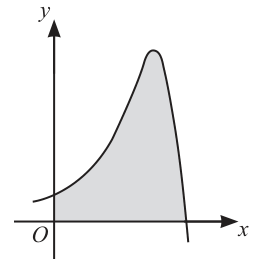
The diagram shows the curve with equation . The shaded region is bounded by the axes and the curve.
Approach
Differentiate with respect to , set , and solve for to find the x-coordinate of the maximum point.
Working
Differentiate using the chain rule:
Set the derivative equal to zero:
Factor out :
Since for all real , the factor cannot be zero. Therefore:
This can also be written as .
Answer
x = ln 4
Walkthrough
Step 1: Differentiate. The function is . Using the chain rule, the derivative of is . So and , giving .
Step 2: Set derivative to zero. At a maximum (or minimum) point, the gradient is zero. So we solve .
Step 3: Factor. Both terms share a factor of . Factoring gives .
Step 4: Solve. Since is always positive and never zero, we must have , giving , so .
Key Takeaways
- The derivative of is , found using the chain rule.
- At a stationary point, .
- Exponential functions are always positive, so they can be safely divided out or ignored when solving equations of the form .
Common Mistakes
- Forgetting the chain rule and writing instead of .
- Attempting to solve (setting ) instead of setting the derivative to zero.
- Writing the answer as a decimal (e.g., ) when the question asks for an exact answer.
Things to Be Careful About
- The question asks for the exact x-coordinate, so leave the answer in logarithmic form: or .
- Always check that before concluding that the other factor must be zero.
Find the area of the shaded region. Give your answer in the form , where and are integers.
Approach
The shaded region is bounded by the curve, the y-axis (), and the x-axis. Find where the curve meets the x-axis to determine the upper limit of integration, then evaluate the definite integral .
Working
Find the x-intercept: Set :
Factor out :
Since , we have:
Integrate:
Apply the limits from to :
Upper limit ():
Using the index law :
So the upper limit gives .
Lower limit ():
Subtract:
Answer
100/3
Walkthrough
Step 1: Find the x-intercept. The shaded region is bounded by the curve, the y-axis, and the x-axis. The y-axis corresponds to . To find where the curve meets the x-axis, set : . Factor out to get . Since is never zero, we solve , giving and . This is our upper limit of integration.
Step 2: Integrate. The integral of is (divide by the coefficient of in the exponent). The integral of is . So the antiderivative is .
Step 3: Evaluate at the upper limit. At , we need and . Using the identity , we get and . So .
Step 4: Evaluate at the lower limit. At , , so .
Step 5: Subtract. Area .
Key Takeaways
- To find where a curve meets the x-axis, set and solve.
- When integrating , divide by : .
- The index law is essential for simplifying expressions like .
- Always check both limits of a definite integral; forgetting the lower limit is a common error.
Common Mistakes
- Using the x-coordinate of the maximum point () as the upper limit instead of the x-intercept ().
- Forgetting to evaluate at the lower limit and just computing the upper limit value.
- Incorrectly simplifying as or instead of .
- Writing the integral as without dividing by the coefficients of in the exponents.
Things to Be Careful About
- The question asks for the answer in the form where and are integers. satisfies this since .
- The constant of integration is not needed for definite integrals, but including it does not lose marks.
- Ensure you use the x-intercept () as the upper limit, not the x-coordinate of the maximum () from part (a).
The polynomial is defined by
where and are constants. It is given that is a factor of and that the remainder is when is divided by .
Approach
Use the factor theorem: since is a factor of , substituting must give . Use the remainder theorem: since the remainder when is divided by is , substituting gives . This gives two equations in and .
Working
Since is a factor:
Multiply by 8:
Since the remainder is when divided by :
Substitute into :
Answer
a = 2, b = 9
Walkthrough
We are told that is a factor of . By the factor theorem, this means is a root, so . Substituting this value into the polynomial gives the first equation. We are also told that the remainder is when is divided by . By the remainder theorem, the remainder is , so . Substituting gives the second equation. Notice that the terms cancel in this second equation, leaving , so is found immediately. Then substitute into the first simplified equation to find .
Key Takeaways
- The factor theorem links a factor to the root .
- The remainder theorem says that division by leaves remainder .
- Substituting known roots or remainders is a powerful way to set up equations for unknown coefficients.
Common Mistakes
- Using instead of for the factor .
- Using instead of for division by .
- Making sign errors when substituting ; the correct substitution gives .
- Stopping before simplifying the first equation; the mark scheme requires the powers of to be evaluated.
Things to Be Careful About
- The factor gives root , not .
- The divisor gives remainder , not .
- If using algebraic long division instead of substitution, you must still end with two expressions correctly equated to and .
- An unsupported value of may only receive partial credit if no method is shown.
Approach
Use the known factor to divide . The quotient will be a quadratic, which can then be factorised completely.
Working
Divide the first term:
Multiply back and subtract:
Bring down . Divide the next term:
Multiply back and subtract:
Bring down . Divide the next term:
Multiply back and subtract:
So the quotient is . Factorise this quadratic:
Therefore:
Answer
p(x) = (2x - 3)(x + 2)(x + 4)
Walkthrough
After finding and , the polynomial is . Since is a factor, dividing by it should produce a quadratic quotient with no remainder. The long division is performed term by term: divide the leading term by , multiply back, subtract, and bring down the next term. This gives the quotient . Finally, factorise the quadratic as , so the complete factorisation is .
Key Takeaways
- Polynomial division reduces a cubic with a known linear factor to a quadratic.
- The quotient can then be factorised by inspection or by the quadratic formula.
- A complete factorisation must include all linear factors.
Common Mistakes
- Sign errors when subtracting after multiplying back.
- Forgetting to bring down the next term during long division.
- Stopping at the quadratic quotient without factorising it.
- If using synthetic division with root , the quotient is ; remember to factor out the and combine with to obtain .
Things to Be Careful About
- The mark scheme requires the division to go as far as the term in ; show enough working.
- Check the final factorisation by expanding: should return .
- One sign error in the division may still earn partial credit, but the final factors must be correct for full marks.
Approach
Use the factorised form of and substitute . Set each factor equal to zero and solve for , rejecting any value outside . Then find the angle in the given range.
Working
Since
we need
First factor:
This is impossible since must lie between and .
Second factor:
This is also impossible.
Third factor:
This is valid. For , is negative in the third quadrant, so
The other solution, , is outside the range.
Answer
θ ≈ 228.6° (228.590°)
Walkthrough
We start from the complete factorisation of . Substituting means each factor must be considered separately. Since , each equation becomes an equation in . The values and are impossible because the sine function only takes values between and . Only is possible. The range includes the second and third quadrants; sine is negative only in the third quadrant, so the reference angle must be added to . The solution in the fourth quadrant, , is outside the range and is ignored.
Key Takeaways
- A product is zero only when one of its factors is zero.
- , so equations involving cosecant can be rewritten in terms of sine.
- The range of is , so any solution outside this interval must be rejected.
- The quadrant determines how to convert a reference angle into the required solution.
Common Mistakes
- Forgetting to reject or .
- Trying to solve without converting to .
- Including , which is outside .
- Using the calculator's negative principal value directly instead of adding .
Things to Be Careful About
- The question is in degrees, so keep the calculator in degree mode.
- The mark scheme accepts or greater accuracy .
- Solutions outside the given range should be ignored, not written as extra answers.
- At , and is undefined, but this is not a solution here.
The parametric equations of a curve are
where .
Approach
We have parametric equations, so use
Differentiate with respect to using the quotient rule, differentiate with respect to using the chain rule, then divide.
Working
Differentiate with respect to :
Simplify the numerator:
Differentiate with respect to :
Now divide:
Simplify:
So .
Answer
dy/dx = (6/5)(3t + 4), c = 6/5
Walkthrough
We are given a curve in parametric form, so the gradient is not found directly. Instead we differentiate and separately with respect to the parameter , then use
First differentiate . This is a quotient, so apply the quotient rule:
Here and , so and . Substituting gives .
Next differentiate . The derivative of is by the chain rule, so multiplying by 2 gives .
Finally divide by . Dividing by a fraction is the same as multiplying by its reciprocal, so the partially cancels with one factor of , leaving . This is exactly the form , so .
Key Takeaways
Parametric differentiation uses . The quotient rule is needed for rational functions. The chain rule is needed for composite logarithms. Always simplify fully to match the requested form.
Common Mistakes
- Forgetting to square the denominator in the quotient rule.
- Making a sign error when expanding .
- Differentiating as without multiplying by the inner derivative .
- Dividing by instead of the other way round.
Things to Be Careful About
The mark scheme requires the final answer in the form , so you must simplify and state the constant . Keep the domain in mind, although part (a) does not need it.
Approach
Use and set it equal to to find . Since , we have , so take the positive square root. Then substitute into the parametric equation for to find , and into to find .
Working
Set :
Use the logarithm power rule:
Hence:
Since , , so:
Therefore:
Find :
Find using part (a):
Answer
a = 1/2, m = 12
Walkthrough
We know the point has -coordinate . Since , set
Using the logarithm power rule, , so
Because is a one-to-one function, the arguments must be equal:
The domain means , so only the positive square root is valid:
Now substitute into the parametric equation for to find :
The gradient is the value of at this point. From part (a), . At ,
Key Takeaways
Logarithmic equations can be solved by using the power rule and the one-to-one property of logarithms. The domain of the parameter is essential for choosing the correct root. A parametric point is found by substituting the parameter value into both coordinate equations, and the gradient is found by substituting into .
Common Mistakes
- Writing as instead of using the logarithm power rule.
- Taking the negative square root and obtaining an invalid .
- Substituting into instead of when finding .
- Forgetting to use the derivative expression from part (a) when finding .
Things to Be Careful About
The mark scheme allows the value of to be implied by a single correct value of , but you should still show the log equation. Only is valid because must be positive. The final answers are and .
State whether the curve represents a decreasing function or an increasing function or neither. Give a reason for your answer.
Approach
The curve is increasing if its gradient is positive for all in the domain. Use the expression for from part (a) and the domain .
Working
From part (a):
Since :
Therefore:
for all in the domain. A positive gradient means the curve is increasing.
Answer
The curve represents an increasing function, because for all .
Increasing, because dy/dx > 0 for all t > -4/3
Walkthrough
From part (a), the gradient of the curve is
The domain is , so . Since is positive, the product is positive for every allowed value of . A positive gradient everywhere means the curve is increasing.
Key Takeaways
The sign of over the whole domain determines whether a function is increasing, decreasing, or neither. Here the domain makes the gradient strictly positive, so the curve is increasing.
Common Mistakes
- Answering "increasing" without giving a reason.
- Claiming the curve is decreasing because appears in the denominator in intermediate steps, without simplifying to .
- Forgetting that ensures .
Things to Be Careful About
The mark scheme awards the mark for "increasing" with a reference to a positive gradient. You must state that the gradient is positive, not just say "increasing". Since the gradient is never zero or negative on the domain, the curve is strictly increasing.
Approach
Use the double-angle formulae to write both and in terms of and , then factorise and simplify.
Working
So
Factorise :
Answer
sin^2 2x + 4cos^2 x cos 2x = 4cos^4 x
Walkthrough
We need to show that the left-hand side can be rearranged to . The most reliable way is to write everything in terms of and .
Start with . The double-angle formula gives , so when we square it we get .
Next, replace by . This is the standard double-angle formula for cosine.
Substitute both results into the left-hand side:
Now factor the common factor :
The terms cancel, leaving in the bracket. Therefore the expression becomes , which is exactly the right-hand side.
Key Takeaways
- The double-angle formulae allow us to convert and into expressions involving only and .
- Factorising common terms is often the key to simplifying a trigonometric expression.
- The Pythagorean identity is used implicitly when simplifying to .
Common Mistakes
- Forgetting to square the when expanding ; it is , not .
- Using the wrong double-angle formula for (e.g. is also correct, but then the factorisation is less direct).
- Dropping the factor when substituting.
Things to Be Careful About
- The identity is an identity, so the final line must use or state that the two sides are equal for all .
- When factorising, ensure every term is included: and both share .
- The mark scheme requires a clear method: write down the identities used and show the intermediate factorised line.
Find the set of possible values of the constant for which the equation
has no real solutions.
Approach
Use the identity from part (a) to rewrite the equation as , then use the range of to find when no real can satisfy it.
Working
From part (a),
So the equation becomes
For real ,
so
Thus real solutions exist exactly when . Therefore the equation has no real solutions when
Answer
k < 5 or k > 9
Walkthrough
The equation contains exactly the expression from part (a). Replace by . Then the equation becomes , or .
For real , the value of lies between and , so lies between and . Multiplying by gives values from to , and adding gives values from to . Therefore the left-hand side can equal any number in .
If is outside this interval, no real can make the equation true. Hence the equation has no real solutions when or .
Key Takeaways
- The range of is , not , because the fourth power makes negative values positive.
- An equation of the form has no real solutions exactly when is outside the range of .
- The identity from part (a) is a powerful tool for simplifying the equation.
Common Mistakes
- Thinking ranges over ; it actually ranges over .
- Forgetting to add when finding the range of the left-hand side.
- Writing or instead of strict inequalities; at and real solutions do exist.
Things to Be Careful About
- The question asks for values for which there are no real solutions, so the answer is the complement of the range .
- Use strict inequalities: or .
- The mark scheme expects the use of the part (a) identity; an unsupported answer may not receive full credit.
Approach
Apply the identity from part (a) with , simplify the square root, then use the double-angle identity for to integrate.
Working
Using part (a) with :
Therefore the integrand is
since .
Now use the double-angle identity:
So
Integrate:
Answer
2pi/3 + sqrt(3)
Walkthrough
This part asks for a definite integral. The integrand has the same structure as the identity in part (a), but with replaced by . Setting in the identity gives
Therefore the square root becomes . Since is always non-negative, .
Now use the double-angle identity , which rearranges to . This is much easier to integrate.
So the integral is
The antiderivative is . Evaluating from to :
Key Takeaways
- Recognising the same algebraic identity in a new variable is a common A-Level technique.
- When simplifying , remember that the result is ; here , so no absolute value is needed.
- The double-angle identity lets us convert into a linear expression in , which is easy to integrate.
Common Mistakes
- Forgetting to replace by correctly; the first term becomes , not .
- Writing without noting that is non-negative; here it is always true, so no sign issue.
- Incorrectly evaluating as instead of .
- Forgetting to subtract the lower limit value from the upper limit value.
Things to Be Careful About
- The limits are , so use exact values for and .
- The final answer must be exact: .
- The mark scheme expects the integrand to be simplified to before integrating; show this step clearly.