Mathematics 9709/15 — May/June 2025
Cambridge AS Level · Pure Mathematics 1 · worked solutions for every part, with the mark scheme
Topics Quadratics · Trigonometry · Integration · Series · Coordinate Geometry · Circular Measure · +2 more
The equation of a curve is such that . It is given that the curve passes through the point .
Find an equation of the curve.
Approach
Integrate each term with respect to . For the term , use the reverse of the chain rule: divide by the derivative of the inside function and by the new power. Then use the point to find the constant of integration.
Working
Use :
Answer
y = 2(2x-5)^3 + 4x^2 - 10 (or y = 16x^3 - 116x^2 + 300x - 260)
Walkthrough
We are given the gradient function and a point on the curve. To recover , we integrate both sides with respect to .
The first term is . This is a composite function: the outer function is squaring and the inner function is . By the reverse chain rule,
Here and , so the integral of is . Multiplying by the coefficient gives .
The second term, , integrates to because .
We must add an arbitrary constant because differentiation removes constants. Then we use the point : substitute and into the integrated expression. This gives , so and .
Therefore the equation of the curve is .
Key Takeaways
- Integration is the reverse of differentiation.
- For a term of the form , divide by when integrating.
- Always include the constant of integration when finding an indefinite integral.
- A point on the curve is used to determine the value of .
Common Mistakes
- Forgetting to include before substituting the point.
- Forgetting to divide by the derivative of the inside function, , when integrating .
- Substituting the point into the derivative instead of the integrated expression.
- Making a sign error when evaluating and then cubing it.
Things to Be Careful About
- The mark scheme awards marks for each correctly integrated term, so leaving terms unsimplified is acceptable.
- When substituting , compute carefully; .
- If you expand the final answer, check the expansion carefully: .
- The final answer must include an equals sign and the expression for .
In the expansion of , the coefficient of is six times the coefficient of .
Find the possible values of the constant .
Approach
Find the coefficients of and in each expansion using the binomial theorem, add the contributions, use the given condition, then solve the resulting quadratic.
Working
For , the coefficient of is:
and the coefficient of is:
For , the coefficient of is:
and the coefficient of is:
So the total coefficient of is , and the total coefficient of is .
The condition gives:
Simplify:
Divide by 6:
Factorise:
Therefore
Answer
a = 4 or a = 5
Walkthrough
This problem asks about binomial coefficients in the sum of two expansions. We only need the terms in and , not the full expansions.
For , the term containing is . Putting gives . Putting gives .
For , write the second term as . The coefficient is . The coefficient is . The minus sign matters because the second term is negative.
Now add the coefficients: the total coefficient is , and the total coefficient is . The condition says the first is six times the second, so . Expand and simplify: , divide by 6 to get , then factorise as . Hence or .
Key Takeaways
- The binomial theorem lets you extract one coefficient without expanding fully: the coefficient of in is .
- When the second term in a binomial is negative, include in the coefficient.
- Coefficients from separate expansions add when the expansions are added together.
- A coefficient condition produces a quadratic equation in ; solving it gives the possible values.
Common Mistakes
- Forgetting the binomial coefficient .
- Making a sign error with , so the coefficient of is written as positive instead of .
- Setting up the condition incorrectly, e.g. writing instead of .
- Not simplifying the combinations, which the mark scheme guidance requires.
- Losing one of the two solutions when solving the quadratic.
Things to Be Careful About
- The mark scheme expects the combinations to be evaluated, so write and rather than leaving or unsimplified.
- The coefficient of in is negative because of the factor.
- If using the quadratic formula, a full substitution must be shown; factorisation is simpler here.
- The final answer must include both possible values, and .
Approach
Divide the equation by 4 so that the coefficient of is 1, then complete the square on . Rearrange to isolate the square term and take square roots.
Working
Divide by 4:
Complete the square on :
Therefore the equation becomes:
Taking square roots:
Equivalently,
Answer
or
x = (1 ± √2)/2
Walkthrough
We solve by completing the square. First divide by 4 so the coefficient of becomes 1. Then write as . Substituting back gives , so . Taking square roots gives , equivalent to .
Key Takeaways
Completing the square requires a coefficient of 1 on . For , use . After isolating the square, remember the sign when taking square roots.
Common Mistakes
- Dividing only some terms by 4 instead of the whole equation.
- Forgetting the sign when taking square roots.
- Not simplifying correctly.
- Giving a decimal answer instead of the exact surd form.
Things to Be Careful About
The mark scheme requires the completed-square method to be shown; a correct answer by another method without this only earns a partial credit mark. Keep the answer exact.
Approach
Convert the equation into a quadratic in , use the solutions from part (a), then find the angles in using inverse tangent and the period of .
Working
Let . Multiply by (valid because in the given interval):
From part (a):
Therefore
Numerically,
For :
Since and , the only solution from this value is .
For :
Add to bring it into the interval:
There are no other solutions in the interval.
Answer
θ = 50.4°, 168.3°
Walkthrough
The equation is quadratic in . Let . Multiplying by gives , exactly the quadratic solved in part (a). Hence . Now solve and . The first value is positive, so its inverse tangent gives the first-quadrant angle . The second value is negative; its principal inverse tangent is about , so add to obtain . Each value of has exactly one solution in , so there are no extra answers.
Key Takeaways
- An equation can be rewritten as a quadratic in a trigonometric function, allowing earlier algebra to be reused.
- To solve , find the principal value with and then add or subtract multiples of to place solutions in the required interval.
- The sign of tells you which quadrant to consider.
Common Mistakes
- Forgetting to multiply both sides by or making a sign error.
- Giving only the positive-tangent solution and missing the negative-tangent solution.
- Giving answers in radians when the question asks for degrees.
- Writing final answers without showing the substitution .
Things to Be Careful About
The interval is , so is never zero at the endpoints and is undefined only at . When is negative, the solution lies in the second quadrant, so use with the negative principal value, or equivalently . The mark scheme requires a clear method; answers only, or answers only in radians, do not earn full marks.
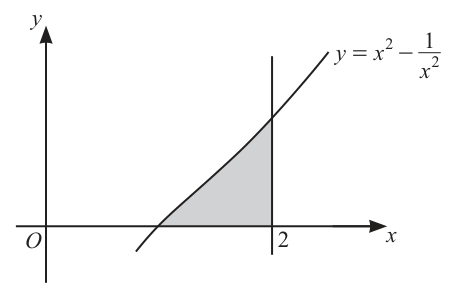
The diagram shows part of the curve . The shaded region is bounded by the curve, the line and the -axis.
Find the volume formed when the shaded region is rotated through about the -axis, giving your answer correct to 2 decimal places.
Approach
To find the volume formed when the shaded region is rotated about the x-axis, we use the formula . First, we must determine the lower limit of integration by finding where the curve intersects the x-axis. Then we set up the integral, expand the integrand, integrate term by term, and evaluate between the limits.
Working
Find the x-intercept (lower limit):
Set up the volume integral with limits to :
Expand the integrand:
Integrate term by term:
Evaluate at the upper limit :
Evaluate at the lower limit :
Subtract the lower limit value from the upper limit value:
Calculate the numerical value:
Answer
14.11
Walkthrough
First, we identify the boundaries of the shaded region. The right boundary is given as . The bottom boundary is the x-axis (). To find the left boundary, we find where the curve crosses the x-axis by setting . This gives , so . Since we are in the first quadrant, . Thus, the limits of integration are from to .
Next, we apply the volume of revolution formula about the x-axis: . Substituting the curve equation, we get .
We expand the squared binomial: . This is much easier to integrate than the original form.
We integrate each term using the power rule: , , and . This gives the antiderivative .
We then evaluate this antiderivative at the upper limit () and subtract the value at the lower limit (). Careful fraction arithmetic is needed here: at , we get . At , we get . The difference is . Multiplying by gives the final volume.
Key Takeaways
- The volume of a solid of revolution about the x-axis is given by .
- Limits of integration must be determined from the geometry of the region, often by finding x-intercepts or intersections with given lines.
- Expanding binomials before integrating can simplify the process, especially when dealing with negative exponents.
Common Mistakes
- Using as the lower limit instead of the actual x-intercept . The function is undefined at , and the shaded region does not extend to the y-axis.
- Forgetting to square the expression in the volume formula, integrating instead of .
- Sign errors when expanding , such as writing instead of .
- Arithmetic errors when evaluating and subtracting the fractional values at the limits.
Things to Be Careful About
- Always check the domain of the function. has a vertical asymptote at , so the lower limit cannot be .
- Ensure all fractions are converted to a common denominator before adding or subtracting to avoid calculation errors.
- The final answer must be given to 2 decimal places as requested, so compute and round appropriately to .
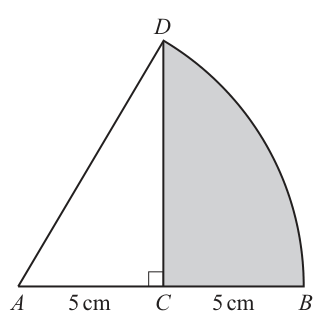
The diagram shows a sector of a circle with centre and radius . The perpendicular bisector of passes through .
Find the perimeter of the shaded region , giving your answer correct to 1 decimal place.
Approach
The shaded region is bounded by the line segment , the line segment , and the circular arc . We need to find the lengths of these three boundaries. We use the right-angled triangle to find the angle and the length , then use the arc length formula for .
Working
Since is the perpendicular bisector of , is the midpoint of . Given the radius cm, we have cm.
In right-angled triangle :
- Hypotenuse cm (radius)
- Adjacent side cm
Using the cosine ratio:
Using the sine ratio to find :
The arc length is given by :
The perimeter of the shaded region is the sum of , , and arc :
Answer
24.1 cm
Walkthrough
First, identify the boundaries of the shaded region : the straight line , the straight line , and the curved arc . Since is the perpendicular bisector of , point is exactly halfway along , making cm.
Next, focus on the right-angled triangle . We know the hypotenuse is the radius of the circle ( cm) and the adjacent side is cm. Using the cosine ratio (), we find , which immediately tells us or radians. This is a standard exact trigonometric value.
Then, find the length of using the sine ratio (), giving cm. Alternatively, Pythagoras' theorem () yields cm.
With the angle radians, calculate the arc length using the formula . Finally, add the three boundary lengths together () and evaluate to 1 decimal place.
Key Takeaways
- Recognising that a perpendicular bisector creates a midpoint and right-angled triangles.
- Using exact trigonometric values (like ) to find angles and side lengths in right-angled triangles.
- Applying the arc length formula with in radians.
- Carefully identifying all boundaries of a composite shaded region when calculating perimeter.
Common Mistakes
- Forgetting to include the arc length in the perimeter and only summing the straight lines.
- Using degrees instead of radians in the arc length formula .
- Miscalculating or during the final addition.
Things to Be Careful About
- Ensure the angle is converted to radians before using the arc length formula.
- The perimeter includes the curved arc , not the straight line or .
- Round only the final answer to 1 decimal place, not intermediate values.
Approach
The shaded region is the difference between the area of the circular sector and the area of the right-angled triangle . We use the sector area formula and the triangle area formula with the values found in part (a).
Working
The area of sector with radius cm and angle radians is:
The area of right-angled triangle with base cm and height cm is:
The area of the shaded region is the sector area minus the triangle area:
Answer
30.7 cm^2
Walkthrough
To find the area of the shaded region , observe that it is formed by taking the entire circular sector and removing the right-angled triangle from it.
First, calculate the area of sector using the formula . We know cm and radians (from part a). This gives cm.
Next, calculate the area of triangle . Since it is a right-angled triangle at , the area is simply . Using cm and cm, the area is cm.
Subtract the triangle area from the sector area to get the shaded area: cm.
Key Takeaways
- Recognising composite shapes as the difference between simpler shapes (sector minus triangle).
- Applying the sector area formula correctly with in radians.
- Using the standard triangle area formula for right-angled triangles.
Common Mistakes
- Using the wrong angle for the sector area (e.g., using instead of ).
- Forgetting to convert degrees to radians before using the sector area formula.
- Calculating the area of triangle instead of triangle .
Things to Be Careful About
- Ensure consistent use of radians for circular measure formulas.
- The shaded region is specifically bounded by , , and arc , which perfectly matches sector minus triangle .
Each year, on her birthday, Ananya receives some money from each of her parents.
On Ananya's first birthday, her father gives her $10. Every subsequent year, her father gives her $5 more than he gave her the previous year.
On Ananya's first birthday, her mother also gives her $10. Every subsequent year, her mother gives her 20% more than she gave her the previous year.
Show that on Ananya's eleventh birthday she receives more from her mother than from her father.
Approach
On the -th birthday, the father's gift follows an arithmetic progression with first term and common difference . The mother's gift follows a geometric progression with first term and common ratio . Apply the appropriate -th term formulas with and compare the results.
Working
Father's amount on the 11th birthday:
Mother's amount on the 11th birthday:
Since , Ananya receives more from her mother on her eleventh birthday.
Answer
Father gives $60 and mother gives $61.92, so the mother's gift is larger.
Mother gives 61.92 and father gives 60, so mother gives more.
Walkthrough
On each birthday, we need an individual gift amount. The father's gifts form an arithmetic progression because a fixed amount of $5 is added every year. The mother's gifts form a geometric progression because the amount is multiplied by the same factor every year: a 20% increase means multiplying by .
For the eleventh birthday, is used in each nth-term formula. The father's calculation is:
The mother's calculation is:
Since 61.92 exceeds 60, the mother's gift is larger. The key is to remember that the eleventh term uses 10 increments or 10 multiplications after the first birthday.
Key Takeaways
- Recognise arithmetic and geometric sequences from word-based descriptions.
- Use for an arithmetic sequence and for a geometric sequence.
- An increase of 20% corresponds to a common ratio of , not .
Common Mistakes
- Using instead of .
- Raising to the power instead of .
- Stopping after finding one amount without comparing the two values.
Things to Be Careful About
- The first birthday corresponds to .
- The father's gift after 10 years of increases is , and the mother's after 10 years of growth is .
- Values may be given to 2 significant figures, but showing both exact forms first avoids rounding errors.
Find the total amount of money Ananya receives up to and including her eighteenth birthday.
Approach
We need the total amount over 18 birthdays, so we sum the first 18 terms of the father's arithmetic progression and the mother's geometric progression, then add the two totals.
Use
for an AP and
for a GP.
Working
Father's total over 18 birthdays:
Mother's total over 18 birthdays:
Using ,
Total received up to and including the eighteenth birthday:
Answer
The total amount is $2226.17.
2226.17
Walkthrough
We need the total amount across 18 birthdays, so we sum the first 18 terms of each sequence.
For the father's arithmetic sequence, the sum formula is:
With , , and :
For the mother's geometric sequence, the sum formula is:
With , , and :
Because , both the numerator and denominator are negative, which gives the positive sum. Finally, add the two totals:
So the total is $2226.17.
Key Takeaways
- Sum an arithmetic progression with .
- Sum a geometric progression with .
- The phrase "up to and including her eighteenth birthday" means the sum of the first 18 terms, not 17.
Common Mistakes
- Summing only 17 terms for the mother or father.
- Forgetting to add the father's and mother's totals together.
- Using the GP sum formula with the subtraction in the wrong order, causing a sign error.
- Reporting as the total; the mark scheme notes to ignore it as an extra answer.
Things to Be Careful About
- Rounding too early can change the last digits; keep enough precision before the final answer.
- When , the formula still works because both numerator and denominator are negative.
- The final total should be given to at least 3 significant figures; $2226.17 is acceptable.
In the parallelogram , the coordinates of are , the coordinates of are and the coordinates of are . It is given that the gradient of is .
Approach
Use the gradient formula for the line through and , set it equal to , and solve for .
Working
The gradient of is
Given that this equals , we have
Multiply both sides by :
Hence
Answer
p = 5
Walkthrough
The gradient of a line through and is
Take and . The vertical change from to is , and the horizontal change is . We are told that the gradient is , so we set up
Multiplying both sides by gives , so . This missing coordinate will be needed for the rest of the question.
Key Takeaways
This part tests the definition of gradient: it is the ratio of the change in to the change in . It also reinforces that if one endpoint is unknown, the gradient formula can be used to solve for the unknown coordinate.
Common Mistakes
- Reversing only one of and when applying the gradient formula, which produces the wrong sign.
- Omitting the method line. The mark scheme requires the gradient equation to be seen explicitly, not just the final answer.
- Making a sign error when moving the constant across the equation.
Things to Be Careful About
The vertical difference should be on top and the horizontal difference on the bottom. Since and have the same form, both and are acceptable, but mixing the two orders gives the wrong sign.
Approach
Use the fact that in a parallelogram , opposite sides are equal and parallel, so . Add this displacement to to find .
Working
The displacement from to is
Since ,
Using from part (a):
Answer
C = (4, 3)
Walkthrough
In a parallelogram with vertices in order , the side is parallel and equal to the side . Therefore the displacement from to is the same as the displacement from to .
First find this displacement:
Starting at and applying the same displacement gives
Substituting the value found in part (a):
Alternatively, using the fact that the diagonals of a parallelogram bisect each other, , which gives the same result .
Key Takeaways
This part shows how vector displacements can be used to locate missing vertices of a parallelogram. It also demonstrates the important follow-through idea: the -coordinate of depends on the value of found earlier.
Common Mistakes
- Getting the order of vertices wrong and using the wrong side relation, for example writing instead of .
- Forgetting that -coordinate of is , so the vertical displacement is rather than .
- Simplifying incorrectly when .
- Giving multiple possible coordinates for ; the mark scheme specifically warns that extra solutions lose both marks.
Things to Be Careful About
Keep the vertices in the order . When applying , be careful to subtract coordinates in the same order for both and . If you already found , substitute it only at the end so the general expression is clear.
Find the area of the triangle formed by the perpendicular bisector of and the - and -axes.
Approach
Find the midpoint of and the gradient of the perpendicular bisector. Use the point-slope form to write its equation, find its intercepts with the axes, then compute the area of the resulting right-angled triangle.
Working
With , . The midpoint of is
The gradient of is , so the gradient of the perpendicular bisector is
The perpendicular bisector passes through , so its equation is
Simplifying to gradient-intercept form:
On the -axis, , giving
so the intercept is .
On the -axis, :
so the intercept is .
The triangle with the axes has vertices , and . Its legs are and , so its area is
Answer
3/16 square units (0.1875)
Walkthrough
After part (a), , so .
The perpendicular bisector of is the line through the midpoint of that is perpendicular to . First find the midpoint:
Next, because the original gradient is , the perpendicular gradient is the negative reciprocal:
Use the point-slope form through :
Simplify to . This line cuts the axes at two points: on the -axis, gives ; on the -axis, gives . Together with the origin, these two points form a right-angled triangle with legs along the -axis and along the -axis. Its area is
The line lies below the -axis between and , so the ordinary triangle-area formula is the most direct method.
Key Takeaways
This part brings together several coordinate geometry ideas: midpoint, perpendicular gradients, the equation of a line, intercepts, and area of a triangle formed by a line with the coordinate axes.
Common Mistakes
- Using the original gradient instead of its negative reciprocal .
- Using the wrong midpoint, e.g. averaging and or and instead of and .
- Writing the line equation without using the midpoint and perpendicular gradient; the mark scheme requires both to be used.
- Forgetting that the intercept on the -axis is negative, and then using a negative length in the area formula. Take absolute values of the intercept distances.
- Simplifying incorrectly; carefully expand to .
Things to Be Careful About
The perpendicular bisector of must pass through the midpoint of , so the equation must use that exact midpoint. When finding the triangle area, the two axes meet at right angles at the origin, so the area is simply half the product of the two intercept distances. If using integration, integrate the absolute value of the line between and ; the mark scheme allows either method.
The equation of a curve is . The curve has a stationary point at .
Approach
The curve passes through , so substitute these coordinates into the equation. Since is a stationary point, the gradient there is zero: differentiate the curve and set at . Solve the resulting linear simultaneous equations for and .
Working
Substitute into :
Therefore
Differentiate the curve:
At the stationary point, the gradient is zero:
So
Subtract the first equation from the second:
Then, using :
Answer
a = -6, b = 9
Walkthrough
The point gives two conditions. Because it lies on the curve, substituting and must satisfy the equation; this gives one linear equation in and . Because it is a stationary point, the gradient must be zero at . Differentiating gives , and setting this equal to zero at produces the second equation. The two equations are then solved simultaneously. The mark scheme awards B1 for each correct condition set up (the point on the curve and the derivative), M1 for using the zero gradient, DM1 for solving the two equations, and A1 for the correct final values.
Key Takeaways
This question tests the fundamental meaning of a stationary point: at a stationary point the derivative is zero, while the curve itself also passes through the given point. It also tests differentiation of powers of and solving linear simultaneous equations. A point on a curve and a stationary point each supply one independent condition, so two unknowns can be found.
Common Mistakes
- Substituting only the -coordinate but not using .
- Forgetting to set the derivative equal to zero at the stationary point.
- Making an arithmetic slip when solving the simultaneous equations.
- Misreading the equation as rather than .
The mark scheme also notes that the final A1 is only available if the working is correct with no wrong working (WWW).
Things to Be Careful About
Check that the values and satisfy both equations: and . Keep the derivative notation clear, and do not confuse the stationary point condition with a point simply lying on the curve.
Approach
Use the values and to write the derivative. Stationary points occur where . Solve the resulting quadratic to find both -coordinates, then find the -coordinate of the stationary point that is not .
Working
With and ,
At stationary points:
Divide by 3:
Factorise:
So or . The point is the given stationary point, so the other stationary point has .
Find its -coordinate:
Answer
(3, 5)
Walkthrough
Once and are known, the original curve is fully determined. Substitute them into the derivative to obtain . At every stationary point the derivative is zero, so solve . Dividing by 3 and factorising gives and . Since is the already-known stationary point from the question, the other one is at . Substitute into the curve equation to get . The mark scheme gives the first M1 for setting a correct derivative to zero, DM1 for solving the three-term quadratic, and A1 for the final point.
Key Takeaways
Stationary points are found by solving . A cubic can have up to two stationary points, and one of them was already given in the question. Factorising a quadratic derivative is a common way to locate stationary points.
Common Mistakes
- Giving only without computing .
- Including as a second answer; the mark scheme says it may be ignored if it appears.
- Incorrectly factorising .
- Substituting into the derivative instead of the curve equation to find .
Things to Be Careful About
Make sure the quadratic is set equal to zero before solving. Check the final coordinates by substituting back: at , the derivative is . The mark scheme notes the final A1 is only dependent on the first M1, so solving must follow from a correct derivative expression.
A point is moving along part of the curve in such a way that the -coordinate of is increasing at a constant rate of 6 units per second.
Find the rate at which the -coordinate of is increasing when .
Approach
Use the chain rule
to relate the two rates of change. First evaluate at , then solve for using the given .
Working
From part (a), the derivative is
At :
Given and using the chain rule,
Therefore
Answer
The -coordinate is increasing at units per second.
dx/dt = 1/4
Walkthrough
This part is a related-rate problem. The quantity we know is how fast changes with time, and we want how fast changes with time. These are connected through the slope : a change in time produces a change in , which in turn produces a change in . The chain rule states . First evaluate the slope at the instant when , using , which gives 24. Then substitute the known : , so . This means one unit of time increases by 6 units; since the slope is 24, needs to increase by only unit.
Key Takeaways
Rates of change with respect to time are connected by the chain rule. Evaluating a derivative at the relevant value gives the instantaneous slope, which is the conversion factor between and . This question also reinforces that the derivative is an instantaneous rate.
Common Mistakes
- Writing the chain rule upside down, e.g. .
- Substituting into rather than into .
- Simplifying incorrectly.
- Forgetting to state the units (units per second) in the final answer.
Things to Be Careful About
The mark scheme accepts equivalent statements such as ; the important step is linking the slope 24, the 6, and . Always check that a larger slope means a smaller for a fixed . Use the derivative from part (a), not the original curve, when finding the rate at .
Functions and are defined as follows.
Describe fully the transformations that have been combined to transform the graph of to the graph of .
Approach
Express in terms of transformations applied to . Start with , apply a horizontal translation, a vertical stretch, and a vertical translation to obtain .
Working
Starting from :
The combined transformations are:
- A translation by the vector (shift right by ),
- A stretch with scale factor in the -direction,
- A translation by the vector (shift up by ).
Equivalently, the last two steps can be combined as a single translation by applied after the stretch.
Answer
The graph of is transformed by:
- a translation by ,
- a stretch with scale factor in the -direction,
- a translation by .
Translation by (π, 0), stretch factor 3 in y-direction, translation by (0, 2)
Walkthrough
We need to describe how to transform into . Work from the inside out:
-
Horizontal translation: The argument means the graph shifts right by . This gives .
-
Vertical stretch: The factor multiplying the cosine means every -value is multiplied by . This is a stretch with scale factor in the -direction, giving .
-
Vertical translation: The at the end shifts the graph up by units, giving .
Note that the translation vector can be stated as a single combined translation applied after the stretch, since the horizontal shift does not interact with the vertical stretch.
Key Takeaways
When describing transformations from to :
- Replace with : horizontal translation by .
- Multiply by : vertical stretch by factor .
- Add : vertical translation by .
The order matters: horizontal translations and stretches are applied first, then vertical stretches, then vertical translations.
Common Mistakes
- Giving two or more stretches (e.g., splitting the vertical stretch incorrectly) — the mark scheme gives B0 for extra stretches.
- Not stating 'translation' or 'shift' when giving vectors — only B1 is awarded if the vectors are correct but the transformation type is not named.
- Incorrect order: if the translation and stretch are not ordered correctly, the maximum is 3/4.
Things to Be Careful About
- The domain also changes from to , which is consistent with the horizontal translation by . This is not a separate transformation but a consequence of the horizontal shift.
- The mark scheme accepts the translation split as before the stretch and after, or as a single vector after the stretch.
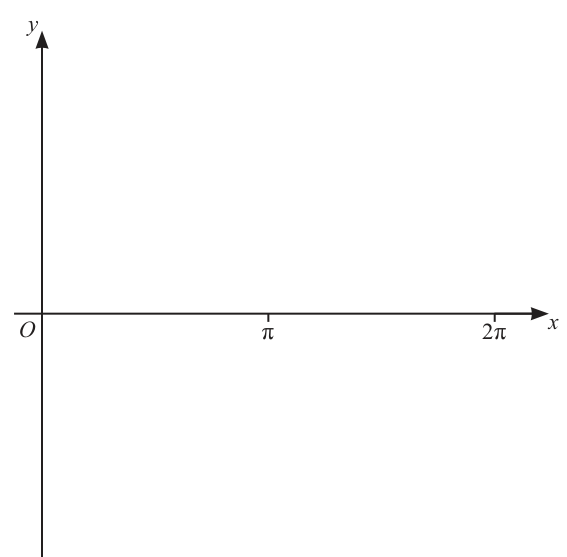
Approach
Sketch for , and for . Evaluate at endpoints and use knowledge of the cosine curve shape.
Working
Graph of , :
This is a decreasing curve from to with zero gradient at both endpoints.
Graph of , :
This is a decreasing curve from to with zero gradient at both endpoints.
Answer
Sketch the cosine curve from to for , and the curve from to for , both with zero gradients at their endpoints.
f(x): curve from (0,1) to (π,-1); g(x): curve from (π,5) to (2π,-1), both decreasing with zero gradients at endpoints
Walkthrough
We sketch both functions on the same axes, noting their domains and key values.
For , :
This is the standard cosine curve over its first half-period. At , . At , . At , . The curve is monotonically decreasing on this interval, with zero gradient (horizontal tangent) at both endpoints and .
For , :
Let , so as goes from to , goes from to . Then .
- At (): .
- At (): .
- At (): .
This is also a decreasing curve, from to , with zero gradients at both endpoints.
Key Takeaways
When sketching trigonometric functions with restricted domains:
- Always evaluate at the endpoints of the domain.
- Check monotonicity to determine whether the curve is increasing or decreasing.
- Trigonometric curves have zero gradient at their peaks and troughs (endpoints of half-periods).
- The domain restriction means the curve should not be drawn outside the given interval.
Common Mistakes
- Drawing the curve beyond the specified domain — the mark scheme requires the domain to be clearly shown.
- Not having zero gradient at the endpoints of the domain — sketches must be curves with zero gradient at the ends.
- Getting the range of wrong — it should be from to , not from to .
- Drawing as an increasing curve — it is decreasing on .
Things to Be Careful About
- The sketch of must have domain and range .
- The sketch of must have domain and range .
- Both curves must have zero gradient at their domain endpoints (horizontal tangents at , for , and at , for ).
Approach
First evaluate , then find of that result. To find , swap and in and solve for , ensuring the correct branch of is used given the domain of .
Working
Step 1: Evaluate
So we need .
Step 2: Find
Let , where .
Since , we have , so .
Therefore:
Step 3: Evaluate
Since :
Answer
5π/3
Walkthrough
We need to compute , which is a composition where we first apply , then apply .
Step 1: Compute . This is a standard exact trigonometric value.
Step 2: Find . Start with and solve for in terms of :
- Subtract 2:
- Divide by 3:
- Apply :
- Add :
The key point is that since the domain of is , we have , which is exactly the range of , so we don't need to worry about multiple branches.
Step 3: Substitute into :
- (since and )
Check: is in the domain of , so this is valid.
Key Takeaways
When finding :
- Always evaluate the inner function first.
- When finding the inverse, ensure the domain restriction is used to select the correct branch of the inverse trigonometric function.
- Always verify that the final answer lies within the domain of the original function .
Common Mistakes
- Forgetting to add when finding — the inverse is , not just .
- Using the wrong value for — it is , not or .
- Not checking that the answer lies in the domain of .
- Sign errors when computing — this equals , not .
Things to Be Careful About
- The range of is , and is within this range, so is defined.
- The domain of is (the range of ), and the range of is (the domain of ).
- always returns values in , so returns values in , which matches the domain of .
Approach
For the composite function to be defined, the range of must be a subset of the domain of . Find the range of and compare it with the domain of .
Working
Domain and range of :
- Domain: , i.e., .
- Range: on gives range .
Domain and range of :
- Domain: , i.e., .
- Range: From part (b), decreases from to on , so the range is .
Condition for to be formed:
For to be defined, every value in the range of must lie within the domain of .
The range of is . The domain of is .
Since , the value (and other values in ) is in the range of but not in the domain of . For example, , and is undefined because .
Therefore, the domain of does not include the whole of the range of , so cannot be formed.
Answer
The domain of is and the range of is . Since , the range of is not entirely contained within the domain of , so cannot be formed.
The range of g is [-1, 5] and the domain of f is [0, π]; since 5 > π, the range of g is not a subset of the domain of f, so fg cannot be formed.
Walkthrough
The composite function means . For this to be defined for any , we need:
- must be in the domain of .
- must be in the domain of .
This means the range of must be a subset of the domain of .
Range of : From part (b), on . At , . At , . Since is continuous and decreasing on this interval, the range is .
Domain of : is defined for , so the domain is .
Comparison: The range of includes values like , , etc., which are greater than . For example, , but is undefined because . Therefore, is undefined, and the composite cannot be formed.
Key Takeaways
For a composite function to be defined:
- The range of the inner function must be a subset of the domain of the outer function .
- Always check this condition by comparing the range of with the domain of .
Common Mistakes
- Saying 'the domain of does not include the range of ' without specifying what the range of actually is — the mark scheme requires mentioning both the range of and the domain of .
- Confusing with — requires the range of to be in the domain of , which is vs ; this also fails, but the question asks about .
- Not giving a specific reason or counterexample — the mark scheme accepts either a general statement about range/domain mismatch or a specific value showing the failure.
Things to Be Careful About
- The mark scheme requires mentioning both 'range of ' and 'domain of ' — just saying 'the domains don't match' is not sufficient.
- , so any value in the range of that is greater than (i.e., values in ) is outside the domain of .
- The alternative method in the mark scheme accepts showing a specific value: for example, gives , and , so is undefined.
The equation of a circle is .
Find an equation of the tangent to the circle at the point , giving your answer in the form .
Approach
Complete the square to find the centre of the circle, then use the fact that the tangent at a point is perpendicular to the radius to the point. Write the tangent in the form .
Working
The circle is . Complete the square in and :
So the centre is .
The gradient of the radius from to the point is
The tangent is perpendicular to this radius, so its gradient is the negative reciprocal:
Using with the point :
Answer
x + y - 10 = 0
Walkthrough
We are given the circle and need the tangent at the point . The radius to a point on a circle is perpendicular to the tangent at that point, so the tangent is found once the centre is known. Completing the square gives , so the centre is . The gradient of the radius joining and is . The tangent must have gradient , the negative reciprocal of . Using with gives , which simplifies to .
Key Takeaways
This question tests completing the square to find the centre of a circle, using the perpendicular relationship between a radius and a tangent, and writing the equation of a straight line in the required general form .
Common Mistakes
- Using the wrong centre because of a sign error when completing the square.
- Taking the gradient of the radius as the gradient of the tangent instead of using its negative reciprocal.
- Leaving the tangent as instead of the required form.
- Giving an answer without working; the mark scheme allows a maximum of 2 marks for an unsupported answer.
Things to Be Careful About
- The centre is , not .
- The tangent gradient is , not .
- The final equation must be in the form ; either or is accepted.
Approach
Substitute the line into the circle equation to obtain a quadratic in . Since the line does not intersect the circle, this quadratic has no real roots, so its discriminant is negative. Simplify the resulting inequality to reach the required form.
Working
From , write . Substitute into the circle equation:
Expand and collect like terms:
For no intersection, this quadratic in has no real roots, so its discriminant is negative:
Expand the discriminant:
Divide by and reverse the inequality:
Answer
k^2 - 20k - 220 > 0
Walkthrough
We are told that the line does not intersect the circle . To test intersection, substitute the line into the circle equation. Rewriting the line as gives a quadratic in ; its roots are the -coordinates of any intersection points. If the line does not intersect the circle, this quadratic has no real roots, so its discriminant is less than zero. Expanding , and collecting like terms gives . The discriminant is , which simplifies to . Setting this less than zero and dividing by reverses the inequality, giving .
Key Takeaways
A line and a circle intersect when the quadratic equation obtained by substituting the line into the circle has real roots. No intersection corresponds to a negative discriminant. This question combines the algebra of lines and circles with the quadratic discriminant condition.
Common Mistakes
- Substituting incorrectly, for example replacing by instead of .
- Forgetting to substitute into every term, including and .
- Making sign errors when expanding .
- Using the wrong discriminant condition: no intersection means discriminant , not .
- Dividing by a negative number without reversing the inequality.
Things to Be Careful About
- The discriminant must be set less than zero for no real roots; it is greater than zero for two intersections and equal to zero for a tangent.
- When simplifying , dividing by reverses the inequality sign.
- The mark scheme also accepts the distance-from-centre method, but whichever method is used, the final inequality must be obtained with full working.