Mathematics 9709/12 — May/June 2025
Cambridge AS Level · Pure Mathematics 1 · worked solutions for every part, with the mark scheme
Topics Quadratics · Trigonometry · Functions · Series · Differentiation · Integration · +1 more
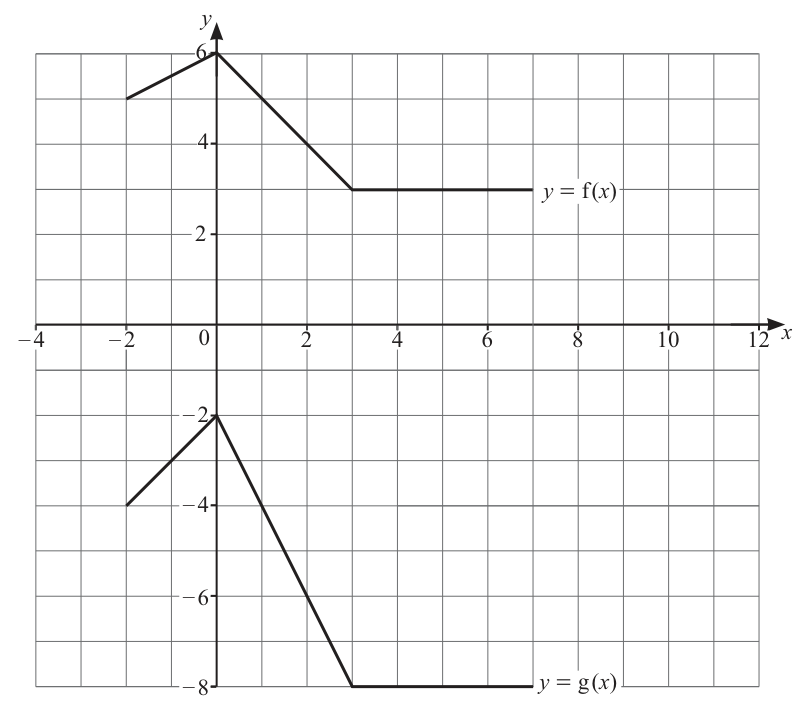
The diagram shows the graphs with equations and .
Describe fully a sequence of two transformations which transforms the graph of to the graph of . Make clear the order in which the transformations should be applied.
Approach
Compare key points on the graphs of and to determine the transformations. Since the x-coordinates of corresponding points are unchanged, the transformations must be purely vertical (parallel to the y-axis).
Working
Method 1: Stretch then translation
-
Consider a vertical stretch by a factor of parallel to the y-axis. The y-coordinates are multiplied by .
Taking the point on , stretching by a factor of 2 gives . -
Now apply a vertical translation by .
The point must map to on .
- Check with another point: on .
Stretch by 2: .
Translate by : . This matches .
Method 2: Translation then stretch
-
Consider a vertical translation by .
Taking the point on , translating by gives . -
Now apply a vertical stretch by a factor of 2.
The point maps to , which matches . -
Check with : translate by gives , stretch by 2 gives . This matches.
Answer
A stretch with scale factor 2 parallel to the y-axis, followed by a translation by .\n(Alternatively: a translation by followed by a stretch with scale factor 2 parallel to the y-axis.)
Stretch with scale factor 2 parallel to the y-axis, then translation by (0, -14)
Walkthrough
First, observe the graphs of and . The x-coordinates of all corresponding points (such as the peaks and corners) are identical, meaning there is no horizontal transformation. The transformations must therefore be purely vertical.
We can determine the vertical transformations by comparing the y-coordinates of key points. For example, and ; and .
Method 1 (Stretch then Translation):
If we stretch vertically by a factor of 2, the point becomes and becomes . To map to , we must translate downwards by 14 units. This translation also maps to , confirming the scale factor and translation are correct.
Method 2 (Translation then Stretch):
Alternatively, if we first translate downwards by 7 units, the point becomes and becomes . Stretching these vertically by a factor of 2 gives and , which exactly match the corresponding points on .
Key Takeaways
- When x-coordinates are unchanged, transformations are purely vertical (parallel to the y-axis).
- A vertical stretch by factor multiplies all y-coordinates by .
- A vertical translation by adds to all y-coordinates.
- The order of stretch and translation matters; if a stretch is applied first, the translation must compensate for the stretched value, whereas if a translation is applied first, the stretch will also scale the translation amount.
Common Mistakes
- Forgetting to specify the direction of the stretch or translation (e.g., saying "stretch by factor 2" without stating "parallel to the y-axis").
- Using the wrong translation value because the stretch was not accounted for (e.g., stating a translation of instead of when stretching first).
- Confusing horizontal and vertical transformations when the x-coordinates happen to be the same.
Things to Be Careful About
- Always state the direction of transformations clearly: "parallel to the y-axis", "in the y-direction", or "vertically".
- Ensure the order of transformations is explicitly stated, as different orders require different numerical values for the translation.
- Check your answer against at least two points on the graph to ensure consistency.
Find the coordinates of the points of intersection of the curve and the line with equations
Approach
Eliminate one variable by substituting the linear equation into the curve equation. This gives a quadratic in one variable. Solve the quadratic, then substitute each solution back into the linear equation to find the corresponding coordinates.
Working
From the line equation, rearrange to make the subject:
Substitute into :
Divide by 4 and rearrange:
Factorise:
So
Now use to find the corresponding -coordinates.
If :
If :
Answer
The points of intersection are
(-1, -2) and (-7/2, 3)
Walkthrough
We are given two equations: a curve equation and a line equation. Since the line equation is linear, we can rearrange it to express one variable in terms of the other. Here it is easiest to write in terms of :
Substituting this into the curve equation eliminates , leaving a single equation in . This is the standard method for solving simultaneous equations where one equation is linear and the other is quadratic.
After substitution, the expression becomes
Expanding gives
which simplifies to
Dividing by 4 and rearranging gives
This quadratic factorises as
so or . There are at most two solutions because the curve is quadratic.
Finally, substitute each -value back into the linear equation to find the matching -value. For , we get . For , we get . Therefore the two intersection points are and .
Key Takeaways
- When solving simultaneous equations with one linear and one quadratic equation, solve the linear equation for one variable and substitute into the quadratic.
- The resulting quadratic can be solved by factorisation, completing the square, or the quadratic formula.
- After finding one coordinate, substitute back into the linear equation to find the other coordinate.
- The final answers must be written as ordered pairs .
Common Mistakes
- Substituting incorrectly because of a sign error when rearranging the line equation. For example, writing instead of .
- Simplifying the substituted expression incorrectly, especially when distributing the and the .
- Finding the -values but forgetting to substitute back to find the corresponding -values.
- Mixing up which belongs to which when writing the final ordered pairs.
Things to Be Careful About
- The mark scheme allows sign errors in the rearrangement or expansion, but the final values must be correct.
- Check that each pair satisfies both original equations.
- When factorising , be careful with the signs: the factors are , not .
- The final answer should list both points clearly, with the -coordinate first in each ordered pair.
The coefficient of in the expansion of is 1280.
Find the value of the constant .
Approach
Use the general term of the binomial expansion of , find the term containing , extract its coefficient, set it equal to 1280, and solve for .
Working
The general term is
The power of in this term is
We require the power of , so
Therefore the required term is
Simplify this term:
So the coefficient of is . Since this coefficient is 1280,
Answer
p = 1/2
Walkthrough
We need the coefficient of in the expansion of . Start by writing the general term of the binomial expansion:
Here is the number of times the second term is chosen. The first term contributes each time it is chosen, and the second term contributes each time it is chosen. So the total power of in a term is .
We want the power to be 7, so we solve , giving . This tells us which term to use: the term in which the second factor is chosen three times.
Now substitute into the general term and simplify:
The coefficient of is therefore . Setting this equal to 1280 gives
so .
Key Takeaways
The binomial expansion can be written term by term using the general term . The index is determined by matching the power of the variable. Once the correct term is found, its coefficient can be written in terms of the unknown constant and used to solve an equation.
Common Mistakes
- Choosing the wrong value of without checking that the power of is 7.
- Forgetting to include the powers of when simplifying the term, so the coefficient is incorrect.
- Dropping the factor and comparing the whole expression to 1280 instead of comparing only the coefficient.
- Losing the factor of when simplifying .
Things to Be Careful About
- The required term is , not , because gives .
- Write brackets carefully, especially , because the cube applies to both and .
- The mark scheme accepts the binomial coefficient as or , but the simplified coefficient must be clearly identified.
- When forming the equation, use the coefficient and set it equal to 1280; do not include the factor.
A point is moving along the curve with equation in such a way that the -coordinate of is increasing at a constant rate of 5 units per second.
Find the rate at which the -coordinate of is changing when . Give your answer in terms of the constant .
Approach
Differentiate with respect to to obtain . Then use the chain rule
with and to find the rate of change of the -coordinate.
Working
Differentiate the curve:
When :
Using the chain rule with :
Simplify:
Answer
dy/dt = 45a/2 - 60 units per second
Walkthrough
The curve is , and the -coordinate is increasing at a constant rate units per second. We need the corresponding rate of change of , i.e. .
The chain rule connects the rates:
First find by differentiating term by term. For , multiply by the power and reduce the power by 1, giving . For , the derivative is . So:
At , , so:
Now multiply by :
This is the rate at which the -coordinate is changing.
Key Takeaways
This problem combines differentiation with the chain rule for related rates. The key idea is that depends on , and depends on , so the rate of change of with respect to is the product of and . Fractional powers are differentiated using the same power rule as integer powers.
Common Mistakes
- Forgetting to multiply by after finding .
- Differentiating incorrectly, for example writing instead of .
- Losing the constant when differentiating .
- Substituting into instead of into .
Things to Be Careful About
- Apply the chain rule in the correct order: .
- Keep the constant throughout; the answer is required in terms of .
- Show the differentiation and the chain-rule substitution clearly to earn the method marks.
Approach
At a minimum point, the gradient is zero, so . Substitute into the derivative and solve for .
Working
The derivative is:
At the minimum point, and :
Since :
Solve for :
Answer
a = 16
Walkthrough
A minimum point is a stationary point, so its derivative is zero. The derivative of the curve is:
At the minimum point, . Substitute this value and set the derivative equal to zero:
Since , this becomes:
Then:
Key Takeaways
At any stationary point, . When the -coordinate of a stationary point is given, substitute it into the derivative and solve for any unknown parameter.
Common Mistakes
- Forgetting to set the derivative equal to zero.
- Substituting into the original equation for instead of into .
- Making fraction arithmetic errors: , so .
Things to Be Careful About
- Although the problem says the point is a minimum, the only condition needed is that it is stationary, so .
- Keep the factor with the derivative; it is easy to drop it when solving.
- The mark scheme allows a restart for if two terms are seen and at least one is correct, so write the derivative clearly.
The equation of a curve is for .
Approach
The function is . Since oscillates between and , we can find the greatest and least values of by substituting these extreme values.
Working
The range of is:
Multiply by the amplitude :
Add the vertical shift :
Answer
Greatest value:
Least value:
Greatest value: 7, Least value: -1
Walkthrough
The function is a cosine wave with amplitude and vertical shift . The cosine function always lies in the interval regardless of the argument. Multiplying by scales this to , and adding shifts the entire range up by , giving . The greatest value occurs when (e.g., at ), and the least value occurs when (e.g., at ).
Key Takeaways
- The range of is .
- The vertical shift moves the midline of the wave, and the amplitude determines how far the curve extends above and below that midline.
Common Mistakes
- Forgetting to add the vertical shift when computing the extremes.
- Confusing the amplitude with the maximum value directly.
Things to Be Careful About
- The question asks for the greatest and least values of , not the values of at which they occur. Only provide the -values.
Approach
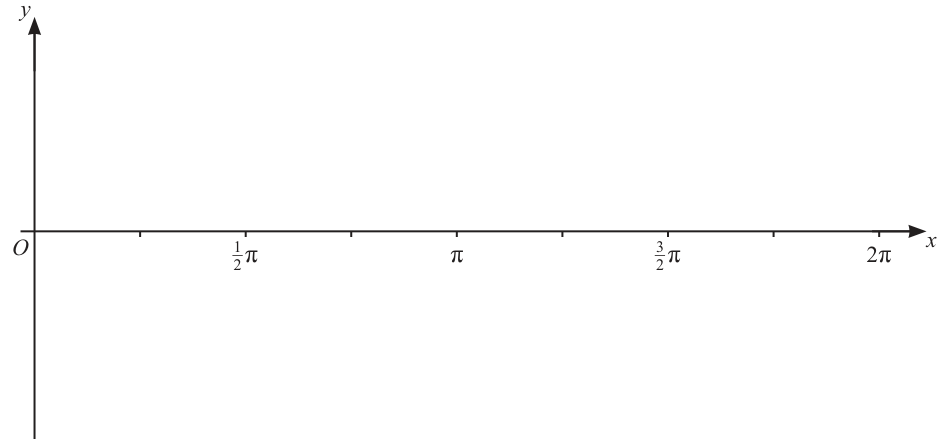
Sketch for . Determine the period, amplitude, and vertical shift, then plot key points at maxima, minima, and midline crossings over two complete cycles.
Working
Period: The basic cosine function has period . For , the period is . Over , there are complete cycles.
Amplitude and vertical shift: Amplitude , vertical shift . The curve oscillates between (minimum) and (maximum), with midline .
Key points:
The curve starts at , decreases to a minimum of at , rises to a maximum of at , decreases to a minimum of at , and rises back to at . The curve should be smooth and rounded at the extrema, starting and finishing with a horizontal tangent (level off).
Answer
A smooth cosine curve completing two full cycles from to , with minima at and , and midline crossings at .
Sketch showing two complete cycles of y = 4cos 2x + 3 from x = 0 to x = 2π, with maxima at y = 7 and minima at y = -1.
Walkthrough
To sketch , we first identify the transformation parameters:
- Amplitude: , so the curve extends units above and below the midline.
- Vertical shift: , so the midline is .
- Period: , meaning one complete cycle takes units of .
- Domain: , which contains exactly complete cycles.
Since this is a cosine function (not sine), it starts at its maximum value at . The key points within each cycle of length are:
- Maximum at the start: with .
- Midline crossing (decreasing): with .
- Minimum: with .
- Midline crossing (increasing): with .
Plot these points and join them with a smooth, rounded curve. The curve should start and finish with a horizontal tangent (level off) at and .
Key Takeaways
- For , the period is , amplitude is , and midline is .
- A cosine graph starts at a maximum (not a midline crossing like sine).
- Always check the domain to determine how many complete cycles are shown.
Common Mistakes
- Drawing only one cycle instead of two over .
- Starting the curve at a midline crossing instead of at the maximum.
- Using straight lines between key points instead of a smooth curve.
- Not letting the curve level off (become horizontal) at the endpoints and .
Things to Be Careful About
- The sketch should only show the curve for ; do not extend beyond this domain.
- The curve must be smooth and rounded at the maxima and minima, not angular.
- Incorrect -axis intercepts are condoned, but the overall shape and key -values must be correct.
Approach
The equation asks where the curve meets the straight line . Use the sketch from part (b) and evaluate the line at key -values to count intersections.
Working
The line has gradient and -intercept .
Evaluate the line at the key -values from the sketch:
Compare with the curve at these points:
The curve and line change relative position between consecutive key points:
- Between and : curve goes from above to below the line → 1 intersection.
- Between and : line goes from above to below the curve → 1 intersection.
- Between and : curve goes from above to below the line → 1 intersection.
- Between and : curve ( to ) is always below the line ( to ) since the curve's maximum → no intersection.
Answer
The number of solutions is .
3
Walkthrough
The equation can be interpreted as finding the -values where the curve (sketched in part b) intersects the straight line .
The line has gradient and passes through . At , the line reaches , which is well above the curve's maximum of .
By evaluating both functions at the key points :
- At : curve is at , line is at . Curve is above.
- At : curve is at , line is at . Line is above. → They must cross once in .
- At : curve is at , line is at . Curve is above. → They must cross once in .
- At : curve is at , line is at . Line is above. → They must cross once in .
- At : curve is at , line is at . Line is above. In the interval , the curve rises from to while the line rises from to . Since the curve's maximum value is less than the line's minimum value in this interval (), they never cross. → No intersection.
Total intersections: .
Key Takeaways
- Equations of the form can be solved graphically by finding intersections of and .
- When counting intersections, evaluate both functions at key points and use the intermediate value theorem to detect sign changes in .
- Always check whether the functions can actually cross in an interval by comparing their ranges.
Common Mistakes
- Assuming there is an intersection in every interval where the relative positions change, without verifying that the functions actually cross (e.g., in where the curve never reaches the line).
- Miscounting by not checking all intervals carefully.
- Forgetting that the line continues to rise and may exceed the curve's maximum value.
Things to Be Careful About
- The word 'hence' means you should use the sketch from part (b); do not solve the equation algebraically.
- Be careful in the last interval : even though the curve is rising, its maximum () is below the line's minimum value in that interval (), so there is no intersection.
- Only count intersections within the domain .
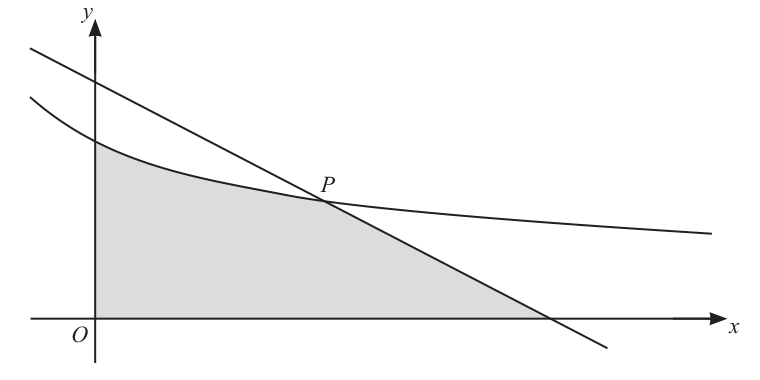
The diagram shows the curve with equation and the line . The line and the curve intersect at the point which has -coordinate 3.
Find the area of the shaded region.
Approach
The shaded region can be split into two parts:
- The area under the curve from to (the -coordinate of ).
- The triangular region between the line and the -axis from to (where the line meets the -axis).
We integrate the curve between and , then add the triangle area.
Working
Step 1: Find the -coordinate of .
lies on the line with :
So .
Step 2: Integrate the curve.
Step 3: Evaluate the definite integral from to .
At : .
At : .
So the area under the curve is:
Step 4: Area of the triangle.
The line meets the -axis when , i.e. at .
The triangle has vertices at , and , so its base is (along the -axis) and its height is :
Step 5: Total shaded area.
Answer
51/10
Walkthrough
The shaded region in the figure is bounded on the left by the -axis, above partly by the curve and partly by the line, and below by the -axis. A clean way to compute its area is to split it at the vertical line (which passes through ):
- From to : the upper boundary is the curve. We compute .
- From to : the upper boundary is the straight line (it touches the -axis at ). The region between the line and the -axis here is a right-angled triangle with vertices , and .
Finding . Since has -coordinate and lies on the line, gives , so . This tells us the upper limit of the curve's definite integral.
Integrating the curve. Rewrite as a function of the form with . Using for :
At the upper limit : .
At the lower limit : .
Subtracting gives the area under the curve as .
Triangle area. The line hits the -axis when , i.e. . The triangle has a horizontal base from to of length , and a vertical height equal to the -value of , which is . So its area is .
Combining. Total area . Using a common denominator of : .
Key Takeaways
- When a bounded region is partly under a curve and partly triangular, split it at a convenient vertical line and add the pieces.
- The standard formula (for ) handles fractional powers like cleanly.
- Always check where any straight-line boundary meets the -axis so you can identify triangles correctly.
- For areas described by a curve from to a vertical line, gives the area between the curve and the -axis directly.
Common Mistakes
- Forgetting to multiply the chain-rule constant: integrating gives , not . The factor of from the derivative of must be divided into the result.
- Using the wrong -coordinate to find the -coordinate of : the question states the -coordinate is , so substitute , not , into the line equation.
- Treating the entire shaded region as a single integral from to : the upper boundary changes at (curve to line), so a single integral would not give the correct area.
- Forgetting the in the triangle area formula.
Things to Be Careful About
- The integration is between and , not between and the -intercept of the curve (the curve is only used to here because is at ).
- The triangle is bounded by and , so its base is , not . Using would give a triangle twice as large.
- The answer is as an exact fraction — leave it in this form unless the question requests a decimal.
- Make sure the limits are substituted in the correct order: upper limit minus lower limit, not the other way around.
Approach
Start with the left side and rewrite as . Combine the fractions, then use to simplify the denominator.
Working
Combine the numerator and denominator:
Simplify the numerator:
Use :
Therefore:
Answer
The identity is proven.
The identity is proven.
Walkthrough
Start with the left-hand side and replace with in both the numerator and denominator. This creates a compound fraction. Write the numerator as a single fraction and the denominator as a single fraction. Dividing by the denominator fraction is the same as multiplying by its reciprocal, so one factor of cancels. The numerator becomes , and the denominator becomes . Finally, use to rewrite the denominator as , which matches the right-hand side.
Key Takeaways
This question tests the two fundamental trigonometric identities and . It also tests the algebraic skill of simplifying compound fractions. Recognising when to substitute and when to apply the Pythagorean identity is essential for proving trigonometric identities.
Common Mistakes
- Forgetting to combine the numerator and denominator before simplifying, which can prevent the cancellation of .
- Incorrectly simplifying ; the result is , not .
- Using the Pythagorean identity incorrectly, for example writing .
- Working on both sides simultaneously without reaching a common correct expression; the mark scheme only allows full marks if one side is transformed into the other.
Things to Be Careful About
- The proof can be done from left to right or right to left, but it is usually easier to start with the more complicated side.
- Keep brackets when substituting, to avoid sign errors.
- The mark scheme condones missing brackets if they are recovered, but it is safer to include them throughout.
Approach
Use the identity from part (a) to replace the left-hand fraction. Then cross-multiply and solve the resulting quadratic in . Finally, find the angles in .
Working
From part (a),
So the equation becomes:
Cross-multiply, noting that and :
Expand and rearrange:
Factorise:
Thus
For , gives an angle in the first quadrant:
For , the angle is in the second quadrant:
Answer
θ = 71.6° and θ = 128.7°
Walkthrough
The key is to use the identity from part (a) to replace the left-hand side by . The equation then becomes a rational equation in . Cross-multiply by and by ; this is valid for the solutions because the denominators are not zero there. Expanding gives a quadratic in . Factorise it to get or . Then solve each equation over . Since tangent is positive in the first quadrant, gives . Since tangent is negative in the second quadrant, gives .
Key Takeaways
This question combines a trigonometric identity with solving a quadratic. A trigonometric equation can be reduced to an algebraic equation by letting . It also reinforces the sign convention: tangent is positive in the first quadrant and negative in the second, so a negative tangent value in to gives a second-quadrant angle.
Common Mistakes
- Forgetting to use part (a) and trying to solve the original complicated fraction directly.
- Cross-multiplying incorrectly, for example writing incorrectly.
- Making sign errors when expanding the equation to form the quadratic.
- Factorising the quadratic incorrectly. The mark scheme condones errors made in forming the three-term quadratic, but not errors in solving it.
- Giving only the first-quadrant solution and missing the second-quadrant solution for the negative .
- Including solutions outside the range .
Things to Be Careful About
- would make undefined, so and are not solutions.
- The interval is , so only the first and second quadrants are used.
- The mark scheme accepts answers within of the correct values, so give and .
- Extra answers outside the range are ignored, but they should not be included in the final answer.
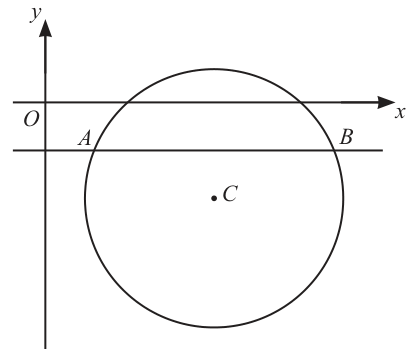
The diagram shows the circle with equation and the line . The line intersects the circle at the points and . The centre of the circle is .
Approach
Complete the square for the circle equation to find the centre and radius. Then substitute into the circle equation to find the -coordinates of the intersection points and .
Working
Finding the centre and radius:
The centre is and the radius is .
Finding points and :
Substitute into the original circle equation:
Factorise the quadratic:
So or . The points are and .
Answer
A = (2, -2), B = (12, -2), C = (7, -4)
Walkthrough
First, we rewrite the circle equation in standard form by completing the square for both and . This gives us the centre and radius . Next, to find where the line intersects the circle, we substitute into the original equation. This produces a quadratic in , which we solve by factorising to get and . These are the -coordinates of and .
Key Takeaways
Completing the square is essential for extracting the centre and radius from a general circle equation. Substituting a line equation into a circle equation is the standard algebraic method for finding intersection points.
Common Mistakes
- Forgetting to add the constant from completing the square to the right-hand side (e.g., writing instead of ).
- Sign errors when completing the square, such as writing instead of .
- Forgetting that both points have .
Things to Be Careful About
The mark scheme concedes and if seen together without parentheses, but full coordinate notation is preferred. Ensure the quadratic is correctly simplified before factorising.
Approach
Use the coordinates from part (a) to find the lengths of the sides of . Then use either the cosine rule or a half-angle right triangle to find .
Working
Side lengths:
Finding :
Let . Using the cosine rule in :
Alternative method using half-angle:
The perpendicular from to (which lies on ) meets at the midpoint . This splits into two right-angled triangles with opposite side and adjacent side .
Answer
2.38
Walkthrough
We first calculate the lengths of , , and using the distance formula. Since , the triangle is isosceles. We can apply the cosine rule with to solve for , giving . Taking the inverse cosine yields radians. Alternatively, dropping a perpendicular from to creates a right triangle with legs and , allowing us to use .
Key Takeaways
The cosine rule is a powerful tool for finding angles in triangles when all three side lengths are known. Recognising an isosceles triangle and using a half-angle right triangle can simplify the calculation.
Common Mistakes
- Using instead of in the cosine rule (the mark scheme awards 0 marks for this).
- Forgetting to double the half-angle if using the right-triangle method.
- Giving the answer in degrees () when radians are requested; this scores a maximum of 1/2.
Things to Be Careful About
The question asks for the answer in radians to 3 significant figures. Ensure your calculator is in radian mode. The mark scheme explicitly states to ignore the degree symbol if present, but the final numerical value must be correct for radians.
Approach
The chord divides the circle into two segments. The larger segment corresponds to the reflex angle at the centre. Its area is the area of the larger sector plus the area of . Alternatively, find the area of the smaller segment and subtract from the total circle area.
Working
Area of :
Base . The perpendicular height from to the line is .
Area of the larger sector:
The reflex angle is radians. The radius is .
Area of the larger segment:
Rounding to 3 significant figures:
Alternative method:
Answer
66.6
Walkthrough
The chord splits the circle into a smaller segment (containing the minor arc) and a larger segment (containing the major arc). The area of the larger segment is the area of the major sector (the sector with the reflex angle ) plus the area of . We already know rad and . The triangle area is easily found using base and height . Adding the sector area and the triangle area gives the final answer.
Key Takeaways
The area of a circular segment is found by combining sector and triangle areas. For the larger segment, you add the major sector area to the triangle area, or subtract the smaller segment area from the total circle area.
Common Mistakes
- Using the angle for the larger sector instead of the reflex angle .
- Forgetting to add the triangle area when calculating the larger segment (this gives the sector area, not the segment area).
- Awarding marks for sighted in earlier parts; it must be explicitly seen in part (c) to earn the mark.
Things to Be Careful About
The mark scheme requires the final answer to be given to an appropriate number of significant figures (3 s.f. gives ). Ensure you use the exact value of or at least 4 significant figures in intermediate steps to avoid rounding errors.
The equation of a curve is such that . It is given that the curve has a stationary point at .
Approach
We integrate with respect to to obtain , including a constant of integration. Since the curve has a stationary point at , the gradient is when ; this determines the constant.
Working
Integrate:
At the stationary point , :
So . Therefore:
Answer
dy/dx = 12/x^2 - 3
Walkthrough
We are given the second derivative . To go from a second derivative to a first derivative, integrate once. Rewriting as makes the power rule for integration clear: increase the power by 1 and divide by the new power, giving . The constant is unknown, so we use the fact that the curve has a stationary point at . At a stationary point the gradient is zero, so substituting into and setting it equal to 0 gives .
Key Takeaways
This question tests integration as reverse differentiation and the use of a boundary/initial condition to find a constant of integration. It also reinforces that stationary points have zero gradient.
Common Mistakes
- Forgetting the constant of integration .
- Making a sign error when integrating a negative power: integrates to , not .
- Substituting instead of using the gradient condition at .
Things to Be Careful About
The stationary point gives at , not . Simplify to before writing the final answer.
Find the -coordinate of the other stationary point of the curve, and determine the nature of this stationary point.
Approach
Stationary points occur where . We already know that gives one stationary point; solve to find the other. Then use at that point to decide whether it is a maximum or minimum.
Working
Set :
One stationary point is at , so the other is .
At :
Since , the stationary point at is a maximum.
Answer
; maximum
x = 2; maximum
Walkthrough
Stationary points are points where the gradient is zero. We set using the expression from part (a). Solving gives , so . Since the question says there is already a stationary point at , the other stationary point is . To determine its nature, substitute into the given second derivative . The value is , which is negative, so the stationary point is a maximum.
Key Takeaways
A stationary point satisfies . The sign of determines whether it is a maximum (negative) or minimum (positive).
Common Mistakes
- Forgetting that is already known and giving only as the answer.
- Using the second derivative at instead of at .
- Misreading the sign of and calling the point a minimum.
Things to Be Careful About
The question asks for the other stationary point, so the answer must be , not . The second derivative is negative at , so it is a maximum. The mark scheme allows other valid methods for determining nature, but the second-derivative test is the most direct.
Approach
Integrate to obtain , introducing a new constant of integration . Substitute the known point to find .
Working
Integrate:
Substitute and :
Therefore:
Answer
y = -12/x - 3x + 7
Walkthrough
We now integrate the first derivative to recover . The expression is rewritten as , which integrates to , or . The new constant is found by substituting the given point into this expression. This gives , so . The final curve equation is .
Key Takeaways
Each integration introduces a new constant. A point on the curve provides the condition needed to determine that constant. The final equation of a curve is obtained by integrating the gradient and using given coordinates.
Common Mistakes
- Forgetting the second constant of integration .
- Using the stationary point condition again instead of substituting the point into .
- Arithmetic errors when evaluating .
Things to Be Careful About
Use the point in the expression for , not in the derivative. Evaluate carefully: and , so the sum is . The final answer must include the constant .
Find the equation of the normal to the curve at the point where and is positive. Express your answer in the form , where , and are integers.
Approach
Set the derivative equal to and solve for the positive value of . Substitute this into the curve equation to find . The normal is perpendicular to the tangent, so its gradient is the negative reciprocal of . Use the point-gradient form and rearrange into .
Working
Set :
Since is positive, .
Find the corresponding -coordinate:
The tangent gradient is , so the normal gradient is:
Equation of the normal through :
Answer
4x - 9y - 88 = 0
Walkthrough
To find the required point, set the derivative equal to . Solving gives , so . Since the question specifies is positive, . Substitute into the curve equation to get . The gradient of the tangent at this point is , so the gradient of the normal is the negative reciprocal, . Using the point-gradient form with gives . Cross-multiply and rearrange: , so .
Key Takeaways
To find a normal, use the perpendicular gradient relationship: if the tangent gradient is , the normal gradient is . The equation of a line can be written from a point and gradient, then rearranged into the required form .
Common Mistakes
- Using as well as ; the question specifies is positive.
- Taking the normal gradient as instead of .
- Making a sign error when rearranging to .
Things to Be Careful About
The normal is perpendicular to the tangent, so its gradient is the negative reciprocal. When rearranging, keep all terms on one side to match . The mark scheme accepts other equivalent forms, but the requested integer form is .
The first, second and third terms of an arithmetic progression are , and respectively, where is a non-zero constant.
Approach
Use the fact that consecutive terms of an arithmetic progression have a common difference. Equate the difference between the second and first terms to the difference between the third and second terms, then solve the resulting quadratic equation.
Working
For an arithmetic progression, the common difference is constant, so
Rearrange:
Factorise:
Hence or . Since is given as non-zero,
Answer
k = 6
Walkthrough
In an arithmetic progression, consecutive terms differ by the same amount. The first three terms are , and , so the difference between the second and first terms must equal the difference between the third and second terms:
Add to both sides and subtract from both sides:
Factorise:
This gives or . The question states that is non-zero, so is not allowed. Therefore .
Key Takeaways
An arithmetic progression is identified by its constant common difference. When a quadratic arises from a context, check every solution against the conditions given in the question.
Common Mistakes
- Equating the terms themselves instead of the differences between consecutive terms.
- Making a sign error when rearranging .
- Forgetting that is stated to be non-zero and leaving as the answer.
The mark scheme allows the extra solution to be written down, but the final answer must be .
Things to Be Careful About
The condition is essential. Also, the method mark is awarded for forming an equation in only, so write the equality of the two common differences clearly.
Approach
Use the value to write the first term and common difference. Then substitute into the arithmetic series sum formula with .
Working
With , the first term is
The common difference is
Using the sum formula for :
Answer
S20 = 2760
Walkthrough
From part (a)(i), . The first term of the arithmetic progression is . The common difference is the difference between consecutive terms, for example . The sum of the first terms of an arithmetic progression is
Put , and :
Key Takeaways
The sum formula for an arithmetic progression needs the first term, the common difference and the number of terms. Here the first term is , not , and the common difference can be found from the terms once is known.
Common Mistakes
- Using instead of .
- Using in the factor outside the bracket instead of .
- Confusing the first term with rather than .
- Forgetting to multiply by after computing the bracket.
Things to Be Careful About
The formula uses inside the bracket, so for the multiplier of is , not . The method mark requires using their values of and in the correct sum formula.
The fourth and sixth terms of a geometric progression are 36 and 6 respectively. The common ratio of the progression is positive.
Find the sum to infinity of the progression. Give your answer in the form , where , and are integers.
Approach
Use the general term of a geometric progression, , to write equations for the fourth and sixth terms. Divide them to eliminate and find , then find and apply the sum to infinity formula.
Working
Let the first term be and the common ratio be .
Dividing the second equation by the first:
Since is positive,
Now find :
Since , the sum to infinity is
Rationalise the denominator:
Answer
S∞ = 1296/(√6 - 1)
Walkthrough
For a geometric progression with first term and common ratio , the th term is . The fourth term is and the sixth term is .
Dividing the sixth-term equation by the fourth-term equation eliminates :
Since the common ratio is positive, . Now use the fourth term to find :
Because , the sum to infinity exists and is
To write this in the required form, multiply numerator and denominator by :
So , and .
Key Takeaways
A geometric progression is described by its first term and common ratio. Dividing two term equations is a quick way to eliminate the first term. The sum to infinity formula is only valid when , and surd manipulation is often needed to present the answer in a required form.
Common Mistakes
- Using the wrong index for the fourth term, such as instead of .
- Taking even though the question says the common ratio is positive.
- Stopping at without rationalising into the required form.
- Forgetting to check that before using the sum to infinity formula.
Things to Be Careful About
The answer must be in the form with integers , and . Here is the number inside the square root, so , not . The mark scheme condones using when first finding , but the positive value must be used because the common ratio is stated to be positive.
Approach
Complete the square on the quadratic expression .
Working
So and .
Answer
a = 2, b = -2, expression (x+2)^2 - 2
Walkthrough
We have the quadratic . To complete the square we focus on the part: half of 4 is 2, so we write this part as , because and we must subtract the extra 4. Then we add the constant 2 that was already in the expression:
Thus and .
Key Takeaways
The technique of completing the square rewrites as . Here that gives , . Later parts reuse this completed-square form to find inverses, so having it exactly right matters.
Common Mistakes
- Forgetting to subtract after writing .
- Incorrectly keeping the constant: the answer is , not .
Things to Be Careful About
Both marks come directly from this result (B1 for each of and ). If you write something contradictory, the mark scheme prefers the completed-square expression, so give explicitly.
The functions and are defined as follows.
Approach
Write in its completed-square form, set , solve for in terms of , then use the domain to choose the correct sign of the square root.
From part (a),
Working
Set . Then
Taking square roots,
Because the domain of is , we have , so the negative root applies:
Hence, replacing with ,
Answer
f^-1(x) = -sqrt(x+2) - 2
Walkthrough
From part (a) we know for . To invert, write , so . Taking square roots of both sides gives two possibilities, or . The domain tells us , i.e. , which forces the negative branch. Hence . Finally we swap back to : .
The mark scheme allows interchanging and at any stage, so you could equally start with and solve for .
Key Takeaways
An inverse function swaps the roles of the input and output. The domain of decides which square-root branch is valid; with we need the negative root.
Common Mistakes
- Dropping the minus sign and writing — this ignores the domain restriction.
- Giving the answer as without replacing by ; the mark scheme does not condone as the final answer.
Things to Be Careful About
The final answer must be written as . Note also that the domain of is (so that ), which matches the range of .
Approach
Form the composite , write it in completed-square form, then invert by setting , solving for and choosing the negative root from the domain .
Working
First form :
Now set . Then
Since the relevant domain is , , so
Replacing with ,
Answer
(gf)^-1(x) = -sqrt(-x-2) - 2
Walkthrough
First compose: . Since , we feed the whole of in: . Using the completed-square form, , so
Quick check by expanding: , and . The two match.
Now invert. Set . Then
so
The relevant domain is still (inherited from ), so and we take the negative root: . Swapping back to :
An alternative is to use the rule . Here , so , the same result.
Key Takeaways
To invert a composite you can either form the composite first and then invert, or invert in reverse order. Both routes need the completed-square form and a correct choice of root sign.
Common Mistakes
- Using instead of — the mark scheme awards zero for , so the order of composition is crucial.
- Sign errors when simplifying: , with the minus distributed correctly through the brackets.
- Picking the positive root, which ignores the domain .
Things to Be Careful About
The final answer must be written as , not . The DM1 step in the mark scheme requires a completed-square form containing a term; an invalid intermediate such as earns no further marks. Note also that the domain of is .