Mathematics 9709/11 — May/June 2025
Cambridge AS Level · Pure Mathematics 1 · worked solutions for every part, with the mark scheme
Topics Quadratics · Trigonometry · Differentiation · Integration · Series · Coordinate Geometry · +2 more
Solve the equation for .
Approach
The equation contains in a denominator, so first multiply through by (with ) to obtain a quadratic in . Factorise the quadratic, solve for , then find every angle in the interval that gives those sine values.
Working
Since is defined, . Multiplying both sides by :
Rearrange:
Factorise:
Hence
For :
The other solution in the interval is
For :
The other solution in the interval is
Answer
-150°, -30°, 41.8°, 138.2°
Walkthrough
The equation has in a denominator, so cannot be zero. Multiplying every term by clears the fraction and gives a quadratic in :
Bring all terms to one side and factorise. The factorisation
gives two possible values for . For each value, use inverse sine to find the principal angle, then use the symmetry of the sine graph to find every angle in . For , the two angles are and ; for , they are and .
Key Takeaways
- A trigonometric equation can often be reduced to a quadratic by treating as the variable.
- Factorising a quadratic in gives candidate sine values; each sine value may give two angles within a interval.
- Use inverse sine for the principal value and the symmetry of the sine graph to find all solutions in the required interval.
Common Mistakes
- Multiplying by without noting that ; although no zero solution arises here, the division by zero must be acknowledged.
- Stopping at and only giving , forgetting .
- Giving angles outside the required interval, such as or .
- Mixing degrees and radians without converting; the question uses degrees, so answers should be in degrees.
Things to Be Careful About
- The interval is , not to , so negative angles must be included.
- For , the two solutions are and ; for , the two are and .
- The mark scheme allows answers within a tolerance (AWRT), so rounding to one decimal place is acceptable.
- If radians were used, the equivalent answers would be , , , ; but the question asks for degrees.
The equation of a curve is such that . The curve passes through the point .
Approach
The gradient of the tangent at is the value of when . Since the normal is perpendicular to the tangent, its gradient is the negative reciprocal of the tangent gradient.
Working
Substitute into the given derivative:
The gradient of the normal is therefore:
Answer
-1/90
Walkthrough
The derivative gives the gradient of the tangent to the curve at any point. At point , the -coordinate is , so substitute into the derivative. This gives the gradient of the tangent as . A normal is perpendicular to the tangent, so its gradient is the negative reciprocal, .
Key Takeaways
- The value of the derivative at a point is the gradient of the tangent there.
- If two lines are perpendicular, the product of their gradients is , so the normal gradient is the negative reciprocal of the tangent gradient.
Common Mistakes
- Using the tangent gradient as the normal gradient instead of taking the negative reciprocal.
- Substituting the -coordinate into the derivative; the derivative is evaluated using only.
- Arithmetic errors such as evaluating as instead of .
Things to Be Careful About
- The mark scheme requires substitution of into ; substituting the point into the equation of the curve is not enough unless it leads to .
- Keep the negative sign in ; the normal slopes in the opposite direction to the tangent.
Approach
Integrate the given derivative term by term to recover , then use the point to find the constant of integration.
Working
Integrate each term. For the first term, use the reverse chain rule:
For the second term:
Hence
Use and :
Therefore the equation of the curve is:
Answer
y = (1/2)(2x - 5)^4 - 6x^(3/2) + 2
Walkthrough
To recover the equation of the curve from its derivative, integrate with respect to . The first term is a composite power, so use the reverse chain rule: the derivative of is , so multiplying by gives . Hence its integral is . The second term is integrated by increasing the power by and dividing by the new power: . Add the constant of integration . Then substitute and into the integrated expression to find . The working gives , so the equation of the curve is .
Key Takeaways
- Integration is the reverse of differentiation, and every indefinite integral must include a constant of integration.
- A point on the curve provides the initial condition needed to determine that constant.
- Composite functions of the form are integrated by reversing the chain rule.
Common Mistakes
- Forgetting to add before using the point.
- Getting the coefficient wrong when integrating ; the factor from differentiating must be accounted for.
- Miscomputing : it equals , not .
- Not simplifying the fraction correctly.
Things to Be Careful About
- The mark scheme accepts unsimplified integrated expressions for the first two marks, but the final answer must be simplified and include the constant.
- Fractions must be simplified; for example should be written as .
- The final answer can be written as instead of and is still accepted.
The third term of a geometric progression is 18 and the sum of the first three terms is 26. It is given that the common ratio is negative.
Find the tenth term of the progression. Give your answer correct to 3 significant figures.
Approach
Let the first term be and the common ratio be . Use the third term and the sum of the first three terms to write two equations, eliminate , solve the resulting quadratic in , and select the negative root. Then compute the tenth term using .
Working
The third term is
The sum of the first three terms is
Since , this becomes
so . Substitute :
Multiply through by :
Factorise:
So or . Since the common ratio is negative, .
Now
The tenth term is
Correct to 3 significant figures:
Answer
-2.40
Walkthrough
Write the progression as . The third term is , and the sum of the first three terms is . Since , the sum equation becomes , so .
To remove , use from the third term. Substituting into gives
Multiplying by gives , or . Factorising,
so or . The question tells us the common ratio is negative, so .
Then . The th term of a GP is , so the tenth term is
which is to 3 significant figures.
Key Takeaways
- A geometric progression is fully described by its first term and common ratio .
- The third term is , and the sum of the first three terms is .
- Eliminating one variable from two equations can reduce the problem to a quadratic.
- The sign of the common ratio is essential when choosing between two possible roots.
Common Mistakes
- Using instead of for the tenth term: the th term is .
- Choosing and ignoring the condition that the common ratio is negative.
- Sign errors when rearranging ; the correct quadratic is .
- Not rounding the final answer to 3 significant figures.
Things to Be Careful About
- The tenth term is negative because is negative and the exponent is odd.
- The exact value is also accepted as .
- The final answer should be written as to show 3 significant figures, not .
Approach
Since , the sum to infinity exists. Use the formula with the values found in part (a).
Working
With and :
Simplify:
Answer
128/7
Walkthrough
The sum to infinity of a geometric progression exists only when . Here , so and the formula applies. Using and in :
This is the exact value; no decimal approximation is required.
Key Takeaways
- The sum to infinity formula is and is valid only when .
- A negative common ratio still gives a finite sum if its absolute value is less than 1.
- Exact answers should be left as fractions when the question asks for the exact value.
Common Mistakes
- Using in the denominator instead of .
- Forgetting to check the convergence condition .
- Giving a decimal approximation such as instead of the exact fraction .
Things to Be Careful About
- The mark scheme follows through on the values of and from part (a), provided .
- Since the question asks for the exact value, leave the answer as .
- The denominator is ; because is negative, .
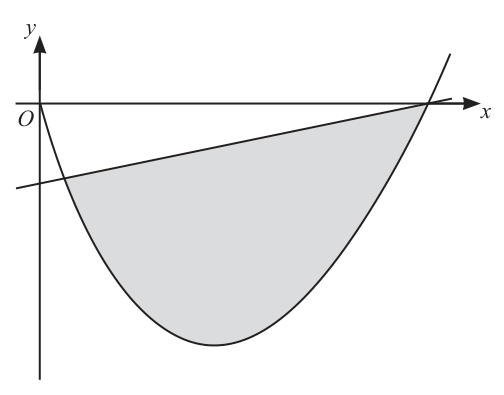
The diagram shows the curve with equation and the line with equation . The -coordinates of the points of intersection of the curve and line are 1 and 16.
Find the area of the shaded region between the curve and the line.
Approach
The area between two curves and from to , where on , is given by:
From the diagram , the line lies above the curve between the intersection points and . We integrate the difference (line curve) with respect to .
Working
Set up the integral for the shaded area :
Simplify the integrand:
Now integrate each term:
Evaluate at the upper limit :
Evaluate at the lower limit :
Calculate the area:
Alternatively, as a fraction:
Answer
391.5
Walkthrough
The problem asks for the area of the shaded region bounded by the curve and the line . The -coordinates of the intersection points are given as and .
-
Identify the upper and lower functions: Looking at the diagram , the straight line is above the curve in the shaded region. We can verify this by testing a point between and , for example . For the line, . For the curve, . Since , the line is indeed the upper function and the curve is the lower function .
-
Set up the definite integral: The area is given by . Substituting the expressions:
-
Simplify the integrand: Combine like terms:
-
Find the antiderivative: Use the power rule for integration :
- For : add 1 to the power to get , divide by (which is multiplying by ). So, .
- For : becomes .
- For : becomes .
The antiderivative is .
-
Apply the limits: Evaluate the antiderivative at and and subtract (Fundamental Theorem of Calculus):
- At : . Note that . So, .
- At : .
- Area .
Key Takeaways
- Area between curves: Always integrate (upper curve lower curve). The diagram is essential to determine which function is on top.
- Fractional powers: Remember the power rule works for fractional as well. For , the next power is , and dividing by is multiplying by .
- Evaluation: Be careful with arithmetic when evaluating large powers like . Break it down as .
Common Mistakes
- Wrong order of subtraction: Integrating (curve line) instead of (line curve) will give a negative area (). The area must be positive.
- Integration errors with fractional powers: Forgetting to divide by the new power (e.g., integrating as instead of ).
- Arithmetic errors: Calculating incorrectly or making sign errors when subtracting the lower limit value (especially since the lower limit value is negative, , so subtracting it adds ).
Things to Be Careful About
- Domain: The function requires . The limits and are both positive, so this is fine.
- Mark scheme allowance: The mark scheme allows for calculating the area as . Both methods yield the same result. Ensure signs are handled correctly when subtracting the second integral.
- Final Answer: The answer or is required. CAO (Correct Answer Only) is noted in the mark scheme, so showing correct working is vital to reach this final value.
Find the first three terms, in ascending powers of , in the expansion of each of the following expressions.
Approach
Use the binomial theorem to expand , keeping only the terms up to .
Working
Answer
The first three terms are .
32 - 80px + 80p^2x^2
Walkthrough
Use the binomial theorem to expand . The first three terms require the constant term, the term, and the term. With , the binomial coefficients for these terms are , , and . Substitute and into the binomial expansion, then simplify each term. Higher powers of are ignored.
Key Takeaways
This question tests the binomial theorem for a positive integer power. The key skill is applying the correct binomial coefficients and handling a negative term inside the bracket.
Common Mistakes
- Forgetting the binomial coefficients, such as writing without the and .
- Sign errors because the second term is .
- Including terms beyond when only the first three terms are required.
Things to Be Careful About
- The terms must be written in ascending powers of : constant, , .
- The mark scheme awards B1 for any two correct terms, but full marks require all three.
- Higher powers of should be ignored; they do not affect the answer.
Approach
Use the binomial theorem to expand , keeping only the terms up to .
Working
Answer
The first three terms are .
1 - 2x + 3/2 x^2
Walkthrough
Use the binomial expansion for . The binomial coefficients for are , , and for the first three terms. Substitute and , then simplify. The term is . The term is .
Key Takeaways
This question reinforces the binomial theorem with a fractional coefficient. It is important to square the fraction correctly when finding the term.
Common Mistakes
- Squaring incorrectly; it should give , not .
- Forgetting the binomial coefficient for the term.
- Writing the term as instead of .
Things to Be Careful About
- The term is positive because a negative term is squared.
- Keep fractions simplified: .
- Only the first three terms are needed; ignore higher powers of .
Given that the coefficient of in the expansion of is 93, find the possible values of the constant .
Approach
Use the first three terms from part (a) for each expansion. Multiply the two expansions and collect the coefficient of . Set this coefficient equal to 93 and solve the resulting quadratic for .
Working
The two expansions are:
The coefficient of in the product comes from three contributions:
- constant term from first term from second:
- term from first term from second:
- term from first constant term from second:
The coefficient of is
Set it equal to 93:
Factorise:
So
p = -9/4 and p = 1/4
Walkthrough
From part (a), we have the expansions up to . To find the coefficient of in the product, multiply the two expansions and collect all terms that produce : constant , , and constant. Add these three contributions to get . Set this equal to 93, simplify to , and factorise to obtain . Hence or .
Key Takeaways
This question combines binomial expansion with solving a quadratic. It tests careful multiplication of expansions and the ability to collect coefficients accurately.
Common Mistakes
- Omitting the cross term , which gives .
- Sign errors when multiplying negative terms.
- Forgetting to subtract 93 before factorising.
- Not showing the factorisation or quadratic formula, which is required for full marks.
Things to Be Careful About
- The coefficient of has three contributions; all must be included.
- After setting the coefficient equal to 93, rearrange to before factorising.
- The factorisation gives two possible values of ; both are valid since the question asks for possible values.
The equation of a curve is and the equation of a line is , where and are constants.
Given that and , find the coordinates of the points of intersection of the curve and the line.
Approach
Substitute the given values of and into the equation of the curve, replacing by the line equation. This eliminates and gives a quadratic equation in , which we solve by factorisation. Each -value is then substituted back into the line equation to find the corresponding -coordinate.
Working
With and , the line is . Substituting into the curve :
Expand the bracket:
Multiplying by gives
or, dividing by ,
Factorise:
Hence
Now substitute each value into .
For :
For :
Answer
The points of intersection are and .
(-1/2, -5/2) and (1/5, 26/5)
Walkthrough
We are told the curve is and the line is . In part (a), the constants are fixed as and . To find where they meet, we substitute the line's expression for into the curve, because any point of intersection must satisfy both equations simultaneously. This turns the two equations into a single quadratic in .
After substituting, expanding and simplifying gives a quadratic equation. We factorise it to find the two -values, then use the line equation to get the associated -values. The coordinates are then the two pairs found.
Key Takeaways
- The intersection of a line and a curve is found by eliminating one variable, usually by substituting the line into the curve.
- Solving the resulting quadratic gives the -coordinates of the intersections.
- Once is known, the line equation is the easiest way to find .
- This is an example of a simultaneous equation with one linear and one quadratic equation.
Common Mistakes
- Forgetting to multiply the term by the coefficient , leading to .
- Sign errors when expanding .
- Finding the -values but not substituting back to find , so losing the coordinate answer.
- Not simplifying fractions such as (though here it is already simplified); the mark scheme requires simplified fractions.
Things to Be Careful About
- Keep the algebra balanced: every transformation must preserve the equation.
- Check that both -values correspond to points on the line; substitutions can be verified in the original curve.
- The final coordinates should be written clearly: and .
- The mark scheme awards A1 for either both -values or both coordinates of one point, but a complete solution should give all four coordinates.
Given instead that , find the set of values of for which the curve and the line do not intersect.
Approach
Substitute into the curve, keeping as an unknown constant. This produces a quadratic equation in . The line and curve do not intersect exactly when this quadratic has no real roots, so its discriminant must be negative. Set up the discriminant inequality in , simplify, factorise and solve for the required range.
Working
The line is . Substituting into :
Expanding:
Group the -terms:
For no intersection, this quadratic in must have no real roots, so its discriminant must be negative. Here
Thus
We need
Factorise the quadratic:
The critical values are and . Since the coefficient of is positive, the quadratic expression is negative between its two roots:
Answer
For , the curve and line do not intersect when .
-4 < k < 4/9
Walkthrough
We now keep unknown and set . Substituting into the curve gives a quadratic in whose coefficients depend on . A quadratic equation has no real roots when . Intuitively, if there is no real satisfying the substituted equation, the line never meets the curve.
We identify , and , compute the discriminant, and require it to be negative. This gives a quadratic inequality in . After simplifying and factorising, we find the roots and . Because the graph of is a U-shaped parabola, it is negative between the roots. Hence the answer is .
Key Takeaways
- Solving simultaneous equations by substitution can lead to a quadratic with parameters.
- The discriminant determines the number of intersections: negative discriminant means no real intersections.
- A quadratic inequality is solved by factorising and using the sign of the parabola.
- The parameter values make the question harder, but the principle is the same as a numerical case.
Common Mistakes
- Omitting the coefficient when computing ; the mark scheme specifically requires the term to have two components.
- Forgetting the sign of the discriminant: for no intersection it is , not or .
- Solving incorrectly or failing to factorise.
- Giving or by choosing the wrong region of the quadratic inequality.
- The mark scheme has a special case (SC B1) if no method is shown for solving the quadratic; always show the factorisation.
Things to Be Careful About
- If , the quadratic would become linear, but this value is not in the final interval, so it does not cause an issue here.
- The mark scheme says A0 if the correct answer follows an incorrect quadratic, so make sure the quadratic is correct before using the discriminant.
- Check the inequality direction: the leading coefficient of the quadratic in is positive, so the expression is negative between the roots.
- Use interval notation or inequality notation consistently; the mark scheme accepts and allows other correct notation.
The equation of a curve is .
A point is moving along the curve in such a way that its -coordinate is decreasing at 5 units per second.
Find the rate at which the -coordinate of point is changing when .
Approach
Differentiate with respect to , evaluate at , then use the chain rule to connect the given rate to the required rate .
Working
Differentiate:
At :
The -coordinate is decreasing at 5 units per second, so . Using the chain rule:
Answer
The -coordinate is changing at units per second, so it is decreasing at units per second.
dx/dt = -4/11 units per second (decreasing at 4/11 units per second)
Walkthrough
We are told the -coordinate is decreasing at 5 units per second. Decreasing means the rate is negative, so . The curve gives in terms of , so to connect and we differentiate with respect to first.
Rewrite as so the power rule applies cleanly: and . Therefore .
At , substitute: . This is the slope of the curve at that point.
The chain rule says . Substitute the known values: . Dividing by gives . The negative sign means the -coordinate is also decreasing, at units per second.
Key Takeaways
This problem combines differentiation with the chain rule for related rates. The sign of a rate matters: decreasing means negative. It also shows the importance of rewriting negative powers before differentiating.
Common Mistakes
- Using instead of .
- Forgetting to take the reciprocal when solving .
- Differentiating incorrectly, e.g. writing instead of .
- Giving as the final answer instead of .
Things to Be Careful About
The mark scheme awards the derivative B1 even if unsimplified. Evaluating at gains M1. The chain rule step with and their gains M1. The final answer must be or "decreasing at units per second"; is also accepted. Always include the negative sign or state decreasing.
Approach
Set to find the -coordinates of stationary points, substitute to find , then use the second derivative to determine their nature.
Working
From part (a),
Set it equal to zero:
For both values, , so:
Now find the second derivative:
At the stationary points, , so:
Since the second derivative is positive at both stationary points, both are minima.
Answer
The stationary points are and , and both are minima.
(sqrt(3/2), 4) and (-sqrt(3/2), 4); both minima
Walkthrough
Stationary points occur where the gradient is zero, so start from and set it equal to zero.
Solve . Multiply through by : , so . Taking the fourth root gives two real values, , because the fourth root of a positive number has both a positive and a negative value. These are also .
To find , notice for both values. Substitute: . So both stationary points have the same -coordinate, .
To determine nature, differentiate : . At the stationary points, , so , which is positive. A positive second derivative means the curve is locally concave up, so both points are minima.
Key Takeaways
Stationary points are found by solving . Solving an equation of the form gives both positive and negative roots. The second derivative test uses the sign of : positive means minimum, negative means maximum.
Common Mistakes
- Forgetting the when taking the fourth root, giving only one stationary point.
- Substituting instead of when finding , or making an arithmetic slip with .
- Differentiating incorrectly, especially the sign of the term.
- Concluding maximum instead of minimum because of a sign error in the second derivative.
Things to Be Careful About
is not in the domain of the curve, so multiplying by does not introduce an extra solution. Since is positive, the second derivative is positive at both stationary points, so both are minima. The mark scheme accepts or , and for both. For the second derivative, at least one correct term is needed for M1; the final nature mark is awarded for both minima.
The circle with equation intersects the line at the points and .
Find the area of the triangle formed by the tangents to the circle at and , and the line .
Approach
Complete the square to find the centre of the circle. Substitute the line to find the points and . Since each tangent is perpendicular to its radius, use the gradients of the radii to write the tangent equations. Find where the two tangents meet; then take as the base and the horizontal distance from the third vertex to as the height.
Working
Centre of the circle. Rewrite the circle equation:
Complete the square:
So the centre is .
Intersection points with . Substitute :
Hence and . Taking and :
Tangent at . The gradient of radius is
so the tangent gradient is the negative reciprocal, :
Tangent at . The gradient of radius is
so the tangent gradient is :
Intersection of the two tangents. Equate the two expressions for :
The horizontal distance from this point to the line is
Area of the triangle.
Answer
216/5 or 43.2
Walkthrough
Start by putting the circle equation into centre-radius form. Completing the square on and shows the centre is and the radius is . This centre is essential because every tangent is perpendicular to the radius drawn to its point of contact.
Next, the line cuts the circle where its -coordinates satisfy the quadratic obtained by substituting into the circle equation. The quadratic factors cleanly, giving and , so the two points are and . Their vertical separation is the base of the required triangle, .
For the tangent at , compute the gradient of the radius joining the centre to . It is . A tangent is perpendicular to the radius, so its gradient is the negative reciprocal, . Using the point-slope form gives the tangent equation. The same process at gives a radius gradient of and therefore a tangent gradient of .
The two tangent lines form the two slanted sides of the triangle. Their intersection is the third vertex. Solving the two tangent equations together gives , and substituting back gives , so the third vertex lies on the horizontal line through the centre. The height of the triangle is the perpendicular distance from this vertex to the base line , which is . Finally, use : .
Key Takeaways
This question brings together several coordinate geometry ideas: completing the square to read the centre of a circle, intersecting an algebraic curve with a line, using the perpendicular relationship between a radius and a tangent, writing straight-line equations in point-slope form, and computing the area of a triangle from its base and perpendicular height.
When a line is vertical, the perpendicular distance from a point to the line is simply the horizontal difference between the -coordinates. Recognising that lies on the vertical line makes the base and height easy to identify.
Common Mistakes
The mark scheme requires the centre to be seen or implied; forgetting to complete the square correctly gives the wrong centre and wrong tangent gradients. It also requires the quadratic from substituting to be formed; leaving it unsimplified can hide the factorisation and lose the method mark. Students often use the gradient of the tangent itself as the radius gradient, so be careful to take the negative reciprocal. A common error is to use the intersection distance to the wrong vertical line or to treat the horizontal distance as the height. The mark scheme condones using only in the area formula with an accompanying error, but the correct perpendicular height is .
Things to Be Careful About
When substituting , every term must be evaluated carefully: and . The centre comes from completing the square with constants and ; the radius is , although it is not needed for the area. The tangent at and the tangent at have opposite gradients, so their equations are symmetric in structure. Check that the intersection point is to the left of : is less than , so the height is not . Finally, give the area either as a fraction or a decimal; the mark scheme accepts or .
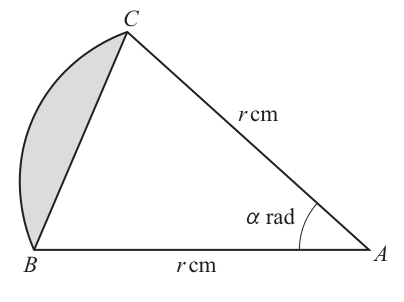
The diagram shows a sector of a circle with centre and radius cm. The angle is radians, where .
It is given that the area of the triangle is and the area of the sector is .
Find the exact area of the shaded segment.
Approach
Use the formula for the area of a sector, , to find . Then use the formula for the area of a triangle, , to find . The shaded segment area is the sector area minus the triangle area.
Working
Step 1: Find using the sector area.
The area of sector is given as cm. Using the sector area formula:
Since , divide both sides by :
Step 2: Find using the triangle area.
The area of triangle is given as cm. Using the triangle area formula with two sides and the included angle:
Substitute :
Since :
Step 3: Calculate the area of the shaded segment.
The shaded segment is the region between the chord and the arc . Its area equals the sector area minus the triangle area:
Answer
(4π/3 - 4) cm²
Walkthrough
Step 1: The sector area formula is . We are told this equals . Since is positive (given ), we can safely divide both sides by , leaving , which gives .
Step 2: The triangle area formula with two sides and the included angle is . Here both sides are and the included angle is , so the area is . Setting this equal to gives . The only solution in is .
Step 3: The shaded segment is the part of the sector that lies outside the triangle. So we subtract: sector area , minus triangle area , giving .
Key Takeaways
- The sector area formula can be used to find the radius when the area is given in terms of .
- The triangle area formula links the radius, angle, and area of a triangle formed by two radii and a chord.
- The area of a circular segment equals the sector area minus the triangle area.
Common Mistakes
- Forgetting to divide by and trying to solve as a quadratic in with still present.
- Using the wrong triangle area formula (e.g., without finding the height first).
- Not simplifying the fraction to .
- Subtracting in the wrong order (triangle minus sector instead of sector minus triangle), which would give a negative answer.
Things to Be Careful About
- The constraint ensures has only one solution: . Without this constraint, would also be valid.
- The answer must be exact, so leave in the answer rather than computing a decimal.
- The fraction can also be written as , which is an equivalent form.
It is given instead that the length of the chord is but the area of the triangle is still .
Find the area of the shaded segment. Give your answer correct to 3 significant figures.
Approach
Use the cosine rule in triangle to find from the given chord length. Then find and use the triangle area formula to find . Finally, compute the segment area as sector area minus triangle area.
Working
Step 1: Find using the cosine rule.
In triangle , the sides are , , and . Applying the cosine rule:
Divide through by (since ):
Step 2: Find .
(This is approximately .)
Step 3: Find using the triangle area.
The area of triangle is cm. Using the formula:
First find . Since and :
Substitute:
Step 4: Calculate the area of the shaded segment.
Answer
0.371 cm²
Walkthrough
Step 1: The cosine rule states . Here, the side opposite angle is the chord , and the two adjacent sides are both . Substituting gives . Dividing by and rearranging yields .
Step 2: Since , we can find rad. We keep extra digits during intermediate calculations to avoid rounding errors.
Step 3: The triangle area is . We compute . Then gives , so .
Step 4: The segment area is sector area minus triangle area: cm.
Key Takeaways
- The cosine rule can be applied to a triangle formed by two radii and a chord to relate the chord length to the central angle.
- When is known, can be found using .
- The segment area is always sector area minus triangle area, regardless of whether values are exact or approximate.
- Carrying extra digits in intermediate steps is essential when the final answer must be given to a specific number of significant figures.
Common Mistakes
- Using or from part (a) — these values do not apply here since the conditions are different.
- Forgetting to square correctly: , not or .
- Rounding or too early, which can lead to an incorrect final answer.
- Using degrees instead of radians in the sector area formula — the angle must be in radians.
Things to Be Careful About
- The sector area formula requires in radians. If you compute in degrees (), you must convert: .
- The answer is required to 3 significant figures, so is correct. Do not write or .
- The triangle area is still cm as stated in the question, so you do not need to recalculate it — it is given directly.
The functions and are defined by
Describe fully a sequence of transformations which transforms the graph of to the graph of . You should make clear the order in which the transformations are applied.
Approach
We compare the definitions of and to identify the transformations. Starting from , we build up to step by step.
Working
The function can be written in terms of as:
This expression tells us the sequence of transformations:
-
Vertical stretch: The factor of multiplying the function indicates a stretch by scale factor parallel to the -axis (or in the -direction). Applying this to gives .
-
Translation: The terms inside the function and outside indicate a translation. The shifts the graph units to the left, and the shifts it units down. This corresponds to a translation vector of .
Applying the translation after the stretch:
Alternative sequence:
- Translation by :
- Vertical stretch by scale factor :
Both sequences are valid as long as the order is consistent with the algebra.
Answer
A stretch by scale factor parallel to the -axis, followed by a translation by .
Stretch by scale factor 3 parallel to the y-axis, then translation by (-2, -5)
Walkthrough
To find the transformations, we express in terms of . Since , we see that .
The algebraic form reveals two operations:
- The multiplication by outside the function is a vertical stretch with scale factor .
- The inside the argument is a horizontal shift left by , and the outside is a vertical shift down by . Together, this is a translation by the vector .
Order matters: if we translate first by , we get . Stretching this vertically by gives , which is incorrect. Therefore, the stretch must come first, or the translation must be adjusted to if applied before the stretch.
Key Takeaways
- Transformations applied outside the function (multiplication/addition) affect the -coordinates (vertical stretch/shift).
- Transformations applied inside the function (addition/subtraction to ) affect the -coordinates (horizontal shift).
- The order of transformations matters; a vertical stretch after a vertical translation will scale the translation distance as well.
Common Mistakes
- Applying the translation before the stretch without adjusting the vertical component of the translation vector.
- Confusing the direction of horizontal shifts (e.g., thinking means a shift right by ).
Things to Be Careful About
- Always check the order: if a vertical stretch is applied after a vertical translation, the translation amount is also stretched. The mark scheme accepts either order as long as the translation vector is adjusted accordingly.
- Specify the direction of the stretch clearly (e.g., "parallel to the -axis" or "vertically").
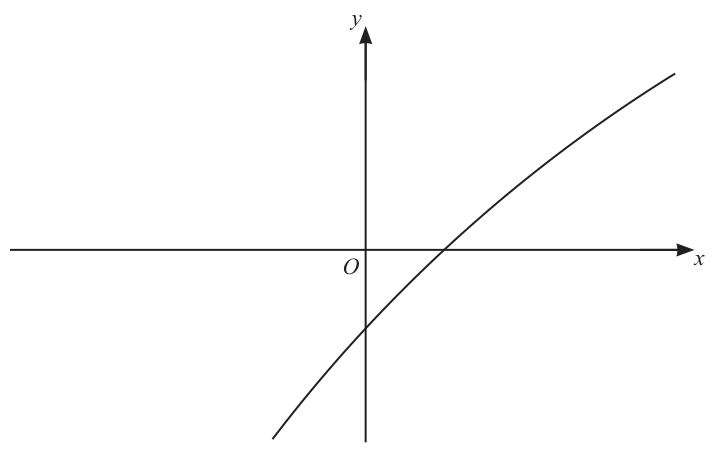
The diagram shows the graph of .
On the diagram sketch the graph of together with any relevant mirror line.
Approach
The graph of is the reflection of the graph of in the line . We identify key points on and reflect them to sketch .
Working
The graph of has its starting point (endpoint) at :
So the graph starts at . It passes through other points such as and .
To sketch :
- Draw the mirror line , which is a straight line through the origin at .
- Reflect the starting point across to get . This is the starting point of .
- Reflect to get , and to get .
- Draw a smooth curve through these reflected points. The curve should be increasing and concave down (like a sideways square root), starting at and passing through the first quadrant.
Answer
Sketch showing as the reflection of in the line , starting at and not passing through the origin.
Sketch of y = g^{-1}(x) reflected in y = x, starting at (-5, -2)
Walkthrough
The fundamental property of inverse functions is that their graphs are mirror images of each other across the line . This is because if is on the graph of , then must be on the graph of .
We identify the endpoint of : since the domain is , the minimum -value is , giving . The point reflects to , which is the starting point of .
We also note that passes through because . This reflects to on .
The curve is a reflection of , so it will have the same general shape but oriented differently. Since is a square root curve opening to the right, will be a square root curve opening upwards.
Key Takeaways
- The graph of is always the reflection of in the line .
- The domain of becomes the range of , and the range of becomes the domain of .
- When sketching, reflect key points (endpoints, intercepts) across to guide the curve.
Common Mistakes
- Drawing the inverse curve passing through the origin , which is incorrect since .
- Forgetting to draw the mirror line .
- Drawing the inverse curve with the wrong shape (e.g., making it concave up instead of concave down).
Things to Be Careful About
- The sketch must be in the correct quadrants. Since starts in the third quadrant and goes into the first, starts in the second quadrant (at ) and goes into the first.
- The curve must not come back on itself; it must be a function (pass the vertical line test).
- No label is needed on the sketch, but the line should be clearly drawn.
Approach
To find , we set , swap and , and solve for .
Working
Let .
Isolate the square root term:
Square both sides to eliminate the square root:
Solve for :
Now swap and to express the inverse function:
Therefore:
Answer
g^{-1}(x) = ((x + 5)/3)^2 - 2
Walkthrough
Finding the inverse function involves algebraic manipulation to express in terms of , then swapping the variables.
Start with . The goal is to isolate .
- Add to both sides: .
- Divide by : .
- Square both sides: . Note that squaring is valid here because the original function has range , so , meaning the square root is non-negative and squaring does not introduce extraneous solutions in this context.
- Subtract : .
Finally, replace with and with to write the inverse function in standard form: .
Key Takeaways
- To find an inverse, set , solve for in terms of , then swap and .
- Always check that the original function is one-one (or restrict the domain) before finding an inverse.
- When squaring both sides, be aware of domain restrictions that may eliminate extraneous solutions.
Common Mistakes
- Forgetting to swap and at the end, leaving the answer as .
- Writing the answer as without explicitly stating .
- Algebraic errors when isolating the square root or squaring both sides.
Things to Be Careful About
- The final expression must be in terms of , not .
- The mark scheme requires the answer in the form , not .
- Although not required here, the domain of is (the range of ), and the range is (the domain of ).
Approach
The range of is equal to the domain of .
Working
From the definition of :
The domain of is .
Therefore, the range of is:
This can also be written as .
Answer
y >= -2
Walkthrough
A fundamental property of inverse functions is that the domain and range are swapped. If , then . This means:
- Domain of = Range of
- Range of = Domain of
Here, is defined for , so the domain of is . Therefore, the range of is , or .
We can verify this using the expression for found in part (c):
Since for all real , the minimum value of is . Thus, , confirming the range is .
Key Takeaways
- The range of an inverse function is always the domain of the original function.
- This is a quick way to find the range of an inverse without analyzing the inverse expression.
Common Mistakes
- Confusing domain and range (e.g., stating the range is instead of ).
- Using strict inequality instead of .
Things to Be Careful About
- Use or interval notation , not .
- The mark scheme accepts various notations including , but must include with a non-strict inequality.
Approach
To find , we evaluate the inner function first, then substitute the result into .
Working
The function is defined by:
Evaluate :
Now find using the expression from part (c):
Substitute :
Answer
31/9
Walkthrough
Composite functions are evaluated from the inside out. For , this means we first compute , then use that result as the input to .
Step 1: Evaluate .
Since for , and is in the domain:
.
Step 2: Evaluate .
Using the inverse function formula from part (c): .
Substitute : .
We can also verify that is in the domain of . The domain of is the range of , which is . Since , this is valid.
Key Takeaways
- Composite function notation means , evaluated from right to left (inside out).
- Always check that the output of the inner function is within the domain of the outer function.
Common Mistakes
- Evaluating first instead of .
- Algebraic errors when substituting into the inverse function formula, especially with fractions and squares.
- Forgetting to subtract at the end.
Things to Be Careful About
- The notation means , not .
- Ensure the value is within the domain of (which is ). It is, so the composition is valid.
- The final answer can be given as a fraction or as a decimal (to 3 significant figures), but exact form is preferred.
Approach
For the composite function to be formed, the range of must be a subset of the domain of .
Working
The function is defined by:
The domain of is .
From part (d), the range of is .
For to be defined, every value in the range of must be a valid input for . However, the range of includes values such as , which are not in the domain of (since requires ).
Specifically, values in are in the range of but not in the domain of .
Therefore, the composite function cannot be formed because the range of is not entirely within the domain of .
Answer
The range of is , which is not within the domain of (). Therefore, cannot be formed.
The range of g^{-1} (y >= -2) is not within the domain of h (x >= 0)
Walkthrough
A composite function can only be formed if the range of is a subset of the domain of . In other words, every output produced by must be a valid input for .
Here, we are considering :
- The inner function is , with range (from part d).
- The outer function is , with domain .
For to be valid, we need: range of domain of .
Is a subset of ? No, because values like are in the range of but are not valid inputs for (since only accepts ).
Since there are values in the range of that fall outside the domain of , the composite function cannot be formed for all in the domain of . Therefore, it is undefined as a complete function.
Key Takeaways
- For to be formed, the range of must be within the domain of .
- Always check domain and range conditions when dealing with composite functions involving inverses.
Common Mistakes
- Stating that the domain of is not within the domain of (confusing domain with range).
- Saying "the domains don't match" without specifying the correct relationship (range of inner vs. domain of outer).
Things to Be Careful About
- The key phrase is: "the range of is not within the domain of ".
- Be precise: it's not that they are completely disjoint (they overlap for ), but that the range of extends outside the domain of (for ).
- The mark scheme accepts "the range of is not within the domain of " as a minimum acceptable explanation.