Mathematics 9709/42 — February/March 2025
Cambridge AS Level · Mechanics · worked solutions for every part, with the mark scheme
Topics Kinematics of Motion in a Straight Line · Forces and Equilibrium · Newton's Laws of Motion · Energy, Work and Power · Momentum
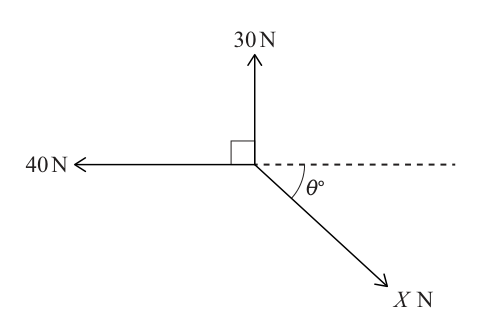
Three coplanar forces of magnitudes , and act at a point in the directions shown in the diagram.
Given that the forces are in equilibrium, find the values of and .
Approach
Since the three forces are in equilibrium, the vector sum of all forces is zero. This means the sum of horizontal components is zero and the sum of vertical components is zero. We resolve the forces horizontally and vertically to form two equations.
Working
Resolve horizontally (taking right as positive):
Resolve vertically (taking upwards as positive):
To find , square both equations and add them:
To find , divide the vertical equation by the horizontal equation:
Answer
X = 50, theta = 36.9
Walkthrough
The problem states that three forces act at a point and are in equilibrium. Equilibrium means that the net force is zero, so the forces must balance out in every direction. We choose two perpendicular directions, horizontal and vertical, and resolve each force into components along these axes.
- Horizontal resolution: The 40 N force acts to the left. The force has a horizontal component acting to the right. For equilibrium, these must be equal: .
- Vertical resolution: The 30 N force acts upwards. The force has a vertical component acting downwards. For equilibrium, these must be equal: .
- Finding X: We have a system of two equations. By squaring both and adding them, we use the identity to eliminate and solve for . This gives .
- Finding theta: By dividing the vertical equation by the horizontal equation, we eliminate and get . Taking the inverse tangent gives .
Key Takeaways
- When a system of forces is in equilibrium, the sum of components in any direction is zero.
- Resolving forces into perpendicular components is a powerful technique for solving equilibrium problems.
- Pythagoras' theorem and trigonometric ratios can be used to find the magnitude and direction of an unknown force from its components.
Common Mistakes
- Forgetting to equate left and right forces correctly, leading to sign errors.
- Mixing up sine and cosine when resolving the force , especially since is given with respect to the horizontal.
- Not showing the method for finding or (e.g., just writing the answer without squaring and adding or dividing the equations).
Things to Be Careful About
- Ensure that is measured correctly from the horizontal, as shown in the diagram. The horizontal component is and the vertical component is .
- The mark scheme allows alternative methods such as using a triangle of forces (Pythagoras directly since 40N and 30N are perpendicular) or Lami's theorem, but resolving forces is the most systematic approach.
- Give answers to an appropriate number of decimal places or significant figures as required (here, 1 d.p. or 3 s.f. is standard, is acceptable).
A cyclist is travelling along a straight horizontal road at a speed of when she passes a point . She accelerates at a constant rate for a distance of , reaching a speed of . She maintains the speed of for and then decelerates at before coming to rest. The distance travelled while decelerating is .
Approach
The deceleration phase is uniform, so use a constant-acceleration (suvat) equation that connects initial speed , final speed , acceleration and distance . The equation involves all these quantities and avoids needing the time.
Working
For the deceleration phase:
Using :
Since is a speed, .
Answer
V = 8 ms^-1
Walkthrough
The cyclist is slowing down uniformly at and comes to rest after . We know the final speed is , the acceleration is (negative because it is a deceleration in the direction of motion), and the displacement is . The quantity we want is the initial speed . The best suvat equation is because it connects all four of these quantities and does not require the time.
Substitute , , and :
This simplifies to , so . Since is a speed, it cannot be negative, so . The mark scheme gives one mark for the correct equation in only and one mark for only; writing as well would lose the second mark.
Key Takeaways
- In uniform acceleration problems, choose the suvat equation that contains the known and required quantities.
- Deceleration is represented by a negative acceleration when the positive direction is the direction of motion.
- Speed is a non-negative scalar, so reject negative roots.
Common Mistakes
- Using instead of , which gives and no real solution.
- Forgetting to square or when substituting into .
- Giving ; the mark scheme requires only.
Things to Be Careful About
- Keep the units in mind: is in .
- The equation must be in terms of only; the mark scheme awards B1 for that equation.
- The sign of acceleration matters: deceleration at means if motion is taken as positive.
Approach
The motion has three phases: acceleration, constant speed and deceleration. Find the time for each phase separately and add them. For the acceleration phase, use the average-speed form of the suvat equations because acceleration is uniform. For the constant-speed phase, use time = distance/speed. For the deceleration phase, use .
Working
Acceleration phase: , , . Since the acceleration is uniform,
Constant-speed phase: distance at speed :
Deceleration phase: , , :
Total time:
Answer
69/4 s = 17.25 s
Walkthrough
From part (a), . The journey has three separate phases.
-
Acceleration phase: the cyclist goes from to over . Because the acceleration is constant, the average speed is , so .
-
Constant-speed phase: she travels at , so .
-
Deceleration phase: she slows from to rest at . Using , , so .
The total time is .
The mark scheme awards M1 for finding a time equation for at least one of the phases using their , a second M1 for finding time equations for the other two phases, and A1 for the final total. It also accepts answers rounding to 17.3 from correct working.
Key Takeaways
- Split a multi-phase motion into intervals and handle each interval with the appropriate formula.
- For uniform acceleration, is often quicker than using the quadratic suvat equations.
- At constant speed, time is simply distance divided by speed.
- Total time is the sum of the times for all phases.
Common Mistakes
- Using an acceleration formula for the constant-speed section.
- Using in the deceleration section instead of .
- Forgetting to include one of the three phases when adding the times.
- If part (a) was wrong, using the wrong ; the mark scheme allows follow-through with their .
- Giving a negative time; the mark scheme requires positive for each phase.
Things to Be Careful About
- The acceleration phase uses the distance , not .
- The constant-speed phase distance is ; its time is .
- The deceleration phase distance is , but the time can be found directly from without using that distance.
- The final answer is an exact fraction ; the mark scheme also accepts 17.3 from correct work.
An aeroplane is flying at a constant speed.
The aeroplane is flying horizontally. The aeroplane’s engines are producing a constant power of , and the aeroplane experiences a constant horizontal resistance force of .
Find the speed of the aeroplane.
Approach
At constant speed the resultant force on the aeroplane is zero, so the driving force from the engines equals the resistance force. The engine power is , where is the driving force and is the speed. Convert the given quantities to consistent units and solve for .
Working
The power is and the resistance is .
Since the speed is constant, the driving force is .
Using :
Answer
The speed of the aeroplane is .
220 m s^-1
Walkthrough
The aeroplane is flying horizontally at constant speed. Constant speed means there is no acceleration, so the resultant horizontal force is zero. Therefore the forward driving force produced by the engines must exactly balance the resistance force of .
The power of the engines tells us how quickly they do work. For a constant force moving at speed , the power is . Here the power is given in kilowatts and the force in kilonewtons. We can either work directly in kW and kN, or convert to W and N. Using gives , so the speed is .
Key Takeaways
- Constant speed in a straight line implies zero resultant force, so driving force equals resistance.
- Power, force and speed are related by when the force is in the direction of motion.
- Units such as kW and kN can be used together as long as they are consistent; here kW/kN gives m/s.
Common Mistakes
- Forgetting that constant speed means driving force equals resistance, not using the given resistance directly as the force in .
- Mixing units incorrectly, e.g. using with without converting.
- Writing with the wrong quantities or solving for instead of .
Things to Be Careful About
- The mark scheme allows errors in the use of kN and kW for the method mark, but the final answer must be correct in m/s.
- The force in must be the force in the direction of motion; here that is the horizontal driving force.
- Since the motion is horizontal, gravitational potential energy is not involved in part (a).
The aeroplane then ascends in , while maintaining the same speed. The resistance force is no longer constant, and the work done against the resistance force in ascending the is . The mass of the aeroplane is .
Find the average power of the aeroplane’s engines.
Approach
The aeroplane maintains the same speed, so its kinetic energy does not change. All the work done by the engines goes into increasing gravitational potential energy and overcoming resistance. Use the work-energy principle:
The work done by the engines over is , so solve for .
Working
Gain in gravitational potential energy:
Work done against resistance is .
Work-energy equation in kJ:
Answer
The average power of the aeroplane’s engines is (or ).
9000 kW
Walkthrough
The aeroplane ascends in while maintaining the same speed. Because the speed does not change, the kinetic energy of the aeroplane is the same at the start and end of the ascent. Therefore no work is used to change kinetic energy.
The engines must do work to increase the gravitational potential energy of the aeroplane and to overcome the resistance force. The gain in gravitational potential energy is:
The work done against the resistance is given as .
The work done by the engines over the is , where is the average power. Using the work-energy principle:
This gives , so .
Key Takeaways
- When speed is constant, there is no change in kinetic energy, so work done by engines equals gain in PE plus work against resistance.
- The work-energy principle can be written as work done by engines = change in PE + work done against resistance (plus change in KE if speed changes).
- Average power is total work done divided by the time taken, or equivalently work done by engines .
Common Mistakes
- Omitting one of the three terms in the work-energy equation; the mark scheme requires a three-term equation.
- Using when the question expects (the mark scheme uses ).
- Mixing kJ and J without converting; the mark scheme allows either consistent set of units, but not mixing them.
- Forgetting to divide by to find average power.
Things to Be Careful About
- The mark scheme awards the method mark for a dimensionally correct work-energy equation with three terms, and allows sign errors.
- The resistance force is no longer constant in part (b), so you cannot use with the given resistance force directly; use the work-energy principle instead.
- The work done against resistance is given as a total, so it should be added to the PE gain, not subtracted.
- Use the same units throughout. In kJ: kJ, and the resistance work is kJ, giving total kJ.
- The mark scheme allows work done by engines instead of in the equation.
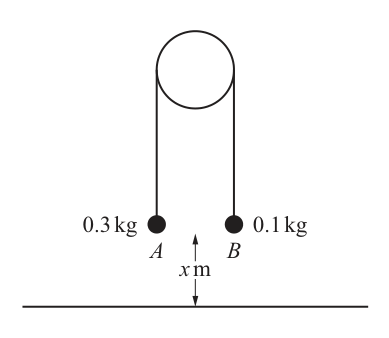
Two particles and have masses and respectively. The particles are attached to the ends of a light inextensible string. The string passes over a fixed smooth pulley, and the particles hang vertically below the pulley. Both particles are initially at a height of above horizontal ground (see diagram). The system is released from rest.
Approach
Apply Newton's second law () to each particle separately. Particle A is heavier, so it accelerates downwards and Particle B accelerates upwards. The tension is the same in the string throughout. Solve the resulting simultaneous equations for acceleration and tension .
Working
Take .
For particle A (mass , moving downwards):
For particle B (mass , moving upwards):
Add equations (1) and (2) to eliminate :
Substitute into equation (2) to find :
Answer
Acceleration = 5 m/s², Tension = 1.5 N
Walkthrough
We analyze the forces on each particle individually. Since the pulley is smooth and the string is light and inextensible, the tension is uniform throughout the string, and both particles have the same magnitude of acceleration .
Particle A () is heavier, so the system accelerates with A moving down and B moving up. We apply Newton's second law () in the direction of motion for each particle.
For A, the forces are its weight () downwards and tension () upwards. The net force is , giving the equation .
For B, the forces are tension () upwards and its weight () downwards. The net force is , giving the equation .
Adding these two equations eliminates and allows us to solve for . Once is known, we substitute it back into either equation to find . Using , we get and .
Key Takeaways
In a pulley system with two hanging masses, write for each mass separately, taking the direction of acceleration as positive for each. The tension is the same in both equations. Adding the equations eliminates tension and solves for acceleration directly.
Common Mistakes
- Using the wrong sign for tension or weight (e.g., for particle A).
- Forgetting that the acceleration magnitude is the same for both particles.
- Using when the mark scheme expects (though is often accepted, the final answers here align with ).
Things to Be Careful About
Ensure the direction of positive acceleration is consistent: downwards for A and upwards for B. The tension must be the same variable in both equations.
During the subsequent motion, does not reach the pulley. When reaches the ground, it comes to rest.
Given that the greatest height of above the ground is , find the value of .
Approach
The motion of particle B has two phases:
- Accelerated phase: Both particles move with acceleration . Particle B rises a distance (same as A falls). Find the velocity of B at the end of this phase.
- Free-fall phase: Particle A is at rest on the ground. Particle B continues moving upwards under gravity alone (acceleration ) until its velocity becomes zero at its greatest height.
Use the constant acceleration formula for both phases and combine the heights.
Working
Phase 1: Accelerated motion
Initial velocity , acceleration , displacement .
Phase 2: Free-fall motion
Initial velocity (where ), final velocity , acceleration .
Let be the additional height B rises after A hits the ground.
Total height of B
B starts at height . During Phase 1, it rises (so it is at height when A hits the ground). During Phase 2, it rises a further .
Total greatest height .
Given that the greatest height is :
Answer
x = 0.48
Walkthrough
Once particle A hits the ground, the string goes slack. Particle B is no longer pulled by the string and continues to move upwards under the influence of gravity alone (free fall).
Phase 1 (Both particles moving):
Particle B starts from rest and accelerates upwards at for a distance (since A falls distance to reach the ground). Using , the velocity squared at the moment A hits the ground is .
Phase 2 (B moving alone):
Particle B now has an initial upward velocity (where ) and accelerates downwards at . It rises until its velocity is zero. Let the additional height be . Using , we have , which gives .
Total height:
B starts at height . It rises during Phase 1 (reaching height ) and rises a further during Phase 2. Total height . Setting this equal to gives .
Key Takeaways
When a connected particle system is released and one mass hits a surface, the other mass continues with the velocity it had at that instant but now moves under gravity alone. Break the problem into distinct phases and link them using the velocity at the transition point.
Common Mistakes
- Assuming B stops when A hits the ground. B has upward velocity and will continue to rise.
- Forgetting that B is already at height (initial + rise ) when A hits the ground, and only adding the extra rise to get the total height.
- Using the wrong acceleration for the second phase (must be , not ).
Things to Be Careful About
Ensure you account for the initial height and the height gained during the first phase () when calculating the total maximum height. The displacement in the second phase is only the additional height gained.

Three particles , and , of masses , and respectively, are at rest in a straight line on a smooth horizontal plane. The distance from to is , and the distance from to is also (see diagram). is projected directly towards with speed . After and collide, continues to move in the same direction with speed .
Approach
Apply the principle of conservation of linear momentum to the collision between P and Q. Since the plane is smooth, there are no external horizontal forces, so total momentum is conserved.
Working
Let be the speed of after the collision. All motion is in the same direction, so we can treat speeds as positive scalars in the momentum equation.
Initial momentum before collision:
Final momentum after collision:
Equating initial and final momentum:
Answer
2.25 m s^-1
Walkthrough
The problem states that and collide on a smooth horizontal plane. "Smooth" means there is no friction, so the only horizontal forces during the brief collision are the internal contact forces between and . By Newton's third law, these are equal and opposite, meaning the total momentum of the system is conserved.
We set up the equation: (mass of ) (initial speed of ) + (mass of ) (initial speed of ) = (mass of ) (final speed of ) + (mass of ) (final speed of ).
Substituting the given values: . Solving this linear equation gives .
Key Takeaways
- Conservation of momentum applies to collisions where no external horizontal forces act.
- Momentum is a vector quantity; here all motion is in one direction, so we use positive signs for velocities in the direction of initial motion.
Common Mistakes
- Forgetting that is initially at rest (using or similar).
- Sign errors if assuming directions incorrectly (though here all final velocities are in the same direction as initial motion for ).
- Arithmetic errors in solving .
Things to Be Careful About
- Ensure units are consistent (kg and m/s give momentum in kg m/s).
- The question asks for speed, which is a positive scalar. The result is positive, confirming moves in the same direction as was initially travelling.
In the subsequent collision between and , these particles coalesce.
Find the speed of the combined particle after this collision.
Approach
When collides with , they coalesce (stick together). This is a perfectly inelastic collision. Momentum is still conserved. The final mass is the sum of the masses of and .
Working
Let be the speed of the combined particle () after collision.
Before collision:
- is moving at (from part a).
- is at rest ().
After collision:
- Combined mass .
- Speed .
Equating momentum:
Answer
0.75 m s^-1
Walkthrough
continues moving and hits . Since they coalesce, they move together as a single object of mass kg. We apply conservation of momentum again. The initial momentum is just the momentum of (since is stationary). The final momentum is the combined mass times the new common speed.
.
Key Takeaways
- In a coalescing collision, the final mass is the sum of the individual masses.
- Momentum is conserved even when kinetic energy is not (this is an inelastic collision).
Common Mistakes
- Using the wrong final mass (e.g., forgetting to add ).
- Carrying forward the speed of instead of (though is not involved in this collision).
Things to Be Careful About
- This is a "follow through" mark from part (a). If the student got part (a) wrong, they can still get marks here using their incorrect value from (a), as long as the method is correct.
Find the time that it takes from when is initially projected until the instant at which collides with the combined particle.
Approach
We need to find the total time from until collides with the combined particle (). This involves breaking the motion into phases:
- Time for to reach .
- Time for to reach (and coalesce).
- Time for to catch up with the combined particle after the second collision.
Working
Phase 1: travels to
Distance m, speed of m/s.
At s, and collide. is now at m (taking 's start as origin), moving at m/s. is at m, moving at m/s. is at m, at rest.
Phase 2: travels to
Distance to m. Speed of m/s.
Total time elapsed when collides with : s.
At this instant ( s):
- The combined particle is at m (position of ), moving at m/s.
- has been travelling from at m/s for duration s.
- Distance travelled in this phase m.
- Position of m.
Phase 3: catches up with
At s:
- Separation distance between and m.
- Speed of m/s.
- Speed of m/s.
- Relative speed of approach m/s.
Time for to catch :
Total time:
Answer
11/3 s
Walkthrough
This is a multi-stage problem. We track the timeline of events.
-
Start to first collision ( hits ): covers 3m at 3 m/s. Time = 1s. At this point, is at 3m, is at 3m. slows to 1.5 m/s, speeds up to 2.25 m/s.
-
First collision to second collision ( hits ): must cover the 3m gap to . Time = s. During this same time, is moving at 1.5 m/s, covering m. So is now at m. hits at position 6m. They stick together and move at 0.75 m/s.
-
Catch-up phase: Now is at 5m (speed 1.5 m/s) and the combined mass is at 6m (speed 0.75 m/s). The gap is 1m. is faster, so it catches up. Relative speed is m/s. Time to close gap = s.
Total time = s.
Key Takeaways
- Break complex motion into distinct time intervals based on events (collisions).
- Use constant velocity equations () for each interval.
- Relative speed is key for catch-up problems: .
Common Mistakes
- Forgetting to add the initial time s to the final catch-up time.
- Calculating the position of incorrectly during the second phase.
- Using the wrong relative speed (e.g., adding speeds instead of subtracting).
Things to Be Careful About
- The question asks for time from when is initially projected, so we must include the time for the first collision.
- Ensure all time intervals are added correctly: .
- Mark scheme allows alternative methods (e.g., setting up equations of motion for position vs time from or from the second collision), but the phase-by-phase approach is most transparent.
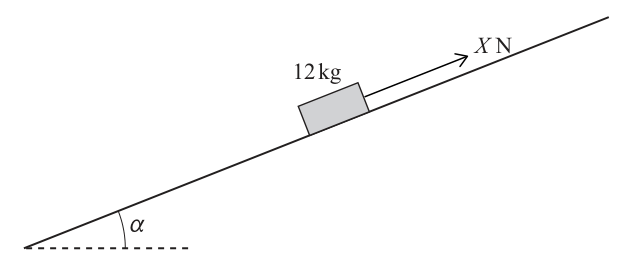
A block of mass is placed on a rough plane inclined at an angle of to the horizontal, where . A force of is applied to the block, directly up the plane (see diagram). The coefficient of friction between the block and the plane is .
It is given that and .
Find the time that it takes for the block to move down the plane from rest.
Approach
The block moves down the plane, so friction acts up the plane. We resolve forces perpendicular to the plane to find the normal reaction , then use to find the frictional force. Applying Newton's second law along the plane gives the acceleration, which we use with the kinematic equation to find the time.
Working
Since , we can construct a right triangle with opposite , adjacent , and hypotenuse . Therefore:
Step 1: Resolve perpendicular to the plane to find .
The forces perpendicular to the plane are the normal reaction (upward, away from the plane) and the component of weight (downward, into the plane). Since there is no acceleration perpendicular to the plane:
Taking :
Step 2: Calculate the frictional force .
Since the block is moving, friction is at its limiting value:
Step 3: Apply Newton's second law along the plane (downward positive).
The forces acting along the plane are:
- Weight component down the plane:
- Applied force up the plane
- Friction up the plane (opposing motion)
Converting to a single fraction:
Numerically:
Step 4: Use kinematics to find .
The block moves from rest () with constant acceleration :
Answer
1.65 s
Walkthrough
Step 1: Determine trigonometric values from the given angle.
We are told . This means we can imagine a right-angled triangle where the side opposite to is and the side adjacent is . The hypotenuse is then . From this triangle, we read off:
These values will be used throughout the solution.
Step 2: Resolve forces perpendicular to the plane.
The block is not accelerating perpendicular to the plane, so the net force in that direction is zero. The only two forces with components perpendicular to the plane are the normal reaction (pushing away from the surface) and the component of the block's weight pressing into the surface, which is . Setting these equal:
Step 3: Calculate the frictional force.
Since the block is moving down the plane, friction opposes the motion and acts up the plane. For a moving block on a rough surface, the friction is at its limiting value :
Step 4: Apply Newton's second law along the incline.
Taking the downward direction along the plane as positive, the forces are:
- Weight component down the plane:
- Applied force up the plane (negative)
- Friction up the plane (negative)
Newton's second law gives:
Solving for :
Step 5: Use the constant acceleration formula to find time.
With initial velocity , displacement , and acceleration :
Key Takeaways
- When is given as a simple fraction, construct a right triangle to find and exactly.
- On an inclined plane, always resolve forces perpendicular to the plane first to find the normal reaction .
- Friction always opposes the direction of motion (or intended motion), so its direction must be determined from the physical context.
- Newton's second law along the incline combines weight components, applied forces, and friction to yield acceleration.
- The kinematic equation is the natural choice when time is the unknown and acceleration is constant.
Common Mistakes
- Forgetting that friction acts up the plane when the block moves down (or vice versa). The direction of friction must be consistent with the direction of motion.
- Using and in the wrong places. The component of weight parallel to the plane is and perpendicular is .
- Not using the exact values of and derived from , leading to rounding errors.
- Sign errors in Newton's second law: ensuring all forces are assigned the correct sign based on the chosen positive direction.
- Using or when the mark scheme expects . Always check which value of is standard for the paper.
Things to Be Careful About
- The direction of friction is critical. Since the block moves down the plane, friction acts up the plane. If the block were moving up, friction would act down.
- The value of must be consistent. This mark scheme uses , which gives the clean exact answer .
- When using , ensure since the block starts from rest.
- The acceleration is positive (down the plane), confirming the block indeed moves down as stated in the question.
- Round the final answer to 3 significant figures: .
It is given instead that and that when , the block is on the point of moving down the plane.
Find the value of and the value of for which the block is on the point of moving up the plane.
Approach
The block is on the point of moving, so it is in limiting equilibrium and friction is at its maximum value . The direction of friction depends on the direction of impending motion. We set up two equations:
- When and the block is on the point of moving down, friction acts up the plane.
- When the block is on the point of moving up, friction acts down the plane, and we solve for the new .
Working
From part (a), we have:
Case 1: Block on the point of moving down the plane ().
Friction acts up the plane (opposing impending downward motion). Resolving forces parallel to the plane (taking up the plane as positive):
Substituting known values:
Solving for :
Since the block is in limiting equilibrium, :
Simplifying:
Rationalizing:
Numerically:
Case 2: Block on the point of moving up the plane.
Now friction acts down the plane (opposing impending upward motion). Resolving forces parallel to the plane (taking up the plane as positive):
The friction is still at its limiting value (since and are unchanged):
Exact form:
Numerically:
Answer
μ = 0.407, X = 97.3 N
Walkthrough
Understanding the two limiting cases.
When a block is on a rough inclined plane and a force is applied, there are two critical scenarios:
-
Impending motion down the plane: The applied force is too small to hold the block, so it is about to slide down. Friction opposes this by acting up the plane.
-
Impending motion up the plane: The applied force is large enough to push the block up, so it is about to slide up. Friction opposes this by acting down the plane.
In both cases, the block is in limiting equilibrium: acceleration is zero, and friction is at its maximum value .
Case 1: Finding when and motion is impending down.
Since the block is about to move down, friction acts up the plane. Taking forces parallel to the plane with the upward direction as positive:
- Forces up the plane: applied force and friction
- Forces down the plane: weight component
Equilibrium gives:
Since and :
Case 2: Finding when motion is impending up.
Now the block is about to move up, so friction reverses direction and acts down the plane. Taking upward as positive:
- Forces up the plane: applied force
- Forces down the plane: weight component and friction
Equilibrium gives:
Key Takeaways
- In limiting equilibrium, friction is at its maximum: .
- The direction of friction reverses between the two limiting cases (impending down vs. impending up).
- When on the point of moving down, friction acts up the plane; when on the point of moving up, friction acts down the plane.
- The normal reaction and the coefficient of friction remain the same in both cases; only the applied force and the direction of friction change.
- Setting up equilibrium equations () is the correct approach when the block is on the point of moving.
Common Mistakes
- Forgetting to reverse the direction of friction between the two cases. This is the most common error and will lead to incorrect equations.
- Using Newton's second law () instead of equilibrium (). Since the block is on the point of moving (not actually moving), acceleration is zero.
- Calculating incorrectly. Remember , not .
- Not recognizing that is the same in both cases. The coefficient of friction is a property of the surfaces and does not change.
- Sign errors when setting up the equilibrium equations. Clearly define a positive direction and stick to it.
Things to Be Careful About
- The problem states , which is a hint that the coefficient of friction is different from part (a). You must find the new value of from the first condition before using it in the second condition.
- When resolving forces parallel to the plane, be consistent with your sign convention. Define one direction as positive and apply it throughout.
- The exact answer for is , which simplifies to approximately . The exact answer for is , which is approximately .
- The frictional force is the same in magnitude in both cases (), but its direction changes. This is a key conceptual point.
A particle moves in a straight line. The velocity of the particle after leaving a fixed point is given by , where and are constants. The acceleration of the particle at is , and the displacement of the particle from at is .
Approach
Differentiate the given expression for with respect to to obtain the acceleration . Substitute and to form a first equation in and . Integrate with respect to to obtain the displacement ; since the particle leaves at , the integration constant is zero. Substitute and to form a second equation. Solve the two equations simultaneously for and .
Working
Differentiating:
At , :
Integrating:
Since when , . At , :
From (1):
Substituting into (2):
Then:
Answer
k = 3, p = 26
Walkthrough
We are given the velocity with two unknown constants and , and two pieces of information at : and . Since , we differentiate term by term: the constant gives , gives , and gives , so . Substituting and gives equation (1): .
Next, since , we integrate term by term: , , and , giving . The particle leaves at , so and therefore . Using at gives equation (2): .
Now solve the two equations. From (1), . Substituting into (2) and multiplying by eliminates and gives a linear equation in : . Collecting terms, , so . Finally, , confirming both values.
Key Takeaways
- Differentiation and integration connect , and : and .
- The constant of integration is fixed by the initial condition that the particle is at when .
- Two unknown constants need two equations; substitute each condition to build the system.
- Solving the simultaneous system requires careful algebraic manipulation, especially clearing a fraction.
Common Mistakes
- Using or instead of differentiating or integrating — the mark scheme awards these no method marks.
- Dropping the constant of integration, or failing to set from the initial condition.
- Sign errors when expanding or .
- Failing to show at least one line of working after eliminating or ; the simultaneous-equation mark requires visible working.
Things to Be Careful About
- The method marks require the power of to change by exactly 1 with a coefficient change in at least one term.
- Because the question asks to "Show that and ", the values are given; any error in the working makes the final answer wrong (A0).
- Make sure both equations are correctly formed before solving — a wrong equation can still produce a consistent-looking algebra path but gives wrong constants.
Find the distance moved by the particle between the time at which its acceleration is zero and the time at which its velocity is zero.
Approach
Find the time at which the acceleration is zero by setting and solving for . Find the time at which the velocity is zero by setting , solving the quadratic, and keeping the positive root. Since the velocity remains positive throughout the interval, the distance travelled equals the change in displacement. Integrate to obtain , and evaluate at the two times, subtracting the smaller from the larger.
Working
Setting :
Setting :
Since , only is valid. For the velocity is positive, so distance equals change in displacement.
At :
At :
Distance travelled:
Answer
4913/18 m (≈273 m)
Walkthrough
From part (a), and , so and .
Step 1 — when is the acceleration zero? Set : , so s. This is the start of the interval.
Step 2 — when is the velocity zero? Set : . Divide by 3, multiply by and reorder to , then divide by 2: . Factor as to get or . Since time cannot be negative here, we keep .
Step 3 — check the direction of motion. The velocity is a downward-opening quadratic whose roots are and ; it is therefore positive for between those roots. The interval lies inside, so the particle never reverses; distance equals the change in displacement.
Step 4 — compute displacement. . At , . At , .
Step 5 — distance m.
Key Takeaways
- Setting and locates the instants that delimit the interval.
- Quadratic equations for often have a negative root to reject on physical grounds.
- When keeps one sign, distance travelled equals the change in displacement.
- Definite integration of gives displacement; subtracting the end values gives the distance.
Common Mistakes
- Forgetting to divide out the factor 3 when solving , or mishandling the signs when rearranging to .
- Keeping both quadratic roots and integrating from the negative one, which has no physical meaning.
- Assuming the particle changes direction without checking the sign of ; here it stays positive so distance equals displacement.
- Dropping the factor 3 in the antiderivative, giving answers off by a factor of 3.
- Using the limits in the wrong order, which would produce a negative distance.
Things to Be Careful About
- The method mark for requires a positive ; the method mark for requires at least one value from solving the quadratic.
- The distance evaluation must use the student's own integrated with positive limits; a bare numerical answer loses the final method mark.
- The exact distance is m; writing m is a rounded approximation and is allowed.
- Double check the fractional arithmetic at — a single slip in the common denominator can change the answer.