Mathematics 9709/12 — February/March 2025
Cambridge AS Level · Pure Mathematics 1 · worked solutions for every part, with the mark scheme
Topics Quadratics · Differentiation · Series · Trigonometry · Coordinate Geometry · Integration · +2 more
A curve has equation and a straight line has equation , where is a constant.
Find the set of values of for which the curve and the line do not meet.
Approach
The curve and the line meet when their -values are equal. Setting the two equations equal and rearranging gives a quadratic equation in ; the number of intersection points is determined by the discriminant of this quadratic. For the curve and line not to meet, the quadratic must have no real roots, so its discriminant must be negative.
Working
Set the two expressions for equal:
Rearrange to form a quadratic in :
Here , and . For no intersection, the discriminant must be negative:
Taking square roots gives:
Adding 3 throughout:
Answer
-5 < k < 11
Walkthrough
We are given a curve and a family of straight lines with the same intercept but varying gradient. We need the values of for which the line does not intersect the curve.
First, eliminate by equating the two expressions. This is the standard way to find intersection points: any common point must satisfy both equations, so its -coordinate satisfies the resulting quadratic. Rearranging gives .
Next, count real solutions of this quadratic. A quadratic has real roots when and no real roots when . Since 'do not meet' means no common point, we need no real -solutions, so we require the discriminant to be negative.
Substitute , , into the discriminant:
, i.e. . This inequality means the distance of from 0 is less than 8, so . Adding 3 gives .
Key Takeaways
- Intersections of a line and a curve are found by solving their equations simultaneously; eliminating gives an equation in .
- The discriminant of a quadratic determines how many real intersections occur: positive means two, zero means one (tangent), negative means none.
- To translate 'do not meet' into algebra, use discriminant (not ).
Common Mistakes
- Using instead of . That would give the values for which the line meets the curve in two points.
- Using : when the discriminant is zero, the line is tangent to the curve and they do meet (at exactly one point), so the endpoints must be excluded.
- Forgetting to rearrange the quadratic into the form before identifying .
- Sign errors when moving terms: moved to the left gives .
Things to Be Careful About
- The coefficient of is , not .
- The constant term is , obtained from .
- The final answer must be a strict inequality, . Do not write 'or', and do not use signs.
- If the mark scheme says 'condone errors', it means small sign slips in the quadratic may still earn method marks, but the final interval must be correct.
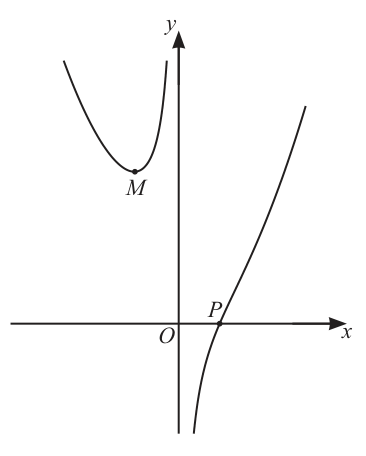
The diagram shows the curve with equation . The curve crosses the -axis at the point and is a minimum point.
Approach
Differentiate the equation of the curve to find , then substitute the -coordinate of to find the gradient.
Working
At , substitute :
Answer
9
Walkthrough
First, rewrite the term as to make differentiation easier. Differentiating gives , and differentiating gives , which is . The constant differentiates to . This gives the gradient function . To find the gradient at , we simply substitute into this expression, yielding .
Key Takeaways
- Rewriting fractions with negative powers simplifies differentiation using the power rule.
- The gradient of a curve at a specific point is found by evaluating the derivative at that point's -coordinate.
Common Mistakes
- Forgetting the negative sign when differentiating , leading to instead of .
- Failing to substitute the correct -value ( instead of ).
Things to Be Careful About
- Ensure the derivative is fully simplified before substituting to avoid arithmetic errors.
- The mark scheme awards method marks for a correct two-term differentiated expression, so showing explicitly is important.
Approach
At a minimum point , the gradient is zero. Set and solve for . Then substitute this -value back into the original equation to find the corresponding -coordinate.
Working
Set :
Multiply by (noting ):
Correct to 3 significant figures, .
Substitute into :
Correct to 3 significant figures, .
Coordinates of are .
Answer
(-1.08, 9.96)
Walkthrough
Since is a minimum point, the gradient at is zero. We use the derivative found in part (a): . Multiplying the entire equation by clears the denominator, giving . Solving for yields , so . Rounding to 3 significant figures gives . To find the -coordinate, we substitute the unrounded value into the original curve equation . This gives , which rounds to to 3 significant figures. Thus, is at .
Key Takeaways
- Stationary points occur where the first derivative is zero.
- When finding coordinates, always use unrounded intermediate values for subsequent calculations to maintain accuracy.
- Rounding should only be applied at the final step as instructed by the question.
Common Mistakes
- Rounding to before substituting into the -equation, which leads to a slightly incorrect -value.
- Forgetting that has a real negative cube root.
- Algebraic errors when multiplying by to clear the fraction.
Things to Be Careful About
- The mark scheme specifies AWRT (Any Correct Rounding Technique), so using 3-4 significant figures for intermediate steps is acceptable, but final answers must be exactly 3 significant figures.
- Ensure the negative sign is preserved when taking the cube root of a negative number.
Approach
Use the binomial theorem to expand term by term, keeping the sign of the second term negative throughout.
Working
Now simplify each term:
Therefore the complete expansion is:
Answer
16x^4 - 96x^2 + 216 - 216x^-2 + 81x^-4
Walkthrough
We need to expand a fourth power of a binomial. The binomial theorem for gives
Here and . The negative sign must be included every time the term appears, because the terms with odd powers of will be negative. Substitute each term into the formula and simplify separately. For example, the second term is . The middle term is . The fourth term is negative because is negative, and the final term is positive.
Key Takeaways
The binomial expansion requires applying the binomial coefficients and carefully combining the powers of and . The result here contains positive, zero, and negative powers of .
Common Mistakes
- Forgetting the binomial coefficients.
- Using instead of , which changes the signs of the odd-power terms.
- Dropping the minus sign on terms with odd powers of .
- Incorrectly simplifying powers such as or .
Things to Be Careful About
The signs in the final expansion are . In particular, , , and . Negative powers of are acceptable in the final answer.
Approach
Use the expansion from part (a). When multiplying by , the coefficient of comes from times the constant term and times the term.
Working
From part (a),
The products that produce an term are:
and
Therefore the coefficient of is:
Answer
-264
Walkthrough
We already know the expansion of . To find the coefficient of in times this expansion, look only at the combinations that give . Multiplying by the constant term gives . Multiplying by the term gives . No other products give : for example, gives , and gives a constant. Adding the two contributions gives .
Key Takeaways
When multiplying two polynomials, the coefficient of a chosen power is found by selecting all contributions whose exponents sum to that power. This is the standard method of coefficient extraction.
Common Mistakes
- Forgetting to multiply the term by .
- Using only or only .
- Confusing the constant term with the term from part (a).
- Mixing up signs: the term is , not .
Things to Be Careful About
The final answer may be written as or ; both are accepted. Use the correct terms from part (a): the constant term is and the term is .
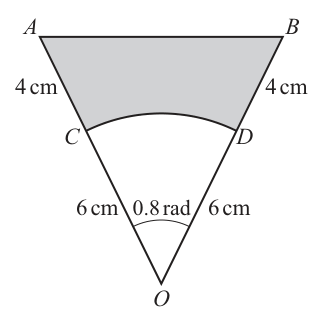
The diagram shows a triangle where and angle . Points and on and respectively are such that the arc is part of a circle with centre and radius . The shaded region is bounded by the arc and the line segments , and .
Approach
The perimeter of the shaded region consists of four parts: the straight segments and , the straight segment , and the curved arc . We are given cm and cm. We calculate the arc length using the circular measure formula , and find using the cosine rule in .
Working
Arc length :
Using the formula for arc length with cm and radians:
Length :
In , we have cm, cm, and radians. Applying the cosine rule:
Total Perimeter:
The perimeter is the sum of , , , and arc :
Rounding to 3 significant figures:
Answer
20.6 cm
Walkthrough
To find the perimeter of the shaded region, we add the lengths of its four boundary components: , , , and the arc .
- Arc : The arc is part of a circle with radius cm and subtends an angle radians at the centre . The arc length formula gives cm.
- Segments and : These are given directly in the diagram as cm each (since cm and cm, so cm; similarly cm).
- Segment : This is the base of the isosceles triangle . We know two sides () and the included angle ( rad). The cosine rule is the appropriate tool: . Evaluating this gives cm.
- Summing up: Adding yields , which rounds to cm to 3 significant figures.
Key Takeaways
- The arc length formula requires the angle to be in radians.
- The cosine rule is used to find a side length when two sides and the included angle are known.
- Perimeter problems involving mixed straight and curved boundaries require summing each distinct component separately.
Common Mistakes
- Using degrees instead of radians in the arc length formula .
- Forgetting to include the arc in the perimeter and only summing the straight lines.
- Using the sine rule incorrectly or failing to set up the cosine rule properly (e.g., sign errors).
Things to Be Careful About
- Always ensure the angle is in radians when using or area of sector .
- The final answer should be given to an appropriate number of significant figures (3 s.f. is standard unless specified otherwise).
- Ensure calculator is in radian mode when evaluating .
Approach
The shaded region is the area of triangle minus the area of the circular sector . We calculate each area separately and then subtract.
Working
Area of sector :
Using the formula for the area of a sector with cm and radians:
Area of triangle :
Using the formula for the area of a triangle with , , and radians:
Area of shaded region:
Subtract the sector area from the triangle area:
Rounding to 3 significant figures:
Answer
21.5 cm^2
Walkthrough
The shaded region is bounded by arc , segment , segment , and segment . This shape is exactly the triangle with the circular sector removed from it.
- Area of sector : The sector has radius cm and angle radians. The formula gives cm.
- Area of triangle : The triangle has two sides of length cm and an included angle of radians. The formula gives cm.
- Subtraction: The shaded area is cm, which rounds to cm to 3 significant figures.
Key Takeaways
- The area of a sector formula requires the angle in radians.
- The triangle area formula is useful when two sides and the included angle are known.
- Complex shaded regions can often be found by adding or subtracting simple geometric shapes (triangle minus sector).
Common Mistakes
- Using degrees instead of radians in or .
- Calculating the area of the wrong sector (e.g., using radius instead of ).
- Forgetting to subtract the sector area and instead adding it.
Things to Be Careful About
- Always check that the calculator is in radian mode when evaluating .
- Use the exact radius for each shape: for the sector, for the triangle sides.
- Round the final answer to 3 significant figures as is standard practice.
An arithmetic progression has first term 5 and common difference 6.
For this progression, find the sum of all the terms that lie between 150 and 400.
Approach
An arithmetic progression has first term and common difference . Write the th term, find the first term greater than 150 and the last term less than 400, then sum the resulting arithmetic series.
Working
The th term is
First term greater than 150:
So the first included term is :
Last term less than 400:
So the last included term is :
The required terms are , so the number of terms is
Their sum is
Answer
11275
Walkthrough
The terms of this progression are formed by adding 6 to the preceding term, starting from 5. We need only the terms that are strictly greater than 150 and strictly less than 400. Because the progression is increasing, these terms form a consecutive block, so once we know the first and last term numbers in that block, we can sum them with the arithmetic series formula.
First, write the general term. For an arithmetic progression with first term and common difference , the th term is . Here and , so
This form is convenient because it lets us solve for when the term crosses 150 and 400.
To find the first term above 150, solve
The smallest integer satisfying this is . Hence the first included term is
To find the last term below 400, solve
The largest integer satisfying this is . The last included term is
Thus the required block is . The number of terms is
Finally, use the sum formula for an arithmetic series, , where is the first term and is the last term. Here , , :
Equivalently, this is the same as : the sum of the first 66 terms minus the sum of the first 25 terms.
Key Takeaways
This question tests the formula for the th term of an arithmetic progression and the formula for the sum of an arithmetic series. It also tests how to convert a range condition such as "between 150 and 400" into strict inequalities on , then choose the correct integer indices. A consecutive block of an arithmetic progression can be summed either directly with its first and last terms, or by subtracting the sum of the terms before the block from the total sum.
Common Mistakes
- Using or instead of and . Because "between" is exclusive, terms equal to 150 or 400 are not included.
- Counting the terms incorrectly: from to inclusive there are terms, not .
- Applying the sum formula with the original first term and ; that would give the sum of the first 41 terms of the whole progression, not the selected block from to .
- Forgetting the boundary step; the mark scheme awards a method mark for attempting to solve or .
Things to Be Careful About
The word "between" is exclusive, so terms exactly equal to 150 or 400 are excluded. When solving , , so the first included term is at index 26; when solving , , so the last included term is at index 66. Use the first and last terms of the selected block, not the original first term, in the sum formula. If using the subtraction method, the correct expression is , not .
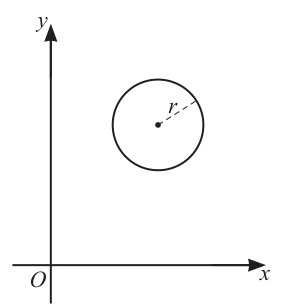
The diagram shows a circle of radius , where and for all points on . The least distance between any point on and the -axis is 8 units, and the least distance between any point on and the -axis is 5 units.
Approach
The circle lies entirely in the first quadrant (, for all points on ). The least distance from any point on the circle to the -axis is the vertical distance from the lowest point of the circle to the -axis. Since the radius is , this equals the -coordinate of the centre minus . Similarly, the least distance to the -axis is the horizontal distance from the leftmost point of the circle to the -axis, which equals the -coordinate of the centre minus .
Working
The least distance from any point on to the -axis is 8 units:
The least distance from any point on to the -axis is 5 units:
Answer
(r + 5, r + 8)
Walkthrough
The circle is drawn entirely in the first quadrant. The lowest point on the circle is directly below the centre, at a vertical distance of from it. If the least distance from the circle to the -axis is 8, then the centre must be units above the -axis, giving . Similarly, the leftmost point is units to the left of the centre, and if the least distance to the -axis is 5, the centre must be units to the right of the -axis, giving .
Key Takeaways
- The least distance from a circle to an axis equals the centre coordinate minus the radius (when the circle is on the positive side of that axis).
- Coordinates of a centre can be expressed in terms of the radius using geometric relationships.
Common Mistakes
- Confusing the least distance with the greatest distance (which would be ).
- Forgetting that the circle is entirely in the first quadrant, which ensures the centre coordinates are both positive.
Things to Be Careful About
- The question states and for all points on , confirming the circle does not cross either axis. This means the centre coordinates are strictly greater than .
- The answer must be expressed in terms of as an ordered pair .
Given that the distance between the origin and the centre of the circle is 15 units, find the value of .
Approach
Use the distance formula between the origin and the centre from part (a), set it equal to 15, and solve the resulting quadratic equation for .
Working
The distance from the origin to the centre is:
Squaring both sides:
Expanding:
Combining like terms:
Dividing through by 2:
Factoring:
So or . Since the radius must be positive, .
Answer
r = 4
Walkthrough
Part (a) established that the centre is at . The distance from the origin to this point is given as 15. Applying the distance formula gives . Squaring both sides eliminates the square root and produces a quadratic in . Expanding and simplifying yields , which factors as . Since represents a radius, it must be positive, so .
Key Takeaways
- The distance from the origin to a point is .
- Quadratic equations arising from geometry problems may have a negative root that must be rejected on physical grounds.
Common Mistakes
- Forgetting to square the 15, writing instead of .
- Accepting as a valid answer without checking the physical constraint .
- Algebra errors when expanding or .
Things to Be Careful About
- Always reject negative values for physical quantities like radius.
- The mark scheme awards follow-through marks based on the answer from part (a), so consistency is important.
The point on the circle furthest from the origin is denoted by .
Find the gradient of the tangent to the circle at .
Approach
The point on the circle furthest from the origin lies on the line joining the origin to the centre of the circle, on the far side of the centre. The radius at is therefore along the line . The tangent at is perpendicular to this radius, so its gradient is the negative reciprocal of the gradient of .
Working
With from part (b), the centre of the circle is at:
The gradient of the line from the origin to the centre is:
Since lies on the extension of beyond the centre, the radius at has the same gradient .
The tangent at is perpendicular to the radius at , so its gradient is:
Answer
-3/4
Walkthrough
Once we know the centre is at , we can find the gradient of the line from the origin to the centre: . The point on the circle furthest from the origin lies along this line, on the opposite side of the centre from the origin. The radius at is therefore parallel to (in fact, collinear with) the line , so it has gradient . A fundamental property of circles is that the tangent at any point is perpendicular to the radius at that point. The gradient of a line perpendicular to one with gradient is . Therefore, the tangent gradient is .
Key Takeaways
- The point on a circle furthest from (or nearest to) a given point lies on the line joining that point to the centre.
- The tangent to a circle at any point is perpendicular to the radius at that point.
- If two lines are perpendicular, the product of their gradients is .
Common Mistakes
- Trying to find the coordinates of explicitly and then computing the tangent gradient, which is unnecessarily complicated.
- Forgetting the negative sign when computing the perpendicular gradient.
- Using the gradient of the radius as the gradient of the tangent.
Things to Be Careful About
- The mark scheme allows the gradient of the tangent to be written as or equivalently , showing that the perpendicular gradient relationship is the key idea.
- Only positive values of are valid, so the gradient expression must use .
Approach
Use the identity to rewrite the left-hand side, then replace with and combine over a common denominator.
Working
Starting with the left-hand side:
Put both terms over the common denominator :
Use :
Expand the numerator and simplify:
Hence the identity is shown.
Answer
3tan^2θ + 5sin^2θ = (8sin^2θ - 5sin^4θ)/(1 - sin^2θ)
Walkthrough
We need to show the left-hand side equals the right-hand side. Start by replacing with , using the standard identity .
Now the expression has two terms. To combine them, write with denominator :
Then use to replace every term. This gives a single fraction in terms of only. Expanding the numerator and collecting like terms produces exactly the required right-hand side.
Key Takeaways
This question tests the two fundamental trigonometric identities:
It also tests algebraic manipulation of fractions, especially writing terms over a common denominator and simplifying.
Common Mistakes
- Forgetting to put over the same denominator as the first term.
- Using the Pythagorean identity incorrectly, such as writing .
- Losing the factor of when expanding .
- Stopping before the expression is fully simplified to the required form.
Things to Be Careful About
The identity is valid when , i.e. when , because is undefined there. In the manipulation, the denominator becomes , which is the same condition. Since this is an answer-given question, all necessary working must be shown.
Approach
Use the identity from part (a) to replace with . Set this equal to , clear the denominator, rearrange into a quadratic in , solve it, and then find all angles in the required interval.
Working
From part (a):
Multiply both sides by :
Expand and rearrange:
Let . Then:
Using the quadratic formula:
So:
Since , discard . Hence:
For :
The second-quadrant angle is:
For , the third-quadrant angle is:
The fourth-quadrant angle is outside .
Answer
54.1°, 125.9°, 234.1°
Walkthrough
The equation has the same left-hand side as the identity in part (a), so replace it with the fraction:
Clearing the denominator gives an equation in powers of . Because only even powers appear, it is actually a quadratic in . Let to make the quadratic structure clear:
Solving by the quadratic formula gives two roots. One root is about , which is impossible because cannot exceed . The other root is about , so .
For the positive value, the acute angle is . Since sine is positive in the first and second quadrants, the second solution is . For the negative value, sine is negative in the third and fourth quadrants. The interval includes the third quadrant but not the fourth, so only is included.
Key Takeaways
- The identity from part (a) converts an expression involving and into a single fraction.
- Many trigonometric equations become quadratics in or ; substituting makes them easier to solve.
- Always reject roots that are impossible for the trigonometric function.
- Use the quadrant rule to find all solutions in the required interval.
Common Mistakes
- Not using the identity from part (a) and trying to solve the original equation directly.
- Making a sign error when rearranging into .
- Forgetting to reject .
- Taking only the positive square root and missing the negative sine solutions.
- Including , which is outside the required interval, or missing .
Things to Be Careful About
The interval is , so and are not included. Also, is undefined at and , so those values cannot be solutions. The mark scheme accepts answers rounded to the nearest degree, so are acceptable. If any additional values within the interval are included, the final answer mark is lost.
A geometric progression is such that its second term is and its sum to infinity is 160.
Approach
Let the first term be and the common ratio be . The second term gives , and the sum to infinity gives . Eliminate to obtain a quadratic in , solve it, then use the convergence condition to choose the correct root.
Working
The second term is
The sum to infinity is
From , . Substitute into the sum to infinity:
Multiply by :
Expand and rearrange:
Divide by 40:
Factorise:
So
Since the sum to infinity exists, . Therefore is rejected, leaving
Answer
r = -1/2
Walkthrough
We are told two facts about a geometric progression: the second term is , and the sum to infinity is . A geometric progression with first term and common ratio has second term , so this gives . Its sum to infinity is , valid only when , so this gives .
Since , we can write and substitute into . This gives an equation containing only . After multiplying by and rearranging, we obtain .
Factorising gives or . The sum-to-infinity formula is valid only when . Since has absolute value greater than 1, it cannot be the common ratio of a progression with a finite sum to infinity. Therefore is the only valid value.
Key Takeaways
- The th term of a geometric progression is , so the second term is .
- The sum to infinity of a geometric progression is , valid only for .
- When a problem gives two conditions, forming two equations and eliminating a variable is often the key step.
- Always check the convergence condition when choosing between possible values of .
Common Mistakes
- Forgetting that the sum to infinity requires , so accepting as well.
- Making a sign error when substituting , especially with the negative sign.
- Rearranging the equation incorrectly, so the quadratic has the wrong signs.
Things to Be Careful About
- The mark scheme requires the method of eliminating or to be shown.
- The quadratic must be rearranged into a three-term quadratic before solving.
- The final answer must be only; the invalid root must be rejected using the convergence condition.
The first nine terms of the progression are now removed.
Find the sum to infinity of the remaining terms of the progression.
Approach
Removing the first nine terms leaves the terms from the 10th onwards. The sum of these remaining terms is the original sum to infinity minus the sum of the first nine terms. First find the first term , then use the formula for the sum of the first terms of a geometric progression.
Working
From part (a), . Since ,
The sum of the first nine terms is
Substitute and :
Evaluate the power:
so
and
Therefore
The sum to infinity of the remaining terms is
Answer
or
-5/16 (or -0.3125)
Walkthrough
After is known, the first term can be found from the second term: , so .
Removing the first nine terms leaves the 10th term onwards. One way to find the sum of these remaining terms is to take the original sum to infinity, , and subtract the sum of the first nine terms. The sum of the first terms of a GP is , so with :
Since , we have , and . Thus . The remaining sum is .
An equivalent check is to treat the 10th term as the new first term. The 10th term is , and the sum to infinity of the remaining terms is .
Key Takeaways
- The sum of the first terms of a GP is .
- Removing the first nine terms of an infinite GP leaves a GP whose first term is the 10th term.
- The sum of the remaining terms can be found as , or as .
Common Mistakes
- Using the original first term as the first term of the remaining progression instead of the 10th term.
- Forgetting that is negative when and is odd.
- Subtracting in the wrong order, which can change the sign of the final answer.
- Giving a rounded decimal like without also showing or .
Things to be Careful About
- Use the follow-through value of from part (a) if it is different but still satisfies and .
- If using the 10th term as the new first term, the first term is , not .
- The denominator is , not , because is negative.
- The final answer should be exact: or .
A curve is such that . It is given that the curve has a stationary point at .
Use the expression for to determine whether the stationary point is a maximum or a minimum point.
Approach
Since the point is stationary, there. To decide whether it is a maximum or a minimum, substitute into the given and check its sign.
Working
At the stationary point, . Substitute into the second derivative:
Evaluate:
Since , the curve is concave up at this point.
Answer
The stationary point is a minimum point.
minimum point
Walkthrough
The question gives the second derivative and tells us there is a stationary point at . A stationary point is where . To classify it, we use the second derivative test: evaluate at the stationary point.
Substitute into the given expression. Since and , we get . Because this is positive, the gradient is increasing through the stationary point, so the point is a minimum.
Key Takeaways
The second derivative test is the standard way to classify a stationary point. If at the point, it is a minimum; if , it is a maximum.
Common Mistakes
- Substituting into instead of .
- Making arithmetic errors with fractional powers, such as writing .
- Forgetting to give the conclusion (maximum or minimum).
Things to Be Careful About
The mark scheme requires evidence of the substitution and evaluation, not just a statement that . It awards a special B1 for a correct sign conclusion only if the numerical substitution is not shown, but full marks require or equivalent.
Approach
Integrate the second derivative once to obtain . Use the fact that the point is stationary, so at , to find the first constant of integration. Then integrate again and use the given point to find the second constant.
Working
Write the second derivative using negative powers:
Integrate term by term:
At the stationary point, when :
Evaluate:
So . Hence:
Integrate again:
Use when :
So .
Answer
or equivalently
y = x^-2 - (5/2)x^-1 + 6x + 7
Walkthrough
We are given the second derivative and a point on the curve that is also a stationary point. To find the equation of the curve, we need to integrate twice.
First, rewrite as so each term can be integrated using the power rule. Integrating gives for . Thus:
and we add a constant because integration is indefinite.
Since the point is stationary, at . Substituting this into the integrated expression gives . This is the key use of the stationary point information.
Then integrate again to obtain . The constant this time is . Finally, substitute the given coordinates into the expression for to find , giving the final equation.
Key Takeaways
- Integrating a second derivative twice recovers the original function, with a new constant of integration each time.
- The stationary point condition can be used to determine the first constant of integration.
- A known point on the curve determines the second constant.
Common Mistakes
- Forgetting one of the constants of integration.
- Making sign errors when dividing by the new negative exponent.
- Substituting the point into instead of when finding .
- Arithmetic errors with and .
Things to Be Careful About
- The mark scheme allows equivalent forms, but the final equation should be simplified.
- When integrating, keep the constants and distinct.
- At , , , and ; check these before substituting.
- The final answer may be written as or .
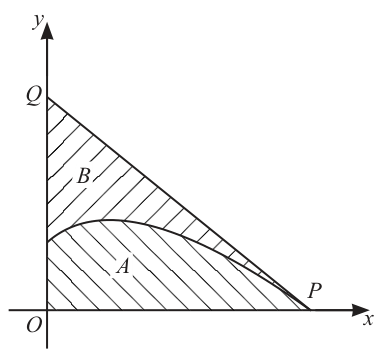
The diagram shows the curve with equation
for values of such that . The tangent to the curve at the point meets the -axis at the point . Region is bounded by the curve and the two axes. Region is bounded by the curve, the line segment and the -axis.
Approach
Region A is bounded by the curve , the -axis, and the -axis. The curve meets the -axis at and the -axis at . The area of region A is therefore given by the definite integral .
Working
Set up the integral:
Find the antiderivative of each term. For , use the reverse chain rule:
For the polynomial terms:
So the antiderivative is:
Evaluate at the upper limit :
Evaluate at the lower limit :
Compute the area:
Answer
13
Walkthrough
Region A lies between the curve and both coordinate axes. Since the curve starts on the -axis at and ends on the -axis at , the area is simply the definite integral of from to .
Step 1: Set up the integral. We integrate with respect to from to .
Step 2: Find the antiderivative. The term is a composite function. Using the reverse chain rule (or substitution ), we increase the power by 1 to get , divide by the new power, and divide by the derivative of the inner function (). This gives . The polynomial part integrates normally to .
Step 3: Evaluate at the limits. At , we get . Since , this becomes . At , we get .
Step 4: Subtract. .
Key Takeaways
- When integrating , the antiderivative is .
- The area under a curve above the -axis between and is .
- Careful arithmetic with fractions and powers is essential to avoid errors.
Common Mistakes
- Forgetting to divide by the derivative of the inner function () when integrating .
- Incorrectly computing as instead of .
- Sign errors when evaluating .
- Forgetting to subtract the lower limit evaluation.
Things to Be Careful About
- Ensure the curve is above the -axis throughout so the integral directly gives the area (the diagram confirms this).
- means , not computed incorrectly.
- The final answer is exact; no rounding is needed.
Approach
Region B is bounded by the curve, the line segment , and the -axis. From the diagram, region B plus region A together form the triangle . Therefore, area of B = area of triangle minus area of region A.
We need to:
- Differentiate to find the gradient of the tangent at .
- Write the equation of the tangent line and find where it meets the -axis (point ).
- Calculate the area of triangle .
- Subtract the area of region A (from part (a)) to get the area of region B.
Working
Step 1: Find .
Step 2: Evaluate the gradient at .
Step 3: Equation of the tangent at .
Using :
Step 4: Find point (where the tangent meets the -axis).
Set :
So .
Step 5: Area of triangle .
The triangle has base along the -axis and height along the -axis:
Step 6: Area of region B.
Answer
33/5
Walkthrough
Region B is the area between the tangent line and the curve, bounded on the left by the -axis. Looking at the diagram, the triangle (with vertices , , and ) contains both region A and region B. Since region A is between the curve and the axes, and region B is between the curve and the tangent line, we have:
Therefore, .
Step 1: Differentiate. Using the chain rule on , we bring down the power , multiply by the outer coefficient , reduce the power to , and multiply by the derivative of the inner function . This gives . The derivative of is .
Step 2: Gradient at . Substituting gives . This negative gradient makes sense as the curve is decreasing at .
Step 3: Tangent equation. Using point-slope form with and gradient , we get .
Step 4: Point . Setting gives , so .
Step 5: Triangle area. Triangle is a right-angled triangle with legs and , so its area is .
Step 6: Region B. Subtracting the area from part (a): .
Key Takeaways
- The gradient of a curve at a point is found by differentiating and substituting.
- The equation of a tangent line can be written using point-slope form .
- When a region is bounded by a curve and a tangent line, it can sometimes be found by subtracting the area under the curve from the area of a simple geometric shape.
- Area relationships: .
Common Mistakes
- Forgetting the chain rule factor of when differentiating .
- Computing as instead of .
- Using the wrong point-slope form or making sign errors in the tangent equation.
- Forgetting that region B = triangle area − region A, and instead trying to integrate the difference directly.
- Arithmetic errors when computing .
Things to Be Careful About
- The gradient at is negative (), which is consistent with the curve decreasing toward the -axis.
- Point is above the curve's -intercept, which is why region B exists between the tangent and the curve.
- The area of region B must be positive; if your answer is negative, check your subtraction order.
- Use exact fractions throughout to avoid rounding errors.
Functions and are defined for all real values of by
where and are positive constants. It is given that .
Approach
Find the inverse of , use the given condition to relate and , then form and simplify.
Working
Since , write and solve for :
so
Using :
Hence
Now form the composite:
Substitute :
Answer
gf(x) = 8x^2 - k - 1
Walkthrough
We are told the value of the inverse function at is . To use this, first find the inverse of the linear function by writing and solving for ; this gives . Substituting gives , so . This relation is the key link between the two constants.
Next, form the composite , which means apply first and then : replace every in by . This gives . Finally, use to replace by , which simplifies to , exactly the required expression.
Key Takeaways
This question tests inverse functions, composite functions, and the importance of using a derived relationship between constants. It also shows that a 'show that' question needs every substitution and simplification written out.
Common Mistakes
- Computing instead of ; the order matters.
- Making an arithmetic slip when finding the inverse, especially forgetting to divide the constant by .
- Not using the relation after deriving it, so the final expression cannot be simplified to the required form.
- Omitting intermediate detail in a 'show that' question; the mark scheme requires all necessary detail.
Things to Be Careful About
- means apply first, then .
- The inverse relation can also be written as , which gives and hence .
- Keep the constants and general until the final substitution; do not try to find their values in this part.
The curve with equation is transformed to the curve with equation by the following sequence of transformations.
Find an expression for in terms of and .
Approach
Apply the three transformations in the order given: translation by the vector , stretch in the -direction by scale factor , then reflection in the -axis. Track how and change at each stage.
Working
Start with
A translation by the vector moves the graph units right and units up. Replace by and add to :
A stretch in the -direction by scale factor multiplies the -value by :
A reflection in the -axis multiplies the -value by :
This can be expanded as
Answer
h(x) = -k(8(x-2)^2 - k + 2) = -8k(x-2)^2 + k^2 - 2k
Walkthrough
We start from and apply transformations in the exact order stated.
- Translation by : a graph shifts right by and up by . In the equation, replace by (because the old equals new minus ) and add to the whole expression. This gives .
- Stretch in the -direction by scale factor : every -coordinate is multiplied by , so multiply the whole right-hand side by .
- Reflection in the -axis: every -coordinate changes sign, so multiply the whole right-hand side by .
The result is , which can be expanded to . The expanded form is useful for part (c).
Key Takeaways
This question tests the order of graph transformations. Translation inside the function affects ; translation outside affects . A vertical stretch multiplies -values, and a reflection in the -axis changes the sign of .
Common Mistakes
- Applying the translation to as instead of .
- Applying the stretch before the translation, which changes the effect of the translation.
- Forgetting the reflection sign, or applying it before the stretch.
- Not simplifying correctly to .
Things to Be Careful About
- The order in the question is translation, then stretch, then reflection; this order is essential.
- The stretch is in the -direction, so it multiplies the whole expression, not just the term.
- The final expression can be left factored or expanded; both are acceptable, but the expanded form helps identify the maximum in part (c).
Approach
The expression for is a quadratic with negative leading coefficient, so its graph is a downward-opening parabola. Its maximum value occurs at the vertex, . Since the range is , the maximum value must be exactly . Solve for , then use from part (a) to find .
Working
From part (b),
Because , the coefficient is negative, so the maximum occurs at :
The range means the maximum is :
Solve:
So or . Since is positive, .
Using :
Answer
k = 5, c = 11/2
Walkthrough
The function is a quadratic in . Its leading coefficient is , which is negative because , so the parabola opens downwards and has a single maximum at its vertex. The vertex is at because the squared term is . At , the squared term is , so the maximum value is .
The statement that the range is tells us the largest output value is . Therefore the maximum must equal . This gives , which factorises as . The solutions are and , but is given as positive, so .
Finally, return to the relation from part (a), . Substituting gives , so .
Key Takeaways
This part combines graph transformations with the range of a quadratic. A downward-opening quadratic has a maximum at its vertex, and the range is all values below or equal to that maximum. It also uses the earlier relation between and .
Common Mistakes
- Taking as a valid solution without checking the condition .
- Treating the range condition as an inequality and stopping without realising the maximum must actually equal .
- Forgetting to use to find after finding .
- Misidentifying the vertex as rather than .
Things to Be Careful About
- The vertex is at , not , because the expression is .
- Since , the coefficient is definitely negative, so the parabola opens downwards.
- The range condition means the maximum is exactly , so equality must be used.
- Both constants are positive: and satisfy this.