Mathematics 9709/13 — October/November 2024
Cambridge AS Level · Pure Mathematics 1 · worked solutions for every part, with the mark scheme
Topics Quadratics · Series · Trigonometry · Functions · Circular Measure · Integration · +2 more
An arithmetic progression has fourth term 15 and eighth term 25.
Find the 30th term of the progression.
Approach
Let the first term be and the common difference be . Use the nth term formula to write equations for the fourth and eighth terms, then solve the simultaneous equations to find and . Finally substitute .
Working
The fourth term is and the eighth term is . Subtract the first equation from the second:
Substitute into :
Now find the 30th term:
Answer
The 30th term is .
80
Walkthrough
This is an arithmetic progression, so each term is obtained by adding a fixed common difference to the previous term. The nth term formula is , where is the first term.
We are told the fourth term is 15. Since the fourth term corresponds to , we have . Similarly, the eighth term corresponds to , so .
These two equations have the same and , so we solve them simultaneously. Subtracting the first equation from the second removes and gives , so . Substituting back gives .
Finally, the 30th term uses , so .
Key Takeaways
The nth term of an arithmetic progression is . Two known terms can be converted into two equations in and , and once these are found, any term can be calculated directly.
Common Mistakes
- Using instead of for the 30th term. The first term is , so the 30th term uses .
- Solving the equations incorrectly, for example subtracting the wrong way round or making a sign error.
- Treating as instead of dividing by 4 to get .
- Giving an unsupported final answer. The mark scheme awards method marks for forming the equations and for a valid method to find , , or directly.
Things to Be Careful About
The fourth term is , not ; the eighth term is , not . Keep the fractions exact: and . Check with the eighth term: , which confirms the values are correct.
Find the exact solution of the equation
for .
Approach
Recognise the exact value of , substitute it into the equation, isolate , and then solve for within the interval.
Working
Since :
The interval for is , so the interval for is . In this interval the tangent function is one-to-one, and . Therefore
This lies in the given range .
Answer
x = -pi/6
Walkthrough
Start by identifying the exact value . Since radians is , we have . Substitute this into the given equation. The term appears twice, so they combine to give , leaving . Rearranging gives .
Next, solve . The interval for is , so the interval for is . On this interval the tangent function is one-to-one, so there is exactly one solution. Since , the value occurs at . Dividing by 2 gives , which lies inside the given range.
Key Takeaways
This question tests the ability to recall exact trigonometric values and to solve a trigonometric equation within a restricted interval. It also highlights the importance of adjusting the interval when the variable is multiplied by a constant, here , before finding the solution.
Common Mistakes
- Confusing with : , not .
- Forgetting to include the negative sign when rearranging, giving instead of .
- Selecting rather than , which would give an answer outside the intended interval.
- The mark scheme notes that simply writing earns no method mark.
Things to Be Careful About
- Always convert the interval for into an interval for before solving.
- The tangent function is one-to-one on , so within this interval there is only one solution.
- The final answer must be exact, so keep the working in radians and use exact values rather than decimals.
- Check that the final value of satisfies the original inequality.
Find the coefficients of and in the expansion of , where is a constant. Give your answers in terms of .
Approach
Use the general term of the binomial expansion of , then choose the value of that gives the required power of .
Working
The general term in is
For the coefficient of , take :
For the coefficient of , take :
Answer
coefficient of x^3 is -90a^3 and coefficient of x^4 is 15a^4
Walkthrough
The expansion of has terms of the form
Here is the power of in the term. For the coefficient of , set . The term is
The negative sign appears because . For the coefficient of , set :
This time , so the coefficient is positive.
Key Takeaways
This question uses the binomial theorem in the form . The key is to identify which value of gives the required power of and to handle the sign of correctly.
Common Mistakes
- Forgetting the binomial coefficient or the factor .
- Sign errors: is , while is .
- Using the wrong value of for the required power of .
Things to Be Careful About
- The coefficient is in terms of ; do not substitute a value for in part (a).
- The mark scheme allows the coefficient to be found inside the full expansion, but the direct calculation should clearly show the coefficient.
Approach
Use the coefficients found in part (a). When multiplying by , the coefficient comes from times the coefficient plus times the coefficient. Set this equal to and solve for the positive value of .
Working
From part (a):
Now multiply by :
Given that this coefficient is :
Since is positive:
Answer
a = 2
Walkthrough
Write the product as
To obtain an term, the first part uses times the term from , because . The second part uses times the term. From part (a):
Therefore
Given that this coefficient is :
Since the question asks for the positive value, .
Key Takeaways
When multiplying a binomial expansion by a linear factor, the coefficient of a given power is formed by summing contributions from pairs of terms whose powers add to that power. This question also shows how to solve a simple quartic equation by taking fourth roots and selecting the positive value.
Common Mistakes
- Forgetting to multiply the coefficient by the factor from .
- Selecting the wrong pairs of terms, such as using the coefficient instead of the coefficient.
- Including as a solution; the question asks for the positive value, and the mark scheme does not accept .
Things to Be Careful About
- The coefficient of is negative, so the contribution from is .
- The equation has two real solutions, , but only is positive.
- Keep the coefficient in terms of until the final equation is formed.
Solve the equation for .
Approach
Let . Then , so the equation becomes a quadratic in . Factorise the quadratic, discard the impossible root because cannot be negative, then solve and list all angles in the given interval.
Working
Let
The equation becomes
Factorise:
So
Since , discard . Therefore
Taking square roots:
For , the angles in are
For , the angles are
Answer
θ = 45°, 135°, 225°, 315°
Walkthrough
The equation contains and . This is a hidden quadratic in . Let ; then . Substituting gives .
Factorise the quadratic: . This gives or . Since is always non-negative, is impossible. So .
Now take square roots: . The positive value occurs in the first and second quadrants, giving and . The negative value occurs in the third and fourth quadrants, giving and . These are all the solutions in .
Key Takeaways
- Recognise a hidden quadratic: an equation with and is quadratic in .
- Use the fact that is always nonnegative to discard impossible roots.
- When solving , consider both the positive and negative cases and use the symmetry of the sine graph to find all angles in the interval.
Common Mistakes
- Keeping as a possible solution, even though cannot be negative.
- Forgetting the sign when taking the square root of .
- Only giving two angles instead of four. For example, writing only and , or only and .
- Giving answers in radians when the question asks for degrees. The mark scheme allows radians only if all four correct angles are given in radians.
Things to Be Careful About
- The interval is inclusive: , so solutions at or would be allowed, but none occur here.
- The exact value corresponds to . Use exact values rather than decimals where possible.
- The mark scheme awards the factorisation mark for the method, then a mark for obtaining and , then marks for the angles: any two correct angles gain one mark, and all four correct with no extra angles gain the final mark.
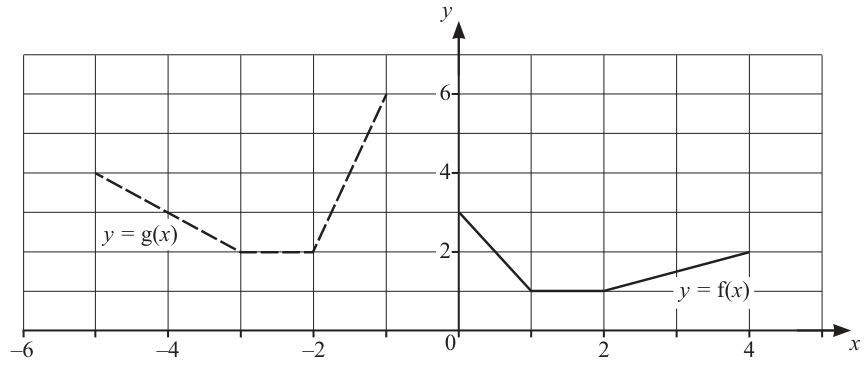
In the diagram, the graph with equation is shown with solid lines and the graph with equation is shown with broken lines.
Describe fully a sequence of three transformations which transforms the graph of to the graph of .
Approach
Identify key coordinates on both graphs to determine the sequence of transformations. Track how the vertices of map to the vertices of through reflection, stretch, and translation.
Working
Key points on :
, , ,
Key points on :
, , ,
Step 1: Reflection in the y-axis
Reflecting in the y-axis maps :
Step 2: Stretch parallel to the y-axis
Applying a stretch with scale factor 2 parallel to the y-axis maps :
Step 3: Translation
Comparing the intermediate points to :
Intermediate: , , ,
Target : , , ,
The y-coordinates match exactly. The x-coordinates are each decreased by 1. This corresponds to a translation by the vector .
The sequence of three transformations is:
- Reflection in the y-axis
- Stretch with scale factor 2 parallel to the y-axis
- Translation by
Answer
Reflection in the y-axis, stretch with scale factor 2 parallel to the y-axis, translation by .
Reflection in the y-axis, stretch scale factor 2 parallel to the y-axis, translation by (-1, 0)
Walkthrough
First, we extract the key coordinates (vertices) from both graphs. For , the vertices are , , , and . For , the vertices are , , , and .
By comparing the y-coordinates, we see that every y-value on is exactly double the corresponding y-value on (e.g., , , ). This immediately tells us there is a stretch with scale factor 2 parallel to the y-axis.
Next, we look at the x-coordinates. The original x-values are , and the target x-values are . The target values are negative, suggesting a reflection in the y-axis. Reflecting the original points gives x-values .
Finally, comparing the reflected x-values with the target x-values , we see that each target x-value is exactly 1 less than the reflected x-value. This means we need a translation by the vector .
The order of transformations matters. We applied reflection first, then stretch, then translation. This is a valid sequence that correctly maps to .
Key Takeaways
- Always identify key points (vertices, intercepts) on both graphs to determine transformations.
- Compare coordinates systematically: y-coordinates often reveal vertical stretches/compressions, while x-coordinates reveal horizontal reflections/stretches/translations.
- The order of transformations is critical; applying them in a different order may yield a different result or require different translation vectors.
Common Mistakes
- Giving the translation as 'left 1 unit' instead of the vector or 'shift left by 1'. Mark schemes often require the vector or precise terminology.
- Incorrectly ordering the transformations. For example, translating first and then reflecting will result in a different final position unless the translation vector is adjusted.
- Forgetting to specify the axis of reflection (e.g., just saying 'reflection' instead of 'reflection in the y-axis').
Things to Be Careful About
- Ensure the stretch is described as 'parallel to the y-axis' with the correct scale factor. A stretch parallel to the x-axis would affect the x-coordinates, not the y-coordinates.
- The translation vector must be written as . Writing just or 'left' may not be accepted depending on the specific mark scheme guidance.
- Verify the sequence by checking all key points. If one point doesn't map correctly, the sequence or vector is wrong.
Approach
Use the sequence of transformations found in part (a) to build the algebraic expression for . Apply the transformations in order to , remembering how each transformation affects the function notation.
Working
Starting with :
1. Reflection in the y-axis
Replace with :
2. Stretch with scale factor 2 parallel to the y-axis
Multiply the entire function by 2:
3. Translation by
Replace with , which is :
Thus, .
Comparing this to the form :
, , .
Answer
where , , .
g(x) = 2f(-x - 1)
Walkthrough
To find the expression for , we apply the transformations from part (a) sequentially to the function .
Step 1: Reflection in the y-axis
A reflection in the y-axis negates the input variable . So, becomes .
Step 2: Stretch with scale factor 2 parallel to the y-axis
A vertical stretch by a factor of 2 multiplies the output of the function by 2. So, becomes .
Step 3: Translation by
A translation by a vector replaces with and with . Here, and . So we replace with .
Substituting into our current expression :
Expanding the inner term:
This matches the required form with , , and .
Key Takeaways
- Reflection in the y-axis:
- Vertical stretch by scale factor :
- Translation by :
- Always apply transformations in the correct order, and remember that horizontal transformations (reflections, stretches, translations) affect the inside the function argument, while vertical transformations affect the entire function output.
Common Mistakes
- Forgetting to apply the translation to the inside the function argument. For example, writing instead of . The translation is a horizontal shift, so it must be applied to .
- Incorrectly handling the negative sign in the reflection. Reflecting and then translating by requires replacing with , giving . A common error is writing .
- Confusing the order of operations. If you translate first and then reflect, the algebraic expression will be different.
Things to Be Careful About
- The form requested is . Ensure your final expression is fully expanded inside the function argument so it matches this form exactly. is correct but should be simplified to to clearly show and .
- Check the signs carefully. is the coefficient of , and is the constant term. In , and .
The first term of a convergent geometric progression is 10. The sum of the first 4 terms of the progression is and the sum of the first 8 terms of the progression is . It is given that .
Find the two possible values of the sum to infinity.
Approach
Write the sums of the first 4 and first 8 terms using the geometric progression sum formula. Form the ratio , simplify it using the factorisation , solve for , then use the sum to infinity formula on the convergent values of .
Working
Let the common ratio be . Since the progression is convergent, .
The sum of the first terms is
Therefore
Given :
Since , this becomes
So
Hence . (The factorised form also gives , i.e. , but these are not convergent and are rejected.)
For a convergent geometric progression,
If :
If :
Answer
20 and 20/3
Walkthrough
We know the first term is and the common ratio is some value . The sum of the first terms of a geometric progression is
Here and . The condition means we should form the ratio of these two sums.
When we divide by , the common factor cancels, leaving
This is the key simplification: we do not need to know yet, but we can simplify the expression using the difference of squares factorisation
so the ratio becomes . Setting this equal to gives , so . The factorisation also produces , but would make the progression non-convergent and the sum to infinity formula invalid, so those values are rejected.
Finally, the sum to infinity of a convergent geometric progression is
with . Substituting gives , and substituting gives .
Key Takeaways
This question tests the formula for the sum of the first terms of a geometric progression, the sum to infinity formula, and the convergence condition . It also tests algebraic simplification: recognising that can be factorised as makes the ratio much easier to solve.
Common Mistakes
- Forming the ratio as instead of .
- Forgetting that the factor cancels, and trying to solve a more complicated equation.
- Writing as directly without using the factorisation.
- Only taking the positive root and missing .
- Including in the final answer; these are not convergent and do not give valid sums to infinity.
- Giving only one value of when two are required.
Things to Be Careful About
- The condition is , so is the sum of the first 8 terms and is the sum of the first 4 terms.
- The equation has two real solutions, . Do not confuse this with , which would give .
- The sum to infinity formula is only valid when . Both and satisfy this, but do not.
- The mark scheme allows or better for , but the exact value is preferred.
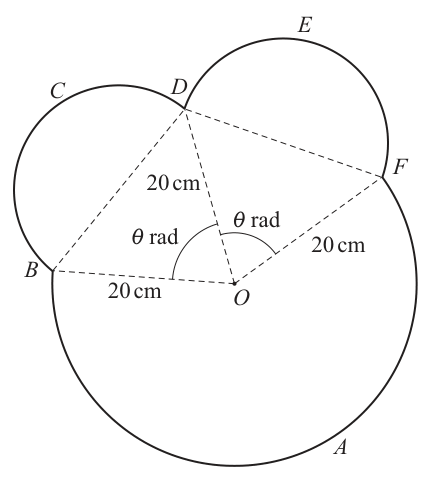
The diagram shows a metal plate consisting of five parts. The parts and are semicircles. The part is a sector of a circle with centre and radius 20 cm, and lies on this circle. The parts and are triangles. Angles and are both radians.
Given that , find the area of the metal plate. Give your answer correct to 3 significant figures.
Approach
The metal plate ABCDEF is composed of four distinct regions:
- The major sector BAFO (the large circular sector with angle )
- Two triangles and
- Two semicircles on diameters and
We calculate each area separately and sum them.
Working
Step 1: Area of sector BAFO
The angle and , so . The sector BAFO is the major sector, so its angle is .
With and radius :
Step 2: Length (and )
In , and . Using the cosine rule:
Alternatively, using the half-angle identity:
Since as well, .
Step 3: Area of the two semicircles
The radius of each semicircle is .
Step 4: Area of the two triangles
Using the formula for and :
Step 5: Total area
Rounding to 3 significant figures:
Answer
1550
Walkthrough
Step 1: The plate is a composite shape. The large sector BAFO is the major sector of a circle of radius 20 cm, with central angle (since and the sector goes the long way around through A). With , this angle is . We use the sector area formula .
Step 2: To find the semicircle areas, we need the diameter . In triangle OBD, we know two sides () and the included angle (). The chord length formula gives . This is equivalent to applying the cosine rule and simplifying using .
Step 3: Each semicircle has radius . Two semicircles together form a full circle, so their combined area is .
Step 4: The triangles OBD and ODF each have two sides of length 20 and included angle . Using , each has area , giving a total of .
Step 5: Sum all three contributions: sector + triangles + semicircles , which rounds to cm² to 3 significant figures.
Key Takeaways
- Composite areas can be decomposed into simpler geometric shapes (sectors, triangles, circles).
- The chord length formula is a useful shortcut when two radii and the central angle are known.
- The area formula is essential for triangles where two sides and the included angle are given.
- Always verify which sector (major or minor) is being referenced by checking the diagram.
Common Mistakes
- Using the minor sector angle instead of the major sector angle . The sector BAFO goes through A, which is the long way around.
- Forgetting that two semicircles on equal diameters combine to a full circle, or miscalculating the radius as instead of .
- Using instead of in the triangle area formula.
- Not converting the final answer to the required number of significant figures.
Things to Be Careful About
- The angle is in radians throughout — ensure your calculator is in radian mode.
- The sector BAFO is the major sector (angle ), not the minor sector between OB and OF.
- When computing , note that , not .
- The mark scheme accepts rounded to 3 sf as , but be careful with intermediate rounding — carry at least 4–5 significant figures through the calculation.
Given instead that the area of each semicircle is , find the exact perimeter of the metal plate.
Approach
Given the area of each semicircle is cm², we first find the radius of the semicircles, then use this to determine . Finally, we calculate the perimeter of the metal plate from the arc lengths.
Working
Step 1: Find the radius of the semicircles
Each semicircle has area :
Step 2: Find
The radius of each semicircle is half the chord length :
Setting this equal to 10:
Since is a positive angle less than :
Step 3: Arc length of sector BAFO
The central angle of the major sector BAFO is .
Step 4: Arc lengths of the semicircles
Each semicircular arc has length cm. There are two such arcs (BCD and DEF):
Step 5: Total perimeter
The perimeter of the metal plate consists of the major arc BAFO and the two semicircular arcs:
Answer
140π/3
Walkthrough
Step 1: From the semicircle area formula , we solve directly for cm. This is the radius of each small semicircle.
Step 2: The chord is the diameter of the semicircle, so cm. In triangle OBD with and , the chord length is . Setting gives , so and .
Step 3: The perimeter of the plate is formed by three curved arcs only — the straight lines , , , , and are all internal to the plate. The boundary consists of:
- The major arc from B through A to F: length
- The semicircular arc from B through C to D: length
- The semicircular arc from D through E to F: length
Step 4: Adding these: cm.
Key Takeaways
- The perimeter of a composite shape may consist entirely of curved arcs if straight edges are internal.
- Working backwards from area to find an angle, then using that angle for perimeter calculations, is a common two-stage approach.
- Exact values like should be used to give exact answers in terms of .
- Always identify which edges form the boundary versus which are internal to the shape.
Common Mistakes
- Including straight internal edges (like , , , ) in the perimeter calculation. These are not on the boundary of the plate.
- Using the wrong sector angle — the arc BAFO is the major arc with angle , not .
- Forgetting that the perimeter of a semicircular arc (not the full semicircle) is , not .
- Not expressing the final answer as a single exact term involving .
Things to Be Careful About
- The question asks for the perimeter of the metal plate, which is the outer boundary only. All internal lines (radii and chords) are not part of the perimeter.
- The answer must be a single exact term — combine the fractions over a common denominator.
- is in radians, so all arc length calculations use radians directly: .
- The mark scheme requires the answer as or equivalently ; decimal approximations are not accepted.
Approach
Complete the square by first factoring out the coefficient of , then completing the square inside the bracket and simplifying the constants.
Working
So and .
Answer
3(x - 2)^2 + 2
Walkthrough
We want to write the quadratic in the form . Start by taking out the factor of from the and terms: . Inside the bracket, complete the square: . Then multiply the by the factor to get , and combine with the constant to obtain . This gives , so and .
Key Takeaways
Completing the square with a leading coefficient requires factoring that coefficient out first. The completed-square form reveals the vertex of the parabola and is useful for finding inverses and solving equations.
Common Mistakes
Forgetting to multiply the subtracted square constant by the factor when removing the bracket. For example, writing instead of .
Things to Be Careful About
The value of is , not , because the vertex form is . Keep the factor outside the bracket throughout.
The function is defined for , where is a constant.
Find the least value of for which the function exists.
Approach
A quadratic function is one-one only on one side of its line of symmetry. The completed square form shows the vertex is at , so the domain must be restricted to (or ). The least value of is therefore the -coordinate of the vertex.
Working
From part (a),
The vertex is at . For the inverse to exist, must be one-one, so the domain must be restricted to one side of the vertex. Thus the least value is
Answer
k = 2
Walkthrough
The function is a quadratic with a minimum point. A quadratic is not one-one over its whole domain because it decreases up to the vertex and then increases. To make it one-one, choose a domain on one side of the vertex. From part (a), , so the vertex is at . Restricting to makes the function increasing and therefore one-one. The least such is .
Key Takeaways
An inverse exists only if the function is one-one. For a quadratic, this is achieved by restricting the domain to either side of its line of symmetry.
Common Mistakes
Writing or instead of . The question asks for the value of , not the domain variable.
Things to Be Careful About
The mark scheme accepts as equivalent, but the least value is . Do not confuse the variable in the domain with the constant .
For the rest of this question, you should assume that has the value found in part (b).
Find an expression for .
Approach
Set using the completed square form, rearrange to make the subject, and use the restricted domain to choose the positive square root. Finally replace by to write the inverse function.
Working
Let
Subtract and divide by :
Since the domain is , take the positive square root:
So
Interchanging and gives the inverse function:
Answer
f^-1(x) = sqrt((x-2)/3) + 2
Walkthrough
To find the inverse, write using the completed square form. Rearrange to isolate . Subtract from both sides and divide by to get . Since the domain was restricted to , is non-negative, so take the positive square root: . Add to get in terms of . Finally, replace with to write the inverse function in the usual notation.
Key Takeaways
Finding an inverse involves swapping the roles of input and output. The restricted domain determines which square root to take. The completed-square form makes the rearrangement straightforward.
Common Mistakes
Taking the negative square root, which would give the inverse for the wrong branch. Forgetting to swap and at the end. Omitting the when writing the final expression.
Things to Be Careful About
The positive root is required because . The final expression can also be written as , which is equivalent to the answer above.
Approach
Since has an inverse on the restricted domain, apply to both sides of . This gives . Evaluate , then solve the resulting quadratic equation, discarding any solution outside the domain .
Working
Using the inverse from part (c):
Therefore
Using the completed square form:
Subtract and divide by :
So
giving or . Since the domain of is , discard .
Answer
x = 3
Walkthrough
The equation means apply twice to and get . Because is one-one on the restricted domain, we can apply to both sides: . Evaluate using the formula from part (c): . So we need . Using , solve , giving , so or . Since is only defined for , is not in the domain and must be discarded. The solution is .
Key Takeaways
Applying an inverse function to both sides of an equation is a powerful way to solve composite equations. Always check solutions against the domain of the original function.
Common Mistakes
Forgetting to discard when using the direct method. Alternatively, expanding and solving a quartic without noticing the domain restriction can produce extra roots. The mark scheme allows either method but requires to be discarded if it appears.
Things to Be Careful About
The domain restriction is essential: is algebraically valid but outside the domain. When using the inverse method, the inverse formula is only valid for . Be careful with the order of operations when evaluating .
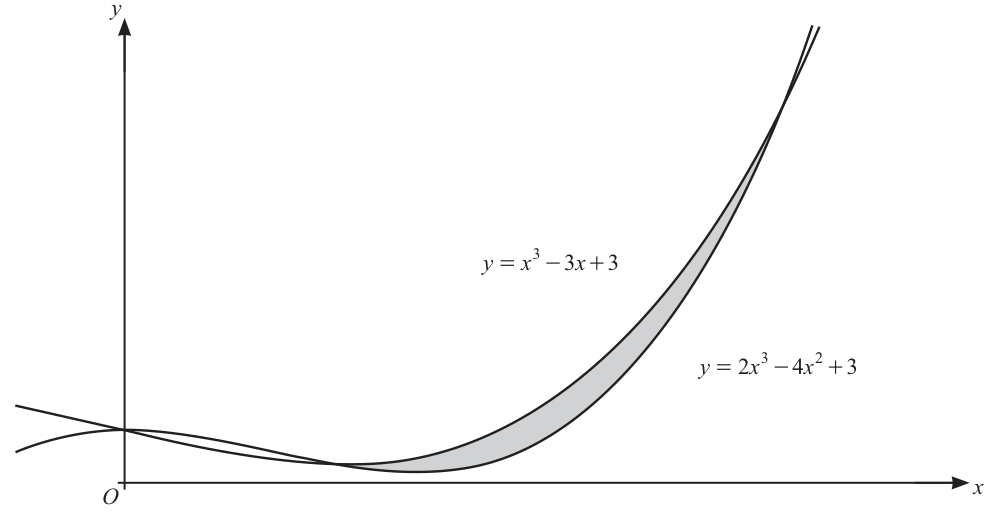
The diagram shows the curves with equations and .
Approach
Set the two curve equations equal to each other and solve the resulting equation for .
Working
Rearranging all terms to one side:
Factor out the common factor :
Factor the quadratic expression:
Setting each factor to zero gives:
Answer
x = 0, x = 1, x = 3
Walkthrough
To find the points of intersection of two curves, we set their equations equal to each other. This gives . Moving all terms to one side simplifies to . We notice every term contains a factor of , so we factor it out to get . The quadratic factors into since and . Setting each factor to zero yields the three intersection x-coordinates: , , and .
Key Takeaways
- Intersection points of curves are found by equating their equations.
- Cubic equations with a common factor can be reduced to a linear times a quadratic.
- Factorising quadratics by finding two numbers that multiply to the constant term and add to the coefficient of .
Common Mistakes
- Forgetting to move all terms to one side before factoring.
- Not factoring out the common term, leading to an incomplete solution (missing ).
- Incorrect factorisation of the quadratic .
Things to Be Careful About
- The mark scheme notes that may be seen in the working and is a valid answer even if not explicitly stated as a final answer.
- Ensure all three roots are found; awarding only and without the method marks is not acceptable.
Approach
From the diagram, the shaded region lies between and . The curve is above in this interval. The area is found by integrating the difference (upper curve minus lower curve) from to .
Working
Simplify the integrand:
Integrate term by term:
Substitute the upper limit :
Substitute the lower limit :
Compute the area:
Answer
8/3
Walkthrough
The shaded region is bounded by the two curves between their intersection points at and . From the diagram, is the upper curve and is the lower curve in this interval. The area between two curves and where on is .
Subtracting the lower curve from the upper curve: .
Integrating term by term: .
Evaluating at : .
Evaluating at : .
Subtracting: .
Key Takeaways
- The area between two curves is .
- Always verify which curve is on top in the interval of integration.
- Careful fraction arithmetic is essential when evaluating at multiple limits.
- The constant of integration cancels out in definite integrals.
Common Mistakes
- Using the wrong limits (e.g., including which is outside the shaded region).
- Subtracting the curves in the wrong order, giving a negative area.
- Arithmetic errors when evaluating fractions at the limits.
- Forgetting to substitute both limits and subtract.
Things to Be Careful About
- The mark scheme explicitly states not to allow as a limit; only and are correct for the shaded region.
- If two separate integrals are used, substitution must be applied to both.
- One sign error is allowed in each expression if brackets are shown, but the final answer must be correct.
- Accept AWRT 2.67 as equivalent to .
Points and have coordinates and respectively. A circle with radius 10 passes through the points and .
Approach
The centre of a circle is equidistant from and , so it lies on the perpendicular bisector of . Find the midpoint and gradient of , then use the perpendicular gradient to write the equation of the perpendicular bisector.
Working
Gradient of :
Midpoint of :
The perpendicular bisector has gradient the negative reciprocal of :
Using point-slope form through :
Simplify:
Answer
The centre of the circle lies on the line .
y = 1/2 x - 4
Walkthrough
Since and are both on the circle, the centre is the same distance from both points. The set of points equidistant from and is the perpendicular bisector of the segment . We first find the gradient of using the coordinates. Then we find the midpoint of , because the perpendicular bisector passes through the midpoint. The perpendicular bisector is perpendicular to , so its gradient is the negative reciprocal of the gradient of . Using the point-slope form of a line with this gradient and the midpoint gives the required line. Simplifying the equation shows that the centre lies on .
Key Takeaways
The perpendicular bisector of any chord of a circle passes through the centre of the circle. To find it, find the gradient and midpoint of the chord, then use the negative reciprocal gradient through the midpoint.
Common Mistakes
- Forgetting to take the negative reciprocal of the gradient of .
- Using the midpoint incorrectly or not finding it.
- Substituting the midpoint into the wrong line form.
- For part (a), the answer is given, so the working must be shown; an unsupported answer is not accepted.
Things to Be Careful About
The coordinates of and must be substituted in the correct order: and . When simplifying , remember to subtract from correctly to obtain .
Approach
From part (a), the centre lies on . Write the centre as . Since the radius is 10, the square of the distance from to is 100. Substitute the coordinates of into the circle equation, solve the resulting quadratic for , and then write the two possible circle equations.
Working
Let the centre be . Using point :
Simplify the second bracket:
So:
Expand:
Therefore:
Multiply through by 4:
Divide by 5:
Factorise:
So or .
Corresponding -coordinates:
Thus the centres are and . With radius 10, the two circle equations are:
and
Answer
The two possible equations are and .
(x - 14)^2 + (y - 3)^2 = 100 and (x + 2)^2 + (y + 5)^2 = 100
Walkthrough
From part (a), the centre lies on the line , so any centre can be written as . The circle has radius 10, so the square of the distance from the centre to any point on the circle is 100. Using point , we get an equation in . Expand both squared brackets, combine like terms, and simplify to a quadratic. Solve the quadratic to find two values of . For each value, compute the corresponding -coordinate from the line. Then write the equation of a circle with each centre and radius 10.
Key Takeaways
The equation of a circle with centre and radius is . When the centre is constrained to lie on a line, substitute the line equation into the circle equation to get a single-variable equation. A quadratic produces two possible circles because two circles of the same radius can pass through the same two points.
Common Mistakes
- Forgetting to use the radius squared: the right-hand side must be , not .
- Sign errors when expanding or .
- Losing one of the two solutions when solving the quadratic.
- Not using the line equation to find the -coordinate of each centre.
- Writing the final equation with the wrong signs for the centre coordinates.
Things to Be Careful About
Check that both centres satisfy the line from part (a): and both give . When writing the final circle equations, match the signs to the centre: for centre , the equation is , not .
The equation of a curve is , where is a constant.
Approach
Differentiate term by term using the power rule, then differentiate the result to find the second derivative.
Working
Given
Differentiate with respect to :
Differentiate again:
Answer
dy/dx = (1/2)kx^(-1/2) - 8x; d^2y/dx^2 = -(1/4)kx^(-3/2) - 8
Walkthrough
The curve is a sum of three terms. Differentiate term by term: the derivative of is because the constant is carried along; the derivative of is ; and the derivative of the constant is . Then differentiate to get the second derivative: the derivative of is , and the derivative of is .
Key Takeaways
This question tests the power rule for fractional powers, the fact that constants multiply through derivatives, and the idea that the second derivative is just the derivative of the first derivative.
Common Mistakes
A common error is forgetting that the derivative of the constant is . Another is subtracting the exponent incorrectly: becomes , not . Sign errors are also common when differentiating to .
Things to Be Careful About
Keep as an unknown constant throughout. Use fractional powers consistently. The mark scheme awards one mark for each correct derivative, so both and must be stated clearly.
It is given that .
Find the coordinates of the stationary point and determine its nature.
Approach
Set , so . At a stationary point the first derivative is zero. Solve this equation for , find the corresponding , then use the sign of the second derivative to determine the nature.
Working
With , the curve is
From part (a),
Set :
Multiply through by :
So
Raise both sides to the power :
Now find :
For the nature, with ,
At :
Since ,
Therefore the stationary point is a maximum.
Answer
The stationary point is and it is a maximum.
(1/4, 11/4), maximum
Walkthrough
Substitute into the first derivative found in part (a). At a stationary point, , so set . Multiplying by gives , which avoids introducing an unwanted solution. Then , so raising both sides to the power gives . Substitute this into the curve equation to get . Finally, substitute into ; the result is , so the point is a maximum.
Key Takeaways
This question combines solving a fractional-power equation with the second-derivative test for stationary points. It also reinforces that a stationary point requires both coordinates, and that the sign of the second derivative determines whether it is a maximum or minimum.
Common Mistakes
The mark scheme warns that squaring directly to is not a valid method and scores M0. Including as a solution is also penalised because is undefined at . Another common mistake is stopping after finding and not calculating or determining the nature.
Things to Be Careful About
Use the multiplication by method rather than squaring. Remember that is not in the domain of the original derivative. The mark scheme allows follow-through on the second derivative using your own -value, but only if is not the only solution.
Points and on the curve have -coordinates 0.25 and 1 respectively. For a different value of , the tangents to the curve at the points and meet at a point with -coordinate 0.6.
Find this value of .
Approach
For each tangent, find the y-coordinate and gradient at the given x-coordinate, write the tangent equation, then substitute into both equations and solve for .
Working
The curve is
At :
Tangent at :
Equivalently,
At :
Tangent at :
Equivalently,
The tangents meet at . Substitute into both tangent equations and equate:
Simplify:
Answer
k = 3
Walkthrough
For each of the two points, compute the -coordinate from the curve and the gradient from . At , the point is and the gradient is . Use point-slope form to write the tangent. At , the point is and the gradient is ; write its tangent similarly. Because the two tangents meet at , substitute into both tangent equations and set the right-hand sides equal. This gives a linear equation in ; solving it gives .
Key Takeaways
This problem tests the application of differentiation to tangents: finding the gradient at a point, writing the tangent equation, and using the intersection of two lines to set up an equation for an unknown parameter.
Common Mistakes
The mark scheme warns that if the constants in both tangent equations are taken to be the same, the method mark is lost. It is also a common error to forget to substitute after equating, or to make arithmetic slips with decimals and fractions. Unsupported answers are not accepted, so all tangent equations and the substitution must be shown.
Things to Be Careful About
Check that each tangent uses the correct point and gradient. Simplify the tangent equations carefully before substituting. Use consistent arithmetic with if preferred. The final value must be reached by a clear method; the mark scheme awards method marks for each tangent equation and for equating them at .