Mathematics 9709/12 — October/November 2024
Cambridge AS Level · Pure Mathematics 1 · worked solutions for every part, with the mark scheme
Topics Quadratics · Series · Differentiation · Integration · Trigonometry · Functions · +2 more
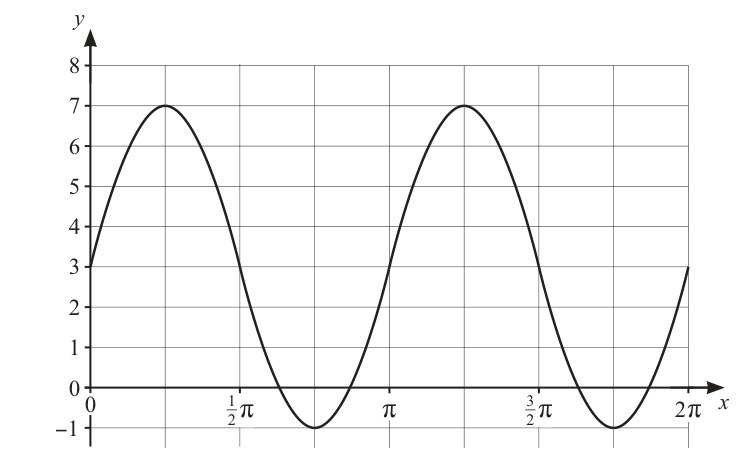
The diagram shows the curve with equation for , where , and are positive constants.
Approach
The equation is . From the graph, we can determine (amplitude), (vertical shift/midline), and (related to the period).
Working
- Find (vertical shift):
The maximum value is and the minimum value is . The midline is the average:
- Find (amplitude):
The amplitude is the distance from the midline to the maximum (or minimum):
(Since is positive, .)
- Find :
The graph completes 2 full cycles between and . Therefore, the period is:
For , the period is . So:
Answer
a = 4, b = 2, c = 3
Walkthrough
The problem asks for the constants , , and in the equation based on the provided graph.
- Vertical shift (): The graph oscillates between a maximum of 7 and a minimum of -1. The midline (equilibrium position) is exactly halfway between these extremes: . Thus, .
- Amplitude (): The amplitude is the distance from the midline to the peak. Peak is 7, midline is 3, so amplitude is . Since is positive, .
- Frequency/Period (): The graph shows two complete sine waves between and . A standard sine wave has period . Here, the period is . The coefficient inside the sine function scales the period to . Setting gives .
Key Takeaways
- The parameter in represents the vertical translation (midline).
- The parameter represents the amplitude (max displacement from midline).
- The parameter determines the period: Period .
Common Mistakes
- Confusing the period with the number of cycles. The graph has 2 cycles in , so the period is , not .
- Forgetting that is given as positive, though amplitude is always positive anyway.
Things to Be Careful About
- Ensure units are consistent. The x-axis is in radians (indicated by ), so the period formula uses .
- Reading the minimum value correctly from the y-axis (it is -1, not 0 or 1).
For these values of , and , determine the number of solutions in the interval for each of the following equations:
Approach
We need to find the number of solutions to for . This is equivalent to finding the number of intersections between the curve and the line .
Working
Let and .
- oscillates between -1 and 7 with period .
- is a straight line with y-intercept 7 and x-intercept 7.
We check values at key points (multiples of ):
- At : , . ()
- At : , . () → Intersection 1 between 0 and .
- At : , . () → Intersection 2 between and .
- At : , . ()
- At : , . ()
- At : , . () → Intersection 3 between and .
- At : , . ()
- At : , . () → Intersection 4 between and .
- At : , . () → Intersection 5 between and .
Since is continuous and changes relative position to at each of these intervals, there are 5 solutions.
Answer
5
5
Walkthrough
We are solving . Instead of solving algebraically (which is impossible here), we treat this as finding the intersection of and .
- The curve has max 7, min -1, midline 3, period .
- The line starts at and goes down with slope -1, ending at .
- At , line (7) is above curve (3). At the first peak , curve (7) is above line (). They must cross once.
- At , curve (3) is below line (). They cross again.
- The curve goes down to -1 and back to 3 at . The line is at . Line is still above curve at .
- At the second peak , curve (7) is above line (). They cross.
- At , curve (3) is above line ().
- At , curve (-1) is below line (). They cross.
- At , curve (3) is above line (). They cross.
Total crossings: 5.
Key Takeaways
- Equations mixing trig and linear functions are best solved graphically or by analyzing intersections.
- Checking values at key points (peaks, troughs, midline crossings) helps determine the number of solutions.
Common Mistakes
- Assuming there is only 1 or 2 solutions without checking the full range.
- Miscalculating the value of the line at key x-values.
Things to Be Careful About
- The interval is . Ensure the line doesn't go below the curve's minimum (-1) before the end of the interval. At , line is , so it's still within range.
- The line has a y-intercept of 7, which is the maximum of the sine curve. This means at , the line is at the max height, but the sine curve is at the midline.
Approach
We need to find the number of solutions to for . This is equivalent to finding the number of intersections between and .
Working
Let and .
- oscillates between -1 and 7.
- is a straight line passing through with slope .
Check key values:
- At : , . ()
- At : , . ()
- At : , . () → Intersection between 1 and .
- For , increases rapidly. At , , which is well above the maximum of (which is 7).
- Since for , and , there can be no further intersections for .
- We verified that between and , the line crosses from below to above the curve. Before , is negative (below -1), so no intersection.
Thus, there is only 1 solution.
Answer
1
1
Walkthrough
We solve .
- Curve is bounded between -1 and 7.
- Line passes through and has a steep positive slope ().
- At , line is at (below curve min -1). Curve is at 3. No intersection near 0.
- At , line is at 0. Curve is at . Curve is above line.
- At , line is at . Curve is at 3. Line is now above curve. They must have crossed once between and .
- For , the line continues to rise steeply. At , line is . At , line is 7 (max of curve). For all , the line is above 7, while the curve is at most 7. So no more intersections.
- Total solutions: 1.
Key Takeaways
- When one function is bounded (trig) and the other is unbounded linear, intersections are limited to where the linear function is within the range of the bounded function.
- Checking the value where the linear function exceeds the maximum of the trig function gives an upper bound for solutions.
Common Mistakes
- Assuming multiple intersections because the trig function oscillates. The linear function rises too fast.
- Forgetting that makes the line pass through , not the origin.
Things to Be Careful About
- The slope is large, so the line rises quickly out of the range .
- Ensure you check the value at carefully; is in radians, .
The first term of an arithmetic progression is and the common difference is .
Approach
Use the arithmetic progression sum formula with , , and .
Working
Answer
The sum of the first 20 terms is .
550
Walkthrough
We are told that the first term is and the common difference is . The formula for the sum of the first terms of an arithmetic progression is . Substituting , and gives the required sum. The first term is and the last term is , so the average of the first and last terms is , and .
Key Takeaways
This question tests the standard sum formula for an arithmetic progression. It also reminds you how to handle a negative first term carefully.
Common Mistakes
- Using the th term formula instead of the sum formula.
- Treating the last term as the 20th multiple of rather than .
- Sign errors when adding and .
Things to Be Careful About
Use the sum formula, not the term formula. Keep the negative first term in brackets so the sign is handled correctly.
It is given that the sum of the first terms is 10 times the sum of the first terms.
Find the value of .
Approach
Use the arithmetic progression sum formula for and . Then use the condition that is ten times , simplify to a quadratic equation, and solve for .
Working
For :
For :
The condition is . Therefore
Bring all terms to one side:
So or . Since represents a positive number of terms, .
Answer
k = 12
Walkthrough
We need to express and using the AP sum formula with and . Substituting gives . Substituting gives . The condition says the sum of the first terms is ten times the sum of the first terms, so we set . Expanding both sides gives , which simplifies to . Factoring gives , so or . The root corresponds to summing zero terms and is not meaningful in this context, so .
Key Takeaways
This question combines the arithmetic progression sum formula with algebraic equation solving. You must substitute and correctly, expand carefully, and solve the resulting quadratic.
Common Mistakes
- Using the term formula instead of the sum formula.
- Forgetting the factor when computing or when multiplying by 10.
- Expanding the brackets incorrectly, leading to sign errors.
- Keeping the trivial root instead of rejecting it.
Things to Be Careful About
Substitute into both and . When multiplying by 10, remember that , so . Finally, reject the trivial solution and state .
The equation of a curve is . Two points and with -coordinates 2 and respectively lie on the curve.
Approach
The gradient of a chord joining two points on a curve is the change in divided by the change in . We substitute the -coordinates of and into the curve equation to find the corresponding -values, then form the difference quotient and simplify.
Working
The -coordinate of (where ):
The -coordinate of (where ):
The gradient of chord is the difference in -coordinates divided by the difference in -coordinates:
Simplify:
Answer
8 + 2h or 2(h+4)
Walkthrough
We want the gradient of the chord . A chord is a straight line joining two points on the curve, so its gradient is given by the change in divided by the change in . Point has -coordinate 2 and point has -coordinate .
First, find the -coordinates. Substituting into gives . Substituting gives . Expand , so the -coordinate of is .
The gradient of the chord is the difference in -values divided by the difference in -values:
Factor out from the numerator: . Since and are distinct points, , so the cancels, leaving .
Key Takeaways
This question introduces the difference quotient, which is the foundation of differentiation from first principles. The gradient of a chord is the average rate of change of the function over the interval .
Common Mistakes
- Forgetting to subtract the -value of (which is 5) when forming the numerator.
- Expanding incorrectly — it must be , not .
- Failing to simplify the fraction fully to .
Things to Be Careful About
- The difference in -coordinates is , not .
- We may cancel the only because (the two points are distinct).
- The mark scheme accepts the simplified form or .
Explain how the gradient of the curve at the point can be deduced from the answer to part (a), and state the value of this gradient.
Approach
The gradient of a curve at a point is the limit of the gradient of a chord as the second point approaches the first. As , the chord becomes the tangent at . We therefore take the limit of the chord gradient from part (a) as tends to 0.
Working
As , the chord approaches the tangent at , so:
Answer
8
Walkthrough
The gradient of the curve at a point is the limit of the gradient of a chord as the second point approaches the first. Here, as tends to 0, the point moves towards , and the chord approaches the tangent to the curve at . Therefore we take the limit of the chord gradient from part (a) as :
So the gradient of the curve at is 8.
Key Takeaways
This is the essence of differentiation from first principles: the derivative at a point is the limit of the difference quotient. The gradient of the tangent at a point equals the limit of the chord gradients.
Common Mistakes
- Not stating that tends to 0 (or that the chord approaches the tangent) — this explanation is required for the first mark.
- Quoting the chord gradient as the answer instead of taking the limit.
Things to Be Careful About
- The mark scheme accepts either "" or "chord approaches the tangent at " as the explanation.
- The value 8 can be obtained from the linear expression in part (a) by substituting ; it is a follow-through mark, so it must come from a correct or consistent expression.
Find the term independent of in the expansion of each of the following:
Approach
Use the binomial theorem to write the general term of the expansion. The term independent of is the one in which the power of is , so set the exponent of equal to and solve for the binomial index . Then evaluate the coefficient.
Working
The general term in is
For the term independent of , the exponent of must be :
So the required term is
Answer
135
Walkthrough
The binomial expansion of is made up of terms of the form . Each such term has a power of equal to . To find the term independent of , we need the power of to be , so we solve , giving . This tells us which term in the expansion contributes the constant. We then evaluate . The coefficient is the binomial coefficient, and comes from the constant factor in the term.
Key Takeaways
This question tests the ability to use the binomial theorem in general form and to identify a particular term by setting the exponent of to the required value. The key idea is that the term independent of is the one whose -power is .
Common Mistakes
A common mistake is to use the wrong value of , such as , which gives a term in rather than a constant. Another is to forget the factor when evaluating the coefficient, giving instead of .
Things to Be Careful About
Make sure the exponent of is simplified correctly: . Also remember that the binomial coefficient is , not ; the division by is essential.
Approach
Write the general term of . When the whole product is expanded, the constant term receives two contributions: the term in from the bracket multiplied by , and the constant term from the bracket multiplied by . Find both terms, then combine them.
Working
The general term of is
For the term in , set , so :
For the term independent of , set , so :
Now expand the product. The only terms that can produce a constant are:
Answer
1485
Walkthrough
Start with the general term of the bracket. Multiplying by will lower the exponent of by ; multiplying by leaves the exponent unchanged. Therefore, to obtain a constant after multiplying by , we need the bracket term with exponent ; to obtain a constant after multiplying by , we need the bracket term with exponent .
For the term, solve , so . Its coefficient is , so the term is . For the constant term, solve , so . Its coefficient is .
Then combine the contributions: and . Adding gives .
Key Takeaways
This question extends the binomial expansion to a product of a linear expression and a binomial power. The important skill is identifying which terms of the bracket are needed to form a requested term after multiplication, rather than expanding the whole product.
Common Mistakes
A common mistake is to only find the constant term of the bracket, , and multiply by , forgetting the contribution from the term multiplied by . Another is to use for the term instead of , or to omit the factor when computing coefficients.
Things to Be Careful About
When multiplying by , the bracket term must contain so that the -powers cancel. Check the exponent calculation: . Also be careful with signs: the second contribution is , not .
The function is defined by for .
Approach
Substitute into the definition and simplify.
Working
Answer
1/3
Walkthrough
To find , substitute into . The numerator becomes and the denominator becomes . The fraction simplifies by cancelling the two negative signs to give .
Key Takeaways
- This question tests the basic skill of evaluating a function at a given input.
- Working carefully with negative numbers is essential when substituting into linear expressions.
Common Mistakes
- Forgetting to apply the negative sign to both terms inside the brackets (e.g. writing ).
- Leaving the answer as by missing that the two negative signs cancel.
Things to Be Careful About
- The mark scheme condones the decimal , so an unsimplified decimal is acceptable.
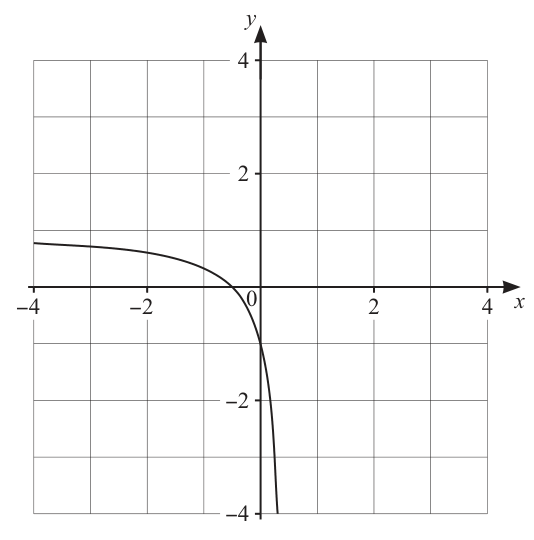
The diagram shows the graph of . Sketch the graph of on this diagram. Show any relevant mirror line.
Approach
The graph of is the reflection of the graph of in the line . Draw the mirror line first, then sketch the reflected curve on the same axes.
Working
The original curve has:
- a vertical asymptote at
- a horizontal asymptote at
- passes through and
Reflecting in the line swaps the - and -coordinates, so the curve has:
- a horizontal asymptote at
- a vertical asymptote at
- passes through and
The two curves must intersect on the line . Solving :
Only the negative root lies in the domain , so the curves intersect at approximately in the third quadrant.
Answer
The graph of is the reflection of in the line , intersecting the original curve in the third quadrant.
Reflection of y = f(x) in the line y = x, intersecting the original curve on y = x in the third quadrant.
Walkthrough
The graph of the inverse function is the mirror image of the graph of in the line . This follows from the definition of the inverse: if lies on the original graph (so ), then lies on the inverse graph (since ). Reflecting in the line swaps the coordinates to give , confirming the reflection property.
To sketch the inverse, first draw the line as a dashed mirror line. The original curve has a vertical asymptote at and a horizontal asymptote at . Under reflection, the vertical asymptote becomes a horizontal one at , and the horizontal asymptote becomes a vertical one at . The point on the original becomes on the inverse, and becomes .
The two curves must meet on the line . Solving gives , so . The negative root is approximately , which lies in the third quadrant.
Key Takeaways
- The graph of is the mirror image of in the line .
- Horizontal and vertical asymptotes swap under reflection.
- The original and inverse curves always meet on the line where they cross it.
Common Mistakes
- Translating the graph instead of reflecting it.
- Omitting the line (this loses a B1 mark).
- Drawing the asymptotes incorrectly on the reflected curve.
Things to Be Careful About
- The mark scheme requires the reflected curve's shape: to the left of the intersection, the reflection lies below the original and crosses the -axis; to the right of the intersection, the reflection lies to the right of the original.
Approach
Let , swap the variables, then solve for . The domain of equals the range of .
Working
Swapping and gives:
To find the domain of , determine the range of :
- As , the denominator while the numerator , so .
- As , from above.
Hence for all , so the range of is . This is the domain of .
Answer
f^{-1}(x) = (x+1)/(2(x-1)), domain x < 1
Walkthrough
Finding the inverse of a function requires solving for and then swapping the variable names. Start with . Multiply both sides by to clear the fraction, giving . Expand the left side: . Collect all terms in on the left by subtracting from both sides: . Factor out : . Divide by : . Finally, swap and to get .
The domain of the inverse is the range of the original function. As from below, the denominator approaches from below, while the numerator approaches (positive), so . As , the fraction tends to the ratio of leading coefficients, namely , approached from above. Therefore takes all values less than , i.e. its range is , which is the domain of .
Key Takeaways
- To find an inverse, set , swap variables, then solve.
- The domain of equals the range of , and vice versa.
- Vertical and horizontal asymptotes swap between and .
Common Mistakes
- Writing (no inversion performed).
- Sign errors when collecting the -terms.
- Stating the domain of as (the domain of ) instead of the range of .
- Writing the answer as , which is meaningless.
Things to Be Careful About
- The mark scheme accepts equivalent forms such as or , but NOT or fractions within fractions.
- Acceptable domain notations: , , . The notation is condoned but unconventional.
Approach
First evaluate the composite , then solve .
Working
Step 1: Find .
Step 2: Apply to this result.
Step 3: Solve .
Since , this value is in the domain of .
Answer
x = 3/8
Walkthrough
The notation means , the composition of after . We need to evaluate this at .
First compute the inner function: .
Next apply the outer function: .
Now solve , i.e. . Multiply both sides by to get . Collect -terms on the left and constants on the right: , so , giving .
Check the domain: , so this value is valid. As a sanity check, ✓
Key Takeaways
- The composition is evaluated right-to-left: first apply , then .
- Setting a rational function equal to a constant leads to a linear equation after clearing the denominator.
- Always check that solutions lie in the original function's domain.
Common Mistakes
- Confusing with (which would give a different value).
- Sign errors when clearing the fraction or applying .
- Not simplifying to .
Things to Be Careful About
- The mark scheme offers an alternative using the inverse: . This is a useful cross-check.
- The condition must be satisfied.
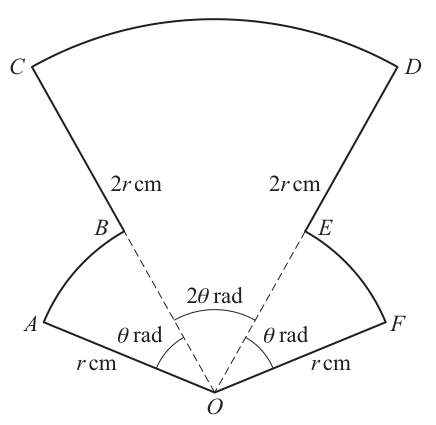
The diagram shows a metal plate consisting of sectors of two circles, each with centre . The radii of sectors and are and the radius of sector is . Angle and angle .
It is given that the perimeter of the plate is and the area of the plate is .
Given that and , find the values of and .
Approach
Use the formulas for arc length and sector area to express the perimeter and area of the plate in terms of and . Set up a system of two equations and solve for and , applying the given constraints to select the valid solution.
Working
The perimeter of the plate consists of the two straight radii and , the two arcs and , the two straight segments and , and the arc .
The lengths are:
- Arc Arc
- Arc
Summing these gives the perimeter:
Given that the perimeter is :
The area of the plate is the sum of the areas of the three sectors:
- Sector
- Sector
- Sector
Summing these gives the total area:
Given that the area is :
From the area equation, solve for :
Substitute this into the perimeter equation:
Multiply through by (since ):
Divide by 2:
Factorise the quadratic:
So or .
Given the constraint , we must have .
Substitute back into the expression for :
Check the constraint : is true.
Answer
r = 2, theta = 0.5
Walkthrough
First, we break down the boundary of the metal plate into its constituent parts to calculate the perimeter. The plate is made of three circular sectors sharing a common centre . The outer boundary consists of the straight lines and (length each), the arcs and (length each), the straight segments and which connect the inner and outer circles (length each), and the outer arc (length ). Adding these gives .
Next, we calculate the total area by summing the areas of the three sectors using the formula . The two smaller sectors have area each, and the larger sector has radius and angle , giving area . The total area is .
We now have a system of two equations. Solving the area equation for gives . Substituting this into the perimeter equation eliminates and yields a quadratic in : . Factorising gives or . The problem states , so we select . Finally, we find and verify it satisfies .
Key Takeaways
- The arc length formula is and the sector area formula is , where is in radians.
- Complex geometric shapes can be decomposed into simpler parts (sectors and straight lines) to find total perimeter and area.
- Simultaneous equations involving a linear and a quadratic relationship can be solved by substitution, often leading to a quadratic equation that must be solved and checked against given constraints.
Common Mistakes
- Forgetting to include the straight line segments and in the perimeter calculation. These have length each, not .
- Using the wrong radius or angle for the middle sector . Its radius is and its angle is , so its arc length is and area is .
- Failing to apply the given constraints ( and ) to reject the extraneous solution and .
Things to Be Careful About
- Always ensure angles are in radians when using the arc length and sector area formulae.
- Check both constraints given in the question. The quadratic yields two valid mathematical solutions, but only one satisfies the physical or stated conditions of the problem.
- When substituting into the perimeter equation, remember to multiply by to clear the denominator, being careful not to lose the case (which is invalid here since ).
By expressing in the form , where , and are positive integers, find the coordinates of the vertex of the graph with equation .
Approach
Complete the square for by factoring out from the quadratic and linear terms, then completing the square inside the brackets. The vertex coordinates can be read directly from the form .
Working
Factor out from the first two terms:
Complete the square inside the brackets. Half of is , so:
Substitute back:
Expand and simplify:
So , , , all positive integers as required.
The vertex of the parabola is at .
Answer
The vertex is at .
(2, 19)
Walkthrough
We need to express in the form . First, factor out from the and terms, giving . Next, complete the square inside the brackets: becomes because half of is , and we must subtract to keep the expression equivalent. Substituting back gives . This is now in the required form with , , . The vertex of a parabola is always at , so the vertex is .
Key Takeaways
- Completing the square for a quadratic with a negative leading coefficient requires factoring out the negative first.
- The vertex form immediately gives the vertex coordinates as .
- Always verify that the values of , , satisfy any given conditions (here, positive integers).
Common Mistakes
- Forgetting to distribute the across the constant term when expanding , leading to an incorrect value of .
- Writing the completed square as instead of .
Things to Be Careful About
- The question requires , , to be positive integers. After completing the square, check that all three values satisfy this condition.
- The vertex is , not or .
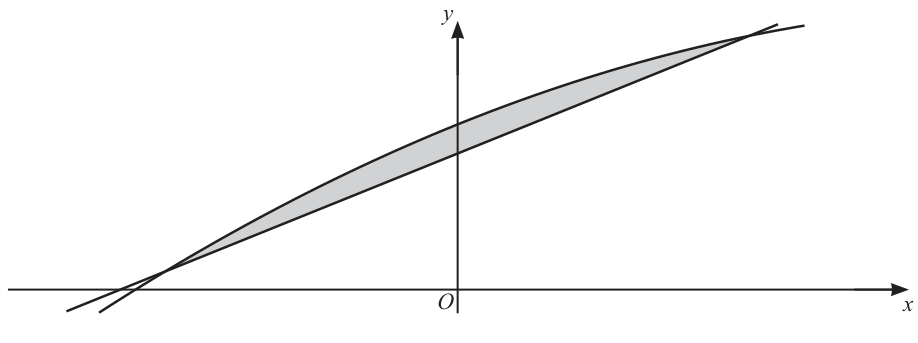
The diagram shows part of the curve with equation and the line with equation .
Find the area of the shaded region.
Approach
Find the -coordinates of the intersection points by equating the curve and the line. The shaded region is bounded above by the curve and below by the line between these two -values. Integrate the difference (curve line) from the lower to the upper intersection point.
Working
Find the points of intersection by setting the equations equal:
Simplify by subtracting from both sides:
The region is bounded between and .
Set up the integral for the area. The curve is above the line in this region:
Simplify the integrand:
Integrate:
Apply the upper limit :
Apply the lower limit :
Subtract:
Answer
The area of the shaded region is square units.
8/3
Walkthrough
First, find where the curve and line intersect by equating their equations: . The terms cancel, leaving , which gives and so . These are the limits of integration.
Next, set up the integral for the shaded area. From the diagram, the curve is above the line between and , so the area is . The integrand simplifies to .
Integrate to get . Evaluate at the upper limit : . Evaluate at the lower limit : . Subtract the lower from the upper: .
Key Takeaways
- To find the area between a curve and a line, first find the intersection points to determine the limits of integration.
- Always subtract the lower function from the upper function inside the integral to ensure a positive area.
- The terms cancel in this problem, making the integrand a simple quadratic.
Common Mistakes
- Using incorrect limits of integration (e.g., forgetting the negative intersection point ).
- Integrating the curve and line separately and subtracting the results incorrectly, leading to sign errors.
- Mistaking the triangular region for a trapezium and using the wrong area formula, which gives instead of .
- Getting a negative answer like due to subtracting in the wrong order.
Things to Be Careful About
- Check which function is on top in the region between the intersection points. Here, the curve is above the line, so integrate (curve line).
- The mark scheme condones a sign error in the final answer (accepting ), but the working must show the correct application of limits.
- Ensure the integration is performed correctly: , not .
The equation of a circle is , where and are constants.
Express the equation in the form , where is to be given in terms of and is to be given in terms of and .
Approach
Complete the square separately for and , then rearrange so the constant terms are on the right.
Working
For :
For :
Substitute into the circle equation:
So
In the required form:
Answer
, , .
a = -p/2, b = -1, r^2 = p^2/4 + 1 - q
Walkthrough
We start with . The goal is to rewrite it as , which reveals the centre and radius .
For the -terms, complete the square:
This is because expanding gives , so we subtract to keep the expression equal.
For the -terms:
Substitute both into the original equation and move the constant terms to the right-hand side:
So , and .
Key Takeaways
Completing the square is the standard way to convert a general circle equation into centre-radius form. The centre is found by reading the signs inside the brackets; the radius squared is the constant on the right.
Common Mistakes
- Forgetting to subtract and after completing the square.
- Writing the -coordinate of the centre as instead of .
- Mixing up the sign of when moving it to the right-hand side.
Things to Be Careful About
The form asked for is , so the centre's -coordinate is , not . The mark scheme accepts either the completed-square expression or an equivalent form such as .
The line with equation is the tangent to the circle at the point .
Approach
The tangent line is . Find its gradient, then use the perpendicular gradient rule to get the gradient of the normal. Finally write the normal through .
Working
From the tangent line:
So the tangent gradient is
For the normal, , so
The normal passes through :
Answer
y = 2x - 5
Walkthrough
The tangent line is . Rearranging gives , so its gradient is . A normal is perpendicular to the tangent, so the product of their gradients is : , hence .
Since the normal passes through , use the point-gradient form:
which simplifies to .
Key Takeaways
For a circle, the tangent and normal at a point are perpendicular. The gradient of a line in the form can be read as .
Common Mistakes
- Using the tangent gradient as the normal gradient.
- Forgetting to take the negative reciprocal.
- Substituting the wrong point into the line equation.
Things to Be Careful About
The normal equation is used again in part (b)(ii) to find the centre, so keep it as . The mark scheme allows with found by substituting .
Approach
The normal at a point on a circle passes through the centre. Use the centre from part (a) in the normal equation to find . Then use the radius-squared expression from part (a) and the distance from the centre to to find .
Working
The centre is
Since lies on the normal :
So the centre is .
From part (a),
The distance squared from to is
Equating:
Answer
p = -4, q = -15
Walkthrough
The centre of the circle from part (a) is . A key fact for circles is that the normal at a point on the circle passes through the centre. Since the normal is , substitute the centre coordinates into this line:
This gives , so . The centre is therefore .
To find , use the radius. From part (a),
With , this is . The radius is also the distance from the centre to :
Equating gives , so .
Key Takeaways
This part combines the completed-square form of a circle with the fact that the normal passes through the centre. It also uses the distance formula, since the radius is the distance from the centre to any point on the circle.
Common Mistakes
- Using the tangent line instead of the normal line to find .
- Forgetting that the normal passes through the centre.
- Substituting incorrectly into ; with , .
- Sign error when solving , giving instead of .
- Giving final values without showing a method; the mark scheme requires method marks.
Things to Be Careful About
The mark scheme permits several methods. One alternative is to substitute directly into the original circle equation to get , then use to find . Whichever method is used, the final values must be consistent with the centre and radius found earlier.
The equation of a curve is and the equation of a line is , where and are constants with .
It is given that one of the points of intersection of the curve and the line has coordinates .
Find the values of and , and find the coordinates of the other point of intersection.
Approach
Substitute the known point into the curve equation to obtain a quadratic in . Solve it and select the root satisfying . Then use the line equation to find . Finally equate the curve and line with these values and solve the resulting quadratic to find the second intersection.
Working
Using in the curve equation:
Simplify:
Multiply by 8:
Factorise:
So or . Since , we take .
Use the line equation at :
Therefore
Now equate the curve and the line:
Simplify:
Multiply by 50:
Factorise:
So or . The other intersection has .
Substitute into the line:
Answer
, , and the other point of intersection is .
k = 2/5, p = -1/2, other point of intersection = (25/2, 9/2)
Walkthrough
We are told that is a point of intersection. This means it satisfies both the curve equation and the line equation. The first step is to substitute this point into the curve equation. Doing so removes and and leaves a quadratic equation in . Solve this quadratic; it gives two possible values of . The condition tells us which value is valid, so we discard the other root.
Once is known, substitute the same point into the line equation . This gives a simple linear equation in , which is solved immediately.
With both and known, equate the curve and the line. This produces a quadratic equation in whose solutions are the -coordinates of the two intersection points. One of these is the given ; factorising the quadratic gives the other, . Finally, substitute this value into the line equation to obtain the corresponding -coordinate.
Key Takeaways
- A point of intersection satisfies every equation involved.
- Conditions such as can be used to choose between multiple algebraic solutions.
- Intersections of a line and a quadratic curve are found by solving the quadratic obtained when the two equations are equated.
- Quadratic equations can be solved by factorisation or the quadratic formula.
Common Mistakes
- Forgetting to reject using the condition .
- Making arithmetic errors when working with fractions such as and .
- Not equating the curve and the line after finding and , so the second intersection is never found.
- Sign errors when rearranging the quadratic in .
Things to Be Careful About
- The condition is essential for choosing the correct value of .
- When multiplying an equation by a constant, multiply every term.
- The known point gives one root of the quadratic in ; the other root is the new intersection.
- Use the line equation (or the curve equation) to find the -coordinate of the other point.
It is given instead that the line and the curve do not intersect.
Find the set of possible values of .
Approach
Equate the curve and the line to obtain a quadratic in . For the line and curve not to intersect, this quadratic must have no real roots, so its discriminant must be negative. Simplify the discriminant and solve the resulting inequality for .
Working
Equating the curve and the line:
Collect like terms:
For no intersection, the discriminant must be negative. Here , and , so
Simplify:
Require :
Since , , so
Answer
p < -5/2
Walkthrough
For the line and the curve not to intersect, the two equations must have no common solution. Equate the curve and the line and collect all terms on one side. This gives a quadratic in with coefficients involving and .
A quadratic equation has no real roots exactly when its discriminant is negative. Identify , and , then substitute them into . Simplify the resulting expression: the terms combine, and the discriminant becomes .
For no intersection, set this discriminant less than zero. Because , is positive, so it can be divided out without reversing the inequality. This leaves , giving .
Key Takeaways
- Two graphs intersect exactly when their equations have a common solution.
- No intersection corresponds to a quadratic with no real roots, i.e. discriminant .
- Parameters can be handled symbolically in the discriminant.
- Dividing an inequality by a positive quantity preserves its direction.
Common Mistakes
- Using discriminant instead of .
- Forgetting that when collecting like terms.
- Expanding incorrectly: .
- Dividing by without noting that ; here the condition guarantees this.
Things to Be Careful About
- The inequality is strict: , not . If the discriminant is zero, the line is tangent to the curve, so they do intersect at one point.
- Keep the sign of the discriminant correct: no real roots means .
- Since , the inequality sign does not reverse when dividing by .
A function with domain is such that . It is given that the curve with equation passes through the point .
Approach
Evaluate the gradient of the tangent at using . The normal is perpendicular to the tangent, so use , then write the point-slope form of the line.
Working
At :
So the tangent gradient is . The normal gradient is
The normal passes through , so
Answer
Equivalently, .
y = (x-1)/18
Walkthrough
The tangent gradient at the point is the value of the derivative at . Substitute into : the term , and , so . The normal is perpendicular to the tangent, so its gradient is the negative reciprocal: . Since the normal passes through , use to obtain the equation.
Key Takeaways
- The gradient of a normal is the negative reciprocal of the gradient of the tangent.
- The derivative must be evaluated at the specified -coordinate before applying the reciprocal.
- A line with a known gradient and a point has equation .
Common Mistakes
- Forgetting the negative sign in the reciprocal, or using as the normal gradient.
- Using the wrong point, such as instead of .
- Misreading as instead of .
Things to Be Careful About
- .
- The domain includes .
- Equivalent forms such as , , and are all valid.
Approach
Integrate term by term, using the composite power rule for the first term and the ordinary power rule for the second. Then use to determine the constant of integration.
Working
Use :
So . Therefore
Answer
f(x) = 3(2x-3)^(4/3) - 6x^(5/3) + 3
Walkthrough
Integrate the two terms separately. For , use the composite power rule: increase the power by , then divide by the new power and by the derivative of the inside. For , use the ordinary power rule. This gives . Then use : substitute and . Since , the equation becomes , so .
Key Takeaways
- for .
- A point on the curve fixes the arbitrary constant of integration.
- Fractional powers obey the same integration rule as integer powers.
Common Mistakes
- Omitting the factor in the denominator when integrating .
- Forgetting the constant of integration before substituting the point.
- Incorrectly simplifying .
- Substituting the point into instead of .
Things to Be Careful About
- The mark scheme awards one mark for each unsimplified integral; show both before simplifying.
- Use , not .
- because the fourth power of is before taking the cube root.
It is given that the equation can be expressed in the form
Determine, making your reasoning clear, whether is an increasing function, a decreasing function or neither.
Approach
Interpret as the quadratic . Use its discriminant to show that it has no real roots, so has no zeros on . Since is continuous, its sign cannot change; check the sign at .
Working
The quadratic has no real roots, so for all ; there are no stationary points.
Now evaluate the derivative at a convenient point:
Since has no zeros and is continuous on , it cannot change sign. Therefore for every , so is decreasing.
Answer
decreasing function
Walkthrough
The equation is equivalent to the quadratic . Compute the discriminant . Since it is negative, the quadratic has no real solutions, so never equals on . A continuous derivative with no real zeros cannot change sign; it is either always positive or always negative. To decide which, substitute any convenient value in the domain, say . Since , the derivative is negative everywhere on , so is decreasing.
Key Takeaways
- The discriminant tells whether the equation has solutions, so it tells whether stationary points exist.
- If the derivative has no zeros and is continuous, its sign is constant; one test point determines the sign.
- A negative derivative means the function is decreasing.
Common Mistakes
- Concluding that is increasing because the quadratic is always positive; the quadratic only records where , not the sign of .
- Forgetting to check the sign of at a point.
- Ignoring the domain .
Things to Be Careful About
- The discriminant is , so there are no real roots.
- The quadratic has a positive leading coefficient, but this is only part of the reasoning.
- The mark scheme requires both "no real roots" and a demonstration that for a positive value of .