Mathematics 9709/11 — October/November 2024
Cambridge AS Level · Pure Mathematics 1 · worked solutions for every part, with the mark scheme
Topics Quadratics · Differentiation · Series · Integration · Coordinate Geometry · Circular Measure · +2 more
In the expansion of , where is a positive constant, the term independent of is equal to 150.
Find the value of and hence determine the coefficient of in the expansion.
Approach
Use the binomial expansion of . The term independent of is the one where the powers of cancel, so set the index of to zero and solve for . Then use the same expansion to find the coefficient of .
Working
For , the general term with factors of is
The power of in this term is
The term independent of occurs when , so . Its coefficient is
Equating this to 150:
Since is positive,
Now the coefficient of occurs when , so . The corresponding term is
Using :
Answer
k = 5/2, coefficient of x^2 = 125
Walkthrough
We need to find the term in the binomial expansion of whose powers of cancel. In a binomial expansion, the term with factors of the first term has the form . The power of is .
For the constant term, set , so . This tells us which term to extract. Its coefficient is . Since the question tells us this coefficient equals 150, we solve to get . Because is a positive constant, .
For the coefficient of , we need , so . The term is . Substituting gives .
Key Takeaways
This question tests the binomial expansion of and the idea of identifying a particular term by its power of . Instead of writing out the whole expansion, use the general term and set the exponent of to the required value. It also tests solving a simple quadratic and substituting back into an expression.
Common Mistakes
- Using instead of the numerical coefficient or ; the mark scheme requires the numerical coefficient or factorial form.
- Forgetting that is positive, and incorrectly giving as the only answer. The negative root should be ignored.
- Confusing the term independent of with the first or last term of the expansion.
- Substituting into the wrong term when finding the coefficient of .
Things to Be Careful About
- The power of in the general term is ; be careful with the signs when subtracting exponents.
- The term independent of is the term, not the term.
- When the question says "coefficient of ", give the number , not the whole term (though is accepted as a final answer).
- The mark scheme accepts the coefficient as ; either form is acceptable.
The curve has a stationary point at .
Find the values of the constants and .
Approach
Differentiate with respect to , then use the fact that the gradient is zero at a stationary point. Substitute into the derivative to find , then substitute into the original equation to find .
Working
Given
Differentiate:
At a stationary point, . Since the stationary point is at :
Now substitute into :
Answer
a = 54, b = 27
Walkthrough
We need to find two constants. The key fact is that a stationary point occurs where the gradient of the curve is zero, so we start by differentiating. The term differentiates to . The term can be written as , and differentiating gives because the power decreases by 1 and the sign changes. Setting the derivative equal to zero and using gives an equation involving only . Solving it gives . Then substitute into the original equation to find the corresponding -coordinate, which is .
Key Takeaways
- A stationary point has zero gradient, so .
- To differentiate , rewrite it as and use the power rule.
- Once a constant is found, substitute back into the original equation to obtain the corresponding coordinate.
Common Mistakes
- Differentiating incorrectly, especially getting the sign wrong.
- Forgetting that at a stationary point the derivative equals zero, not the value of .
- Substituting into the derivative but not solving for ; the mark scheme requires an attempt at differentiation and equating to zero.
- Confusing with the gradient; is the -coordinate of the stationary point.
Things to Be Careful About
- At a stationary point, set , not .
- When substituting , remember .
- Keep signs correct: , and .
- The mark scheme requires showing the differentiation and the substitution into the derivative for the method marks.
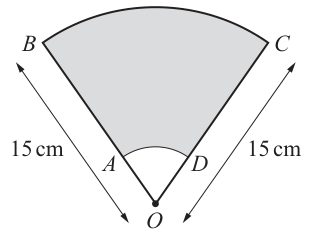
The diagram shows a sector of a circle, centre , where . The size of angle is radians. Points and on the lines and respectively are joined by an arc of a circle with centre . The shaded region is bounded by the arcs and and by the straight lines and . It is given that the area of the shaded region is .
Find the perimeter of the shaded region. Give your answer in terms of .
Approach
The shaded region is the difference between two sectors: the larger sector and the smaller sector . We use the sector area formula to find the inner radius , and then use the arc length formula and the straight line segments to find the perimeter.
Working
Let cm. The angle radians and the outer radius cm.
The area of the shaded region is the area of sector minus the area of sector :
Substitute the known values:
Simplify the first term:
So the equation becomes:
Divide through by :
Multiply by 5:
Since is a length, . So cm.
The perimeter of the shaded region consists of the outer arc , the inner arc , and the two straight line segments and .
Arc length of :
Arc length of :
Length of straight segments:
Total perimeter:
Answer
22 + 38/5 pi
Walkthrough
First, recognise that the shaded region is an annular sector, which is the difference between a larger sector and a smaller sector sharing the same centre and angle . Let the unknown inner radius be . The area of a sector is given by . Set up the equation . Solve this algebraically to find .
Next, calculate the perimeter. The boundary of the shaded region has four parts: the outer arc , the inner arc , and the two straight radial segments and . Use the arc length formula to find the lengths of the arcs: and . The straight segments are simply the difference in radii: cm each. Add all four components together and collect the terms to get the final answer.
Key Takeaways
- The area of a sector is and the arc length is , where is in radians.
- A shaded region between two concentric sectors can be found by subtracting the smaller sector area from the larger one.
- The perimeter of such a region includes both arcs and the straight radial segments connecting them.
Common Mistakes
- Forgetting to include the straight line segments and in the perimeter calculation.
- Using degrees instead of radians for the angle in the sector area and arc length formulas.
- Rounding or too early, which leads to an incorrect final numerical answer.
- Failing to collect like terms, so the answer is not fully simplified.
Things to Be Careful About
- The angle must be in radians when using and . Here it is given as radians, so no conversion is needed.
- The final answer must be left in terms of as requested. Do not evaluate numerically.
- Ensure all terms are combined into a single fraction or simplified expression.
Show that the curve with equation and the line with equation meet for all values of the constant .
Approach
Substitute from the line equation into the curve equation to obtain a quadratic in . Then use the discriminant to show that this quadratic has real roots for every real value of .
Working
From the line equation,
Substitute into :
This is a quadratic in with , , . Its discriminant is
Since for all real , we have . Therefore for every value of , so the quadratic always has two distinct real roots.
Answer
Hence the line and the curve meet for all values of the constant .
The discriminant is 9k^2 + 1600 > 0 for all k, so the line and curve meet for all values of k.
Walkthrough
We are given a curve and a line and asked to show they always meet. The key is to solve the two equations simultaneously. Because the line equation is linear, we can write in terms of : . Substituting this into the curve equation removes and leaves a quadratic in .
For the line and curve to meet, this quadratic must have at least one real solution for . A quadratic has real solutions exactly when its discriminant is greater than or equal to zero. So we compute the discriminant in terms of and check its sign.
Here , and , so
Because , the expression is always at least , hence strictly positive. Therefore the quadratic always has two real roots, no matter what is. This means the line always intersects the curve.
Key Takeaways
- Intersections of a line and a curve are found by substituting one equation into the other.
- The discriminant of the resulting quadratic tells us how many intersection points exist.
- A sum of a non-negative term and a positive constant is always positive, so such a discriminant guarantees real roots for all parameter values.
Common Mistakes
- Forgetting to expand the bracket when substituting ; the term becomes , not .
- Making a sign error in the discriminant: since , .
- Writing the discriminant as instead of .
- Stating that the discriminant is positive without justifying that .
- According to the mark scheme, the discriminant must be isolated; do not hide it inside the quadratic formula without explicitly showing .
Things to Be Careful About
- The coefficient of is , not , after substitution.
- is a real constant, so is never negative.
- A positive discriminant gives two distinct real roots, so the line meets the curve in two points; the question only requires that they meet, so this is more than enough.
- If you substitute for instead, you would obtain and its discriminant , which is also always positive; both approaches are acceptable.
The equation of a curve is such that .
Approach
Set the derivative equal to the given gradient, rearrange into a quadratic in , factorise, solve for , then square to find . Since is non-negative, discard the negative root.
Working
The gradient is . Set this equal to :
Subtract from both sides:
Let , so . Then:
Multiply by :
Factorise:
So or . Since , discard .
Hence:
Answer
x = 9/4
Walkthrough
The derivative gives the gradient of the curve at any point. We are told this gradient equals . So we set
and solve for . The equation contains both and , so it is not a simple linear equation. Write , so that . This converts the equation into a quadratic in :
Factorising gives two possible values for . Since cannot be negative, the negative solution is discarded. The remaining solution is squared to obtain .
Key Takeaways
- A gradient condition is applied by setting equal to the given value.
- An equation involving and can be made quadratic by substituting .
- Always check whether a root is valid when the substituted variable has a restricted sign.
Common Mistakes
- Forgetting to specify before factorising; the mark scheme requires this substitution to be clear.
- Keeping the negative root , which is impossible for a real square root.
- Stopping at instead of squaring to find .
Things to Be Careful About
- The equation must be rearranged into a 3-term quadratic before factorising; a method with no working shown may only earn partial credit.
- When squaring, only the positive root is used;the extraneous value must be ignored.
- Use the substitution explicitly to avoid losing method marks.
Approach
Integrate the derivative term by term, add a constant of integration, then use the given point to determine the constant.
Working
Rewrite the derivative using powers:
Integrate:
Use :
Since :
So . Therefore:
Answer
y = 2x^2 - 2x^(3/2) + x - 9
Walkthrough
The derivative is given, so the equation of the curve is found by integrating:
Integrate each term using the reverse of differentiation: . This gives
The constant is unknown. Use the fact that the curve passes through : substitute and into this equation. Since , we get
so . Therefore the equation is
Key Takeaways
- Integration reverses differentiation and introduces an arbitrary constant.
- The constant is determined by substituting a known point on the curve.
- Powers like must be written as before integrating.
Common Mistakes
- Forgetting the constant of integration, then being unable to use the point condition.
- Incorrectly integrating ;the coefficient must be divided by , giving .
- Substituting into the derivative instead of the integrated function.
Things to Be Careful About
- The final answer must be simplified;the mark scheme does not allow an unsimplified constant.
- When computing , either take the square root first or cube the square root;both give .
- Check the final equation by differentiating: .
Circles and have equations
respectively.
Approach
Complete the square on the first circle equation to write it in centre-radius form. The second equation is already in centre-radius form. Then apply the distance formula between the two centres.
Working
For :
So the centre of is and its radius is .
For :
So the centre of is and its radius is .
The distance between the centres is:
Answer
The distance between the centres is .
15
Walkthrough
First rewrite in completed-square form. The -terms become , and the -terms become . Including the constant gives , so . Therefore the centre of is and its radius is .
For , the equation is already in centre-radius form, so its centre is and its radius is .
The distance between the centres is found by applying the distance formula to and :
Key Takeaways
A circle equation in the form has centre and radius . Completing the square converts a general quadratic circle equation into this useful form. The distance formula measures the straight-line distance between two points.
Common Mistakes
- Sign errors when reading the centre from completed-square form: has centre , not .
- Forgetting to subtract the squared constants when completing the square, leading to the wrong radius.
- Confusing the radius with the distance between centres.
Things to Be Careful About
The mark scheme awards one mark for each centre and one mark for the distance calculation. Show the completed-square step clearly so the centres are evident. Also note that the radius is the square root of the constant on the right-hand side, not the constant itself.
and are points on and respectively. The distance between and is denoted by .
Find the greatest and least possible values of .
Approach
The greatest distance between a point on one circle and a point on the other occurs when the two points lie on the line joining the centres, on opposite sides of the centres. The least distance occurs when the two points lie on the same side of the centres, between them. Therefore add or subtract the radii from the centre distance.
Working
From part (a), the distance between the centres is .
The radii are:
So the sum of the radii is .
Since , the circles do not overlap.
Least distance:
Greatest distance:
Answer
The least possible value of is and the greatest possible value is .
Least = 3, greatest = 27
Walkthrough
For two separate circles, the closest points lie on the straight line joining the centres, between the two circles. Starting from the centre of , move toward the centre of by the radius of to reach the nearest point on , then continue to the nearest point on by the radius of . The least distance is therefore the centre distance minus both radii.
The farthest points lie on the same line of centres but on opposite sides of the two circles. From the centre of , move away from by , and from the centre of , move away from by ; the distance between those two points is the centre distance plus both radii.
Using the values from part (a):
and
Key Takeaways
The line joining the centres of two circles is the line along which the closest and farthest points between the circles occur. For separate circles, the least distance is and the greatest distance is .
Common Mistakes
- Giving the distance between the centres, , as the answer instead of adjusting for the radii.
- Subtracting the radii incorrectly, e.g. using instead of .
- Forgetting to consider both the least and greatest values when the question asks for both.
Things to Be Careful About
The mark scheme gives a mark for stating the radii and , a follow-through mark for one of the two distances, and a final follow-through mark for both. Always use the centre distance found in part (a), labelled as '15' in the mark scheme, and check that the circles are separate before assuming the least distance is positive. Here , so the least distance is indeed .
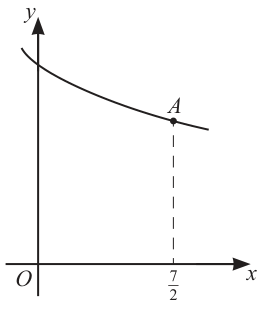
The diagram shows part of the curve with equation . The point on the curve has coordinates .
Approach
Rewrite the curve equation using a negative fractional exponent to make differentiation straightforward. Differentiate using the chain rule to find . Substitute to find the gradient of the tangent at . Use the point-slope form with point and the calculated gradient to find the equation of the tangent in the form .
Working
Rewrite the equation:
Differentiate using the chain rule:
At , the inner term is . Substitute this into the derivative:
Evaluate :
So the gradient is:
Use the point-slope form with and :
Expand and rearrange into form:
Answer
y = -1/2 x + 31/4
Walkthrough
First, rewrite the curve equation using a negative fractional exponent to make differentiation easier: . Then, apply the chain rule: bring down the power , subtract 1 from the power to get , and multiply by the derivative of the inner function , which is 2. This gives . Next, substitute into this derivative. Since , we evaluate . The cube root of 8 is 2, and , so . The gradient is . Finally, use the point-slope formula with the coordinates of and the gradient to find the tangent equation in the form .
Key Takeaways
- Rewriting fractional roots as negative fractional exponents simplifies differentiation.
- The chain rule is essential for differentiating composite functions like .
- The point-slope form is a reliable way to find the equation of a tangent given a point and a gradient.
Common Mistakes
- Forgetting to multiply by the derivative of the inner function when using the chain rule.
- Incorrectly evaluating fractional negative powers, such as .
- Algebra errors when rearranging the point-slope equation into form.
Things to Be Careful About
- Ensure the gradient is calculated from the differentiated expression, not by guessing or using a calculator if not allowed.
- The final answer must be in the form as requested.
Approach
Set up the definite integral for the area under the curve from to . Integrate using the reverse chain rule (or substitution). Evaluate the integrated expression at the upper limit and subtract the value at the lower limit .
Working
The area is given by the integral:
Integrate using the reverse chain rule. Bring up the power to get , divide by the new power, and divide by the derivative of the inner function :
Now evaluate the definite integral from to :
Substitute the upper limit :
Substitute the lower limit :
Calculate the area:
Answer
27
Walkthrough
Set up the definite integral for the area under the curve from to . The integrand is . To integrate, use the reverse chain rule: increase the power by 1 to get , divide by the new power , and divide by the derivative of the inner function , which is 2. This simplifies to . Next, evaluate this antiderivative at the upper limit : . Then evaluate at the lower limit : . Subtract the lower limit value from the upper limit value to get .
Key Takeaways
- The reverse chain rule is used to integrate composite functions of the form .
- When integrating, remember to divide by the derivative of the inner function .
- Definite integrals are evaluated by substituting the upper limit, subtracting the substitution of the lower limit.
Common Mistakes
- Forgetting to divide by the derivative of the inner function after integrating.
- Incorrectly evaluating fractional powers, such as .
- Forgetting to subtract the lower limit evaluation from the upper limit evaluation.
Things to Be Careful About
- Ensure the limits of integration are correctly identified from the problem statement ( to ).
- Check that the integrated expression is correct before substituting the limits.
Approach
Use the identity and the Pythagorean identity to write everything in terms of . Since lies between and , is negative, which fixes the sign of .
Working
Given .
Using :
From :
Because , , so:
Therefore:
Answer
a^2/(1-a^2) + 3a sqrt(1-a^2)
Walkthrough
We are told and is in the second quadrant. The expression contains and , so we need to rewrite them using . The identity gives . Since , the numerator is . To get , use , so . The quadrant matters: for , is negative, so . Substituting into gives . The two negatives cancel to produce the plus sign.
Key Takeaways
- The Pythagorean identity lets you replace one trigonometric function with another.
- The identity is essential for rewriting .
- The quadrant of the angle determines the sign of .
Common Mistakes
- Forgetting that is negative in the second quadrant, which changes the sign of the final term.
- Writing without simplifying to .
- Dropping the square root or using without considering the quadrant.
Things to Be Careful About
- Since , is positive, so .
- is positive, so the square root is defined.
- The sign of must be chosen before substituting into the expression.
Approach
Replace using , then rearrange into a quadratic equation in . Solve the quadratic, discard any root outside , and use the quadrants where is negative to find the required angles.
Working
Start with the equation:
Use :
Rearrange:
Solve the quadratic in :
Since , the two values are:
Only is valid.
Let be the reference angle. Since is negative, the solutions are in the third and fourth quadrants:
Answer
195.5° and 344.5°
Walkthrough
Start by replacing with so that the equation contains only . Expanding gives . Rearranging all terms to one side produces . This is a quadratic in , so apply the quadratic formula: . The value is outside the range of sine, so discard it. The valid value is . Since sine is negative, the solutions must be in the third and fourth quadrants. The reference angle is . Therefore and .
Key Takeaways
- The identity reduces a trigonometric equation to a quadratic.
- A quadratic in can have roots outside , which must be rejected.
- The sign of tells you which quadrants contain the solutions.
Common Mistakes
- Making a sign error when rearranging; the correct quadratic is .
- Keeping the root , which is less than and therefore impossible.
- Using directly instead of using the positive reference angle .
- Placing solutions in the wrong quadrants, such as using the first and second quadrants where sine is positive.
Things to Be Careful About
- The interval is , so and are not included, but neither appears as a solution.
- If your calculator is in radian mode, convert the final answers: radians and radians.
- Check that both final angles satisfy the original equation by substituting back if time permits.
The equation of a curve is .
Approach
The curve decreases as increases when its gradient is negative, so we require . Differentiate , solve the resulting quadratic inequality, and state the set of values of .
Working
Differentiate the curve:
For the curve to be decreasing:
Multiply by and reverse the inequality:
Factorise:
The critical values are:
Since the coefficient of is positive, the quadratic is positive outside the interval between the roots.
Answer
x < -1/3 or x > 5/3
Walkthrough
The phrase 'decreases as increases' means the curve is sloping downwards, so its gradient is negative. We differentiate to obtain . Set this gradient less than zero and solve the quadratic inequality. Multiply by to get , and factorise as . The critical values are and . Because the quadratic opens upwards, it is positive outside the interval between the roots, so the curve decreases for or .
Key Takeaways
- A curve decreases where its derivative is negative.
- Differentiating a polynomial gives the gradient function.
- Quadratic inequalities are solved by finding critical values and choosing the correct intervals.
Common Mistakes
- Forgetting to reverse the inequality sign when multiplying by .
- Choosing the interval between the roots, which is where the curve increases.
- Using or instead of strict inequalities, since the curve is not decreasing exactly at the critical points.
Things to Be Careful About
The mark scheme requires a full method for solving the quadratic; an unsupported answer will not receive full marks. Also, write the final answer with on the correct side of each inequality: or .
Approach
A line is tangent to the curve where its gradient, , equals the gradient of the curve. Set , solve for , find the corresponding -value on the curve, and then use the tangent equation to find .
Working
The gradient of the curve is:
For the tangent, the gradient is , so:
Simplify to a three-term quadratic:
Multiply by :
Factorise:
Therefore:
Find the corresponding -value on the curve:
Compute:
Using denominator :
The point of tangency is . Since it lies on :
Therefore:
Answer
k = 28/9
Walkthrough
A line is tangent to a curve when its gradient equals the gradient of the curve at the point of contact. The line has gradient , so we set . From part (a), , so we solve . Rearranging gives , and multiplying by gives , which factorises as . Thus . Substitute this into the original curve equation to get . Since the point of tangency lies on the tangent line, , so .
Key Takeaways
- A tangent line has the same gradient as the curve at the point of contact.
- To find the point of contact, set equal to the gradient of the tangent line.
- Once the point is known, the constant in the tangent line can be found using .
Common Mistakes
- Not simplifying into a three-term quadratic; the mark scheme requires this simplification.
- Using the wrong sign when rearranging the quadratic.
- Forgetting to find the -coordinate of the point of tangency before finding .
- Substituting the point into the curve equation again instead of into the tangent line equation.
Things to Be Careful About
There is a repeated root, so the tangent line touches the curve at exactly one point. Use the original curve equation to compute , not the tangent equation, because is unknown. Then subtract carefully: .
An arithmetic progression has first term 5 and common difference , where . The second, fifth and eleventh terms of the arithmetic progression, in that order, are the first three terms of a geometric progression.
Approach
The AP terms are written using the formula for the th term. Since the second, fifth and eleventh terms form the first three terms of a GP, the common ratio condition is used to form a quadratic equation in . The root is then selected using .
Working
The AP has first term and common difference . Its second, fifth and eleventh terms are:
These are the first three terms of a GP, so the ratios of consecutive terms are equal:
Cross-multiplying gives:
Expand both sides:
Simplify:
Factorise:
So or . Since , reject .
Answer
d = 2.5
Walkthrough
The AP has first term and common difference , so its th term is . To get the second, fifth and eleventh terms, substitute :
These three numbers are the first three terms of a GP. In a GP the ratio between consecutive terms is constant, so:
Cross-multiplying gives:
Expanding and simplifying gives , which factorises as . Hence or . Since the question states , the solution is .
Key Takeaways
This question links the definitions of arithmetic and geometric progressions. The key idea is that consecutive terms of a GP have a common ratio, so the square of the middle term equals the product of the outer terms. It also tests forming and solving a quadratic equation from a geometric condition.
Common Mistakes
- Forgetting to reject , even though the question specifies .
- Making expansion errors, especially with or .
- Using the wrong AP terms, such as for the second term instead of .
Things to Be Careful About
- The nth term of an AP with first term and common difference is , not .
- Use the given order: second, fifth and eleventh terms are the first three GP terms.
- The zero root must be rejected because .
The sum of the first 77 terms of the arithmetic progression is denoted by . The sum of the first 10 terms of the geometric progression is denoted by .
Find the value of .
Approach
Use the AP sum formula with , and . Then identify the GP first term and common ratio from the terms found in part (a), use the GP sum formula with , and subtract.
Working
For the AP, , and :
Evaluate the bracket:
Therefore:
The GP has first three terms , so its first term is and its common ratio is .
Using the GP sum formula for :
Since :
Therefore:
Answer
S_77 - G_10 = 27.5
Walkthrough
From part (a), . The AP has first term and common difference . The sum of the first terms is found using the AP sum formula:
Substituting , , :
The GP has first three terms equal to the second, fifth and eleventh AP terms:
So the GP first term is and the common ratio is . The sum of the first terms is:
Finally:
Key Takeaways
This part tests fluency with both the AP and GP sum formulae. It also shows that once the common difference is known, the GP is fully determined by the AP terms, so the two progressions are linked.
Common Mistakes
- Using the wrong sum formula: AP uses , while GP uses .
- Using as the first term of the GP; the GP first term is actually .
- Arithmetic slips with or with decimal multiplication.
Things to Be Careful About
- The GP common ratio is , not or .
- is and is ; subtract carefully to get .
- The mark scheme expects the correct sum formula to be used with the value of found in part (a).
The function is defined by for .
Approach
Factor out the coefficient of from the quadratic terms, complete the square, then expand to obtain the form . Use the fact that a squared expression is always non-negative to determine the maximum value and hence the range.
Working
Factor out from the -terms:
Complete the square inside the bracket:
Substitute back:
So , , .
Since for all , we have , and therefore:
The range of is .
Answer
f(x) = 15/2 - 2(x - 3/2)^2, range y ≤ 15/2
Walkthrough
We are asked to rewrite in the form . This is a completing-the-square problem.
Step 1: Factor out the coefficient of , which is , from the -terms only:
Step 2: Complete the square for . Half of is , so:
Step 3: Substitute back and distribute the :
Step 4: Determine the range. Since , multiplying by gives . Adding means , with equality when .
Key Takeaways
- Completing the square for a quadratic with gives a maximum value.
- The range of a downward-opening parabola (with ) is .
Common Mistakes
- Forgetting to include the constant term when completing the square.
- Sign errors when distributing the negative coefficient .
- Writing the range with instead of — the maximum is actually attained at .
Things to Be Careful About
- The marking scheme accepts given or clearly implied; using would lose the mark.
- The values of , , must match the form exactly — note the minus sign before .
The graph of is transformed to the graph of by a reflection in one of the axes followed by a translation. It is given that the graph of has a minimum point at the origin.
Give details of the reflection and translation involved.
Approach
From part (a), has a maximum at . To obtain a minimum at the origin, first reflect in the -axis to convert the maximum to a minimum, then translate to move the minimum to .
Working
Reflection: Reflect in the -axis to get :
This is an upward-opening parabola with a minimum at .
Translation: To move the minimum from to the origin , translate by:
Answer
Reflection in the -axis, followed by a translation by .
(Note: the order of reflection and translation can be reversed.)
Reflection in the x-axis, then translation by (-3/2, 15/2)
Walkthrough
The original function is a downward-opening parabola with vertex (maximum) at .
Step 1 — Reflection: Reflecting in the -axis replaces with , giving . This is now an upward-opening parabola with a minimum at .
Step 2 — Translation: We need the minimum at the origin . The current minimum is at . To move it to , we shift left by and up by , i.e., by the vector .
The order of reflection and translation can be swapped — both give the same result.
Key Takeaways
- Reflecting in the -axis changes a maximum to a minimum (and vice versa).
- A translation by vector moves the vertex from to .
Common Mistakes
- Reflecting in the -axis instead of the -axis — this would not convert the maximum to a minimum.
- Getting the translation vector signs wrong (e.g., instead of ).
Things to Be Careful About
- The marking scheme accepts transformations in any order, so stating translation first then reflection is also valid.
- The translation vector must follow from the student's own values in part (a). If part (a) is wrong, part (b) can still earn marks via follow-through.
The function is defined by for .
Sketch the graph of and explain why is a one-one function. You are not required to find the coordinates of any intersections with the axes.
Approach
The function is defined for . From part (a), the full parabola has its vertex (maximum) at . Since is entirely to the left of the vertex, is strictly increasing on this domain. Sketch the left branch of the parabola and use the horizontal line test to show is one-one.
Working
Sketch: The function for :
- At : , so the graph passes through .
- As : .
- The graph is the left branch of the downward-opening parabola, lying in the second quadrant (for , where ) and the third quadrant (for , where ).
The curve is strictly increasing on because it lies entirely to the left of the vertex at , and the parabola opens downward.
Why is one-one:
Since is strictly increasing on its domain , each -value is associated with exactly one -value. Equivalently, any horizontal line intersects the graph of at most once (the horizontal line test is satisfied).
Answer
The graph of is the left branch of the parabola for , passing through and extending downward into the third quadrant. is one-one because it is strictly increasing on , so each -value corresponds to a unique -value (horizontal line test).
g is one-one because it is strictly increasing on x ≤ 0; each y-value corresponds to a single x-value.
Walkthrough
We are given for .
Step 1 — Understand the shape: From part (a), the full parabola has its vertex at and opens downward. For , we are looking at the portion of the parabola to the left of the -axis.
Step 2 — Key points for the sketch:
- At : , so the curve meets the -axis at .
- The -intercept (where ): . This is in the second/third quadrant boundary region.
- As , .
Step 3 — Why one-one: On the domain , the function lies entirely to the left of the vertex. Since the parabola opens downward, moving left from the vertex means the function is increasing (as increases toward , increases). Therefore is strictly increasing on , which means each -value is produced by exactly one -value. This satisfies the horizontal line test.
Key Takeaways
- Restricting the domain of a quadratic to one side of its vertex makes it one-one.
- A strictly monotonic function on its domain is always one-one.
- The horizontal line test is the geometric way to verify one-oneness.
Common Mistakes
- Sketching the full parabola instead of only the branch for .
- Saying the function passes the vertical line test — this is always true for any function and does not prove one-oneness.
- Not mentioning that the function is increasing or that horizontal lines meet the graph at most once.
Things to Be Careful About
- The question says you are not required to find axis intersection coordinates, so do not spend time calculating them.
- The sketch should clearly show the curve only in the second and third quadrants (for ).
Sketch the graph of on your diagram in (c), and find an expression for . You should label the two graphs in your diagram appropriately and show any relevant mirror line.
Approach
Sketch by reflecting the graph of in the line . To find the expression for , set , swap and , and solve for using the quadratic formula, selecting the branch consistent with the domain .
Working
Sketch: Reflect the curve (from part (c)) in the line . The resulting curve lies in the third and fourth quadrants only, passing through (the image of ) and extending downward to the right.
Finding :
Set and swap and :
Rearrange into standard quadratic form in :
Apply the quadratic formula:
Since the domain of is , the range of must satisfy . We need:
Since , the branch gives , which is invalid. The branch gives:
Check: at (the image of ), . ✓
Answer
g^{-1}(x) = 3/2 - sqrt(15/4 - x/2)
Walkthrough
We need to sketch and find its expression.
Step 1 — Sketch the inverse: The graph of is the reflection of in the line . Since is defined for and has range , the inverse is defined for and has range . The curve passes through (reflection of ) and extends into the third and fourth quadrants.
Step 2 — Find the expression algebraically:
- Start with .
- Swap and : .
- Rearrange: .
- Quadratic formula: .
Step 3 — Choose the correct branch: Since the range of is (because the domain of is ), we need the branch that gives . The branch gives , which is wrong. The branch gives , and for , , so . ✓
Step 4 — Simplify:
Key Takeaways
- The inverse function is found by swapping and and solving.
- When solving a quadratic to find the inverse, always check which branch is consistent with the domain/range restrictions.
- The graph of is the reflection of in .
Common Mistakes
- Choosing the branch of the square root, which gives , violating the range restriction .
- Forgetting to swap and before solving (solving for in terms of without swapping gives the inverse relation but not the function ).
- Not drawing the line on the sketch.
Things to Be Careful About
- The final expression must involve , not .
- The domain of is (from the range of ), and the range is (from the domain of ). The sketch should reflect this — the curve appears in the third and fourth quadrants only.
- The mark scheme accepts equivalent forms such as .