Mathematics 9709/41 — May/June 2024
Cambridge AS Level · Mechanics · worked solutions for every part, with the mark scheme
Topics Kinematics of Motion in a Straight Line · Forces and Equilibrium · Energy, Work and Power · Newton's Laws of Motion · Momentum
A car starts from rest and accelerates at for . It then travels at a constant speed for . The car then uniformly decelerates to rest over a period of .
Approach
Find the maximum velocity reached during the acceleration phase using , then plot the three phases of motion on a velocity-time graph.
Working
During the first , the car accelerates from rest at :
The car then maintains this constant speed of for , from to .
Finally, it decelerates uniformly to rest over , from to .
The velocity-time graph is a trapezium with vertices at , , , and .
Answer
The velocity-time graph is a trapezium with vertices , , , .
Trapezium with vertices (0,0), (10,20), (40,20), (60,0)
Walkthrough
First, we need to determine the key points on the velocity-time graph. The car starts from rest, so the graph begins at .
During the first phase, the car accelerates at for . Using the constant acceleration formula , we find the velocity at :
This gives the point on the graph. The line from to has a positive gradient equal to the acceleration.
During the second phase, the car travels at a constant speed of for . This means the velocity does not change, so the graph is a horizontal line from to .
During the third phase, the car decelerates uniformly to rest over . The graph is a straight line from down to , with a negative gradient equal to the deceleration.
The overall shape is a trapezium with the parallel sides along the time axis (length ) and the horizontal segment (length ), and height .
Key Takeaways
- The gradient of a velocity-time graph represents acceleration.
- A horizontal line on a velocity-time graph indicates constant velocity.
- The area under a velocity-time graph represents the total distance travelled.
- Key coordinates on the graph are found using for each phase of motion.
Common Mistakes
- Forgetting to calculate the maximum velocity before plotting the graph.
- Plotting the wrong time intervals for each phase (e.g., using instead of the end time ).
- Not labelling the axes or key coordinates on the graph.
- Drawing curved lines instead of straight lines for uniform acceleration/deceleration.
Things to Be Careful About
- Ensure the graph starts at the origin since the car starts from rest.
- The horizontal segment must span from to (a duration of ), not from to .
- The final time is , so the graph must end at .
- Axis labels must be correct if used; if not labelled, assume is on the horizontal axis and on the vertical axis.
Approach
The total distance travelled equals the area under the velocity-time graph. Calculate this area using the trapezium formula or by splitting into simpler shapes (two triangles and a rectangle).
Working
The area under the graph is the area of the trapezium with parallel sides and and height :
Alternatively, splitting into two triangles and a rectangle:
Answer
900 m
Walkthrough
The total distance travelled by the car is equal to the area under the velocity-time graph. This is a fundamental principle of kinematics: since velocity is the rate of change of displacement, integrating velocity over time gives displacement (or distance, when velocity is always positive).
The velocity-time graph from part (a) is a trapezium. We can calculate its area in two ways:
Method 1: Trapezium formula
A trapezium has area , where and are the lengths of the parallel sides and is the perpendicular height between them.
- The longer parallel side lies along the time axis from to , so .
- The shorter parallel side is the horizontal segment from to , so .
- The height is the maximum velocity, .
Method 2: Split into simpler shapes
- Triangle 1 (acceleration phase): base , height , area
- Rectangle (constant speed phase): width , height , area
- Triangle 2 (deceleration phase): base , height , area
Total distance
Both methods give the same answer, confirming the result.
Key Takeaways
- The area under a velocity-time graph represents the total distance travelled (when velocity is positive).
- The area can be calculated using the trapezium formula or by decomposing into simpler shapes.
- Units must be consistent: velocity in m/s and time in s gives distance in m.
Common Mistakes
- Using the wrong parallel sides in the trapezium formula (e.g., using and instead of and ).
- Forgetting to include all three phases when splitting into shapes.
- Using an incorrect value for the maximum velocity (must use from part (a)).
- Not showing the method (M1 mark) before the final answer (A1FT mark).
Things to Be Careful About
- The trapezium formula requires the two parallel sides to be the horizontal lengths: (total time) and (constant speed duration).
- The height is the vertical distance between the parallel sides: .
- The final answer must carry correct units: metres (m), not seconds or m/s.
- Follow-through marks depend on using the correct value of from part (a). Using instead of would give marks for the final answer.
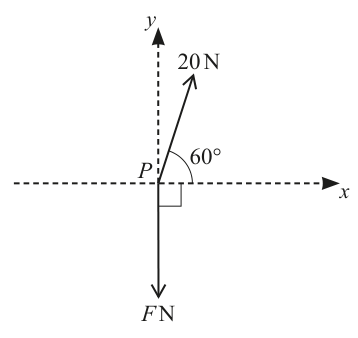
Two forces of magnitudes and act at a point in the directions shown in the diagram.
Given that the resultant force has no component in the -direction, calculate the value of .
Approach
Resolve the forces into their vertical (-direction) components. Since the resultant force has no component in the -direction, the sum of the vertical components must be zero.
Working
The force makes an angle of with the positive -axis, so its vertical component is upwards. The force acts vertically downwards.
Setting the sum of vertical components to zero:
Solving for :
Answer
F = 17.3 N
Walkthrough
First, identify the vertical components of both forces. The force is at to the horizontal, so its upward vertical component is found using the sine ratio: . The second force acts straight down along the negative -axis, contributing a downward component of . The problem states the resultant has no -component, meaning the upward and downward forces must balance exactly. We set and evaluate to find .
Key Takeaways
When a resultant force has zero component in a specific direction, the sum of the force components in that direction must be zero. This allows you to solve for an unknown force magnitude directly.
Common Mistakes
Using the wrong trigonometric ratio (e.g., instead of for the vertical component). Forgetting that the vertical component of the force is upwards while is downwards, leading to an incorrect sign in the equation.
Things to Be Careful About
Ensure angles are measured correctly from the axis specified. Here, is from the positive -axis, so the vertical component uses . The mark scheme accepts or , so exact surd forms are preferred unless a decimal is explicitly required.
Approach
With , resolve both forces into horizontal () and vertical () components. Find the resultant components and , then calculate the magnitude and direction of the resultant force.
Working
Horizontal component of the resultant, :
Vertical component of the resultant, :
Magnitude of the resultant force, :
Direction of the resultant force, (measured above the positive -axis):
Answer
Magnitude = 12.4 N, Direction = 36.2° above the positive x-axis
Walkthrough
First, resolve each force into its horizontal and vertical parts. The force contributes horizontally and vertically. The force contributes horizontally and vertically. Adding these gives the resultant components: and . The magnitude is found using Pythagoras' theorem: . The direction is found using the inverse tangent of the vertical component over the horizontal component: . Since both and are positive, the resultant lies in the first quadrant, above the positive -axis.
Key Takeaways
To find the resultant of multiple forces, resolve each into perpendicular components, sum them to get the resultant components, then use Pythagoras' theorem and trigonometry to find the magnitude and direction.
Common Mistakes
Forgetting to include the sign of the vertical component for the downward force . Using instead of for the vertical component of the angled force. Calculating the angle from the wrong axis or misidentifying the quadrant.
Things to Be Careful About
Always specify the direction of the resultant relative to a clear reference (e.g., "above the positive -axis"). The mark scheme accepts or radians ( to 3sf). Ensure magnitude is given to 3 significant figures as .
A train of mass ascends a straight hill of length , inclined at an angle of to the horizontal. As it ascends the hill, the total work done to overcome the resistance to motion is and the speed of the train decreases from to .
Find the work done by the engine of the train as it ascends the hill, giving your answer in .
Approach
Apply the work-energy principle: the work done by the engine is the total energy required to raise the train's gravitational potential energy, overcome resistance, and account for the change in kinetic energy.
Working
The hill is long, inclined at .
Gravitational potential energy gained:
Initial kinetic energy:
Final kinetic energy:
Kinetic energy lost:
Work done against resistance .
Work done by engine:
Converting to kJ:
Answer
44400 kJ
Walkthrough
The train is moving up a hill. Three things happen: it gains height (so gains gravitational potential energy), it slows down (so loses kinetic energy), and it fights resistance (so energy is lost to resistance). The engine must supply the energy for the height gain and the resistance, but since the train is slowing down, some of the initial kinetic energy is converted to help, so the engine needs less. We use the work-energy principle: work done by engine equals PE gained plus work against resistance minus KE lost.
Step by step:
- Convert 1.5 km to 1500 m.
- Compute PE gained: where .
- Compute initial and final KE.
- Find KE lost.
- Add PE gained and work against resistance, subtract KE lost.
- Convert to kJ.
Key Takeaways
- The work-energy principle links work done by forces to changes in kinetic energy.
- When an object gains height, it gains gravitational potential energy.
- When an object slows down, its kinetic energy decreases; this energy can be released to do work.
- Always convert units consistently (kJ to J, km to m).
Common Mistakes
- Using the vertical height instead of .
- Forgetting to convert 1.5 km to 1500 m.
- Mixing up signs: the KE loss should be subtracted (or equivalently, added as a negative term).
- Forgetting to convert the answer to kJ as required.
- Using the wrong value of g (the mark scheme uses ).
Things to Be Careful About
- The mark scheme accepts , giving PE = 70,677,760.4 J. If you use , you get a slightly different value, but the final answer should be approximately 44400 kJ.
- The work done by the engine is the work done by the driving force; it is positive.
- The final answer must be in kJ.
A car of mass is pulling a trailer of mass along a straight horizontal road. The car and trailer are connected by a light inextensible cable which is parallel to the road. There are constant resistances to motion of on the car and on the trailer. The power of the car’s engine is .
Find the acceleration of the car and the tension in the cable when the speed is .
Approach
The driving force is found from the power equation . Once the driving force is known, apply Newton's second law separately to the car and the trailer, introducing the tension in the cable. Add or eliminate the tension to find the common acceleration, then substitute back to find the tension.
Working
The driving force is related to engine power and speed by , so
Let the acceleration be and the tension in the cable be .
Apply Newton's second law to the car:
Apply Newton's second law to the trailer:
Apply Newton's second law to the whole system (car + trailer):
Solve for the acceleration:
Substitute into the trailer equation:
Answer
Acceleration = 0.075 m s^-2; Tension = 172.5 N
Walkthrough
Start by finding the driving force of the engine. The engine delivers a power of while the car moves at . The relation between power, driving force and speed is , so the driving force is
This driving force acts forwards on the car. The cable tension pulls the car backwards and pulls the trailer forwards, and the resistances oppose motion. For the car, the net forward force is driving force minus its resistance minus the tension:
For the trailer, the only forward force is the tension, and the resistance opposes it:
Adding these equations eliminates and gives a single equation for the whole system:
so
Finally, substitute this acceleration into the trailer equation to find :
This is the tension in the cable while the car and trailer accelerate at .
Key Takeaways
The key relationships used in this problem are:
- : engine power equals driving force times speed.
- Newton's second law applied to each body.
- Connected bodies moving together share the same acceleration.
- The cable tension is an internal force when the car and trailer are treated as one system, so it cancels when applying Newton's second law to the combined system.
Common Mistakes
- Using as the driving force instead of first dividing by the speed .
- Getting the direction of the tension wrong: it acts backward on the car and forward on the trailer.
- Forgetting one of the resistances when using the system equation.
- Using different values of in the two separate equations; the tension is the same at both ends of a light cable.
- Assuming the acceleration is zero because the speed is constant; a constant power can still produce acceleration.
Things to Be Careful About
- Always calculate the driving force from power and speed before applying Newton's second law.
- The system equation can be obtained either by adding the two body equations or directly by applying Newton's second law to the combined mass of .
- Since the road is horizontal, the weights of the car and trailer are perpendicular to the motion and play no part in the horizontal dynamics.
- The mark scheme condones as an acceptable rounding, but the exact value is .
A straight slope of length is inclined at an angle of to the horizontal. A bobsled starts at the top of the slope with a speed of . The bobsled slides directly down the slope.
It is given that there is no resistance to the bobsled’s motion.
Find its speed when it reaches the bottom of the slope.
Approach
Take . With no resistance, the only force along the slope is the component of the bobsled's weight down the slope. Use Newton's second law to find the acceleration, then apply the constant acceleration formula .
Working
Resolving along the slope:
so
Now use with and :
Answer
The speed at the bottom is (3 s.f.).
16.6 m s^{-1}
Walkthrough
The bobsled slides down a straight slope of length inclined at . Since there is no resistance, the only force along the slope is the component of the weight pulling it downhill.
For a weight on an incline at angle to the horizontal:
- the component down the slope is ,
- the component perpendicular to the slope is .
So resolving parallel to the slope gives . The mass cancels, so . Using , this gives .
The acceleration is constant, so we can use the constant acceleration formula . Here and . Substituting gives , so .
A useful check is energy conservation: the loss in gravitational potential energy is , and this equals the gain in kinetic energy . Cancelling gives the same value of .
Key Takeaways
- On a frictionless incline, the acceleration is , independent of mass.
- The weight component along the slope is ; the component perpendicular to the slope is .
- Constant acceleration problems can be solved with the suvat equations.
- Energy methods can be used as an alternative when no work is done against resistance.
Common Mistakes
- Using as the force down the slope instead of .
- Forgetting the initial speed and using .
- Using the wrong suvat equation, e.g. without knowing .
- In the energy method, using as the vertical height instead of , or forgetting the initial kinetic energy.
Things to Be Careful About
- The mark scheme uses ; with the answer would be slightly different.
- Keep units consistent: distances in metres, speeds in .
- Give the final speed to 3 significant figures: .
It is given instead that the coefficient of friction between the bobsled and the slope is .
Find the time that it takes for the bobsled to reach the bottom of the slope.
Approach
Resolve perpendicular to the slope to find the normal reaction . Use the friction model with . Apply Newton's second law parallel to the slope to find the acceleration, then use to find the time.
Working
Take .
Perpendicular to the slope:
Friction:
Parallel to the slope, taking down the slope as positive:
Substitute :
Cancel :
Use with , :
Solve using the quadratic formula, taking the positive root:
Answer
The time taken is (3 s.f.).
5.86 s
Walkthrough
Now there is friction, so we first need the normal reaction force . The bobsled does not accelerate perpendicular to the slope, so the perpendicular component of weight is balanced by :
The friction force is . It acts up the slope because the bobsled is moving down the slope.
Take down the slope as positive. The weight component down the slope is , and friction opposes motion, so Newton's second law gives
Substituting and cancelling :
With ,
Because the acceleration is constant, use with , :
This is the quadratic . Solving with the quadratic formula and taking the positive root gives .
An energy alternative: work done by gravity minus work done by friction equals the change in kinetic energy. This gives the final speed , then gives the same time.
Key Takeaways
- On an incline, the normal reaction is , not .
- The friction force is and always opposes the motion.
- Newton's second law is applied separately parallel and perpendicular to the slope.
- Constant acceleration allows the suvat equations; solving for time may require the quadratic formula.
Common Mistakes
- Using instead of .
- Using or instead of .
- Taking friction down the slope instead of up the slope.
- Using as the force down the slope.
- Losing the mass when applying Newton's second law.
- Forgetting to discard the negative root of the quadratic.
- In the energy method, using the slope length as the vertical height for gravitational potential energy.
Things to Be Careful About
- Use to match the mark scheme values.
- The acceleration is smaller than in part (a) because friction opposes motion.
- The quadratic has two roots; time must be positive.
- Give the final answer to 3 significant figures: .
- The mark scheme awards marks for resolving perpendicular (B1), applying Newton's second law (M1), using (DM1), and solving the suvat equation (DM1), so show each stage clearly.
A particle moves in a straight line, starting from a point . The velocity of the particle at time after leaving is . It is given that , where is a positive constant. The maximum velocity of the particle is .
Approach
At a maximum value of , the acceleration is zero. Differentiate , solve for in terms of , substitute into with the known maximum , and solve for .
Working
The velocity is
Differentiate with respect to :
At the maximum, :
Substitute this into :
Since the maximum velocity is ,
Because ,
Answer
k = 10
Walkthrough
The velocity is given as a function of time, so its maximum occurs where its derivative, the acceleration, is zero. Differentiate term by term:
Setting the derivative equal to zero gives , so the maximum occurs at . Substitute this into the original expression for :
Because the maximum velocity is , solve . This gives , so . Since is positive, .
Key Takeaways
- A stationary point of occurs when .
- Fractional powers differentiate using .
- A known value at a stationary point can be used to find an unknown parameter.
Common Mistakes
- Forgetting that the derivative of is .
- Losing the when differentiating .
- Taking instead of rejecting it because .
- Trying boundary values such as instead of solving .
Things to Be Careful About
- This is an "answer given" question, so any error in the working loses the final accuracy mark.
- The derivative of is , not .
- Reject the negative root because the constant is stated to be positive.
Approach
Use from part (a) and substitute and into , showing both give .
Working
For :
For :
Answer
At both and , .
v = 0 when t = 1 and t = 16
Walkthrough
Since part (a) found , the velocity is . To verify the two given times, substitute them one at a time.
For :
For , remember that :
Both substitutions give , as required.
Key Takeaways
- Verifying a value means substituting it into the formula and simplifying.
- Roots of the velocity equation are times when the particle is at rest.
Common Mistakes
- Calculating as instead of .
- Forgetting to use .
Things to Be Careful About
- This is an "answer given" (AG) part; any arithmetic error causes the mark to be lost.
- Show both substitutions clearly so the verification is complete.
Approach
Distance travelled is the integral of speed, not signed velocity. Since changes sign at , split the interval into and . On , ; on , . Integrate over each interval, take the absolute value of the negative displacement, and add.
Working
Integrate :
The constant cancels in definite integrals.
On , the displacement is
The distance on this interval is
On :
Since and the value at is :
Since on this interval, this is also the distance.
Total distance:
Answer
142/3 m (approximately 47.3 m)
Walkthrough
Distance is total length travelled, so integrating over the whole interval would only give net displacement. A particle changes direction exactly where . From part (b)(i), at and . A quick sign check, for example and , shows the particle moves backwards for and forwards for .
Integrate the velocity term by term:
The displacement from to is
Because this interval is backwards, the distance is .
The displacement from to is
Add the two distances:
Key Takeaways
- The integral of velocity gives displacement, not distance.
- To find distance, split the motion at times when velocity is zero, integrate over each interval, take absolute values, and sum.
- is essential for the numerical evaluation.
Common Mistakes
- Integrating from to and treating the result as distance; the net displacement is actually different from the distance.
- Forgetting to take the absolute value of .
- Evaluating incorrectly.
- Sign errors when subtracting the value at , especially missing the double negative.
Things to Be Careful About
- Use limits and for the second interval, not and .
- The first interval contributes positive distance even though its displacement is negative.
- The mark scheme accepts or better as the final numerical answer.
- Keep the unit metres in the final answer.
A particle of mass is projected vertically upwards from horizontal ground with speed .
Approach
Use the constant acceleration formula connecting initial speed, acceleration, displacement and final speed. Take upward as positive, so , and .
Working
Since the particle is still moving upwards at this height, the speed is .
Answer
15 ms^{-1}
Walkthrough
We know the initial speed, the displacement and the acceleration, and we want the final speed. The suvat equation is ideal because it does not involve time. Taking upward as positive, the acceleration is . Substituting , and gives , so . Because the particle is still moving upwards at that height, the speed is .
Key Takeaways
This part tests the ability to choose the correct constant acceleration formula and to substitute values with a consistent sign convention. It also shows that speed is the magnitude of velocity, so the positive root is chosen.
Common Mistakes
- Quoting the answer without showing an intermediate equation loses the method mark.
- Using instead of for upward motion gives , which is wrong.
- Mixing up and , or using , can produce an incorrect sign.
Things to Be Careful About
The mark scheme requires at least one intermediate step from the equation of motion to the given result; a bare statement of is not enough. Also, if you use the energy method, you must show the energy equation with all three terms.
When reaches above the ground it collides with a second particle of mass which is moving downwards at . is brought to instantaneous rest in the collision.
Find the velocity of immediately after the collision.
Approach
Use conservation of linear momentum during the collision. Take upward as positive. Before the collision has velocity and has velocity ; after the collision has velocity . Let be the velocity of immediately after the collision.
Working
The positive sign means upwards.
Answer
10 ms^{-1} upwards
Walkthrough
During a collision, if no external impulse acts, total momentum is conserved. Choose upward as positive. Before the collision has momentum and has momentum because it is moving downwards. After the collision is at rest, so its momentum is zero. If is the velocity of after the collision, conservation gives . Solving gives , so moves upwards at .
Key Takeaways
Momentum is a vector, so a positive direction must be chosen and velocities substituted with their signs. In a direct impact, total momentum before equals total momentum after.
Common Mistakes
- Using the projection speed instead of the speed at collision is a common error and is not awarded the method mark.
- Forgetting the negative sign on 's downward velocity.
- Writing momentum as instead of ; the mark scheme gives at most M1 A0 for that.
- Giving only a magnitude without stating the direction; the accuracy mark requires the direction.
Things to Be Careful About
The mark scheme allows sign errors in the momentum equation for the method mark, but the final answer must include the direction. Use the speed found in part (a), not the initial projection speed.
When reaches the ground it rebounds back directly upwards with half of the speed that it had immediately before hitting the ground.
Find the height above the ground at which and next collide.
Approach
Track the motion in stages. First find how long takes to fall from to the ground and its speed just before impact. Then find where is at that same instant. Finally, after rebounds, set the upward distance travelled by plus the downward distance travelled by equal to the separation.
Working
Stage 1: falls from rest at .
Speed just before ground:
So rebounds upwards with speed .
At , has been moving for with initial velocity upwards and acceleration :
so is back at above the ground, moving downwards at
i.e. downwards.
Stage 2: Let be the time after rebounds. Upward displacement of :
Downward displacement of from :
They collide when:
Height above ground:
Answer
5 m above the ground
Walkthrough
After the first collision, is instantaneously at rest at , while moves upwards at (from part (b)). then falls. From with , it reaches the ground after , and its speed just before impact is . It rebounds with half this speed, so it leaves the ground at upwards.
At that same instant, has been moving for with initial velocity upwards and acceleration . Its displacement is , so it is also back at , now moving downwards at .
Now take at the instant rebounds. rises from the ground with upward displacement . falls from with downward displacement . They meet when the sum of these displacements equals the original separation: . This gives , so . The height is then .
Key Takeaways
This is a multi-stage kinematics problem. The key is to identify a convenient time origin, here the instant rebounds, and to write consistent displacement equations for both particles. The collision condition is that the two displacements add to the initial separation.
Common Mistakes
- Using or for the speed of at ground impact instead of .
- Forgetting that also moves during the that is falling.
- Using the same sign convention for both particles without adjusting for their different directions, leading to instead of .
- Forgetting to halve the impact speed when rebounds.
- Stopping at without converting to height.
Things to Be Careful About
The mark scheme awards separate marks for the speed at impact, the time to reach the ground, the two displacement equations, the time of collision and the final height. It uses 'their 10' from part (b), so a wrong value in part (b) can still gain method marks in part (c) if the working is consistent. The final height must be correct with no earlier errors (CWO).