Mathematics 9709/22 — May/June 2024
Cambridge AS Level · Pure Mathematics 2 · worked solutions for every part, with the mark scheme
Topics Differentiation · Integration · Algebra · Logarithmic and Exponential Functions · Numerical Solution of Equations · Trigonometry
Solve the inequality .
Approach
For an inequality involving two moduli, first find the boundary values where the two expressions are equal in magnitude. These occur when the expressions inside the moduli are equal or are negatives of each other. Then test one point in each interval to decide which intervals satisfy the inequality.
Working
Solve the two linear equations that give equality of the moduli.
Case 1: .
Case 2: .
These two values divide the real line into intervals. Test :
so satisfies the inequality. Test :
so is false, and the interval between the critical values does not satisfy the inequality. Therefore the solution consists of the two outer intervals.
Answer
x < -10/3 or x > -4/7
Walkthrough
We need all values of for which the distance of from zero is greater than the distance of from zero. The boundary between true and false occurs when . This equality holds when the expressions inside the moduli are equal or are negatives of each other.
Solving gives ; solving gives . These two critical values split the real line into three intervals: , and .
We test one point in each interval. At , and , so is true. At , and , so is false. Thus the middle interval is not part of the solution, while the two outer intervals are.
An alternative is to square both sides: since both sides are non-negative, is equivalent to . Expanding gives a quadratic inequality whose boundary roots are the same two critical values; testing intervals then gives the same answer.
Key Takeaways
The main idea is that a modulus inequality can be solved by first locating the points where the two sides are equal, then testing the intervals between these points. This avoids having to split into many case branches. The final answer must be written as a union of intervals using "or", not "and".
Common Mistakes
- Writing the answer as and instead of using "or". The marking scheme specifically disallows "and".
- Forgetting to solve both equality cases and ; solving only one case loses the second critical value.
- Sign errors when expanding : it is , not .
- Including the boundary points in the solution. Because the inequality is strict, and are not included.
Things to Be Careful About
The critical values themselves do not satisfy the strict inequality, so use strict inequality signs in the final answer. When testing intervals, choose simple values such as and to avoid arithmetic errors. If using the squaring method, remember that squaring is valid here because both and are non-negative; the resulting quadratic inequality must still be solved with the correct sign.
Use logarithms to solve the equation . Give your answer correct to 4 significant figures.
Approach
Take natural logarithms of both sides so the unknown exponents become linear factors. Apply the logarithm law to the right-hand side, then solve the resulting linear equation for .
Working
Take logarithms of both sides:
Use on the left and on the right:
Expand the left-hand side:
Collect the -terms on one side:
Factor out :
Solve for :
Evaluating with a calculator:
Answer
x = 9.256
Walkthrough
The equation has the variable in the exponents, so we cannot isolate it by ordinary algebraic operations. Taking natural logarithms of both sides is the key step because logarithms convert powers into products: . Applying this to gives .
On the right-hand side, is a logarithm of a product, so use :
because . The equation is now linear in :
Expand the left side, move every term containing to one side and constant terms to the other, then factor out . Dividing by the coefficient of gives the exact expression for . Finally, use a calculator to evaluate the expression and round to 4 significant figures.
Key Takeaways
- Logarithms are the standard tool for solving equations with the unknown in an exponent.
- The power law brings the exponent down.
- The product law separates a product inside a logarithm.
- Because the equation contains , natural logarithms are especially convenient since .
- After obtaining an exact expression, evaluate it accurately before rounding.
Common Mistakes
- Writing as instead of . The logarithm of a product is a sum, not a product.
- Forgetting to multiply the whole bracket by : the left side is , not .
- Making a sign error when moving to the other side. From , adding to both sides gives on the right.
- Rounding intermediate values too early, which can change the fourth significant figure.
Things to Be Careful About
- Use natural logarithms because of the ; this makes immediate.
- The denominator is positive here, so the division is valid.
- The final answer must be given to 4 significant figures: , not or .
- Show the linear equation solving steps clearly to earn the method marks; an unsupported calculator answer may not receive full credit.
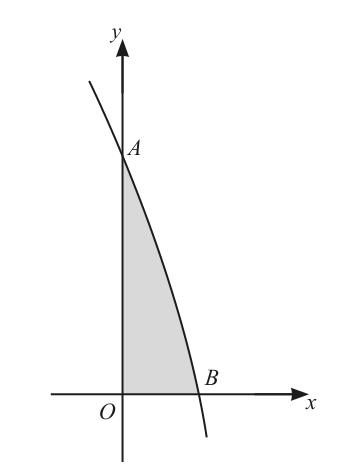
The diagram shows the curve with equation . The curve crosses the -axis at the point and the -axis at the point . The shaded region is bounded by the curve and the two axes.
Approach
The curve crosses the -axis at point , so the -coordinate at is . Differentiate the equation of the curve with respect to to find the gradient function, then substitute .
Working
At point , :
Answer
-10
Walkthrough
Point is where the curve crosses the -axis, which always occurs when . To find the gradient at this point, we first compute the derivative of the given equation . Using the chain rule for exponential functions, the derivative of is and the derivative of is . This gives . Substituting into this gradient function yields .
Key Takeaways
- The -intercept of a curve always has an -coordinate of .
- The derivative of is , so careful attention to the chain rule and signs is required.
Common Mistakes
- Forgetting the negative sign when differentiating , leading to instead of .
- Forgetting the factor of when differentiating .
- Evaluating the derivative at the wrong -value (e.g., using the -coordinate instead of ).
Things to Be Careful About
- Ensure the chain rule is applied correctly to both exponential terms.
- Remember that , which simplifies the evaluation step.
Approach
Point is where the curve crosses the -axis, so set and solve for using logarithms. Once the upper limit is confirmed as , integrate the curve equation from to to find the area of the shaded region.
Working
Finding the -coordinate of :
Multiply both sides by :
Take the natural logarithm of both sides:
Finding the area of the shaded region:
Evaluate at the upper limit :
Evaluate at the lower limit :
Subtract the lower limit value from the upper limit value:
Answer
5/2
Walkthrough
First, we find the -coordinate of point by setting . The equation rearranges to . Multiplying by gives . Taking the natural logarithm yields , and since , we get . This confirms the upper limit of integration.
Next, we calculate the area under the curve from to . The integral of is and the integral of is . Evaluating this antiderivative at requires knowing that and . This gives a value of . At , the value is . Subtracting the lower limit evaluation from the upper limit evaluation gives .
Key Takeaways
- Solving exponential equations often involves isolating the exponential term and using logarithms.
- Properties of logarithms and exponentials, such as and , are essential for simplifying evaluation steps.
- Always subtract the lower limit evaluation from the upper limit evaluation when computing definite integrals.
Common Mistakes
- Forgetting to multiply by on both sides when solving , leading to an incorrect equation.
- Incorrectly evaluating as instead of .
- Forgetting to subtract the lower limit value, resulting in instead of .
- Using decimal approximations for during the working, which the mark scheme explicitly penalises (A0 if decimals used).
Things to Be Careful About
- Ensure all working for showing is present; the mark scheme requires necessary detail and awards A0 if decimals are used.
- Be careful with the signs when integrating , which gives , not .
- The area is always positive; if a negative area is obtained, check the subtraction order (upper limit minus lower limit).
A curve is defined by the parametric equations
for values of such that .
Find the equation of the normal to the curve at the point for which . Give your answer in the form where , and are integers.
Approach
Differentiate and with respect to , then use
Evaluate this at to find the gradient of the tangent, then take its negative reciprocal to get the gradient of the normal. Finally, find the coordinates of the point and write the equation of the normal.
Working
Differentiate parametrically:
Therefore
At :
So the gradient of the normal is .
The coordinates of the point are
The equation of the normal is
Multiply by :
so
Answer
4x - 2y - 9 = 0
Walkthrough
We are given a curve in parametric form, so the gradient of the tangent is found using
First differentiate . Using the chain rule, the derivative of is , so
Then differentiate . The derivative of is , so
Substitute into both derivatives. Since
we get
This is the gradient of the tangent. The normal is perpendicular to the tangent, so its gradient is the negative reciprocal:
Next find the coordinates of the point on the curve when :
Finally, use the point-slope form of a line:
Multiplying by and rearranging gives
Key Takeaways
- For parametric curves, the gradient is obtained as the ratio of the two derivatives with respect to the parameter.
- Trigonometric derivatives such as those of and must be applied carefully, including the chain rule.
- The gradient of the normal is the negative reciprocal of the gradient of the tangent.
- The final line equation must be simplified to the required integer form.
Common Mistakes
- Forgetting the negative sign when differentiating .
- Missing the factor when differentiating .
- Using the tangent gradient instead of taking its negative reciprocal for the normal.
- Failing to find the actual coordinates of the point before writing the line equation.
- Leaving the equation with fractions instead of multiplying through to integer coefficients.
Things to Be Careful About
- The parameter range ensures the point is on the given part of the curve, but the calculation itself does not depend on this restriction.
- At , , so the formula for is valid.
- The mark scheme requires an attempt at substitution before the value of is accepted.
- The final answer must be written as with integer coefficients; here that is .
The polynomial is defined by .
Approach
Use polynomial long division to divide by . The quotient and remainder are read from the final division line.
Working
Divide by to get the first quotient term:
Multiply and subtract:
Bring down . Divide by :
Multiply and subtract:
Bring down . Divide by :
Multiply and subtract:
Thus the quotient is and the remainder is .
Answer
Quotient = 3x^2 + 4x - 1, Remainder = 6
Walkthrough
We are dividing a cubic polynomial by a linear polynomial. The goal is to write
where is the quotient and is a constant remainder. Since the divisor has degree 1, the remainder must be a constant.
Start by comparing the leading term with . The first quotient term is . Multiply by to get , subtract from the first two terms, and continue with the remaining terms. Repeat this process: the next quotient term is , then . After the final subtraction, the leftover is the remainder.
This long-division process directly gives both the quotient and the remainder, so no separate check is needed.
Key Takeaways
- Polynomial long division expresses a polynomial as divisor times quotient plus remainder.
- The degree of the remainder is less than the degree of the divisor.
- To show a remainder when the answer is given, you must show the division or an equivalent check.
Common Mistakes
- Sign errors when subtracting the product of the divisor and the current quotient term, especially with negative terms.
- Forgetting to bring down the next term before continuing.
- Stopping too early; the remainder is the final leftover after all terms are used.
- Using only the factor theorem to show the remainder is will not find the quotient, which is required.
Things to Be Careful About
- The divisor is , not , so the quotient coefficients differ from division by .
- Because the question says the remainder is , the mark scheme requires enough working to confirm it.
- Keep the subtraction aligned by place value to avoid arithmetic slips.
Approach
Use the quotient from part (a) to rewrite the integrand as a polynomial plus a term of the form . Then integrate term by term and apply the limits.
Working
From part (a):
Integrate:
Evaluate at :
Evaluate at :
Subtract:
Use logarithm laws:
Therefore:
Answer
14 + ln 16
Walkthrough
From part (a), the division identity is
Dividing both sides by gives
This is the key step: it turns a rational integrand into a simple polynomial plus a reciprocal term.
Now integrate term by term. The polynomial part integrates normally: , , . For the reciprocal term, recall
so integrates to .
Apply the limits and . At the antiderivative is ; at it is . Subtract the lower value from the upper value and combine the logarithms using
Thus the definite integral is .
Key Takeaways
- A division identity can simplify an integral of a rational function.
- The integral of is .
- Logarithmic terms from definite integrals must be combined using logarithm laws.
Common Mistakes
- Integrating as instead of ; the factor is essential.
- Forgetting to subtract the value of the antiderivative at the lower limit.
- Combining incorrectly. It equals , not or .
- Not using the quotient from part (a); the mark scheme follows through from the candidate's quotient.
Things to Be Careful About
- On the interval , , so the absolute value in is unnecessary.
- The final answer must be in the form with integers and ; here and .
- Keep the limits attached to the whole antiderivative, not to individual terms separately.
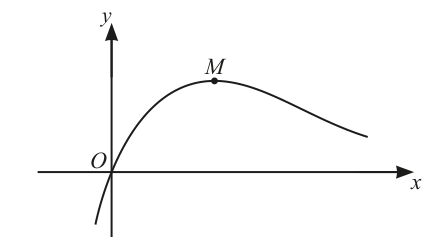
The diagram shows the curve with equation . The curve has a maximum point .
Approach
The function is a quotient, so the quotient rule is the natural tool. The numerator is a composition of with a linear function, so use the chain rule for its derivative.
Working
Let and .
By the chain rule:
And trivially .
Applying the quotient rule :
Answer
dy/dx = ((x+3)·(2/(2x+1)) - ln(2x+1)) / (x+3)^2
Walkthrough
The function is a quotient of two expressions, so the quotient rule is the standard technique:
For the top function , this is a composition of the natural log with the linear function . The chain rule says: differentiate the outer function () evaluated at the inner, then multiply by the derivative of the inner:
The factor of comes from the inner derivative; forgetting it is a very common slip.
For the bottom function , we have .
Substituting into the quotient rule:
This is the required expression. An important observation for what follows: the denominator is always positive wherever the function is defined, so the sign of the derivative is determined entirely by the numerator.
Key Takeaways
- The quotient rule differentiates by computing and dividing by .
- Composite functions like require the chain rule: differentiate the outer function, then multiply by the inner derivative.
- For this curve, the denominator of is always positive, so stationary points occur exactly when the numerator is zero.
Common Mistakes
- Forgetting the chain rule when differentiating , writing instead of .
- Misapplying the quotient rule (e.g., instead of ); the order of subtraction is the minus sign in the middle, not a plus.
Things to Be Careful About
- The chain rule contributes a factor of because the inner function is , not .
- The expression can be rewritten by distributing over to give , which is algebraically equivalent; either is acceptable.
Approach
At the maximum , the gradient is zero: . Since the denominator of (from part (a)) is , which is positive, the numerator alone must vanish. Rearrange this equation to obtain the form .
Working
Set the numerator of to zero:
Rearrange:
Cross-multiply:
Divide both sides by :
Subtract from both sides:
Answer
x = (x+3)/ln(2x+1) - 0.5
Walkthrough
A maximum point is where the gradient is zero, so . Because the denominator is always positive, this means the numerator from part (a) must vanish:
The target equation is in 'fixed-point' form (with on the right). To reach it, isolate step by step:
- Move the log term to the right: .
- Cross-multiply: .
- Divide by : .
Now , so the right-hand side is . Subtracting isolates :
This rearrangement is not just algebraic curiosity — it produces the fixed-point form that drives the iteration in part (d).
Key Takeaways
- Stationary points occur when , which for this curve means the numerator is zero.
- Rearranging the stationary-point equation into a fixed-point form is the standard way to set up an iteration.
- The chain of equivalences (dividing by a positive quantity, cross-multiplying) is valid because on the relevant domain ().
Common Mistakes
- Forgetting that the denominator is never zero — a student who sets it to zero is looking for an undefined point, not a stationary point.
- Dividing by without first checking it is non-zero (it is positive for , which is satisfied by the relevant part of the curve).
- Sign error in the step that converts to .
Things to Be Careful About
- The rearranged form has on both sides. The 'show that' wording means we are not solving for , only verifying the equivalence.
- A 'show that' question demands all working, since the final answer is already given.
Approach
Use the sign change method. Define , so that is exactly the equation from part (b). Evaluate at and . If the signs differ, the root of — and hence the -coordinate of — lies in the interval.
Working
At :
Using :
At :
Using :
Since and , the values have opposite signs. The function is continuous on (since throughout), so by the intermediate value theorem, has a root in the interval . Therefore the -coordinate of lies between and .
Answer
The -coordinate of lies between and (sign change of at the endpoints).
2.5 < x < 3.0
Walkthrough
To prove that a root lies in a given interval using algebra, the standard approach is the sign change (or 'change of sign') method. We define a function whose root is the quantity we want, evaluate it at the two endpoints, and check whether the signs differ.
The equation from part (b) is . Rearranging gives , so we set
A root of is exactly the -coordinate of .
Computing :
- Numerator inside: .
- Logarithm: .
- Fraction: .
- .
Computing :
- Numerator inside: .
- Logarithm: .
- Fraction: .
- .
The values have opposite signs: . Since is continuous on (the only potential issue would be , which occurs at , well outside the interval), the intermediate value theorem guarantees a root in .
Key Takeaways
- The 'change of sign' (or interval halving) technique locates a root by showing for continuous .
- This is the algebraic counterpart of looking for where a graph crosses the -axis.
- The justification is the intermediate value theorem, which requires the function to be continuous on the interval.
Common Mistakes
- Using the wrong equation (e.g., trying to find where directly via the original derivative rather than via the rearranged equation ).
- Making a sign error when defining .
- Quoting only the sign of the value at one endpoint without stating the other.
- Not justifying the conclusion: simply observing opposite signs is not enough; you must invoke the intermediate value theorem (or 'continuous function has a root between sign changes').
Things to Be Careful About
- The function is continuous on because throughout the interval.
- The two approximations and are correct to 1 decimal place; the more precise values and are also acceptable.
- This is a 'show that' question: the answer is given, so you must show all working clearly.
Use an iterative formula based on the equation in part (b) to find the -coordinate of correct to 4 significant figures. Give the result of each iteration to 6 significant figures.
Approach
The equation from part (b) is already in fixed-point form , so the iterative formula is
Start with (in the interval from part (c)) and iterate until two consecutive values agree to 6 significant figures.
Working
Start with .
Iteration 1:
Iteration 2:
Using :
Iteration 3:
Using :
Iteration 4:
Since to 6 significant figures, the iteration has converged.
Answer
x = 2.569
Walkthrough
The equation from part (b) has the form with . This is exactly the shape required for fixed-point iteration: .
A good starting value is one that lies in the interval we just located — is the upper bound and works well.
Iteration 1: Substitute into :
- , .
- .
- .
Iteration 2: Substitute into :
- , .
- .
- .
Iteration 3: Substitute into :
- , .
- .
- .
Iteration 4: Substitute into :
- , .
- .
- .
Because and agree to 6 significant figures, the iteration has converged: subsequent iterations will not change the 6th digit. To 4 significant figures, the -coordinate of is .
The convergence is also visible in the successive differences: , , . The map is a strong contraction near the fixed point (its derivative is close to zero), so successive iterates get closer very quickly.
Key Takeaways
- An equation of the form gives the fixed-point iteration .
- The starting value should lie in an interval known to contain the root.
- Convergence is judged by repeated iterates agreeing to the required number of significant figures (here, 6 sf for intermediate, 4 sf for the final answer).
- The logarithm is well-defined and positive for , so the iteration is safe once .
Common Mistakes
- Using the wrong iterative formula (e.g., rearranging differently and getting a formula that does not match the equation in part (b)).
- Stopping after only one or two iterations, which is not enough to justify 4 sf accuracy.
- Not giving intermediate values to 6 significant figures, even though the question explicitly asks for it.
- Rounding errors: if you truncate each iterate, you can introduce bias; ideally carry full accuracy in the calculator and only write the rounded value.
Things to Be Careful About
- The sign of the log is positive throughout, so no sign issues arise.
- The iteration must continue at least until two consecutive values match to 6 sf — three or four iterations is the norm here.
- The starting value is the upper bound from part (c); would also work and converges similarly. The chosen start does not affect the final answer (to 4 sf), only how quickly the iterates settle.
Approach
Rewrite as , use the double-angle formula , cancel, and simplify to .
Working
Using :
Since , the identity is proved:
Answer
sec θ
Walkthrough
We start with the left-hand side . The cosecant function is defined as the reciprocal of sine, so . This lets us write the whole expression as a single fraction. Next, we replace using the double-angle formula . The factor then cancels with the numerator, leaving , which is exactly . Because the question says the identity is given, we must show enough working to justify the cancellation and the final equivalence.
Key Takeaways
This question tests the definitions of reciprocal trigonometric functions and the double-angle formula for sine. It also reinforces the idea that proving an identity means transforming one side into the other using known formulae, with every step justified.
Common Mistakes
- Forgetting that , not .
- Incorrectly writing instead of , which prevents the cancellation.
- Since the identity is given, an unsupported statement such as "" without intermediate steps may not receive full credit.
Things to Be Careful About
The identity is defined only where and are non-zero, so cannot be a multiple of or a half-multiple where . In a proof, we assume these values are excluded. Also, be consistent with notation: , while .
Approach
Use the identity from part (a) to replace with . Then use to obtain a quadratic in . Solve the quadratic, convert to , and find all angles in .
Working
From part (a):
Substitute into the equation and use :
Multiply by 2:
Let :
Using the quadratic formula:
Since :
Now .
For :
For :
All four values lie in , so:
θ ≈ ±0.952, ±1.76 radians
Walkthrough
We first use the identity proved in part (a): . This converts the term into . The equation still contains , so we use the Pythagorean identity . This gives a quadratic equation in only. Multiplying by 2 gives . We solve this with the quadratic formula, obtaining two values of . Since , each value of gives a value of . Because is even, each positive or negative value of gives two angles in : one positive and one negative. Hence there are four solutions. The mark scheme requires all four and no extra values in the interval.
Key Takeaways
This problem combines trigonometric identities with solving a quadratic equation. It also tests the ability to find all solutions of in a given interval, remembering that .
Common Mistakes
- Forgetting to use and trying to solve an equation with two different trig ratios.
- Solving the quadratic in but forgetting to convert to before finding angles.
- Only giving the positive angles and missing the negative counterparts, since is even.
- Not checking that all found angles lie in .
Things to Be Careful About
The quadratic formula gives two values of ; each must be handled separately. When is negative, is negative, and the corresponding angles are in the second and third quadrants; in the interval these are the negative and positive angles with the same reference angle. Use sufficient accuracy, e.g. and , and do not include any angles outside the interval.
Approach
Simplify the integrand using and the double-angle formula . Then integrate the resulting .
Working
Using :
So the integrand becomes:
Therefore:
Since :
Answer
4 tan(x/2) + C
Walkthrough
We need to integrate . Since , the integrand is . The denominator contains , so we use the double-angle formula . Squaring this gives . The factors cancel, leaving . This is the key simplification. Now we integrate: since the derivative of is , multiplying by 2 gives , so the integral is . We add the constant of integration.
Key Takeaways
This question shows how a trigonometric identity can simplify an apparently complicated integrand into a standard form. It also tests the standard integral .
Common Mistakes
- Forgetting that and trying to integrate directly.
- Incorrectly expanding ; the factor 2 must be squared when squaring.
- Forgetting the factor 2 when integrating : .
- Omitting the constant of integration, though the mark scheme condones this.
Things to Be Careful About
Remember that . Here , so the factor is 2. Also, the simplification requires ; at such points the original integrand is undefined. The final answer is .