Mathematics 9709/21 — May/June 2024
Cambridge AS Level · Pure Mathematics 2 · worked solutions for every part, with the mark scheme
Topics Differentiation · Algebra · Logarithmic and Exponential Functions · Integration · Trigonometry · Numerical Solution of Equations
A curve has equation for .
Find the -coordinate of the stationary point of the curve. Give your answer correct to 3 significant figures.
Approach
Differentiate with respect to using the standard derivatives and . Set the derivative equal to zero because stationary points occur where . Then use to obtain an equation in , and take the inverse cosine.
Working
Differentiate:
At a stationary point, :
Use :
Multiply by (valid because , so ):
Therefore:
Correct to 3 significant figures:
Answer
x = 0.742
Walkthrough
The first step is to differentiate the curve. The derivative of is , and the derivative of is , so
A stationary point occurs where the gradient is zero, so set this derivative equal to zero:
To solve this, rewrite as . This turns the equation into one involving only :
Multiplying through by gives , so . Taking the cube root gives . Finally, apply to find the angle in radians:
Rounded to 3 significant figures, the -coordinate is .
Key Takeaways
- The standard derivatives and are essential.
- Stationary points are found by solving .
- The identity lets us rewrite a derivative equation as a purely trigonometric equation.
- In calculus, angles are measured in radians unless the question says otherwise.
Common Mistakes
- Forgetting the constant factors: the derivative is , not .
- Trying to solve without converting to .
- Taking a square root instead of a cube root after obtaining .
- Giving the answer in degrees. The mark scheme allows as an intermediate step, but the final answer must be in radians: .
Things to Be Careful About
- The domain ensures , so multiplying by is safe and no extraneous solutions are introduced.
- Use the cube root, not the square root, when solving .
- Round only at the final step. The unrounded value is , so to 3 significant figures it is .
- Make sure your calculator is in radian mode before evaluating .
A curve has equation .
Find the gradient of the curve at the point .
Approach
Differentiate the given equation implicitly with respect to , using the product rule for the term and the chain rule for terms involving . Then substitute the coordinates of the given point and solve for .
Working
Differentiate each term with respect to :
So the differentiated equation is
Substitute and :
Since , this becomes
Answer
-2/3
Walkthrough
We are given a curve defined implicitly by an equation in and , and we need its gradient at a point. Since is not written explicitly as a function of , we differentiate both sides with respect to and treat as a function of . Every time we differentiate an expression involving , we must multiply by .
The first term is a product of and , so we use the product rule:
The derivative of is by the chain rule.
The second term differentiates to , again by the chain rule.
The term differentiates to , and the constant differentiates to . Collecting these gives the implicit derivative equation.
Then we substitute the given point . Because , the first term disappears, and the equation simplifies to a linear equation in . Solving it gives the gradient.
Key Takeaways
- Implicit differentiation: differentiate both sides with respect to and multiply each derivative of a -expression by .
- The product rule is often needed for terms that contain both and .
- After differentiating, substitute the given coordinates and solve for .
- Remember ; this often simplifies substitution.
Common Mistakes
- Forgetting the factor when differentiating or .
- Applying the product rule incorrectly to ; the first term is , not alone.
- Forgetting to include the derivative of (which is ) on the left-hand side.
- Substituting the point before differentiating.
- Making an arithmetic error when solving ; the answer must be exact, e.g. , and not obtained from wrong working.
Things to Be Careful About
- The derivative of with respect to is , not just .
- The derivative of is , not .
- The right-hand side is a constant, so its derivative is ; keep the equation equal to .
- When substituting, , so the term vanishes.
- The mark scheme requires an exact equivalent answer and does not allow an answer obtained from wrong working, so show all steps clearly.
Approach
Sketch the V-shaped modulus graph by locating its vertex and the gradients of its two branches, then draw the line on the same axes, marking the two intersections.
Working
For :
- Vertex: , so and .
- For , (gradient ).
- For , (gradient ).
The line has gradient and intercept .
Find the intersection points. For :
For :
So the graphs meet at and .
Answer
Sketch the V-shaped graph with vertex , and the line , intersecting at and .
V-shaped graph with vertex (8/3, 0) and line y = 5 - x intersecting at x = 3/2 and x = 13/4
Walkthrough
The graph of is not a single straight line. The modulus changes the sign of when , i.e. at . To the right of this point is positive, so the graph is ; to the left it is negative, so the graph is . This creates a V shape with vertex at .
The line is a straight line with slope and -intercept . To place it correctly, find where it meets each arm of the V. On the left arm use , giving . On the right arm use , giving . These are the two intersection points required by the mark scheme.
Key Takeaways
A modulus expression can be graphed as two linear pieces meeting at the point where . The graph is V-shaped. Solving requires solving two linear equations, one for each branch.
Common Mistakes
- Drawing the vertex at the wrong point; the vertex is where , not at the -intercept.
- Drawing only one arm of the V.
- Placing the line so that it does not cross both arms.
- Forgetting that the two intersections are needed to show the line is correctly positioned.
Things to Be Careful About
Use the correct branch conditions: for the right arm and for the left arm. The intersection on the left arm is and on the right arm is . Label these points on the sketch.
Approach
Solve the boundary equation by considering the two possible signs of , then use a test value to decide which interval satisfies the strict inequality.
Working
The boundary values satisfy .
Case 1:
Case 2:
Test :
Since , the interval between and satisfies the inequality. The endpoints are excluded because the inequality is strict.
Answer
3/2 < x < 13/4
Walkthrough
To solve , first solve the corresponding equality because the boundary of the inequality occurs where the two sides are equal. The modulus requires two cases: when , the modulus sign can be removed; when , it is replaced by a negative sign.
For , the equation becomes , giving . For , it becomes , giving . These are the two boundary values.
To decide which region satisfies the strict inequality, test a point between the boundaries, such as . Since , the interval between the boundaries is correct. The endpoints are not included because the inequality is strict.
Key Takeaways
Modulus inequalities can be solved by first solving the associated equality, then testing intervals. The solution can also be read from the graph: the modulus graph must lie below the line .
Common Mistakes
- Including the endpoints and ; the inequality is strict, so they must be excluded.
- Choosing the wrong interval; always test a point.
- Forgetting the branch condition when removing the modulus sign.
- Reversing the inequality when dividing by a negative number.
Things to Be Careful About
When , is negative, so . The two boundary values are and . The final answer may be written as or and .
Approach
Set . The inequality has exactly the same form as part (b), so must lie between the two boundary values. Use natural logarithms to isolate , then choose the largest integer that satisfies both bounds.
Working
From part (b), the inequality is equivalent to
Substitute :
Since is increasing, take natural logarithms:
For the upper bound:
The lower bound gives , so the largest integer is .
Check:
and
so is valid.
Answer
N = 11
Walkthrough
The key idea is to notice that the inequality in part (c) is the same as part (b) with replaced by . Therefore the solution of part (b) applies directly: must be between and .
Since the exponential function is increasing, we can take natural logarithms of all three parts without changing the direction of the inequalities. This gives between and . Multiplying by isolates .
The upper bound gives , so the largest possible integer is . The lower bound gives , so is certainly within the interval. We check by substituting back: , which lies between and .
Key Takeaways
Recognising a repeated inequality structure allows substitution. Logarithms are used to solve inequalities where the unknown is in an exponent. The monotonicity of means taking logs preserves the inequality direction.
Common Mistakes
- Rounding up to ; the inequality is strict, so must be less than , making the largest integer.
- Forgetting the lower bound and not checking that satisfies both sides.
- Using the wrong base for the logarithm; here natural logarithms are appropriate because the expression is .
Things to Be Careful About
The inequality is strict on both sides. The upper bound is the one that limits the largest integer. Always verify the chosen integer by substituting back into the original exponential inequality.
Approach
Use the double angle formula for and the compound angle formula for to write the left-hand side entirely in terms of , then combine the two terms over a common denominator.
Working
Let . Then:
Also, since :
To combine the fractions, write the second term with denominator :
Therefore:
Replacing with gives the required identity.
Answer
Identity shown: (tan^2 θ + 8 tan θ + 1)/(1 - tan^2 θ)
Walkthrough
The left-hand side of the identity contains two trigonometric terms, while the right-hand side is a single fraction in . To prove the identity, express both terms on the left in terms of and combine them.
First, use the double angle formula for tangent:
Multiplying by gives .
Next, use the compound angle formula for tangent:
With and , and using , this becomes:
The two terms now have different denominators. Since , multiply the numerator and denominator of the second fraction by :
Now both fractions have the same denominator, so add their numerators:
Simplify the numerator to , which is exactly the right-hand side.
Key Takeaways
- The double angle formula for expresses in terms of .
- The compound angle formula for expresses in terms of .
- Rational expressions with related denominators can be combined by rewriting one denominator as a product and scaling the other fraction.
- When an identity is given, all algebraic steps must be shown; the final answer cannot be assumed.
Common Mistakes
- Forgetting that .
- Using the wrong sign in the denominator of the compound angle formula: the denominator is , not .
- Stopping after writing the two terms separately instead of combining them into a single fraction.
- Making sign errors when expanding .
Things to Be Careful About
- The identity is only defined where ; the proof is algebraic and assumes the expressions are defined.
- The mark scheme requires the left-hand side to be expressed as a single fraction before the final answer is confirmed.
- Use consistently; substituting a letter such as can make the algebra clearer.
Approach
Use the identity from part (a) to replace the left-hand side of the equation, then solve the resulting quadratic in . Finally use the period of to find all solutions in .
Working
From part (a):
Let . Then:
Multiply both sides by :
Using the quadratic formula:
So or .
For :
Since has period , the other angle with this tangent is , which is outside the interval. So this tangent gives only .
For :
Adding gives:
This is in the interval. The next angle would be , outside the interval.
Answer
θ = 17.4°, 117.6°
Walkthrough
Part (b) says "Hence solve", so use the identity proved in part (a) to replace the left-hand side of the equation . This gives:
Let . Multiplying both sides by gives:
Rearranging:
This is a quadratic in . Solve it with the quadratic formula:
So the two possible values are and .
Now find the angles. For a positive tangent, the calculator gives the first-quadrant angle . Because has period , the next angle with the same tangent is , which is outside , so only is kept.
For the negative tangent, the calculator gives . Adding gives , which lies in the interval. The next angle would be , outside the interval, so the solutions are and .
Key Takeaways
- A trigonometric equation can often be reduced to a quadratic by using a proven identity.
- The inverse tangent function gives only a principal value; the period of is , so add or subtract to find all solutions in a given interval.
- Positive tangent values correspond to angles in the first and third quadrants; negative tangent values correspond to the second and fourth quadrants.
Common Mistakes
- Forgetting the second solution by only taking the principal value of .
- Including or as answers without checking the interval.
- Making a sign error when rearranging ; the terms combine to give .
- Not using the identity from part (a), which is the intended method for the "Hence".
Things to Be Careful About
- The interval is open, , so endpoints are not included.
- The period of is , not .
- Both roots of the quadratic must be considered; one root can give one solution and the other root can give another.
- The mark scheme requires a correct method for solving the quadratic and both correct angles with no extra angles in the interval.
A curve has equation . The curve has exactly one stationary point .
Approach
Differentiate using the quotient rule. At the stationary point , set and rearrange the resulting equation to isolate .
Working
Let and . Then and .
Using the quotient rule :
At the stationary point, , so the numerator must be zero:
Expand the brackets:
Divide both sides by :
Answer
The -coordinate of satisfies
x = 1/6 + (1/2)e^(-2x)
Walkthrough
We are given a curve and told it has exactly one stationary point . A stationary point occurs where the derivative is zero, so the first task is to differentiate the function.
The function is a quotient of two expressions, so the quotient rule is the natural tool. With and , we compute (the derivative of is by the chain rule) and .
Substituting into the quotient rule gives the derivative as a single fraction. Setting the numerator equal to zero (since the denominator is never zero for the relevant values) yields the stationary-point condition.
Expanding the brackets and collecting like terms gives . To isolate , divide both sides by , which is valid since for all real . This produces , and a final rearrangement gives the required equation.
Key Takeaways
- The quotient rule is essential for differentiating fractions of functions.
- At a stationary point, .
- Dividing by is always safe because exponential functions are strictly positive.
- The equation is an implicit equation for — it cannot be solved algebraically in closed form, which motivates the numerical methods in parts (b) and (c).
Common Mistakes
- Forgetting the minus sign in the quotient rule: the formula is , not .
- Incorrectly differentiating — the chain rule gives , not .
- Dropping the factor of 3 when differentiating .
- Mark scheme guidance: since the answer is given in the question, "necessary detail" must be shown — every algebraic step from to the final equation must be present.
Things to Be Careful About
- The denominator is positive for all , so setting the numerator to zero is fully equivalent to setting .
- Use exact terms throughout: keep and as fractions rather than decimals to match the required form exactly.
Approach
Define . The -coordinate of is a root of . Evaluate at and and show the signs differ.
Working
Let
Evaluate at :
Evaluate at :
Since and , there is a sign change between and . Therefore the root of , which is the -coordinate of , lies between 0.35 and 0.45.
Answer
and , so by the sign-change rule the -coordinate of lies between 0.35 and 0.45.
f(0.35) < 0 and f(0.45) > 0, so the x-coordinate of P lies between 0.35 and 0.45
Walkthrough
From part (a), the -coordinate of satisfies . Rearranging, this is equivalent to finding a root of .
The sign-change rule states that if a continuous function changes sign between two points, it must have a root between them. Here is continuous because it is built from polynomials and exponentials, which are continuous everywhere.
We evaluate at the two endpoints of the proposed interval. At we compute , giving , which is negative. At we compute , giving , which is positive.
The sign change from negative to positive confirms that a root lies strictly between 0.35 and 0.45.
Key Takeaways
- The sign-change (intermediate value) theorem is the standard tool for locating roots of continuous functions.
- The auxiliary function is formed by moving all terms to one side of the equation.
- Only the signs of the function values matter for the conclusion — the magnitudes give extra confidence but the sign change is the key observation.
Common Mistakes
- Evaluating the wrong function — some students try to substitute into itself rather than into .
- Arithmetic errors in computing or — use a calculator carefully.
- Mark scheme guidance: since the answer is given, "necessary detail" is required — both function values must be shown explicitly with their signs.
- Forgetting to state the conclusion explicitly: a sign change means the root lies between the two points.
Things to Be Careful About
- Keep enough decimal places in the intermediate calculations so the sign is unambiguous. Values like and are clearly negative and positive respectively.
- The function is continuous on , which is required for the sign-change argument to be valid.
- The mark scheme also accepts evaluating from part (a) at the two endpoints instead — the same sign-change logic applies to the derivative.
Use an iterative formula based on the equation in part (a) to find the -coordinate of correct to 3 significant figures. Give the result of each iteration to 5 significant figures.
Approach
Use the iterative formula starting from a value inside the interval found in part (b), say . Iterate until successive values agree to 5 significant figures, then round the final value to 3 significant figures.
Working
Starting with :
To 5 significant figures: .
To 5 significant figures: .
To 5 significant figures: .
To 5 significant figures: .
To 5 significant figures: .
To 5 significant figures: .
To 5 significant figures: .
To 5 significant figures: .
To 5 significant figures: .
To 5 significant figures: .
To 5 significant figures: .
The iterations have converged to 0.39403 to 5 significant figures. Therefore, to 3 significant figures, the -coordinate of is 0.394.
Answer
x = 0.394
Walkthrough
Part (a) gave the equation , which is already in the form . This is ideal for an iterative scheme: we guess a starting value , then repeatedly apply .
From part (b) we know the root lies between 0.35 and 0.45, so is a sensible starting point.
Each iteration computes . The values oscillate slightly around the true root before settling: 0.39133, 0.39527, 0.39345, 0.39427, 0.39388, 0.39406, 0.39397, 0.39401, 0.39404, 0.39403, 0.39403. The last two values agree to 5 significant figures, so we can confidently state the root to 3 significant figures as 0.394.
The question specifically asks for each iteration to be given to 5 significant figures, which is why we round each intermediate value before using it in the next step (though in practice keeping full precision internally and rounding only for display is also acceptable).
Key Takeaways
- An equation of the form can be solved iteratively using .
- A good starting value (from a sign-change interval) speeds up convergence.
- Convergence is confirmed when successive iterates agree to the required precision.
- Rounding each displayed iteration to 5 significant figures lets the reader verify the convergence pattern.
Common Mistakes
- Using the wrong iterative formula — some students try to iterate itself rather than .
- Not showing enough iterations. The mark scheme requires "sufficient iterations to 5 sf to justify answer" — at least 5–6 iterations, ideally until two consecutive values agree.
- Rounding the final answer incorrectly: 0.39403 to 3 significant figures is 0.394, not 0.3940 or 0.39.
- Giving iteration values to the wrong number of significant figures — the question explicitly asks for 5 significant figures.
Things to Be Careful About
- The sequence oscillates (values alternate slightly above and below the root) before converging. This is normal for this type of iteration and does not indicate a problem.
- To be certain of 3 significant figures, the interval must contain the root; the converged value 0.39403 clearly does.
- Keep full calculator precision when computing each value; only round the displayed to 5 significant figures.
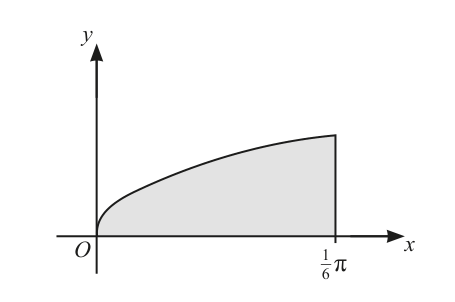
The diagram shows the curve with equation for . The shaded region is bounded by the curve and the straight lines and .
Use the trapezium rule with two intervals to find an approximation to the area of the shaded region. Give your answer correct to 2 significant figures.
Approach
Use the trapezium rule with 2 equal intervals across and substitute the function values at , and into the formula.
Working
With 2 intervals, the strip width is:
The -values at the three points are:
- At :
- At :
- At :
Applying the trapezium rule:
Answer
0.39 (to 2 significant figures)
0.39
Walkthrough
The trapezium rule estimates the area under a curve by splitting the region into a number of trapezium-shaped strips and adding their areas together. With two intervals, the interval is divided into two equal strips, each of width . Three function values are needed: the two endpoints and the midpoint.
The function is evaluated at each of these -values. At the value is 0 (the curve passes through the origin, as shown in the diagram). At , we have so and the value becomes . At , and , giving approximately .
The trapezium rule formula weights the middle value twice because it borders two strips. Substituting the values gives . To 2 significant figures this is .
Key Takeaways
- The trapezium rule gives an approximation, not an exact value; the answer must be given to a specified accuracy.
- With 2 intervals over , the strip width is .
- The formula is : only interior values get the factor 2.
Common Mistakes
- Using or instead of .
- Forgetting to double the middle -value.
- Reporting too many significant figures (the question specifies 2 s.f.).
- Computing -values from instead of (the argument is , not ).
Things to Be Careful About
- The mark scheme permits an answer of but not greater accuracy, so 4-figure or more precision is not allowed.
- Work in radians throughout because the limits are given as multiples of .
The shaded region is rotated completely about the -axis.
Find the exact volume of the solid produced.
Approach
The volume of the solid formed when the region is rotated completely about the -axis is . Square the curve, expand using the identity , integrate term by term, and apply the limits exactly.
Working
Set up the volume integral using :
Use the double-angle identity to rewrite the integrand:
So:
Integrate term by term:
Evaluate at the upper limit :
Evaluate at the lower limit :
Subtract the lower from the upper value:
Distribute the :
Answer
V = (1/4)π + (1/12)π² − (1/16)π√3
Walkthrough
When a region bounded by a curve , the -axis and two vertical lines is rotated about the -axis, the volume of the resulting solid is given by . The crucial first step is to square the function: .
The expression cannot be integrated directly, so we apply the double-angle identity with , giving . This converts the integrand into a sum of standard functions: a sine, a constant, and a cosine of .
The next step is to integrate each term separately. Recall that , , and . Applying these:
So an antiderivative is .
Applying the limits, the trickiest values are at : and . At everything simplifies cleanly: , . Subtracting the lower value () from the upper value () gives the bracket . Multiplying by the outer produces the final exact volume.
Key Takeaways
- Volume of revolution about the -axis: .
- Always square before substituting: the disappears.
- The identity is the standard tool for handling in an integrand.
- Exact values of and at multiples of and must be used, not decimal approximations.
Common Mistakes
- Forgetting to square: writing instead of .
- Integrating as (treating it as a chain rule integral).
- Using instead of the form, which produces an unnecessarily complicated integrand.
- Forgetting the chain rule when integrating (must divide by 4, not 1).
- Sign errors: integrates to , not .
- Using degrees instead of radians at the exact-value step.
Things to Be Careful About
- The mark scheme follows through on the candidate's own integrand only if it is of the correct form with all three constants non-zero. If the identity is applied incorrectly, subsequent marks are for the candidate's own (wrong) antiderivative.
- The lower-limit subtraction must be done carefully: the constant at is subtracted, so .
- The final answer must be exact, so decimal approximations of or are not accepted.
The polynomial is defined by
where is a constant.
Approach
Divide by using polynomial long division. The quotient and remainder are read from the final subtraction.
Working
First term of quotient:
Multiply back:
Subtract from :
Next term of quotient:
Multiply back:
Subtract:
So the quotient is and the remainder is .
Answer
Quotient = ; remainder = .
Quotient = 3x^2 + 4; remainder = k - 8
Walkthrough
We are dividing a cubic polynomial by the linear factor . Start by comparing leading terms: divided by gives . Multiplying by gives , which exactly removes the first two terms of , leaving . Then divided by gives . Multiplying by gives , and subtracting leaves . This is the remainder. Since the question says 'show that', the subtraction must be written out clearly; an unsupported answer would not earn the final mark.
An equivalent method is synthetic division using the root . The coefficients give , so the quotient is and the remainder is .
Key Takeaways
This question tests polynomial division and the relationship between dividend, divisor, quotient and remainder:
It also shows that the remainder theorem can be used as a check: substituting into gives .
Common Mistakes
- Not showing enough working. Because the remainder is given in the question, the mark scheme requires the division detail; simply stating the answer loses the final mark.
- Sign errors when subtracting, especially with .
- In synthetic division, forgetting to use or making a sign error in the multiplier.
Things to Be Careful About
The quotient has no -term: it is , not with a missing term. The remainder is a constant because the divisor is linear. If , the division would be exact.
Approach
Use the quotient and remainder from part (a) to rewrite as a polynomial plus a reciprocal-linear term. Integrate term by term, apply the limits, then use logarithm laws to compare with .
Working
From part (a):
Integrate:
Apply the limits to :
Since , the given equality is
Equate the constant terms and the coefficients of :
Hence , so .
Answer
and .
a = 235, k = 17
Walkthrough
Part (b) asks for a definite integral, but the integrand is a rational function. The key is to use the result of part (a):
This splits the integral into a polynomial part and a reciprocal-linear part. The polynomial integrates to . For the reciprocal part, recall that
so the factor gives . On the interval , , so no absolute value is needed.
Substitute the limits. At , the polynomial part is ; at , it is ; the difference is . The log terms combine as
Finally, compare with . Since , the coefficient of on the right is . Therefore and , giving .
Key Takeaways
This question combines polynomial division, integration of , definite integration with limits, and logarithm laws. It shows how a previous part can be used to simplify an otherwise difficult integrand.
Common Mistakes
- Forgetting the factor when integrating .
- Not applying the limits to every term, especially the logarithmic term.
- Writing instead of .
- Comparing the expression to without first writing .
- Using an incorrect quotient from part (a); the mark scheme follows through on the quotient, but the final would be wrong.
Things to Be Careful About
- The question says to use the answer from part (a); the integration mark depends on using the quotient.
- The limits are and , giving and respectively.
- When equating with , the constant and logarithmic parts must match separately.
- Since is stated to be an integer, this confirms that the polynomial part is exactly .