Mathematics 9709/13 — May/June 2024
Cambridge AS Level · Pure Mathematics 1 · worked solutions for every part, with the mark scheme
Topics Series · Trigonometry · Quadratics · Differentiation · Integration · Functions · +2 more
Find the coefficient of in the expansion of
Approach
Expand only as far as the term, then multiply by and collect the coefficient of .
Working
The binomial expansion of begins
The term is
The term is
So
Now multiply by . The terms come from
Therefore
Answer
660
Walkthrough
The expansion of would normally contain many terms, but we only need the coefficient of in the final product. Since we are multiplying by the linear factor , the term in the product can only come from two places:
- the constant multiplied by the term of the expansion, and
- the term multiplied by the term of the expansion.
So we only need the first three terms of the binomial expansion of .
Using the binomial theorem, the term is
and the term is
Higher terms such as and above will not contribute to the coefficient of after multiplying by , because the highest power needed in the product is .
Now multiply:
and
Adding these gives
so the coefficient of is .
Key Takeaways
This question tests the ability to use a binomial expansion efficiently. You do not need to write out the whole expansion; you only need the terms that can contribute to the required power after multiplication. It also tests careful multiplication of polynomials and accurate collection of like terms.
Common Mistakes
- Expanding the whole of instead of stopping at the term. This wastes time and increases the chance of error.
- Forgetting to multiply the term by and the term by .
- Making a sign error when multiplying by : the term is , not .
- Stating the final answer as without clearly identifying the coefficient. The mark scheme accepts if it is clearly identified as the coefficient, but it is safer to state the coefficient as .
Things to Be Careful About
- Only the terms with and in the binomial expansion are needed; all higher powers can be ignored.
- Keep track of signs throughout the multiplication.
- The final coefficient is a number only, not the full term. The question asks for the coefficient of , so the answer is .
- Show the intermediate binomial terms clearly, because the mark scheme awards separate marks for the term, the term, the multiplication step, and the final coefficient.
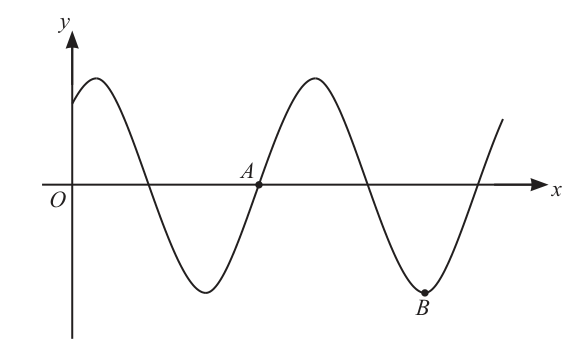
The diagram shows the curve where is a positive constant and is measured in radians. The curve crosses the -axis at point and is a minimum point.
Find the coordinates of and .
Approach
To find the coordinates of point , set and solve for , identifying the correct root from the diagram. To find the coordinates of point , determine where the cosine function reaches its minimum value of .
Working
For point , the curve crosses the -axis, so :
Since is a positive constant, we can divide by :
The general solution for is for integer . Thus:
From the diagram, the curve starts at a positive -intercept (), reaches a maximum at , and then descends. The first -intercept (where the curve is decreasing) is at , giving . Point is the next -intercept (where the curve is increasing), which corresponds to :
So the coordinates of are .
For point , it is a minimum point. The minimum value of is , which occurs when :
The first minimum is at , giving . From the diagram, point is the second minimum point to the right of the origin, so we take :
The -coordinate at a minimum is .
So the coordinates of are .
Answer
Point :
Point :
A = (5π/3, 0), B = (19π/6, -k)
Walkthrough
First, we analyze the equation . The basic cosine curve has -intercepts at and minima at . The term represents a phase shift to the right by .
For point , we set to find the -intercepts. Solving gives , or . Looking at the diagram, the curve starts at a positive -value, goes up to a maximum at , then crosses the -axis at (decreasing). Point is the next crossing, where the curve is increasing. This corresponds to , giving . The -coordinate is .
For point , we need the minimum point. The cosine function reaches its minimum of when the argument is . Solving gives . The first minimum is at . The diagram shows is the second minimum, so we add one full period () to get . The -coordinate is .
Key Takeaways
- Phase shifts in trigonometric functions translate the graph horizontally without changing its shape or amplitude.
- Identifying specific points on a trigonometric graph requires matching the algebraic solutions to the visual features (increasing/decreasing, first/second occurrence).
- The minimum value of is .
Common Mistakes
- Selecting the wrong root for when solving . Always check the diagram to see if the curve is increasing or decreasing at the intercept.
- Forgetting to add the full period when looking for the second minimum point.
- Assuming the first minimum shown in the diagram is at without verifying against the phase shift.
Things to Be Careful About
- The diagram is crucial here. Point is not the first -intercept; it is the second one (where the curve is rising). Point is the second minimum, not the first.
- Ensure angles are in radians as specified in the question.
- The constant remains in the -coordinate for point ; do not attempt to find its numerical value as it is not given.
Approach
Evaluate the exact value of , substitute it into the equation, and then isolate to solve for .
Working
The given equation is:
First, evaluate . We know that , and the range of is , so:
Substitute this back into the equation:
Subtract from both sides:
Divide by 3:
Now, take the sine of both sides. Since , we have:
We know that , so:
Divide by 3:
Answer
t = 1/6
Walkthrough
The equation involves inverse trigonometric functions. The first step is to simplify the known constant term: . Recognizing that and that , we find this equals .
Substituting into the equation gives , which simplifies to .
Isolating the inverse sine term: , so .
To solve for , we use the definition of the inverse sine function: if , then . Thus, .
Since , we have , which gives .
Key Takeaways
- Memorize the exact values of inverse trigonometric functions for standard angles (e.g., , ).
- Inverse trigonometric equations can be solved by isolating the inverse function and then applying the corresponding direct trigonometric function to both sides.
- Pay attention to the range of inverse functions; for , the range is , and for , it is .
Common Mistakes
- Incorrectly evaluating as or . Remember the special right triangles or unit circle values.
- Forgetting to divide by the coefficient (3) when isolating .
- Algebraic errors when solving for .
Things to Be Careful About
- Ensure consistency in units (radians vs. degrees). The problem uses , so work in radians.
- The value gives , which is within the domain of (i.e., ), so the solution is valid.
- Do not confuse with ; the is crucial.
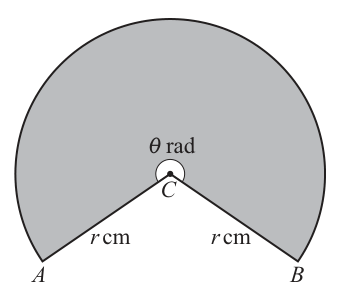
The diagram shows a sector of a circle with centre . The radii and each have length and the size of the reflex angle is radians. The sector, shaded in the diagram, has a perimeter of and an area of .
Approach
Use the standard formulas for the perimeter and area of a circular sector. The perimeter of the shaded region includes the two radii and the arc length corresponding to the reflex angle . Set up a system of two equations with two unknowns ( and ), eliminate one variable to form a quadratic equation, and solve. Finally, check which solutions are valid given that must be a reflex angle (i.e., ).
Working
The perimeter of the shaded sector is the sum of the two radii and the arc length:
The area of the shaded sector is given by:
From the perimeter equation, express in terms of :
Substitute this expression into the area equation:
Expand and rearrange into a standard quadratic form:
Factorise the quadratic equation:
This gives two possible values for :
Now find the corresponding values of and check if they are reflex angles (where ):
- If , then , giving radians. Since , this is not a reflex angle. Reject this solution.
- If , then , giving radians. Since , this is a valid reflex angle.
Thus, the valid values are and .
Answer
r = 10, θ = 4.5
Walkthrough
First, recall the formulas for the perimeter and area of a circular sector. The perimeter of a sector is the sum of the two straight radii and the curved arc length. For a reflex angle , the arc length is . This gives the equation . The area of the sector is given by .
Next, solve this system of equations. Isolate from the perimeter equation to get . Substitute this into the area equation to eliminate and form a quadratic in : , which simplifies to . Factorising gives , yielding or .
Finally, test both values of to find the corresponding . If , , which is less than and therefore not a reflex angle, so it is rejected. If , , which lies between and , confirming it is a valid reflex angle. The correct values are and .
Key Takeaways
- The perimeter of a sector includes the arc length plus two radii: .
- The area of a sector is .
- Always check the validity of solutions against the geometric constraints of the problem (e.g., whether an angle is reflex, acute, or obtuse).
Common Mistakes
- Forgetting to include the two radii in the perimeter calculation (using only ).
- Failing to reject the solution because must be a reflex angle ().
- Algebraic errors when forming or factorising the quadratic equation.
Things to Be Careful About
- Ensure is in radians when using the arc length and sector area formulae.
- A reflex angle is strictly between and radians ( and ). The value is a minor angle, not a reflex angle, so it must be discarded.
- The mark scheme awards a method mark for forming a 3-term quadratic or cubic, so show the substitution step clearly.
Approach
The area of triangle can be found using the formula , where and are the lengths of two sides and is the included angle. The sides and both have length . The angle at inside the triangle is the non-reflex angle, which is .
Working
The angle inside triangle at vertex is:
The area of triangle is:
Substitute and :
Answer
48.9 cm^2
Walkthrough
To find the area of triangle , use the trigonometric formula for the area of a triangle: . Here, the two known sides are the radii and , both equal to cm. The included angle is the angle at inside the triangle. Since the reflex angle is radians, the non-reflex angle (the one inside the triangle) is . Calculate this angle, take its sine, and multiply by to get the area.
Key Takeaways
- The area of a triangle with two known sides and an included angle is .
- When a reflex angle is given for a sector, the interior angle of the corresponding triangle is .
Common Mistakes
- Using the reflex angle directly in the sine formula. Note that , which would give a negative area. Using ensures a positive sine value since is in the second quadrant.
- Forgetting to include units in the final answer.
Things to Be Careful About
- Ensure your calculator is in radian mode when evaluating , or convert to degrees () first.
- The mark scheme allows for answers to 3 significant figures (48.9) or greater accuracy.
Show that the equation can be written in the form , where , and are integers to be found.
Approach
Use the identity to remove the tangent, then use to obtain a quadratic in .
Working
Start with
Using :
Now use :
Answer
The equation is
so , , .
5 sin^2 θ + 7 sin θ - 6 = 0; a = 5, b = 7, c = -6
Walkthrough
The aim is to rewrite the left-hand side as a quadratic in . Start by expanding the bracket using the identity . This is helpful because the factor outside the bracket cancels with the in the denominator of , leaving . The second term becomes . The equation is then .
To make this a quadratic in , replace using the Pythagorean identity . Substituting gives . Expanding and rearranging gives , so , , . This matches the required form.
Key Takeaways
This question tests the two fundamental trigonometric identities:
It also shows how an expression involving different trig functions can be reduced to a single quadratic expression in one trig function.
Common Mistakes
- Expanding incorrectly, especially forgetting the negative sign on .
- Using or another incorrect identity.
- Making a sign error when moving the constant to the left-hand side, which would give the wrong value of .
- Not simplifying fully to the required form .
Things to Be Careful About
The mark scheme requires the use of both identities to be shown. An answer that jumps straight to the final quadratic may not earn the method marks.
The equation could equivalently be written as ; the mark scheme allows either sign. The integers are , , (or all multiplied by ).
Since the original equation contains , values where are not in the domain, but this does not affect the algebraic rearrangement.
Approach
Use the result from part (a) with . Solve the quadratic in , reject any impossible root, then solve over the interval and divide by 2.
Working
From part (a), with :
Let . Then
Factorise:
So
Since must satisfy , reject . Hence
For , we have . The solutions of in this interval are
Therefore
Both values lie in the required interval, so these are the only solutions.
Answer
x = 18.4°, 71.6°
Walkthrough
Since part (a) proved the identity for any angle, replace by to get . This is a quadratic in .
Let . Factorising gives , so or . The second value is impossible because the sine of any angle is always between and . Therefore .
Now solve where . Since , doubling gives . In this interval the sine function is positive in the first and second quadrants, so the two solutions are and . Dividing by gives and . Both lie in the required range, so these are the only solutions.
Key Takeaways
- A trigonometric equation can often be reduced to a quadratic in one trig function.
- The range of is , so roots outside this range must be rejected.
- When solving in a given interval, use the symmetry of the sine graph: the second solution is .
- If the variable is , solve for first and then divide by , remembering to double the interval.
Common Mistakes
- Forgetting to reject and trying to solve , which has no solution.
- Only giving the principal-value solution and missing .
- Solving for and then forgetting to divide by , giving and as the final answers.
- Using the interval instead of when finding sine solutions.
Things to Be Careful About
The question says 'Hence', so the solution should use the quadratic obtained in part (a). The mark scheme awards a method mark for attempting to solve a three-term quadratic and finding at least one value of .
The final answers should be given in degrees. If working in radians, the corresponding values are and radians, but the question asks for .
Because the interval for is one full period from to (with endpoints excluded), there are exactly two solutions. Do not add extra solutions by continuing the sine pattern beyond this interval.
The equation of a curve is .
Approach
Differentiate the curve term by term, set to locate stationary points, solve for , then substitute back to find .
Working
Given
Differentiate:
Set the derivative equal to zero:
Multiply by :
Solve:
Substitute into :
Answer
(-1/2, 9/2)
Walkthrough
We need to find where the curve has a stationary point, i.e. where the gradient is zero. First rewrite the term as so we can use the power rule. Differentiating gives . Setting this equal to zero gives an equation involving and ; multiplying through by turns it into the simple cubic . Solving gives . Substituting this back into the original equation gives . Therefore the stationary point is .
Key Takeaways
- Stationary points occur where the derivative is zero.
- Negative powers can be differentiated using the same power rule as positive powers.
- Multiplying by removes the denominator and makes the equation easier to solve.
Common Mistakes
- Forgetting that the derivative of the constant is .
- Making a sign error when differentiating ; the derivative is .
- Stopping after finding without substituting back to find .
Things to Be Careful About
- The curve is not defined at , but the stationary point is at , so no issue arises.
- The mark scheme gives only a special-case mark if the cubic is not solved visibly, so show the step clearly.
Approach
Differentiate the first derivative to obtain the second derivative, evaluate it at the stationary point, and use its sign to determine the nature of the stationary point.
Working
From part (a),
Differentiate again:
At :
Since ,
Because , the stationary point is a minimum.
Answer
Minimum
minimum
Walkthrough
We already know the first derivative from part (a). To determine the nature of the stationary point, differentiate again to get the second derivative. Substituting gives , which is positive. A positive second derivative means the gradient is increasing at that point, so the curve is locally concave up and the stationary point is a minimum.
Key Takeaways
- The second derivative tells us the nature of a stationary point: positive means minimum, negative means maximum.
- Evaluating the second derivative at the stationary point is often quicker than testing nearby values.
Common Mistakes
- Forgetting to differentiate the first derivative correctly; the derivative of is , not .
- Confusing the sign rule: positive second derivative means minimum, not maximum.
Things to Be Careful About
- The mark scheme allows a sign test on the first derivative as an alternative, but if using the second derivative, the substitution must be shown or implied by a correct inequality.
- Ensure the final conclusion follows from correct working only.
For positive values of , determine whether the curve shows a function that is increasing, decreasing or neither. Give a reason for your answer.
Approach
For , examine the sign of the first derivative. If it is positive for all positive , the function is increasing.
Working
The first derivative is
For , both terms are positive:
Therefore
So the curve is increasing for positive values of .
Answer
Increasing
increasing
Walkthrough
For positive values of , we only need to know the sign of the gradient. The derivative is . When , the term is positive and the term is also positive because the denominator is positive. Hence the whole derivative is always positive for . A positive gradient means the function is increasing on that interval.
Key Takeaways
- The sign of the derivative determines whether a function is increasing or decreasing.
- A function is increasing on an interval if its derivative is positive throughout that interval.
- It is enough to argue that each term of the derivative has the same sign, rather than substituting individual values.
Common Mistakes
- Substituting a few values of is not sufficient; the mark scheme requires a clear reference to the derivative being always positive for .
- Saying the function is neither increasing nor decreasing because it has a minimum for negative ; the question only asks about positive values of .
Things to Be Careful About
- The derivative is undefined at , but the interval is strictly , so this does not affect the conclusion.
- The conclusion must be based on the first derivative, not on the shape of the curve alone.
A curve passes through the point and is such that .
Approach
We are given the derivative and a point on the curve. We integrate the derivative with respect to , then use the given point to determine the constant of integration.
Working
Write the derivative in power form:
Integrate with respect to using the rule :
Substitute and :
Therefore the equation of the curve is:
y = 4/(5x-3) - 7
Walkthrough
We are given the derivative and a point on the curve. To find the equation of the curve, we integrate the derivative. The integrand is of the form with , , , and . Using the integration rule :
Now we substitute the point into :
So , and the equation is .
Key Takeaways
- Integration is the reverse of differentiation: to recover from , integrate.
- The rule applies to all , including negative powers.
- The constant of integration is determined by substituting a known point on the curve.
Common Mistakes
- Forgetting the factor in the denominator when integrating .
- Substituting the point in the wrong order (e.g., , ) — the mark scheme explicitly awards DM0 for this.
- Forgetting to include the constant before substituting.
Things to Be Careful About
- The coefficient divided by gives , not .
- The mark scheme condones the absence of at the integration stage, but must appear before the substitution step.
- The final answer should be written as or .
The curve is transformed by a stretch in the -direction with scale factor followed by a translation of .
Find the equation of the new curve.
Approach
Apply the two transformations in the order given. A stretch in the -direction with scale factor replaces by . A translation by replaces by and by .
Working
Start from the equation found in part (a):
Step 1: Stretch in the -direction, scale factor .
Replace by :
Step 2: Translation by .
Replace by and by :
Simplify inside the brackets:
Add 10 to both sides:
Answer
y = 4/(10x-23) + 3
Walkthrough
We start from the equation found in part (a).
The first transformation is a stretch in the -direction with scale factor . A stretch in the -direction with scale factor replaces by . With , we replace by :
The second transformation is a translation by . A translation by replaces by and by . Here and , so we replace by and by :
Simplify inside the bracket: .
Add 10 to both sides:
Key Takeaways
- A stretch in the -direction with scale factor replaces by .
- A translation by replaces by and by .
- Transformations must be applied in the order given.
Common Mistakes
- Applying the transformations in the wrong order — the mark scheme awards M1 for the stretch as the second transformation and M1 for the translation as the first.
- Getting the stretch factor wrong: scale factor means replace by , not by .
- Sign errors in the translation: replacing by instead of , or by instead of .
Things to be Careful About
- The mark scheme says "Do not ignore sign errors" — the translation must use and .
- The final answer must be simplified to .
The first term of an arithmetic progression is and the sum of the first ten terms is .
Approach
Use the formula for the sum of the first terms of an arithmetic progression, substitute the given values, and solve for the common difference .
Working
The sum of the first terms of an arithmetic progression with first term and common difference is:
Here and , so:
Answer
d = 2.5
Walkthrough
We are told the first term is and the sum of the first ten terms is . The sum of the first terms of an arithmetic progression is given by . Substituting , and gives the equation . This simplifies to , so and . The key idea is that the sum formula links , and , so with three known quantities we can solve for the unknown common difference.
Key Takeaways
The sum formula is the fundamental tool for arithmetic progressions. Substituting the given values and solving the resulting linear equation gives the common difference.
Common Mistakes
- Forgetting to halve the number of terms: writing instead of .
- Arithmetic slips when solving , e.g. subtracting incorrectly.
Things to Be Careful About
- The bracket is , not .
- When , the bracket contains , not .
- Check the result: . ✓
Find the sum of all the terms of the arithmetic progression whose values are between and .
Approach
Use the nth term formula to find the term numbers that fall strictly between 25 and 100, then sum the arithmetic series formed by those terms.
Working
The nth term is:
First term greater than 25:
So the first term in the set is the 11th term:
Last term less than 100:
So the last term in the set is the 40th term:
The terms from the 11th to the 40th inclusive form the required set, so there are terms.
Using the sum formula with the first and last terms of the set:
Answer
1882.5
Walkthrough
We need the sum of all terms whose values lie strictly between 25 and 100. Using the nth term formula , we solve two inequalities.
For the lower bound: gives , so the smallest integer term number is , giving .
For the upper bound: gives , so the largest integer term number is , giving .
The set therefore runs from the 11th to the 40th term inclusive, which is terms. The sum of an arithmetic series with 30 terms and first and last terms and is .
Key Takeaways
To find the sum of terms in a range, first identify the term numbers at the boundaries using the nth term inequality, then apply the sum formula with the correct number of terms.
Common Mistakes
- Using as the first term instead of (the inequality forces the first integer to be 11).
- Using as the last term instead of (the inequality forces the last integer to be 40).
- Counting the number of terms incorrectly: it is , not 29.
What to Be Careful About
- "Between 25 and 100" is strict: neither endpoint is included.
- The number of terms is .
- The sum can also be found as , which gives the same result: and , so . ✓
A circle with equation meets the -axis at the points and . The tangents to the circle at and meet at the point .
Find the coordinates of .
Approach
Find where the circle meets the -axis by setting and solving the resulting quadratic. Complete the square to locate the centre . For each intersection point, use the fact that a tangent is perpendicular to the radius, so its gradient is the negative reciprocal of the gradient of the corresponding radius. Write the equations of the two tangents and solve them simultaneously to find .
Working
Set in the circle equation:
Factorise:
So the circle meets the -axis at
Complete the square on the circle equation:
Hence the centre is
and the radius is .
Gradient of :
Gradient of :
Since each tangent is perpendicular to the radius at the point of contact, the tangent gradients are the negative reciprocals:
Equation of tangent at :
Equation of tangent at :
Solve the simultaneous equations:
Substitute into the tangent at :
Answer
(-16/3, -1)
Walkthrough
We start by finding the two points where the circle cuts the -axis. On the -axis every point has , so we substitute into the circle equation. This gives a quadratic in : . Factorising gives and , so the two points are and .
Next, we need the centre of the circle. Rearranging by completing the square gives , so the centre is and the radius is .
The key geometric fact is that a tangent to a circle is perpendicular to the radius drawn to the point of contact. Therefore, once we know the gradient of the radius or , the gradient of the tangent is the negative reciprocal. For , the gradient of is , so the tangent at has gradient . For , the gradient of is , so the tangent at has gradient .
Using point-slope form, we write the two tangent equations. Since both tangents pass through , their equations must both be true at . We therefore solve the two linear equations simultaneously. Equating the two expressions for gives , and substituting back gives . Thus is .
Key Takeaways
The question combines several coordinate-geometry skills: finding intercepts, completing the square to identify a circle's centre, using the perpendicular relationship between radius and tangent, and solving simultaneous linear equations. It also shows the value of drawing a clear mental picture of the circle and its tangents before algebra.
Common Mistakes
- Substituting instead of when finding where the circle meets the -axis. The -axis is the line .
- Factorising incorrectly; the roots are and , not and .
- Forgetting to complete the square correctly: the centre is , not .
- Using the radius gradient as the tangent gradient instead of taking the negative reciprocal.
- Making sign errors when forming the tangent equations, especially with the point .
- Not showing the method for solving the quadratic; the mark scheme only gives as a special case for the correct -values with no working.
Things to Be Careful About
- The tangent at has gradient , while the tangent at has gradient ; swapping these will give the wrong equations.
- When solving the simultaneous equations, be careful with fractions: leads to .
- The -coordinate of is the same as the -coordinate of the centre, , because the two tangents are symmetric about the horizontal line through the centre. This can be used as a check.
- The mark scheme allows alternative methods such as implicit differentiation or similar triangles, but the perpendicular-radius method is direct and reliable.
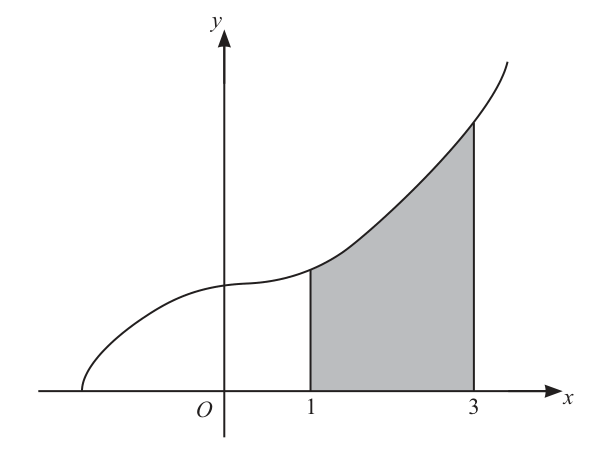
The diagram shows the curve with equation .
Find the equation of the tangent to the curve at the point where . Give your answer in the form where , and are integers.
Approach
Differentiate using the chain rule to find , evaluate at to get the gradient, find the corresponding -value, then use the point-gradient form to write the tangent equation in the form .
Working
The curve is .
Differentiate using the chain rule:
At , find the -coordinate:
So the point of tangency is .
Evaluate the gradient at :
Use the point-gradient form of the tangent at :
Multiply through by 8:
Rearrange to the form :
Answer
27x - 8y - 17 = 0
Walkthrough
First, we rewrite as so we can apply the chain rule. Differentiating gives . At , we compute , so the point is . Substituting into the derivative gives the gradient . Using the point-gradient form , we get . Multiplying by 8 and rearranging yields , which is in the required integer form.
Key Takeaways
- The chain rule is essential for differentiating composite functions like .
- The tangent equation can be rearranged into the general form by clearing fractions and collecting all terms on one side.
- Always verify that , , and are integers as required by the question.
Common Mistakes
- Forgetting to multiply by the derivative of the inner function when applying the chain rule.
- Making arithmetic errors when evaluating .
- Not clearing the fraction when rearranging into the form , leaving non-integer coefficients.
- Using the gradient of the normal instead of the tangent (this would lose the DM1 mark).
Things to Be Careful About
- The question requires , , to be integers, so clear any fractions before rearranging.
- The mark scheme awards DM1 for an attempt at the tangent equation with the correct numerical gradient; using the normal's gradient gives DM0.
- The answer or any integer multiple such as is accepted.
The region shaded in the diagram is enclosed by the curve and the straight lines , and .
Find the volume of the solid obtained when the shaded region is rotated through about the -axis.
Approach
Use the volume of revolution formula about the -axis, with limits to . Since , we have , which simplifies the integrand to a polynomial.
Working
The volume of the solid obtained by rotating the region about the -axis is:
Substitute :
Integrate:
Evaluate at the upper limit :
Evaluate at the lower limit :
Subtract:
Answer
60π
Walkthrough
The shaded region is bounded by the curve , the -axis (), and the vertical lines and . When this region is rotated about the -axis, the volume is given by . Since , the integrand becomes a simple polynomial. We integrate to get , then evaluate at the upper limit and lower limit , subtracting the results. The final answer is .
Key Takeaways
- The volume of revolution about the -axis uses .
- Squaring eliminates the square root, giving a polynomial integrand.
- Always apply the limits of integration correctly by subtracting the lower limit value from the upper limit value.
Common Mistakes
- Forgetting the factor in the volume formula.
- Attempting to integrate directly instead of using .
- Arithmetic errors when evaluating or .
- Forgetting to subtract the lower limit evaluation from the upper limit evaluation.
Things to Be Careful About
- The mark scheme does not allow an unsimplified form such as ; you must simplify to before integrating.
- Numerical answers in the range 188–189 are accepted as equivalent to .
- The should appear only at the end of the final answer, not inside the integral.
The geometric progression has first term and common ratio where . It is given that .
Approach
Write the th term of the geometric progression, substitute the given terms into the condition, and solve the resulting quadratic in . Since , discard the negative possibility.
Working
For a GP with first term and common ratio ,
Hence
Substitute into :
Let . Then
So or . Since and ,
Answer
r = 2/3
Walkthrough
We are told that the progression is geometric with first term and common ratio . The key is to express every term in the given condition using . The th term of a GP is , so and . Substituting these into gives , or . This is not a quadratic in , but it is a quadratic in : writing turns it into . Factorising gives , so or . Because cannot be negative, the only possible value is . Finally, since the question states , we take the positive square root and obtain .
Key Takeaways
- The th term of a geometric progression is .
- An equation such as can be solved by substituting .
- Always use the given conditions such as to select the correct root.
Common Mistakes
- Substituting and incorrectly, for example forgetting the factor from the first term.
- Treating as a quadratic in rather than in .
- Keeping as well as even though .
- Giving an unsupported answer: the mark scheme only allows a special-case mark for the final answer without working.
Things to Be Careful About
- is never negative, so must be discarded.
- Check the factorisation: .
- Use the sign condition before taking the square root.
Find the sum of the first terms of the geometric progression. Give your answer correct to significant figures.
Approach
Use the formula for the sum of the first terms of a geometric progression with , and , then round to 4 significant figures.
Working
For a GP,
Substitute , , :
Simplify the denominator:
Evaluating,
Correct to 4 significant figures,
Answer
5.998
Walkthrough
Part (b) asks for the sum of the first 20 terms. The formula for the sum of the first terms of a GP is . We substitute , and . The denominator is , so dividing by is equivalent to multiplying by , giving . Evaluating this gives approximately . The instruction asks for 4 significant figures, so the answer is ; the next digit is , so we do not round up.
Key Takeaways
- The sum formula for a GP is .
- When is close to , the sum can be close to , but the exact value must still be evaluated.
- Significant-figure rounding requires looking at the first digit after the required number of figures.
Common Mistakes
- Using the formula for the th term instead of the sum formula.
- Using in the numerator but forgetting that the denominator is .
- Rounding to 4 decimal places instead of 4 significant figures.
- Giving the unrounded value instead of the required .
Things to Be Careful About
- Since , the formula is appropriate; the alternative form gives the same result.
- is small, so is slightly less than .
- The mark scheme accepts answers within a range (AWRT), but is the exact 4-significant-figure value.
Approach
The sequence is itself a geometric progression. Find its first term and common ratio, then use the sum-to-infinity formula.
Working
For the original GP, with . The first term of the new progression is
The common ratio of the new progression is
Since , the sum to infinity exists:
Answer
36/19
Walkthrough
The progression is obtained by taking every third term of the original GP. Its first term is . Its common ratio is the ratio of consecutive selected terms: . Since , the sum to infinity exists. Using with and , we get .
Key Takeaways
- Taking every third term of a GP produces another GP whose common ratio is .
- The sum to infinity formula is valid only when .
- Compound fractions can be simplified by multiplying by the reciprocal of the denominator.
Common Mistakes
- Using the original first term instead of the new first term .
- Using the original common ratio instead of the new common ratio .
- Applying the sum-to-infinity formula without checking that .
- Arithmetic errors when dividing fractions, such as writing as incorrectly.
Things to Be Careful About
- The common ratio of the selected progression is , not .
- The sum to infinity exists because is less than in magnitude.
- The answer can also be written as ; the mark scheme accepts either exact or rounded forms.
The function is defined by for .
Approach
Complete the square on to write it in the form . Since , the expression is at most , so the range is all real values up to and including that maximum.
Working
Complete the square inside the bracket:
Therefore
Since for all real ,
So the range is
or equivalently .
Answer
The range of is , i.e. .
(-∞, 19]
Walkthrough
We are asked to find the range of by completing the square. The range is the set of all possible output values as ranges over the real numbers. Since the coefficient of is negative, the graph is a downward-opening parabola, so the function has a maximum value and the range is of the form .
First rewrite the quadratic with the term factored out as a negative: . Then complete the square on : . Substituting back gives .
Now is never negative, so subtracting it from 19 can only make the value smaller than or equal to 19. The maximum value 19 occurs when . Therefore every output is at most 19, and every value below 19 is attainable, giving the range .
Key Takeaways
- Completing the square reveals the vertex of a quadratic: for , the maximum is at .
- For a downward-opening quadratic the range is ; for an upward-opening quadratic it is .
- The range must use (or ) at the endpoint, not , because the maximum (or minimum) value is actually attained.
Common Mistakes
- Forgetting the negative sign when completing the square, e.g. writing instead of .
- Writing instead of . The value 19 is achieved at , so it must be included.
- Using calculus or a graph when the question explicitly requires completing the square; the mark scheme requires the completed-square method.
Things to Be Careful About
- Complete the square correctly: becomes , not .
- The final range can be written as , , or . It must contain the endpoint 19.
- If the completed-square form is written as , it is equivalent because .
The function is defined by for where is a constant.
It is given that the graph of meets the graph of at a single point .
Determine the coordinates of .
Approach
Find the inverse of the linear function , form the composite , and set it equal to . The condition that the two graphs meet at a single point means this equation has exactly one solution, so its quadratic has discriminant zero. Solve for , then solve for and substitute back to find .
Working
Find :
Form the composite:
Set :
Multiply by 4:
Rearrange into a quadratic in :
or equivalently
For the graphs to meet at a single point, this quadratic must have exactly one solution, so its discriminant is zero:
Substitute into the quadratic:
So
Find the corresponding -coordinate using :
Therefore the single point of intersection is
Answer
The coordinates of are .
(-5, -13)
Walkthrough
We need to find where the graph of meets the graph of exactly once. The word “single point” is the key: it tells us that the equation formed by equating the two expressions has exactly one solution.
First, find the inverse of . Writing and solving for gives , so .
Next form by replacing in with :
Then set this equal to and multiply through by 4. Rearranging gives the quadratic (after multiplying by ).
Because the two graphs meet at a single point, this quadratic must have a repeated root, so its discriminant must be zero:
This simplifies to , so .
With , the quadratic becomes , i.e. , so . Finally, substitute into to get . Hence .
Key Takeaways
- To find where two graphs meet, equate their expressions and solve.
- “Meet at a single point” for a quadratic equation means the discriminant is zero: .
- Finding an inverse of a linear function is done by swapping and solving, giving .
- A composite like is formed by substituting into .
Common Mistakes
- Forgetting to include when forming the composite; the discriminant condition cannot be applied without .
- Using the wrong sign when rearranging the quadratic. The equation can be written either as or ; both give the same discriminant.
- Stopping after finding ; the question asks for the coordinates of , so you must also solve for and substitute to find .
- Substituting into instead of ; the point lies on (and also on ), and the mark scheme uses to find .
Things to Be Careful About
- The discriminant must be applied to the quadratic in after both sides have been combined, not before rearranging.
- Check the sign of the constant term: from , multiplying by gives , so .
- When solving , there is only one root, , consistent with the “single point” condition.
- The final answer should be an ordered pair, not just the value of or .