Mathematics 9709/12 — May/June 2024
Cambridge AS Level · Pure Mathematics 1 · worked solutions for every part, with the mark scheme
Topics Quadratics · Trigonometry · Differentiation · Series · Functions · Integration · +2 more
The coefficient of in the expansion of is 12 times the coefficient of in the expansion of .
Find the value of the positive constant .
Approach
Use the binomial theorem to extract the coefficient of in each expansion, then combine the given condition and solve for the positive constant .
Working
For , the term in is
so the coefficient of is .
For , the term in is
so the coefficient of is .
The coefficient in is 12 times the coefficient in :
Since is positive,
Answer
a = 1/2
Walkthrough
We compare the coefficients of in two binomial expansions. First, expand : the term is obtained by choosing the factor twice and the factor four times. The binomial coefficient is , and , so the coefficient is .
Second, expand : the term is obtained by choosing the factor twice and the factor three times. The binomial coefficient is , the constant factor is , and the variable part gives , so the coefficient is .
The condition states that the first coefficient is 12 times the second, so we set . This simplifies to , giving . Since is specified to be positive, we take the positive square root: .
Key Takeaways
- For , the term containing is .
- The coefficient of a power of is the numerical multiplier of that term, not the whole term including .
- When a coefficient is a multiple of another, set up an equation between the coefficients before solving.
Common Mistakes
- Forgetting the factor when finding the coefficient in .
- Forgetting to multiply the second coefficient by 12.
- Taking the negative root even though the question specifies a positive constant.
Things to Be Careful About
- The sign in : is positive, so the coefficient is , not .
- The mark scheme condones , but the final answer should be because is positive.
- Always simplify the ratio fully to before taking the square root.
The curve is transformed to the curve .
Describe fully a sequence of transformations that have been combined, making clear the order in which the transformations have been applied.
Approach
Compare the transformed equation with the original . The factor outside the square gives a vertical stretch, the term gives a horizontal translation, and the gives a vertical translation. The vertical stretch must be applied before the translation in the -direction.
Working
Start from .
Apply a stretch with factor in the -direction:
Then translate by , i.e. units in the positive -direction and units in the negative -direction:
This is a stretch and the two translations only. The stretch is applied before the translation in the -direction.
Answer
- Stretch factor in the -direction, parallel to the -axis.
- Translation by , i.e. units to the right and units down.
Equivalently, after the stretch, translate by and then by .
Stretch factor 4 in the y-direction, then translation by vector (3, -8) (3 units right and 8 units down).
Walkthrough
The original curve is . After the transformation we want . Break the target expression into separate changes from .
- The coefficient on the square multiplies every -value by . This is a stretch with factor in the -direction.
- Replacing by inside the square shifts the graph units to the right, i.e. a translation by .
- Subtracting at the end shifts the graph units down, i.e. a translation by .
Now check the order. If the vertical translation were done before the vertical stretch, we would get , which is not the target. Therefore the vertical stretch must be done before the vertical translation. The two translations can be combined as and applied after the stretch.
Key Takeaways
- For : is a vertical stretch with factor ; is a horizontal translation of units; is a vertical translation of units.
- When transformations act on the same axis, their order matters. A vertical stretch and a vertical translation do not commute.
- A translation vector means units horizontally and units vertically.
Common Mistakes
- Saying the stretch is in the -direction. The factor multiplies the whole function value, so it is in the -direction.
- Thinking that means a shift to the left. It is actually a shift to the right by units.
- Translating down by before the vertical stretch, which would give instead of .
- Omitting the order. The mark scheme requires the vertical stretch to be before the translation in the -direction.
- Writing only the translation by without mentioning the stretch, or vice versa.
Things to Be Careful About
- Use “factor 4” or “scale factor 4” for the vertical stretch; both are accepted.
- The translation counts as two translations, one in each direction. If you separate them, give both vectors.
- Numerical values must be correct. Loose words such as “shift”, “up”, “down” are accepted only if the intention is clear.
- The -axis is invariant under a vertical stretch, so the stretch is parallel to the -axis.
Approach
Rewrite as and simplify the compound fraction. Then use the Pythagorean identity to replace , and rearrange to obtain the required quadratic form.
Working
Start with the given equation:
Use the identity :
Simplify the compound fraction:
Multiply through by :
Use :
Expand and collect terms:
Rearrange to the required form:
Answer
12 sin^2 θ - 7 sin θ - 12 = 0
Walkthrough
The aim of this part is to transform the given trigonometric equation into the stated quadratic form in .
Step 1: Replace with . This is the fundamental tangent identity and is the only way to bring everything into terms of and .
Step 2: Simplify the compound fraction. Dividing by is the same as multiplying by , so . The denominator becomes , not — this is a common trap.
Step 3: Multiply every term by to clear the denominator. This gives . Note that the constant 12 must also be multiplied by .
Step 4: Use the Pythagorean identity to write . Substituting this in eliminates the cosine term completely.
Step 5: Expand and rearrange. Expanding gives , so the equation becomes . Multiplying through by and reordering gives , which is exactly the required form.
Key Takeaways
This question tests the two core trigonometric identities: and . It also tests algebraic manipulation of fractions — specifically, simplifying a compound fraction and correctly multiplying every term through by the denominator. The skill of expressing a trigonometric equation as a quadratic in a single trigonometric function is fundamental and appears again in part (b).
Common Mistakes
- Incorrectly simplifying the compound fraction: is , not .
- Forgetting to multiply the constant term 12 by when clearing the denominator.
- Sign errors when rearranging: the final form requires , so care is needed with the signs after expansion.
- Using the identity incorrectly: , not .
Things to Be Careful About
The mark scheme awards M1 for the use of and DM1 for the use of , so both identities must be shown explicitly. The final A1 requires the equation in exactly the stated form — the answer is given in the question (AG), so the working must lead to it convincingly. The mark scheme condones the use of abbreviations like , and , but the final answer must be correct.
Approach
Use the quadratic from part (a) and factorise it to find possible values of . Reject any value outside the range , then find all angles in that satisfy the remaining equation.
Working
From part (a):
Factorise the quadratic:
Set each factor to zero:
Since , this has no solution because . So:
Find the principal value:
is negative in the third and fourth quadrants. Therefore, in the range :
Answer
θ = 228.6°, 311.4°
Walkthrough
This part uses the result from part (a) directly — the word "Hence" tells us to build on the quadratic we just derived.
Step 1: Factorise . We look for two binomial factors: multiplies out to , which checks out.
Step 2: Set each factor to zero. This gives and .
Step 3: Reject . Since the sine function only takes values between and , is impossible. This is a crucial step — many students miss it.
Step 4: Solve . The inverse sine of is approximately . This is the principal value, but it is not in our required range .
Step 5: Find the angles in the range. Since is negative in the third and fourth quadrants, we add to get the third-quadrant angle () and subtract from to get the fourth-quadrant angle ().
Key Takeaways
This question combines two skills: solving a quadratic equation in a trigonometric function, and finding all solutions of a trigonometric equation within a specified interval. The key insight is that the quadratic may produce roots that are invalid for the sine function, and these must be rejected before finding angles. The quadrant method for finding all angles in a range is essential.
Common Mistakes
- Forgetting to reject — this would give no valid angles from that root, but it must be explicitly dismissed.
- Only giving one solution instead of two. In the range to , has two solutions.
- Giving as a final answer — it is outside the required range.
- Using the wrong quadrants: is negative in quadrants III and IV, so the angles are and , where .
Things to Be Careful About
The mark scheme awards M1 for the factorisation, B1 for identifying (or ), and B1 for the two correct angles. The angles must be in the range — answers outside this range are ignored. The mark scheme accepts answers within rounding tolerance (AWRT), so and are expected, but and are also condoned. No other angles in the range satisfy the equation.
The function is defined as follows:
Approach
Let , then interchange the roles of and and solve for . This gives the inverse function.
Working
Add to both sides and square:
Interchanging and :
Answer
f^{-1}(x) = (x + 1)^2
Walkthrough
To find the inverse of a function, we start by writing . We then swap the variables and , which effectively reverses the input/output relationship, and finally solve the new equation for in terms of . Here, isolating by adding to both sides gives , and squaring removes the square root to give . Swapping and then gives .
Key Takeaways
- The inverse reverses the effect of the original function: if takes to , then must take the output back, undoing the "minus " and the "square root".
- A square root in becomes a square in .
- The domain restriction on translates into the range for the inverse.
Common Mistakes
- Forgetting to swap the variables and just solving for in terms of (this gives the original back, not the inverse).
- Squaring before adding — that would give which is wrong because you cannot square alone; you must first isolate the square root.
Things to Be Careful About
- Make sure the square root is isolated before squaring. Once isolated, squaring is the safe operation.
- The domain on is needed to keep the range of non-negative, which is required since uses where the input represents .
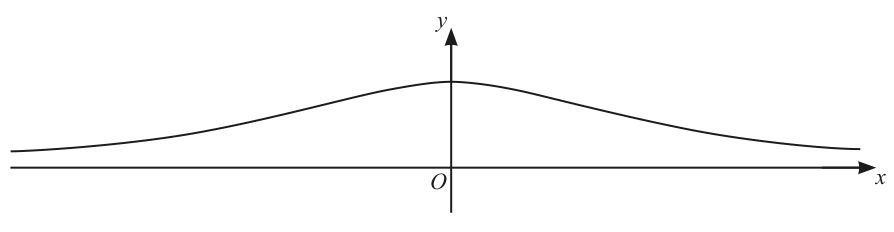
The diagram shows the graph of where for .
State the range of and explain whether exists.
Approach
For , find the largest and smallest values it can take, then check whether the function is one-to-one.
Working
The denominator is smallest when , giving . Therefore attains its maximum at :
As , and , but never equals . Since is positive for all real , the range is:
The graph is symmetric about the -axis, so a horizontal line such as cuts the curve in two points. Hence is many-to-one and does not exist.
Answer
Range: . does not exist because is not one-to-one.
Range: 0 < g(x) ≤ 1/2. g^{-1} does not exist because g is not one-to-one.
Walkthrough
For a function of the form , the maximum occurs where the denominator is smallest. Here the denominator has minimum at , so the maximum of is . The function never reaches because the denominator is always at least , and the function value gets arbitrarily close to as grows. Putting these together gives the range .
An inverse function only exists when the original function is one-to-one. Looking at the graph, the bell shape is symmetric about the -axis: a horizontal line at, say, crosses the curve at two different -values. This means each -value in the range comes from more than one -value, so the function is many-to-one and has no inverse.
Key Takeaways
- For where , the range is when is attained.
- A function has an inverse only if it is one-to-one; the horizontal line test is the graphical check.
- Even functions () are immediately non-injective unless their domain is restricted to one side of the axis.
Common Mistakes
- Stating the range as — the upper bound is achieved (at ), so the inequality is , not .
- Saying " does not exist" without giving a reason. The mark scheme requires a justification involving the function not being one-to-one.
- Writing the range as two separate inequalities joined by a comma (the mark scheme explicitly forbids this form).
Things to Be Careful About
- Always include the maximum value with when the maximum is actually attained.
- The justification for the non-existence of the inverse must mention the failure of injectivity (one-to-one / horizontal line test) — that is what examiners want to see.
The function is defined by for .
Solve the equation . Give your answer in the form , where , and are integers.
Approach
First evaluate . Then form the composite and set it equal to that constant. Invert the equation, isolate , and square. Finally discard any solution that violates the domain .
Working
Evaluate the right-hand side:
Form the composite. With and :
Set this equal to and invert both sides:
Isolate the squared term:
Take square roots (noting the sign will be checked against the domain):
So
and squaring gives the candidate solutions
Check the domain . The value is negative, so it cannot be a square root; this branch is rejected. Only is valid, giving
Answer
x = 3 + 2√2
Walkthrough
The equation has two parts: we need a number (the right-hand side) and a function of (the left-hand side). The right-hand side is straightforward — just plug into to get .
The left-hand side is a composite. To form , we take the formula for , replace its input with , and simplify. Here that means in , producing .
Setting the two sides equal gives a fraction equal to . Reciprocating both sides turns the equation into , i.e. . Taking square roots gives , so or .
A square root is by definition non-negative, so is rejected. Squaring the surviving branch yields . The discarded alternative does not satisfy the original domain restriction (in fact it is about ), confirming why it is extraneous.
Key Takeaways
- Composite function notation means "first apply , then apply ".
- A fraction equalling a fraction can be cleared by reciprocating only when both sides are non-zero; here both equal and so this is safe.
- When squaring introduces a , always re-check against the domain of the original function. Here the domain implies , so the negative branch is automatically impossible.
- The answer is in surd form with integers , confirming the instruction.
Common Mistakes
- Forgetting to evaluate first and using the wrong target value on the right.
- Squaring only one side instead of isolating the square root before squaring — this introduces extra terms and is hard to undo.
- Reporting both and without checking the domain — the mark scheme requires the negative branch to be explicitly discarded.
- Writing as the final answer, which the mark scheme explicitly awards for.
Things to Be Careful About
- The domain from is essential. Even though is defined for , the original function only allows , so any solution with is invalid.
- The composite also requires (so that the input to lies in its domain ). This is the same condition , and combined with the original it gives .
- Squaring can introduce extraneous solutions, so the final answer must always be re-checked in the original equation.
The first and second terms of an arithmetic progression are and respectively, where .
Approach
Use the first term and the second term to find the common difference . Substitute and use the formula for the sum of the first terms of an arithmetic progression.
Working
For an arithmetic progression with first term and common difference , the second term is . Hence
When ,
so
The sum of the first terms is
Substitute , and :
Answer
390√2 - 740
Walkthrough
We have an arithmetic progression whose first two terms are and . For any AP, the common difference is obtained by subtracting consecutive terms, so . With , we use the exact values and , giving .
Then apply the AP sum formula . Here , , and is the value above. Substituting and simplifying gives . The key is to keep the exact surd form throughout; a decimal answer such as is not exact and would not satisfy the request.
Key Takeaways
This question tests the definition of an arithmetic progression, the use of exact trigonometric values at special angles, and the formula for the sum of the first terms. It also emphasises careful algebraic simplification with surds.
Common Mistakes
- Using the wrong formula for the sum, such as with as the second term instead of the last term.
- Evaluating or incorrectly, or using degrees instead of radians.
- Making a sign error when simplifying , especially the step.
- Giving a rounded decimal instead of the exact surd form.
Things to Be Careful About
- The common difference is , not the other way round.
- Use and remember the formula contains , not just .
- Keep exact values such as until the final answer.
- The mark scheme allows a decimal sight of for the common difference, but the final sum must be exact.
The first and second terms of a geometric progression are and respectively, where .
Approach
For a geometric progression, divide the second term by the first term to find the common ratio . Simplify using , then apply the sum-to-infinity formula , valid because gives .
Working
The first term is and the second term is . Therefore
Since , we have , so the series converges. The sum to infinity is
Answer
tanθ/(1 - cosθ)
Walkthrough
For a geometric progression, the common ratio is the second term divided by the first term. Since the first term is and the second is , . Using , this simplifies to .
Because , we know , so the geometric series converges. The sum to infinity is , where and . This gives .
Key Takeaways
This part links geometric progressions with trigonometry. The key skills are finding the common ratio, simplifying it using a trigonometric identity, checking the convergence condition , and applying the sum-to-infinity formula.
Common Mistakes
- Using instead of .
- Forgetting that the first term is , not .
- Leaving the answer as a complex fraction such as , which the mark scheme does not allow.
- Omitting in the final expression.
Things to Be Careful About
- The domain guarantees , so the sum to infinity exists. No need to state it explicitly for the marks, but it justifies the formula.
- Simplify to before using the sum formula.
- Keep the final answer as a single fraction in terms of .
Given that , find the sum of the first 10 terms of the progression. Give your answer correct to 3 significant figures.
Approach
Use the geometric progression with first term and common ratio . Substitute , then apply the formula for the sum of the first terms, , with .
Working
For :
and
Using the finite GP sum formula with :
Answer
3.46
Walkthrough
For the geometric progression, the first term is and the common ratio is , as found in part (i). With , and .
The sum of the first terms is given by . Substituting and gives . Since , this simplifies to , correct to 3 significant figures.
Key Takeaways
This part applies the finite geometric series formula with exact trigonometric values. It also checks the ability to evaluate powers of and round to a required degree of accuracy.
Common Mistakes
- Using instead of . The question asks for the first 10 terms; although may round to the same value, it is not the correct sum.
- Forgetting to subtract from 1 in the numerator.
- Using or incorrectly; the ratio is , not .
- Giving the exact answer without the required 3 significant figure approximation. (The exact form is accepted, but the question asks for 3 s.f.)
Things to Be Careful About
- and .
- When dividing by , multiply by 2.
- Round to , not .
- The mark scheme allows the exact form but the final answer should be stated as to 3 significant figures.
The curve with equation has a minimum point at and intersects the positive -axis at .
Approach
To find the minimum point , differentiate the curve equation and set to find the -coordinate, then substitute back to find . To find the -intercept , set and solve for .
Working
Given the curve equation:
Differentiate with respect to :
At the minimum point , :
Substitute into the original equation to find the -coordinate:
So the coordinates of are .
To find , set :
Factor out :
This gives or . Since is on the positive -axis, .
So the coordinates of are .
Answer
A = (4, -8), B = (16, 0)
Walkthrough
First, we find the minimum point by differentiating the curve equation . The derivative is . Setting this to zero gives , so and . Substituting back into the curve equation gives , so .
Next, we find the -intercept by setting . The equation can be factored as . The solutions are and . Since is on the positive -axis, we take , giving .
Key Takeaways
- Differentiation is used to find stationary points (minima/maxima) by setting .
- Equations involving fractional powers like can be solved by factoring or substituting to form a quadratic equation.
Common Mistakes
- Forgetting to substitute the -value back into the original curve equation to find the -coordinate.
- Making algebraic errors when differentiating fractional powers, such as forgetting to multiply by the power or mishandling the negative exponent.
- Selecting instead of for point when asked for the positive -axis intersection.
Things to Be Careful About
- Ensure the derivative is simplified correctly: , not .
- When solving , remember that is a valid solution but does not correspond to point as specified in the question.
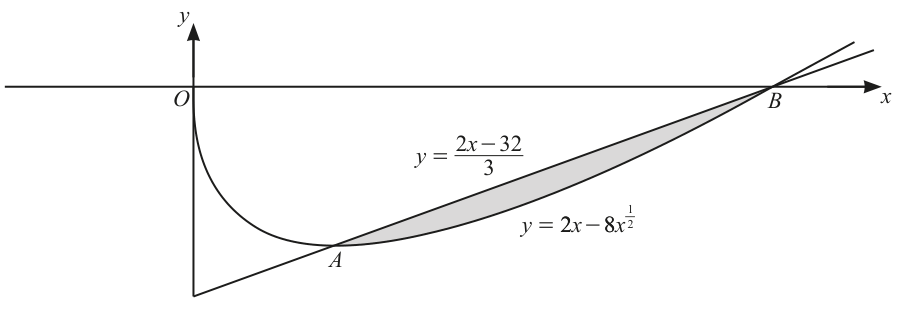
The diagram shows the curve with equation and the line . It is given that the equation of is .
Find the area of the shaded region between the curve and the line.
Approach
The area of the shaded region between the line and the curve is found by integrating the difference between the upper function (the line) and the lower function (the curve) from to . The limits are the -coordinates of points and found in part (a).
Working
The equation of the line is:
The equation of the curve is:
The area is given by:
Simplify the integrand:
Integrate term by term:
Evaluate from to :
At :
At :
Subtract the lower limit value from the upper limit value:
Answer
32/3
Walkthrough
The shaded region is bounded above by the line and below by the curve , between and . To find the area, we integrate the difference (line minus curve) over this interval.
The integrand simplifies to . Integrating this gives .
Evaluating at the upper limit : .
Evaluating at the lower limit : .
The area is .
Key Takeaways
- The area between two curves is found by integrating .
- Careful algebraic simplification of the integrand before integrating reduces the chance of errors.
- Evaluating definite integrals requires substituting both limits and subtracting the lower limit result from the upper limit result.
Common Mistakes
- Integrating the curve and line separately and subtracting the results, but making sign errors when combining the integrals.
- Forgetting to raise to and divide by during integration, leading to incorrect coefficients.
- Evaluating incorrectly (it is , not ).
- Subtracting the upper limit value from the lower limit value instead of the other way around, resulting in a negative area.
Things to Be Careful About
- Ensure the line is above the curve in the interval so that (line - curve) is positive. The diagram confirms this.
- Use the exact -values from part (a) as the limits of integration; do not use the -values or any other numbers.
- When integrating , the result is , not .
The equation of a circle is . The line with equation is a tangent to the circle.
Approach
Substitute the tangent line into the circle equation to obtain a quadratic in . Since the line is tangent, this quadratic must have exactly one solution, so its discriminant is zero. Then solve the resulting equation for .
Working
Substitute into the circle equation:
Since , expand:
Collect all terms on one side:
For a tangent, the discriminant of this quadratic in is zero:
Expand:
Factor:
Hence or .
Answer
a = 0 or a = 4
Walkthrough
The line is tangent to the circle, so it touches the circle at exactly one point. To find the intersection algebraically, substitute into the circle equation. This gives a quadratic equation in whose coefficients contain .
For the line to be tangent, the quadratic in must have exactly one solution. A quadratic has exactly one solution when its discriminant is zero. Setting the discriminant to zero gives an equation in , which is then solved to find the two possible values.
Key Takeaways
This question connects geometry with algebra: a line is tangent to a circle exactly when substituting the line into the circle gives a quadratic with one repeated root. The main technique is to use the discriminant condition. It also reviews expanding quadratics and solving a quadratic equation in a parameter.
Common Mistakes
- Forgetting to move the 18 to the left-hand side when collecting terms.
- Expanding incorrectly, especially the sign of the term.
- Using the discriminant of the equation in instead of the discriminant of the quadratic in .
- Solving and forgetting that is also a valid value.
Things to Be Careful About
- The coefficient of in the quadratic is , so .
- The constant term is after simplifying .
- The discriminant must be set equal to zero because a tangent gives exactly one point of intersection.
- Both and are required by the question.
For the greater value of , find the equation of the diameter which is perpendicular to the given tangent.
Approach
Use the greater value . Find the centre of the circle, then write the equation of the diameter through the centre with gradient perpendicular to the tangent.
Working
With , the circle is
so the centre is .
The tangent line is
which has gradient . A diameter perpendicular to this tangent therefore has gradient .
Using the centre with gradient :
Answer
y = x - 10
Walkthrough
The greater value from part (a) is . Substitute this into the circle equation to get , so the centre is .
The given tangent is , whose gradient is . A diameter perpendicular to this tangent has gradient , because perpendicular gradients multiply to .
A diameter of the circle is a line through the centre. Use the point-slope form of a line through with gradient .
Key Takeaways
This part uses two facts: the centre of a circle is read directly from its equation, and a diameter perpendicular to a tangent has the reciprocal gradient of the tangent. The equation of a straight line through a known point with a known gradient is then straightforward.
Common Mistakes
- Choosing instead of when the question asks for the greater value.
- Using gradient for the diameter, because the tangent has gradient .
- Using the tangent point instead of the centre, or using the wrong point.
- Sign errors in point-slope form, such as writing .
Things to Be Careful About
- The centre is , not .
- The tangent line has gradient ; the perpendicular gradient is .
- Simplify the line equation to .
- If using the tangent point , the same equation is obtained; the mark scheme allows either the centre or the tangent point as long as the gradient is .
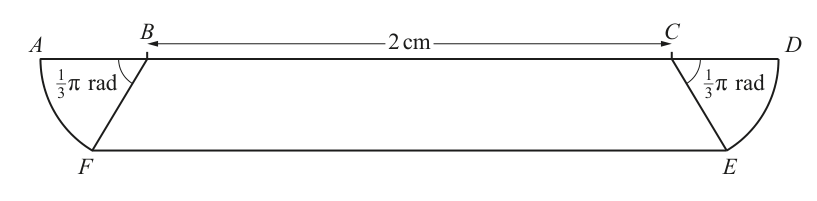
The diagram shows a symmetrical plate . The line is straight and the length of is . Each of the two sectors and is of radius and each of the angles and is equal to radians.
It is given that .
Approach
Consider the right-angled triangle formed by the radius CE, the vertical through C, and the horizontal through E. Use the trig ratio in this triangle to find the horizontal offset XE, then add both offsets to BC using symmetry.
Working
Let X be the point directly below C at the same level as E. Then CX is vertical, XE is horizontal, and the right angle is at X. The line CD is horizontal, so CX is perpendicular to CD.
The angle of the sector at C is . The angle between CD and the vertical CX is , so the angle between CX and CE is
In the right-angled triangle CEX (hypotenuse CE = 0.4):
By symmetry, the horizontal offset from B to F is also 0.2. Hence
Answer
EF = 2.4 cm
Walkthrough
We want the bottom edge EF of the plate. E is the endpoint of the radius CE of the sector centred at C, and F is the corresponding point of the sector centred at B. The line ABCD is straight, so we can think of E and F as being horizontally offset from C and B by some distance.
To find the horizontal offset, we form a right-angled triangle. Drop a perpendicular from E to a vertical line through C, calling the foot X. Then CX is vertical (perpendicular to the horizontal line CD), XE is horizontal, CE is the radius (length 0.4), and the right angle is at X.
The sector angle at C is . Since CX is perpendicular to CD, the angle between CX and CE is .
In the right-angled triangle CEX, with the angle at C equal to and hypotenuse CE = 0.4, the side opposite this angle is XE. Using the sine ratio:
By symmetry, the horizontal offset from B to F is also 0.2. Therefore cm.
Key Takeaways
- The bottom edge EF of this symmetric plate equals BC plus twice the horizontal offset of each sector.
- The horizontal offset of one sector equals the radius times (or equivalently, the radius times ).
- The right triangle inside a sector relates the radius, the horizontal offset, and the sector angle.
Common Mistakes
- Forgetting to add the offset on the OTHER side too, giving EF = BC + 0.2 = 2.2 instead of 2.4.
- Using the full sector angle as the angle at C in the right triangle, instead of its complement .
- Confusing the horizontal offset (which is ) with the vertical drop (which is ).
Things to Be Careful About
- The right angle is at X (the foot of the perpendicular), not at C.
- The angle in the right triangle at C is the COMPLEMENT of the sector angle: .
- All angles are in radians, and is an exact value.
Approach
Split the plate into a central trapezium with parallel sides BC (top) and FE (bottom), plus the two sectors at the ends. Find the perpendicular height of the trapezium using the right triangle from part (i), compute the sector areas, and add everything together.
Working
Height of the trapezium. The perpendicular distance from F (or E) to the line ABCD is found from the right-angled triangle CEX used in part (i):
Area of the trapezium. The parallel sides are BC = 2 (top) and FE = 2.4 (bottom), and the height is :
Area of one sector. Using the formula with r = 0.4 and :
Total area. Adding the trapezium and the two equal sectors:
Answer
0.930 cm²
Walkthrough
The plate has an irregular shape, but it can be split into pieces whose areas we can compute.
Choosing the decomposition. The plate is bounded by the top line ABCD, two arcs (one at each end), and the bottom line FE. The natural split is:
- A central trapezium with parallel top side BC = 2 and parallel bottom side FE = 2.4 (the result of part (i)).
- Two circular sectors at the ends: one for sector ABF and one for sector DCE.
Trapezium height. The height of the trapezium is the perpendicular distance between BC and FE, which equals the vertical drop from C to E. In the right-angled triangle CEX from part (i), with CE = 0.4 and the angle at C equal to :
Trapezium area. Using with a = 2, b = 2.4, and :
Sector area. Each sector has radius r = 0.4 and angle :
Two such sectors give a total of .
Adding the pieces.
Key Takeaways
- A non-standard shape can be split into standard pieces (trapeziums, sectors) whose areas are easy to compute.
- Sector area formula: (angle in radians).
- Trapezium area formula: , where a and b are the parallel sides and h is the perpendicular distance between them.
- The trapezium height here is the vertical drop CX, not the radius r.
Common Mistakes
- Forgetting to multiply the single sector area by 2 (there are two sectors).
- Using BC's length as the top of the trapezium but then including the radii AB and CD in the area (they are not part of the trapezium, they are part of the sectors).
- Mixing up the trapezium height: it is CX (the vertical drop), not the radius r = 0.4.
Things to Be Careful About
- The top side of the trapezium is BC (length 2), not ABCD (length ). The portions AB and CD are inside the sectors, not the trapezium.
- The trapezium height is the perpendicular distance CX = , not the radius r = 0.4.
- Round only at the end of the calculation if you want the most accurate 3 s.f. result.
- The exact form is mathematically equal to 0.930 cm² to 3 s.f.
It is given instead that the perimeter of the plate is .
Find the value of . Give your answer correct to 3 significant figures.
Approach
The perimeter is the sum of all six boundary segments: the four straight parts (AB, BC, CD, EF) and the two arcs. Write each in terms of r, add them up, set the total equal to 6, and solve the resulting linear equation for r.
Working
Boundary components in terms of r.
- (radius of sector ABF)
- (given)
- (radius of sector DCE)
- arc (arc length formula)
- (from part (a)(i) with general r: )
- arc
Perimeter equation.
Setting P = 6 and solving.
Numerical value.
Answer
0.393 cm
Walkthrough
The perimeter of the plate is the total length around its boundary, which consists of six pieces: the two radii at the top (AB and CD), the middle straight part BC, the bottom straight part EF, and the two arc pieces (the curved parts of the two sectors).
Expressing each piece in terms of r.
- AB and CD are radii of the sectors, each equal to r.
- BC = 2 is given.
- EF is the bottom of the plate. From part (i), with general r, the horizontal offset of each sector is , so . The crucial point is to keep this in terms of r — we must not substitute r = 0.4 from part (a).
- Each arc has length .
Adding them up.
Solving P = 6.
Rounded to 3 significant figures, cm.
Key Takeaways
- The perimeter of a sector is the sum of two radii and one arc: .
- When solving a problem with a parameter r, keep expressions in terms of r throughout — do not substitute numerical values from earlier parts.
- The boundary of the plate here has 6 pieces; missing one gives a noticeably wrong answer.
Common Mistakes
- Using EF = 2.4 (the value from part (a) with r = 0.4) instead of EF = 2 + r. This gives a wrong value of approximately 0.391, not 0.393.
- Forgetting to include one of the six boundary pieces (e.g. one of the arcs).
- Mixing degrees and radians (e.g. using 60° directly in the arc length formula instead of ).
Things to Be Careful About
- depends on r. With general r, .
- The answer 0.393 (3 s.f.) comes from the correct EF = 2 + r. Using EF = 2.4 (the constant value from part (a)) would give 0.391 instead — a tell-tale sign of the wrong substitution.
- Make sure both arcs are counted: there are two sectors, hence two arcs.
A function is such that for .
Approach
A function is decreasing where its derivative is negative. Set , expand and simplify the quadratic, factorise it, and read off the interval between the roots.
Working
Expand and simplify:
Divide by 6:
Factorise:
The roots are and . Since the quadratic has a positive leading coefficient, it is negative between its roots.
Answer
1 < x < 9/4
Walkthrough
A function is decreasing where its derivative is negative, so we start from .
Substitute the given derivative:
Expand the square: . Multiplying by 6 gives , and subtracting gives . Dividing by 6 simplifies the inequality to .
Factorise the quadratic: . The roots are and . Because the coefficient of is positive, the graph of the quadratic is a U-shape, so the expression is negative between the two roots. Therefore the set of values is .
Key Takeaways
- The sign of tells whether is increasing or decreasing: negative derivative means decreasing.
- Solving a quadratic inequality requires finding the roots and then using the sign of the leading coefficient to decide the interval.
- For a positive quadratic, the expression is negative between the roots and positive outside them.
Common Mistakes
- Using instead of .
- Making sign errors when expanding or collecting like terms.
- Giving or separately instead of the combined interval .
- Forgetting to divide by 6 before factorising, although the same roots can still be found.
Things to Be Careful About
- The mark scheme condones or , but the mathematically correct condition for decreasing is .
- The final interval must link both inequalities, not be written as two disconnected conditions.
- If you use the alternative method , be cautious about squaring and domain restrictions.
Approach
Integrate term by term. For the first term use the reverse chain rule for . Add the constant of integration , then use the condition to determine .
Working
Check the first integral: the derivative of is , so the integral is correct.
Use :
Hence .
Answer
f(x) = (2x-3)^3 - 3x^2 + 3
Walkthrough
To recover from , integrate the derivative.
For the first term, integrate . Since the derivative of is , the integral is . Equivalently, substitute : then , so
For the second term, . Add the constant of integration .
Now use :
So , giving
Key Takeaways
- Integration is the reverse of differentiation; for a term like , divide by after increasing the power.
- Always include the constant of integration before using an initial condition.
- An initial condition such as determines the constant .
Common Mistakes
- Forgetting to add before substituting .
- Integrating incorrectly as and forgetting the factor from the chain rule.
- Sign errors when integrating .
- Stopping at without finding .
Things to Be Careful About
- The mark scheme awards marks for each correct integral and for the correct use of .
- The final answer must have simplified coefficients, so should be substituted and the expression simplified.
- If you expand the derivative first, you get the equivalent answer ; both forms are acceptable as long as the working is consistent.
The equation of a curve is for .
A point is moving along the curve in such a way that the -coordinate of point is decreasing at 5 units per second.
Find the rate at which the -coordinate of point is increasing when .
Approach
Differentiate the curve to find using the chain rule. Find the -coordinate where . Then use the related-rates chain rule , with (since the -coordinate is decreasing), to find .
Working
Given , differentiate with respect to :
When :
At :
The -coordinate is decreasing at 5 units per second, so .
Using the chain rule for related rates:
Answer
The -coordinate of is increasing at units per second.
5/9 units per second
Walkthrough
We are told the -coordinate of point is decreasing at 5 units per second, so . We need to find when .
The chain rule connects these rates: . So we first need at the point where .
Step 1: Differentiate . Using the chain rule, the derivative of is . The constant 5 differentiates to 0.
Step 2: Find the -coordinate where . Set , so . Raising both sides to the power gives , so .
Step 3: Substitute into the derivative: .
Step 4: Apply the chain rule: , so .
The positive sign of confirms the -coordinate is increasing, as stated in the question.
Key Takeaways
- Related-rates problems use the chain rule to connect rates of change.
- A decreasing quantity has a negative rate of change; this determines the sign in the equation.
- The chain rule for differentiating requires multiplying by the derivative of the inside function, .
Common Mistakes
- Forgetting that 'decreasing' means is negative — writing gives the wrong sign for .
- Forgetting the factor (the derivative of ) when applying the chain rule to .
- Miscomputing — it equals , not a larger number.
Things to Be Careful About
- The domain is satisfied by , so the point is valid.
- Include units in the final answer: units per second.
- The mark scheme requires the differentiation step to be shown explicitly to earn the method mark.
Point on the curve has -coordinate 32. Point on the curve is such that the gradient of the curve at is .
Find the equation of the perpendicular bisector of . Give your answer in the form , where , and are integers.
Approach
Find the coordinates of (where ) and (where the gradient is ). Then compute the gradient of , take its negative reciprocal to get the perpendicular gradient, find the midpoint of , and use the point-slope form to write the equation of the perpendicular bisector.
Working
From part (a), when , . So .
For , the gradient is :
At :
So .
Gradient of :
Gradient of the perpendicular bisector:
Midpoint of :
Equation of the perpendicular bisector using point-slope form:
Multiply through by 13:
Rearrange:
Answer
2x - 13y + 247 = 0
Walkthrough
We need the perpendicular bisector of segment . A perpendicular bisector passes through the midpoint of and has gradient equal to the negative reciprocal of the gradient of .
Step 1: Find . From part (a), when , , so .
Step 2: Find . The gradient at is , so set . This gives , so and . Substituting into the curve equation gives , so .
Step 3: Compute the gradient of : . The perpendicular gradient is the negative reciprocal: .
Step 4: Find the midpoint of : .
Step 5: Use the point-slope form of a line through with gradient : . Multiply through by 13: , then rearrange to .
Check: the midpoint satisfies . ✓
Key Takeaways
- The perpendicular bisector of a segment passes through its midpoint and has gradient equal to the negative reciprocal of the segment's gradient.
- Setting the derivative equal to a given gradient locates the point on the curve where that gradient occurs.
- The midpoint formula averages the coordinates of the two endpoints.
- The general form of a line is with integer coefficients.
Common Mistakes
- Forgetting to take the negative reciprocal of the gradient of .
- Using the wrong midpoint (e.g. averaging only one coordinate or using a single point).
- Sign errors when rearranging to the form .
- Not simplifying the perpendicular gradient (e.g. leaving instead of ).
Things to Be Careful About
- The final answer must be in the form with integer coefficients; integer multiples of the answer are also accepted.
- The perpendicular gradient is positive () because the gradient of is negative.
- The mark scheme requires clear working when using the gradient and midpoint formulae — show the differences in coordinates explicitly.